John Wiley

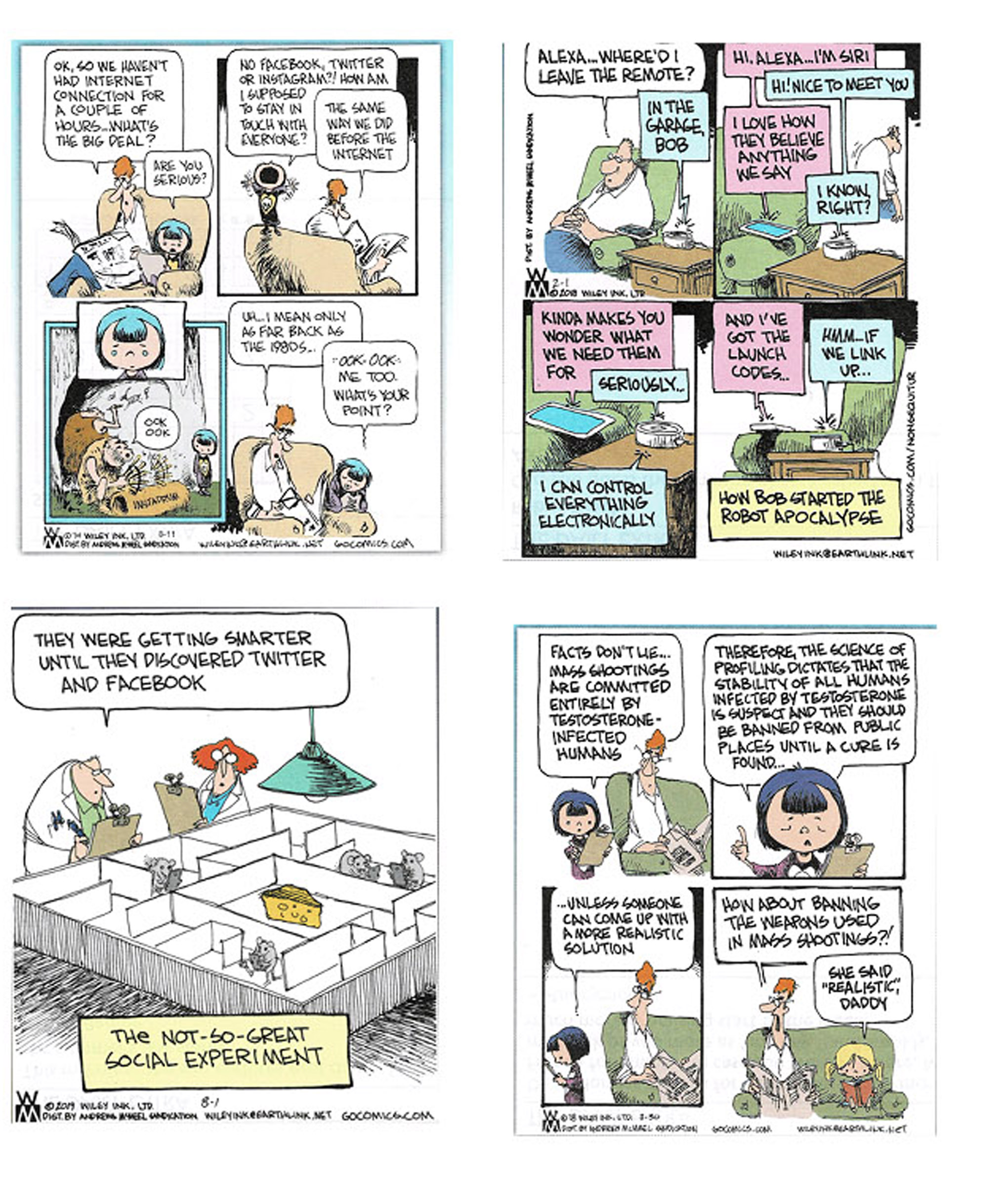
John Wiley, the artist in Nonsequitur, captures in a few cartoons and few words whole philosophies and behaviors it would take a dozen books to express. Some of mariner’s favorites:

Mariner grows weary of a conflicted world. He knows that more and more he is seen as a zealot. It is hard for a humanist to be considered a zealot but that says a lot about society today.

There are real and validated social reasons for the uprising of the working class; how destructive their political payback will be remains to be seen.

Big data is an immoral capitalist snowball that has grown to a dangerous size. Mariner’s defense of personally owned privacy and the double whammy of not being able to share in the sale of his information are compounded by the fact that it is sold to interests who want to manipulate him for their own purposes, seems to the electorate much ado about nothing.

While his opinions about humanity are supported by many professional thinkers, again the electorate couldn’t care less. As a parting validation to mariner’s ‘zealotry’, the supermarket where mariner’s wife shops pays a handsome discount on her gas station prices in return for tracking her purchases – a fair arrangement in mariner’s mind.

But retreat is inevitable. Mariner is a member of the useless generation, an antique, aspiring middle class person and a humanist. He yearns to be off the grid electrically, politically and spiritually. One day he will buy a donkey cart.

Ancient Mariner

Decisions

Some will say, “I’ve made a decision – right or wrong. The important thing is that I made a decision.”

Some will say, “Someone else should make the decision. I don’t want the responsibility.”

Some will say, “There must be more to know before I have to make a decision.”

Some will say, “Occam was right – keep it simple.”

Some will say, “I make a decision based on how I feel. If it wasn’t the right decision, I’ll make it again.”

Some will say, “A decision is all about the vision – even if we have to move to Cuba.”

Some will say, “What is the decision I need to consider?”

Some will say, “What’s in it for me?”

Some will say, “I avoid making decisions.”

Some will say, “Just tell me what to do.”

– – – –

All of us are in this list somewhere. Decision making is like shifting gears; it changes our focus, our energy, even our scruples, even our sanity. Add the perspective of those who are obsessive and those who are attention deficient and the world becomes a conflicted decision-making environment. Further, add those who are bright and those who are dull and it is amazing that useful decisions are made at all.

Then add in those with ulterior motives: any middleman, any corporation, and God forbid any politician. Given their contribution to decision making, we may not know what decision was made!

There are different classes of decision making. Should I marry this person? Should I quit my job? Do we want children? Do I want to have a dog? There are procedural decisions: Should I go to the bathroom before I go? Do I need gas? Where are my keys? What color should we paint the living room?

Do I really want to argue with this ass? What is on TV? Life cannot move through one day without decision making skills. The downside is if we don’t know our own decision making style. So many arguments have been provoked by style rather than substance. To some extent we are constrained by our personality and often by dire circumstances. But resolution may require more than one style to be resolved. This is the main reason group discussions often are the only way to arrive at a rational decision. In business, team management is important. Virtually every organization has a group-based decision making group.

The advice here is to know thyself and accommodate other’s styles and conclusions – something the nation has in short supply these days.

Ancient Mariner

Technology Today

It was in the news the other day that China is outlawing crypto, AKA bitcoin et al. Although the news clip alluded to competitive technology, it is more likely that China knows it cannot control transactions or investments because no institution is involved that can be subject to government regulation. Further, the transaction database cannot be erased.

On the other hand, using common tracking software, the government could know when someone entered a transaction on their own computer. On the other hand, there is home security software that frequently changes the computer id. But then the government can track a person’s bank transactions from which a crypto investment was drawn or perhaps would notice a windfall deposit into that account.

It isn’t just about China. Across the world government, business, special interest groups, spammers and social media are addicted to information about our personal lives. On the other hand, a person could buy software that erases all the cookies. However, the intruders can check our internet history. But then one could buy software that erases our internet history and of course change the computer id.

Mariner uses a bank that refuses to know who he is. Passwords, id, not a robot, names of relatives and friends, confirming emails and still the bank doesn’t accept his identity. Why? Because his computer changes its id every hour. The situation is exacerbated because mariner uses a search engine that doesn’t track him; so even if the computer didn’t change id, the bank still does not know mariner because the search engine provides no personal information.

Using email and social media is wide open. Once a party has your email or social media address, they never forget; even years later, the democratic parties still know where to find him. On the other hand, mariner could change his email account. On the other hand, databases exist that can be cross referenced. Mariner wins in the end because he never gives them money.

Who needs internet gaming? Play the real life version.

Ancient Mariner

A Recipe for Progress

Feeds 350 million – Let rise for 30 years.

Add 50 states:

AXIOS – “States are responsible for many of the laws with the greatest direct impact on people’s daily lives. Republicans control 30 state legislatures and the GOP has the trifecta — the governorship, state House and state Senate control — in 23 states, while Democrats do in 15.”

Blend with gerrymandering to maximize representatives in the House of Representatives.

Toss in a Constitutionally mandated representation of 2 senators from each state regardless of population. (Wyoming, the least populated state with 581,075 citizens, has two senators; California, with 39,512,223 citizens, has two senators).

Divide into two halves representing the 20th century and the 21st century. Using Covid, throw away the half representing the 20th century.


Herbs and Spices

Do not use antitrust – especially with the technology sector.

Use taxation sparingly if at all.

To increase hot spiciness, divide two political parties into four.

To add an aged flavor, do not enact a term limits act.

Do not add new concepts of education; it will confuse the older generations.

Ask China to economically control South America.

To prevent too much rising, avoid supply economics.

Continually agitate while baking. For a topping, use China’s Artificial Intelligence global network.


Good Luck, Zees.[1]

Ancient Mariner


[1] Generation Z, born from 1997 to 2012

It’s Happening

The musical group ABBA is cutting its first album in forty years as part of a stage performance – as digital avatars! Sigh. . . ABBA, the most popular pop singing group in the seventies, is one of mariner’s favorite singing groups. But as digital avatars? Mariner has never watched the movie ‘Mama Mia’ because no one can replicate the ABBA sound – especially not Pierce Brosnan and Meryl Streep. Mariner listened to a couple of new songs that will be on the album. They still have the same sound but he isn’t sure he wants to see them in their avatar world.

How much sacrifice and damage is digital ‘reality’ causing the normal human experience? Mariner is reminded of occasional events when mirrors and photographs were shown to primitive tribes that were not part of the modern technical world. They reacted fearfully and suspected that their spiritual self had been stolen; certainly the image of self was altered if not stolen. So, too, mariner is suspicious.

Television used to be a handy tool as a remote camera. Mariner was a fan of the Baltimore Colts back in the days of John Unitas; the television broadcast away games. That was handy and appreciated. Now the television camera and telephones have been invaded by surreal reality, loaded with false imagery, false information and false ABBA.

Documentaries have warned us time and again about digital tomfoolery especially when it involves political information or marketing; it is hard to produce a hit movie today without outrageous digital monsters, scenery and abuse to rational comprehension. Where is Bela Lugosi when you need him?

Humans should have known this would happen, that their real human world would be distorted and leveraged. It is only fair, though, because humans have been distorting and leveraging the biosphere for 20,000 years.

It is the spirit and philosophy of humanism that suffers damage. Humanism can be traced to ancient Greek philosophy, which prioritizes human morality. Humanism is the prevalent philosophy embedded in democracy; humanism is the core of compassion; humanism is required for a cohesive society.

But the technical world of computer intelligence feels no need for these qualities. Just as we have plundered the planet’s biosphere, so is computer intelligence plundering humanism. Artificial intelligence is not bound by morality; it is bound only by whether it can be done – without regard or accountability to the human-only world of emotions and 200,000 years of evolutionary responsibility as a tribal species.

Goodbye, ABBA. You are missed.

Ancient Mariner

Life in the fast lane

It is too fast for mariner and other elderly folk. It is common knowledge that the beginning of the twenty-first century is a tumultuous border between a disappearing culture and an emerging one. Computers began the transition seventy years ago, and then the internet emerged. These two advances alone changed how a person views daily reality. In fact, reality itself is subject to revision.

Mariner read in his email today that the hottest market in software-related purchases is to buy and register an avatar that represents you while you are logged on. First, accessing the internet required a simple password; then it was a password and a clue; then the passwords had to be extraordinarily complex; then many services required the names of relatives; then a four-digit pin was added. Taken together these identifications assured others on the internet that the linked person was actually the real person. But now all that folderol will be unnecessary because you will be an animated creature or thing when you are logged on.

Two movies come to mind: The Matrix and Avatar. At least Neo retained his human form in The Matrix. In Avatar Jake Sully had to have blue skin and a funny nose. Facebook has been in the news for its aggressive pursuit of metaverse, a three-dimensional internet that seems lifelike similar to your representation in an online game. When you log on to Facebook, you won’t just be logged on; you will be one of the creatures in a bizarre zoo.

Ironically, mariner is reading a book about how we define factual reality.[1] The central point is that truth is not a finite object. The human perception of truth is just that – an ever changing perception based on what is judged to be the most dependable information at that moment. Unfortunately the computer combined with the internet has loosed Pandora’s Box in the form of unsubstantiated ‘truths’. Social media is the evil device that can use false information flamboyant enough to sway our perception of reality.

The clue that hints at the future culture is the dependence on unsubstantiated information – including an electronic shaping of our interaction with reality. Google makes billions of dollars selling access to our personal profiles, shaping what we know, believe and depend on as a full and truthful reality. Mariner often makes the point that opinion doesn’t need facts; today, manipulating opinion is out of control and is the biggest threat to the new culture.

Ancient Mariner

[1] The Constitution of Knowledge, A Defense of Truth by Jonathan Rauch. Published by the Brookings Institution 2021, ISBN 9780815738862.

Wife versus smart TV

Mariner often publishes the fine poetry his gifted wife produces. He has always claimed she should make a living as a poet. But now, his wife is showing that she is multi-talented. She wrote an accounting of our introduction to a new smart TV. She sent the piece to the Fort Madison Daily Democrat, a newspaper published in Fort Madison. The editor was pleased with her description of our adventure and encouraged my wife to send more articles.

Her article was headlined across the top of the opinion page and took more than half of the page. Below the article is printed in its entirety:


Adventures in the Brave New World of Television

When a thin purple line appeared down the middle of our TV screen, it didn’t seem too ominous.   Within a few days, the thin line became a thick stripe of purple and we knew the end was near.  I suppose we could have watched it that way for a long time–like using up the last of the shampoo in the bottle–but  we had already cut the cord of our DISH subscription, and we were ready to step into the new world that awaited us with a smart TV.

Have you bought a new TV recently?  I went online to read reviews.  We wanted to replace our massive 43 inch screen with one of the same size.  It turns out that 43 inches is no longer considered massive.  It is the size you buy for a second bedroom or a dorm room.  If we wanted to stay with that same puny size, we would not have all the bells and whistles that are available on larger screens that start at the small end at 50 inches and go up to 85 inches or larger.

We decided we did not need all the bells and whistles or have room for a theater experience in our living room,  so we ended up buying  a 43 inch TCL Roku TV that we found at Walmart.  Did I mention that it is a smart TV?  Did I mention that we had cut the cord to our satellite service?  We thought we knew what we were doing as we had used a Roku stick on the old TV to get free streaming TV from the internet.   We plugged in the new TV and it said “Welcome!  Let’s get started setting up your new Roku TV.”  That was a good sign.  Then it asked us to find the internet using our wifi password.   We knew our wifi password and typed it into the box on the TV screen using the remote control.   We were feeling fairly confident that we were just as smart as our new TV.  Then the TV screen said, “Great.  Now let’s set up your Roku Account.  Type in the email address linked to your existing account.”

The Roku stick that went with our old TV was a gift from our California son in law.  He had bought the stick, stuck it into the back of the old TV and set up a Roku account.  We did not know what email he used to set up the account.  We did not want to start a new account as we had saved a number of channels and we did not want to start over from scratch trying to find them again.  The screen said, if you do not know the email that is linked to your Roku account “go to settings/account/help.”  We couldn’t find a settings link anywhere on the TV.  I thought maybe settings was on the Roku account on the internet so I googled Roku.com.  In order to sign in to my account I needed….the email address that was attached to it.

Fortunately there was an 800 number to call if all else failed.  You may be wondering why I did not call my California son in law who had set up the account.  He was at that very moment on an airplane somewhere over the Atlantic Ocean and we did not want to bother him.  Instead we bothered Vineesha, a young woman who was possibly somewhere in India.  She asked for the number on the Roku stick from our old purple stripe TV.  Vineesha stayed on the line while we found the old Roku stick in the mess of cables behind the new TV.  With the number from the Roku stick Vineesha was able to give us the email address linked to our Roku account.  It was my daughter’s email account.

My daughter was not on a plane, but she was far away in California.  I called her to explain that she would be getting the code numbers to type into her computer that would link our new TV to the old Roku account.  She got an email from Vineesha with the code, she typed it in to her computer in California and instantly our Iowa TV said, “Success!   Now there is just one more step.  Type in your Roku password.”

Do you see the problem with smart TV’s?  They are a little condescending in their helpful tone.  They are a little smug in their assumption that we had all of our passwords in place.  Our password was, in fact, flying somewhere over the Atlantic Ocean.

My daughter in California  texted her husband on the plane, he texted the password back to her,  she called us with the password, we typed it in on our Iowa remote control and our TV was finally, finally set up and running.  It did not have a purple stripe down the middle of the screen.  It had all of our channels in place.

So what have we learned?   We learned that it takes a village to set up a smart TV.  A global village that spans the globe across multiple time zones from Iowa to India to California to a transatlantic flight somewhere in midair over the ocean.  It is a humbling experience to realize that your household devices can be controlled from a few lines of code transmitted from thousands of miles away.

And yes, we learned to use old fashioned paper and pencil to write down the email and password to our own TV.   Our wonderful new TV that is smarter than we are.

Multi-talented, indeed.

Ancient Mariner

Living like bears

A recent article from Science Magazine reported on a study performed on the west coast of Canada that wanted to know why, over thousands of years there were distinct genetic differences between bears that existed in close proximity. The environment was rich in food and environmental support; bears did not travel much over thousands of years. The geography, in part, has many large islands.

What made the study intriguing was that when the human genome of several indigenous human tribes from the same area was examined, there were genes that appeared similar to those in the bears and, interestingly, in the same part of the genome.

The conclusion by the scientists is that we are closer to our environment than we may think. Over generations, our bodies adapt to the environment – not just globally but regionally!

The finding contributes to the observed quick differentiation between human races that did not intermingle for many thousands of years. The concept even applies to smaller regions where the Irish, Germanic and Spanish tribes lived, for example. What is most fascinating is that the genetic changes for bears, the Irish and racial differences are located in the same part of the genome. Mariner wonders whether there is racial prejudice among the different bear colonies.

Oh well, this is fascinating science but it no longer applies generally to humans. Humans invented ships, planes, cars, highways; intermingling is inevitable. Perhaps, however, class distinction over many generations still may be a cause for adaptation. This is not as presumptuous as it sounds. In the latest edition of The Atlantic, David Brooks wrote an article that suggests that very thing.

David wrote an excellent commentary about what has brought the United States to the circumstances found today. Largely, it is a separation of what is defined as ‘successful’ among the various classes of society. It turns out that assumptions about what defines successful living have a direct effect on the society as a whole. David says that today in the U.S. culturally, the only successful lifestyle is the meritocracy built on being educated, smart, inventive and contributing to society through some form of creativity. He calls it the ‘creative’ class and is largely represented by today’s Democratic Party and very wealthy Republicans.

Society in the U.S. suggests that those who work with their hands, do monotonous work and have no need to indulge in ‘smart’ stuff cannot by definition be successful. This has led to the many variations of class war that are present today. The national turmoil will increase because the creative class is too small to survive in politics – the only frontier where being smart is not an absolute virtue.

So look forward to attacks on big data, socialist issues, tax advantages, science in general and the ideological fantasy of freedom and success – as in guns, law enforcement, racism and any other issue – even to the extent of whether one ‘must’ participate in fighting the pandemic that is now playing out in more conservative states.

Why can’t a gun-toting stevedore be seen as successful as a computer programmer?

Ancient Mariner

What Price Laxity?

Mariner mentioned in an earlier post that he had entered a ‘homesteader’ phase. What that means is that he is interested in self-sufficiency, simplicity and a liaison with the biosphere. While his muscles ache a bit from the added labors of keeping busy physically, he has begun learning more about the Amish, whose whole philosophy of life is based on family and community working together and finding salvation through labor.

The Amish philosophy of valuing community and family above convenience or, dare mariner say, ‘aspiration’, is close to pure communism save its commitment to a literal interpretation of the words of Jesus. The economic model is communistic in that the political superstructure never extends beyond a certain geographic range where ethical authority remains totally internal to a tribe-sized collection of families. Further, the economic needs of any individual in that community are shared by the full community.

In his search for information about the Amish, he came across a documentary called “The Amish: A People of Preservation”. It was produced originally by PBS but mariner is not familiar enough with the ROKU world to tell readers where to search. The writer of the documentary is gifted; every closed caption is a quotable comment. For example,

“The old order Amish man is not yet ready for self-propelled equipment. This, he fears, will set off a chain reaction whereby everybody would follow the principles of efficiency and convenience to the neglect of humility and communal discipline.”

If there’s anything our American culture lacks, it is humility and communal discipline.

While the strength of Amish communism is sustainability, its moral structure is weak with respect to humanist reality. Justice is an informal opinion of a gathering of elders strictly bound by the grace of Jesus’s forgiveness. Punitive gestures destroy the Amish ethos. There was a case several years ago where a boy continually raped his sister. In each complaint brought before the elders, he confessed and repented. The elders forgave him as Jesus would. The boy returned to rape his sister yet again only to repeat the process to be forgiven.

Still, there is merit in not pursuing aspiration – particularly in the most capitalistic economy in the world. Resources are not endless; as the wealthy accrue more wealth, resources for everyone else diminish. Mariner has no idea how the future of this century will play out. It certainly will be different.

Ancient Mariner


Fire up some briquettes

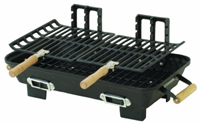
As regular readers know mariner is home alone for a couple of weeks. As a result of cooking only for one, he dug out his old hibachi to grill food instead of using the regular gas grill. His experience was positive enough to wonder why he hasn’t used the hibachi all along. True, it takes a bit of patience to start the briquettes but the efficiency – if only measuring that the hibachi is just outside the kitchen door – was significant. A five-gallon bucket of briquettes easily will last as long as a 7 liter LPG tank. A bucket of charcoal is about 30 pounds at an average cost of $25. A tank of LPG gas costs about the same.

The hibachi is convenient as a substitute for a campfire to cook hotdogs and make s’mores. Does anyone still have an old metal 6-cup percolator coffeepot? Make morning coffee and toast! The hibachi can substitute as a crockpot, too.

When mariner was in Taiwan, many restaurants had nothing more than a couple of ceramic style hibachis shaped like large flower pots. In Tainan mariner visited a restaurant which claimed to have the longest continuously burning hibachi fire in Taiwan. The primary menu items in these restaurants is what a crockpot or wok is used for in the U.S. Interestingly, a standard wok always seem to fit those flower pots perfectly. Genuine Chinese herbs and spices made the best stir-fries mariner has ever tasted.

Many small neighborhood restaurants were totally portable. Each morning the kitchen and seating were set up in what we would call a garage with no utilities. Customers ate outside on the sidewalk. In the evening these restaurants lit up the entire block with colorful lanterns. When the restaurant closed, everything was packed and removed leaving an empty garage. This setup method was common among many small retailers.

Being a foreigner, these kinds of social experiences were enjoyable. But alas, across from mariner’s hotel was a McDonalds. At least the food was still Asian. Mariner worked in the ‘down country’ of Taiwan. Visit the City of Taiwan on the north end and one would think they’re in New York City except everything is written in mandarin.

There are many other ways of living besides living amid Interstates and gazing at smartphones. Perhaps next our travelogue will visit Kazakhstan.

Ancient Mariner