
A New Sport for These Times

Does the reader remember the Trans-Pacific Partnership (TPP)? Twelve nations, primarily along the Pacific Ocean, negotiated a trade agreement. The nations were:

United States • Singapore • Brunei • New Zealand • Chile • Australia • Peru • Vietnam • Malaysia • Mexico • Canada • Japan

The TPP was based on a unique concept that each member nation was assured a commensurate share of income based on the Gross Domestic Product of the partnership. Earlier trade, tax and tariff arrangements were modified to accommodate this unique idea of international partnership instead of international balance of trade.

There were progressive economic concepts in the agreement but there were many loopholes that benefited corporate interests above national interests.[1] While the language touted liberal issues like environment, labor rights and humanist politics, there were just as many backdoor caveats that would permit corporate participants to ignore the ‘nice’ language. A good description of the new trade relationship was that nations were investors in the partnership, not traders.

For the United States, this was all for naught when Congress dragged its feet and Donald officially withdrew in 2017. Nevertheless, the new partnership was signed by the remaining eleven nations in 2018 and became the Comprehensive and Progressive Agreement for Trans-Pacific Partnership.

A characteristic of these agreements is that while there are direct economic benefits for being part of a team instead of constantly manipulating trade and tariff, it is more difficult to shift national politics or apply sanctions to other members of the partnership. Unlike today’s supply and demand free-for-all, being part of a supply partnership introduces permanence to international economics – meaning that whichever partnership has the most important partners, the more likely that partnership will dominate the global economy.

Another aspect is that a partnership needs one partner that is large enough to sustain the overall economy for all the nations in the agreement. There are only three nations that can fill this role: China, the United States and possibly India. The economic ballast needed for a successful partnership requires one partner that has global dominance in GDP, population and land mass. Corporations already know this and have constructed supply chains that depend on one massive corporation to sustain the chain. Amazon, Walmart and Google are examples.

Now that the reader has suffered through the rules for the sport for these times, the sport is which of the three anchor nations (China, US and India) can build partnerships with the most nations, the best nations and the nations with the best natural resources in the shortest amount of time? The winner will dominate the global economy for a long time.

The game already is in play:

China understands the concept; in 2013 China started its Belt and Road project using infrastructure as an international connection between 70 nations and intends to dominate politically and militarily as well as economically. The US along with the G7 nations belatedly introduced its own Belt and Road plan; Joe Biden hopes the plan, known as the Build Back Better World (B3W) initiative, will provide a transparent infrastructure partnership to help narrow the $40 trillion needed by developing nations by 2035.

Ancient Mariner


[1] To keep this post from becoming a book, if the reader has further interest just type TPP in your search engine – much has been written pro and con.

Trends

Folks tend to look for clues about climate change in weather patterns. It is true that climates are shifting but on a seasonal basis it is hard to measure how much is change and how much is typical variability. The global indicators, melting glaciers, ocean temperatures and melting permafrost are a more direct way to measure change. All indications are that global warming is accelerating, to wit:

The Washington Post reports that Antarctica’s Pine Island Glacier, a river of ice large enough to raise sea levels by 1.6 feet, was already among the fastest-melting glaciers in the world. Now scientists have found that the ice mass is flowing even more rapidly.

Further, Siberia is experiencing active permafrost melt on a grand scale. Some prognosticators suggest that by the end of the century Russia will make more from wheat exports than it does from oil today.

– – – –

Mariner has mentioned often that the United States is in the long, painful death throes of Reaganism. Causes are a changing world, changing environment, changing technology and new economic structures. What is trending at the moment is Republican autocracy. Will manipulation of the elections be enough to sustain the twentieth century into the twenty-first?

– – – –

Speaking of economics, a growingly obvious trend is the shrinking of Europe’s role in world economics. Europe has tended toward smaller business models; for example, Apple has a larger net value than the top 30 firms in Europe. Perhaps its history of smaller nations and many economies has led Europe to this preference but as a result, there will be only two global business leaders: China and the United States – perhaps, with luck, India. The global trend definitely is toward international, multimarket corporations who will anchor worldwide supply chains similar to Amazon.

The government role is to develop supply chain style arrangements between nations. One new example of this is an agreement by the G7 to levy a worldwide 15 percent tax on corporations to prevent corporations from avoiding taxes by moving operations to the nation with the least tax.

– – – –

Several news items have been about seafood. It seems the warming oceans have had an effect on everything from seals and whales to lobsters and commercial fishing species. From Science Magazine:

“… basically what we found all over the ocean, wherever we had data, is that the abundance of large fish, in terms of numbers and weight, were ten times higher originally than they are now. That is, that what we’re left is one-tenth of the original number and weight of large, large fish.”

Here in the United States it already has been noted several years ago that the ‘Maine’ lobster has moved on to other locations.

Ancient Mariner

Everything is the same but different.

Last Friday on an early, Way To Early, news show there was a piece about how manufacturers were resizing products to compensate for rising production costs rather than raising prices and lose customers. It has a term: ‘shrink-flation’. Demonstrated were toilet paper, potato chips and ice cream, which had fewer sheets, less weight and smaller capacity respectively. Shoppers have been taught to read labels for health reasons; now they must school themselves on size by learning how many grams in a quart or a pound and beware of count in artificial sugar packets; the price doesn’t change.

– – – –

Turning to a more sociological vein, everyone agrees the United States is having an identity crisis. It is difficult to know how to handle the situation. For the common citizen, it seems only to be a mish-mash of conflict and pointing fingers. The citizen truly is in the depths of the trenches and even trenches within trenches. How does a citizen gain perspective so that reasonable evaluation can be made?

Learn some facts. Mariner knows this is a tall order for the electorate but if a rational path to recovery is to be available, one must check history for similar situations. Sorry, electorate.

In place of buying textbooks, use Wikipedia to collect information – and make a donation while you’re at it. Search for information on the cause of the French Revolution, the Magna Carta, the Luddite rebellion and the rise of Nazi government (including persecution of Jews) in Germany. Clues for why there were national identity issues may involve financial security of the masses, oppression, racism, power wars and concentration of wealth.

For starters find something in these events comparable to wage freezes for forty years; find something that represents too much cash for the well-to-do; find something that erased major chunks of job availability; find something where power blocks competed too much for the good of the nation. Once historical information has been gained, how were these issues resolved?

Vote accordingly.

Ancient Mariner

The Money Rodeo

Covid, shelter-in, election turmoil, Afghanistan, Brexit, China, impeachments, perhaps these things still are unresolved but at least we’ve had a chance to beat them with sticks and throw stones, pushing them into some kind of partial remission. There is time now to take a quick shower, put on some clean clothes and prepare for the next item in the national job jar: managing money.

News outlets are covering the party debate about Joe Biden’s infrastructure bill; the sport of legislation will be headlines for a while. Slowly emerging into electorate awareness, however, are the issues of government spending, taxes, user fees and inflation. These are the bucking bulls behind the battle over bridges and health care. Some bucking broncos are bank and investment regulations, bitcoin, and climate change just to mention a few money issues. The rodeo clowns still are putting on a show, that is, everything Trump, McConnell, McCarthy and Gaetz but the main events will take over quickly.

The main attraction is inflation. It is devastating to the value of the dollar bill in our wallets. Economists, both political and institutional, see inflation taking off and running because the US government has – or will – dump $6 trillion dollars into the general economy (6 includes Trump’s contribution). An extremely brief description of how inflation works is “If there is so much money around, then you can afford to pay $10 for this hamburger instead of $4.”

The problem is that common citizens don’t receive salary increases commensurate with the rate of inflation. Everything is subject to inflation from toilet paper to homes and automobiles. Mariner experienced the 1970 inflation by having a pleasant salary that over ten years became a meager one that required him to shift careers. During the 70s the Consumer Price Index (how much things cost) went from 37.8 to 76.7, cutting in half what that dollar in the wallet could buy.

The second attraction is taxes and fees. These actions slow the possibility of inflation to a degree. Biden has said no one with an income below $400 thousand will receive a tax increase; he intends for the wealthy to pay for infrastructure and health services instead of spending government debt money. It can’t be denied that very wealthy citizens are sitting on a pile of money that isn’t doing anything for the economy but republicans don’t want to raise taxes at all. Instead, they prefer that government spending be offset by user fees (an attempt to hide the fact that ‘fees’ actually are taxes applied to specific purchases like gasoline, tolls and utility services) – meaning that the general population foots the bill.

The next two issues of extreme financial importance are regulations to restrict banks to what banks are for and to push them back from ventures into Amazon-like partnerships and credit card manipulations; the other issue is automation of finances generally, that is, replacing the dollar in your wallet with the state of an electron in a computer somewhere.

Finally, climate change will impact everything – everything! Whole industries may disappear as well as whole cities. Climate change is like a very, very, very slow hurricane. There is no doubt all the other money issues will be affected.

Put your chaps and spurs on – the legislators will need guidance.

Ancient Mariner

Democracy at risk

This morning Guru seemed a bit apprehensive. He is concerned about global readiness for democracies around the world, especially for the United States. It is obvious that authoritarian governments like China, Saudi-Arabia, the ‘Stans in south Asia and mob governments like Russia and Turkey – all can move more quickly than democracy while disregarding human rights and truly collaborative economics.

On the other hand, many democracies, especially in South America and nations around the Pacific Rim are at the edge of economic failure, some even facing national bankruptcy. Many democracies are in worse social condition than the US appears to be as riots and government distrust encourage populism.

These democratic nations are waiting for the United States to create an economic solution that will restore democracy as the way to a sound existence.

Taiwan has been in the news recently as a democratic nation under increasing threat of a Chinese military invasion. Taiwan is a firm ally of the US and is a gem to be owned because they are the largest producer of microchips in the world. If the reader has kept up with real news (hard to find) they know there is a global shortage of microchips which likely will grow larger as the world adapts to artificial intelligence.

Recently there was a meeting of many democracies in Copenhagen. Bravely in defiance of Chinese storm clouds, Taiwan has addressed the issue of democratic unity head-on. From the Politico Newsletter:

TAIWAN — WE MUST COLLABORATE TO UPHOLD RULES-BASED ORDER: President Tsai told the Copenhagen Democracy Summit this morning that she is looking forward to Biden’s summit for democracy (a clear sign she expects to be invited), and urged the EU to “restart negotiation on a bilateral investment agreement” with her country, in light of the collapse of a draft EU-China investment agreement.

“Taiwan’s response to Covid-19 shows how pandemics can be contained without curtailing democratic freedoms … we are determined never to surrender these freedoms,” Tsai said, adding “it is imperative that we collaborate to secure our supply chains and safeguard the global economic order.”

The United States is not prepared to step up to its role as the democratic leader of world democracies. Unfortunately, the moment is fleeting; autocracies do not wait and are destructive in the process.

The news that is marketed in the US [Yes, marketed, a thorn in mariner’s side – news is a public service and should not be a profit center] is all about 1980 Reagan economics; pundits are using words similar to supply and demand, runaway inflation, keep corporate and private equity taxes low, and stop paying a dole to pandemic victims because they won’t come back to work – but don’t raise the minimum wage. All these arguments are virtually irrelevant in today’s economic circumstances and reek of political attitudes that long ago became inadequate.

In a recent post mariner expressed joy about a move by the Biden administration to visit Guatemala to see if the US could help that nation restructure its failing government and somehow generate a GDP for its citizens – an alternative solution to separating children from parents. This gesture is a form of supply chain dependency where democratic nations bond together and share an economic partnership rather than depending on twentieth century trade negotiations. Jeff Bezos understands this concept. Amazon is a business that depends on many businesses sharing a common outlet, that is to say, a supply chain.

Internationally, the US needs to be more like Amazon.

Ancient Mariner

Environment

We humans have become increasingly aware that we live in an environment not as a dominating owner but simply as just another renter who tends to trash the apartment. Perhaps it’s the global warming issue that helps with human awareness; perhaps it’s the growing scarcity of food resources for the planet; perhaps it’s the cost to farmers when they plow the soil which strips the fields of all nutrients and plants, especially in regions where there are strong winds that carry away the soil farmers just tilled and fertilized and put weed killer down – producing poor yield in the fall.

Evidence of growing awareness is all about. TV broadcasts about gardening, farming, waste management, and collaborative sharing with the environment are frequent. Extension agencies, libraries and garden clubs sponsor programs about collaborative gardening. Mariner has a relative whose hobby is planting colorful plants around the base of trees along New York streets; mariner has a friend who has decided to let violets stay in the lawn. And mariner himself is tinkering with a number of collaborative projects in his own garden.
֎ One example is the cursed Creeping Charlie, a very rapidly spreading weed that defies elimination. It still is a killing pest in the lawns but in some garden beds mariner has decided to experiment with Creeping Charlie as the ground cover to keep other weeds out and at the same time add to the décor of the garden. It turns out that Charlie has taken hold of his new job with relish. Not even the dreaded crabgrass can sprout beneath a robust covering of Creeping Charlie. In fact, mariner is saving money because he doesn’t have to buy mulch for those areas.

֎ Another experiment is mariner’s tolerance of a rambunctious mole. He must protect against the mole’s burrowing in vegetable beds where seedlings are emerging but otherwise he has let the mole venture about. Tolerance by the mariner is an experiment to see how many Japanese beetle grubs can be eaten; mariner has many fruit and ornamental trees on a property surrounded on all sides by large concrete pads and accompanying large garages. All beetles come to mariner’s garden.

An unexpected reward is the mole gradually aerates the lawn. Typically, a lawn keeper occasionally will need to rent an aerating device to pull plugs from the lawn so it can grow and accept water. Mariner keeps his lawn a bit high (another anti-weed collaboration rather than performing the typical buzz cut) so the lumps from the mole burrowing aren’t noticeable.

Mariner has mentioned in past posts that his town has lawn Nazis. It is of a different spirit, certainly not one of collaboration with nature but comparatively speaking takes more time, labor and cash to maintain. This difference between collaboration with and dominance of nature has existed throughout history from the first scraping of the ground to cast wheat seeds to the large open mining pits and deliberate elimination of forests today.

In just a few years many farmers have proven that any way to collaborate with the environment is more productive, less expensive, saves waste and is good for surrounding atmosphere, water and wildlife. One common practice by farmers that has been implemented for many decades is a natural easement by creeks and rivers rather than plowing closer to the water’s edge.[1] It is entertaining to work with nature as a partner – both existentially and philosophically. What projects does the reader have?

Ancient Mariner


[1] An excellent documentary on collaborative farming, ‘Kiss the Ground’, is available on Netflix but the reader must search ‘The Littlest Farm’ – the title is in error. The Littlest Farm also is an excellent film about how a family uses nature to transform virtual wasteland into a productive farm but mariner could find it only as a rental or purchase. 3 minute trailers are available online for both films.

Wealth is for the Wealthy

Several of mariner’s news sources have begun to focus on issues that fall under the general subject ‘plutocracy’. Latest topics are from Florida, a government that sees itself as a partner with business, having passed legislation to protect obstetricians from lawsuits about botched births and now passing legislation to protect sugar harvesters from lawsuits about polluting the air.

On manipulations of the rich to stay rich, Elizabeth Warren just released her wealth tax legislation – she is back on the hunt and is the archenemy of the banking industry. The legislation targets the wealthy’s privileged investment practices that in fact are protected by Federal investment practices. Further, Banking has become more involved in partnering with nonbanking enterprises as a legitimate partner and not just a source of financing (Did you notice an American bank tried to launch the Super League in European soccer?)

ProPublica just posted an article that says “longstanding inequality in the U.S. has been exacerbated by the Fed’s role in touching off a multitrillion-dollar boom in stock markets — and stock ownership is heavily skewed toward the wealthiest Americans”. It is worthy to note that the average citizen’s IRA and 401(k) accounts don’t share comparatively in this boondoggle. [1]

Further, Social Security is the top source of wealth for most lower-income households with workers nearing retirement, according to Teresa Ghilarducci, an economist at The New School in New York City who specializes in retirement. If the guaranteed income stream of Social Security is treated as an asset, she estimates it amounts to 58% of the net worth for near-retirees in the bottom half of the U.S. wealth distribution. Other retirement savings represent only about 11% of their net worth, and stocks are just 1% – meaning that the wealthy have their own, federally supported economic world while the remaining US citizens still struggle with minimal income and no long term security. Apparently Andrew Yang’s chart about the distribution of income was correct.[2]

The most effective way to attack this plutocracy is to have term limits for all legislators state and federal and to outlaw party-managed redistricting, otherwise known as gerrymandering. In the meantime, the voting citizen will be caught in a battle between those who collect dollars for satisfaction and those who extol populism for satisfaction. It’s up to the electorate in 2022.

Ancient Mariner

[1] It is mariner’s opinion that ProPublica is by far the most honest, accurate AND the most thorough investigative reporting source among many online services. He recommends everyone subscribe to their email service at https://www.propublica.org

[2] See mariner’s post, “A Stipend for a Day Lived” published April 19, 2021.

Moving South

As regular readers know, one of mariner’s political dreams is to merge North and South America into a planet-leading powerhouse for economics, culture and science. This is fantasy of course; the United States considers brown people second class citizens – whether Mexican, Guatemalan, Puerto Rican, Columbian or the far reaches of Asia. If there were more Eskimos, they’d be thrown in as well.

But wait! As if it is the first creature to move out of a primordial sea, there is a glimmer, a faint, fragile thought that has emerged in Congress. Senator Tom Carper (D-Delaware) is traveling to Guatemala to meet with that nation’s president to discuss ways to eliminate the migration of its citizens to the United States. The subject of the visit is economic in nature, that is, how can the US help Guatemala’s economy.

Further hope comes from Tom’s close relationship with Joe Biden, himself an ex-Senator from Delaware. If white supremacists were rational, they would push the republicans to back these ventures to keep nonwhites below the border. (Yes, racist, but mariner is desperate; otherwise republicans will fight this idea for sure. Consider mariner’s effort similar to throwing a stick to entertain a dog)

It took a long, long time for aye-ayes to become humans. Mariner suspects the same will be true for unified Americas. Mariner asks that the reader be careful where they walk lest they squash this primordial thought.



Ancient Mariner

A Stipend for a Day Lived

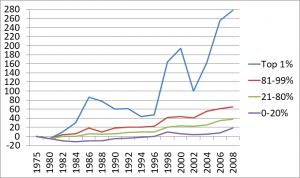
Mariner has read Andrew Yang’s book, The ‘War on Normal People’. The reader may recall he was the democratic candidate who espoused a monthly $1,000 stipend be paid to citizens of working age which had no relationship to what would be called wages earned from a job. His first chapter is about how the nation arrived where it is today. He cited some startling statistics. Just one of many as a sample:

Cumulative growth in average after tax income by income group

To clearly demonstrate the percentages in dollars, assume mariner gives the reader, a member of the top one percent, one dollar. Below is the number of dollars reader’s dollar will grow every two years:


80 82 84 86 88 90
95¢ 1.10 1.40 87.40 165.40 225.40
92 94 96 98 00 02
286.40 330.40 378.40 542.40 736.40 930.40
04 06 08
1,092.40 1,348.40 1,626.40

On the other hand, if mariner gives one dollar to a reader in the bottom twenty percent, the reader ends with less than they started, losing as much as $50.05 spending value in 1992 before finishing in 2008 still with less than they started: -$1.05.

80 82 84 86 88 90
95¢ -9.05 -21.05 -31.05 -41.05 -46.05
92 94 96 98 00 02
-50.05 -45.05 -45.05 -35.05 -30.05 -24.05
04 06 08
-24.05 -19.05 -1.05


These numbers seem really out of whack but mariner has charted these values in several different ways in past posts and Yang’s numbers are in the same ballpark. The big discriminator is that labor wages have remained stagnant as inflation has risen an average of 3.27 percent each year since 1980 for a total increase from 1980 of 91 percent overall – meaning that in real purchasing power labor wages are half what they were in 1980.

Is it any wonder that the working classes are up in arms and mad with the US government? This separation of economic circumstances may suggest why the stock market continues to set new records even while a different economy exists for the average citizen. [An issue for another post is the relationship between economic stress and the rise of racial prejudice in the working classes.]

One more chart from Andrew’s book:

Level of Education Attainment Median Income – assume 40-hr week
Less than ninth grade 16,267     –        315.25
Ninth to twelfth grade no diploma 17,116     –        331.70
High school graduate 25,785     –        499.70
Some college no degree 30,932     –        599.45
Associate degree 35,072     –        679.68
Bachelor’s degree or more 55,071     –     1,067.26
Bachelor’s degree 49,804     –         965.19
Master’s degree 61,655     –     1,194.86
Professional degree 91,538     –     1,773.99
Doctorate degree 79,231     –     1,535.48

Another statistic that mariner culled from the news is that the average person does not have the cash to pay an unexpected bill for $500. Further, the average disparity between white total assets ($34,755) and black total assets ($2,725) is astonishingly unbalanced – making race an economic issue that is bound to cause disruption.

As to Andrew’s arguments for guaranteed income, we have forgotten that in the more affectionate times of the Kennedy era, the US government prepared to pass the Family Assistance Plan – a plan endorsed by President Nixon – which would have provided a base income of up to $10,000 for every citizen beneath the poverty line. In a study performed to determine whether workers would stop working with such a benefit, it was found that men continued to work and women dropped out of their jobs by an average of five hours per week, typically to be with children.

Mariner is pleased to note that Andrew also espouses dropping Adam Smith capitalism. To quote Andrew:

“Human capitalism would have a few more tenets –

  1. Humanity is more important than money.
  2. The unit of an economy is each person, not each dollar.
  3. Markets exist to serve our common goals and values.”

Mariner’s post grows long but it should be noted that job displacement, especially to the working classes, is a serious issue that may well damage the American economy – especially as artificial intelligence and global warming take their toll on available jobs for the working class.

Ancient Mariner

Tactics

Tarun Chhabra, now a senior director on Biden’s National Security Council, wrote in Foreign Affairs in 2020 an article titled “The Left Should Play the China Card: Foreign Rivalry Inspires Progress at Home,” Chhabra argued that framing “large-scale public investment” as a way to counter China was the surest way to get conservatives on board.

Asia always has been perceived as a direct competitor. The increased, mindless abuse on US Asian citizens today by the socially inadequate Trumpists and racists reflects how misdirected the US electorate becomes when dealing with sophisticated, foreign diplomacy issues.

Mariner is concerned about Chhabra’s militant attitude. It is very true and proven throughout history that a foreign enemy unifies the home front. It is also proven, even back to the Mesopotamian wars in 2900 BC, that if the home front wins the skirmish, the losers are deliberately killed or made into slaves. (Did the reader see the news clip where a man shoved an older Asian woman to the ground and stomped on her face?) Today it’s a game of teamsmanship not survivorship.

During World War II, Asian citizenry was collected and imprisoned in internment camps until after the war – something like seizing a whole hay pile for fear there may be a needle. Innocent lives were ruined. The same was true for Germans and Italians although their appearance protected them to a great degree. The point is that militancy quickly will unify a nation but at great cost to civilized behavior and especially to a democracy. With the Trumpists running at large and with the nuclear warhead potency of social media, this is a dangerous strategy.

Mariner believes the real war will be fought with international economic liaisons, something like drafting the best players to make a championship team, otherwise known as supply chain economics.

It boils down to this: Who is our most dangerous enemy? Congress.

– – – –

But wait! There is another enemy: plutocracy. As if corporate graft weren’t already a major influence in legislation, JPMorgan CEO Jamie Dimon urges companies to play a bigger role in fixing the world’s problems. He thinks government isn’t up to the job. Already Big Data has used the pandemic to install tracking devices in hospitals, police departments and corporate marketing activities with virtually no regulations. Does the American citizen want to place control over ethics, morality and citizen rights in the hands of corporations? God forbid they may be successful instead of our woeful government. (Note that JPMorgan is a prime target of the democrats who want to restructure the role of banks.)

We may appreciate the social awareness of today’s boycotting corporations; we shouldn’t let them be in control of social issues.

As a footnote, remember the TPP? It failed because it was written by corporate interests instead of government diplomats. They wrote it in a way that ignored human and national rights.

Ancient Mariner