Yuval Noah Harari talks about the Future

Frequent readers know the mariner has three alter egos: Chicken Little, whose fears are a response to imminent events, Amos, a skeptic and critic of human ethic and behavior, and Guru, a futurist, generalist and philosopher at large. Mariner mentions this because this post reflects, to a great extent, mariner’s perception of reality for all three. The post cites a number of quotes from an interview on the Atlantic website with Yuval Noah Harari, a renowned futurist who has provided books, articles, lectures and opinions about how to interpret today’s reality and project the interpretations into mankind’s future.

Read the interview.[1]

Here are some samples:

Derek Thompson: First, work. You have a smart and scary way of looking at the political implications of mass automation. At the end of the 19th century, France, Germany, and Japan offered free health care to their citizens. Their aim was not strictly to make people happy, but to strengthen their army and industrial potential. In other words, welfare was necessary because people were necessary. But you ask the scary question: What happens to welfare in a future where government no longer needs people?

Yuval Harari: It’s a very scary scenario. It’s not science fiction. It’s already happening.

The reason to build all these mass social service systems was to support strong armies and strong economies. Already the most advanced armies don’t need [as many] people. The same might happen in the civilian economy. The problem is motivation: What if the government loses the motivation to help the masses?

In Scandinavia the tradition of the welfare state is so entrenched that perhaps they’ll continue to provide welfare even for masses of useless people. But what about Nigeria, South Africa, and China? They have been encouraged to provide services mostly in the hope of advancing prosperity, [which requires] having a large basis of healthy and smart citizens. But take that away and you might be left with countries with elites who don’t care about the population.

Thompson: Americans might be richer and better educated than they used to be a generation ago, with better health care and superior entertainment options. But the fact of progress doesn’t seem to matter. The story is all that matters. And the victorious Trump story was that America’s cities were falling apart and “I alone can fix it.”

Harari: [White Americans without a college degree] are a declining class within a declining power. The U.S. is losing power compared to the rest of the world, and within the U.S., the Trump voters are losing their status. Even though they are experiencing better conditions, the narrative self which is dominant in most people tells a story of decline, which says that the future will be worse than the present. And most people’s happiness depends on their expectations, not their conditions.

—-

There is a good section on the demise of humans in the future computer age. See the interview.

For the present, however, use it while you have it:

It is not too late in February to select a pleasant day to visit an outdoor place like a park, forest, botanic garden, or walking trail to take in the fresh whiffs of Cancer thaw. While enjoying this pleasure, stop by a restaurant akin to such pleasures.

It has been a long, stressful election season. Discharge some tension by visiting the following website:

http://www.politicalcartoons.com/

Turn off the television for 24 hours and use your phone device only for phone calls – not even texts! Wander around your property to see what’s going on, discover some interesting but small tasks at hand, maybe rummage in the attic or basement. The inner you needs exercise just like your quadriceps do.

Arrange a family gathering perhaps around Memorial Day or Independence Day – include a generation in each direction.

Arrange a summer fête for neighbors.

Be glad you are alive today!

Ancient Mariner

[1] See https://www.theatlantic.com/business/archive/2017/02/the-post-human-world/517206/?utm_source=nl-atlantic-daily-022117 Also check out Yuval Harari’s new book, Homo Deus. In other words, turning ourselves into gods. There are critics, e.g. see http://www.openlettersmonthly.com/book-review-homo-deus/ however it is difficult to perceive other directions than Harari suggests.
Too Smart

As a creature on this planet, we weren’t supposed to be super smart. We were supposed to be the smartest primate, perhaps, but not super smart. We’ve always known it was a mistake. To be honest, as a primate, humans aren’t developed enough intellectually to mess with their biosphere. The Jewish Bible has a story about it; it is carried forward from an older version from ancient Babylon. God built his earthly garden and all that was in it obeyed God without question.

God created two last primates, a man and a woman, who were his pride and joy. In the story, a snake represents improper behavior (If we modernize the myth, the snake represents unexpected genes). The snake encourages the woman to eat a fruit she is not supposed to eat. It is the fruit of the tree of knowledge and awareness of good and evil, that is, ethics and morality on the one hand and disingenuous and immoral behavior on the other. Being aware of intellectual judgment, suddenly the two primates become super smart; they know things only God should know. God’s earthly garden is about to be trashed. Passing centuries have exposed the truth: this primate can’t handle super smartness. Super smartness must coexist with super sensitivity to orderliness – one of four words used to describe God’s presence (love, truth, beauty and order) and required to sustain God’s garden. Had the man and woman also eaten of the tree of Eternal Life in the garden, maybe human history would have been better off.

Physiologically, there is no difference between the human primate and other primates. Habitat is identical consisting of vegetation, insects and meat and similar landscape and weather. Humans behave no differently than other primates except they are a little less demonstrative than chimpanzees and more like silverbacks and gibbons. As a rough comparison, adult simian (ape branch of primate evolution) primates behave like adult humans but demonstrate the comprehension of a five-year old human.

But humans have awareness; we have judgment; we have choice; we can choose disorder.

At first, humans didn’t disturb the biosphere. About 12,000 years ago humans began tinkering with their habitat: seed casting was discovered to increase preferred vegetation; domesticating animals already was part of migrating lifestyles; weapons and tools were made of stone, antler and other natural resources. The first disturbance of the natural environment occurred when humans combined tin with copper to make bronze, then soon after discovered iron and carbon combined make steel. By 7000 BC it was de rigeuer and moral for this super smart primate to use the surface of the Earth willy-nilly for human activities. We have refined this behavior, of course, so that today it is moral to have open tin mines that cover several miles in diameter. Profit making activities like a combined energy zone in Alaska seems perfectly moral to entrepreneurs. The energy zone will cover hundreds of miles and literally destroy several major species of animals by poisoning or destroying habitat.

By human standards, this is acceptable but is it orderly? Are we disregarding the fact that this is God’s garden not ours? Which comes first, God’s intentions[1] or that of a super smart primate who cannot respect the intrinsic requirements for a garden of love, truth, beauty and order? The traditional choice between God and mammon is avoided by the super smart primate; apparently we cannot control our desire for disorder. Perhaps we should not be so smart.

Examples of human disorder abound and will not be listed here. The point is that humans have pretty much destroyed order across the planet. Nowhere, absolutely nowhere the super smart primate has gone, has touched, has tinkered with, remains orderly and functioning properly within this biosphere. But there are signs our disorderliness will not be tolerated much longer in Earth time. The super smart primate emerged six million years ago and by all measures has around 10 thousand years left before the garden will oust all primates. It could have lasted longer in an orderly garden.

Ancient Mariner

[1] Interpret laws belonging to the universe rather than to humans in any theological model that is comfortable. Mariner uses the Judeo-Christian model because it is familiar and practiced widely.

The Real News

Tom Friedman, a prolific writer of politics and economy, has a favorite phrase to describe the behavior of human society. In regards to our attention to really important issues like global warming, environmental destruction, over population and critical resources like water, he says, “Humans are really enjoying the golden age of doing anything we want to the Earth to indulge our overconsumption and indifference about the planet’s resources. It’s like jumping off a tall skyscraper and saying, ‘Look, I’m flying!’ which is enjoyable until the first floor where everything goes splat.”

From the Earth’s perspective, we are easily distracted by bright lights and noise – things like war, Donald, flagrant disregard for the side effects of mass destruction of irretrievable habitat and disruption to the Earth’s sensitive balance of our biosphere. Despite severe warnings from our birth mother, we are trashing ourselves into extinction. “Yes, old news – I’ve heard all this before.” That indifference is the very issue!

We are no more sensitive to the finer threads of existence than our brother monkeys, who in ignorance at least follow the rules. Lust and primitive satisfaction are all we can handle. The dollar bill, an ignorant interpretation of intrinsic value, dominates our self-control. We have no feeling of debt to our planet and in Trumpian fashion, don’t hear what we don’t want to hear.

Our planet is in charge, however, and will tolerate only so much obnoxious abuse and destruction. It will have the last say.

So the primitive and simplistic economy of capitalism – a mistake sanctified only by the industrial age near the end of the 1800’s because it was easy and self-serving – will permit the dollar wealthy to fly in first class to the first floor.

Martin Luther started the Protestant Reformation in 1517. It wasn’t the first attempt but this time it succeeded. For the first time in western civilization, man’s spiritual core was no longer bound to theological virtue. Western Christianity hadn’t always been the wisest ethical guide, what with wars, murder and intense judgmental abuse but still, it was theological and as such had a place for planet stewardship – if only by reference and not by obligation; Adam and Eve had to alight somewhere.

If one thinks about the entire history of religion and faith covering 12,000 years, one is aware in the beginning that the faith part was more the guide to our ethical lives than mortal achievement. Of course it wasn’t perfect but religion played the role of managing our morals from beyond our petty perimeter of day to day life. Then, it still was God’s world; we had an obligation of some sort to planet stewardship and the living environment on it.

Then steam and oil were discovered and new ways through chemistry and engineering were found to increase the cost to the planet for each human. But the big deal was the discovery of the Americas. Humans had their own brand new planet – a blank canvas that God hadn’t mentioned. Western civilization needed a new bible for this opportunity. In 1904, Max Weber wrote the new bible: The Protestant Ethic and the Spirit of Capitalism and in 1915 the new testament, The Theory of Social and Economic Organization. Max Weber was no intellectual slouch; he was well educated and has an impressive bibliography. Max, along with Karl Marx and a few others, emulated Martin Luther in that they opened a new era of human-managed ethics called ‘sociology.’ In very broad terms, according to Guru, ‘sociology’ is a term that implies that human behavior is human-managed behavior.

At that moment in western history, we became our own god. “Why do we behave this way?” Just ask Freud or Yung or Max or Karl – our new set of apostles. What little obligation we had to care for God’s world was replaced by a profit spirited pocketbook in a godless world. It was a Trump moment.

Today, despite many different theologies, disciplines and practices, there is no way for us to reach beyond our belief in our own social behavior. We are our destiny; we need no validation at the Holy Gate.

It was Madeleine Albright who commented, “You can’t expect Congressmen to tackle global issues; they were elected to bring home the goods today.”

The mariner has mentioned in the past many, many times that we are in the midst of great universal change – greater even than just the Earth’s biosphere. We are on increasingly stormy seas. Where is our compass? Is it whatever provides us the most dollars? Is it even more humans? Is it war? What device among us is not tarnished by us? What will give us guidance to focus on issues of humanity and not on issues of our ego? Dare we restore discarded religious virtues cast in a modern perspective? Where is our compass to show us the way to care beyond our simian prerogative?

ADDENDUM – Mariner received an email from his advocacy organization, Food and Water Watch.; a very above board, independent and serious group that looks out for our wellbeing:

Food & Water Watch

Everett,

We just got our hands on Trump's to-do 
list for the EPA - and as expected, it's 
horrifying. Starting today, the Trump 
administration will start trying to methodically 
gut the Environmental Protection Agency.

On inauguration day, the Trump 
Administration took all references to climate 
change off of the White House website. Now, 
they're beginning a months-long rollout of 
budget cuts and roll backs of key regulations 
designed to protect our air, water and climate 
from corporate polluters.
The leaked to-do list makes it clear that 
Trump will follow through on promises to gut 
the agency.
*  The document identifies opportunities to 
cut programs, including $513 million from 
"state and tribal assistance grants," $193 
million from ending climate programs and 
$109 million from "environmental programs 
and management."
*  The administration outlines initiatives 
they want to stop, including "Clean Air Act 
greenhouse gas regulations," clean car 
standards and clean water protections.
*  The to-do list also includes a plan to 
permanently change how the EPA uses 
science to prevent the agency from returning 
to "its bad old ways as soon as an 
establishment administration takes office."

Ancient Mariner


The Path to World Peace

This post qualifies as something for the musing category but if the world’s circumstances happened to shift in a different direction, this musing could well be a literal event in the future of human beings.

For the last 40 years, technology, computers, robots, escaping into space, growing variations of totalitarianism, stratified economies, all have controlled the center lanes of our attention – of the way H. sapiens may gain control of the runaway culture that has slowly emerged over millennia.

Reading about recent mosquito diseases and how the most promising solutions come from changing mosquito DNA set the mariner thinking that genetics is the best source to find an effective solution for many of the dilemmas mankind faces. Society is busy trying to retrofit technology to help with these dilemmas when, in fact, paying more attention to genetics may be the better option.

This will be perceived as radical, of course. Let’s learn a bit about how genetics has been an active player in our lives since primates came into existence.

Most of us know that our genome, the map that creates each individual human when they are conceived, controls every thought, motion, reflex, emotion, and appearance, all of our physiology as a creature on this Earth. Even our beliefs, whether we are democrat or republican, a psychopath or a romantic pacifist – all can be blamed on our genome, our DNA.

As the works of Charles Darwin enlightened us 150 years ago, the genome has a partner: evolution. Evolution is the teamwork of finding the best way to survive within a given environment. Readers have hundreds of ready examples: some brown bears became polar bears; some weasels became seals; some notably short people were ancestors of Shaquille O’Neill (7’1”, 305 lbs) but his mom Lucile was 6’ tall at the age of 12. More directly, human ancestors climbed out of trees to walk because the Serengeti suffered an endless drought so long that what used to be forest became grassland with trees few and far between. It became easier to walk from tree to tree. Moving from tree to tree as safely as possible became important to survival so more walking predecessors survived to breed than four-footed predecessors. Did you know during those early times our ancestors could walk and jog all day without stopping while requiring fewer calories than a continental breakfast?

If you are interested in delving further into the details of genetics, visit a good library or the Wikipedia. Now that we’ve had a 5-cent tour about genetics and evolution, here’s the insight:

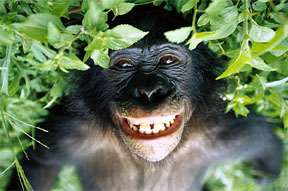
Bonobos. Yes, Bonobos. Zillions of years ago, long before the drought on the Serengeti, There was no Congo River coursing through the middle of the African continent. Dozens of ape species lived across the continent. Some were large, like the Silverback and Mighty Joe Young; some were small like chimpanzees and Bonobos. Eventually, the simians had to compete for food and, as individuals, began to become territorial and even a bit nasty – growing large fangs for fighting one another. The meanest, toughest male became the leader of the local troop.

The dry years dragged on eliminating many ape species. Only one species survived in the southern plains: Bonobos. Eventually the rain came. It was a lot of rain and formed the Congo River. All the large apes lived above the Congo and the smaller species still had to compete with the large ones. Fighting for food and territory had been bred into the northern species via the evolution partnership with DNA.

South of the Congo, Bonobos had it pretty easy. Food was plentiful. As it turns out, Bonobos do not have brash egos, territorial attitudes or gang fights. In fact, they don’t fight at all. Bonobos are quiet, even shy. Interestingly, Bonobos have matriarchal troops; the females are political but not inclined to fight. Authority and troop allegiance is maintained by continuous touching, nurturing and protecting. Sharing inadequate food and territory is a non-issue. Consequently, Bonobos have no inbred need to fight; Bonobos have no belligerent personality profile; bonobos have no masculine need to use violence as an expression of sexuality like most other mammals.

So the path to peace is not Roman domination; it is not automation; it is not greed, prejudice, avarice or the other Ten Commandments. These disruptive attitudes can be traced back to the North African apes. No wonder religion is so testy. No wonder corporations are territorial to a fault and lack empathy. Territory, however, is another issue in 2017 – 7,000,000,000 living on a space designed for 1,000,000,000 at most – and projected to be 12,000,000,000 by 2200.

Nevertheless, reproduction can be controlled by the genome as well as belligerence.

The path to peace lies in planned change to the human genome. Find out what genes in us are missing from the Bonobos genome then remove them from the human genes. In a compassionate manner, begin reengineering our genomes to lack belligerence. Pretend we are mosquitoes that carry bad genes and fix them.

Afterward

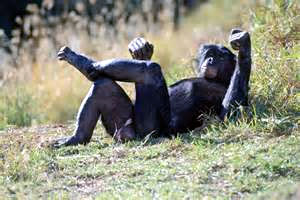
Immediately, pro-aggression types leap forward to claim without aggression, belligerence and domination, humans would not have made scientific progress, etc. The question is does Mr. Bonobo above need a computer?[1] That is a cop out; progress and lack of belligerence are cohabitant.

World peace is at hand.

Ancient Mariner

[1] Do not stop here. We must know more about the Bonobos. They are an endangered species living only in The Democratic Republic of the Congo. They are reduced in number daily by hunting and logging of their habitat. Please read on at http://www.bonobo.org/bonobos/what-is-a-bonobo/

Consider This . . .

The last post did a short analysis of the causes and voting behavior of the electorate’s response to the candidates. In this post, we look forward – not so much about the cabinet and key players in the White House, which looks neither republican nor democrat but certainly a team who will fumble as the weight of running a democratic republic falls upon them. We must give them time to fumble and see how they recover.

The Guru still is contributing to the mariner’s thoughts so our focus will address – in the looong view – well rooted troubles evidenced by the election and the consequences that will occur if they are not addressed.

Consider religion –

Guru blames our religious difficulties on Puritans and other fundamentalists who relocated in America because their practices did not fit well with a rapidly liberalizing Church in Europe. Even today, employees of Planned Parenthood may be shot, burned off the property, forced by a government who ignores the US Constitution to dismantle financial support, lay debilitating regulations upon them and otherwise ostracize Planned Parenthood from their presumed right to pursue basic human rights. When was it that Protestants stopped slitting open the length of every Quaker’s nose just because they were Quakers?

The current fundamentalist unrest should not even be an issue. The nation was clearly founded on freedom of religion. The pettiness is not really religious; it is the belief that because our money references God, the nation is a theocracy – just the conflict our founders wanted to avoid. If this conflict cannot be put to rest, the conservative theocratic movement will keep our politicians from dealing with tough issues through politically democratic compromise. The tea party folks came close to bringing down the US for good. Further, throughout time since the beginning, religious practices have changed as society changed – but not without questionable abuses of religious doctrine in defense of tradition. It is not enough to be an American Citizen and be safe from beheadings and genocide by ISIL; we owe our own nation loyalty to its premise of freedom for all citizens. Being citizens of the only nation in the world that defines itself as ‘freedom for all citizens’ requires even the religiously devout to – in this nation at least – be loyal to that principle. Religious faith is relevant or it becomes destructive if not meaningless.

We need all three branches of the Federal Government and state governments as well to deal successfully with international politics, greed-based corporatism, scientific knowledge that may leave us on a pile of extinct species before we may want to do that and a planet that is pretty much fed up with us. The new world of governance cannot be held back by regional faith; virtually every issue will require international agreements involving many faiths, cultures and races.


Consider economics –

The United States is founded on principles never before used to run a nation. US citizens were required to manage themselves. True, there was a republic but that was for serious things like war, taxation, balance of national economy, and dealing with other nations. In practice, citizens believed in freedom – the principle that everyone could pursue a successful life without oppression; they were free to believe independent religious beliefs – the principle that ethnicity and prejudice would not interfere with the pursuit of happiness; and they believed in loyalty to their fellow citizens to support the principles of freedom of faith, freedom of opportunity, and the personal and cultural loyalty to believe in freedom for everyone. In other words, citizens had to believe in their nation’s principle and manage themselves as keepers of freedom.

Freedom includes citizen wellbeing. If one citizen takes from another unjustly, or prevents a citizen from opportunity, or fair exchange for labor, in public discourse protects a citizen’s equal rights under the Constitution but consciously interferes with citizen freedom as a shared right, to a just and fair economy owned by everyone, then the US concept that everyone has freedom to pursue life and liberty has disappeared. Mariner does not suggest every citizen be equal in assets but taking more than is deserved, necessary or leveraging dishonestly is not in the interest of the US – which depends on each citizen to be loyal to the right of equality and freedom.

Corporatism is the belief in profit above freedom; Corporatism provokes class prejudice; Corporatism is free of allegiance to freedom, compounded by guaranteed protection as a human participant, a corporation is a double-barreled abuse of the founding fathers’ intentions.


Consider Globalism.

The mariner groups several diverse movements under this term: corporatism, technology, biological progress through medicine and chemistry, protection of the biosphere, and competition by war for greedy and ideological reasons. All these activities have one thing in common: they are not based on the concept of nationalism; they are not based on one nation’s philosophy of government; and by definition, globalism cannot be allocated to nations individually.

If the reader thinks it has been a hard row to move humanity from 1760 to 2016, prepare for even more from 2016 to 2272. A person alive today cannot fathom what civilization will be like 256 years from now.

One wonders what events, provocations, inventions and changes in principles of governance will be required – either collaboratively or with great conflict – to achieve insights and rules that achieve solutions to global issues humanity has never experienced – let alone survive in the process. The triangle of strength and success written by Os Guinness[1] and resurrected by Eric Mataxas[2], that is, “Freedom requires virtue; virtue requires faith; faith requires freedom” is the only tool set available. Considering advancing historical eras by government ideologies, The United States is the beginning of a new, common governance that may be the only ideology capable to take on Globalism:

Freedom, if you can keep it.


[1] Os Guinness is an English author and social critic. Born in China, where his parents were medical missionaries, he is the great-great-great-grandson of Arthur Guinness, the Dublin brewer. He was a witness to the climax of the Chinese revolution in 1949, and returned to England in 1951, where he went to school and college. He received a B.D. from University of London in 1966 and a D.Phil from Oriel College, Oxford in 1981. Guinness first stated the Freedom Triangle when promoting his book, A Free People’s Suicide. Guinness is still alive at age 75.

[2] Reference to the Freedom Triangle is resurrected by Mataxas in his book If You Can Keep it, the Forgotten Promise of American Liberty. 2016 best seller. Mariner believes this book is required reading for every American citizen.

Ancient Mariner

Hades

The mariner is reminded of the harsh apocalyptic and horrific movies popular today. Similar is his life wandering among fire pits and unexpected explosions caused by politics; ghoulish realities of extinct creatures and vacant deserts with burnt and smoking ruins where forests and clean water used to be; billions of hollow, starving humans sitting everywhere with swollen bellies; millions of fat, selfish billionaires and millionaires perched like vultures watching humans everywhere in case a profit pops up to be taken from the disadvantaged.

But all’s well – we will elect a new president on November 8, 2016.

But that is false hope. The mariner knows governments and class culture and disrespect for the planet are no more than scenery on the set – props. Reality will remain a fearful, deadly, poisoned place; it is likely that reality will not end nicely.

Times past could have been better but humans are not smart, orderly, or responsible. Humans will not be able to share the planet much longer.

The planet will take us to task. It’s called the Day of Reckoning.

Ancient Mariner


On Being Human

While having a free breakfast at an Albuquerque motel, mariner and his wife watched TV. David B. Agus was a guest on the Kelly Ripa Show. Dr. Agus was speaking to a number of healthy habits most of us don’t pursue. One that caught the mariner’s ear was the Doctor’s promotion of walking as a preventative or deterrent for many disorders and discomforts about which we lazy humans have become vulnerable.

His entire solution is we don’t walk enough – not 15 minutes; not a half hour or hour; maybe 2 hours without stopping may do some good. [Health note: don’t start with these times; start very slowly, building steadily but within capacity]

The Doctor’s most salient and undeniable premise is that Homo sapiens, over our species’ 100,000-year evolution beyond four-footed and tree-swinging cousins[1], emerged as an ape that could walk and trot continuously all day without stopping except for a bit of water and a few nuts, plants and berries! The mariner looked into this a bit; it seems the Doctor is main stream among physiologists.

Dr Agus goes on to say that our physiology is designed so precisely for walking that many early-brain functions don’t wake up until we’re walking. This includes hormones, enzymes, and organ and brain functions that work better when we’re walking. Intestines and circulation, lungs, richer blood (like sports doping?), control of mood swings, a shot of dopamine, faster response to sensate awareness, and like everyone in mariner’s family, walking while talking on the phone is virtually required. Mariner conjures that the walking manages the body and brain which makes talking without focus on anything else work better.

The Doctor’s focus on physical disorders included back trouble, curvature of spine and neck, balance, arthritis, pulmonary disorders and physical weakness, headaches, etc. Many of these discomforts are caused by not having strong muscles on the entire back nor a strong diaphragm. The stoop that develops in our upper backs as we sit through our fifties, sixties and beyond is entirely caused by bad posture, that is, not walking enough and sitting way too much. The muscles weaken and don’t support the spine. The mariner has noticed on talk shows that female guests make every effort to sit with an erect back; they look much more attractive. Males tend not to. If we sat as erect as the females whenever we sat, curvature will be less likely – and it may be conceivable that we could be more attractive as well.

Imbalance is caused by weak muscles in the legs. Walking a meaningful length of time each day will improve the rusty link between our brain where body control and balance occur and the smaller, more sensate muscles in the legs. As for the quads and hamstrings, add jumping and sprinting to your walk. Just go out in the field and pretend you are hairier, swifter, and can leap small sticks. Don’t stop until you come back.

More a sailor than a walker, mariner may have to acquire a walking hobby. How about treasure hunting with a magnetometer? Or he could return to one of his childhood pleasures: rock hunting. Perhaps Forest Gump knew a lot more than we thought he did!

– – – –

The day before yesterday was Earth Overshoot day. To remind readers, here is information about a foreboding yearly celebration:

Earth Overshoot Day 2016: August 8

As of today, we humans have used as much from nature in 2016 as our planet can renew in a whole year. Nothing will seem to change for many of us from this day to the next, but collectively we are draining Earth’s capacity to provide. Overshoot Day is a red light warning of trouble ahead — and it is flashing five days earlier than it did last year (Aug. 13); eleven days earlier than the year before (Aug.19).

Earth Overshoot Day is devised by Global Footprint Network, an international think tank that coordinates research, develops methodological standards and provides decision-makers with a menu of tools to help the human economy operate within Earth’s ecological limits.

End quote

As the overshoot day retreats earlier into the calendar year, the deficit of resources will be made up by denying others the right to their own individual resources. Those who can will steal from the fair share of others – eating off a starving man’s plate so to speak.

(A line of thought from Guru suggests that eventually capitalism will collapse because sharing of resources will be necessary if we are to remain humane. Otherwise violent and destructive cultures will hasten our extinction)

[1] The Wikipedia timeline begins at 4000 MYA with the appearance of the earliest life-forms and includes 10 MYA for when human ancestors speciate from the ancestors of the gorillas.

The first anatomically modern humans (Homo sapiens) appear in Africa some time before 100kYA — they evolved from Homo heidelbergensis.

Ancient Mariner

What is Empathy?

In the mariner’s last post, “The Greatest Sin is Prejudice,” it was suggested that the real measure of successful evolution was not intellectual prowess but empathy. The post prompted notable interest in the midst of confusion about the differences between sympathy, pathos, compassion, empathy, etc. It is important to understand empathy as a unique experience because the post suggests that empathy is a positive phenomenon capable of shaping evolution.

This post will focus on words that often are mistaken for empathy and a focused note about empathy as an evolutionary influence.

Aware – On the scale of emotional interaction, being aware of human behavior in others is more a result of the five senses behaving normally. At best, ‘sensitive’ may mean the same. For example, ‘I am aware that you are a democrat. Being aware of that opinion helps me adjust my sociability when interacting with you.’

Pathos – Often used to express ‘sympathy,’ it is not the same. Pathos is an intense response to a situation usually intensified by art or other imagery.

Pity – While pathos can be an intense response, it lacks personal engagement. Pity, on the other hand, suggests that you are aware that the person(s) do not deserve their difficulty; you have a perspective about the circumstances in which they find themselves but rarely stop to involve yourself in easing their plight unless they already have a bonded relationship with you.

Passion – The key to recognizing passion is that you are at the center of the emotion. Passion is a self-serving response which drives your focus to accomplish something that has captured your emotions. Examples are infatuation, personality tendencies, response to a perceived threat, perseverance to modify an important social situation, etc.

Sympathy – Surprisingly, rather than being focused primarily on one person, sympathy is an allegiance to a group ethic or morality. Sympathy means your reality is intertwined with values and experiences of others. Sympathy is the feeling that binds you to what is important to others – enabling you to experience the ebb and flow of group or individual values. Often used erroneously in place of pity, a closer synonym would be ‘loyalty.’

Compassion – A common expression among married couples of long standing is “Passion turns into compassion.” The meaning of the phrase represents the replacement of personal passion with a commitment to the wellbeing of the spouse, that is, your personal emotions become integrated with your spouse’s emotions such that neither stands alone. This same allegiance, when applied to social situations, means you and others experiencing that situation are bound to support the well being of others involved, engaging physically in real time response to achieve solutions. A popular distinction in literature follows the theme, “A warrior has passion; a hero has compassion.”

Empathy – Empathy obviously is derived from the same Greek root as pathos. Empathy carries the same intensity as pathos but has an added dimension: empathy also means the ability to infuse one’s understanding of another’s inner feelings so amazingly that it seems as if you could become that being. One becomes so obsessed with the other being’s gestalt that the two beings appear twin-like in behavior, motivation and awareness. This does not suggest magic or weird music; rather, you become so aware of the internal feelings and values of the other person that you can fully represent their gestalt.

A simplified example of not exercising empathy by choice is common among dog owners. Animal psychologists have determined the following:[1]

Dogs do not like to be hugged. They feel trapped and unable to escape if necessary.

Dogs are born to run. They are hunters very much like their wolf ancestors – even if it is a Shih Tzu. Life in a pocketbook or at the end of a chain or locked up in a house all day must be hard.

A great experiment (and something that will probably have your dog sighing with relief) is to try to spend a whole day not saying a word to your dog, but communicating only with your body. You’ll realize just how much you “talk” with your body without realizing it.

Most humans think that dogs like being patted on the head. The reality is that while many dogs will put up with this if it’s someone they know and trust, most dogs don’t enjoy it. You may notice that even the loving family dog might lean away slightly when you reach for her face to pet her. She’ll let you because you’re the boss, but she doesn’t like it.

Fortunately, over thousands of years of breeding, we have made dogs more empathetic than we are.

The future for the current environment and all its inhabitants is not bright. Homo sapiens has overrun the planet in a savage way and every day is driving species of every kind into extinction. Already humans consume more than the Earth can provide each year; the oceans show rates of depletion that suggest the oceans will be fished out by the end of this century. The Earth itself is slowly shifting to a warmer environment that in time will stress all living creatures.

The philosophical question is, how will whatever is still alive continue to exist? Futurists are suggesting competition between species and between ourselves will only hasten extinction. The opposite of conflict is empathy – living in close harmony with the best interest of any living thing as closely managed as we can. That may grant our biosphere a few more centuries.

Empathy is a parallel behavior to what religions have been espousing for 8,000 years: love and giving is the true key to survival. There will be no room for expensive idiosyncrasies, greed, or waste. Love and giving, i.e., empathy may be our best chance to evolve properly for the end of our age.

Ancient Mariner

[1] From Jaymi Heimbuck, http://www.mnn.com/family/pets/stories/11-things-humans-do-that-dogs-hate

Liberal Arts on Cable TV still exist.

For those who have not been exposed to liberal arts and to those frightened away by the word ‘liberal,’ let the mariner assure the reader that liberal arts means the study of humanity and is neither liberal nor conservative. It is open-minded – which may be frightening to any close-minded person conservative or liberal.

Many TV viewers are moving on to the new marketing format available through HULU, NETFLIX, HBO, SPORT networks and even social networks. The channels rich in liberal arts are not the reason for this move; rather it is less costly and provides more personal control over channel selection although not much. To be honest, most viewers consider liberal arts channels the ones they don’t want to pay for.

Still, there is a growing need for some percentage of the American population to understand that mental sophistication and insightful judgment are critical both to our enjoyment and to our future. Liberal arts sources grow scant and even unavailable as college after college drops liberal art majors and humanities requirements from its curriculum. It is a dangerous time for dismissing sophisticated thinking about humans and what may be important digressions from the powers of artificial intelligence.

For an accounting of Liberal Arts in past posts, use the search box to recover posts containing the term liberal arts.

In this post, the mariner will point out a number of broadcast and cable TV channels that give generous time to thoughtful programming across the spectrum of insight, education and art. Cultural events are available as specials, for example, “The Kennedy Center Honors” is primarily entertainment but the program’s tone acknowledges cultural style and cultural significance – artificial intelligence unnecessary. News specials appear regularly on all the broadcast channels: ‘Special Reports’ programming typically focuses on important events more deeply and insightfully; Frontline on PBS always is on the frontline…; calendar specials – recent broadcasts were informative about Jackie Robinson and Martin Luther King; another was about the mindset of the founding fathers. There is a bit of burden on the reader to peruse broadcast listings and promotions to identify thoughtful presentations about any subject. Even CNN and MSNBC broadcast good ones once in awhile.

Of notable contribution to liberal arts is PBS. Viewed in collaboration with PBS on line, a veritable library of liberal arts topics is available from Pushkin to Pythagoras to Emerson. Add NPR on the radio and all programming is treated as serious, personal and event oriented. Did you say goodbye to Garrison Keillor and A Prairie Home Companion? President Obama did with an on-the-air telephone call.

BBCHD and BBCAHD contribute a good amount of broadcast time to humanities programming. On Saturdays there is a series of programs that are enjoyable yet targeted around topics one would think have little of consequence. Try Studio-1 and Brilliant Ideas.

CSPAN1 and 2 are rich in humanity programs. The library of videos on line has tens of thousands of programs. Not all are based on book reviews with authors; they include interviews with world leaders, US politicians, government actions and human interest in all the humanities. One never knows when a particular author interview may spark enough interest to buy or borrow the book at the library. Mariner can attest to dozens of interviews that led to further research.

Discounting Fox channels because they reinforce close-mindedness with their already close-minded audience, there is little left to represent humanity’s political ideology. Two liberal channels, LINK and FSTV, present material close to the positions of Bernie Sanders but their material frequently is out of date and may not match current reality. Still, liberal figures whose ideas represent mainstream socialism appear in their broadcasting; examples are Chomsky and Ralph Nader plus activists and personalities participating in current activity. Mariner watches occasionally to keep his ship’s keel in line. (If all the reader does is watch news on TV, one will be led quickly away from reality. Humanities is not a strength of news media.)

Then there is the champion of free information on any subject one can imagine. Unlike TV, which feeds the viewer a pre-researched topic, the viewer can know everything plus more if the viewer does all the research about a topic of personally determined interest. Mariner has said in the past that Wikipedia is a playground for liberal arts.

The point is this: Every element of our species that we hold dear is vulnerable to displacement by the digital takeover of “big data.” Computers already have learning algorithms that teach them to form their own functional solutions to computer-determined needs; give computers access to all there is to know about you, your environment, your motivations and the patterns of human behavior, and the computers will live your life for you and do the work that once needed you. Humans will be displaced to the point that economic rules will collapse and humans will have no way to produce income. Only the enrichment of liberal arts in the minds of leaders will have any chance to divert pure digital solutions from displacing humanity. Chicken Little, Amos and the Guru all agree on this outcome. Further, you can find television programs and books already describing this future. Even Stephen Hawking feels computers will dislodge the human species  as humans give up human functionality. Care to consult a digital psychologist for counseling? That function already exists.

– – – –

There are two ‘third party’ options for the 2016 election: The Libertarian Party and the Green Party. The libertarian party promotes a harmful, draconian view of government that would destroy today’s culture; it allows only military, printing money and international relations as Federal functions. There is no room for anything else. All other matters are left to the fifty states. The other party, the green party, has Jill Stein running for President. The Green Party is left-center but notably more progressive. The political platform can be read at http://www.gp.org/four_pillars_10_kv . If the two major candidates don’t fit the bill for you, check out the Green Party manifesto. The mariner personally does not recommend Donald.

REFERENCE SECTION

The latest Atlantic Magazine has a good lead article, “How American Politics Went Insane.” Check out the September issue or read it on line at

http://www.theatlantic.com/magazine/archive/2016/07/how-american-politics-went-insane/485570/

Even more insightful is to watch “The Greeks” on PBS TONIGHT (Tuesday, July 05, 2016). Everyone will recognize the similarity of American history to Greece’s path to democracy.

Ancient Mariner

Humans are not Creators, they are Stuff

It is wise to listen, not to me but to the Word, and to confess that all things are one.

Alas, Heraclitus was not a theist for he also said:

This Universe, which is the same for all, has not been made by any god or man, but it always has been, is, and will be an ever-living fire, kindling itself by regular measures and going out by Heraclitus smallregular measures.

Heraclitus, who lived from 535-475 BC in Ephesus Iona (Turkey), predates Socrates and Plato by a century and was not part of the mainline Greek philosophical revolution although he was commonly quoted by many later Greek thinkers and shows up as a quote in books about other philosophers.

Heraclitus appeals to the mariner because he established the principle that the law of the Universe is the only law and all things that exist in the Universe must obey the same law. Too often the creative genius of H. sapiens is attributed to itself when in the broader view it is, as Heraclitus suggested, a child playing with blocks.

It is difficult for humans to associate with the Universe. The Universe has no recognizable goals. The Universe does not show responsiveness, preference, appreciation, personality, possessiveness, vengeance, favoritism, or kindness. There is only astronomical stuff, chemical stuff, unending space and two unending energy resources: time and gravity – immeasurable time, pervasive gravity and all the space the Universe needs. These eternally present things are called Universe stuff. It isn’t easy to talk with the Universe over a breakfast muffin and coffee; trying to get the Universe’s attention by discovering how to fly to the stars with the Universe’s own stuff doesn’t score, either – less than a spit in the Milky Way.

Before we begin dissecting how humans fit into Earth’s stuff, it will be easier to have a consolidating word for all Earth’s detailed activity, cause and effect, and interactions between elements of Earth’s environment: let’s call it all “stuff.” Specialized stuff. For example, anything created, altered or thought about by humans is “human stuff;” things like orbit changes, volcanoes, earthquakes, geologic ages, atmospheres and magnetic fields are “Earth stuff.” There’s also environmental stuff that includes weather, living things, gold, diamonds, sulfur, critical stuff like water, oxygen and other stuff as may be required.

From a few miles in space, human stuff right now looks very much like a colony of disturbed ants long resident under a large rock. Like the ants, humans are racing about blindly, trying to conjure what is going on; what shall we do? Experiencing reality like an ant but on a human scale, consider the following:

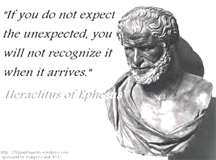
Environment stuff is increasingly unstable – some unstable because of human stuff but most because of Earth stuff. Observant, thinking humans acknowledge that Earth’s surface stuff is growing warmer. Even indifferent humans acknowledge that humans have accelerated warming with excessive release of Carbon into Earth’s atmosphere and oceans. As Heraclitus suggested above, if you do not expect the unexpected, you will not recognize it when it arrives. Such is the case with carbon pollution, which arrived unnoticed and unexpected shortly after the Civil War.

The use of the word “stuff” is an important tool; viewing the Universe on the scale of normal human cognition quickly exaggerates the importance of human stuff. It isn’t really important at all – except to humans. Similar to ants, reality is greatly distorted by personal experience. Brazilian farmers continue to deforest the Amazon rain forest despite the suggestion that removing the forest will change environment stuff. The farmers’ reality is distorted by personal gain; they are incapable of expecting severe changes in their weather so the true scale of their reality is much like an ant’s. On the scale of Universe stuff, ants and humans are closely related.

Humans keep track of mathematical versions of stuff. An arctic fox may have a sense that it is unusually cold but it seems not to care that not only is it unusually cold, it is minus 120 degrees Fahrenheit cold – now that’s cold! Humans mathematically track a lot of phenomena about other stuff; that’s how humans know the environment is growing warmer on Earth’s surface.

A reputable scientist wrote an article in Atlantic Magazine about a year ago. He was ridiculing humans’ plan to reverse climate change: “They think they will fix the problem in a lifetime or two. What they can’t see is the scale of global warming. It may take the Earth 30 thousand years to reset its global environment!” Many scientists agree and also believe that the Earth will enter a long ice age at that time. Each set of stuff has its own scale of size and time. We forget how small human stuff is when compared to environment stuff and Earth stuff. A simple example is we count our lifespan in years; environment stuff easily can count lifespan in centuries, i.e., how many years does it take for the Fertile Crescent to come and go through a desert cycle? Earth counts lifespan in eras; an era has two or three cycles called periods – the length of time during which rock formations appear, e.g., the Rocky Mountains.

If human stuff is messing around with Earth stuff, the results may take so much time they never will be known. On the other hand, looking down the scale of different stuff, say solar system stuff messes with environment stuff, things can change rapidly. Remember the meteor that helped wipe out the dinosaurs? That meteor may have been floating around the solar system’s inventory of asteroids for billions of years then POP! If we had been alive at the time, we could have watched the entire global environment change within a week.

Mariner can hear the reader complain, “What’s all this stuff about? What’s the point?” This always happens when Guru is allowed in the room. What it’s all about is that the twenty-first century confronts humans in a new and unpredictable way. Like the ants, Earth stuff is changing our reality: our comfortable rock has been lifted to expose new, larger issues that force H. sapiens to realize it is not as much in charge as it thought. Further, time is short enough to be relevant to our psyche. Stephen Hawking is confident H. sapiens will be extinct within ten thousand years. Our line of ascendency began nearly 90 million years ago as a simple primate. We’ve only 10,000 years left to come to terms with the relative value of our messy human stuff as a part of Universe stuff. One example: Are we a benevolent species or a predatory one?

This Universe, which is the same for all, has not been made by any god or man, but it always has been, is, and will be an ever-living fire, kindling itself by regular measures and going out by regular measures.”

POST SCRIPT

Mariner’s in-laws, nine cousin families strong, are celebrating their eighth quinquennial this week. Posts may be scant during that time.

Ancient Mariner