The Wind Is Changing

The mariner does not make predictions or propose a direction at this time but feels the wind differently. Just a small whiff that may mean nothing.

Donald sees himself as king of the world, not just the United States.

Four larger democracies are suffering from authoritative would-be kings who hold no allegiance to human rights and intend to “fix things” and not be wrong about it. (US, Russia, Greece and Turkey) The fuse is the Middle East.

Donald already has infringed on freedom of the press telling it when and where it can receive canned news releases. Individual threats have been made at several specific news agencies. Where is enforcement of the First Amendment?

Donald already has made it clear that his judgment is not to be fair but rather never to be wrong and he will visit his wrath on those who may insist he is wrong. (Sounds exactly like Kim jong il).

It is obvious his scope of importance does not separate the opportunity for profit at the expense of human welfare – wherever profit may take him internationally.

The mariner can go on endlessly with these thoughts but two cultural indicators are emerging that hold his attention: too many crooners and incidents of swing music are popping up on entertainment media and too many Father Knows Best shows are popping up – signs of transition in pop music and entertainment suggest instability in cultural values – couldn’t ask for a better barometer.

Our last chance to avoid war is to stop Donald absolutely without fail at the emolument clause with an impeachment. A bleak future with the US Congress is far better than a world with Dictator King Donald.

Ancient Mariner

Donald

There are many who have made up their mind about Donald. Some see strengths in his extremely pragmatic judgment, which is counter to the conservative’s doctrinaire adherence to the Reagan era; some see opportunity in Donald’s intellect, that is, his ability to see the state of affairs differently; some see a new public representative to the corporate world and among the one-percent – those who believe corporatism is the path to US strength and prosperity.

Others see Donald as politically incompetent and dangerously uneducated at a time when certain mistakes and improper behavior may be destructive; some see disruption to the establishment by his disregard for old-school liaisons; some see a collapse of multidimensional government because he has no allegiance to public wellbeing.

Still others see Donald as morally corrupt and untrustworthy; some see life-long cronyism and business relationships dominating his perception of what is important; some see his narcissistic disorder, pathological lying and his aberrant ego as disqualifying.

To be honest, all these perceptions of Donald have some validity – some have more merit, others less. Factually, Donald does not react normally to doctrine, morality and public perceptions; Donald is all that everyone sees.

Granting Donald with a free pass to the Presidency, accepting the whole person, will he do the nation some good? To answer that question, another one: what does the President need to provide to our nation? Ponder the second question broadly. Some examples using other Presidents (mariner’s perceptions):

George Washington provided weighted stature to a young, helter-skelter nation. He won the war with England, never wore anything but his military garb, and defended the idea that independence could not co-exist beside authoritarianism.

Andrew Jackson was an outsider like Donald (much ado in social media about similarities). When Andrew moved to the White House, he rode in the front door on horseback. Andrew had no allegiance to decorum; he was a racist; he ordered the Trail of Tears; he closed the Central Bank; he started the Democratic Party. Like Donald, his report card was not all A’s in any case. But Andrew gave the nation what it needed. The following quote from Tablet Magazine clarifies the contribution Jackson made to the US versus that expected from Donald:

“….Jackson preferred a republic without a special class of uniquely privileged aristocratic rulers: a democratic republic, in short. Democracy was a pressing matter, in his estimation, and not just a utopian aspiration. Modern capitalism, with its sophisticated system of banking and credit, took root in the United States in the 1810s and ’20s and was proving to be a mixed blessing. The new economic sophistication allowed the financiers to assemble vast piles of capital, which was good. Only vast piles could pay for ambitious new industrial enterprises. But the new sophistication also allowed and even encouraged a swindler’s economy, based on unsecured loans and misrepresentations. Swindler capitalists began to set off one financial crash after another—the Panic of 1819 was the first—which were devastating to ordinary working people. Jackson and his followers worried that swindler capitalists were going to establish themselves as a malignant new aristocracy, on top of the traditional old aristocracy. And Jackson and his political movement became the enemy of swindler capitalism—the enemy of financial frauds and exploitations in their own time, and the enemy of swindler capitalism for the American future.

On this count alone, Andrew Jackson was not a Donald Trump. Jackson was an anti-Trump. The whole style of Trump’s business empire, with its systematic bankruptcies, tax evasions, and mountains of debt, is a throwback to the swindler style that Jackson found offensive….

….[Andrew] tried again in 1828. His party was by then on its feet. The party mobilized the largest electorate by far in the history of the world—a mass of people who in many cases were enjoying for the first time their political rights. The immense size of the electorate guaranteed victory. It was a revolution. And, in his triumph, Jackson succeeded in ascribing his preferred meaning to the American Revolution and to the United States, which was democracy, and not aristocracy: a democratic republic, and not an aristocratic one. Today we do not remember Jackson’s achievement because we assume it. We cannot imagine the United States in any other light, and therefore do not give the matter any thought. But we had better give it some thought.”[1]

Abraham Lincoln was a rare politician in that he firmly followed virtuous objectives. Abe knew in a practical sense that the nation was splitting further apart over slavery. It was a conflict between citizens engaged in a slave economy and citizens (who did not use many slaves) engaged in an industrial economy. Yet underneath there was a democratic Republic that would not survive a split economy. Abe saw that the ideals of the nation would be destroyed as two economies put pressure on the US culture. He had the fortitude to press the slavery issue to closure. He knew that the slave states would be exposed to economic collapse that would require decades for recovery. He signed the Emancipation Proclamation. Six hundred thousand citizens died in the Civil War that followed but the concept of freedom, liberty and justice for all was restored and the nation remained whole. The nation needed a virtuous imperative at any cost.

Franklin Delano Roosevelt was elected President at a time when the US was broke. Not just in debt, broke. The banks were closed. The citizens were broke; the economy had failed. As in every economic model that lasted long enough to dominate world economies and alter the morality and ethos of its time, the unique economic freedoms were abused to excess. In the time of FDR, it was about to roll over a nation losing the core experiment on which the US was founded: freedom, liberty and justice for all. Among many Presidential acts and decrees, and a government dominated by Andrew’s Democratic Party, FDR resuscitated the nation. Despite the firm disrespect for FDR by conservatives and establishmentarians that exists even today, FDR provided what the nation needed to survive.

It is time again to require a powerful and virtuous President. The nation’s old economy, a typical tail end era of hodge-podge banking practices, disappearing middle class, over assimilation of wealth, growing numbers of poor, and inadequate regulations on the economy have again threatened the survival of virtuous and multidimensional beliefs that support a signal concept among nations. The framers of the Constitution wanted a democratic republic founded on the crazy idea that the citizens should manage the nation – not authoritarians, plutocrats, totalitarians, or kings.

The citizens must take note, however, that their votes for a virtuous President come only from citizens who have virtue in themselves. Loyalty to the survival of a democratic republic is a voter’s number one responsibility – especially now!

Ancient Mariner

[1]  http://www.tabletmag.com/jewish-news-and-politics/219613/donald-trump-andrew-jackson

Things You should Keep in Your Brain’s Ready-Reference

It’s true information is more available to individuals than it has ever been. It’s true that information is relatively inexpensive compared to past forms of data collection. It’s true that more information is available to us intentionally manipulated either for business purposes or deliberately maligned to influence us with falsehoods and premeditated lies. Each of us needs a small ready-reference to keep our head straight about reality and rationality. Mariner offers a few samples that not only provide guidance but are the kind of values that tell us who we are as well.

  • Asset/Debt Ratio (A/DR)…..For example, the net worth of your home, your car, all your savings and investments, and your bank balances (say a total $150K) divided by all your debt balances – mortgage, car, furniture, credit cards, loans, outstanding betting slips, and any other debts outstanding (say a total $80K). Divide 150K by 80K = 1.875. This quotient is your Asset/Debt Ratio.

Track this number every time you complete a budget cycle, probably monthly. If you live within your normal cash flow without changing budget credits, perhaps quarterly may be frequently enough. Why it is important to have your A/DR in your ready-reference is to compare it to the new A/DR. Rule one: under normal circumstances, it should never be below 1.0; that means you are not worth anything; you have no assets. Rule two: it should not drop three months in a row without investigating why. If either rule is broken, you must identify the cause and move to repair it as much as possible.

  • Know your income tax bracket. It is an important tool to analyze the real value of all sorts of things.A part of an IRS web site is copied below.[1] .

Federal Tax Brackets

Your tax bracket is the rate you pay on the “last dollar” you earn; but as a percentage of your income, your tax rate is generally less than that. Here are the tax brackets and the income ranges where they apply:

Taxable Income          Tax Bracket

$0 – $9.275                        10%

$9.275 – $37.650               15%

$37.650 – $91.150              25%

$91.150 – $190.150            28%

$190.150 – $413.350          33%

$413.350 – $413.350          35%

$415.050 and above           39.6%

As a value in our ready-reference, it is used simply as a constant. One would say, “If I win 400m in the lottery, that will put me in the 39.6 tax bracket; I’ll only keep 241.6m.”

On the other hand, if a discretionary fund item, say 1b aid to college enrollment, and the article says that’s .003 cents of every tax dollar, you can whip out your tax rate and determine that the nation’s college assistance program will use your paid taxes, at a typical 25% tax rate – your sample tax bill (25x40K=$1,000) the 1b will cost you three dollars of your paid income taxes. Unless the IRS raises tax rates, your taxes don’t go up; it’s just that of your taxes, $3.00 will be allocated to the college fund line item.

The huge numbers in governments need your tax rate from your ready-reference to put some perspective on surrealistic values.

  • Another ready-reference in this post is to know the inflation rate. In years gone by fluctuating inflation had a serious impact in everything from groceries and gasoline to housing and automobiles; mariner remembers an annual rise of 14% during the seventies. Soon, inflation will be in the news. It’s one of the reasons the big banks are hyper. For the most part, inflation also is a constant used to evaluate savings and investment interest. Savings banks pay interest just a tiny bit above inflation (but not always) and if you don’t keep track, you may be losing money against inflation. Another common situation is converting a large investment CD. If you know your inflation rate, you’ll know the penalty for cashing the CD early is less than the interest you will lose to inflation over the remaining time for the CD.
  • The final ready-reference in this post is to know how dependable your data source is. Keep a check step in your ready-reference that causes you to think about the source you are using to improve your knowledge. The last election suffered greatly because social media became a source of undependable opinion and fact. Of course this is easily true because anyone can say anything without authorization or validation. Are you using PBS or reading a reputable paper or magazine? Your chances are decent that the information is true and not skewed or missing too much. On the other hand, private websites (like this one), commercial websites, ideological websites, Facebook, twitter, et al are wide open to manipulation, garbage opinions and destructive lies.

There are other values to keep in your brain’s ready-reference. We’ll go back to them at some point.

This has been a nice diversion. Don’t look out the window – Donald is out there.

Ancient Mariner

[1] See: http://www.moneychimp.com/features/tax_brackets.htm

Everyone should have a Financial Bomb Shelter

Things are getting a little too uneasy. It’s one thing to read about a war zone and another to be in one. Donald is showing his real persona: He is a sleazy con-man with no morality. He has abandoned his base lock, stock and barrel. All he wanted were their votes. Now he doesn’t care. His cabinet and staff picks are fellow selfish autocrats with whom he has dealt for decades. Mariner hears echoes of Reagan appointments when the Secretaries did not believe in the virtues of the Secretariats they were appointed to and brought an end to a democratic foundation fostered since FDR.

This is worse. There is a foul smell about. The mariner fears that the Republic itself is at risk. No one has hit Donald between the eyes with a steel bar to tell him he can’t mix personal business with public trust. He will find a way. In fact, if he brings a few more plutocrats and generals aboard, Donald can meld the Republic and his business empire into one objective: make money for the team. Screw the public trust.

Meanwhile Paul Ryan and Mitch the Turtle are unencumbered in their plans to disassemble the remnants of the whole concept of discretionary spending.

Will it become so distressful that truly in fact the US will have a problem with emigration as citizens follow their jobs into other countries? If we are incapable of managing our own freedom because an international mafia has taken the country, what else are we to do? There’s one option: turn the second amendment militia loose.

Mariner suspects Donald is having difficulty appointing a Secretary of State because of two circumstances: first, Donald is in up to his armpits with shady deals worse than he accused Clinton of during the campaign; the Secretary of State will be exposed to Donald’s illegalities and un-American financial ties with adversaries to the US. Second, there is no doubt that his ‘friends’ overseas are hardnosed friends just as he is and should things not go as expected, the result won’t be sharing ice cream cones. US military will be put into action for less than scrupulous causes.

Out of harm’s way as change slowly approaches us, Amos[1] has casually warned about increasing tension and feelings of imminent risk. Amos has warned about the confusion and turmoil of the moment of chaos. Similar to global warming, change is here – now.

Donald et al will cause great damage to us. Think North Korea. How can this be stopped?

Ancient Mariner

[1] One of mariner’s 3 alter egos; fashioned after Prophet Amos in the Old Testament. Amos is always complaining about the quality of our behavior.

How High the Moon?

Who among us remembers this song when it was popular? Les Paul and Mary Ford made a hit of it and the Beatles covered it in their era.[1]

We on Earth, for the most part, pay little attention to the Moon except as an ornament in the sky. Many are educated in a general way about the Moon’s role in the creation of the Earth – an unimaginable clash of two giant spheres colliding head-on thereby creating an Earth-sized piece and a Moon-sized piece; The Moon ended in orbit around the Earth and set the Earth on an angle that created Earth’s seasons and continues to affect tides not only in water but in Earth itself.

Here is an intriguing update on Moon stuff: The Moon is drifting away from Earth each year by the same distance as our fingernails grow in a year, about 2½ inches. Balanced in a strange pirouette (both spin), the two bodies are held in place by gravity and pulled apart by centrifugal force. Evidently but very slowly, centrifugal force is stronger and eventually will pull the Moon out of its Earth orbit. What will happen next is not agreed upon by astronomers and astrophysicists. Will the Moon simply fly away into space, leaving the Earth an unrestrained pirouette wobbling uncontrollably around the Sun? At some distance will the Moon find neutrality and settle into a new orbit? As the Moon lessens the balance held today, will polar wobbling on Earth become an issue? Stay tuned.

– – – –

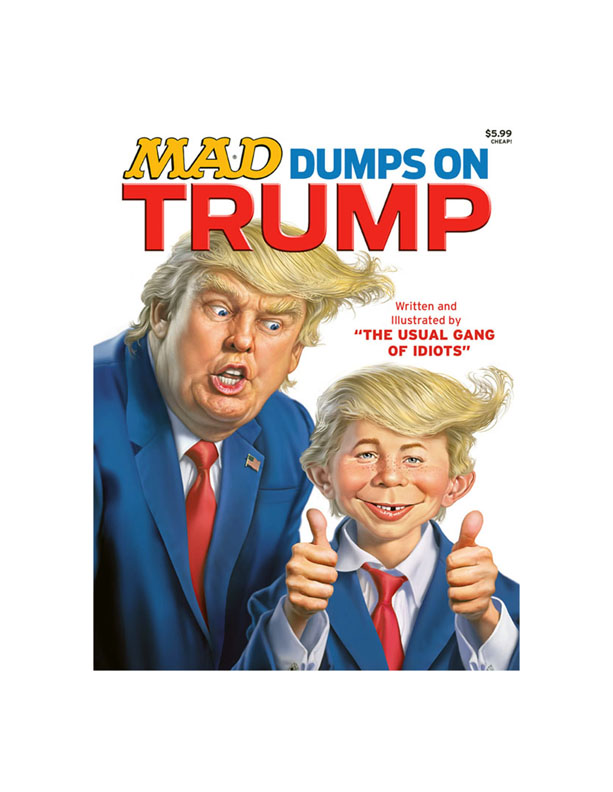
When mariner was a young rebellious teenager, his favorite comic book was Mad Magazine. Mad is a disrespectful, ill mannered publication that holds no restraints with its tasteless satire and mockery. Fortunately, Mad is still around[2]; there are times when only Mad’s commentary is equal to reality. In honor of Mad, here is the latest cover:

mad

– – – –

Mariner hasn’t taken a tour of his Internet/magazine reading list for awhile. Every so often he offers a list of websites that constitute a decent review of most of the subjects that fill our lives. Here forthwith:

Politics, Economy and Public News

http://www.politico.com/  …….everything newsy and active in politics

https://www.theatlantic.com/  and the paper edition…….mariner ranks Atlantic as a premier data source for today’s busy, changing world

http://fivethirtyeight.com/  …….a statistical look at many subjects by the numbers

http://www.nytimes.com/  (New York Times) and the paper edition…….world-encompassing coverage of news

http://www.pbs.org/  …….At the website one feels they are in a library. True! Pick your subject

http://bloomberg.rapid-news.cool-links.georgemoen.tel/  …….top notch cable series Reality, Big Problems, Big Thinkers

http://www.economist.com/ and the paper edition…….best common sense reading about the state of economics

https://www.c-span.org/  …….tens of thousands video clips, articles, and programs


Science, Technology and the Future

http://www.livingscience.com/  ……eclectic collection of information from scientific sources; written for light reading

http://www.nature.com/news/  and the paper edition…….serious articles about new positions taken on any scientific subject

https://www.scientificamerican.com/  and the paper edition…….many articles about science frontiers and how they affect humanity

http://bloomberg.rapid-news.cool-links.georgemoen.tel/  numerous social, scientific and general interview shows of excellent quality


Literature and the Arts

Bloomberg Television   interviews and presentations of operas, artists, sculptors, etc.

http://www.aldaily.com/  (Arts and Letters Daily) source of URLs to numerous artists and other literary news

https://www.wikipedia.org/ …….can’t be beat for detailed review of language, arts, music, writing, philosophy and their histories


Health

http://www.medicalnewstoday.com/ …….satisfying survey of current issues

http://www.webmd.com/news/default.htm ……. catch some news and use their libraries to check on your symptoms


Social Sciences and History

http://www.smithsonianchannel.com/  and the paper edition, http://www.smithsonianmag.com/

https://www.wikipedia.org/ the best, most comprehensive data source on the Internet


Entertainment

Science TV Channel (Outrageous Acts of Science)

http://politicalhumor.about.com/od/politicalcartoons/ig/Political-Cartoons/Debate-Gotcha-Question.htm#step-heading …….even in these troubled times, a visit is comforting

http://www.realclearpolitics.com/cartoons/cartoons_of_the_week/ …….another rewarding stop

Mariner recommends making a quick stop at the list every week or so or when you have an interest in a specific issue.


Ancient Mariner


[1] To listen, see: http://www.last.fm/music/Les+Paul+&+Mary+Ford/The+Best+Of+The+Capitol+Masters

[2] http://www.madmagazine.com/

Loyalty without Virtue is Simply Routine

 Mariner appreciates the response of Readers to the last post. The idea that being loyal to one’s fellow citizens is a requirement of US citizenship has been forgotten but nevertheless remains a critical element since the founding discussions of how the United States would exist as a nation. One speculates whether the disappearance of loyalty along Main Street and the Town Square has led our citizenship to the point of civil disarray today.

As one might expect, capitalism has made an easy mark of loyalty. Every measure of self worth, success, winning and what falsely may be considered ‘virtue’ has been redefined as a dollar value; the human value of our nation fades away ever more quickly. As this occurs, the spirit of our nation weakens and feels the incursion of prejudice, greed, avarice, inequity, malfunction and unhappiness in a nation that was designed to manage itself – loyalty to all our citizens before asset statements and class.

In our desire to recover loyalty to fellow citizens as an important aspect of our citizenship, loyalty must be stronger and more entrenched than community rules, taxes and pension regulations. These acts are established as routines. A citizen understands these procedures and lives by their minimum commitment to loyalty. However, while a nice gesture, loyalty is not improving routine alone; loyalty is learning to care without provocation; loyalty doesn’t start and stop within the citizen as if the need is the provocation and loyalty is a learned response. Loyalty needs virtue to sustain commitment to our nation’s great experiment in self management.

The holiday season offers a quick window into the difference between loyalty as a provoked response and loyalty as a constant obligation: If one is motivated by holiday spirit to cough up a few extra bucks or buy a sample gift for a charitable cause, that is ritual, playing along, paying off some guilt. One incorporates virtue by believing that it is one’s obligation to be loyal; it is a pre-committed act as a meritorious part of who one is – not to separate procedures from core beliefs about moral obligations. It’s like believing in the Cubs – no matter what. You will always be there for the Cubs! You will take every opportunity to root for the wellbeing of fellow citizens.

You will be a real American Citizen.

Ancient Mariner


Loyalty is Everyone’s Mandate.

During the holiday season many, many charity organizations are working at maximum speed to spread the cheer that someone cares for the wellbeing of another. The reader should become aware of the many efforts at feeding, gifting, paying for, providing shelter, providing warmth, and providing other critical support to the growing number of those left bereft and friendless by our abusive society.

Do you attend religious services? Your place of worship inevitably supports several charity projects – probably even sponsors volunteer activities in house to distribute evidence of care and concern but even more, befriending those who can’t afford friends. That includes more often than not families with children.

The best gift is you. That is hard for many people to do. But once one gives with personal effort and time, once one shares with another face-to-face, hand-to-hand, there are two gifts: You receive one, too, and it will be the best gift to you for the whole holiday season!

Our national culture slowly has worn thin. Citizens relate combatively. All the circus acts in politics, all the pretending that when whole industries have discarded wage earners, there is no human impact and that their futures are chopped off – leaving them homeless and penniless with families to support – these are not bad people; these are not failed people; these are not to be scorned; at least not yesterday why today? The US was founded on a new philosophy among nations that every citizen is responsible for every other citizen.

We have forgotten that in the US, we aren’t loyal to a regime or an ideologue. In the US, the strength of our society is not loyalty to the flag. No, it isn’t. We are loyal to each other. Not just in political rituals or paying taxes; each of us has a bonded responsibility to look after our fellow citizens and they must look out for us.

Loyalty to one another is a political mandate to keep the US together and strong. It is not a game for soft-hearts or ‘liberals.’ It is a hard game to be played every day, in every moment. Eric Metaxas said the US is founded on freedom. Freedom requires belief in freedom; freedom requires loyalty; loyalty requires virtue.

Now show your freedom, loyalty, virtue and wisdom: get out there and create some truly precious and needed holiday spirit!

REFERENCE SECTION

ERRATA

In a recent post lamenting mariner’s fortunes at the voting box, there was a poorly phrased sentence about the Presidential terms of Lyndon B. Johnson. To clarify, LBJ finished JFK’s term when Jack was assassinated; Lyndon won his own term in the next election but declined to run for a second elected term.

Did you forget your reading assignment? It’s “If You Can Keep It” by Eric Metaxas, copyright 2016, Penguin Random House. ISBN 9781101979983 hardbound — ISBN 9781101980002 ebook. $26.00 hardbound. Or see your library.

Ancient Mariner

Why Have Elections?

Mariner has lamented from time to time that his fellow electors never see politicians running for office the same as he does. For many (but not enough to win an election) who are disgruntled by all the candidates, there is little to celebrate as elections roll by year after year after decade after decade. JFK and LBJ was the last successful vote cast by the mariner and Lyndon chose not to run for a full term. Undercard elections are worse.

Constantly rejected in this manner, mariner is ever hopeful but more skeptical that ethical culture one day will emerge in his nation. Guru, mariner’s alter ego that looks far into the future, considers his vision a pastime; masses of voters will see to it that it is never achieved. Just call mariner a dreamer.

Mariner’s downfall is not the wrong ideology; it is not racial, sexist or subject to class accouterments. If all the sources he checked since the 2016 election are correct, (in his heart mariner knew it all along) he knows voters vote for themselves or at least the most like themselves in the election. Fareed Zakaria brought this home painfully in his show today: No one, no one votes for policy. No one votes for new plateaus or spiritual caring or conscientiousness. Voters vote for candidates who make them feel most comfortable about themselves – after all, this isn’t the time to go messing with one’s gestalt!

Quite seriously, in 2016 the entire world is in disarray: global understanding of economy is becoming unraveled; industrially based cultures are at the end of machinations to hold on to the way we get jobs, solve serious problems (as examples Brexit, Donald, and the playboys in France and Italy). Beyond the western world, Africa holds onto the word ‘civilization’ by a thread; China has internal conflict and an unbalanced national sense of self (they still debate birth policy and have begun imposing on all the small nations across Indonesia, the China Sea, and even moving toward India. Only India is large like China – both are sumo wrestling metaphors much larger than the US. India has a region in the northeastern part that has no government. If India had cowboys, NE India could be the US wild, wild, west all over again.

Wherever one looks, there is weakening economics, disappearing environment, tumbling governments, and collapsing cultural morality. Like the global warming issue, if one believes these silly rumors, one will not make as much profit if one must face the inconvenience and cost involved. This point is made in the household as well as the boardroom. Observing coal workers will tell us we have only to lose if we vote to feel good and think not at all.

Freedom is all we have in this unique nation of the United States. The electors don’t even know what it looks like.

Ancient Mariner


The Sky is Falling!

A big chunk of sky fell in Indiana the other day. Chicken Little still is in a state of fear; he probably will remain in that state – not one of the fifty states – for another four years. Watching Donald begin to create an authoritarian state by bribing Carrier with seven million dollars of Indiana’s tax dollars doesn’t help Chicken, either. No need for Senate legislation; no need for House legislation; no need for an Executive Order; no need for Indiana legislation. Donald says do it and someone else puts up the money whether they want to or not.

It’s all about Donald’s chutzpah. It’s all about Donald never losing. It’s all about Donald basking in what he presumes is a win. Poor Donald; so simplistic, so narcissistic and so wrong on the Carrier deal. Congress is as eager as a chained dog to be turned loose on Obama’s heritage. Perhaps Congress should set aside Barrack and keep an eye on Donald. Shelling out $7,000 for every job kept from moving overseas (but not preventing the company and 2,000+ jobs from moving to Mexico) quickly will take the US and its fifty states into fatal debt levels. Oh well, just so Donald thinks he is winning. At least Carrier may give bonuses this year – if they feel like it.

Do not say, “Well, he saved a thousand jobs anyway.” The real price for 1,000 jobs is circumventing a Federal Democratic Republic to install a King. Just what the founding fathers were hoping for.

Our ancient ancestors believed the wind was a spirit because they could not see it. Ever watch a tornado take down a house? That metaphor means that more is at play in sustaining our great country than what Donald ever sees or understands. Like the trapped Indianans, we all will pay – except Donald, who always “wins.”

It is the mariner’s fervent wish that every citizen read Eric Mataxas’ s book “If they can Keep it.” We all are obligated to manage freedom. An authoritarian king owns ALL the freedom and ignores yours.

Ancient Mariner


About the Presumption about Shapes and Genomes

Thoughts about the last post, A Presumption – Is it true or False? which assumed that a preference for a given shape is stored in the genome, are far ranging. Many arguments don’t address the genome-memory presumption; rather the responses provide evidence that would allow the presumption to be true or false.

Mariner lists different ideas submitted by readers, responding to cogent arguments. Many responses from readers were edited for length. The mariner’s response is in italics.

  • About the Presumption about Shapes and Genomes. This is more evidence that aliens visited Earth in prehistoric times.May or may not be relevant; did visiting aliens morph our genomes to prefer certain shapes or sizes?
  • Primitive cultures did not need the sky to explain their theology; they worshiped what they saw in nature. One might ask why low round shapes dominated religious edifices in a region that has several large mountain ranges with Mount Ararat topping out at 17,000 feet. Did the genome prefer round shapes?
  • It wasn’t until the Iron Age that humans had the materials to build upward. A good assumption in its own right – linking religious shapes to emerging paleontological skills. What decided what the shape would be – a genome or a committee?
  • The American Indian worshipped Mother Earth, a view of which was limited to the horizon – a circular view that influenced them in their religion. A good metaphor. Circles are everywhere in American Indian culture. Did the Indian genome prefer circles?
  • The genome drives everything. In birds especially, instinct predetermines nest shapes, height and building materials; plumage is an ingrained judgment to make decisions about mating, etc. Free will is not as prevalent as humans would like to think. I vote for the genome. A strong argument. The mariner considered birds as well. Do birds have a religious culture – the other side of the presumption?

The presumption is much ado about little. The human brain is a montage of experience, genetic instruction and external reality as humans interpret it. Completing the puzzle or not won’t change anything or mean anything. It’s just a puzzle.

Still, by following one’s thoughts, there are many side streets that help the brain stay supple and alert. For example, there is an old pop-psych quiz about preferred shapes: One is asked which of four shapes is most appealing – a circle, a square, a triangle or a squiggly line? Purportedly, a personality that chooses the circle likes things to be simpatico, undisturbed and pleasant; the person that picks the square likes things to be orderly, secure and well defined; the person that prefers the triangle is comfortable with change, conflict and existential attitudes. Finally, the one who picks the squiggly line is artistic, comfortable with surrealistic solutions, and dislikes redundancy. Which do you prefer?

4-shapesIn the end, does a personality select the edifice shape?

Is widespread use by others of an original religious shape simply practical and the simplest path?

In Washington D.C., edifices abound. Consider the Washington Monument, Saint Paul’s Cathedral and the Viet Nam Memorial. Which chose, the architect, the committee, the religion, or a shape preference in our genome?

Could it be all of the above?

Ancient Mariner