News of the Day

National Public Radio (NPR) is launching a new newsletter all about China. When reading the first reports, it became blatantly obvious to mariner that China, while a communist state, also is an aggressive capitalistic state. Not having to mess with sloppy democracy, China’s leadership (Xi Jinping, elected for life) can dictate the priorities of its economy, its culture, its international behavior and its ethics. One example of China’s aggressiveness is its invasion of other nation’s economies; the old idea of international trade is not the major strategy. China simply joins the target nation’s production economy – starting businesses without mentioning the link to China and hiring away the best and brightest from that nation’s existing workforce. Mariner highly recommends the NPR series especially because US TV news media is useless.[1]

– – – –

Yesterday, mariner returned to watching TV news broadcasts after a four-month self-imposed hiatus. If reality is anything like the content of news programs, our nation is doomed to the trash heap. Mariner felt he needed to track more closely the coming election next week so he watched a full day accessing every broadcasting source. As they say today, OMG.

Watching the various broadcasts, mariner felt he was watching an Asian table tennis tournament. No, perhaps it was more like whack-a-mole. In any case, in four months, broadcast news has begun to ignore ideological differences and simply engage in discounting competitors’ news stories. It is a blood battle for market share. Mariner blames broadcasting corporations for making news a profit center.

Add to this a President intent on destroying the unity of the United States, its culture, its democratic ethos and its sense of fair play and equality of life. Mariner now knows firsthand the feelings of an individual trapped in a horror film.

His advice to his readers is to join the growing number of newsletters that pride themselves on quality research, unbiased reporting and covering news worldwide in every subject. Augment digital sources with a few quality magazines that provide in-depth articles about reality.

If there is even a remote chance of returning to civility and international leadership, and mariner must be honest and repeat ‘remote’, that chance hangs on whether the reader will vote on November 6.

VOTE

Ancient Mariner

[1] To receive NPR newsletter, see:
https://www.npr.org/newsletter/best-of-npr

FYI

Tidbits from mariner’s email:

֎60 percent of vertebrate species

According to a new report from the World Wide Fund For Nature (formerly the World Wildlife Fund), there has been an average 60 percent decline in vertebrate animal species population — you know, like mammals, fish, birds, etc. — between 1970 and 2014. “Earth is losing biodiversity at a rate seen only during mass extinctions,” the report reads. The cause? “Exploding human consumption.” [BBC]

֎2,681 planets

The Kepler Space Telescope is dead. Long live the Kepler Space Telescope. The NASA craft discovered 2,681 planets since its launch in 2009, along with many more promising outer space “blips.” Kepler ran out of fuel. It will be missed. [The Verge]

֎1 million lost users

Facebook saw zero growth in the U.S. and Canada and lost 1 million users in Europe last quarter. God bless you brave million. Go outside. Dance. Sing. Frolic. Be free. [TechCrunch]

֎The Democratic Divide:

New York progressive Alexandria Ocasio-Cortez did better in gentrifying precincts than she did in working-class neighborhoods. Do blue-collar Democrats really want what the far left is offering? [David Freedlander, Politico Magazine]

֎How much will summer temperatures in US cities change by 2050?

Des Moines, Iowa:             2018 – 85.4° ….. 2050 – 91.1°

Los Angeles, California:    2018 – 83.5 ….. 2050 – 87.1°

Baltimore, Maryland:         2018 – 82.6° ….. 2050 – 92.3°

Denver, Colorado:             2018 – 86.4° ….. 2050 – 91.7°

New York City, New York: 2018 – 83.1° ….. 2050 – 87.9°

Billings, Montana:              2018 – 85.4° ….. 2050 – 90.7°

Miami, Florida:                   2018 – 89.9° ….. 2050 – 93.4°

Phoenix, Arizona:              2018 – 104.7° ….. 2050 – 109.2°

[VOX]

֎Worried about voting? Here’s what to know before you go:

Double Check Your Registration

Know Your State’s ID Requirements

Know Where You’re Going

Beware of Misinformation

Find Out What’s on Your Ballot Right Now

Access to the Ballot if You’re Disabled

Vote Provisionally if You Must

If All Else Fails, Call For Help [ProPublica]

Ancient Mariner


Notes from the Alter Egos

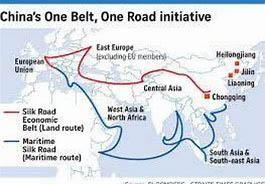
Guru speculated about China’s Belt and Road Initiative (in China more often referred to as One Belt One Road or OBOR). Very generally, Belt and Road is China’s plan to be the most powerful economic engine in history. This is not simply bravura but a scale of economic activity necessary to accommodate China’s very large population and its stressed economy. It is a huge goal costing more dollars than anyone can begin to estimate but at the same time creating economic opportunities for about 60 percent of the developed nations in the world today.

Guru noted two things:

  • OBOR sounds aggressive and immediately brings to mind an automated form of colonialism. In truth, to use a mariner metaphor, China needs more stoves to burn its wood. Think of a family with twenty children trying to establish a rotation of food, clothing and household goods without being overcome by storage and process – it is easier to send out for pizza than having to make it at home. Investment opportunities seem to abound both for China and nations on the OBOR. However, economists are less than enthusiastic about using geopolitical solutions to solve internal economic issues.
  • Today, at least until Donald was elected, there was no question that the western nations, especially the US, were at the center of global economics and political influence. Guru proffers that if OBOR is successful, the center of global economy will drift back to the centuries where Sino-Eurasian economy prevailed (The original Silk Road). Still, guru ponders whether nations on the sea route in particular will be susceptible to economic bondage.

Amos has had it with the US citizen. The harsh combination of identity politics, populism, incompetent, party-zealotist and opportunistic Congressmen, news programming required to make a profit, predator corporations, a horrific, selfish, hoodlum-like Whitehouse, and more, all virtually have eliminated the American ethos. Acknowledging activist interest, albeit it often a part of the list above, common citizens don’t care about ethos as long as they have their Facebook, smartphone, Echo, and Netflix. Putin is right – Americans have irretrievably trashed their respected role among nations. And the beat goes on . . .

Meanwhile, Chicken Little is fearful that he may be deported because his grandmother at age nine arrived in the US as an immigrant.

Mariner agrees with dissenters of Elizabeth Warren’s claim to be a Native American. Mariner’s Aunt Mary married a full-blooded Cherokee and had a son that looked more native than the man on the nickel. But that heritage was never used to differentiate their family. Elizabeth should be ashamed for practicing identity politics.

ELECTION DAY: TUESDAY, NOVEMBER 6. BE THERE AND DO IT – VOTE!

Ancient Mariner

Merger of CVS and Aetna

In what was a disturbing interview on PBS NewsHour between Judy Woodruff and Larry Merlo (CVS CEO), Judy pressed Merlo several times about how the merger will benefit individuals. Continually, Merlo ducked that specific question by advocating better procedures, better integration of services and a number of platitudes all of which reflect a larger corporate-driven control of market, profits by collusion and most disturbingly, the point Merlo ducked, was quality control of corporate costs by managing patients directly.

This is an article/video that is very important for the reader to read/watch. It speaks clearly to the control factor that large data clouds and massive records of daily life are being integrated for corporate benefit, not for personal benefit. Go to:

https://www.pbs.org/newshour/health/what-the-cvs-aetna-merger-could-mean-for-you

The reader may recall a recent post in which mariner mentioned John Hancock converting it policies to a program called “interactive policies” where insured will be screened and if selected, must participate in the interactive program.

John Hancock, one of the oldest and largest North American life insurers, will stop underwriting traditional life insurance and instead sell only interactive policies that track fitness and health data through wearable devices and smartphones, the company said on Wednesday.

 The move by the 156-year-old insurer, owned by Canada’s Manulife Financial, marks a major shift for the company, which unveiled its first interactive life insurance policy in 2015. It is now applying the model across all of it’s life coverage.

It works like this:

Policyholders score premium discounts for hitting exercise targets tracked on wearable devices such as a Fitbit or Apple Watch and get gift cards for retail stores and other perks by logging their workouts and healthy food purchases in an app. In theory, everybody wins, as policyholders are incentivized to adopt healthy habits and insurance companies collect more premiums and pay less in claims if customers live longer.

Privacy and consumer advocates have raised questions about whether insurers may eventually use data to select the most profitable customers, while hiking rates or not accepting those who do not participate.

Hancock says customers do not have to log their activities to get coverage even though their policies are packaged with the Vitality program. The insurer will begin converting existing life insurance policies to Vitality in 2019, it said.

As mariner understands it, your insurance company knows if you eat three strips of bacon instead of one or skip a morning run when Grandma visits and will have the right to raise your premium or even drop you for someone else who helps the company’s profit margin. As regular readers know, mariner is extremely sensitive to corporations telling him what to eat, know, or do with his life – especially if it is for the benefit of the corporation.

– – – –

To wax philosophically for a moment and promising not to be verbose, we are watching capitalism leverage a changing technological society for profit. The way to tell the difference between capitalism and other isms is that the wellbeing and advantage in other isms is driven by the individual or by government in the individual’s behalf – not using the individual foremost as a controlled instrument for profit. If there is no profit in an individual, buzz off. Who cares?

The beginning of this post mentioned the merger of CVS and Aetna. Leverage gained will be through combined databases about customers. Then, just like the book 1984, the customer will have to do what the corporation says to do – which cuts overhead and locks in pharmacy prices based on each individual’s profit value instead of what the market in general will bear.

And to top it off, one’s life is not managed by one’s own decisions.

More disturbingly, these corporate controls smell of Harari Yuval’s belief that in the future unwanted humans will not be cared for by society. Is the future now?

Ancient Mariner


Ballot Initiatives

Donald may go away at some point but he has done conservatives a big favor that will last a long, long time: McConnell and Donald now have confirmed 84 judges over the past two years, including two Supreme Court nominees. [Politico]

– – – –

Mariner has been looking at what and who are on the ballot in November. He noticed a larger than usual number of referendums AKA ballot initiatives; 38 states will sponsor 154 ballot initiatives. He took the initiative (sorry) to poke about the subject of voters legislating government policy directly. An article at www.Citylab.com talked about the common response from legislators:

“It took about 45,000 Washington, D.C., voters to pass a ballot initiative this June raising the minimum wage for tipped workers. It took only eight city council members out of 13 (and a ton of public pressure) to begin the process of repealing it only a few months later. This wasn’t a bug in democracy. In D.C., and many cities and states across the U.S., it’s part of democracy.”

Here’s a sampling of what legislation is on the ballot instead of by a vote in the legislature:

– Voters in Arkansas and North Carolina will decide whether to enact voter ID requirements.

– Florida, Maryland, Michigan and Nevada have measures that aim to make it easier for people to vote and register.

– Florida’s Amendment 4 would restore felons’ voting rights.

– Montana voters could make it a crime to collect and turn in ballots cast by others.

– In a few states, judges have struck down unconstitutional voter legislation. These states are using a referendum this time to incorporate the voting language into the state constitution to prevent further rejection by the court.

– Voters in Idaho, Montana, Nebraska and Utah will decide the fate of Medicaid expansion, a key issue in Obamacare.

– Voters in three states (Alabama, Oregon and West Virginia) could restrict or preemptively criminalize abortion.

– Massachusetts may join California to become only the second state in the country to limit the number of patients that hospital nurses can help at one time.

– Also in Massachusetts, voters could repeal a 2016 law that protects transgender people from discrimination in public spaces, including bathrooms.

– Oregon has the oldest sanctuary state law in the country. Voters will decide whether to keep the law or repeal it.

– California, like Florida did recently, wants to forego Daylight Savings Time. It is a ballot initiative this year. Florida actually passed the anti-DST initiative but apparently the US Congress must give it a blessing.

In Colorado and Oklahoma, there are tax initiatives to raise taxes to improve support of public education. Oklahoma is last in the nation in dollar support per student.[1]

– – – –

Two sources noted that legislators have become less willing to accept voter legislation even if it passed easily. As noted above, Washington DC legislators wasted no time in repealing the rise in minimum wage for tipped workers; the public pressure was from businesses that hire tipped workers.

Voters can cause serious issues. Older folks remember Howard Jarvis leading a property tax revolt in California in 1978 called Proposition 13. The voters were disgruntled by the tax rates as homes grew in value. The proposition changed the state constitution to limit property tax increases to 1% of value and requires future tax legislation of any kind to pass with a minimum of two-thirds of the legislature. Because the constitution was changed, it requires that same two-thirds to change it. The law was challenged in the Supreme Court in 1992 and was upheld.

This voter revolt changed California government forever. Before 1978, the California budget was adequate for the large size and industry of the State. In 1980, the first year Proposition 13 was invoked, State revenue dropped $40 billion.

On the other hand, legislators today have a bit more starch about voter interference. In the case of Washington DC, business lobbyists forced the hand of legislators to ignore a public wish to improve the quality of at least one sector of the working class.

Government is a difficult business – voters want one thing, business wants another and both the legislators and the voters can make prejudiced if not harmful mistakes.

If your ballot has a ballot initiative, read and think about its effect before voting day.

Ancient Mariner


[1] If the reader wants more information, see:

http://www.governing.com/topics/politics/gov-2018-ballot-measures-statewide.html

The United States Senate

Virtually everyone in the US agrees that things are not what they should be for the common citizen. First glance criticism points at inbred party politics; others are concerned about the shifting economy that takes growth and reward from working classes and feathers the nests of capitalistic oligarchs; others worry that the cash-rich special interests own Congress through donations, favors and intense lobbying.

All these issues are real and burdensome. But they are political in nature, that is, these issues affect the rituals of governance. There are larger issues that affect the doctrine of our nation, its Constitution, its court systems and the relationship between State governments and the Federal government. Some doctrinaire issues are:

֎The US Supreme Court is the only ‘appointed for life’ court among other nations with similar high courts. When times change slowly, as they did before the telegraph, telephone, television, and computerized decision making, perhaps life time appointments were satisfactory. Today, as everyone is aware, culture, science, technology and economics are changing at lightning speed. Given the constraints of knowing most about one’s own developmental years and less about current society as one grows older, is it relevant that lifetime, politically anointed appointments degrade the decision quality of the Supreme Court? Thinking differently, should judges be rotated?

֎Gerrymandering and a politically controlled census process seem to be just political at first glance but coupled with voter suppression not only at the polls but not allowing voting via modern techniques e.g., mail-in and email ballots, party or government manipulation of voter registration records and the idea of an Electoral College – together permit a virtual plutocracy to exist hidden beneath a plethora of manipulative laws and regulations. Mariner need only point out that he and his wife were not allowed to vote for their candidate in the last Presidential primary. One person, one vote has not existed for a century or more.

֎The United States Senate is an old fix to encourage the original States to go along with new Federal powers that impinged on the independence of states at the time. In fact, voters did not have a say in their Senator’s appointment until 1913 when the 17th amendment was ratified. Still, the representation stayed at two senators per State rather than integrating their election into a population-based representation. As a consequence, today, 12% of the US population elects 60% of the Senate. Ironically, the fewer citizens a State has, the more powerful is their voice in the Senate. Politically this means that farm states, low population states like Idaho, Montana and North Dakota – all typically conservative because of the lack of industrial cities and population density – are able to sway the Senate voting power in a way that does not genuinely represent the common US voter.

One wonders why the gun issue cannot be resolved – could it be the Senate with 60 % of the vote coming from rural and underpopulated states that do not have inner city gun murders on a daily basis, does not care so much? Mariner suspects hot issues like guns, prioritized education and comprehensive discretionary funding similar to welfare, health and career opportunity will remain unresolved because the Senate is intrinsically biased.

It was a man in West Virginia recently who said to a reporter that it was time the Senate was eliminated. Perhaps he is right.

Ancient Mariner

Quick Look Ats

֎According to a Bloomberg report last week, China used tiny microchips, placed on server motherboards, to infiltrate nearly 30 American companies including Amazon and Apple. But Amazon and Apple challenged the report and the Department of Homeland Security said it “had no reason to doubt” the companies’ statements. Bloomberg, whose article is based on 17 anonymous sources, is standing by the story. [Reuters]

**** This may or not have happened but it occurs to mariner that wars among the fifty largest nations may not use gunpowder or TNT in this century. Should the United States, which spends three times as much on military as any other nation, consider a serious revamp of the military to face an age of cyber warfare? More ominous, could there be war between the military and large international data corporations? Perhaps we should abandon social media to avoid being in that crossfire.

֎Burning down the house: Jeff Bezos is donating money to fund schools and homelessness initiatives. Mark Zuckerberg is giving 99 percent of his Facebook shares to charity. The wealthy get high praise for donating money to social causes, but how much can we expect these efforts to change systemic societal issues, especially when some of those very same business interests are taking steps that negate this philanthropy through lobbying and their own workplace policies?

In a new book, Winners Take All, Anand Giridharadas argues that this system of philanthropy reinforces the inequities that put billionaires on top. [Citylab]

**** This is an old complaint about philanthropists who are so wealthy that no matter how large a donation to good causes, it doesn’t affect the oligarchic life style to which they are accustomed. Meanwhile, any pressure on their business model is addressed instantly and is concerned only with the bottom line. The real bottom line, life and happiness for all, goes unaddressed. Such is the conflict between capitalism and socialism. Can the two be homogenized?

֎McKINSEY HIRES BRACEWELL ON BANKRUPTCY ISSUES: McKinsey & Company has hired Bracewell in response to a lobbying effort from Jay Alix, a businessman and founder of Alix Partners. Earlier this year, Alix hired Cornerstone Government Affairs, Cogent Strategies and Lakeview Capital Holdings to lobby on “protecting the integrity of the bankruptcy system.” It’s not clear what exactly Alix is doing, but McKinsey is fighting back. In July, Alix filed a motion to reopen a bankruptcy case involving Alpha Natural Resources, which McKinsey advised during its bankruptcy proceedings. Last week, The Wall Street Journal reported that McKinsey is fighting that request, “denying allegations that conflicts of interest and an undisclosed investment broke the law and tainted the outcome of the multibillion-dollar chapter 11 case.”

**** Mariner inserted this story to show the depth of lobbying and backdoor shenanigans that goes on behind the headlines. Thanks to Donald, we know bankruptcy proceedings can be a tool not only for salvaging something from a failed venture, but a way to hide super large profits and bank manipulations. Apparently Alix wants to strengthen the bankruptcy laws to eliminate abusive, big dollar gamesmanship. It reminds mariner of Donald’s experience with casinos: he pulled all the profits from the casinos not even leaving enough to pay bills. Then he filed bankruptcy obviously to dissuade regulators that there was any profit at all. He played this game three times: the Taj Mahal, Trump Castle Associates, and Trump Entertainment Resorts.

Mariner has the entertaining thought that global warming, which Donald denies, will soon put Mar a Lago under water. Oh well, he’ll game the situation somehow.

Speaking of Global warming, Tangier Island, a small, isolated island in the middle of the Chesapeake Bay is going under. Forty percent of the island already has disappeared. This is no small event in DelMarVa. Tangier Island is 12 miles from the nearest shores of the Bay. Consequently, this culturally pure location has retained much of the dialect of its original founders from England in the eighteenth century; it has retained the strict Victorian Christian beliefs from that era as well. Every family on the island is a fishing family by trade: rockfish, crabs, oysters, clams – all from the waters of the Chesapeake Bay.

More important to the Mid-Atlantic States is its place in the history of the Bay. It is a well-known location and is an endearment to the citizens of Delaware, Maryland and Virginia. To watch the video shown by PBS Newshour, see:

https://www.pbs.org/newshour/show/will-the-traditions-of-tiny-tangier-island-survive-or-sink

Ancient Mariner


Good Sources to Interpret Reality

Once in a while mariner is asked what his sources are – especially given he doesn’t watch CNN, FOX, MSNBC, HLN, NEWSY and Late Shows. There are a number of channels that try to be balanced and factual:

PBS – PBS intentionally has neutral news including BBC news broadcasts and no nonsense series like Christiane Amanpour. In addition, newsworthy topics often are explored more deeply. Additional series like Frontline provide in depth analysis of important issues.

CSPAN and CSPAN2 – A great advantage for CSPAN is its ability to cover live political events occurring in session and other political events that are headline worthy but not in governmental locations. Further, the on-line video library is enormous; one can search for significant subjects that may have fallen out of contemporary news cycles.

BITV – Bloomberg television – Clearly a business and investment channel. Compared to similar business channels, Bloomberg reports just the facts, Ma’am; pundits stay on the mark and explain issues clearly. Mariner appreciates the Saturday broadcast shift to arts, sciences and technology.

– – – –

Mariner depends heavily on websites of proven quality. He subscribes to several email newsletters from websites, magazines and newspapers that provide daily updates on both headline news and tangential activity that may not be ‘breaking news.’ Here are a few website email services:

www.fivethirtyeight.com – This website was started by Nate Silver, an odds maker of the first degree in sports betting. He branched into politics in a big way covering all election campaigns from early polling for primaries to the final minutes of election night and correctly called 98% of his picks in 2012. He wrote a book on probability mathematics which mariner has in his library: (“The Signal and the Noise, 2012, Penguin). His newsletter uses a related number as a headline for each entry.

www.atlantic.com has several email services focusing on news, photography, books, and commentary. Mariner considers the print Atlantic an excellent magazine. Emails often recommend cultural news related to headline news.

www.propublica.com – Similar to PBS, Propublica is supported by subscribers but reading access is unrestricted. This website pursues information more deeply than typical news journalists.

www.politico.com – A broad coverage of politics from headlines to who hired whom to/from lobby firms, law firms, international firms and who is leaving the Government to fill these positions.

www.citylab.com – A website that sees the world through the eyes of cities. A different level of news is covered, e.g., subways, issues with rent control, bicycle lanes, funding for inexpensive housing, etc.

www.newyorker.com – Generally in the print version, headline articles have more to do with politics and culture than with just New York. The same is true of the website and the email newsletter.

www.axios.com A newcomer to the news game. It is independent and prides itself on accuracy and fact checking; it covers all major subjects, e.g., politics, climate change, international issues, et al.

www.ted.com – TED is a nonpartisan nonprofit devoted to spreading ideas, usually in the form of short, powerful talks. Often, speakers provide insight into the real causes and results in contemporary culture.

www.cctv.com – Surprisingly, this China sponsored website has balanced world news. It is, of course, slanted toward China’s view of the news but it is a refreshing view on world news that isn’t available on American television.

– – – –

On radio, follow NPR programming. In its email service, a lead story is examined in detail. On the radio, honest broadcasts include its podcasts.

 www.wikipedia.com – For anything the reader may ever want to know in any context from Cybele to Prokopios Pavlopoulos, Wikipedia has documentation. In his early years, mariner grew up with a ‘Book of Knowledge’ encyclopedia. One of the few positive things about the Internet and its data storage is a dependable source for historical and intellectual information. It is user supported. Financially, Mariner supports this critical goldmine of information; he urges the reader to support Wikipedia as well.

– – – –

Mariner remembers reading a quip in some magazine that said, “It used to be that if a person knew things, they were educated and smart. Today, knowledge is so available as to suggest one no longer gets credit for knowing things; it’s a matter of how one applies the information.”

Ancient Mariner


Watch the European Union

The European Union (EU) is having a more intense disruption with populism, nationalism and a drift toward totalitarianism. We in North America – particularly the US – should pay attention to what’s happening across the pond because the causes of disruption are quite similar.

IMMIGRATION – Donald has heightened the reactions of his base by taking the side of racist politics and exacerbating border issues with his fence initiatives; along with Jeff Sessions (lest we forget Jeff took Strom Thurman’s place as the leader of racist policy in the Senate), has eliminated sympathy, empathy, fairness and every other human instinct from ICE, tearing families apart not only in the Southwest but across the country. Further, Donald is defunding several assistance programs for immigrants, for example, DACA and aid programs for newly arrived legal immigrants. This legislative turmoil is magnified in the EU by confrontation in 28 member nations.

Actually, US citizens statistically are not as upset about global migration as Donald and his followers are. The proportion of immigrants in the US is quite a bit less than the proportions in EU nations; as of 2015 immigrant population in the EU was 19.9 percent of total population (1 of every 5) while the US immigrant population is 14.3 percent (1 in 7). These numbers reflect all immigrants, not just the headline wave in the news. Unlike EU migrations from the Middle East and Africa, US migrations largely are from Central and South America and some from Asia.

Having made this case, it can be seen that Donald did not cause immigration woes; he is the result of a populist condition energized by several circumstances in the US having to do with economic imbalance, technology and cultural transition. Fortunately, the size and democratic philosophy of the US have not permitted totalitarian leaders as in Greece, Turkey and other small nations suffering from the same woes – though Donald wishes it were so.

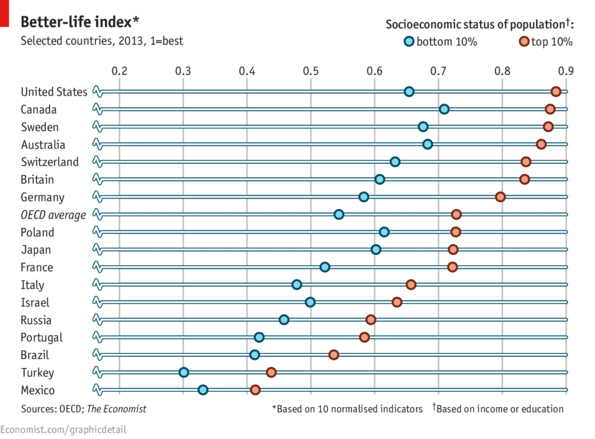
ECONOMY – The following chart from The Economist magazine shows a relative comparison between the US, EU and other nations for the quality of life for the poorest 10% and the wealthiest 10% in each nation. Note not only the relative quality between nations also note the US has the greatest spread between the poor and wealthy groups.


The US does have the widest spread between rich and poor. Further, with middle class income stagnant for forty years and still not climbing today with record profits among the wealthier, it is no surprise that there is a populist reaction in the US. As a philosophical note, the three countries with higher quality for the poor (Canada, Sweden and Australia) have constraints on capitalistic abuse: Sweden has a socialist economy, Canada has socialist policies and, as an entertaining note, Australia keeps capitalism in check with a robust news media!

TECHNOLOGY – While for the moment the US is the leader in several technologies, Europe is no slouch. In fact, the European population is 196,734,765 people larger than the US and is second only to the US in GDP – United States 19,390,600 and EU 17,308,862. The point is, although the US perception is that all countries including the EU are tiny in comparison to ourselves, the EU is a global competitor not only in commerce generally but a competitor in technology and in some ways a leader in responding to the emerging AI global market (witness an EU trade agreement only days ago with Japan, usurping US economic influence (thanks, Donald).

Just as with the United States, EU is struggling with the definition and role of jobs in the future. Although not as thoroughly capitalistic as the US, taxation and industrial strength both are up for reinterpretation in the near future; EU is suffering the emergence of AI as is the US but even more so because of multinational issues among EU member states. An example is the push back on privacy usurpers like Google et al – something the US has not begun to do at Federal levels.

 CULTURAL TRANSITION – Many decades ago, perhaps in the late 80’s, Oldsmobile introduced the world to the slogan, “This is not your father’s Oldsmobile.” No one denied it was a different vehicle with newer technology but many opined that the older versions had more power and comfort. Since then the phrase has become an icon for claiming significant changes in familiar objects and circumstances. We can safely say today a variation: “This is not your twentieth century!”

The millennial generation was the pivot generation to new behavioral forces that today continue to erode our 20th century religion, job security, Federal conservatism (AKA Establishment) and class/race relations. Each generation has put more pressure on social change that is long overdue.

Mariner burns leaves in the fall. The approaching age of artificial intelligence, perhaps only one more generation into the future, has an effect on culture change that pouring gasoline has on a leaf pile.

Perhaps by watching the European Union wander into this vortex, we may have a few weeks lead on what will happen on this side of the pond.

Ancient Mariner


Belonging is a Feeling

There has been an upward tick in visits during the last two posts that dealt with the difference between nationalism and shared personal feeling. It appears that most of us are self-evaluated based on self-adopted, doctrinaire rules that are supposed to yield a successful life. By their nature, these rules of life are self-oriented and place each of us in an isolated role where our own achievement is the measure of our social worth (those without jobs are unworthy; I have a job therefore I am worthy).

This strategy for defining meaningfulness for ourselves becomes aggravated in times of rapid, significant change in society. It seems that our assumed measures of self-value don’t work as well; especially when we see success in other parts of our society. This is the insecure energy that feeds populism and identity politics. We blame our social structures for not accepting what we thought were ‘inalienable’ rights and values. There are real conditions that feed the flame of insecurity; for example, living longer than our generational culture, a drop in financial security, changes in religious culture, and artificial constraints to personal dignity brought on by racism and class stratification.

We forget that we belong. We are charter members of our civic population. We belong despite the fact that we are conservative, liberal, greedy, selfless, ill, jobless, persons of different classes, cultures and races, green card citizens, or immigrants. We belong to a civic organization, from township to nation, which provides a philosophy of life that values every resident as equal. In some civic organizations, belonging may require the experience of commonly applied severe and brutal abuse as in Syria or Venezuela. The United States philosophy, however, stated in our Declaration of Independence and iterated in our Constitution, requires a working democracy where every vote counts and thereby provides life, liberty and the pursuit of happiness for everyone. As the reader may know, life ain’t perfect.

Having a feeling of belonging introduces a feeling of equality which is important to each individual. Despite the inequalities of society and opportunity, one can always say “I am an American citizen – no less important than any other citizen.” Belonging to an idea rather than an artificial doctrine is what Bono’s message is all about.

Mariner, long an advocate of practiced empathy, sees a link between civic-mindedness and empathy. Civic-mindedness acknowledges an equal basic value for every citizen; every citizen is a member of the greater idea – which generates a feeling of belonging even under different individual circumstances.

When a citizen quits belonging and instead identifies with an adopted value system – as the Congress of the United States has – the feeling of citizenship and belonging to the US suffers. Suffered enough, citizens form counter values and adopt populism as a remedy. As the mariner is doing in an effort to find his garden among the weeds, the reader, too, should rummage about looking for the feeling that you belong to your country along with everyone else – despite your personal evaluations.

Ancient Mariner