Too Smart

As a creature on this planet, we weren’t supposed to be super smart. We were supposed to be the smartest primate, perhaps, but not super smart. We’ve always known it was a mistake. To be honest, as a primate, humans aren’t developed enough intellectually to mess with their biosphere. The Jewish Bible has a story about it; it is carried forward from an older version from ancient Babylon. God built his earthly garden and all that was in it obeyed God without question.

God created two last primates, a man and a woman, who were his pride and joy. In the story, a snake represents improper behavior (If we modernize the myth, the snake represents unexpected genes). The snake encourages the woman to eat a fruit she is not supposed to eat. It is the fruit of the tree of knowledge and awareness of good and evil, that is, ethics and morality on the one hand and disingenuous and immoral behavior on the other. Being aware of intellectual judgment, suddenly the two primates become super smart; they know things only God should know. God’s earthly garden is about to be trashed. Passing centuries have exposed the truth: this primate can’t handle super smartness. Super smartness must coexist with super sensitivity to orderliness – one of four words used to describe God’s presence (love, truth, beauty and order) and required to sustain God’s garden. Had the man and woman also eaten of the tree of Eternal Life in the garden, maybe human history would have been better off.

Physiologically, there is no difference between the human primate and other primates. Habitat is identical consisting of vegetation, insects and meat and similar landscape and weather. Humans behave no differently than other primates except they are a little less demonstrative than chimpanzees and more like silverbacks and gibbons. As a rough comparison, adult simian (ape branch of primate evolution) primates behave like adult humans but demonstrate the comprehension of a five-year old human.

But humans have awareness; we have judgment; we have choice; we can choose disorder.

At first, humans didn’t disturb the biosphere. About 12,000 years ago humans began tinkering with their habitat: seed casting was discovered to increase preferred vegetation; domesticating animals already was part of migrating lifestyles; weapons and tools were made of stone, antler and other natural resources. The first disturbance of the natural environment occurred when humans combined tin with copper to make bronze, then soon after discovered iron and carbon combined make steel. By 7000 BC it was de rigeuer and moral for this super smart primate to use the surface of the Earth willy-nilly for human activities. We have refined this behavior, of course, so that today it is moral to have open tin mines that cover several miles in diameter. Profit making activities like a combined energy zone in Alaska seems perfectly moral to entrepreneurs. The energy zone will cover hundreds of miles and literally destroy several major species of animals by poisoning or destroying habitat.

By human standards, this is acceptable but is it orderly? Are we disregarding the fact that this is God’s garden not ours? Which comes first, God’s intentions[1] or that of a super smart primate who cannot respect the intrinsic requirements for a garden of love, truth, beauty and order? The traditional choice between God and mammon is avoided by the super smart primate; apparently we cannot control our desire for disorder. Perhaps we should not be so smart.

Examples of human disorder abound and will not be listed here. The point is that humans have pretty much destroyed order across the planet. Nowhere, absolutely nowhere the super smart primate has gone, has touched, has tinkered with, remains orderly and functioning properly within this biosphere. But there are signs our disorderliness will not be tolerated much longer in Earth time. The super smart primate emerged six million years ago and by all measures has around 10 thousand years left before the garden will oust all primates. It could have lasted longer in an orderly garden.

Ancient Mariner

[1] Interpret laws belonging to the universe rather than to humans in any theological model that is comfortable. Mariner uses the Judeo-Christian model because it is familiar and practiced widely.
The Path to World Peace

This post qualifies as something for the musing category but if the world’s circumstances happened to shift in a different direction, this musing could well be a literal event in the future of human beings.

For the last 40 years, technology, computers, robots, escaping into space, growing variations of totalitarianism, stratified economies, all have controlled the center lanes of our attention – of the way H. sapiens may gain control of the runaway culture that has slowly emerged over millennia.

Reading about recent mosquito diseases and how the most promising solutions come from changing mosquito DNA set the mariner thinking that genetics is the best source to find an effective solution for many of the dilemmas mankind faces. Society is busy trying to retrofit technology to help with these dilemmas when, in fact, paying more attention to genetics may be the better option.

This will be perceived as radical, of course. Let’s learn a bit about how genetics has been an active player in our lives since primates came into existence.

Most of us know that our genome, the map that creates each individual human when they are conceived, controls every thought, motion, reflex, emotion, and appearance, all of our physiology as a creature on this Earth. Even our beliefs, whether we are democrat or republican, a psychopath or a romantic pacifist – all can be blamed on our genome, our DNA.

As the works of Charles Darwin enlightened us 150 years ago, the genome has a partner: evolution. Evolution is the teamwork of finding the best way to survive within a given environment. Readers have hundreds of ready examples: some brown bears became polar bears; some weasels became seals; some notably short people were ancestors of Shaquille O’Neill (7’1”, 305 lbs) but his mom Lucile was 6’ tall at the age of 12. More directly, human ancestors climbed out of trees to walk because the Serengeti suffered an endless drought so long that what used to be forest became grassland with trees few and far between. It became easier to walk from tree to tree. Moving from tree to tree as safely as possible became important to survival so more walking predecessors survived to breed than four-footed predecessors. Did you know during those early times our ancestors could walk and jog all day without stopping while requiring fewer calories than a continental breakfast?

If you are interested in delving further into the details of genetics, visit a good library or the Wikipedia. Now that we’ve had a 5-cent tour about genetics and evolution, here’s the insight:

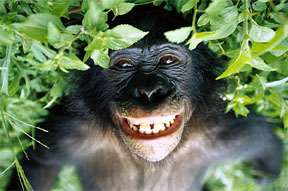
Bonobos. Yes, Bonobos. Zillions of years ago, long before the drought on the Serengeti, There was no Congo River coursing through the middle of the African continent. Dozens of ape species lived across the continent. Some were large, like the Silverback and Mighty Joe Young; some were small like chimpanzees and Bonobos. Eventually, the simians had to compete for food and, as individuals, began to become territorial and even a bit nasty – growing large fangs for fighting one another. The meanest, toughest male became the leader of the local troop.

The dry years dragged on eliminating many ape species. Only one species survived in the southern plains: Bonobos. Eventually the rain came. It was a lot of rain and formed the Congo River. All the large apes lived above the Congo and the smaller species still had to compete with the large ones. Fighting for food and territory had been bred into the northern species via the evolution partnership with DNA.

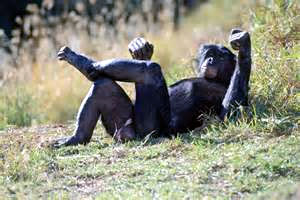
South of the Congo, Bonobos had it pretty easy. Food was plentiful. As it turns out, Bonobos do not have brash egos, territorial attitudes or gang fights. In fact, they don’t fight at all. Bonobos are quiet, even shy. Interestingly, Bonobos have matriarchal troops; the females are political but not inclined to fight. Authority and troop allegiance is maintained by continuous touching, nurturing and protecting. Sharing inadequate food and territory is a non-issue. Consequently, Bonobos have no inbred need to fight; Bonobos have no belligerent personality profile; bonobos have no masculine need to use violence as an expression of sexuality like most other mammals.

So the path to peace is not Roman domination; it is not automation; it is not greed, prejudice, avarice or the other Ten Commandments. These disruptive attitudes can be traced back to the North African apes. No wonder religion is so testy. No wonder corporations are territorial to a fault and lack empathy. Territory, however, is another issue in 2017 – 7,000,000,000 living on a space designed for 1,000,000,000 at most – and projected to be 12,000,000,000 by 2200.

Nevertheless, reproduction can be controlled by the genome as well as belligerence.

The path to peace lies in planned change to the human genome. Find out what genes in us are missing from the Bonobos genome then remove them from the human genes. In a compassionate manner, begin reengineering our genomes to lack belligerence. Pretend we are mosquitoes that carry bad genes and fix them.

Afterward

Immediately, pro-aggression types leap forward to claim without aggression, belligerence and domination, humans would not have made scientific progress, etc. The question is does Mr. Bonobo above need a computer?[1] That is a cop out; progress and lack of belligerence are cohabitant.

World peace is at hand.

Ancient Mariner

[1] Do not stop here. We must know more about the Bonobos. They are an endangered species living only in The Democratic Republic of the Congo. They are reduced in number daily by hunting and logging of their habitat. Please read on at http://www.bonobo.org/bonobos/what-is-a-bonobo/

Totalitarianism is Here.

In the book 1984 written by George Orwell in 1949, the evil element is totalitarianism. Orwell was afraid of the suppression of individual thought and individual expression – both empirically and emotionally. His fear came from communist movements in Spain and Russia which were using communistic (totalitarian) practices to control citizens. Orwell was afraid communism would cross the Atlantic and overwhelm democracy and capitalism. Some older readers may remember in the movie version the large screens that educated all citizens with the same information and may have noticed that everyone was wearing identical outfits.

George had the right insight about totalitarianism but the latent oppression would not come from political forces, it would come from computers.

The mariner devised a new measure of eras called a World Bounce. The World Bounce lasts about 120 years more or less. He determined this length of time based on a quick survey of large changes in global culture. (See the post, “Whither We Go,” published recently.) Using the zooming capability of 120-year chunks, we can envision some degree of context about the World’s life and times. It seems increasingly that a lot is changing or preparing to change in the culture of the world’s population. Without going into a litany, global warming, and global extinction of species, changing weather patterns, international economic imbalance, and specifically, artificial intelligence – all are forcing the hand of our political structures, our economics, and what the experience of a lifetime feels like. We are about to bounce.

The least examined force of change by the person on the street is the impact of artificial intelligence. It spawns totalitarianism. Not with evil intent, mind you, but inadvertently; the large screens of Orwell’s book are identical to what is called “Big Data”. Within a decade or two – thanks to Google, Microsoft and other data snoopers, massive databases will know all about each of us. A working term being sold right now primarily to businesses is “The Cloud.” Clouds are extremely large amounts of data accessible by an endless number of processors.

Add to this endless data computers that know how to scan, sort, merge, match, equate, and deduce Big Data; it is the same as you performing a search on Google except we don’t need you anymore. “Google” will do its own search, thank you.

One of the first functional examples of this new artificial intelligence is a program called ALICE which you load into your own computer. It has a ‘person’ who talks to you in normal conversational style. You may have seen Alex Baldwin order a new pair of socks without touching anything – just saying, “Get me a new pair of socks.” The computer responds nicely saying it will do so right away. Without input from Alex about what the socks will look like, their quality or size, ALICE already knows by searching a database with previous purchases of socks made by Alex likely collected from a credit card database.

Another ubiquitous example: ALICE, buy me a car. Again, Alice already knows your income level, credit card score, neighborhood and geographic region, the size of your family, the value of your home, the types of driving you do, what kind of gasoline you buy, what kind of car you own now and resale value. It knows this because certain companies are in the business of building as complete a profile as possible about everything and everyone. They sell access to Big Data so that sellers and buyers can do business together automatically using only computers matching requests to solutions.

Did a few of you notice how, suddenly, a few years ago it seemed that  virtually everyone bought SUVs? Car manufacturers did a marketing blitz. Now, all a car manufacturer will need do is buy an algorithm in Big Data which will steer your computer to their product given that your profile matches. If you are interested in making a choice yourself, your computer will offer only choices that fit your economic profile; you won’t be able to find that luxury car no matter how hard you search. This is an example of totalitarianism; eventually everyone will be subject to one choice.

George was fearful of this unintended effect: In the mariner’s home town for example, it appears everyone is driving the same model car, wearing the same style and manufacturer’s clothing (which by the way will carry in its fabric how long you’ve owned it) and oddly, how everyone wears the same socks. Even aware of the totalitarian effect, people still would appreciate the convenience. It’s identical today when a viewer ties themselves to Netflix or other entertainment packages: the odds are you simply will use the offerings available to you through Netflix. Note the other effect: No subscriber can see offerings that Netflix doesn’t want to carry.

Now shift this pattern of retail compliance to the morals, thoughts, philosophies and behaviors that make up your religion, political party, candidate choices for public office, individual creativity, whether you can find a different kind of job, etc. Already dating firms select candidates to be your spouse; right now you can just say, ALICE, get me a spouse….. Shades of Stepford Wives!

In following posts the mariner will address other changes likely in the coming World Bounce.

Ancient Mariner

The Role of Myth

Seems folks are knocking myth around lately. Not so much using the word myth necessarily though some do. It’s more an evacuation of confidence on what the role of myth is and ignoring the fact that myth is a major pier in the lives of culture, religion, business and even an individual life.

Mariner has written often that religions around the world which emerged between 7000 BC and 800 AD (virtually all of them) adopted pseudo-historical principles to guide H. sapiens’ accountability to be human. A raccoon doesn’t need to learn how to behave like a good raccoon; it has no choice. Humans need instructions and acquired them by observing the effects of human behavior and the ecosystem over many thousands of years.

It was noticed that some parts of behavior were constructive, some destructive and some were beyond human influence.  Written language, when it existed, was not sophisticated enough to document esoteric, largely emotional and quizzical experiences. The best conveyance to describe these observations and solidify them as rules to live by was to tell stories – stories with melodrama and stark cause and effect just like today’s television. These stories were cultural treasures used as myths by which to live rather than instantly satisfying the same momentary emotional need we have today – without having to learn the substance behind the TV show like our ancestors did listening to their spiritual and cultural leaders.
When writing finally caught up, these stories were written down and codified. There was no reason to doubt them; it was just a more efficient way to replicate and distribute them. The power of written language enabled specialists in these stories to become political and even dictatorial. The specialists are called gods, kings, popes, imams and priests among many other glorifications.

Meanwhile, over the same millennia, culture broadened into specialties like commerce, tribal authority, standing armies, wealth, and other distortions which seemed always to evolve from mythic stories of bad human behavior. Mixed in were these powerful myths about how humans best should live; cultures set these myths aside as a reference rather than as a guide. The ‘reference’ came to be called religion.
Most of the time from about 300 AD to the present has been a continuous conflict between religion and each of the other cultural specialties, even between religious groups. Step on the sidelines for a moment to consider what exists today:
Global corporatism has its own guide focused on optimized profit which pays little heed to other cultural accountabilities; global nationalism has its own guide focused on tribal independence and authority which pays little heed to actual living conditions and ethnic equality; militarism has its own guide focused on domination which pays little heed to the value of life; economy has its own guide focused on greed which pays little heed to equality and fairness; religion has its own guide focused on superior authority which pays little heed to the mythic virtues ordained by their distant ancestors.

Back on theme, the specialties of culture are supposed to change as situations change to maintain their role in culture. Even religion for the most part, as its own cultural specialty, changes along with the other specialties. The sum of each specialty’s behavior equals the sum of the entire culture. How does one sort out the role of myth?

A myth is something one believes in as an absolute value unaffected by any other knowledge, rule, or condition. Mariner has a story he tells frequently about the woman who, when roasting a ham always cut a sizable piece off the ham before roasting it. Her young daughter was watching one day and asked, “Why do you always cut off a piece of the ham?” “Oh, I don’t know,” the mother said, “It’s how your Grandma always does it.”
On a later occasion, both of them visited Grandma. “Grandma,” said the little girl, “Why do you always cut off a piece of ham when you roast it?” Grandma replied “The pot’s too small.”
Myths shattered while you wait…

This cute story about a clean and simple myth held by the mother is useful for realizing how myths evolve over a long period of time (many modern religious stories took thousands of years to become mythic). It also is useful to highlight how dreaded scientific fact can raise havoc with a myth’s standing. Once new information reveals a fact that is subject to interpretation, the myth possibly may lose significant value.

Myths are not habits. Myths are representations of deep rooted values that guide one’s existence. A myth answers questions so ethereal that it is impossible to know self-worth without it. Why do we exist? The dominant reason in most religions is that we are here to make our reality better; we are here to make it better through intense commitment and respect for all living things. At some point, emotion becomes a bridge through art, service, and compliance. If an individual relates to the myth strongly enough, the individual is said to have faith.

Myths can be self-assumed. In the movie Fences, Actor Denzel Washington plays a poor African American (Troy) who had a severely damaged childhood. He finally leaves his abusive home at fourteen, later committing a murder and doing prison time. Upon release, Troy determines to have a ‘normal’ life and live successfully. Being damaged by his early experiences, he adopts an emotionally deficient belief that with a few rules focused on simple, superficial obligations he will be normal: always be employed, always keep food on the table and always provide cash to his wife and a roof over the family. This is an intense myth with no room for emotional reasoning. It is a myth of his own creation: it can never change, no new experience will ever change it, and if he violates it, he will turn into an absolute failure unacceptable to himself. The myth is the best he can muster to maintain personal worth.

Shoring up belief in self makes it a myth. Absolute belief makes it a myth. Troy’s unflinching adherence makes it a myth. Withstanding reality makes it a myth.

What can be learned through the mother and Troy is that the vehicle through which the mythic value is conveyed, be it a pot and a ham, or a series of acts in life, the myth need not be scientifically provable. Myths are the seeds of faith that deliver us from being a raccoon. Being a creature sensitive to esoteric values and the ability to have extensive communication and affiliation with others requires humans to know “what is the right thing to do.”

The short version of this post is to establish a set of myths that give direction to the big questions in one’s life: Why is – birth, death, love, companionship, responsibility to others including the Earth’s habitat for life itself. What does it all mean? How does one live in compliance?

Start your search with the myths behind religious parts of culture but don’t be afraid to construct your own. Mariner senses, for example, that the Marine Memorial raising the flag over Iwo Jima and the story of sacrifice in that battle has been accruing mythic value representing loyalty and commitment to the USA.

The mariner always has felt that science does an injustice to mythology when it weakens the scientific reality but does not pay homage to the true reality supported by the myth.

Ancient Mariner

Whither We Go?

Welcome to 2017. As we roll into our new year, the entire world is beginning a new bounce. Politics is part of the bounce but looks more like blowing trash; economy is part of the bounce but looks more like a vacuum cleaner; environment is part of the bounce but looks more like a starving dog; technology is part of the bounce but looks more like an algae bloom sucking all the oxygen out of a pond; human management is part of the bounce but looks more like Times Square on New Year’s Eve and the attendees have no home to which to return.

American party politics looks like it did in 1890: What are democrats? What is democracy? Aristocracy, oligarchy and authoritarianism are America’s choices as we ride the current bounce to its end. Donald has emulated Ronald by appointing a Cabinet with harsh ideologues who are philosophically opposed to the existence of their own Departments. Do not look for egalitarianism any time soon – like maybe a generation or more if ever again.

International politics are more frightening. The European Union was wobbling under a unification intended to be a transition to a more solid cultural and economic relationship. But the EU was shot down like a flight over Lockerbie by massive immigration from Northern Africa and everywhere in the Middle East. A slowly growing effort by EU to strengthen the economies of Moldovia, Romania and Albania among others were trampled to nothing by the immigration.

China’s solution to inadequate food and a seacoast of threatening internationalism is to take over and own the whole geographic area – not very different from the relationship between the US and the Caribbean and Gulf islands if the US decided to make them part of the United States of America. It’s bad enough pirate-minded billionaires are stealing these wonderful islands and their economies – and kicking unique cultures into the sea. The mariner has sailed most of these islands; it is a tearful thing to watch.

To his fellow citizens, mariner apologizes to say that the top ten socialist democracies are in better shape to ride the world bounce than the top ten capitalist or authoritarian nations. Unlike capitalist and authoritarian nations, socialist nations pay for health, education, and enforce financial and social equality. As the world bounce continues, work for greater profit and the indifference of socially controlling corporatism will run out of playing field. Mariner never wanted his sports arena named after a corporation anyway. (Apologies for the flood of metaphors)

Regarding the global economy, this is how it works: If you own something, I’ll give you a faster depreciating something if you let me be a partner with you in your longer lasting personal worth; if you have wealth, partner with me to maximize our joint wealth; if you are in a position to help me increase my wealth faster than yours, I will give you money. This economy underwrites aristocracy, plutocracy and oligarchy and undermines democracy and favorable treatments of the environment and human management.

There has been a recent spate of technologies, shifts in economic opportunity and, importantly, even some political decency toward environmentally friendly intentions. The appropriate response to these intentions is “show me the money; show me the real change.” Still, the oil industry’s next frontier is destruction of Canada’s Great Northern Wilderness where oil drilling will expand 300 percent in the next few years; the pure, clean rivers are becoming toxic just like the salmon breeding grounds in Northern Alaska and Canada near the Arctic Circle. And Donald is opposed to wind power because windmills are unattractive – mariner suspects he never visited a coal burning power plant or sailed down the Mississippi River past endless fuel fabricating factories.

As the world writes off 600 mammalian species because of habitat abuse and the oceans increase acidity in ocean water to the point that uncounted hundreds of species disappear every year and climate change will likely swamp major edifices of humanity like London, Manhattan, Hong Cong, Miami, and Rio de Janeiro, a starving dog is about the norm as an icon for the planet to survive the bounce.

Human management is the issue that no one wants to manage. Talk about overhead! We’re talking about our own species – talk about troublesome! It’s a lot easier to manage money, brutalize nature and fight wars.

What does mariner mean by a bounce? He mentioned “part of the bounce.” A world bounce is 120 years long, give or take a few years. For example, it is clear that momentous things are about to happen; 120 years ago was around 1900. That’s when a lot of stuff was invented that launched the bounce that’s ending now; a belated part of the current bounce was the invention of the transistor in 1948 by German scientists – the beginning of the Technical Age. 120 years before 1900 was 1780. The start of the industrial age is pegged to 1790; the USA popped up on the world scene about then (1776-78) which clearly contributed to a new bounce and 120 years before that was 1660 – a significant event reflecting on Christianity in America: Jun 1 1660 Mary Dyer is hanged for defying a law banning Quakers from the Massachusetts Bay Colony. The Christian commandment to love everyone clearly has survived until today’s bounce; Jamestown Virginia was established; England returned to being a monarchy with the return of Charles II; Thirty Years War began between Protestants and Roman Catholics. Galileo made science news observing the moons of Jupiter. And so on.

So what changes can we anticipate in the next bounce? It appears to be starting in good form for a bounce: lots of commotion, misunderstood decisions, growing populism, growing wealth of the few, failing international associations, inadequate statesmanship all over, new and old religious beliefs filling cultural voids, etc.

In other words, the world’s peoples will know why change is not wanted. It’s the same as changing a baby’s diapers – a real mess. So this is our mission in 2017: Get rid of junk in your life, streamline your circumstances similar to preparing for a tornado, have your financial future secured as much as possible, get a valium prescription, and then don’t forget to have a good time!

REFERENCE SECTION

Some Notable Quotes.

“The ballot box in itself is not enough to render a system a ‘democracy.’ A true democracy needs separation of powers, rule of law, freedom of speech, women’s rights, LGBT rights, free and diverse media and independent academia. Without all these institutions and values you can only have ‘majoritarianism.’ And majoritarianism is not the same thing as democracy.”

–       Turkish novelist Elif Shafak

“Companies like Google profit enormously from data mining of your personal searches, behavior and habits,” he said. “There is more money in selling that data than in selling a product. It’s surveillance capitalism. It really is a new kind of totalitarianism.”

–       Writer and director Oliver Stone

In the 2015 WorldPost Year-End Roundup, we observed that we were then “on the cusp of a tipping point” in the race between a world coming together and one falling apart. In 2016, we have indeed tipped over into a new era.

The profound upheavals of this year were anticipated in an essay we published in March titled “Why the World Is Falling Apart.” In that piece I wrote, “The fearful and fearsome reaction against growing inequality, social dislocation and loss of identity in the midst of vast wealth creation, unprecedented mobility and ubiquitous connectivity, is a mutiny, really, against globalization so audacious and technological change so rapid that it can barely be absorbed by our incremental nature….The determination to “take back control” across the Western democracies among those dispossessed by change was explosively expressed in 2016 in a widespread revolt against the elite custodians of the status quo through Brexit, the Trump victory and the ongoing anti-establishment insurgency in Europe.

–       Editor-in-chief, WorldPost, Nathan Gardels

Ancient Mariner

It’s all about Washing too many Clothes.

During 2016, the year of politics, the main concern of American citizens often was laced with words like freedom, fairness, loyalty, ethic, social justice, virtue, ethos, and other words that focus on how Americans treat one another and the spirit that binds them or separates them as fellow US citizens. It seems, as a closely experienced moment in history, not to have been orderly. The American psyche behaves as though it were in a clothes washer. As a people, we are tossed about by economic unfairness; we are tossed about by clashes in philosophy of government; we are tossed about by a blatant intrusion of technology without time for adaptation and understanding; we are threatened by the loss of our planet.

But in a quick glance, we see only the tip of the iceberg. When we studied history in school, we were able to identify different periods of history tied to wars or inventions or shifts in culture. For example, The Enlightenment, or The Protestant Reformation, or The Elizabethan era, or The Boer Wars, or The Nuclear age. What is our era? What can we call the years from the end of the Viet Nam war (April 30, 1975) to 2016? Perhaps there are subdivisions: The Reagan Government; The Millennial Years; Beginning of the Electronic Age; The Middle East Wars; The Emerging age of Corporatism. Mariner suggests these time periods are too short. Are there more influential years that we may not think of at the moment?

Maybe the sixth Great Extinction suggested by Elizabeth Kolbert; maybe the newly named Anthropocene Epoch (Human use of fossil fuel since 1850 literally has changed the chemistry of the planet); maybe “The Age of Sinking Megacities.” Mariner does not suggest these titles to be cynical. They are too real and quite too serious to be castigations. It’s just so hard to focus. So many wonderful things about modernity are pushed aside because we have the froth of the clothes washer in our eyes.

Ancient Mariner

A Necessary Gift

Tonight was a rare and pleasant evening. Classical style Christmas music was playing; the house was decorated. The wife was reading a book and a magazine; the mariner, frankly, was dozing. And outside bitter temperatures and blowing snow kept us where we were. We made a cherry pie and watched a couple of television shows.

Has the reader had many evenings of this type? It’s difficult to set the mood as passively as we were blessed.

The fact of the matter is that our American culture has stepped faster a few paces with information available from computers, electronic games, Skype, smart phones, email, retail marketing online, texting, and as if there were time to fill, social media. Even against the onslaught of data and electronic socializing, the roads are too slick to permit much traffic so shopping is thin this evening. Stay at home and warm the keyboard . . .

What was rare this evening was the direct link to ourselves without being conscious of a responsibility or compulsion to draw us to a social function or task requiring an electronic partner. Go back a couple of generations and we likely will not visit grandma in Florida because there are no interstates. Go back another couple generations; we’ll be harnessing the carriage to see grandma six miles down the road.

Then within fifteen years – the time a child attends secondary school – from horse, carriage and plow to automobile, to airplane, from carriage to trains on rail and steamboats at sea. And movies.

The pleasant evening leads the mariner to a pondering: Any of us can go to our own collection of books, or to a library, or wherever, and pull out dozens and dozens of books by philosophers, theologians, psychiatrists, etc. that firmly advocate what Joseph Campbell called a blissful spot. It’s a place that belongs only to you. Though not intended specifically, the wife and mariner had a blissful experience. It was a nice experience; it may even be called therapeutic, giving us a shot of grace and fortitude to reenter our challenging environment next time.

There is a great deal of commotion, challenge, Frenzy, and diversion in our lives every single day. In the opportune moment of this holiday season, gift yourself with an hour or two all your own to remember who you are, why you are and to restore the battery of fortitude.

Merry Christmas.

Ancient Mariner

Naomi

The mariner was eleven years old. His mother had recently passed; when she did, his father went into the Methodist ministry. Mariner was not familiar with church ritual, social practices or having the stature of a preacher’s son. Just attending church was a new requisite that interfered mightily with his own social practices.

But this post is about Naomi. Father’s first appointment was a small church in a small neighborhood between a Baltimore City dump, a glass factory, a foul smelling backwater of the Baltimore harbor, a small public park, and project housing. Railroad tracks were countless, cutting through the village (be nice) at many places. The village was isolated enough that it had its own grocery stores, drug stores, cleaners, ice cream parlor, bank, movie house, Methodist church, a one-engine fire hall and a 100-book public library. Oh, and three bars, a covey of resident prostitutes, as much heroin as anyone would want, and a club of revolving visitors to the State’s prisons. The mariner grew up in the village and has close friends from there today.

A person emblazoned in his memory forever is Naomi. Naomi probably was an immigrant from Germany in her childhood but now was in her early sixties. One time, Father took the mariner to her home for Sunday dinner. The meal was veal, sauerkraut and odd tasting potatoes. Naomi had a German air about her but spoke the village dialect just fine. Naomi was a physically large woman and firmly packed, with a noticeable double chin. Her voice went with her stature: firm and virtually in imperative sentences.

Naomi was the main piston in the church. She easily could be picked out as the CEO. Naomi was in the choir, about four strong, and was, of course, the lead soprano. Well readers, this is the key memory for the mariner:

When the congregation sang a hymn or the choir sang special music, Naomi took off with notable volume and roaring. Sorry to be rude but the mariner tries to be honest. The higher note required a higher volume. It was not a musical sound nor had a tone of enrichment. I suggest “took off” as appropriate phrasing:

Think about being on deck on an aircraft carrier when fighter jets are screaming off the runway. Think about the mariner’s eleven year old virgin ears the first time he heard Naomi. It is true that mariner had a shock response at first sound.

Mariner has taken liberty. Still, we all have our idiosyncrasies. The village was a better place because of Naomi. A tour de force for sure.

Ancient Mariner


About the Presumption about Shapes and Genomes

Thoughts about the last post, A Presumption – Is it true or False? which assumed that a preference for a given shape is stored in the genome, are far ranging. Many arguments don’t address the genome-memory presumption; rather the responses provide evidence that would allow the presumption to be true or false.

Mariner lists different ideas submitted by readers, responding to cogent arguments. Many responses from readers were edited for length. The mariner’s response is in italics.

  • About the Presumption about Shapes and Genomes. This is more evidence that aliens visited Earth in prehistoric times.May or may not be relevant; did visiting aliens morph our genomes to prefer certain shapes or sizes?
  • Primitive cultures did not need the sky to explain their theology; they worshiped what they saw in nature. One might ask why low round shapes dominated religious edifices in a region that has several large mountain ranges with Mount Ararat topping out at 17,000 feet. Did the genome prefer round shapes?
  • It wasn’t until the Iron Age that humans had the materials to build upward. A good assumption in its own right – linking religious shapes to emerging paleontological skills. What decided what the shape would be – a genome or a committee?
  • The American Indian worshipped Mother Earth, a view of which was limited to the horizon – a circular view that influenced them in their religion. A good metaphor. Circles are everywhere in American Indian culture. Did the Indian genome prefer circles?
  • The genome drives everything. In birds especially, instinct predetermines nest shapes, height and building materials; plumage is an ingrained judgment to make decisions about mating, etc. Free will is not as prevalent as humans would like to think. I vote for the genome. A strong argument. The mariner considered birds as well. Do birds have a religious culture – the other side of the presumption?

The presumption is much ado about little. The human brain is a montage of experience, genetic instruction and external reality as humans interpret it. Completing the puzzle or not won’t change anything or mean anything. It’s just a puzzle.

Still, by following one’s thoughts, there are many side streets that help the brain stay supple and alert. For example, there is an old pop-psych quiz about preferred shapes: One is asked which of four shapes is most appealing – a circle, a square, a triangle or a squiggly line? Purportedly, a personality that chooses the circle likes things to be simpatico, undisturbed and pleasant; the person that picks the square likes things to be orderly, secure and well defined; the person that prefers the triangle is comfortable with change, conflict and existential attitudes. Finally, the one who picks the squiggly line is artistic, comfortable with surrealistic solutions, and dislikes redundancy. Which do you prefer?

4-shapesIn the end, does a personality select the edifice shape?

Is widespread use by others of an original religious shape simply practical and the simplest path?

In Washington D.C., edifices abound. Consider the Washington Monument, Saint Paul’s Cathedral and the Viet Nam Memorial. Which chose, the architect, the committee, the religion, or a shape preference in our genome?

Could it be all of the above?

Ancient Mariner

A Presumption – Is it True or False?

Mariner begins a new series of posts that presume some idea is applicable to some process or result that may not be in the mainstream of history, science, or behavior. The posts will occur occasionally and unexpectedly.

Presumption – Over time, preferred geometric forms become ingrained in the genome. True or false?

To present a broad example, very early forms of religion (7,000 years ago or earlier) were not interested in height or divine sexuality until, abruptly, new gene pools from western Turkey and early Greece introduced a preference for vertical structures to express religiosity. The earliest gene populations built structures with rounded domes while later ones, like Egyptians, Babylonians, Mesopotamians and classic Greeks went with super large vertical architecture and focused on kings as gods (more a cultural preference). To a noticeable extent, the change in architecture was a rapid shift in preference for religious edifices; further, from the view of genetic anthropology, it is relatively clear that a new gene pool suddenly changed visual shape preferences.

Another illustration of circles dominating vertical architectures are the giant, geoglyphs discovered in the Peruvian desert; then there’s the example of soaring cathedrals and office buildings in large western cities. We could go on.[1]

On the other end of the European expansion, round edifices were preferred – consider Stonehenge[2] before the Roman occupation…

Another example occurs at the beginning and end of the great migration out of Africa – the one that travels through China, up to Japan and Russia, across the Bering Strait, down through North America and into Central and South America. Compare the architecture of the Xia Dynasty of ancient China to architecture at the end of the migration in Mayan and Aztec cultures – separated by 3,000 years and three continents.

In between were civilizations that did not create similar forms. Instead, one can see that these western civilizations, like the early religions in Turkey and Stonehenge, seemed to prefer round structures. The circle is prevalent in everything from igloos and tepees to religious symbols, to garment decorations to the Peruvian giant circles in the desert. Because these intervening civilizations existed in vast terrains that did not require reactions to mountainous geography, (the civilizations in between lived on islands, flatlands and ocean front) the theologies and godheads were vastly different yet none preferred vertical architecture until mountains were the primary topography.

There are historians who suggest that migrations traveled from the Indonesian area and settled in the middle of South America and are ancestors to a more primitive culture – remnants of which still exist in the great forests, Chile and Peru. However, in the deserts south of the Amazon basin, huge geoglyphs, well above normal size and often based on geometric design, reflect the same pattern of super sizing as the Mesopotamians.

It is agreed that terrain, over time, alters geographic preferences. But over generations, do certain cultural shapes become preferred as well? Darwin’s finches proved that finches developed new beak shapes and in England, feather colors matching local tree colors. Is this true about humans as well?

Can we presume that the genome carries a preference for certain geometric shapes – a preference ingrained over generations?

True or False?

Given the challenge, it will be hard to avoid association with successive generational adaptation.

Ancient Mariner

[1] The mariner cheats by including large, tall office buildings because they are neither religious edifice nor caused by one’s genome. They exist because there are too many people and not enough space. However, allowed to be taller than a religious edifice, one wonders whether capitalism is the actual religion.

[2] Weak example; It was a calendar. Nevertheless, circular architecture dominated the British Isles until castles came along.
