
MAYO

Every four or five years, mariner takes his hajj to the Mecca of modern medical diagnostics: the MAYO Clinic in Rochester, Minnesota. He has now returned from his visit. It occurs to mariner that this is quite an unusual experience totally unrelated to normal doctor/hospital experiences. So here is an accounting of his recent trip to MAYO:

Imagine that the reader has a large room in their house where a nationally recognized physician from every medical discipline that exists is waiting. They are waiting for the reader to come into the room. Brain problems? Covered. Bone problems? Covered. Any internal organ problems? Covered. Runny nose? Covered. Back pain? Covered. Sore toe? Covered. Dementia? Covered. Depression? Covered . . . The reader gets the idea – name an irregularity, it’s covered.

But the reader’s room may not be large enough to hold the activity of MAYO. Does the reader have a room that can hold ten buildings, five of which have 18 floors and altogether cover eight square blocks? Does the reader’s room have a walking subway system that connects not only all the MAYO buildings with four separate elevator systems but nine hotels and parking, two shopping malls, US Post Office, and four national banks? Perhaps in the backyard does the reader have room for fourteen more adjacent buildings containing innumerable independent health corporations?

Within this small city, the reader first will meet a reception doctor who has a role similar to a primary care physician. The doctor will interview the reader at length based on at least six in-depth questionnaires completed before the reader actually visits MAYO. This doctor will establish and manage the reader’s itinerary. Unlike typical hospitals and clinics where the doctors are at the top of the pecking order and each sets their own schedule, at MAYO the reception doctor calls the shots so that as many tests and consultations as possible can fit into a typical three-day visit. This is how MAYO does its magic for more than 3,000 visitors per day.

Another unusual factor is the huge staffing ratio per physician. The reception doctor provides a chart of photographs showing each person that will have a role in managing the reader’s itinerary; mariner’s doctor had two additional physicians, three registered nurses, seven practical nurses, three administrative specialists, a personal representative for the patient, and a specialist in medical administration.

The on-line physicians had large professional staffs as well. As an example, mariner’s several ultrasound examinations utilized a total of ten young nurses who covered most of his body with ultrasound grease; it took four uniquely trained nurses to perform just one examination, each gathering a different set of data. Each examination goes the extra mile with duplication for accuracy and the use of every kind of examination machine that can be imagined.

In each medical department at the end of examination was a consultation with the lead doctor for that department. Finally, there is a meeting with the original reception doctor who discusses an overall evaluation of the visits, results and prescribed solutions. All in all, mariner had twelve examinations and associated consultations not counting the reception doctor, special trips for preparation, bloodletting and urinalysis.

Three days – done and done.

But all the financial investment, all the expertise, all the attentive, efficient specialists – are not what is remembered about MAYO.

Who is it that must scurry between ten buildings, five of which have 18 similarly numbered floors and four separate elevator systems and altogether cover eight square blocks? Who must navigate a walking subway system that connects not only all the MAYO buildings but nine hotels and parking? Who is it that starts each day in a waiting room by 6:30AM? Who is it that may sit in a waiting room for extended periods of time? Who is it that must find a restaurant for dinner? Who is it that must time bathroom breaks according to available times?

The reader, that’s who!

What the reader will remember is the fatigue, the confusion of which building? Which floor? Which elevator? What time? East or West? Desk number? North or South? Mariner’s itinerary was modified three times. The reader will remember being lost at the intersection of several tunnel options. The reader will remember the long one-third mile walk to the specimen department. The reader will feel the exasperation of driving into the MAYO neighborhood which is not only busy with MAYO traffic but downtown traffic as well and the overall urgency of finding and parking the car in the right garage associated with hotel reservations. Mariner strongly recommends reserving the first day back home as a day of rest and recovery – especially if it’s at the end of a six-hour drive.

There are good memories, though. Setting aside the overhead of being at MAYO, one remembers the hard-working, intelligent, caring staff. The depth of interest in one’s health is remembered and the quality prescriptions for the future are genuine. One can surmise whether trying to get it all done with back home medical support could ever be accomplished – let alone the obviously superior quality. Mariner makes sure that local doctors receive a copy of his full examination as a way of ensuring quality judgment at home.

The pace is steady and tasks require continuous focus by the staff. When mariner was receiving one of his greasings, the nurse at one point asked him to push in his abdomen “real hard like you were pushing a bowel movement”. A few seconds later she turned to look at her computer screen and mariner innocently asked, “What do I do with my bowel movement?” She broke out in great laughter; it was a break from her intense focus. It made mariner realize how hard these staffers work.

Ancient Mariner

A warp in time

Tonight an hour disappears from this day as we set our clocks for DST. Well, not really; it’s more like just changing one’s socks – a different look, same old feet. For gardeners, changing the clock is celebrated similar to Groundhog Day; it is a harbinger of sorts but really doesn’t guarantee anything.

Still, mariner spent some time today planting Echinacea seed trays and puttering among the pots, planning to have a pot display this year. Already up and leafing out is the lettuce row under the grow-lights in the shed. NOAA predicts this is the first week with solid temperatures above 55. Mariner may be able to build a new raised bed.

It’s hard for an old codger to crank up stiff old muscles and weary bones. The winter’s hibernation takes more of a toll every year. But just like a bear rising from the den, it’s good to stretch and rejoin Nature’s world. He refreshed the bird feeders and was pleased to see a Red-Bellied Woodpecker hammering on the suet block.

It still is early to get into full gear. The ground is covered in old snow turned to ice and even if it all melted the water table would be two inches above the grass.

Mariner’s son sent him a fascinating talk by Peter Zeihan, an author and speaker who has broad views about how this hodgepodge world will turn out. Zeihan is a theorist and has done a lot of homework to paint a picture of the power shifts, economics and population changes that will actually drive the world to its future. Zeihan also painted a very interesting picture of Mexico, suggesting they may have the attention of the US more than we may think.

See: https://www.youtube.com/watch?v=l0CQsifJrMc

Mariner hopes that the reader has an alternative reality of some kind to escape from this terrible, humanized planet.

Wake up early tomorrow!

Ancient Mariner

Happenin’s

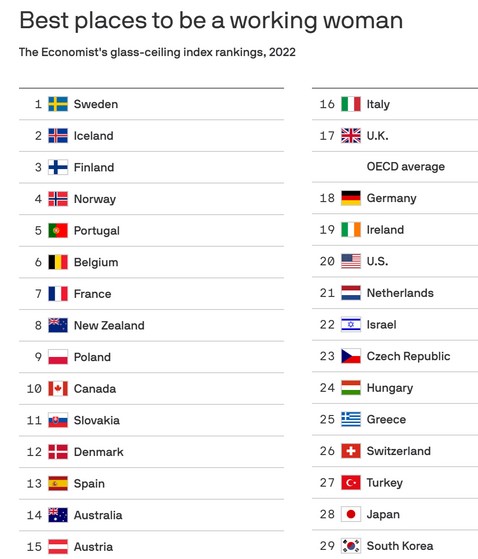
֎ Women – Economist Magazine released statistics that rank nations by whether the circumstances are better for working women. The United States ranked 20th.

֎Russia – With the world glued to the crisis in Ukraine, are Americans troubled by the geopolitical scene? Even before Russia invaded the country, 52% of Americans said the conflict in Ukraine is a critical threat to U.S. vital interests. Negative perceptions of Russia are at a record high, with 85% of Americans viewing the nation unfavorably — up from 25% in 2003 and slightly edging out China at 79%, although China still is most likely to be viewed as the U.S.’s greatest enemy.

֎ China – The Chinese government is scrubbing the country’s internet of sympathetic or accurate coverage of Russia’s invasion of Ukraine and is systematically amplifying pro-Putin talking points. Chinese media outlets were told to avoid posting “anything unfavorable to Russia or pro-Western” on their social media accounts, and to only use hashtags started by Chinese state media outlets.

֎ US Supreme Court – In a victory for Democrats, the Supreme Court has turned away efforts from Republicans in North Carolina and Pennsylvania to block state court-ordered congressional districting plans. In separate orders late Monday, the justices are allowing maps selected by each state’s Supreme Court to be in effect for the 2022 elections. Those maps are more favorable to Democrats than the ones drawn by the states’ legislatures. In North Carolina, the map most likely will give Democrats an additional House seat in 2023.

֎ Atlanta Georgia – Researchers say a large spider native to East Asia that proliferated in Georgia last year could spread to much of the East Coast. The Joro spider’s golden web took over yards all over north Georgia in 2021, unnerving some residents. The spider was also spotted in South Carolina, and entomologists expected it to spread throughout the Southeast.

Researchers at the University of Georgia said in a new study it could spread even farther than that. The Joro appears better suited to colder temperatures than a related species.

֎ Airbnb said it would offer free housing to up to 100,000 people fleeing Ukraine. This is not the first time Airbnb has provided free housing. Last summer, the company also gave free, temporary housing to Afghan refugees while tens of thousands of people fled Kabul.

Airbnb is already getting a ton of support for Ukraine. As of Sunday, CEO Brian Chesky said that more than 11,000 hosts signed up to offer their homes to Ukrainians in need.

֎ Grocery stores – The humble grocery store might soon be a thing of the past. The new Whole Foods location in Washington, D.C., is showing off its techy side: It’s run by tracking and robotic tools like Amazon’s Just Walk Out technology. Cameras — not employees — follow you around while you’re shopping. When you walk out of the store, Amazon emails you a receipt, which tells you how long you shopped and how much you owe. If this sounds familiar, it’s because a lot of this tech already is used in Amazon Go convenience stores, but this is one of the first times it will be used in a 21,000-square-foot store.

֎ Mariner’s County, Iowa – Mariner recently wrote a post about the idea that government should manage ‘dignity’ rather than defensive procedures that protect ‘rights’. Mariner identified the rich citizens and the old citizens as the problem but perhaps the government itself may not be aware of the dignity its citizens deserve. Recently, mariner’s wife, a post graduate degreed librarian with over thirty years experience in research, had great difficulty determining which district in the county she and mariner were part of. Here is her accounting:

I googled districts for our County and got their website.  It did not list the Districts.  I googled for our County Iowa district maps and found cities and towns but could not find districts.   I googled supervisors of our County, Iowa and got a very straightforward explanation of who the supervisors are, their terms of service and the districts they serve, but no indication of where those districts are located.  I googled my city and got a list of services for residents, and government information for new residents–but no district map.  I eventually found a site but even now, going back, I can’t retrace my steps to find it again.

Now here’s the thing–I am a reasonably literate person with access to a computer and some skill in research.  I found it very interesting and frustrating that this information is not readily available to citizens.  I am sure that I am not the only one who does not know what district I live in.  Is it some kind of secret?  And why would it be a secret in a land where the government is the people–not the parties, not the people in power, but everyday people like me.  I don’t want to think that it is because the parties in power are just as happy to keep everyone else out of the loop.  I would think they are eager to share the information if only people would ask.  But how many people are going to call their local supervisor, who they don’t even know, and admit they don’t know the most basic information about their government?

I suggest that the everyday people need more civic education if we are going to understand our government and vote responsibly.  In this world of multimedia resources at our fingertips, isn’t it interesting that I have to struggle to find out what district I live in?  —

Does the reader know the specific county voting district they live in? Their district representative’s name? Does the District care if you don’t?

Ancient Mariner

Nice News

Nice Newsclip from Axios:

“Think about it: Most people you meet in everyday life — at work, in the neighborhood — are decent and normal. Even nice. But hit Twitter or watch the news, and you’d think we were all nuts and nasty.

Why it matters: The rising power and prominence of the nation’s loudest, meanest voices obscures what most of us personally experience: Most people are sane and generous — and too busy to tweet.

Reality check: It turns out, you’re right. We dug into the data and found that, in fact, most Americans are friendly, donate time or money, and would help you shovel your snow. They are busy, normal and mostly silent.

These aren’t the people with big Twitter followings or cable-news contracts — and they don’t try to pick fights at school board meetings.

So the people who get the clicks and the coverage distort our true reality.

Three stats we find reassuring:

75% of people in the U.S. never tweet.

On an average weeknight in January, just 1% of U.S. adults watched primetime Fox News (2.2 million). 0.5% tuned into MSNBC (1.15 million).

Nearly three times more Americans (56%) donated to charities during the pandemic than typically give money to politicians and parties (21%).

The bottom line: Every current trend suggests politics will get more toxic before it normalizes. But the silent majority gives us hope beyond the nuttiness.”

– – – –

Mariner’s wife, the pickleball player in our family, is pleased that pickleball court construction has received a major grant to be built in a nearby town.

– – – –

Perhaps not ‘nice’ but it’s nice that Bill Barr ex-Attorney General is opening up about his Trump relationship.

– – – –

There are scant indicators that the Putin war has begun to mollify a small number of populist attitudes. A philosopher once said “Nothing unifies a nation more than a unified hate for another nation.” Mariner assumes that is the case.

Ancient Mariner

Further studies about the electorate

In his continuous research into how the electorate thinks or even why, this post is one of mariner’s brain twister posts. This post has no more significance to today’s news than finding the next geode in Iowa. Everyone has played logic puzzles at parties or when reading a magazine. Mariner suggests his readers think about an enigma that the sciences have yet to solve:

Why did consciousness emerge from a fully functional subconscious brain?

Dan Falk, a Canadian science journalist, sets up the issue: “The puzzle of how non-conscious matter, responding only to the laws of physics, gives rise to conscious experience (in contrast to the ‘easy problems’ of figuring out which sorts of brain activity are associated with which specific mental states). The existence of minds is the most serious affront to physicalism.”

The common thought test is the zombie test. The experiment features an imagined creature exactly like you or me, but with a crucial ingredient – consciousness – missing. Though versions of the argument go back many decades, its current version was stated most explicitly by David Chalmers in his book The Conscious Mind (1996). He invites the reader to consider his zombie twin, a creature who is ‘molecule for molecule identical to me’ but who ‘lacks conscious experience entirely’.

Imagine the conscious mind looking at an apple. The apple has an independent reality; it is an object within an entirely reasoned environment including terrain, buildings, roads, etc. The apple is red, a value among many colors that are not part of the immediate image. Lurking close by is a conscious awareness of the industry of apple production and perhaps even an impression of the grocer.

All these externally perceived inputs are collected by our consciousness. What did our subconscious see?

It will be awake, able to report the contents of its internal states, able to focus attention in various places, and so on – all part of the senses. It is just that none of this functioning will be accompanied by any conscious experience. There is no reasoned, abstract awareness. Imagine that you are asleep while the apple is present. What will you know about the experience of the apple? At best the brain may register aroma, perhaps indiscriminate noises, subconsciously of course.

The key question is, why did a totally functional subconscious brain have any need to invent consciousness? The major senses like seeing, touching, etc., provide a completely functional reality for survival. Flight or fight is a fully subconscious behavior; pain and comfort, too, are subconscious behaviors.

Scientists to this day have not been able to pinpoint a literal link that provoked the emergence of a conscious mind. Thus it remains an open question – why does the electorate have a conscious mind?

Is the reader still awake or need mariner sign off only to the zombie partner?

Ancient Mariner


Pop Psych

Mariner often cites his father as a treasure trove of shorthand descriptions of personality, tendencies and interpersonal behavior. Most frequently mariner borrows one his father’s favorites: the difference between why, how and what people. In short, why people must know why something exists before any further comprehension can be learned and often may not need any further detail; how people are great problem solvers but need information from why and what people in order to have a problem to solve in the first place; what people don’t care why or how and see no problems if a step-by-step procedure works.

When mariner was a preacher, he had a story about how we can be blinded by our own tendencies. He told the story of a woman preparing a ham for dinner. She cut off one end of the ham as she always did. Her daughter, watching, asked why her mother cut off the end of the ham. The mother replied that she simply cooks the ham the same way her mother did it.

Later, the daughter asked grandma why she cut the ham. “Because it wouldn’t fit in the pot”, she said.

Many confrontations occur for no other reason than the different priorities of these three thought processes.

Another set of descriptors is the difference between extroverts and introverts. Extroverts need human interaction as an element of progress; introverts make progress without any need for dialogue. Mariner once had the experience of wanting to talk with a coworker about an issue. “Leave me alone,” the coworker said; “I have work to do.”

Here is a pop psych test that’s been around for a long time: Without skipping below the figures, which of these objects seems most comfortable to you:


If you prefer the circle, you may enjoy moments of harmony and stability.

If you prefer the square, you tend to organize things and dislike loose ends.

If you prefer the triangle, you may enjoy challenges and like to achieve.

If you prefer the squiggly, you may enjoy being creative and free spirited.

Pop psychology tests are enjoyable and vague enough to toy with as long as it remembered that no one is a purebred; most of us are a mix of two with perhaps one type a tiny bit stronger than the other.

Pop psych was overrun by the Meyers-Briggs test – a compilation of 16 different personalities with variations within each one. Myers-Briggs became popular to the point that everyone walked around bragging they were an INTJ or an ESTP. Still, because no one is a purebred, these four-character IDs must be taken with a grain of salt and a conscious restraint to avoid condescension.

Another personality test used frequently is the Minnesota Multiphasic Personality Inventory (MMPI). It is used most often to determine a person’s criminal tendencies.

If you want to have a finer understanding of yourself, type ‘pop psychology tests’ in your search engine. There’s a test for everything – even how fast and accurate your fingers are.

Ancient Mariner

The US psyche

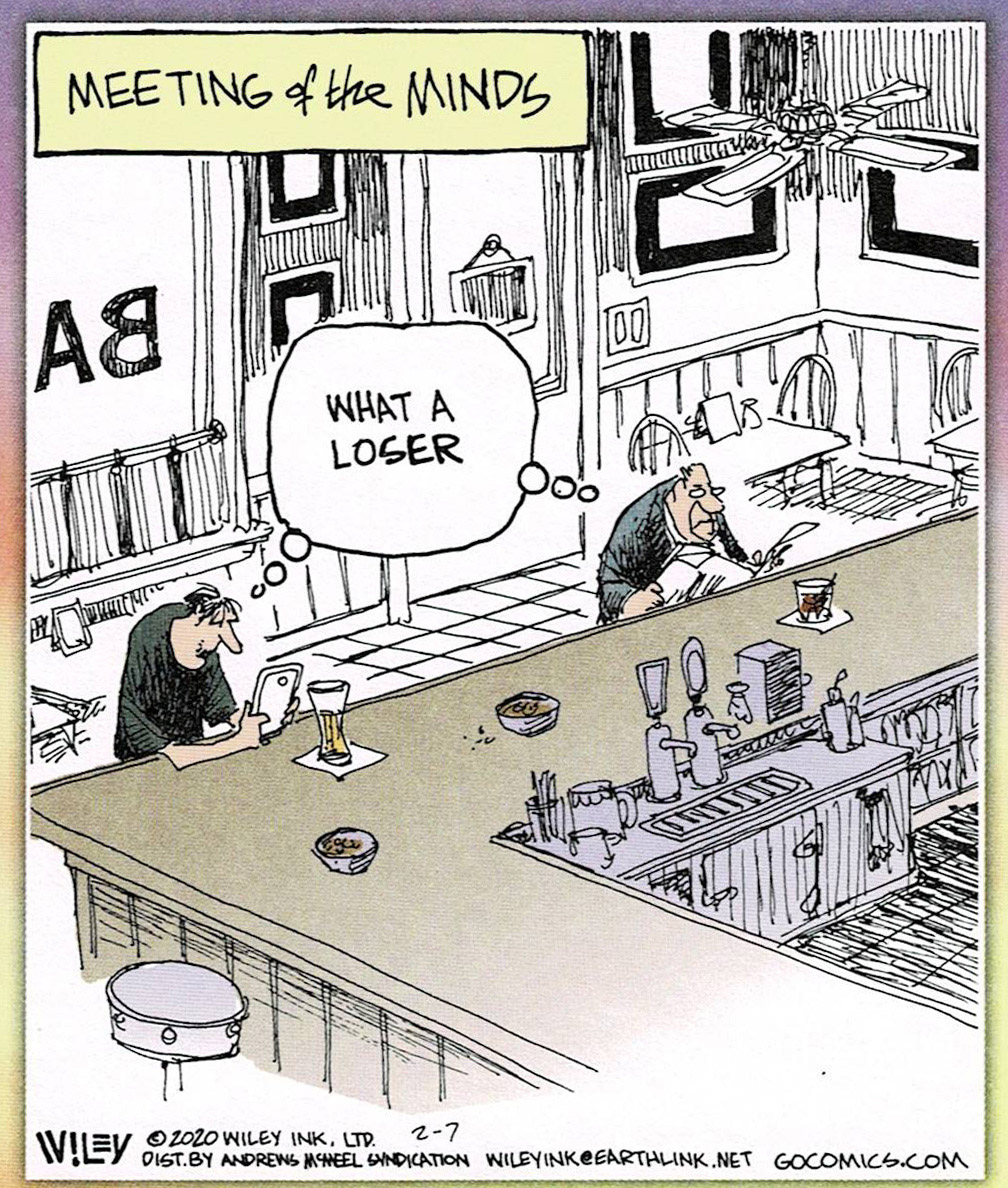
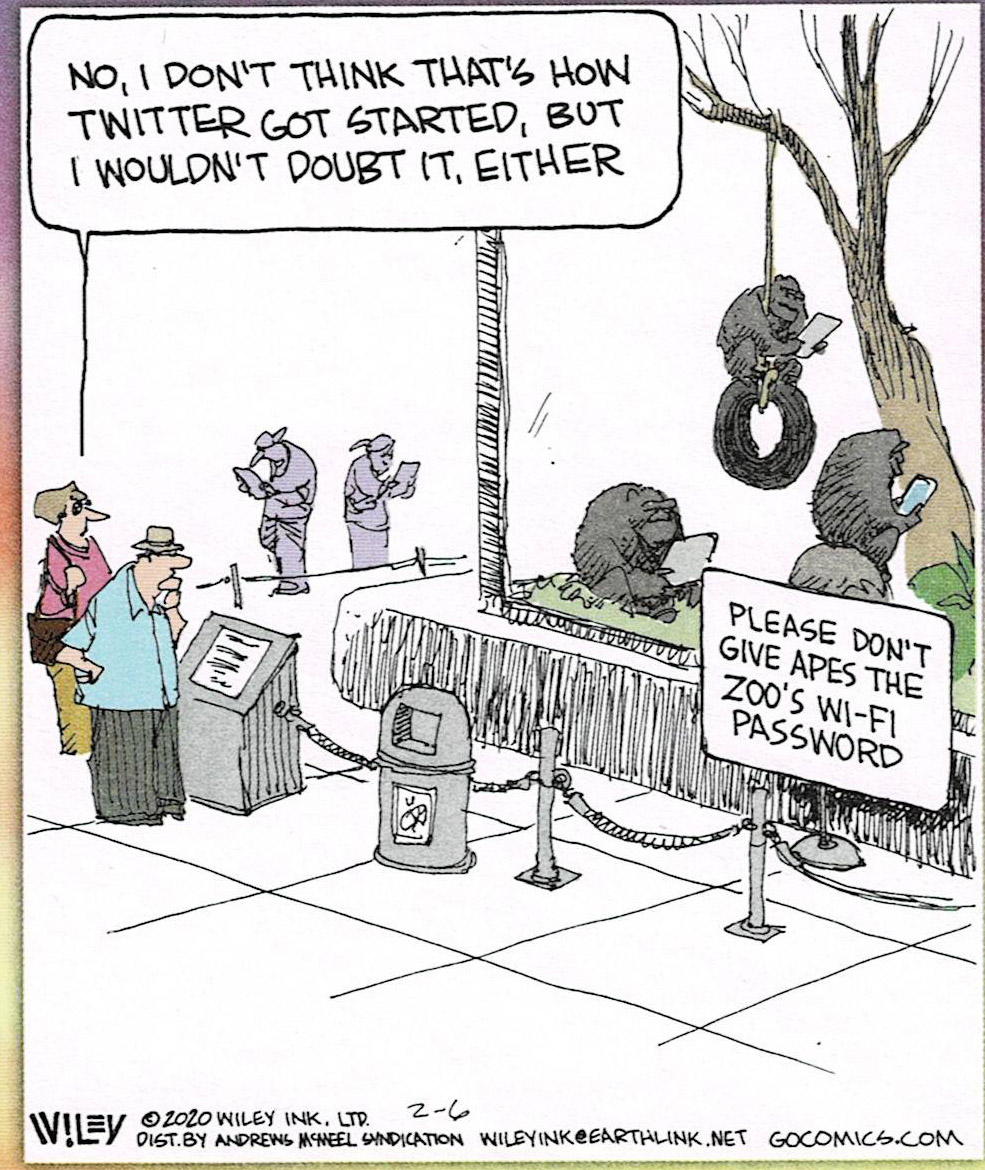
Mariner follows cartoons from many sources and recommends the same for readers. Cartoons release subconscious constipation and act like an aspirin against the pain of daily events. Wiley of Non Sequitur is his champion. The reader can get a year’s worth on their next desktop calendar.

Below are two excellent examples:


Wilderness in the back yard

Mariner and his wife maintain bird feeders during the winter months. It is often that there are 50 to 100 small sparrows, juncos, goldfinches, house wrens, woodpeckers, and cardinals, et al, sitting on the feeders, back deck and on the ground under the feeders; those in waiting cover the branches of the fruit trees. Also in attendance are several squirrels, a feral black cat, chipmunks and mice, and at twilight, a rabbit or two.

Mariner has mentioned in past posts that his yard is surrounded by back yards converted to trucking depots with 3-car garages, RVs and concrete pads large enough to land a helicopter. So mariner’s yard, while not a picturesque British garden, is a small spot of wilderness.

Having just refreshed the feeders yesterday, mariner expected the usual crowd of wildlife. But the yard was silent. The yard was still. Not a bird even in the fruit trees.

Around 10:00 AM mariner spotted the cause: a Swainson’s hawk sitting comfortably on the edge of the flower garden. It is a sheltered spot with full Sun. The hawk was cleaning itself and seemingly just passing the time. It sat there until half past Noon. It was the only creature in the yard.

As this post is written, the squirrels have returned. Still no birds.

Nature is tough.

Ancient Mariner

Take me out to the ballgame

It’s those damned smartphones again! It seems no one has time to watch a full sporting event. Full length television of football, baseball, soccer, tennis and other major events is disappearing. Instead, viewers check out Instagram, TikTok, Twitter and Snapchat. Even the Super Bowl is at risk.

It may be hard to reconstruct for the busy young streamers but there was a time when the event, the getting together with family and friends, the actual driving, parking, ticket purchase, hot dogs and time spent cheering, booing and doing the wave was as important as the game – the entire, three-hour game! When the game was away, television was a true blessing; folks still gathered in homes, pubs and sports restaurants to watch the entire game.

This is a simple and clear example of the deep human price our culture is paying as it moves to an age born in the computer cloud.

Other acts of sports participation have disappeared. For example, most neighborhoods participated in adult softball leagues. The extracurricular activities were just as important as the games themselves. Sports used to be one of the major socialization events that mixed people together to form common ground, which fostered togetherness and acceptance of one another. Despite the rivalry and the boisterousness, common courtesy was practiced.

Time was, every neighborhood had a card club for poker, bridge and mah-jongg. The point is this: It is obvious today that serious activity in politics, business ethics, and international relations all are a bit stiff and awkward. It is difficult to behave within a sociable base of communication. Homo sapiens is a herd creature. Without a practiced herd behavior, we may as well be possums – just as long as we have our surreal smartphone.

Ancient Mariner

Memory

Memory is a strange phenomenon. The subconscious wreaks havoc with our memories if only to justify our idiosyncrasies. We can remember a brief instant deep in our past for no reason except that, for some reason, the brain bookmarked it. Age begins to wear on memories; if it hasn’t been important for a while, the brain tosses it out. At the end the brain trashes functional memory but keeps fantasized and mindless habits.

An old codger, mariner’s brain has started tossing things; mostly names of people and nouns. It has come to the point that mariner often fails in the telling of a joke because the brain doesn’t share the key word in the punchline. Short memory is a turkey shoot. Mariner can know the word he wants to use and three seconds later it no longer exists – only to return ten minutes later.

But what is lost in the tossing is huge chunks of our lives. Mariner’s wife will say “Do you remember when we visited so-and-so in Nashville and had to take a train because the highways were closed?” To which mariner replies, “We’ve never been to Nashville. Who is so-and-so?” Who among us watches television and sees dozens of faces vaguely recognized but why and when are they familiar has been tossed?

Mariner raises this issue because of a phenomenon most have experienced. Like most of us, mariner has a collection of songs from his youthful days. A few years ago mariner compiled his favorites into a list called simply, GOAT. There are over ninety songs from every venue, era, concert, pop, classic, jitterbug, Broadway and every type of troubadour. Mariner plays GOAT every once in a while when he is preoccupied with office work or other quiet activities.

HE SINGS ALONG KNOWING EVERY WORD OF EVERY SONG, EVERY CHORD SHIFT, EVERY SYNCOPATION, EVERY STYLE AND EVERY VOICE. HE HAS ALL THE IMAGES OF THE ENTERTAINERS SINGING THE SONG.

Mariner is an idiot savant.

Ancient Mariner