
Of Our Time

֎1/3 OF ITS GLACIERS

One-third or more of the Himalayan ice cap is “doomed to melt due to climate change,” according to a new report called The Hindu Kush Himalaya Assessment. They’ll be gone by the year 2100, the report finds, affecting hundreds of millions of people who rely on the glaciers as “a critical water store.” [The Guardian]

[[One might ask what the real price of a barrel of crude oil is.]]

֎59 NEW EMOJI

The Unicode Consortium, which is in charge of such things, has announced 59 new emoji along with 171 new variations on existing emoji. The new ones include a deaf person, people in wheelchairs, people with probing canes, a mechanical arm and leg and service dogs. They also include an otter, a sloth, an orangutan, an ice cube, garlic, falafel and a ringed planet. [The Verge]

[[Verbs! Where are the verbs? And adjectives!! Farewell, art of nuance.]]

 ֎DONALD IS GOOD AT SOMETHING

President Donald is first in his class . . . of worst Presidents in the history of the United States. Still adding to his achievements, already he tops several websites documenting US Presidential history.

A few others courtesy of WorldAtlas:

James Buchanan, Jr., a Democrat, was the 15th President of the United States, and held this prestigious post from 1857 to 1861. President Buchanan not only failed to broker peace between a divided nation, but also ended up alienating members of both warring factions. Many still blame President Buchanan and his ineffective presidency for failing to prevent the outbreak of the Civil War, with some even referring to the devastating national conflict as “Buchanan’s War”.

Warren G. Harding. The 29th President of the US was Warren G. Harding, who held office from 1921 to 1923. After his death stories of corruption and scandal became rampant. Aside from his actual political policies Harding’s personal life was marred by tawdry revelations of his extramarital affairs with numerous women. In terms of issues related to governing the country, President Harding ran into trouble with his mishandling of the Teapot Dome oil reserves which also proved quite scandal-worthy for his administration.

Andrew Johnson. After Abraham Lincoln’s assassination, Andrew Johnson was sworn in as the 17th head of state. Johnson, a native of Raleigh, North Carolina, governed the country from 1865 to 1869. Due to a violation of the Tenure of Office Act, he was impeached in 1868. Acquitted by the Senate, however, Johnson was able to remain in office. President Johnson was unpopular for opposing measures, such as the Fourteenth Amendment, which were aimed at affording ex slaves with US citizenship.

Ulysses S. Grant. Republican Ulysses S. Grant who served as the head of state from 1869 to 1877. President Grant’s accomplishments during his two terms in office include overseeing the reconstruction in the southern states, dismantling the Confederacy, as well as supporting civil rights for black citizens. Perhaps the most significant cause of Grant’s downfall and reputation as a poor leader is due to the many allegations of corruption and financial misconduct which plagued his administration.

Herbert Hoover. Herbert Hoover served as the 31st President of the United States during the Great Depression, serving between 1929 and 1933. Hoover was criticized for being a poor communicator who many Americans perceived as cold and uncaring. Although the timing of his presidency was unenviable, his political policies were accused of actually worsening the Depression. Interestingly, Hoover had won in a landslide victory.

[[The majority of the worst Presidents are on the list because they bucked the founding principles of equality, justice by law, and criminal activity on the side along with philandering. Donald appears to be an appropriate nomination.]]

֎Finally, mariner wants to suggest that measuring wages versus inflation, the popular way for pundits to determine wage quality, is misleading. In ordinary times, these measurements would reflect reality. However, the flow of profit is so skewed to the super wealthy that inflation becomes irrelevant. The measure of wage quality should be measured against the Gross National Product (GDP) – a value in which the US working class does not participate. Wages versus inflation has been out of kilter since the 1980’s and has little meaning. Salaries are a built-in overhead. All profits, virtually 99%, and a factor of GDP, are kept by corporations and oligarchs.

Ancient Mariner
 

Mother Nature Continued

The last post recognized how much and how rapidly change is occurring in our global society. It introduced four key areas that drive society: economics, sociology, religion and psychology. The last post addressed economics and sociology. The background theme was that humans are bound to behave the way Mother Nature created them no matter how sophisticated the extra-human inventions and liberties therefrom may seem.

Economics is based on a leverage of group behavior and its rewards – not mathematically but as a group of H. sapiens participants. Lifestyle and the conveniences of electricity, combustion and modern chemistry draw Mother Nature’s primates away from the normal physical environment for which they were designed. Each and every new invention, including telecommunication advances, which draw the brain away as well, have created a society that will change overnight to adapt to the newest contrivance. Yet ties to primate limitations cause stress on the relationship between basic human characteristics and omnipotent domination by a non-primate world. Mother Nature is watching.

This post will present the last two areas that drive society: religion and psychology.

– – – –

Religion, stripped of specific theologies, doctrines and rituals, is how humans relate to a reality that is beyond their understanding and control. Mariner’s use of the term ‘Mother Nature’ is typical shorthand for the Universe and its parochial characteristics on Planet Earth. In a subtle way, if one wants to stabilize one’s psyche, the individual must feel in unison with the universe; one must be linked to the power that permits existence. Throughout time, H. sapiens has developed interpretations for being in accord with the universe. Various interpretations have evolved in history depending on when and where and why – hence different theologies, doctrines and rituals.

Today, religion is caught in the same rampant change as the rest of society. The advancement of science, universal knowledge, an awareness of global issues, and instant communication has altered the reasons for religion in daily life. A human has been elevated from parochial wisdom and ritual to a point where a world view is available – even the kind of world among billions of other worlds in the Universe. Theologies are struggling.

Joseph Campbell, a renowned anthropologist, used the term ‘myth,’ suggesting that the myths or understandings between humans and the powers of creation that developed from 6000BC to 1000AD are no longer de rigueur. Wars in the name of religion (if only in name) have existed almost continuously because religion is as important as any human endeavor; religious sanctity is discriminatory in its ethics and morals. Today, however, situation ethics, a term coined in the 1960’s, is prevailing as a general doctrine. The new God is not anthropomorphic, it is the Universe.

– – – –

Psychology incorporates terms like behavior, personality, maturity, compassion, fear, greed, self-awareness, emotions, and many other terms including those that describe emotional disorders like neurotic, schizophrenic, arrested development, etc. For the purposes of this post, its broadest interpretation is used: psychology is the response mechanism that reacts to sensory input.

Despite more obvious influence on behavior by modern technology (don’t get mariner started on smart phones), the true threat is the displacement of human, plain old H. sapiens control over its own behavior and priorities. To keep from prattling on, mariner offers the global, environmental conflict between MN, her primates and that of the non-human influence of devices made from electricity and chemistry which discount the environment and the behavior of species within that environment: the John Henry syndrome.

As mentioned in the previous post, mariner suggests that the global war for humanity is represented as a battle for control between governments (A version of control that focuses on primate need first) and corporations (a version of control that uses primates as objects of profit). Even simpler, it is a battle between money and human liberties based on MN’s creations. This conflict is of immense proportions, truly a global conflict over the future of life on the planet.

Today, this conflict, hidden beneath keyboard games and meaningless conveniences, is fully engaged. It is a battle between the corporations and the common life of normal H. sapiens – who owns the rights to human life?

Ancient Mariner


Mother Nature

No one can deny that the times they are a-changin’. They are changing in every corner of economic, sociologic, religious and psychologic areas. Mariner is a gardener and he relates cultural change in human societies to the seasonal cycle of plants, birds, insects and mammals of all sizes. What all these living things have in common is that Mother Nature is a bitch – it’s her way or the highway and often she makes the choice herself.

From a less extreme perspective, humans are unique among the flora and fauna and as such can manipulate Mother Nature (MN) just a bit. MN notices but is tolerant for a while until things obviously aren’t going her way. At first MN sits and smirks as humans pretend they are independent of their own biological place in her environment. Perhaps she hopes that humans will learn their place in the larger reality of things but alas, they never do. Humans have this disorder called hubris (excessive pride and self-importance).

Today, humans are in disarray, in conflict with MN and dismissive of the behavioral rules of the human species. To varying degrees most of today’s humans hoard if they can. That’s not the way it is supposed to be. Anthropologists have identified a characteristic in Homo sapiens that differentiated them from Neanderthals – H. sapiens was able to construct multiple roles for members of a small group which in turn generated more resources. Further, the rules for sharing reflected the amount of resources available. Had an individual hoarded in the face of group need, they would have been driven from the group and possibly killed according to primitive, H. sapiens roles of behavior. So in one sentence we can make a generalization about economics: If the rules aren’t fair, H. sapiens is going to take umbrage. That’s how MN designed her primates. That is a brief explanation why most industrialized nations are having difficulty with their citizenry.

It is also the reason why many humans are promoting the idea of income distribution that is, in over simplified terms, taxing the wealthy class to redistribute GDP to lower income classes. Whether governments can rein in corporate profits is the battlefield.

– – – –

Sociologically speaking, behavior didn’t change much in the good old days. The good old days ran from 90,000 years ago until electricity was invented in 1600 and combustion was harnessed around 1800. Before those dates, humans were permitted to toy with seven tools: lever, wheel and axle, pulley, screw, wedge, and inclined plane. There were simpler tools like the rock but the advantage of a rock can be distributed among the seven tools depending on how one uses it. The most significant change in the good old days was the enslavement of animals like horses and water buffalo. Still, the animals had to make do operating a lever, wheel and axle, pulley, screw, wedge, and inclined plane. This was fine with MN because the energy still came from H. sapiens or other MN creations. To quote Tennessee Ernie Ford, “muscle and blood and skin and bones, a mind that’s weak and a back that’s strong.” Or to quote Pete Seeger,

“The man that invented the stream drill

Thought he was mighty fine,

But John Henry made fifteen feet;

The steam drill only made nine. Lord, Lord.”

Alas, John Henry died and the glory of human capacity was forever diminished by combustion. How we measure our worth changed, ergo our social values changed and changed and changed ever more rapidly as H. sapiens forgot its MN roots and sought existence beyond primate reality. The path of combustion has been rude to MN. Beginning around 1850, humans began interfering with MN’s environment. She has noticed.

Manner often has pondered that the popularity of sports is because of a deep desire to have one’s value based on genuine human capacity – like John Henry.

Continued in the next post.

Ancient Mariner


Touching without Touching

Mariner has never done this before but he feels an old post speaks directly to a latent disorder in our time. We as a nation, as a culture, even as a family member, have stopped touching other people – and other people have stopped touching us.

Who was the last person you feel changed your life? Who was the last person that taught you a maturing sensation about life? Who was the last person you considered wise – and without knowing shared that wisdom with you and made you a better person, a smarter person, a more mature person? It’s not physical touching that’s at risk, it’s learning through others, that your soul, your sense of self, your sense of human responsibility is changed. The old post:

The Power of Mentors

Posted on January 17, 2017 by skipper

Usually, in our late teens and early twenties, each of us comes across a special person. This person is a mentor; not necessarily a teacher from school but someone who enters your life in a direct way – perhaps someone you golf with or meet on the job or perhaps just an older neighbor you never really talked to before.

You learn some special wisdom from this person. Something that helps you finish growing up with a bit more wisdom and maturity; someone who may have enlightened you to what courage is about or what it means to be gracious or what it really means to take responsibility. Sometimes it’s a book or a trip. Sometimes, you just watch a special person perform in a special way that changes you for the rest of your life.

The mariner actually had two or three mentors. One, named Mike, was more or less a surrogate father for about five years. Being a scratch golfer, Mike taught him to play a decent round; he and mariner were leaders in the Explorer Scouts. We fished in the rushing rivers of the Appalachians. But most intensely Mike taught the mariner what courage was all about. At the age of 41, Mike had a massive heart attack. He was bedridden and limited to the first floor of his home. After a month or so, he advised his wife and children that he could not live like an invalid any longer. Knowing he was not going to live long, he asked the doctor to grant him a release. Mike went back to work; He played nine holes with his son and the mariner; He went to an Orioles game with friends; a week later he took off for two days of deer hunting with friends. It was a typical regimen for him. Two weeks later he died of a fatal heart attack.

Mike was greatly missed by many people. He was a gracious and caring person. He has remained mariner’s benefactor to this day. He taught mariner the value of sharing; he taught confidence; he taught the power of the human spirit.

– – – –

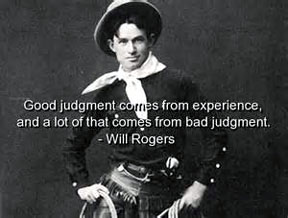
Mariner came by another mentor via public reading sources, books, and old timey movie clips. The reader likely knows him, too: Will Rogers. Will was a traveling humorist and writer. He was very popular with the national audience – constantly full of funny quips and derisive comments about any institution, especially government. Will had a way of making you laugh at yourself despite the sarcasm. He lived from 1879 to 1935, dying in a private airplane crash at 55 on the way to Alaska with Wiley Post. Will was born to Cherokee parents in Oologah, Oklahoma on a Cherokee reservation. In his young days he performed in Wild West shows, becoming an expert at cowboy skills and especially enjoyed doing tricks with lariats. He moved to Broadway shows, movies and writing – truly becoming a world famous author and speaker.
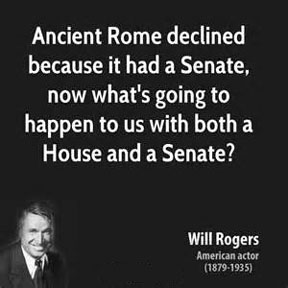
“Rogers increasingly expressed the views of the “common man” in America. He downplayed academic credentials, noting, “Everybody is ignorant, only on different subjects. Americans of all walks admired his individualism, his appreciation for democratic ideas, and his liberal philosophies on most issues. Moreover, Rogers extolled hard work and long hours of toil in order to succeed, and such expressions upheld theories of many Americans on how best to realize their own dreams of success. He symbolized the self-made man, the common man, who believed in America, in progress, in the American Dream of upward mobility. His humor never offended even those who were the targets of it.”[1]

It was Will’s personal economic philosophy of life that caught the mariner’s attention. In various periods of his life, Will lived on a ranch in California. He had his family and a number of Indian workers. Will followed the American Indian philosophy: The hunters go out on a hunt and when they return with the kill it is given to the tribe to distribute. The hunters do not own or control the kill; it belongs to the tribe and there are no requisites for anyone to have access to the kill. Simply, the kill belongs to everyone.

Will worked hard for his income; similar to tribal procedure, the profits of Will’s labors were, as simply as the hunters, turned over to the family. Will didn’t pay his workers, their sustenance was provided the same as with everyone – family, Indians, food, clothing, materials in general. Everyone on the ranch received the same benefits and was cared for in like fashion.

Conservatives call this a dole. Profit is earned and owned by the one who earns it. Handouts are unfair and signify laziness, cheating, and unworthiness. Note that the Indian culture, along with Will, did not confuse individual worth as a scale of value equal to the amount of profit at hand. Mariner remembers the day he had this insight. How novel, how caring, how fair, how sustainable. This economy which belonged to no one and everyone had immense capacity to sustain far more participants (not just the 1%).

Without hearing, mariner knows the selfish will lash out at those who seem to be working less than the mighty profit takers. Alas, conservatives, it is a complex world and not everyone has the same profile.

Will wrote during the depression: “Now everybody has got a scheme to relieve unemployment, but there is just one way to do it and that’s for everybody to go to work. ‘Where?’ Why right where you are, look around and you see lots of things to do, weeds to be cut, fences to be fixed, lawns to be mowed, filling stations to be robbed, gangsters to be catered to.…”

In reality, the variance in work capacity or in amount of income is not an issue. On Will’s ranch, no one was told they had to assist with sustenance; they knew it – without intimidation or belittlement. Everyone saw to it that some part of the ranch labor was attended to without condescension. The trick is to not bind hunting to self-worth.

Mariner is pleased to note that Sweden, as a nation, as everyone’s government, has just passed legislation to experiment with Will’s way. Several thousand people will receive about $600/month and not be required to work at a defined ‘job.’ It is not seen as a dole; it is seen as a way to stretch the kill across everyone even when resources become lean. Sweden understands that humans have been scarfing down the Earth’s wealth far beyond what will be available as humans expand their population by another 40% in 100 years. Don’t worry about working at a defined job – everyone will be working at something to better the tribe.

Isn’t it fascinating that a Stone Age civilization is showing modern man the right way to do things?

Ancient Mariner

[1] James M. Smallwood, “Will Rogers of Oklahoma: Spokesman for the ‘Common Man’”. Journal of the West 1988 27(2): 45-49. ISSN 0022-5169


Of Tomatoes and Immigration


֎It was, if you can believe it, only 11 million years ago that tomatoes split away from peppers, evolutionarily speaking. But now, thanks to gene editing technology, scientists may be able to activate genes already lying dormant in tomatoes to, yes, make tomatoes spicy again. [Gizmodo]

The seed catalogues must be drooling over the opportunity for yet another new tomato variety.

֎Last night between tennis matches, mariner tuned to The Last Word with Lawrence O’Donnell (MSNBC). Lawrence had Ezra Klein as a guest. Ezra provided an excellent interpretation of Donald which mariner thought was dead on. It is worth a check with the video collection at https://www.msnbc.com/the-last-word

֎In these times of overwhelming change, reason and necessity can be worlds apart. Both are real motivations and both are rational responses but in times of significant upheaval their solutions for managing change sprint away from each other. The immigration issue is a good example.

The majority of US citizens are pragmatic, dollar-conscious, and feel shortchanged by their changing culture. Their opinions reflect their concern for their immediate wellbeing and are, of necessity, urgent in nature. Hence, racism increases, identity politics emerges and everything NIMBY is the rule of the day. This is a valid response.

Some citizens are preoccupied with the long view, using reason rather than necessity to establish values. They ask questions like, “What effect does immigration have on the economy and GDP?” or, “Will additional people create overcrowding issues?” or, “What does the Constitution say about immigration?” One question that may be asked is based on the age of the US population. The US, along with Germany, France, China and Japan among others, has a rapidly aging population. Economists suggest that a few decades out there won’t be a large enough labor force to care for all the old people and further, GDP will drop precariously. This line of reasoning suggests that immigration is a good thing and will slow the aging curve.

If this is not enough to chew on, some may involve the effect of artificial intelligence (AI) on the work force and question whether there will be enough jobs to accommodate a new influx of immigrants, thereby shifting the core issue to “What do we do with all the old people?”

In any case, one can see that reason and necessity truly are worlds apart in their responses to extensive change.

Ancient Mariner

Power Corrupts

The last post, “The mice warned us,” dealt with the self-destructive nature of overcrowding. Calhoun’s mice experiments showed that unity broke down into have and have not classes, that violence erupted in self-destructive ways, and social mores disappeared. Eventually the physiology of procreation completely failed. Violence was common; illness and flagrant disregard for the wellbeing of other mice became universal. Across several experiments, the population fell to an average of 116 mice before beginning to grow again.

– – – –

Just to get the reference out of the way, it was John Emerich Edward Dalberg Acton who, in 1887, said “Power tends to corrupt and absolute power corrupts absolutely. Great men are almost always bad men.”

This post deals with an imbalance in power. “The Stanford Prison Experiment” (SPE) was a 1971 social psychology experiment that attempted to investigate the psychological effects of perceived power, focusing on the struggle between prisoners and prison officers. It was conducted at Stanford University between August 14–20, 1971, by a research group led by psychology professor Philip Zimbardo using college students. In the study, volunteers were randomly assigned to be either “guards” or “prisoners” in a mock prison, with Zimbardo himself serving as the superintendent. Several “prisoners” left mid-experiment, and the whole experiment was abandoned after six days. Early reports on experimental results claimed that students quickly embraced their assigned roles, with some guards enforcing authoritarian measures and ultimately subjecting some prisoners to psychological torture, while many prisoners passively accepted psychological abuse and, by the officers’ request, actively harassed other prisoners who tried to stop it.” [Wikipedia][1]

This experiment has been challenged because of questionable methodologies and unwarranted suggestions to participants by Zimbardo. In fact, other similar experiments with more disciplined methodologies suggest that the breakdown of social roleplay was caused by the manner in which Zimbardo exercised dictatorial control over participants, whether guards or prisoners. It was Zimbardo himself who proved Lord Acton’s quote.

In a similar experiment in England, it was found that tyranny (cruel, unreasonable, or arbitrary use of power or control) can only arise when groups become dissatisfied with their circumstances. Organized social structure that is fair and reinforcing will not let tyranny take form. In other words, fragmentation of society (we call it identity politics) will permit extreme reactions to occur in an effort to rebalance group ethos. Mariner found the English study highly relevant to the history of democracy in the US and those troublesome times when privileged groups took advantage (as in Calhoun’s mice studies) or when there was dissatisfaction on a broad scale (one example is the Vietnam War along with inflation). The conservative voters Reagan met that year became the core of his support in the decades ahead. They embraced Reagan not just for his moving pro-America rhetoric, but also for his anti-tax, small government policies and his strong stance against communism and the Soviet Union. Today, the issue again is economic imbalance as old style capitalism begins to fail in an international economy.

Forty years later, the US President seeks to restore Reagan’s policies by tyrannical behavior and disregard for a fair and reinforcing society.

Ancient Mariner

[1] For the 2015 film, see https://en.wikipedia.org/wiki/The_Stanford_Prison_Experiment_(film)

Think Abouts

Mariner watched an episode of Christine Amanpour when she interviewed Jon Stewart and Dave Chapelle. Both men are astute observers of human life and social discourse. One comment that stayed with mariner was a comment by Jon Stewart; he was alluding to the brashness and unthinking environment that marks our society today. He said our opinions don’t have time to mature because we live at a circadian pace driven by tweets. Think about the rapidness of our society. Does rapidity override social grace?

Words that stir thought from Amanda Kolson Hurley:
“Ah, suburbia, land of the bland. White-picket-fenced realm of white-bread people and cookie-cutter housing. That’s still the stereotype that persists in how many of us think about and portray these much-maligned spaces surrounding cities. But if there was once some truth to it, there certainly isn’t today.

“In the past several years, a much more complex picture has emerged—one of Asian and Latino ‘ethnoburbs,’ rising suburban poverty, and Baby Boomers stuck in their split-levels. And 2018 really drove home the lesson that, when Americans say they live in the suburbs, the suburbias they describe are vastly different kinds of places.

“A century and a half after Frederick Law Olmsted laid out one of the first planned American suburbs in Riverside, Illinois, and seven decades after the builders Levitt & Sons broke ground on the ur-tract ’burb of Levittown, New York, we haven’t fully mapped the contours of modern suburbia—not just who lives there and why, but the role that suburbs play in politics and society.”

Mariner once read in a forgotten sociology book that towns, suburbs and other neighborhoods have a cultural lifespan of sixty years. Since reading that passage, mariner is convinced by continuous examples that it is true give or take a few years. Mariner is old enough to remember the new instant neighborhoods, some large enough to be small cities. Economics required that only one or two models would be available else costs would be too high for profit. Given today’s situation, income and profit slowly have dwindled in these suburbs; new better housing is found elsewhere and newer prices and salary requirements have trapped residents in their homes, unable to move out of the old neighborhood. Think about your childhood neighborhood; is it culturally the same as you remember?
– – – –
In mariner’s home town things have changed dramatically over sixty years. Mariner lived in his town in the sixties, left and returned ten years ago. In the sixties, the town was booming and healthy with robust churches, agricultural employment, investment potential for banks and entrepreneurs, active social life with dozens of clubs and social activities. It was a good time to live in his town. But it was the last decade of growth. Since then, the town slowly dwindled; churches are on the verge of closing; the older folk are trapped because their economic model has yielded to relentless inflation; and significantly, the age of electronics, computers, and soon artificial intelligence will totally reconstruct the daily culture and economic model of town citizens. From 1960 to 2020 will be sixty years. . . Think about how a town in the middle of corn fields can energize itself. It is a necessary goal for 800 people – many of them are young with families.
– – – –
Now think about this. An increasing number of nations are considering paying a basic income stipend to every citizen. Mariner is neutral on this issue. However, to solve the rapidly growing injustice of income and economic injustice as money gravitates to the upper classes; as a growing poor increases day by day; as an aging population cannot keep up with inflation and earnings; as the ability to produce dwindles in most neighborhoods, towns and even cities (consider the rustbelt on one end and impoverished Native Americans on the other), there are no other recommendations with the dynamic effect capable of reducing class-based economic disparity. Let’s use the Swiss as an example:

“Switzerland has a very direct style of democracy. For example, changes to the constitution, or “popular initiatives,” can be proposed by members of the public and are voted on if more than 100,000 people sign them. If a majority of voters and cantons (Swiss states) agree, the change can become law. This system not only allows individual citizens a high degree of control of their laws, but also means that more unorthodox ideas become referendum issues.

“Recently, there has been a spate of popular initiatives designed to curb inequality in the country. Earlier this year Swiss voters agreed to an idea proposed by entrepreneur Thomas Minder that limited executive (in his words, “fat cat”) salaries of companies listed on the Swiss stock market. Next month, voters will decide on the 1:12 Initiative, which aims to limit the salaries of CEOs to 12 times the salary of their company’s lowest paid employee.

“Earlier this month, an initiative aimed at giving every Swiss adult a “basic income” that would “ensure a dignified existence and participation in the public life of the whole population” gained enough support to qualify for a referendum. The amount suggested is 2,500 francs ($2,800) a month.

“While most observers think that the vote is a longshot, it has certainly sparked debate — and not just in Switzerland. Writing for USA Today, Duncan Black said that a “minimum income” should be considered for the U.S.” [Business Insider]

If ever there were a curse word in capitalism, it is “guaranteed basic income.” Very much a socialist concept, today’s conservatives perhaps even more than the rich, will have apoplexy if such a bill were submitted to Congress. Still, is there another alternative which forces income into communities and individuals who are production negative?” Think about it.

Tangentially, ProPublica published a report saying:

“A new data analysis by ProPublica and the Urban Institute shows more than half of older U.S. workers are pushed out of longtime jobs before they choose to retire, suffering financial damage that is often irreversible.”

Ancient Mariner

2018 Observations

    Speak to a member of Donald’s base and they will say “Donald is doing exactly what we want him to do.” The populist base wanted a grenade thrown at the Establishment. It did explode and has upset the status quo to a great extent – especially in Cabinet policy. In fact, the grenade exploded so strongly that it exposed the GOP for what it is: Republican Senators living foremost for selfish reasons; Senators holding on to Reagan economics which don’t work in today’s international economy; GOP Senators are conservative tribalists rather than national statesmen. Could a blue wave wash over the Senate in 2020? Mariner believes a few new democrats may make it but not enough to overturn the GOP majority. The Senate doesn’t work correctly in today’s Government consisting of 50 states, 350 million citizens and a modern computerized society. Mariner’s observation is to abolish the Senate completely or at a minimum combine the two houses thereby making every representative subject to proportional representation. And toss out the Electoral College while we’re messing with the Constitution.
   January 2018 had bouncy temperatures ranging from below zero to days in the sixties in the Southeastern part of Iowa. El Nino is forming in the Pacific; it appears the winter jetstream will offer slightly warmer weather in January 2019 than we had last year. If one lives in the Carolinas or New England, the same jetstream won’t be so nice with increased rain, snow and energetic storms. It is a fact that one cannot predict climate change with weather forecasts over a short time. However, mariner agrees with the observation of scientists who study the Earth in geologic terms: the climate change thing already is out of the bag and will have its way with us. Even if the international community meets the requirements of the Paris agreement, the Earth is a big place and large, slow moving planetary phenomena have too much momentum for us to steer. The main worry is what will rising seas, floods and droughts do to our economy?

   According to a Senate Intelligence Committee report, Instagram “was a significant front” in Russian election meddling, eclipsing even Facebook itself. Between 2015 and 2018, there were 187 million interactions with Instagram content from the Internet Research Agency, the Russian trolling operation, compared with 77 million interactions on Facebook and 73 million on Twitter. [Bloomberg]

A popular quote is in frequent use at the moment. The quote is Ben Franklin’s response to a woman’s question about what the founders had delivered: “A republic, if you can keep it.”

A democratic republic requires constant maintenance by its citizens. This means that managing our government at Federal, State and Local levels is a necessary chore that we must continually exercise by voting (but today only 47 percent vote), attending town hall meetings and other events that provide access to our representatives, participating in political causes and party affiliations (only 12 percent of citizens participate even minimally in civic activities). This is sophisticated stuff that requires an educated understanding of citizen responsibilities (civics is not taught in public schools).

It is mariner’s observation that US citizens duck responsibility and blame Russian influence on the Russians. There’s nothing stopping any citizen from taking ownership of their democratic republic at a cultural level and at a political level. Stop blaming others a la Donald and step up to ownership of a nation. If we Americans did that, the Russian issue wouldn’t exist.

Ancient Mariner


One for Many but Many for One, too

Mariner was a young lad, well, not really young, he had progressed a bit in his career and was working as a staff consultant assisting all state law enforcement agencies in complying with new Federal regulations about reporting law enforcement activities to a State database. Let’s just say he had a full head of hair with a flat top.

The work was both tedious and fraught with conflicts about changing behaviors that had long existed in local police agencies. After a hard Friday, we all stopped after work to enjoy a happy hour at a local pub. It was a good release from a difficult day and, after a couple of hours, mariner had had an uncounted number of half-priced gin and tonics. Needless to say, as he left for home, he had an accident on the interstate. One is supposed to slow a bit when taking a tight exit ramp, which mariner failed to do.

But the accident is only a set-up for a genuine insight that has stayed with mariner throughout his life and sets his belief in what democracy is all about.

Mariner rolled his jeep-like vehicle and totaled it. He crawled out the back window virtually unhurt. The first person to be there as he crawled out of the vehicle was a nurse who checked him for critical injuries, determined he would survive and left. The second person to greet mariner simultaneous to the nurse fed him two breath mints to help ward off law enforcement analysis of his inebriation and left. The third person redirected traffic. There was no judgment of mariner’s behavior; there was no judgment of inconvenience; there was no judgment of moral principles. Mariner was a fellow interstate traveler. Further, because he was in law enforcement and reported to the Secretary of Public Safety, police officers saw to it that there were no ticketing or other law enforcement transactions as a result of the accident.

This tale has nothing to do with regulatory justice, alcohol, or nuisance among interstate travelers. What mariner learned is that he belonged. He was a fellow interstate traveler; he was a fellow law enforcement employee; he was a fellow human being. He belonged. Not only that, he was accountable to other travelers for the same concern about wellbeing. He learned that judgment and prejudice are not the rules for living together. Just the opposite, it is compassion and understanding that hold us together.

At this time we are confronted in our nation with a despot president, an unjust economic system and many citizens suffering from innumerable injustices in daily life. Democracy is at risk. Our nation is not so far from the cliff not to be concerned about abject collapse into a so-so nation that will be left behind in the artificial intelligence age. Already our allies are drifting away.

The solution is to feel that we belong. We are one of many. Also, we are among the many that care for the one. Democracy requires unity and mutual participation without judgment.

Ignore the fake news concerned about prejudice and malfeasance. Go outside and look for someone who needs to belong. While you’re at it, let yourself belong to the nation as well – without judgment.

Ancient Mariner

Travel isn’t Broadening – It’s Frightening

Mariner grows disinterested after hearing hour after hour day and night the same statistics, speculations and campaign ads intent on assassinating the character of the other candidate. Today he focused on the rest of the world. He should have stayed home.

We live in an age of rapidly growing nationalism. Most countries have had a form of nationalism but today it is the democratic nations that are switching rapidly. To name just ‘a few’: every member of the European Union (EU), most dramatic are England (Brexit), Poland, Hungary, Serbia, Turkey, Greece and Germany – just a quick list. South America is awash in nationalism with Brazil and Venezuela in great disarray. Central America has long had several abusive, crooked governments but even there dictatorship is on the rise.

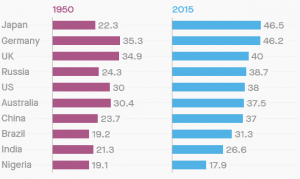
Drivers of nationalism include a slow economic recovery, an increase in people displaced across borders, and anxiety about terrorism, according to Harun Onder, an economist at the World Bank. Another factor, which perhaps is not as appreciated, is age. Many rich nations are in the grips of a big demographic shift toward older populations, and aging populations experience economic pressures that can lead to more nationalistic tendencies. Most frightening is that the newly elected nationalists in these democracies act and sound exactly like Donald! Racism and religious oppression are rampant around the world and are used to incite even more fear in stressed populations.

Median Age [qz.com]

On a more theoretical level, our global economy is 170 years old and shows signs of wear as oligarchical practices gather more and more wealth to fewer and fewer people. In the US, despite apparently good unemployment statistics, general wage levels are half of what they would be if wages kept up with inflation. Corporate power expands ever more rapidly as new digital technologies emerge.

Regarding migrations, mariner has noted that major migrations occur periodically throughout history. Humans moved out of Africa because food was becoming scarce; two very long droughts drove large numbers of humans further into Europe and Asia. Today, the reasons are war, violence and abject poverty. Ironically, the human population is growing to such an extent that soon there will be no room to migrate.

Global culture is in a state of severe turbulence. Change is everywhere and in everything. Is nationalism a solution? Is nationalism similar to a storm cellar during a tornado? Can democracy survive during hard times; during times of uprooted society and morality? Coming back to the US this evening, mariner is concerned about the state of western society. China may not know what it is getting into.

Ancient Mariner