Whither we go?

Perhaps this post is a form of Requiem Mass for Bed, Bath and Beyond. Further, a favorite local branch of the department store Shopko, also has passed. There is a mall in a good-sized town nearby that was the center of a shopping beehive fifteen years ago. It stands empty, stark testimony to a time gone by.

Mariner walked down the main street of his small town noting the sparse retail presence. When he first visited sixty years ago, the town was the business heart of the county and enjoyed a farmer shopping invasion every Saturday. It’s hard to believe this small town once hosted three farm implement shops and two car dealerships.

Today, rural society suffers great duress – which is reflected in national politics.

But the issue goes beyond small towns and rural living. Society, as a phenomenon, is tied to resource management, specie sustainability and a balance with the greater environment. This is the intended lifestyle not only of humans but all types of species – especially our fellow primates.

As mariner has lamented many times, the tribal culture is a solution to the above-mentioned phenomena. Tribal association has proven to be a sustainable lifestyle even in tumultuous times like war. Today, extended families and tribal economies are shredded and spread around the world.

Whither we go? There are two movies to recommend. One, of course is Matrix, an oft-touted movie about the distant future when humans lived their entire life in a coffin supported by automated life sustainability and a three-dimensional, interactive reality fed to them electronically. The other movie, which reflects the conflagration of society today, is a dark comedy about life. It’s called “Little Murders’. Check it out on YouTube.

While it is true that mariner is an old fogie and well past his generational prime, he is not unduly stupid. He once watched a young person put on one of those face masks that supplanted visual and reflex behaviors with a Matrix-like reality. Add to this the dissipation of extended family, de-socialization of public schooling with laptops, smartphones, home delivery of anything and everything, cashless economy, robots for anything from cleaning house and cutting grass to the most private pleasures, and one can say, “Who needs limbic response?”

Whither we go?

Goodbye, Bed, Bath and Beyond.

Ancient Mariner

The REAL Election Results

Printed by Politico

Here are your Lobbying Disclosure Act revenue rankings for the first quarter of 2023.

Brownstein Hyatt Farber Schreck: $15.8 million (versus $15.6 million in Q4 2022 and $15.4 million in Q1 2022)

Akin Gump Strauss Hauer & Feld: $13.4 million (versus $14.1 million in Q4 2022 and $13 million in Q1 2022)

Holland & Knight: $10.8 million (versus $11.1 million in Q4 2022 and $10.1 million in Q1 2022)

BGR Group: $10.2 million (versus $10.1 million in Q4 2022 and $9.6 million in Q1 2022)

Cornerstone Government Affairs: $9.8 million (versus $9.5 million in Q4 2022 and $9.2 million in Q1 2022)

Invariant: $9.7 million (versus $9.9 million in Q4 2022 and $9.2 million in Q1 2022)

Thorn Run Partners: $6.5 million (versus $6.7 million in Q4 2022 and $6.4 million in Q1 2022)

Capitol Counsel: $6.3 million (versus $6.5 million in Q4 2022 and $6 million in Q1 2022)

Mehlman Consulting: $6.3 million (versus $6.4 million in Q4 2022 and $6.4 million in Q1 2022)

Forbes Tate Partners: $6.1 million (versus $6.2 million in Q4 2022 and $6.1 million in Q1 2022)

Squire Patton Boggs: $6 million (versus $6.1 million in Q4 2022 and $7.2 million in Q1 2022)

Crossroads Strategies: $5.9 million (versus $6 million in Q4 2022 and $5.8 million in Q1 2022)

Tiber Creek Group: $5.8 million (versus $6.3 million in Q4 2022 and $6.3 million in Q1 2022)

K&L Gates: $5.5 million (versus $5.3 million in Q4 2022 and $5.2 million in Q1 2022)

Cassidy & Associates: $5.4 million (versus $5.6 million in Q4 2022 and $5.5 million in Q1 2022)

Subject Matter: $4.8 million (versus $4.8 million in Q4 2022 and $4.9 million in Q1 2022)

Van Scoyoc Associates: $4.8 million (versus $6 million in Q4 2022 and $4.5 million in Q1 2022)

Alpine Group: $4.6 million (versus $4.7 million in Q4 2022 and $4.2 million in Q1 2022)

Ballard Partners: $4.5 million (versus $4.3 million in Q4 2022 and $4.4 million in Q1 2022)

Monument Advocacy: $3.9 million (versus $3.6 million in Q4 2022 and $3.3 million in Q1 2022)


OTHER NOTABLE FIRMS:


— Fierce Government Relations: $3.2 million (versus $3.2 million in Q4 2022 and $3.2 million in Q1 2022)


— Venable: $3 million (versus $2.9 million in Q4 2022 and $2.4 million in Q1 2022)


— Kountoupes Denham Carr & Reid: $2.9 million (versus $3 million in Q4 2022 and $2,820,000 million in Q1 2022)


— Venn Strategies: $2.8 million (versus $2.6 million in Q4 2022 and $2.8 million in Q1 2022)


— Vogel Group: $2.6 million (versus $2.7 million in Q4 2022 and $2.2 million in Q1 2022)


— Miller Strategies: $2.9 million* (versus $2.5 million* in Q4 2022 and $2 million* in Q1 2022)


*Estimated based on Senate disclosure filings. All other numbers have been verified by the firms.


TOP SPENDERS:


Chamber of Commerce of the U.S.A.: $18.7 million (versus $21 million in Q4 2022 and $18.7 million in Q1 2022)

National Association Of Realtors: $13.3 million (versus $25.3 million in Q4 2022 and $12.1 million in Q1 2022)

Pharmaceutical Research And Manufacturers Of America: $8 million (versus $6.6 million in Q4 2022 and $8.1 million in Q1 2022)

CVS Health (and subsidiaries): $7 million (versus $3.8 million in Q4 2022 and $3.7million in Q1 2022)

American Medical Association: $6.7 million (versus $5.1 million in Q4 2022 and $6.5 million in Q1 2022)

American Hospital Association: $5.6 million (versus $7 million in Q4 2022 and $5.4 million in Q1 2022)

The Cigna Group and subsidiaries (formerly Cigna Corporation and subsidiaries): $5.2 million (versus $1 million in Q4 2022 and $3.6 million in Q1 2022)

General Motors Company: $5.1 million (versus $1.8 million in Q4 2022 and $4.7 million in Q1 2022)

The Business Roundtable, Inc.: $4.8 million (versus $5.3 million in Q4 2022 and $4.8 million in Q1 2022)

America’s Health Insurance Plans, Inc. (AHIP): $4.7 million (versus $2.5 million in Q4 2022 and $4.7 million in Q1 2022)

Amazon.Com Services LLC: $4.6 million (versus $4.8 million in Q4 2022 and $5 million in Q1 2022)

Pfizer Inc.: $4.6 million (versus $3.1 million in Q4 2022 and $3.8 million in Q1 2022)

Meta Platforms, Inc. and various subsidiaries: $4.6 million (versus $3.7 million in Q4 2022 and $5.4 million in Q1 2022)

CTIA-The Wireless Association: $4.5 million (versus $4.5 million in Q4 2022 and $3.7 million in Q1 2022)

Northrop Grumman Corporation: $4.3 million (versus $2.1 million in Q4 2022 and $4.4 million in Q1 2022)

AARP: $3.9 million (versus $4.2 million in Q4 2022 and $3.5 million in Q1 2022)

Boeing Company: $3.8 million (versus $4 million in Q4 2022 and $2.7 million in Q1 2022)

UPS (United Parcel Service): $3.7 million (versus $1.4 million in Q4 2022 and $4.3 million in Q1 2022)

Edison Electric Institute: $3.6 million (versus $2 million in Q4 2022 and $2.8 million in Q1 2022)

Elevance Health, Inc.: $3.6 million (versus $1.3 million in Q4 2022 and $2.1million in Q1 2022)


BIGGEST CONTRACTS:


Brownstein Hyatt Farber Schreck: Johnson & Johnson Services, Inc. ($1.4 million)

Tributary LLP: HR Policy Association ($990,000)

Covington & Burling: Qualcomm Incorporated ($790,000)

Akin Gump Strauss Hauer & Feld: Gila River Indian Community ($760,000)

Akin Gump Strauss Hauer & Feld: Partnership to Address Global Emissions, Inc. ($640,000)

Ballard Partners: Renewable Energy Aggregators, Inc. ($630,000)

Squire Patton Boggs: Wau Holland Stiftung ($600,000)

Sidley Austin: Illumina, Inc. ($550,000)

Covington & Burling: Apple Inc. ($540,000)

Arnold & Porter Kaye Scholer: Pharmaceutical Research and Manufacturers of America (PhRMA) ($410,000)


What plutocracy?

Ancient Mariner

Odd-lot stuff

֎ The use of extracted Phosphorus by humans is becoming a serious issue. Every living thing in nature uses Phosphorus to survive but it is in a chemically bound form that exists in nature. It is part of bones, part of plant material, part of rock, part of every known plant and animal.

As early as the 1600s humans learned to concentrate Phosphorus using various forms of composting. Today huge chemical factories extract Phosphorus so pure it bursts into flame if not kept under water. The Phosphorus is rebound with inert fillers which become the second number in garden fertilizers. Agriculture worldwide uses concentrated Phosphorus to grow more productive products. Unfortunately, farming is the source of major amounts of Phosphorus draining into bodies of water.

Nature is not used to having free Phosphorus any more than we are used to having free health care. Extracted, free-form Phosphorus is what causes algae bloom in water and was chemically severe enough to shut down public water drawn from the Great Lakes.

֎ From the other end of the climate change field, local fishing companies along the Atlantic Ocean are being threatened by wind towers. It seems private equity has invested in wind farms and has the money and political power to disregard concerns about local fishing industries. Wind tower property would be off limits to fishing.

֎ A new definition for ‘public health’: Federal Trade Commission announced that it had fined prescription discount site and telehealth provider GoodRx $1.5 million for sharing customer data with Google, Facebook and other firms, then in March hit online therapy provider BetterHelp with a $7.8 million levy for sharing customer data.

֎ Finally, why mariner knows Mother Earth will win the global warming war. From NPR:

“Red States Are Trying To Fight The World On Climate

By Maggie Koerth

State Rep. Jeff Hoverson didn’t want anyone getting in the way of using fossil fuels in North Dakota. Not the United Nations. Not international nonprofits. Certainly not the Intergovernmental Panel on Climate Change. So he made a law to stop them. In March, the North Dakota legislature passed a bill that Hoverson co-authored with a state senator. It’s short, sweet and to the point: “A climate control-related regulation of an international organization, either directly through the organization or indirectly through law or regulation, is not enforceable on this state.”

Hoverson told me he isn’t sure what that will mean the next time the federal government wants to sign a climate treaty. Frankly, he’d prefer the feds not have that kind of power, anyway. But while his law stands out for the scope of its ambitions, it’s not exactly an outlier in its spirit. Across the country, bills pushing back against climate policy have been a trend this legislative session, with multiple states proposing — and passing — laws that would undermine efforts to limit greenhouse gas emissions.”

Ancient Mariner


Are humans and the biosphere still in the Pleistocene?

Traces of Homo genes have been found that existed more than 600,000 years ago but the variation that represents the beginning of humans as we would define them today (Homo sapiens) appeared about 300,000 years ago.

Here is a picture of our Great Grandfather:

Homo heidelbergensis


300,000 years ago is before the Industrial Revolution. It is before the invention of the wheel. It is before the idea of government. It is before rafts. It is before American slavery. It is before George Washington. It is before Texas and New York. It is even so far back that Henry Louis Gates Junior can’t trace ancestors on his “Finding Your Roots” show.

The point is this: We are 99.9 percent the same creature that walked around buck naked in the Pleistocene. The .1 percent that continued to evolve was the ability to have abstract thoughts – thoughts and imaginings that weren’t real. To this day our limbic system is confused and can’t tell what is real. There is no physiological chemistry designed to respond to railroad trains.

How did Homo sapiens relate to the environment? It’s a difficult question to answer. For a long time, Pleistocene folks were classified as herbivores who survived primarily by eating roots and grasses that are still around today. However, recent discoveries at one site showed plenty of bones. Most of the animal bones came from gazelles. Among the other remains were hartebeests, wildebeests, zebras, buffalo, porcupines, hares, tortoises, freshwater mollusks, snakes and ostrich eggshells.

It is unlikely that early man kept gazelles and buffalo in body-sized cages as modern man does. Our ancestors had to chase them down. That is why the limbic system is confused by railroad trains. An interesting footnote to this paragraph is that only 20 percent of water-sourced food remains from averages posted just 50 years ago. Something is happening that is different from the last 300,000 years. Further, arable land is disappearing due to many things from population to industrial consumption to climate change.

Speaking of climate change, it is not coincidental that Homo sapiens has been able to populate the planet in the blink of an eye – given evolutionary timelines. Generally speaking, the planet has been tough on life since the beginning. Consider an ice age that lasted millions of years and in modern times can run 200,000 years without blinking an eye. Volcanic eruptions are another phenomenon that raises its disturbances every so many thousand years. But fortunately, scientists have noted a very still, cooperative and generous period for the last 300,000 years.

But now there is foreboding activity. It is true that modern Pleistocene man has trashed the climate, biosphere and has driven the animal kingdom to extinction – that’s the result of abstract thinking. But Homo is not the only driver of change. Most of the methane comes from deep in the Earth, from a time before rafts were invented. Further, volcanoes seemed disturbed by an unbalanced spinning of the Earth’s core. Scientists already have proven that the planet has entered a stage where the polarity will switch – something that happens over many years but can be disruptive. Will polar bears and penguins have to switch places?

Let’s not add any significance to Donald but doesn’t he look like an old Homo heidelbergensis? Then, so does mariner’s Great Aunt Denise.

Good Luck Zees!

Ancient Mariner

Your next book to read

Several days ago mariner’s wife brought home a book from the library she thought might interest him. Like many in today’s world, he often feels reading is not part of the world of speed and instant opinion. Reading is ‘old fashioned’. Use Google instead; use twitter instead; use Wikipedia instead. Let FOX tell us, or maybe MSNBC.

Also like many, learning that the book had 353 pages and 50 more pages of reference and commentary, mariner let the book lay on the end table by his chair for a week. Finally, though, he had a pause one evening with nothing else to do so he began reading the book.

Wow. This book is to the troublesome times of the twenty-first century as the Holy Bible is to the first century. The author is amazingly apolitical in his presentation. In fact, it is written in a smooth readable style that will leave the reader with something to think about when the book is set aside.

The author, Philip Bump, has written a view of today’s world through the phenomenon of generational change. It a story of America reflecting the individual worlds that confronted the Boomers, (born 1946-54) then the Xers (1965-79), then the Millennials (1980-90s) and now the Gen Zs (1990s-2010s). As you read it, you easily will discover yourself among the descriptions of your generation.

Philip’s statistical analysis is broadly based and incorporates the work of other sociologists studying the world as we know it – and knew it. He offers no solace for us until the Boomers get out of the way. Unfortunately, about that time all the Millennials will retire, causing a serious rift in economics. The author puts a lot on the Gen Zs, who must invent a new and different future for America.

Reading the descriptions of the generations and their idiosyncrasies will entertain you and you can’t help saying, “Yes, that’s the way it was.” This is indeed a Bible for your bookshelf. No TV program can match it.

“The Aftermath – the Last Days of the Baby Boom and the Future Power of America” by Philip Bump, Viking Press, ISBN 9780593489697.

Buy it. Then you will know why nothing makes sense.

Ancient Mariner

Meet a friend of mine

Mariner invites you to watch a short video about artificial intelligence:

Watch now – https://truepic.com/revel/

The news item from which mariner copied this video also mentioned an AI version of Barack Obama doctored in the same way as Nina; His image was doctored to say words he never said.

This issue also made it to TV news because its capabilities may replace 40 percent of newscasters. The video is encrypted with a content certification standard called the C2PA. The technical-sounding name is just the acronym of the group behind it, the Coalition for Content Provenance and Authenticity. The C2PA standard is backed by a set of tech giants, including Adobe, Arm, Intel, Microsoft and Truepic.

Recently people have made fun of Zuckerberg’s metaverse with its artificial three-dimensional world and how it would control viewers’ options, that is, more a control of commerce than anything else. The chiding of this ‘other world’ has dropped quickly and has been replaced by a fear of our real world disappearing.

As usual, no constraints have been placed on the technology sector. Politicians who are older than 25 have no idea what the social ramifications are; neither do representatives from rural jurisdictions. As with many other important issues like gun control and health care, American governments care more about abortion and sexual variability.

Perhaps we are only days away from that time when there will be no nation to which we can escape, no Shangri-La. After all, privacy is nonexistent on the internet and cameras, the likes of Siri, and DNA trapping will find us anywhere.

Even if mariner retreats to his two-ponies and cart, satellites will know which shirt he is wearing and what brand feed he uses to feed the ponies, and what road he is on. Now, he won’t even know what’s happening when he watches the ‘evening news’. Fortunately, he can still use cash.

Dictators used to require armies and strong enforcement rules. Now all a dictator needs is a cartoon artist with a computer; citizens will think they are living in a democracy.

Ancient Mariner

Western Europe

As a metaphor, consider Western Europe, from Norway and Iceland in the north to Sardinia and Crete in the south and Turkey, though Asian, as a warm-blooded creature. The various nations are organs. The interlocking economy is blood. The European Union is bones. The NATO Alliance is muscle. Democracy is its persona.

Aren’t metaphors wonderful? When looking at an inclusive map, Western Europe looks like some creature sitting on its rear haunches (Spain) and has large perked ears (Norway/Sweden). With just this one metaphor we have a general understanding of Western European politics.

Let’s give Western Europe a health check. England is a pain like a persistent kidney stone. France has gall stones. Germany is the heart (but only as a pump). Poland has migraines. The nine Eastern perimeter nations plus Croatia suffer both from Schizophrenia and Parkinson’s. Ukraine has fourth stage cancer. Czech Republic and Hungary are neurotic. Turkey has a bowel issue.

Climate change is fostering a blood disorder affecting the entire creature. Portugal, especially, has severe dehydration. Ukraine’s cancer is affecting circulation across the entirety of Western Europe.

Mariner suspects the US Congress does not offer Medicare for most of these disorders – only cancer treatments for Ukraine. Western Europe’s democratic persona has begun to have inflammatory issues.

Well, doctor, what’s your prognosis? Metaphoric language only.

Ancient Mariner

Cracks in the dam

In a recent post, it was suggested that the current state of affairs, probably a global phenomenon, was a conflict between collective communities and top-down governance. The conflict occurs as differences in lifestyle or circumstance becomes confrontational. Donald’s entire public strategy has been based on the subtle disrespect of the labor class by an educated, advantaged, and socially successful society – now assigned the moniker ‘woke’.

In that recent post, two examples were offered: NIMBY (Not In My Back Yard) and Native Americans, two smaller societies (collectives) who have direct conflict with the broader objectives of top-down governance. ProPublica, a highly regarded investigative news source, has provided a sense of the seriousness for the Native Americans. An excerpt is reprinted below:

“In May, Oregon Public Broadcasting and ProPublica reported on how the federal government’s neglect of an old and struggling hatchery system had put tribal fishing rights in jeopardy. The news organizations’ analysis showed that the outlook for fish survival was so poor that the hatchery system was at risk of collapsing under the strain of climate change, unable to produce meaningful levels of fish.

The federal government has announced plans to increase funding for the Columbia River Basin’s salmon hatcheries, the often-crumbling facilities that maintain the river’s dwindling salmon populations. But tribes and state agencies say the influx of funds is only a fraction of what is needed.

The Bonneville Power Administration, the federal agency that’s required to pay for salmon recovery using proceeds from selling power generated by hydroelectric dams, is putting an additional $50 million toward repairs at hatcheries operated by tribes and states. The agency also plans to increase annual funding for hatchery upkeep from $500,000 to $2.7 million.”

 A good example of ProPublica’s investigative reporting forcing a top-down organization to pay attention to a collective need.
Collectives come in all sizes and shapes. Consider Puerto Rico, a financially collapsed territory of the US. Except for a few charitable organizations, the best the island has received is Trump’s toilet paper. Climate change without financial stability may make the island uninhabitable. What? More immigrants?

Consider the MAGA people, Donald’s confused army. They are belligerent, destructive, do not accept government in any form, and, after more than five decades of social disrespect defined by lack of a college degree, the deliberate shutdown of labor unions, and an income that, by the standards in 1980 means they have less spending power today than in 1980 – inflation applied – is it any wonder that open rebellion has occurred?

Consider several major religious organizations, including the Roman Catholic Church among many protestant churches from Baptist to Methodist, who are suffering splintered Christian principles because of top-down edicts forcibly describing faith, purpose and the opportunity for personal grace. Left to defend for themselves in a disruptive, socially disrespectful society, devotion has become political rather than spiritual; prejudice has become a defense of righteousness that is otherwise unavailable.

Consider the slums. Pages upon pages could be written describing permanent despair, homelessness, poor health, no collective GDP because there are no stores or industry, and violence between people that can be matched only by the collapse in the mouse population studies from the 1960s.

Yes, cracks in the dam of society. It will take time; it will take generational shifts economically, culturally and sadly, militarily. Without exception, history says there will be war.

Ancient Mariner


New signs

Bottom up power: [Politico] “The country’s 900 or so rural electric cooperatives serve remote rural customers and are member-driven, -owned and -controlled. Their nonprofit status has made it hard to make investments in low-carbon energy; unlike investor-owned utilities, they can’t go into debt or sell shares to pay for a solar farm. But getting them off of fossil fuels is essential to meeting climate goals.

Already five co-ops have either left or announced they will leave a major G&T (generation and transmission) called Tri-State Generation and Transmission Association, which covers parts of four Western states.”

This tendency is happening in Europe as well. Despite all the ‘effort’ to stop using fossil fuel, oil companies are making record profits. Even Biden is allowing a new oil-drilling operation in Alaska – talk about plutocracy!

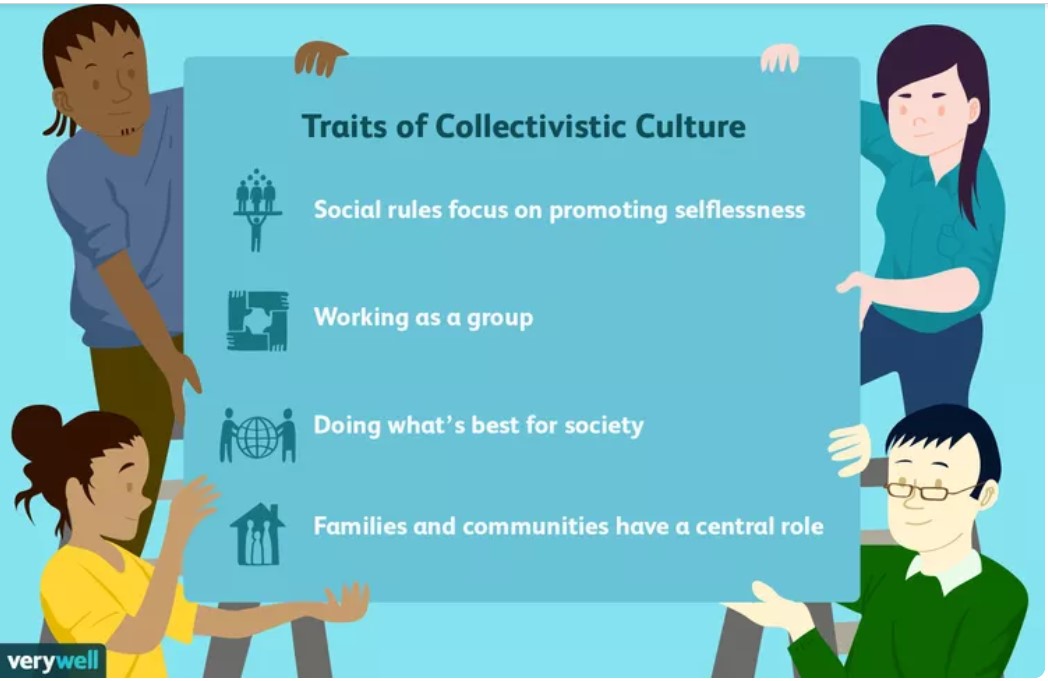
Mariner often writes about collective cultures. Collectivism includes concepts like extended families, local government, local cooperatives, community rules for equality of life, etc. To one degree or another, terms for collectives include cooperative, clan, communist, commune, tribe and many other terms denoting a localized group. The image below captures the general spirit:

Just being a small group does not automatically grant goodness. There are many small groups bent on anything but sharing and survival of all – NIMBY is one of countless examples that demonstrate the conflict between collectivism and the imposing needs of a much larger population.

Having learned from many sources over many years, mariner knows Homo sapiens is a tribal species, along with most of its primate ancestors. In past posts, he has cited authors who said things like “The maximum number of individuals that can be familiar to a human is 150”, “The further a person gets from a direct relationship with the environment, the more abusive the relationship becomes” and recently, “I’m first if its fair for everyone”.

When he studies the development of western nations, and the unimaginable wealth that suddenly appeared on the American continents, mariner is reminded of a group of hoodlums during a riot who break into a store and steal all its goods. Such tactics work for the hoodlums if there is plenty to go around. Western Capitalism is the fastest way to reorganize wealth.

Today, however, there is not enough to go around. Capitalism has an idiosyncrasy that doesn’t work anymore: Grow or die.

Because the West has achieved such wonders and accomplishments – especially when the achievements provide convenience, collective terminology is not popular and its advantages often are discounted. It is this resistance that makes it good news to mariner that there is a breakaway of self-owned electric companies from large conglomerates. There are other appropriate concepts of management that will work better in these challenging times. Bigger may not be better.

There are many more sociological points of interest but mariner can become boring.

Ancient Mariner

Is Big Better?

The news from every quarter, whether conservative, liberal, science, democracy or dictatorship, it is the same: There isn’t enough to go around. An increasing number of nations are participating in or pontificating war as a path to sustain order. In both the East and the West, social mores are collapsing. The economies of wealthy nations are vulnerable. Hoarding behavior within plutocracies, corporatocracies, oligarchies and martial command nations prevail in global policy making. Yet the global number of homeless, starving and abused people is rising; small historical cultures are disappearing and conflict with the Earth’s biosphere grows more volatile.

Since 1980, the rate at which poor nations are collapsing has doubled, largely from the burden of climate change and the hoarding philosophy prevalent among all nations which in turn minimizes assistance.

The most frequent causes cited by public sources are unrealistic tax formulas, cultural abuse (woke, racism, Uyghurs, Moslems, on and on . . .), national cultures ignoring the needs of large populations, and antiquated judicial practices. A new one is artificial intelligence with its self-interest in managing public behavior for profit.

It occurs to mariner that the common denominator to all these dysfunctions is that they are controlled top-down. A simple contradiction would be democracy, a government that is managed by the individual citizen through local, state and federal elections – clearly a bottom-up philosophy today being managed by a plutocracy – a top-down philosophy that makes it so expensive for a local candidate to campaign that only national deep pockets can dictate who can run in local elections.

If one were to examine Earth’s evolution of every plant and animal, compressed into the instinct of every cell is a behavior that would be survival by bottom-up practices. In other words, survival of the fittest at SUSTAINING THE SPECIES. Opossums can only behave in a way that would be good for any opossum. Even the large flocks of birds, herds of cattle and swarms of fish all live in an equal but very personal state of survival: me first but only if it’s fair for the others. Of course, these creatures don’t reason this conclusion, it is in their genes.

Originally, sustaining the species was in the genes of the primates and likely still is but the thorn is the ability to reason, to perceive reality not bound by direct reality – not bound by a balance between the biosphere and physical dependence. Should we curse the first primate that conceived a tool not provided by nature? Of course not. However, should we curse the first primate who discovered how to grow more wheat than was needed and hoarded it? Perhaps, that was not an act to sustain the species.

It may be that the last structured society to sustain the evolutionary rule, ‘me first if it’s fair’, was the Chinese culture which existed around the beginning of the fifth century BCE. The period was before empire-building. It was a society of self-sufficient towns of about 250-1,000 people, likely all related in extended families. The economy was based on a collective style where everyone had a role in sustainability and no one went without.

The idea of a collective economy arose in Europe, if only briefly, with Anabaptist communism; there are remnants today in The United States and Europe but the overwhelming presence of modern commerce is too much to sustain pockets of collectivism. In the nineteenth and twentieth centuries, there were numerous attempts at collectivism, the most notable being the Commune movement in the 1960s. A few sympathizers maintain that white man forced native Americans into an independent collective economy; recent news articles have addressed the invasion of commercial interests into Indian sources of locally sourced food, e.g., salmon.

֎ If, indeed, ‘top-down’ management is the issue, could we ever return to bottom-up? Not likely. It is very difficult to imagine what world order will look like in 100-150 years. There are so many substantive forces changing at the moment that it is easy to imagine an Armageddon catastrophe. Short of that, there are many presumably unmanageable situations that politics may not be able to manage. For example:

Population. Simply said, there are far too many humans on Earth to be supported by a natural ratio to Earth’s biosphere nor by any industrial or technological solution. The following quote is from the Smithsonian:

One can speculate that, at least in the United States and Europe, the worker rebellions are the beginning of a new politic.

Uncontrolled corporatism. The last time the Federal Government knew enough to tell corporations what to do was the generation in 1982 that forced Bell to split its empire into smaller independent companies. Before that, in 1911 Standard Oil was forced to split into 34 companies. Given the political power of Google, Amazon, Facebook, etc., not to mention weaponized Plutocratic political parties, it may not be possible to restore bottom-up economy.

Instant global communication. It is a marvel for anyone to log on to the internet and instantly acquire knowledge, news and ideas from around the globe. The nature of this instantaneousness is that there is no need to stop at a national border to show a visa; there is no need to have independent corporations operating in diverse nations of the world; there is no need for anyone to be loyal (AKA collective) to local markets when one can instantaneously purchase cheaper goods in Asia – no Silk Road needed. The most common evidence of this at the local level is the demise of storefronts. A nation’s borders may not mean much as commerce becomes global and can skirt or otherwise dominate national politics.

Global Warming. This is the big change. With the flick of her weather finger, Mother Earth can cause billions of dollars in property damage, increase homelessness, and disrupt government budgets. Further, she has demonstrated how easy it is to change agriculture to desert or a pleasant valley to a lava flow. Politics are irrelevant – no nation can own her or avoid her. Ask Pakistan.

Will there be Armageddon? You’ll have to prove it to mariner.

Ancient Mariner.