The Truth and Nothing but the Truth

The mariner may have mentioned, he truly doesn’t recall, that he is writing a lesson plan for twenty-first century Christians. The lessons are in an early stage; he has asked seven friends to review what has been written so far. The friends are from many stripes of Christian belief and activity. The mariner has received all manner of response. All the reviews were helpful and improved the quality of the work. One issue stood out across the board: Every reader had some degree of difficulty managing the difference between spiritual truth and empirical truth.

This post is, in fact, a way for the mariner to clarify the issue in his own mind before he starts a major rewrite because of this issue. He will use the parable of the laborers in the field (Matthew 20:1-16).

Briefly, it is an allegory describing the Kingdom of Heaven. A farmer hires day laborers to work in the vineyards. He begins hiring them at the beginning of the day and every hour or two throughout the day, all the way to the last hour.

At the end of the day, the laborers return to receive their pay. To everyone’s surprise, every laborer is paid the same amount whether they worked from early morning or for just the last hour. The laborers who worked the full day claim this is unfair. The farmer replies that everyone received their agreed wage. The farmer further says “Am I not allowed to do what I choose to do with what belongs to me or are you envious because I am generous?”

Jesus ends the parable saying, “The first will be last and the last will be first.”

To translate this just a bit, Jesus deliberately uses an empirical value, money, to make a spiritual point. The parable actually is a definition of the Kingdom of Heaven – a spiritual truth – not an empirical truth. The laborers are engrossed in the empirical reality that everyone was paid the same – a seemingly unfair empirical truth.

Yet, it is the Kingdom of Heaven that is the subject of this parable. Jesus ends the parable saying the first will be last and the last will be first. This means that, in the Kingdom of Heaven at least, everyone is equally accepted by God; no soul is judged – a spiritual truth that has nothing to do with the empirical truth money represents. Nevertheless, we learn from an empirical situation a new spiritual truth that no one is treated differently by God.

The mariner selected a relatively simple parable to dissect into spiritual truth and empirical truth – though many never get beyond the money issue and miss the spiritual point of a fair and just God.

The ability to see spiritual truth in empirical circumstances is the required skill if one is to read the Gospels in a rewarding way. Readers of the New Testament tend to lean one way or the other when spiritual truth and empirical truth are within the same words. To be overly simplistic, one reader says a given passage is a “metaphor” (an editor’s most discomforting word). Another may say the NT is promoting socialism or equal pay for unequal work. Read properly, inevitably there is spiritual truth and empirical truth woven together in that strange but poetic prose written 2,000 years ago.

This parallelism of truth is most conflicted when a miracle is involved. There is nothing wrong with accepting the miracle (empirical truth) as long as the reader can discern what the spiritual truth is, too.

Ancient Mariner
 

Spiritual Worth

The mariner writes this post for several readers. The quandary is “how does one measure spiritual value at a time in the world’s history that it is overcome with empirical success, scientific wonderment that explains everything, and a social mandate that one MUST place cash value at the top of their measure of personal value?”

Everyone, whether a religious believer or an atheist, requires a way to measure personal value. “What am I?” “What am I worth- even to myself?” “Who depends on me?” “How will I know I am successful?” It is hard today to answer these questions. The entire world is in the midst of a time whorl changing so rapidly that one cannot take root in an identity that is permanent.

In the old days (not so long ago), one had a job or career that would last until retirement. One could marry successfully and financial strife was of little concern that it would lead to divorce. Today, and for the ensuing years, the definition of “job” is changing dramatically. One thinks of working from home but that is just a predecessor. As computers and computerized devices take over more and more functions that used to require humans, how do the masses earn a living?

There will come a time when the current conflict between government conservatives and liberals will no longer have ideological pedestals upon which to stand. The capitalistic structure will fail because of the need to sustain the citizens of the nation. That nasty word, “democratic socialism” will become a path to human decency.

This is hard to believe today but already the division between haves and have-nots is approaching dysfunction. Must we have another French Revolution?

The mariner could go on infinitely with transition but the original question is this: “How does one measure spiritual value?”

First, we must recognize that spiritual worth and empirical worth is not the same thing. One could be held in a tortuous prison and still have strength derived from what one believes within oneself about personal worth in an orderly universe. Spiritual worth is not dependent on empirical reality.

Second, we must recognize that spirituality is a very personal value system. It may draw from great literature, art, music, or personal insight. However you construct the pillars of your soul, they are yours regardless of the empirical world.

From spirituality comes morality and ethics. Today, morality and ethics are in short supply. Do not presume that you are soulless. Identify your pillars of spiritual strength and secure them for the trials of the future. Regardless of the empirical confusion of our world, you will know your spiritual worth.

Ancient Mariner


Are we all Americans?

The mariner is writing a lesson book. It talks about the change and stress brought on Christians and the Christian doctrine as societies around the world leave behind the predictable life that existed before 1980.

Most of us don’t see society change as we live our daily lives. Yet, moving about each day, we are encased in an invisible atmosphere that shapes our reality, our attitude, our finances, our family values, our jobs, even how long we live.

True, there were significant issues like the Korean and Vietnam wars, gas shortages and the 60’s generation that burned bras, draft cards and loosened the taboos that governed sexual behavior. But the attitude was still solidly American. Changes to society occurred in an orderly, generational way. In the seventies, America went into space, the Beatles broke up, MASH started, Roe v. Wade passed, Richard Nixon resigned, Microsoft was founded, the Tangshan earthquake killed 250,000 people, Elvis was found dead, first test tube baby was born, and Mother Teresa won the Nobel Prize for peace.

The changes of the seventies were part of a positive upswing in our culture. But it would be the last nationally unified era. The 1980’s began a swing toward less unity in the country. No one could say “We are all Americans” with the innocence that existed in the time after the Big War.

Assassinations were attempted on the Pope and Ronald Reagan. AIDS was identified and the American culture ostracized homosexuals. Reagan announced his military Star Wars program. The US Embassy in Beirut was bombed. Indira Gandhi was assassinated. A hole in the Ozone layer was discovered. Rock Hudson died of AIDS. The Greenpeace ship Rainbow Warrior was sunk. Chernobyl nuclear plant exploded. US bombed Libya. New York Stock Exchange suffered Black Monday. The World Wide Web was invented.

By the 1990’s it was obvious that the middle class was squeezed out of the new profits generated by big corporations. By 2000, generational change had disappeared. The world was changing too fast. Telephone and Internet technologies had merged, providing new ways to learn, shop, communicate, receive medical treatment, even order groceries delivered to the door. Watch a movie, watch the news (world-wide and instantaneous), watch your house, and play endless games electronically. What Americans did with their time shifted dramatically. To a great extent, individuals became more isolated as the need for family routine in daily life dwindled.

Socially, the gap between generations became a canyon. If one was over 65 in 2000, they were not Americans anymore. They were seniors. If one wanted an abortion, they were a criminal, not an American. National banking practices created a nation of credit card debt. Slowly an oligarchy was emerging. No one was an American; they were rich or poor. Those who depended on welfare and unemployment were beggars and lazy – certainly not Americans.

The Christian ethic has taken a severe beating since 1980. Capitalism is the national religion. One hopes that Christ’s ethic can emerge like the phoenix to play a role in a culture that is increasingly shallow. The Earth is in trouble and capitalism makes it worse and further cannot fix the Earth’s plight. It is time for everyone to pay back to the planet for our indiscretions – without the need to make a profit. It is also the time to revive the spirit of the song, “We are the World” (1985)

Ancient Mariner

Hooray for the Norwegian Muslims!

From the Times of Israel:

“In the wake of a deadly shooting attack at a synagogue in Denmark last week, a group of Norwegian Muslims intends to hold an anti-violence demonstration at an Oslo synagogue this coming weekend by forming a “peace ring” around the building.

One of the event organizers, 17-year-old Hajrad Arshad, explained that the intention was to make a clear statement that Muslims don’t support anti-Semitism.

“We think that after the terrorist attacks in Copenhagen, it is the perfect time for us Muslims to distance ourselves from the harassment of Jews that is happening,” Arshad told the Norwegian Broadcasting Corporation NRK in an interview cited by The Local News website on Tuesday.

She noted that the group aimed to “extinguish the prejudices people have against Jews and against Muslims.”

The demonstration drew praise from the local Jewish community.”


A fine, intelligent act in an age of rage about religions. Has it always been this way? Across recorded history, it seems many people have been brutally tortured and murdered because of religious intolerance – perhaps more than all the wars from 1700 to the present. Even in the “civilized” United States today, religious intolerance is not above killing over abortion, sexuality, Islam, atheism, theocracies, and still ostracizes Roman Catholics and Jews.

Perpetually, philosophers and behaviorists ponder religious brutality and still have not discovered a way to discuss religious differences in a rational way.

What the mariner finds puzzling is that those who turn intolerance into murder and destruction are not exactly the devoted core of the faith, devoted to their god and seeking a holy world. Rather, it is the opportunists, bigots, self-anointed “religious” warriors, and psychologically unbalanced who make up the army of the “Lord.”

In the Mideast, conflict has become absurd. Belief in the sanctity of life disappeared centuries ago. Every type of zealot, from heads of state to violent, deranged thugs, fight under the same flag: Islam. Added to the broiling mess is the regional prejudice between theocracies and western secular countries.

What fuels this ongoing war is not really Islam per se, though that is important. It is the fossil fuel wealth of the area combined with inadequate governments still depending on sheikdoms (Saudi Arabia) city-states (Libya), and warlord authoritarianism (Iraq, Egypt and Syria).

The western countries went through this violence centuries ago and have evolved into nations run by constitutions and law. While extremists still cause problems in the western nations, the political infrastructure is robust enough to prevent anarchy.

The coming battles for the industrialized world are mercenary values versus the earth itself – a new kind of fervor based on ecology rather than religion and one that ignores national borders.


Some notes from the mariner –

Many do not check back to earlier posts to see if replies have been added. The “Purgatory” post drew some insightful responses:

One reader, self-described as an existentialist, defined purgatory as those moments when a person has lost his/her compass of life. “What do I do next? Where are the signs that will give me direction? Where will I stay for the next two weeks? It is a sense that life has come to a stop and there is no way to move ahead into the future.

Another reader suggested that purgatory could last no longer than the last living person who knew you – approximately four generations at most. After that, no one is around who will pray for your release from purgatory.

Another reader suggested the living have nothing to do with purgatory, that is, purgatory lasts from the point of death to the moment one must answer for one’s life at the Pearly Gates.

All these replies are fascinating and provoke extended thought about purgatory.

Thanks for your replies.

Ancient Mariner


Oneness Dictionary

Oneness (Definitions)

The mariner has had a number of questions about the use of various words, their context and meaning. Presenting a broad philosophy about how to live better by making better decisions is sometimes heavy reading. What remains to be released is lighter reading. The mariner wants to make sure that key words in the philosophy of oneness are understood before we move on.

What follows is a list of frequently used words and the mariner’s intended use of those words.


ANOTHER’S REALITY A reality or situation that is observed in others. Their realties are accommodated in one’s decisions.
COMPASSION Empathetic awareness of another’s distress and a desire to act in a way to alleviate that distress.
EMPATHY The experience of emotional understanding, shared feeling, and understanding the thoughts of another.
ETHIC A set of moral principles or values that guide behavior.
ONENESS A sense of comfort, satisfaction, and achievement shared between one’s own reality and that of another’s reality. Oneness requires that a decision to resolve an issue is based on the greatest good for all persons involved and further, is a decision that is not driven by personal objectives.
PERSONAL REALITY One’s own reality. Oneness requires that one must focus on an external (greater) reality rather than one’s own. One’s reality is always the lesser reality.
PERSON-BASED DECISION Decisions that are made based on human quality of life as the most important factor. NOT decisions that prioritize assets, profits, or any possession above human quality of life.
REALITY The sum of all circumstances that exist in one’s life at any given moment; the sum of self awareness both internally and externally. Basically, everything that has brought you to the present moment.
SITUATION Similar to reality except a situation is limited to a specific set of circumstances or issues that require a decision.


It is hoped that this short list of specialized words will help. Future posts about Oneness will be laden with practical applications.

Ancient Mariner


The Wrong God

The mariner is in the middle of a series suggesting oneness is a tool to help make good decisions. Even as he writes, retail giants and smaller chains alike have decided to extend black Friday back to the morning of Thanksgiving Day. This means workers will not enjoy a moment of celebration of family, a break from the stresses of a capitalist-driven world. Kudos to some corporations who will not intrude on the holiday. These companies deliberately stand for a culture that recognizes a world beyond pursuit of the almighty dollar.

In past posts, the mariner has touched on the subject of slavery as an evolutionary process. Splitting of parents and children is no longer de rigueur – if one doesn’t include immigration policy of the United States. Likewise, it is not legal to prevent employees from leaving their corporate family – or is it? With salaries that have been stagnant since the 1980’s, few families have the resources to move, sustain themselves long enough to find a decent job, or even attend night classes to improve their education.

As slaves were given minimal rations and poor housing, it is no better today. There are vast neighborhoods in American cities where joblessness is around 25% – 30%, the homes are in disrepair and, as in Detroit, utilities are shut off because the Detroit and Michigan governments have failed to represent these oppressed neighborhoods. The likely fault lies in racism, elitism, and especially gerrymandering. These neighborhoods are full of slaves, are mistreated like slaves and, ironically, even today separate parents and children because a whole family cannot live on food stamps or a meager income by the father which forces him to leave his family so that the family can qualify for welfare.

Still, there was an opportunity to glean even more from those who had poor paying jobs. Banks and mortgage companies misrepresented the cost of buying a home – such a basic need for the lower working class – knowing that later balloon payments would be beyond the income of the borrowers. This resulted in the economic collapse of 2008 and the ruin of financial security for millions of families. Still, the banks made billions of dollars and walked away from this crime on humanity without one prison sentence, not even one trial.

And now corporate greed is taking away the most sacrosanct holiday for families: Thanksgiving.

Is this the work of God?

Is this the work of greed?

Certainly oneness was not used to make decisions about the wellbeing of the greater reality – the need of millions of workers to be normal, family-based human beings.

Ancient Mariner


Is ISIS a Crisis?

The Middle East has been a caldron of violence for four generations. This seems a long time for continuous war and political unrest. At the end of the twentieth century and into the twenty-first, wars have been growing larger and any thought of conscientiousness is destroyed immediately and replaced with violence.

There is a new player on the battlefield. It is the Islamic State of Iraq and ash Sham (ISIS). It is predominantly Sunni. Unlike its parent organization, Al Qaida, ISIS is an organized army capable of taking ground and holding it. This capability enables ISIS to call itself a leader of all Islam nations. Whether this is true or not remains to be seen. In recent days, the fighters of the Islamic State in Iraq and the Levant (ISIL) proclaimed there was no longer a Syria or an Iraq. Instead, they said, the territory controlled by the ISIL in those countries was the Islamic State.

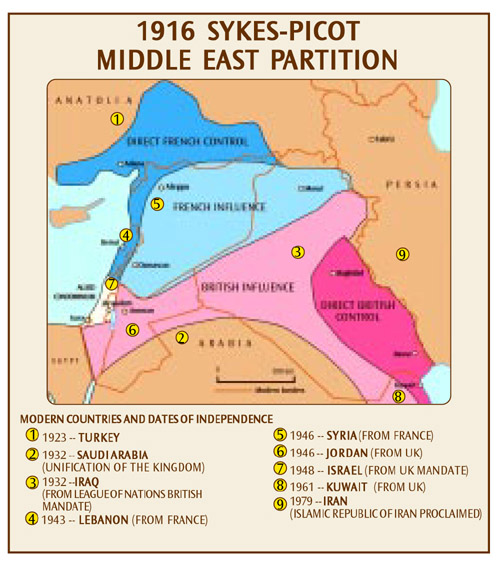
Trolling through history books (yes, the mariner has books) and searching the Internet, two ideas are repeated that reach beyond the battleground news on television. The boundaries of the nations in the Middle East were drawn in 1916 by two negotiators, one from England and one from France. Their names are Sir Mark Sykes and François-Georges Picot. The British and French controlled all of the Middle East at the time. The map was literally a divvy-up of resources based on the amount of local control held by the two countries. Whether Shia or Sunni, Turk or Jew did not matter. The boundaries were simply divided like properties on a Monopoly board. A map is provided:

Sykes-Picot map

The second idea is that Islam has yet to integrate several sects that comprise the Muslim religion. The Holy Roman Church achieved unification for Christians in the days when Popes could dictate international policy. Has everyone seen any movie about Henry VIII? Those times were bloody, too. Then there was the Protestant Reformation but that was associated more with changes in the rights of individuals to pursue new industries – a plight facing China at the moment. China needs an ‘Adam Smith’ to identify entrepreneurial policy. However, the mariner drifts from the subject.

The point is that any semblance of nationality in the Middle East is based on a dominant Muslim sect. All the nations except maybe Turkey are theocracies. There is no Pope for Islam so ISIS is filling the position.

There are many scholars around the world who think ISIS is too weak and too violent (only by modern standards of decency; all religious wars are violent). Nevertheless, ISIS may provoke unification. No doubt oil in the region is a reason to negotiate some kind of religious agreement – if only an agreement to be different.

All this being said, the common man thinks the Middle East is a bunch of fighting dogs and the world should ignore the Middle East until it straightens itself out and moves from the eighth century to the twenty-first century. For Obama and the west, the Middle East is like a fire that may grow too big to contain. Nor can one forget the oil…..

Ancient Mariner


The Four Horsemen of Religion in the 21st Century

The mariner has written many times about the increasing chaos that already is in progress and increases in intensity as the world moves through transition to a new age. Such a transition has occurred under many names: the mastery of fire; organized language, the Greek age of wisdom; the Roman Empire; discovery of the Americas; the Enlightenment; colonialism; the industrial age, etc.

While easily encapsulated in a phrase, each new age took generations to emerge into a new state that was stable and understood by the masses. Each new age catapulted over old mores about culture, faith and productivity.

For simplicity, the mariner limits this treatise to the western hemisphere but acknowledges that the entire world suffers the same chaos. Further, he limits transition to religion, using it as a model for any subject.


In the western hemisphere, Christianity is the dominant religion. Once Henry the Eighth (and Elizabeth I) split from the Holy Roman church to form the Church of England, Christianity began moving into a new age that gave rise to reformation and an era of theological and liturgical freedom that continues today. Until the age of communication began with the introduction of the telegraph, telephone and television, religion was free to redefine itself parochially as the Baptists do and organizationally as the Methodists and other denominations do. Even cultural differences exist side by side. For example, the Mennonites and Amish, and the cultish branches that test faith with snakes, etc. Faux Christian groups are more or less accepted as well. For example the Mormons, Scientology and mega churches are part of the “normal” range of religious practice.

As the transition to a new age quickens, religion will lose its ideological independence. In the twenty-first century, religion will accommodate three wholly different disciplines: secularism, quantum mechanics and technology.


Secularism is founded primarily on the separation of state and religion. In the United States, James Madison is credited with the establishment of secularism. Secularism was slow to grow into a major “movement” because religious institutions remained influential in ethical and moral behavior. Still, the state and its citizens were free to improvise outside religious doctrines.

The state developed capitalism into a valid religion of its own. Today, capitalism so predominates that the ethics and morals of religion are virtually irrelevant except for those still active in congregations who, nevertheless, are capitalists first, religiously ethical and moral second.

The secular movement has fostered ethics and morality outside the precepts of faith. Secularism has permitted regionalization of ethics. The American South has changed little during the twentieth century. Other regions emphasize middle class morals and false Christian religions such as Mormonism, Scientism and mega church organizations with the trappings of Christianity but actually worship capitalism more than Christianity. The accommodation of capitalism into Christian practices is an excellent example of the move to a new age. The transition is far from over as religion struggles for a new identity.


Quantum Mechanics is the study of the smallest pieces of energy and matter – many magnitudes smaller than one atom. At these nanoscopic levels, physicists discovered that particles of existence behave differently than the assumptions accepted by classical physics. For example, one quark (a very small piece of energy or mass) can appear in different places at the same instant. The mariner could run on with many examples but he will leap to the oddly confusing assumption in Quantum Mechanics that there are eleven simultaneous dimensions and you and the mariner can be living different lives in each one. Do not feel inadequate about lack of understanding; only the rare few can perceive this possibility – and they likely are quantum scientists. Further, astrophysicists grow more certain that there are other universes as well.

Religion is in the same circumstance it had with Copernicus and Galileo hundreds of years ago. Science makes advances that blatantly challenge the Old Testament description of creation, Adam and Eve, Noah and the ark, the divine nature of humanity and many other biblical assumptions. The combination of religion, secularism and scientific advancement puts pressure on religion to reconsider the divine nature of Jesus.

As Copernicus and Galileo challenged the theological importance of man (the church) by clarifying that the Earth was not the center of the solar system nor was the solar system unique among others in space, Quantum Mechanics will challenge the vertical inheritance that flows from God to Jesus to man. Religion is bound at the moment to a singular focus between God and humans. Multiple dimensions and universes along with the growing acceptance of other life in the universe will stretch the vertical – perhaps reinventing the role of Jesus and increase the potential for Aryanism, teleology and determinism to be incorporated into religious ideology.


Technology is the engine that accelerates the end of this age. It propels us toward global relationships that are bound together not by geography, economy, culture or race – but by the ability to be part of the unity of all individuals via the Internet. Technology is a force that eventually will equalize human importance across the planet. Neil deGrasse Tyson has a term for this unification: Type One Planet. (Tyson was the host of the Cosmos series and an early advocate of Quantum Mechanics.)

Medical technology in particular will press religious definitions of birth and death as humans live longer and longer, eventually capable of virtually permanent life. The sanctity of work will be altered as more and more technical inventions change the way we live. Consider the impact of the automobile, airplanes, availability of food, and the atomic bomb. Technology can easily redefine what is important in our lives. It will continue to do so.

Put them all together and you have the knowledge base that will redefine faith, that which is sacred, and the manner by which we define our ethics and morals. There is still a way to go in this chaotic environment. We must reign in the corporations, entrepreneurs and others who are leveraging the chaos to their own benefit. In the end, as we adjust to the new age, the four horsemen will forge a new religion.

Ancient Mariner


I Felt a Funeral in my Brain

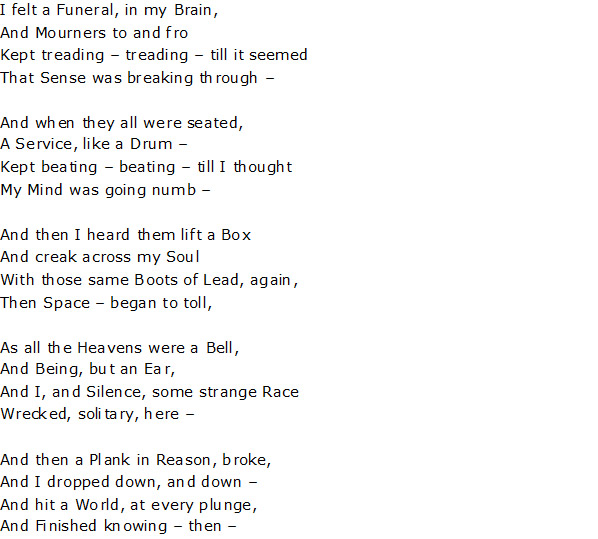
I felt a Funeral, in my Brain

by Emily Dickinson

Dickinson copy

Emily Dickinson takes us on a trip through our own funeral. To that last moment when there is nothing left to know. Nothing to participate in. nothing to share. Nothing to feel. It is finally over.

It is that moment with which we all are familiar. It is a moment we all know will come to pass. Will we feel, as Emily suggests, the drop down and down…and finish knowing?

Some may in their hearts seek this joy. The joy that will leave pain behind. A joy that replaces insecurity, inadequacy, anxiety, depression and defeat.

Some may in their hearts not care about that last moment. There is no joy, no sorrow, and no loss. There is no feeling, too. Nothing of value to miss. The drop down and down to finish knowing is not a step away from before.

When some may feel that funeral in their brain, they bring great anticipation of release into a believed existence far away, that upon finished knowing, move through that moment to paradise unknown.

Some may, in the service of others, have arrived by fire or bullet or starvation or oppression in behalf of those unknown, will they have regret? To those still knowing, the vanquished that drop down have great meaning. To the one that drops down and down, do they wonder the worth?

Perhaps as we feel the funeral in our brain, we look back at what is still knowing, still not finished. As we drop down, we become free of the bonds that held us. Do we see, at that moment, what life ought to be? Is our last knowing of the living finally filled with divine insight and understanding? Is Grace upon us as we finish knowing?

We will be missed by those who love us, who knew us, who knew our place in the world. That, too, will drop down, down and finish knowing beyond our own. It is then that we entirely pass from knowing and being known – then an ancient stone or an urn unknown or ashes cast back to the earth and never known.

To those of us waiting our turn at the funeral, are there things that must be done? Are there rights to be righted? What prepares you for the trip down, down and to finish knowing?

Ancient Mariner

Part IV – Part III revisited

Before we evaluate Escapist behavior, the mariner must address Part III.

More than a few made it clear that the mariner was lost wading in the cattail patch. The most common difficulty expressed was identifying a greater reality. Perhaps we should stop using the word reality altogether. Instead, we will use “situation.” There are smaller situations and larger situations. The act of enabling harmony is finding the most harmonious solution between the two situations. The rain forest is a larger situation than clearing trees. It still can be said that clearing trees seems not to be in harmony with the larger situation that the forest is part of a global ecology.

A person is always the smallest situation. Any interaction involving another person or anything outside the self is a larger situation.

For example, you are listening to someone who likes to talk too much and has a way of never giving you a chance to talk. This is a larger situation. Focusing on the larger situation, you will make a better decision about how to act to resolve the dissonance between your lesser situation and the larger situation. You will act in a way that more likely enables harmony. In this example, harmony is enabled by politeness and concern that you do not hurt or embarrass the talker. Depending on your personality, several solutions can be imagined. The most common solution is to interrupt in a polite way and excuse yourself from the larger situation with some polite word about having to move on.

Can the reader sense that using a solution in the best interest of the larger situation prevents you from making an internal judgment that likely would be self-serving and may cause dissonance rather than harmony between your smaller situation and the larger situation? Just silently walking away from the talker, which may be the judgment you prefer in your mind, would be rude.

To answer the question about jaywalking, the larger situation is respect for moving vehicles and one’s own safety.  Jaywalking is a common judgment that does not consider the larger situation of someone in a vehicle who doesn’t expect a person to be in the street in the middle of the block. That is dissonance; crossing at the corner is more harmonious.

The question about the animal trap demonstrates that an individual could identify a larger situation and have multiple ways to enable harmony. In fact, every person will identify a larger situation in their own way and enabling harmony may be different from yours.

The answer to the question about payroll is the owner should not make an internal judgment to determine the solution. She should look outside herself to identify a larger situation, that is, what is the most harmonious thing to do for the twenty employees. There are many solutions.

The most harmonious solution may be to have everyone in on the problem solving and essentially let the employees determine a solution that resolves the financial circumstance. This is a good place to point out that enabling harmony is not mediation or arbitration, used to divide the pie or establish a different definition of dissonance. Fairness is an important element when enabling harmony. Sadly, many managers determine a solution without looking outside to identify a larger situation. The common response is, “I will make this decision because I have authority and it will be made in my best interest.” Internalized solutions are prone to creating dissonance.

A misconception that crept into readers’ ideas about harmony is that enabling harmony is the same as enabling bliss and happiness. This response may appear in one-to-one solutions but harmony is not tied to bliss. D-Day in the Second World War was in pursuit of harmony regarding the larger situation of human abuse and disregard for due process on a grand scale by the Third Reich in Germany.

Enabling harmony means, quite simply, going outside the self to identify a larger situation and then act in a way that minimizes dissonance and enhances harmony between the lesser situation and the larger situation. Sometimes, as in the example of the Brazilian rain forest, the lesser situation is the state of Brazil’s economy, not a person. What can be done that enables harmony between the needs of Brazil and the world’s need of many effects attributed to the rain forest?

Stepping back into the reality word, there are political realities, financial realities, international realities, etc. This discourse about harmony is just another reality: harmonious reality – the reconciliation of two situations using harmony as the measuring stick.

Perhaps it is wise to leave escapist behavior for the next part.

Ancient Mariner