
Thoughts on Economics

Mariner is not an educated economist. Nevertheless, he seeks common sense relationships that make an economy work and he flavors the numbers with human reality. This flavoring is important to regular human beings who, not being career economists, are not bound solely by interpretations of profit, loss and growth.

An economy flows in a long, somewhat circuitous river that starts in rural areas and small businesses everywhere and like the mighty Mississippi River, feeds into larger and larger economies that eventually reflect the generalized circumstances of a national economy. If the economy dries up at any point, the ‘flow’ stops; words like depression and recession prevail; an example is the coal industry in West Virginia. On the other hand, the economy can flow too fast, which is like the flooding of the Mississippi after significant rainfall; the word becomes inflation – a condition where investment values drop, as in a flooded home; a dollar in hand this morning will buy less tomorrow morning. A few insights:

  1. There are several relatively independent branches of the economic river, e.g., manufacturing, agriculture, investment (stock market, cash savings), services (very large including restaurants, health, transportation, etc.), engineering, and telecommunications. Not a complete list but one gets the idea.
  2. At the state level, economics is fifty separate branches of the economic river. Each state is responsible for the flow of economics within its borders. Modern economic times have altered this independence as corporations grew and merged and as population has shifted, taking income with it.
  3. The Internet has had a profound impact on the relationship of a region, with its geographic ties to productivity, versus the imposition of production from elsewhere, even beyond national borders. Two examples are Walmart and Amazon. Local businesses are disappearing very rapidly. Further, the profits from local sales are not recorded in the local region but reflect income at the home office of the corporation.
  4. What provides current in the economic river is something called Gross Domestic Product (GDP). Typically, one learns about GDP for the nation during news broadcasts. Actually GDP can represent something as small as a neighborhood or small town. GDP consists entirely of how much income is generated within a defined region – including businesses and all residents (AKA jobs).
  5. Until the late 1980’s when computerization and new US economic policy shifted dramatically, GDP was tied almost exclusively to actual production, that is, stuff that is made or grown. A significant shift in how to generate income was launched during the bountiful years of the nineties: investment became as important as making things. The US went from manufacturing to investment.

Suddenly it was more profitable to ship production overseas where production costs were lower than it was to stay in the US. In the abstract, this new economy opened an era of international GDP, e.g., Trans Pacific Partnership, but at the same time reduced the job security that was had in the days of ‘made in America.’ (One can speculate whether this was the source of Donald’s base) Adding insult to injury, many corporations and capitalist-minded entrepreneurs invested their profits in offshore banks to avoid paying taxes – and to forego investing in the US economy.


Given these insights, that is the state of affairs in the US economy at present. But as the street-wise aphorism says, “The times they are achangin.” Two huge areas of new history are upon the citizenry and upon the responsibilities of government policy and business practices: Cloud technology and climate change.

֎ Cloud Technology[1]. Awesome. Beyond imagination. It is hard to imagine how Cloud technology (CT) will change everything without exception. Will a ‘job’ exist after CT? Will GDP be measurable in any geographic manner? Will any governmental border matter? Google has always had a stated goal: to know everything there is to know in the world. This includes one’s privacy not just in the home but wherever one is, whatever one is doing, and what one had for breakfast. CT will know when one needs new shoes or an oil change – if there is ‘oil’ in future machines. On New Year’s Eve, CT will pick one out of the densest crowd in Times Square in New York City.

CT, coupled with a faster Internet, will not need to be aware of time zones; all data around the world will be instantaneous. Mariner could go on with matters of awe but the big question is, what will CT do to economics – not just in the US but everywhere? Today, investment strategies count on the delay of stock markets opening in a staggering fashion as the world turns. This single strategy will not be available in the world of instant data. International stock exchanges will, in fact, be one giant stock exchange. It will be impossible to keep anything secret – even perhaps what one will name their newborn baby (Has the name been discussed in hearing distance of Alexis? Can one imagine receiving promotions for babywear that already has the unborn baby’s name on it?).

Still, the main issue is jobs. Another aspect of CT is artificial intelligence. Middle management will take a big hit. So will truck drivers, factory workers, fast food employees, and tens of thousands of person-to-person jobs like tax preparers, retail salespeople and primary care physicians. Further, the role of cash will change. Don’t underestimate cryptocurrency; if properly instituted, one will no longer need cash just as, increasingly, one will no longer need storefront shopping.

CT requires a mountain of economic policy change in the federal government. For this reason alone, voters must not be distracted by party shenanigans, racism, incompetent elected officials or plutocratic domination of ‘our’ government. Without starting another post, vote sensibly in 2020.

֎ Climate Change. Naysayers take advantage of the slow pace of Planet Earth compared to the lifespan of a human being. In January, “Where is global warming now?” or “There have been hot Junes as long as I remember” or “Fossil fuels aren’t the cause.” Well, actual, Donald-proof evidence says it is happening; it has been happening; it will accelerate throughout the rest of this century.

For the sake of brevity, mariner will describe just one issue raised by climate change: rising sea level. There are other ramifications like increased volcanic and earthquake occurrences, extensive extinction of life including plants and especially the ocean environment, and severe changes in drought and rainfall across all regions of the planet that will significantly alter agricultural economies and threaten sufficient food to feed a population approaching 11 billion people.

Rising sea level is the most disruptive and expensive phenomenon associated with climate change – even though it is within the capability of humans to manage it. Today there are those who gripe and complain about immigration around 100,000 to 150,000 at one general location in the US. Consider this issue as practice for relocating people, jobs, homes, churches, factories and specialized services for 11.6 million citizens of the larger cities at sea level from New York to New Orleans. Of course it will be a lot easier because the US has about a decade to pull it off . . . mariner jokes.

What makes population migration scary is that these massive relocations of entire societies will happen around the world. London: 8.9 million; The Indian Sundarbans in India: 13 million; Hong Kong: 7.4 million; Tokyo and Yokohama: 11.8 million. And this is just a sampling.

It will be expensive. So expensive that many smaller economies will become bankrupt. Even the US is in danger of economic instability as it helps pay for relocation of new homes, businesses, health services and other important social functions. How about interstates and airports? Must they be relocated and rebuilt? On and on. Sadly, many island nations will be gone.

These are mariner’s thoughts on the US economy. Nevertheless, enjoy a warm, warm summer.

Ancient Mariner

[1] Cloud technology: cloud computing is storing and accessing data and programs over the Internet instead of accessing private computer hard drives. The cloud is just a metaphor for the Internet but is paired with banks of very high speed computers that can share processing. Limits to data storage and retrieval virtually do not exist; response is instantaneous anywhere in the world.

Emoji and Donald

֎ [536.com] But, soft! What emoji news through yonder computer screen breaks? Apple has announced fall additions to its keyboard that will include a guide dog, an ear with a hearing aid, a person in a wheelchair, a prosthetic arm and a prosthetic leg. There will also be expanded options for the “hand-holding couple” emoji, which will feature 75 different combinations of the hand-holders’ race and gender.

When mariner learned to write, he remembers it being difficult to satisfy his cursive instructor. Not only that, he had to write cursive with his right hand since being left of anything was a reference to evil in the Bible. With Apple’s inclusion of emoji on the keyboard, cursive isn’t the issue; the issue is will anyone remember the alphabet?
– – – –

Tom Friedman was interviewed on The Eleventh Hour with Brian Williams after having been a guest on MSNBC earlier that day with the same message. His message was simple, direct and clearly a choice for the democrats: “Which do the democrats prefer, start a revolution now and accept four more years of Donald or focus on getting rid of Donald, weaken the GOP hold on the Senate and then start a revolution?”

This is the first piece of solid planning mariner has heard and believes it is a good place to go in the democrat’s bid for the presidency. Having two dozen candidates doesn’t help with a solidified front against Donald; it is a serious distraction and doesn’t focus on Donald. Ocasio-Cortez et al may have a legitimate assignment from their electorate and may be historically correct in the long term but there are two phases (1) get rid of Donald and safeguard against the Electoral College (2) clean up Donald’s mess and move toward a modern economy capable of dealing with brand new issues like job creation as AI erases jobs, balancing the US debt versus dysfunctional taxes, climate change and international liaisons that protect against too many dictators.

Ancient Mariner

It’s Time for Religion

There are times when we must return to religion. This is difficult in today’s helter-skelter value systems and rapidly shifting beliefs in the world in which we live. To the extent that religion itself is caught up in the raging politics of wealth, depravation and transition, finding a value to which to return is difficult and precarious. As religious believers, we are lost in a morass of myth change, unstable human value and empirical disruption.

Sometimes, it is helpful to discard that which is confusion. What is it that has proven to be survivable, worldly, simpatico and stable beneath the fray of economics, politics, common prejudices and conflict? There is comradeship in basic human existence. There is comradeship in nature’s rule of life. There is partnership in the pursuit of survivability.

But who will lead the path to religious morality? Who will reset the world to the powers of creation and sanctity? Who will link the power of ethos and universal value to a day in the life of humanity?

You.

Elected officials and government cannot do this. Militarism cannot do this. Great leaders cannot do this. Elitism cannot do this. You can do this. Live your life according to your beliefs in Divine Providence. Do not allow your sense of right to be distracted by the confusion and misdirection of life. You know what is sacred. Believe your faith in the holiness of reality; believe in the virtue of equality among humans and humanness. If God is your leader, obey God’s rules.

Politics will not save us. Wealth will not save us. Battles against oneness will not save us. Love will save us.

Ancient Mariner


Fly By Subjects from Mariner’s Mail

֎ Astrophysicists have pursued dark matter for decades. It seems there is growing evidence for yet another kind of dark matter. The new dark matter is called ‘Chameleon Theory.’ It is so named because it can change its mass thereby ‘hiding’ among other objects. If the reader is interested, check out https://www.livescience.com/65919-chameleon-theory-explains-dark-energy-maybe.html?utm_source=lst-newsletter&utm_medium=email&utm_campaign=20190712-lst

֎ The US dominates international trade when it comes to services. The following statements are from a Politico podcast.

The national dialogue about trade has almost exclusively focused on hard goods, the things the US makes or grows. But if the tariff debate focuses only on goods, there is a risk of leaving out something crucial to our understanding of trade today. There’s been an equally stunning shift in a different segment of the economy. . . . In fact, when we look at the US, the US actually runs a trade surplus when it comes to the services component.

. . . . The hottest areas of the economy, consumer tech, software, retail, entertainment, and communications now account for the most number of jobs, and they’re becoming export industries.

– – – An educational podcast that looks at global trade from a fresh perspective. See the podcast at https://podcasts.apple.com/us/podcast/sponsored-content-rethinking-americas-role-in-global/id1202281739?i=1000442921861

֎ Fivethirtyeight.com (Nate Silver’s website) has an article about the Democratic campaign for the presidency. A hidden influence is asking voters who their second choice would be. See: https://fivethirtyeight.com/features/lanes-are-starting-to-emerge-in-the-2020-democratic-primary/

֎ From The Atlantic: The age of TikTok begins.

If you didn’t know, now you know. The fun, jumpy, puppy-and-meme-laden video app is well on its way to becoming the next big social network. It’s already broken the 1-billion-monthly-users mark and ranks as the third-most installed app worldwide—just behind Facebook’s WhatsApp and Facebook Messenger—for the first quarter of 2019. TikTok overtook YouTube as the star of this year’s VidCon, an influential gathering of content creators in Anaheim, California. “The older generation doesn’t realize how important TikTok is yet,” one 21-year-old attendee told our Gen Z translator Taylor Lorenz. See: https://www.theatlantic.com/technology/archive/2019/07/tiktok-stars-are-preparing-take-over-internet/593878/?utm_source=newsletter&utm_medium=email&utm_campaign=atlantic-daily-newsletter&utm_content=20190712&silverid-ref=NDkwMjIzMjA1Mjg2S0

Ancient Mariner

When it comes down to it, you’re not on your own

[NPR] Debbie Baker thought she qualified for a federal program that helps teachers such as her, as well as nurses, police officers, librarians and others. The Department of Education program forgives their federal student loans if they make their payments for 10 years and work in public service.

But it turns out that her $76,000 in student loans didn’t get forgiven. Baker was finally told she was in the wrong type of loan. If she’d known that at the beginning, she could have switched loans and ended up qualifying. But she says nobody ever told her.

The tough message is that no one is in your corner but you. There are many who want to help you but they can do only so much. The bottom line is, in the jungle of politics, government programs, health, career, taxes and survival, one must be responsible for one’s self – but not by one’s self! This is especially true in these times of confusion and change.

It used to be if a person had a good physician and at least knew of a lawyer, the person’s interaction with society was manageable. Today, of course, a person requires specialists for dozens of relationships with society; most of these relationships are not petty and can have an impact on finances, insurance, property and taxes – to say nothing about education and medical expenses. Even taking a vacation often requires interacting with travel agencies.

To the reader, this means two things: 1- society is like a herd of elephants; they are big, cumbersome and even if they want to help out, it’s just as likely they will crush you. 2- surviving elephants requires special knowledge; it is a sad fact that one can no longer simply visit a specialist who will guarantee one’s wellbeing. Today, one must first do homework.

  • Know very specifically what one wants to achieve. Have an idea about how the achievement will be accomplished.
  • Educate one’s self about the subject; the Internet is a marvelous place to research details. So are libraries. Particularly learn about the responsibilities of those who will help. Ideally, talk with someone who has achieved the same goal.
  • Just as Debbie made a mistake by not reading the fine print, most folks will overlook something that may be important. Fine print is everywhere today. A common error when investing is to not know the difference between a financial planner and a fund salesman. Financial planners were required by federal law to act in your best interest. Mariner said ’were’ because Donald had that rule removed early in his presidency; still, financial planners have one’s best interests at heart. Unfortunately, the larger investment firms stock up on fund salesmen; unless one is genuinely wealthy, one will not be serviced by a financial planner.
  • Use a local bank and a local attorney. Let them know they will be counted on for all actions even if circumstances require additional specialists.
  • When it comes to health insurance, it is a cutthroat business. Find neutral intermediaries to help with jargon and options. Some pharmacies offer services that will help make the best decision; there are quasigovernmental agencies (SHIIP, for example) that will help when making decisions about medical insurance. In matters of health finances, homework is required.
  • Voting is the most important civic responsibility. Shortly before voting season, write to your elected officials to request promotional literature. Mariner cannot count the number of conversations with folks who not only didn’t know much but what they did know was attributed to the wrong party.

Just on a lark mariner decided to list within one minute as many specialists as one may need when engaging society:

Banker, attorney, financial advisor, primary care physician, optometrist, dentist, automobile mechanic, heating and air conditioning technician, proficient carpenter, proficient electrician, baby sitter, public school teacher, marriage counselor, psychologist, fitness center instructor, Tai Chi instructor, real estate agent and on TV, advice for everything from Doctor Oz to movie reviews.

The point is that today one cannot go it alone and must do homework as well. Make sure the right person and the right decision occur.

REFERENCE SECTION

‘1 Million Americans Will Be Shot in the Next Decade’

Video by The Atlantic

“I see more gunshot wounds as a trauma surgeon here in the United States per week than I did when I was serving in Kandahar, Afghanistan,” says Dr. Mallory Williams, chief of the Division of Trauma and Critical Care at Howard University Hospital. “There’s no question about it.”

In a new Atlantic short documentary, American Trauma: How the NRA Sparked a Medical Rebellion, Dr. Williams and other esteemed trauma surgeons explain how the severity—and, frequently, fatality—of gunshot-related injuries has galvanized the medical community to take action against gun violence. However, in many ways, their hands are tied: In 1996, Congress passed an amendment—lobbied for by the National Rifle Association—that prevented the Centers for Disease Control and Prevention from using federal funds to “advocate or promote gun control.” This includes conducting government-sponsored research on the effects of gun violence.[1]

Ancient Mariner

[1] For video see: https://www.theatlantic.com/video/index/593707/trauma-doctors/?utm_source=newsletter&utm_medium=email&utm_campaign=video-series-atlantic-documentaries&utm_content=20190711&silverid-ref=NDkwMjIzMjA1Mjg2S0

This is a strange, scary World

The Atlantic Magazine has an article about the love relationship between Evangelical Christians and Donald. Mariner suggests only the strongest in faith and self-confidence read that article.

Reason, a so-named ‘skill’ of Homo sapiens, is not to be trusted. Reason is free to imagine anything, whether reasonable or not. Further, the human success derived from inventions and discovery, while entertaining and imaginative, has not changed the human brain one iota in its 100,000 years of immediate evolution.
Humans first respond to the five senses as all creatures do (one will never put one’s finger in the fire twice); humans then respond to sustained survival (me, my offspring and my belongings come first); finally, humans make the mistake that they can create a reality that fits one’s unique perspective, bending or dismissing empirical reality, existential experience and the core virtues of sympathetic awareness – the last of which is present in all mammals.

Relating to theology and doctrine first, humans toyed with how the universe came to be. In the western world, the earliest documentation of a theology emerged around 7500 BC with the creation of Cybele, the female creator of nature who always had two fierce lions beside her.[1] Cybele may have been the first super hero because of her ability to procreate an entire biosphere. In the rest of the world ancient Egyptians and others applied anthropomorphic values: rocks were gods, trees were gods, the Sun, the Moon, etc. Later, theology allowed males to be gods and also to have more than one god at the same time. The panoply of Greek and Roman gods reads like Downton Abbey.

About 2,000 years ago, a religion emerged that was based on love as its core value. The power of God was love. God created Jesus so people will understand who god is and how they should live accordingly. While proselytizing in Turkey, disciple Paul learned that the local name for this new religion was ‘Christian’. The name stuck.

Until this day there has been confusion about how god relates to individuals or perhaps how individuals relate to god. There is a huge library on this issue, especially on whether god is a personal god (Old Testament) that interjects himself into the daily life of individuals or is a force to which all believers respond (New Testament).

Perhaps the sagest observation was made by theologian Reza Aslan who said, “Humans want a god like themselves.”

A good segue to the second subject, politics. Many Evangelical Christians (ECs) have adopted Donald as a current day savior (for the sake of sanity please don’t correlate Donald to Jesus). Forgetting every verse of faith and decorum in the New Testament, ECs believe Donald will preserve the culture and doctrine that ECs believe. The enemy is the rest of the population who generally are more liberal and Donald’s non-Christian behavior, indeed criminal behavior, is exempted just so he can fight the liberals in the nastiest way possible.

This political circumstance was true for Adolf Hitler, Joseph Stalin, and all of history’s despots. ECs believe all virtues are dispensable to sustain the EC world. Welcome to Sodom and Gomorrah.

But mariner knows this will begin the decline of the Evangelical Christian. Dare he say God works in mysterious ways?

Ancient Mariner.

[1] See mariner’s post, Cybele, posted April 7 2016

Beyond Donald -3

Isn’t this fun? Regular readers will recall the last two posts moving beyond Donald and clearing out the debris and smoke of Flanders Field. As the smoke thins, a farther view of the horizon emerges and reality is visible again.

֎ Housing. The word ‘infrastructure’ conjures thoughts of highways, antipollution, communication, public transportation, even climate change. One of the most critical areas, however, is housing. Two influences have led to the US housing crisis: a shift from manufacturing to investment as the backbone of the economy and – because houses are a major investment – an exaggerated resistance to socially integrated housing.

  • By the latter, mariner means Not in My Backyard (NIMBY). In Silicon Valley, the public school teachers cannot afford to purchase a home near their school because those with mansions around the school will not allow ‘cheaper’ housing that may reduce the value of their mansions.
  • NIMBY also applies to gentrification of neighborhoods in cities and suburbs where a new home buyer invests in a fixer-upper and joins a Home Owners Association (HOA) to set rules of exclusion that will preserve the value of homes in the neighborhood.
  • Housing is growing scarce because homes are too expensive for the younger generations, because homes are held onto by an aging population, and because the lack of US housing regulations doesn’t enforce multiple levels of housing or zoning. Already, there is a shift in the social structure of a family. The Census Bureau reports:

“Young adults are experiencing traditional milestones such as getting a job, marrying and having children at a later age than their parents.

One of the striking signs of delayed adulthood is the rising number of young adults who live in their parents’ home – now the most popular living arrangement for young adults.

A third of young people, or 24 million of those aged 18 to 34, lived under their parents’ roof in 2015. More young adults lived with parents than with a spouse in 2016. Almost 9 in 10 of the young people who lived with their parents a year ago are still living there.”

  • Regulations that permitted multiple family buildings (tenements) have suffered at the hands of HOAs and are less than important to local governments because of the resultant increase in the tax base for cities and counties during gentrification.
  • Over the next 25 years climate change will have a significant impact on housing in flood plains. Mariner notes many places along the Mississippi River that already have driven small communities from their homes – not to mention the nation’s coastlines and metropolitan areas.
  • The housing issue will not be as easy to remedy as one may think. One of the side effects of capitalist profit-taking over the last 40 years is that investments (like houses) have grown in value while salaries have not kept up. Salaries are part of the issue.

As mariner suggested in Donald -2, the US needs a burst of new productivity, new gross domestic product, and a new image of what America stands for. Housing is critical both for its need and for changes in government oversight.

Ancient Mariner

Beyond Donald -2

In the previous post, mariner envisioned the time of Donald to be similar to Flanders Field in WWI. With visibility clouded by the smoke of conflict and confusion, the horizon of reality could not be seen. Mariner contributed some verifiable realities about the US economy as the nation begins again to move into the future.

In this post, mariner seeks to clear enough smoke to see the reality of education. Do not worry, Betsy Devos is gone – and so is Lori Loughlin.

The contemporary grading model for public schools and colleges, i.e., As, Bs, Cs, or 100s, 90s 80s, etc. plus the separation into grades, i.e., 1st, 2nd, 3rd, etc. plus ringing a bell to change classes, plus being required to sit still at a desk – are a grading methodology established in 1853 by Horace Mann and others. 1853! Nevertheless, readers must offer kudos to Horace for advocating and installing (in New England) government-supported free public education without prejudice to race, religion, or social status.

By and large, primary and secondary schools still abide by this methodology; colleges have added variations – but still tests – like ACT, SAT and activity history (cheerleader? sports? honorary recognition?)[1] In the last thirty years or so, individual teachers have been exploring teaching not with individual desks but having students sit around a table; students are allowed to influence content and to be openly expressive. Still, though, that damned bell rings to ruin the mood.

But as the smoke clears beyond Donald, education is no longer a pure – or effective – ideology. Race is an issue; religion is an issue; social status is an issue; cost is an issue and to be blunt, the electorate is satisfied if their children can read, write and can deal with rudimentary arithmetic. Beyond that expectation, education should not be a first-line expense for their taxes.

Due solely to an outdated economy manipulated by capitalism and compliant government for 40 years, education and housing both suffer pricing that is beyond the general public’s reach. Some progressive candidates advocate free education via paying off student debt and cancelling tuition. Mariner is suspicious of this approach because it deals only with the imbalanced economy and doesn’t mention learning targets, new concepts for elementary education or modifying that grading system students have lived with since 1853. Education is more important than ever as the approaching technical age changes every aspect of an electorate’s reality.

Ancient Mariner


[1] For a good survey of issues related to methodologies, check out The New Education: How to Revolutionize the University to Prepare Students for a World In Flux, by Cathy N. Davidson, Basic Books 2017.

Beyond Donald

The political battlefield today reminds mariner of the Fields of Flanders in WWI: smoke, poison gas, sluggish trench warfare, cannon shells screaming overhead. Is it no wonder that news programs are losing market share? One can learn from destructiveness, gossip, falsehood and grandstanding only so long. But someday, history tells us, at a moment in time the populace will come together, strap on a common harness and pull this wasteful time out of the muck.

As the smoke clears and propaganda diminishes and both armies greet one another amid the carnage, what real issues will become visible?

The tattered, worn out and unmanaged economy will become visible. Amid the smoke, visibility was limited. One could say, “Unemployment is 3.5%. We must be doing really well.” But as the horizon stretches, one is aware the economy may change drastically in the near future.

֎ Climate. Yes, Virginia, there is climate change. Not only will the economy of the US be severely pressed to cover climate related expenses, but the entire world will suffer at the same time. This is a situation the world has not faced since the viral plagues of the Dark Ages. No, not even the great wars match the financial and social strain of climate change.

֎ New Economy.

  • Within just a few years think about cryptocurrency, cashless paychecks, cashless retail and expenditure managed by banks instead of people.
  • Wages and the meaning of ‘job’ will be changed by Artificial Intelligence and international consortiums. In some manner, those without a livable income will be carried by US governments. Already Congress is toying with monthly stipends paid to every citizen.
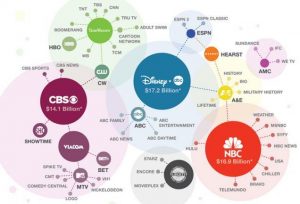
  • Corporatism. In the mid-eighties, the Federal Government and capitalist interests began changing regulations to ease corporate opportunity for investment and expansion. Tax laws, too, were excessively loosened. While this strategy was needed through the nineties, it was not repaired as the economic environment shifted for the new century. Corporatism is very much out of hand and is the primary contributor to plutocracy today. Mariner offers just one example of how Corporations have run amuck and control too much of the economy. Consider Disney – ol’ Mickey’s place:

The lobbying power alone will weaken democracy and move toward a genuine plutocracy where economic policy is made by a few very powerful executives. The solution to this is totally political: enforce antitrust laws already on the books. A second example is the power of banks such that they sit at the center of the US economy. One may recall that Senator Warren has made breaking up big banks a major plank in her campaign.

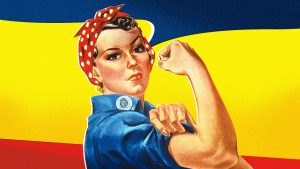
  • National image. The US has no economic image that reflects its industrial might or its ability to keep pace with the future. Not having this image is the same as an individual not having a psyche. An image will be needed if US society is to overcome identity politics. The only model at present is the Green New Deal which will provide for infrastructure, reducing climate change and bring manufacturing back to the shores of the US. The nation needs a new Rosie.

So that is a view of the economy as the smoke and shells clear. Were readers masochistic, the discussion could continue to fascinating topics like church versus state, revamping undemocratic issues such as the Senate, elections, universal health and reasons for going to war.

May the Force be with you.

Ancient Mariner

Postmodernism

Mariner was drifting through the endless world of the Internet last evening when he came across the author Frederic Jameson, a prolific writer in the 1980s and 1990s who contributed ideas about postmodernism. Mariner hasn’t thought about postmodernism since the 1990s. It is refreshing to revisit the perceptions of Jameson and others about the philosophical interpretations that underlie the way people perceive the world today.

Most readers are aware of ‘the age of enlightenment’, a movement that occurred in the 18thcentury. It evolved because of new scientific understanding at the time and the beginning of industrialization – both of which changed how people lived and identified with society (Luddite rebellion in 1811).

Then, from about 1900 to 1965, came modernism. To keep the post short, mariner cites Wikipedia:

[Modernism, in general, includes the activities and creations of those who felt the traditional forms of art, architecture, literature, religious faith, philosophy, social organization, activities of daily life, and sciences, were becoming ill-fitted to their tasks and outdated in the new economic, social, and political environment of an emerging fully industrialized world.]

It is intriguing to note that the end of modernism was imprinted in American history by three significant assassinations: John and Robert Kennedy and Martin Luther King. As an example of the breadth of philosophic change at the time, one of mariner’s favorite authors, Paul Tillich, wrote “Christianity and the Encounter of the World Religions” in 1963 and “Situation Ethics: The New Morality” by Joseph F. Fletcher was written in 1966. Since then the role of Christian doctrine in American culture has been changing dramatically.

Postmodernism is the next interpretation of society, religion, art, economics, etc. It defines how everyone today experiences society and daily ethics. In the turbulence of the sixties, from Viet Nam to Woodstock, a conservative resurgence occurred to quell general disruption and was empowered by the election of Ronald Reagan. During this conservative period especially during the 1990s, philosophers like Jameson began to realize a new world was emerging that would be culturally segmented and institutions of every kind would not be sacrosanct.

Just like the earlier periods of enlightenment, change has been brought about by scientific advancement, an emerging new kind of economy, and a separation of human values from religious and ethical traditions. Today, the polarized conflict between conservatives and liberals in all walks of life represents the same conflict experienced at the end of earlier periods of philosophical change. It is interesting that shifts in global philosophy occur more rapidly each time.

Ancient Mariner