Pragmatism

The mariner has always been pragmatic. He supposes most folks feel that way about themselves. The mariner tends to depend on his five senses and his experience to evaluate the world around him. As a child of five, he saw in an encyclopedia pictures describing the solar system and the universe. That great bodies could float in space was a mysterious marvel and that meteors came from nowhere and left just as mysteriously was fascinating to conjure.

This mystery and others eventually made the mariner a frequent visitor to the local library and in later years to the Internet as well. He sought what others thought about his questions; perhaps an answer would be provided – at least a better one than the mariner had at hand.

There is good and bad in being pragmatic. The good is that rationality prevails in all circumstances. What is reasonable is the most correct perspective. Among fellow human beings, the mariner’s dependence on rationality leads to a middle of the road attitude and, to a degree, a willingness to search for better solutions.

The mariner does not accept behaviors that reinforce dependence on mystery as fact. He has difficulty understanding why so many believe in miracles and intervention by otherworldly beings. Often, his perception of a situation is far different from others. One that most can relate to is the leap from reason to belief in “flying saucers and creatures from space.” This is not the place to debate the subject. It is an example of building belief on mystery rather than fact.

To the mariner’s dismay, there are many pragmatic behaviors for identifying the correct perspective. For example, one wonders why the Congress (the sentence can be ended here as a question) vetoes gun registration when 92% percent of U.S. citizens favored registration. The rationality is perverse and is centered on personal success rather than American wellbeing. The concept of greater good has disappeared from virtually every government in the United States. The idea of greater good and democracy go hand in hand. Without one or the other, the whole concept is dysfunctional. This dysfunction includes the Supreme Court. The Court refuses to hear cases that deal with one-person one-vote, a subject that encompasses voting practices based on racist and political oppression, abuse of the concept of redistricting, and the Court bias toward Reconstructionist thinking at the expense of large numbers of citizens suffering repression and the lack of fairness. The framers of the Constitution established a capitalistic democracy because they were businesspersons and successful entrepreneurs. Still, it was important to them to preserve fairness and civil liberty for every citizen. This is no longer true in the halls of government.

To the dismay of extreme conservatives and extreme progressives, the world will never be a happy place. These folks are dreamers, believers, and champions of their cause. The world is a pragmatic place. The significantly bad side of pragmatism is that it lacks soul. Lack of soul is what permits the rich to get richer, the Earth to fall into disarray from human abuse, and the lack of concern for victims and disadvantaged peoples. All these imbalances stem from a pragmatic logic but a logic that has no soul.

Some individuals and organizations combine soul with pragmatism: volunteer organizations, charitable organizations, even the United Nations, the only government designed to be a worldwide government – albeit it strangled by the wealthier nations. The UN is buried under the motives of international banks, military supremacy, corporate greed, crooked governments, often, if not totally, denied the right to intercede in behalf of the starved, the slaughtered, and the bereft. Woodrow Wilson rolls in his grave.

Pragmatism shows its best side when the greater good is included in its rational conclusions. The greater good is the soul of pragmatism.

Ancient Mariner

The Simple Life

As the mariner grows older, his hearing continues to fade. He watches the meaningful television shows, mostly on PBS, but cannot understand the audio portion very well without captions or hearing aids. This is not to say that his ability to think or read has diminished. The mariner knows one thing for certain, though: He will miss the full effect of the new and exciting age of audiovisual technology. It is an exciting age coming toward us as quickly as the wind blows across the prairie.

How we communicate; how we participate in government, retail, and personal decisions about our lives will change. The smart phone is just the beginning. Very soon, entrepreneurs will master cloud technology (simply defined, the ability to maintain your entire life in a database online), It will be as if you had a servant and a parent watching every decision you make.

If you decide to buy a Jaguar instead of a Ford, “it” will know about that aberration and suggest alternatives. A consortium of banks will manage your finances automatically such that you will be unable to go into unreasonable debt.

In entertainment, it will be a glorious release from the constraints of cable where one must buy 200 channels just to watch four. You will be able to shape to a very specific degree what you want to watch – including events that are not part of television as we know it. Three dimensional experiences, where you, the watcher, are part of the action and even able to alter the plot, is not far away.

The future technology will not be limited to your budget and entertainment. Automobiles are within a decade of accident-proof driving. Your grocery purchases will be managed according to your likes and dislikes. Clothing stores will know your size, style and price range. Anything you purchase will be known by your money-managing banks. The downside is that maybe the banks will stop a purchase for one reason or another. Suppose you want to go on a nice vacation but your account balances and credit margins say you can’t go. There is a price to pay for all this technical automation.

Even simple things like doorbells will change. Technology is available today to notice someone is at the door, do a face ID search and announce to you that John and Debbie are at the front door.

Social Networks will become your calendar, schedule your bills, arrange vacations and track not only where you are but where everyone is that you want to know about – and their schedules, too.

Unlike today, where one logs on to a world wide web of choices, your service provider will shape your access according to your history. This happens today if you allow it. The mariner was using email with Google chrome active the other day and mentioned, quite innocently, a psychological term in the text. Google immediately offered me a choice of nearby psychiatrists.

It is truly a new world coming to us. Not only in a personal sense, but we will know in real time the activities of our governments, the global politics and the issues of global warming and anything else –miniscule or overwhelming, that is happening.

Your knowledge can be the sum of the entire world’s knowledge. The father of Greek Philosophy, Thales, would be proud.

Ancient Mariner

The American Health System

If anyone uses the excuse that the United States should not have a new health system – especially if they say, “In Canada and Europe, you have to wait in line,” tell them that the wait time in the United States is much longer.

About a year ago, the mariner hurt his back trying to lift a 500 pound, seven foot sofa bed up the stairs, his son helping at the other end. It was a comical affair leading finally to a chainsaw to cut the sofa enough that it would bend around a turn like two trolley cars. We completed the job and tossed the bed into a large dumpster. Done and done. At least the mariner thought so.

Sometime in February, the mariner began to feel soreness at the low end of his back. Like anyone, he treated the discomfort with over-the-counter pain relievers. When spring came, with the outdoor chores of planting and cleaning and shoveling, his back didn’t want to participate and told him so by causing muscle spasms along the pelvis, the right hip and up the right side of his back. Many readers can relate.

In March, the mariner called for an appointment in Des Moines with his primary care doctor; first available time was in April. The doctor requested an MRI, which by the grace of his efficient nurse assistant, the mariner was able to get the MRI in Iowa City that night – out of the way but sort of on the way home. Otherwise, the MRI would not have occurred for three days. The primary care doctor scheduled an appointment to review the MRI a week later.

When the mariner arrived for the review, the doctor said it was inoperable. The mariner asked if the doctor had passed the MRI to a neurosurgeon for an opinion. He had. “Inoperable.”

The mariner wanted a second opinion. Through a friend, a quick appointment was scheduled in three weeks at Iowa University Hospital with the head of neurology. When the mariner arrived, another neurosurgeon had his appointment. That neurosurgeon agreed that the mariner’s back problem was inoperable. The neurosurgeon said the next thing to do was to go to a pain clinic. Sitting in his office in May, the pain clinic could not schedule the mariner until September.

The mariner’s primary care physician prescribed stronger pain relievers that prevent spasms but still, the mariner finds it painful to bend over or lean forward.

Obviously, this is not over. It may be true that the mariner did not stand in a line for a doctor visit the very same day; he had the pleasure of waiting at home for weeks and months. Good friends of the mariner traveled to England for a vacation. One of them broke a wrist. They were treated the same day, including x-rays, and never had to pay a dime for treatment even though they were foreigners. The mariner pondered how much it might cost a Brit to break their wrist in the United States.

Ancient Mariner


The Truth Shall Set You Free

The mariner observed a news item on television that claimed drinking four cups of coffee or less suggests that his life will be extended by lowering his risk of a heart attack. The mariner is skeptical about the statistical announcements that claim to modify one’s lifespan.

When the mariner was a teenager, he owned a 1939 Chevrolet four-door. In those days, motor manufacture was not as precise as it is today. A gallon of gasoline did not go very far; adding a quart of oil when one filled the tank was de rigueur.  Paperback magazines, comic books and newspapers had frequent advertisements for additives to the gas tank or the oil pan that would increase mileage by x miles per gallon, or less oil consumption per gallon.  One ad was for belt wax that assured better performance in all moving parts of the engine.

The mariner once added all the claims and determined, skeptically, that if he used every additive, he could increase miles per gallon by fifty percent.

I recently wrote a post called “Our Brain and Probability.” Its premise was that it is hard for the brain to understand events that may or may not occur. The brain wants to say, “Oh, if I drink less than four cups of coffee, I won’t have a heart attack as soon as I would if I drank more coffee.” Someone within that statistical assumption will have a heart attack tomorrow at age forty-five.

No matter how many samples are in a probability table, the conclusion is never absolute.

The brain can add all the suggested preventatives that minimize heart attacks and determine that one will not have a heart attack until the age 105. Death by automobile accident was not in the table.

The current cause is to eat heart healthy diets. The diet approach does not put a probability in its claims, only that one can live without having a heart attack at all. It does not mention that arthritis, cancer or dementia statistics will rise in old age or that slip in the bathtub….

The point is this: The brain is poor at understanding probability. However, the brain is quite superior in its ability to rationalize. For example, the brain can associate being overweight with eating too much. No probability involved. Given the will, one can lose weight by not eating as much. When one will die is not part of the equation except some pencil person will want to find the probability that being overweight affects lifespan by X percent.

Examples are infinite. Driving habits include dozens of rationalities, for example, whether we choose to be rational or irrational by using our text devices at sixty miles per hour. Being rational or irrational is an issue within the brain rather than executing a probability that you may die. One does not say, “It’s my turn to die so that the probability can be true.”

The modern American has so many information sources that they are overwhelmed with information that is useless, half-true, or bogus altogether. Some information may be true but irrelevant. There are two realities, perhaps even two separate worlds, when one listens to FOX news then listens to MSNBC. At PBS the news is rinsed in cold water before broadcasting.

One also must deal with the surreal world of retail advertising. If one watches a commercial on television, one must be careful not to make rationalizations based on the commercial. The mini-realities in beer commercials are particularly surreal. If you drink beer (brand does not matter), you must be one of those beautiful thirty-year olds who have money to burn and know the words to a beer song. Be thirsty, my friend.

The mariner surmises that his rhetoric comes from a reaction to the falsehood presented by information providers. Remember in the Viet Nam war when the US ran an ‘incursion’ into Cambodia? The true word is ‘invasion.’ Today, a coup is not a coup in Egypt; it is the removal of a troublesome, albeit elected, President by military force. The US President, who is the legal arbiter to determine whether it is a coup, fills the air with “I am not required to execute that law.” (referring to the law that says if Egypt has a coup, the 1.5 billion in US aid will stop).

Politics is as bad as beer commercials except politicians use real bullets and our pocket money to sustain their surrealistic world.

It is very hard for one to obtain unbiased and truthful information that is relative to a person’s daily decisions. I wonder if the historian Josephus had a similar problem.

Ancient mariner


An Iowa Town

The mariner first arrived in Iowa in 1964. He had never seen black soil before driving through Illinois, crossing the Mississippi River into Iowa. The first night was spent in Fort Madison, a small city on the river. The next morning, the mariner walked out of the hotel into a scene from a horror movie. The Mayflies had hatched. The air was so full of billions of Mayflies that the Sun was not as bright as it should be.

Mayflies filled the streets level with the sidewalk; shop owners were using coal shovels to clear the sidewalks; they crunched under foot and passing automobiles had a strange sound as the tires crushed the Mayflies. There was no way to avoid the flies tangled in his hair or slipping inside the shirt collar. The Mayflies were in his ears and eyes.

Mayfly

Fortunately, Mayflies are harmless and rise from the river one day a year to mate. In 24 hours they are dead and cover every inch of Fort Madison’s riverfront community. The mariner had never seen Mayflies before, either.

The mariner left Fort Madison to travel to his destination. It is a small town, perhaps 1,000 – 1,200 residents at the time. The very first thing the mariner noticed was the lawns. Every lawn mowed and trimmed all through the town. So obvious was the characteristic that the image remains embedded in the mariner’s memory. Even today, in 2013, homeowners never shirk the duty of cutting the lawn. In the Spring, this means cutting the grass every third day – or fourth, depending on the frequent rainfall. The mariner had never seen such uniformity of lawns. He pondered what this meant about the Iowans who live in this town.

Main Street clearly identified that the town was supported by farming. On Main Street were two farm implement dealers, a Ford dealer, a bank, two restaurants, a hardware store, two grocery stores, a furniture store, four gas stations, a dry goods store, a pharmacy, two barbershops and one church. Farmers came to town on Saturday night, which provided a holiday-like atmosphere. A commuter train ran right through the middle of town. Off Main Street were a mill, three churches, a Chevrolet dealership, another implement dealer, a funeral home, a small motel, a blacksmith shop, an ice cream stand, and a school building that housed all twelve grades.

Clearly, the fifties and sixties were halcyon years. A lot has changed. Today on Main Street there is no implement dealer, no Ford dealer, a different bank, no restaurant except sometimes at the golf course, no hardware store, no grocery store, no furniture store, two gas stations, no dry goods store, no pharmacy, one barbershop, no church, and the train tracks disappeared long ago. Off Main Street, the mill is there, the three churches, a different funeral home, no ice cream stand, no blacksmith, the same small motel that has not changed in over sixty years, and no school.

The majority of townspeople were related through seven major families; everyone truly knew everyone – for multiple generations.

In 1964, the residents were a mix of tradesmen, retired farmers and folks who worked in nearby towns like Fort Madison. Back then, there were few rental homes. Today, absentee ownership is a growing concern. The tone of the town no longer carries an agricultural air; it is a bedroom town, which, if it had a different history, would be called a development. Most residents today have no relationship with farming and while most folks know some folks, no folks know everyone.

The same story is told of hundreds of towns in the Corn Belt. What caused this change? To make a long sociological story short, some major causes are listed below.

Underpriced land in the seventies prompted many farmers to go into debt. Then a few bad crop years forced selloff. This resulted in fewer but larger farms – and fewer farmers who came to town.

Walmart, HyVee and other “box” stores drove the price below what the small town dealers could afford.

The eighties ushered in the giant farm. Where there once were six or eight farm families, now there was only one.

Government subsidies enabled larger farms to purchase smaller farms, driving the population down further.

Improved roads made it easy to go to Fort Madison or two other small cities twenty miles away.

The school was moved out of town. Now there was no childhood allegiance to the town by townsfolk or farmers.

The train disappeared.

Low property values encouraged absentee property owners and working class families. Few retired townsfolk made their living on an outlying farm.

It isn’t over. The churches languish trying to hold on to the old culture and have steadily dropping membership. The Golf Club struggles in a similar fashion. Since the new highway was built around the town, not even truck traffic passes through anymore.

What still remains, almost magically, is the small town culture. It is a culture that is laid back, easy going, and friendly. We townies still cut our grass regularly and do not mind stopping to share a few words. It is a leg up on city life for sure. The mariner would like to move this town to an oceanfront location.

Ancient Mariner

Personal Experience

Personal experience is defined as the events, successes, failures, sensory input, and thought that create our value systems – the personal experiences throughout our entire life that guide our judgment, our understanding of good and bad, our perception of reality, and our personal opinions.

In the post “The Evolution of Faith,” a metaphor describes how personal experience is very real but also very limited. We ask a fish: What is water? The fish will know water as a collective experience of its lifetime. However, the fish will not know about water in its entirety. The fish will not know the chemistry, the physics, the behavior of water as ice, or the cyclical atmospheric role of water through evaporation, rain, humidity, and the creation of climate – not even the source of the very water that sustains the fish.

This limitation may be satisfactory if a human were a fish. In many ways, a human is much more sophisticated than a fish, particularly as a thinking creature who knows it is always important to understand the greater view of reality beyond personal experience. If a human does not continuously learn about and examine reality, the human mind unnoticeably slows down, shrinks and becomes brittle.

The mariner attended a social gathering with some of his closest friends. All were bright, successful individuals; all were middle class; men and women were present; all were very caring in nature and open to radical thought. As the conversation progressed through the evening, the mariner became aware of how influential personal experience can be. There were several opinions where a simple experience prevented a logical examination of reality, where personal experience disrupted the judgment of broader issues.

Often, the middle class is described as the worrying class: They are in the middle between the wealthy, who do not experience the squeeze of financial insecurity, and the poor, who do not experience the challenge to have a successful future. The wealthy seemingly are interested only in becoming wealthier without regard for the wellbeing of the middle class; the poor are interested only in survival without regard for the morality of the middle class. Therefore, judgmental behavior abounds in the middle class – sustained by worrisome personal experience.

There are many classic middle class prejudices toward the poor: abuse of food stamps, welfare cheaters, lack of a job. The list is much longer. Two aspects of these prejudices occur to the mariner: First, personal experience cannot be the measure of another person’s personal experience – the “walk a mile in my shoes” argument. Second, allowing personal experience to be the primary thought process does not achieve anything – the issue is always broader and more complex than personal experience can explain. If not, behold, the human has become a fish!

It is harder to be judgmental about the wealthy. First, everyone would prefer to be wealthy so the middle class accepts behavior of the wealthy more easily. Second, individuals of wealth can afford to buy their way out of immorality. Is this why the wealthy never go to jail? Is it acceptable to steal billions of dollars from the economy while receiving infusions of capital from the government to cover losses? Is it within the morality of the middle class to destroy the lives of millions of people in order to gain even more wealth? Is it within the morality of the middle class to toss out a government program that is a lifeline for millions in poverty because personal experience noticed a difference in moral behavior?

Readers may ponder these questions. However, ponder them with more than a fish brain.


Ancient Mariner


Snow in May

Yes, in Iowa, it can snow in May. It’s been a long haul to break free of winter. The ground is still too cold for tomato plants to grow very much and a lot of flower seeds still sit in their packets waiting for the mariner to prepare the garden beds.

The temperature will be in the seventies today, after an overnight low in the low forties. Tomorrow the forecast is for sunny and 90°. That’s Iowa for you. Iowa’s best seasons are spring, which runs two weeks in late may, and autumn, which runs two weeks in late September.

The mariner had a small landscaping business many decades ago. It is still fun to look at a plot of land and envision what can be done to make it a spectacular landscape – an artist with a blank canvas. So gardening includes a lot of hardscape work.

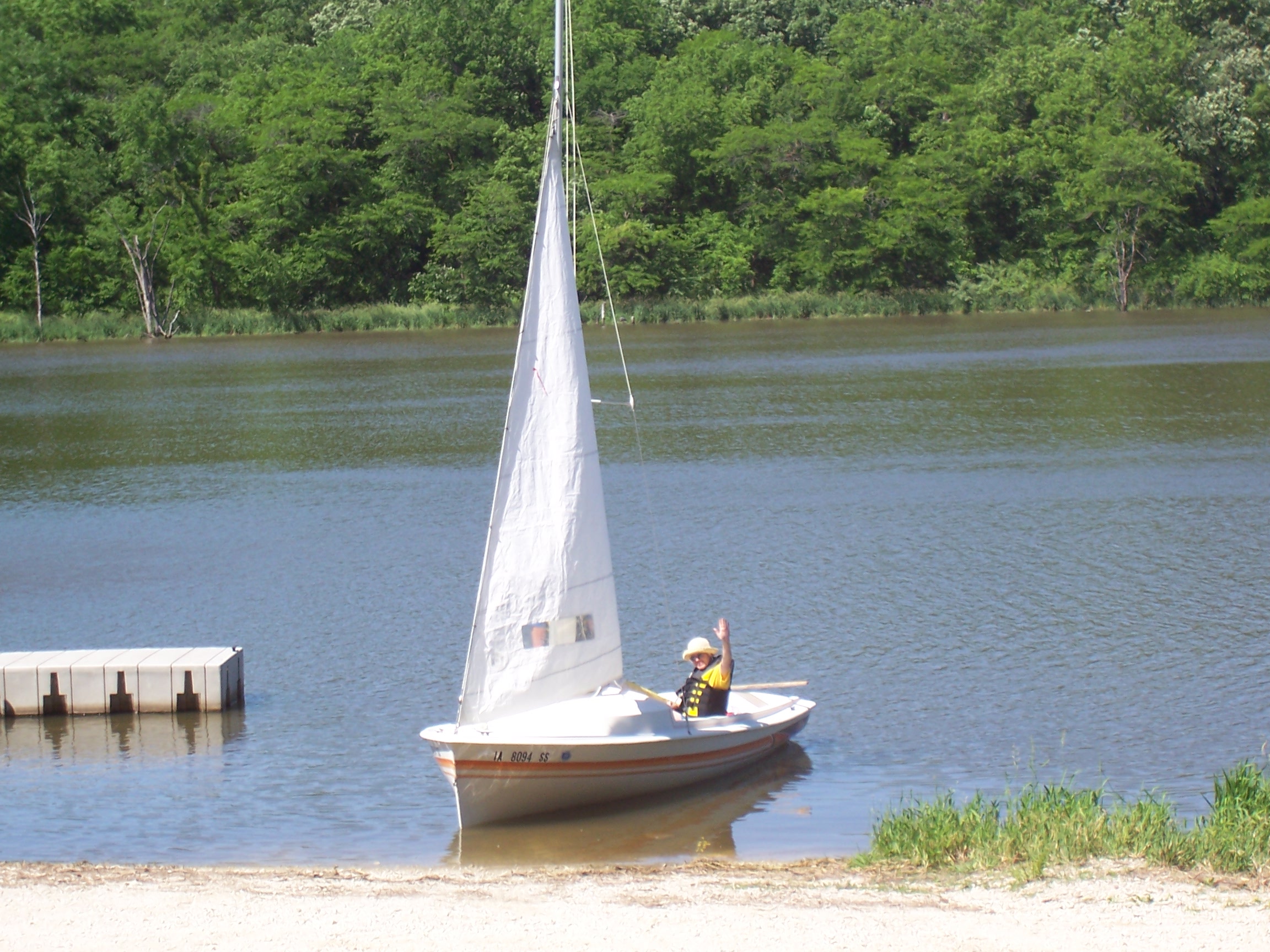
The mariner has a 17 foot 1982 O’Day day sailer. It had an accident being blown into a low bridge; the deck had separated from the hull on the port quarter and the boat has seen some tough years as well. I bought it for the price of the trailer plus 500 bucks for the boat. I reunited the deck with the hull and sailed it for a season or two. The centerboard didn’t work well when under way and the boat did not come with a motor. In a stiff wind, sailing was, shall we say, in an undetermined direction.

Marty in O'Day

The mariner lived on a twelve acre farm at the time and stored the boat in the implement shed next to the tractor. I raised the boat off the trailer and dismantled the trailer completely – every piece. Rust spots were sanded; new wiring would be put in. The mariner painted the trailer with a car finish white.

We sold the farm and moved to town. The mariner had no place to store the boat. So the mariner built a forty thousand dollar shed in the back yard to house the boat. For the money, the shed is also a wood shop, storage for garden tools and supplies and has a vehicle bay.

Shed 12-12 007

The poor boat hasn’t seen a drop of water for two years. This summer, there are plans to completely refurbish the boat. With only a sail cuddy, it ain’t exactly a passage boat but don’t forget – the mariner lives in Iowa.

The late spring jams things a bit. Late garden preparation, rewiring and building storage in the garage, and refurbishing the boat.

It is still my goal, however, to sail in the Chesapeake Bay this fall. It won’t be pretty but it will float and steer. It will be fun.