
Living life on carnival rides

Spending some time in Chicken Little’s henhouse, where news broadcasts and publications are not allowed, mariner has become aware of how myopic news programming is. Many readers will agree that if one watches the news on Monday then watches the news a week later, it’s the same news. Perhaps Fox news, MSNBC, all the social media sources and ‘streaming’ news together have set the bar very low in terms of other topics that, while not blowing things up, starving people, giving coverage to useless and mostly conspiratorial congressmen, may have more impact on the near future of mankind. Below are a couple of topics that are very important and are changing reality on a daily basis.

Extinction

Back in 2014 Elizabeth Kolbert wrote a scholarly treatise about the rapid decline of the world’s creatures. A quote from the flyleaf of The Sixth Extinction – An unnatural history:

“Over the last half billion years, there have been five major extinctions, when the diversity of life on Earth suddenly and dramatically contracted. Scientists are currently monitoring the sixth extinction, predicted to be the most devastating since the asteroid impact that wiped out the dinosaurs. This time around, the cataclysm is us.”

Elizabeth cites the disappearance of over 16,000 species of every nature and every family of creatures. There are too many humans (see Overpopulation below) taking up way too much space, consuming way too much of the planet’s reserve of chemicals, and by their nature, deliberately and wantonly destroying critical balances in the Earth’s environment.

Through technology and industrialization, humans have been able to flaunt the natural restraints of Mother Nature, enabling humans to live longer, live conveniently and ignore disturbances in the planet’s biosphere – at the cost of 16,000 innocent creatures and, since the 19th century, destabilizing the careful balance of global weather; an issue that is important enough to make the news. For the last 300,000 years, the weather has been unusually stable, allowing an excellent opportunity for all creatures to flourish. That stability is rapidly disappearing. The inability of humans to evaluate human economics versus planetary economics may be the doom to life on Earth as we have known it.

Humans, being the smarty pants that they are, abide by a major perspective: “If it can be done, do it”. In this vein, humans may be adding themselves to the list of species that are becoming extinct. Less than a year ago, scientists celebrated a special accomplishment: They were able to marry a computer sequence with a chromosome such that the computer sequence can reproduce itself. Now computer programmers themselves may be out of a job. Two scientists, no less than Albert Einstein and  Stephen Hawking, held that if artificial intelligence can propagate itself, humans are too inefficient to compete and will become extinct.

Overpopulation

Regular readers know that mariner has placed great stock in the similarity between mouse and rat overpopulation studies done in the 1960s and 70s and the state of human society today. Quoting managing scientist John Calhoun’s observation about the study:

“At the peak population, most mice spent every living second in the company of hundreds of other mice. They gathered in the main squares, waiting to be fed and occasionally attacking each other. Few females carried pregnancies to term, and the ones that did seemed to simply forget about their babies. They’d move half their litter away from danger and forget the rest. Sometimes they’d drop and abandon a baby while they were carrying it. The few secluded spaces housed a population Calhoun called, “the beautiful ones.” Generally guarded by one male, the females—and few males—inside the space didn’t breed or fight or do anything but eat and groom and sleep. When the population started declining the beautiful ones were spared from violence and death, but had completely lost touch with social behaviors, including having sex or caring for their young. At least the rodents had unlimited food and water – not true with the human population.To human advantage, humans have guns and bombs, shoot children and anyone that seems different. Is this enough to reduce population?

A special carnival ride is the combination of not enough food with climate change. The combination is trashing whole nations’ economies.

And with war on every continent, rising authoritarian governments that will enforce inequality, and artificial intelligence cutting society from the past like a pair of scissors, this is a grand carnival ride!

Ancient Mariner


A new sign, a new hope

One of the main reasons mariner has had such a cynical view on the state of affairs is that there were no positive movements. Every issue was argumentative and intent on destruction of counter proposals. Every leader was either a democracy-busting dictator or an oligarch. Schools continue to crumble, wages remained static, the nation engaged in not one war but many, Mother Nature was coming down hard on global stability. Where was the hole in the fence? Where could we step through to a new, constructive society? There was only barbed wire and trump, a Hitler look-alike.

Until today. Flipping through the AOL news clips, mariner came upon the attached clip. It is the first positive sign in this century. Mind you, it is in its infancy and could be crushed in this societal hurricane. Nevertheless, it is a genuinely positive and constructive sign that there may be a hole in the fence. Please read to sustain hope.

https://www.aol.com/news/another-christian-movement-changing-politics-130312336.html

Ancient Mariner

What if –

Our nation went back to the original campaigning environment where, because of the spread of the population and a relative isolation because modern transportation and communication weren’t around yet, the funds for campaigning were limited to local funding within the electoral jurisdiction and the selection of campaigners was a local decision?

Albert Einstein said we can’t go back.

What if credit cards didn’t exist and the local economy depended on cash, check and local bank financing? Would giant retail mega-corporations exist?

Albert said we can’t go back.

What if the amount of income from any source was subject to an upper limit beyond which federal taxes would be 100 percent? FDR did it.

But Albert just chuckled.

What if unions were pervasive enough to restore full-time, corporate guaranteed retirement and full medical benefits?

Albert said nope.

What if the entire education industry had been able to keep up with inflation like the universities did?

Stop this says Albert. The laws of physics say that under certain conditions it may be possible to leap into the future but going back in time is not possible.

Anyone care to peek into the future?

Ancient Mariner


The good and the bad

Mariner often has feedback suggesting he is an ‘old timer’ that won’t accept the modern world; they suggest he is too negative. He can’t deny these opinions and he is vulnerable to flamboyant metaphors as well. Still, his values stem from his humanist beliefs – a known and accepted philosophy in the world. But seldom practiced. Humanist ethics and Christianity have similar beliefs; both virtually are nonexistent today because the Romans declared that Christianity was the state religion.

It acted like a state acts; it went to war; it monopolized the economies of Europe; ‘Christian’ explorers entered the new world butchering, raping and stealing the wealth of native cultures; today it still behaves as a Roman adjunct to government. He finds it a validation of modern Christian values that it is more important to rebuild Notre Dame, a symbol of religious authoritarianism than to save 1,000 mature trees required to rebuild it in a time when global warming threatens catastrophe. He agrees that the times today require a remake of tradition – but let’s take it in the humanist direction. No room here to talk about American racism and gay follies or oligarchian authoritarianism.

Turning to unimportant issues like speech, mariner has added another word to his dictionary of words beloved by the hearing impaired: shouldna. It means ‘should not have’. What makes this word an interesting addition to the dictionary is the nuanced ‘should not of had’.

So what’s the good news to be had? Foremost, mariner and his wife have had the entire family visit during October. That means two children and their spouses, three children, one dog, two nephews, two cousins and five lifetime friends – all between the eleventh and the thirty-first! Who says extended families are passe?

Further good news, albeit spotty, is that the Republican party is dickering among themselves. The founding fathers intended to have two parties that represented the rainbow of citizens. It’s not over but there’s hope. At some point we may be able to reverse Newt Gingrich’s weaponizing of the two-party system. He shouldna done that.

Ancient Mariner


On democracy

The premise of this post is to examine the impact of progress upon the cultural perceptions that existed in 1778 when the United States was born. Progress is not a bad thing; the benefits in comfort, health and functional prowess cannot be denied. What also cannot be denied is that progress has altered human behavior.

The ideals of democracy, its philosophy and manner of governing, is a product of the Great Awakening, the intellectual era that lifted Europe and America out of the dark ages. Similar to citizen behavior today, the public held a defiant resistance against the power structures of the Dark Ages. The transition to a new culture where each individual participated in society was led by religious liberation from the corrupt and powerful control of Roman Catholicism. The Reformation, led by religious leaders, preached that every person had an equal place in the eyes of God.

Sociologically, human behavior at the time still was constricted by the primitive forms of communication and travel. There were large cities where trading and governance occurred but generally the common citizen was bound to local and regional economics and self-reliance on a day-to-day basis. The term used to cite this culture is ‘communalism’. This was the nature of society in 1778.

What follows is the description of a series of historical moments that changed the economics and social behavior of the public. It can be argued that the troubles of the United States in 2023 are the unintended result of progress.

֎ In 1778 it was virtually impossible for a citizen to communicate with anyone even 50 miles away. Daily responsibility to sustain survival took an immense amount of time, which also limited communication. As a result, the Declaration of Independence and the Constitution proposed a distributed form of governance that would allow every citizen to have a say in that governance. Hence the creation of a democratic republic divided into states, counties and districts.

The intent, philosophically, was to have each district contribute political or legislative needs and elected representatives that would be submitted to the county, then to the state. Each state then met with all the other states to pass legislation that accommodated local needs for the entire nation. In 1778, this process allowed each citizen, in principal, to participate in governing the nation in a way that accommodated a locally isolated society. The flow of information and decision making rose from the local communities, processed by the next level of governance and finally to represent national policies.

֎ In 1827 The Baltimore and Ohio Railroad opened its lines. The isolated nature of communal economics changed rapidly. Especially in agriculture, it was possible to integrate farm produce in quantities that required processing companies and much wider distribution to the end user. The local farmer was not dependent just on local markets to sustain his financial security. The bottom-up politics of communal economy had been displaced; processing corporations influenced many different districts, counties and states, often appealing directly to states and the national government. Further, transportation was a new political force that influenced national politics without the need to follow the bottom-up philosophy of democracy.

֎ From April 12, 1861 – April 26, 1865 the American Civil War caused severe damage to the idea of local self-sustenance. The war destroyed many communities and killed more than 600,000 soldiers (comparable to 7 million in today’s population). At the end of the war many did not or could not return home. Despite the truce that ended the war, the philosophy of a democratic republic continued to suffer because of racism and unwanted intrusion in Confederate states by the national government. Communalistic representation suffered a permanent change in daily life.

Even today the political scars remain that cause the two-party system to operate inappropriately in light of the philosophy of a democratic republic.

֎ The next culture-changing advancement in progress was the telegraph and telephone. The first public network was organized in 1877. Before 1877, if one wished to talk to another, it had to be face-to-face. Today, in 2023, we can recognize this new telecommunication device to be the first version of the smartphone! One more reason not to harness the pony and ride a mile and a half down the road.

As with all types of progress that covered many voting districts, the job of Gross Domestic Product (GDP) was removed from communal economics and was, politically at least, in the hands of corporations. Retrospectively, one can see that the nation was quickly replacing democracy with corporatism.

֎ The ultimate collapse of communalism and bottom-up democracy was caused by the internal combustion engine. No one needed to keep the pony around anymore. State fairs became popular and represented the local remnants of communalism – just as they do today. Still, it was a burden to travel too far on two lane roads that meandered from town to town having followed old roads from one community to another (Remember Route 66? It was started by Indians.). The two World Wars facilitated shifts in population to support industries needed by the wars, causing a breakup and redistribution of communal families. But the final blow came when Ike created the Interstate system. One could travel on roads that were not managed by states – only by national government contracts.

A ghost of the past is sustained by air travel. Remember your parents who still live in the old home where you were born? It takes an airplane to get there and back in a reasonable time.

So here we are today with an electorate that has no voting power. Political opinion no longer comes from dialogue within a community. The power lies with corporations and the wealthy class who fund very expensive campaigns most local people cannot afford and forces the communal person to pick from television ads, biased news programs and gaming strategies like gerrymandering and avoiding term limits. One recent suggestion is rank voting, which may help with the act of voting, but will not repair communalism, aka democracy.

It is time to have a constitutional convention. Yes, the mariner is as afraid of such an event as anyone. The reality is, however, that democracy doesn’t work anymore. What is the new equality? What is the new ‘all men are created equal’? How do we get there from here? Will wearing a gaming goggle help?

Ancient Mariner


All over again

We live in a time of change, no doubt about it. Not just the normal change between generations or the systemic changes brought on by cyclical weather eras or the changes in economics brought on by political shifts. Today it is a time of change commensurate with the first time, about 15,000 years ago, when humans discovered economic trade and the political advantages that went with it; nomadic cultures quickly disappeared.

Today is a time of change commensurate with the technology of the printing press when, for the first time, ideas and history were available to the common citizen, not exclusive only to the tiny elite of theorists and theologists. At a time when the Americas were discovered, the Great Awakening, the Reformation, and the Industrial Revolution rapidly emerged and changed human life around the world.

Today is a time of change commensurate with the invention of the internal combustion engine in a global moment when natural resources were unlimited – allowing global trade and global warfare, and the quick dissipation of tribalism replaced by a new wave of politics called colonialism.

Today, computer-based communication replaces the printing press; today, advances in travel, technology and economics have released a new age of exploration – not across the oceans but from the Northern Hemisphere to the Southern Hemisphere.

Today, global politics enters a new age when nationalism will be replaced by corporatism.

Today, an uncontrolled warming of the planet replaces cyclical weather eras.

Today, the number of humans on the planet exceeds the limits of the planet’s environment.

Today, the era of European white dominance will shift to a non-white majority, leaving the United States in a disadvantaged position because of its intense racism.

One wonders what the next era of change will look like, starting all over again.

Ancient Mariner

Regarding the Apocalypse


Mariner’s alter ego Guru, responsible for wide ranging philosophical and futuristic insights, claimed in a recent post that the Apocalypse already has begun. There have been queries about definition.

From his safe house in Chicken Little’s hen house, mariner will lay out the timeline implied by Guru.

It all began innocently 2 million years ago when a new species evolved that had a growing brain. The species was Homo. 1 million years ago, Homo began splitting into variations. Many failed to sustain themselves and became extinct but a few with names like Neanderthal, Habilis, Australopithecus and Erectus survived into the age of humans. Together they would become Homo sapiens.

In those days, Homo had no choice but to live within the natural confines of their habitat. Living a plenteous life in an agreeable environment, a typical lifespan was about 40 years. Homo’s predators were meat eaters, infections and serious injury.

These characteristics are similar to the few indigenous tribes that still exist in remote areas of Africa and South America. These tribes to this day sustain themselves only with the restorative resources their environment provides.

About 10,000 years ago, Homo discovered how to grow more grain than he needed, hence the beginning of commerce by acquiring more grain than would be consumed by a local tribe. In a subtle way, this is the first abuse of the natural relationship between Homo and the environment.

Centuries roll by and Homo learns more ways to consume the environment beyond his natural relationship with nature. Homo extracted from nature other creatures like donkeys, horses, and wolves that would help expand the ability to acquire excessive amounts of Nature’s resources. Then Homo discovered iron, tin, lead and carbon-based energy. Now Homo could consume many times his need from Nature. Homo was consuming Nature faster than Nature could replenish itself.

This imbalance was the seed that has grown into the apocalypse we have today.

After I million years of living in accordance with the rules of Nature, in the last 1,000 years, Homo has trashed Nature; Homo has trashed the basic tribal society; Homo has trashed multiple generations that cohabit as a protective wall against difficult times. Homo quickly learned to ignore Nature and lived by the rule ‘If you can do it, do it’. He developed elaborate tools which, at every step, diminished the evolutionary potential of every Homo. For example, the use of coal and gasoline in the last 150 years has destroyed the security provided by extended family and tribe (town economy). Its method was to produce trains, automobiles, mechanized, oversized farms, superhighways and national and globally based industries.

In just 150 years the apocalypse gained speed. Isolated nuclear families became the norm – left defenseless without the human support of multiple generations and tribal support. Giant corporations became the norm, slowly eliminating local economies, local jobs and the existential satisfaction found in smaller towns and cities.

In the last 175 years, the apocalypse has shifted into a higher gear. 16,000 species are extinct because of Homo indifference. Around the world potable water is becoming scarce. Seafood from the oceans is 20 percent of what it was 100 years ago. And obviously the excess use of fossil fuel has launched serious changes in air quality and of the planet generally.

But in this century the chains are off. What easy transportation did to tribes, the Internet is doing to society. Communication technology makes war easier and more horrific; interpersonal skills and rewards are replaced by artificial behavior that dismisses 1 million years of evolutionary sophistication; privacy and security are fallacious assumptions.

Now a new age is upon us: artificial intelligence (AI). AI can emulate the entire reality of Homo. The final bridge to the apocalypse is that AI can reproduce itself. Who needs Homo?

Ancient Mariner


Climate change versus Tipping Points

Everyone with a television or a radio knows the climate is shifting. Typically, scientists and weather broadcasters will cite old weather records that are broken by today’s storms, flooding, drought and heat, inching up in small amounts each year. Generally, the public acknowledges these unusual changes but often dismisses them as part of a slow and probably long-term condition.

Scientists have begun redefining ‘climate change’ as a series of increasingly disastrous events called tipping points. For example, Vermont, a no-news weather area, has had its second 100-year storm in roughly a decade. This likely could not have happened twenty or thirty years ago but the ‘slow creep’ of statistics has reached a point where new conditions permit sudden disruptions in climate that were not previously possible.

Several nations around the world have experienced economic collapse because of new levels of turbulence, drought or flooding. Rather than defining these news events as a gradual increase in the effects of global warming, scientists have recognized them as notable events that were not possible in the past and identify them as ‘tipping points’.

For the past ten years or so, scientists have used annual statistics to predict that turbulent times will occur between 2030 and the end of the century. Today, however, there is a correlation for climate change based on tipping points. In each instance tipping points become more disruptive.

To be metaphoric about it, we are accustomed to watching the weather train go by but that is no longer appropriate. We should be watching cluster bombs explode and consider the circumstances should the cluster bombs become nuclear bombs.

How can we cry “Uncle” to Mother Nature?

Mariner has his sunscreen, hard hat, flippers and an innertube ready to go at his apartment in Chicken Little’s hen house.

Ancient Mariner

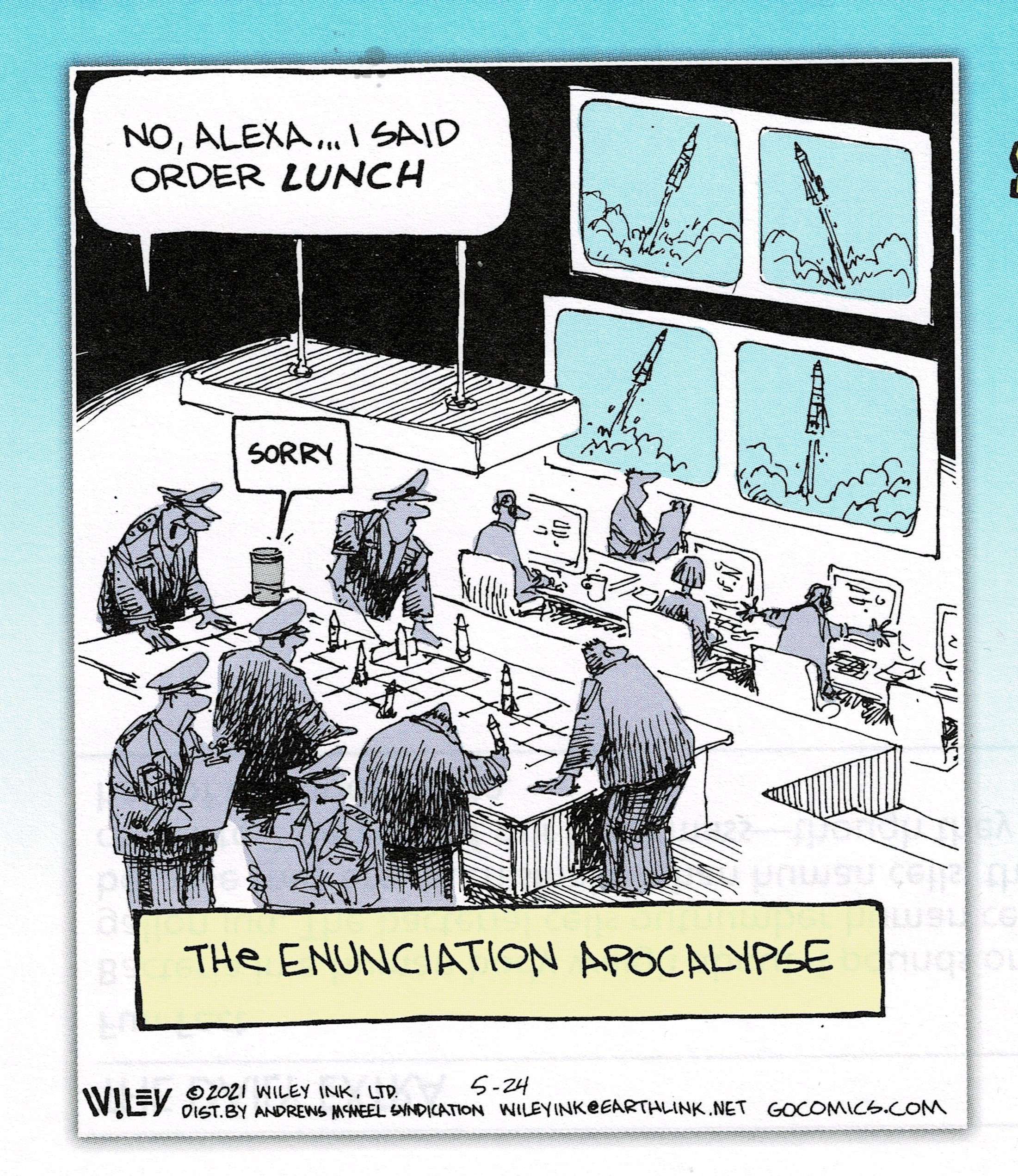
Does anyone have a plot line?


By Wiley:

Is it possible that our eager scientists are consumed by the phrase, “I do it because I can”? Is Homo sapiens ready for an automated lifestyle? Is the biosphere ready for Homo sapiens to have an automated lifestyle?

Scientists have created Xenobots, computer cells that can reproduce. Even Steven Hawking predicted this will be the demise of humanity.

Over the millennia, humans have learned to adapt to significant changes in the biosphere status quo; everything from ice ages to rocket ships and nuclear bombs. But each epoch was singular – just one at a time.

It isn’t the same today. There is AI, collapsing nationalism, global warming, social abuse, over-population and the waning of Adam Smith economics.

Can we Homos handle it?

Ancient Mariner

Pick your worries

There must be dozens of worries from which to choose. Perhaps start with some of the big ones: A failing democracy, the collapse of religion, war with China, Trump becomes President, Social Security gets chopped, housing for normal Americans gets worse, Health industry collapses, public schools can’t educate anymore.

Mariner opts for the war with Mother Earth – global warming/climate change. The time is approaching when all the other worries will disappear because of extreme disruption to global economics, agriculture, viable living zones and human migration on a scale that has never been experienced. Governments will not be able to pay for wars, although groups of rebels around the world will cause as much destruction. Plutocracy will worsen then collapse as The US runs short on funding.

ProPublica, a much awarded and exceptional news company, published a report titled, “Climate Crisis Is on Track to Push One-Third of Humanity Out of Its Most Livable Environment”. One paragraph is presented below:

“The notion of a climate niche is based on work the researchers first published in the Proceedings of the National Academy of Sciences in 2020, which established that for the past 6,000 years humans have gravitated toward a narrow range of temperatures and precipitation levels that supported agriculture and, later, economic growth. That study warned that warming would make those conditions elusive for growing segments of humankind and found that while just 1% of the earth’s surface is now intolerably hot, nearly 20% could be by 2070.”

 Add to that thought rising oceans wiping out the viability of dozens of nations, even making large areas of land become flooded or submerged. Current tax structures will be changed dramatically as the United States begins to feel social and economic pressures that remind us of World War II America. In the 1930s and 40s, the tax philosophy was to tax the rich so the poor would not have to underwrite government expenses. FDR, for example, put a 100 percent tax on income over $25,000 (about $500,000 today).

One wonders whether the new facemask telephones will matter even though they are one step closer to Matrix reality. The world’s environment is up in arms and that will dictate our pleasures. Can Alexa and Siri keep up?

Ancient Mariner