
Red Brain, Blue Brain

The following information was published in the PLoS ONE journal on February 13, 2013:

“Red Brain, Blue Brain: Evaluative Processes Differ in Democrats and Republicans

Liberals and conservatives exhibit different cognitive styles and converging lines of evidence suggest that biology influences differences in their political attitudes and beliefs. In particular, a recent study of young adults suggests that liberals and conservatives have significantly different brain structure, with liberals showing increased gray matter volume in the anterior cingulate cortex, and conservatives showing increased gray matter volume in the in the amygdala.

Here, we explore differences in brain function in liberals and conservatives by matching publicly-available voter records to 82 subjects who performed a risk-taking task…. Although the risk-taking behavior of Democrats (liberals) and Republicans (conservatives) did not differ, their brain activity did. Democrats showed significantly greater activity in the left insula, while Republicans showed significantly greater activity in the right amygdala….. These results suggest that liberals and conservatives engage different cognitive processes when they think about risk, and the results support recent evidence that conservatives show greater sensitivity to threatening stimuli….. Conversely, liberals had stronger responses to situations of cognitive conflict than conservatives.”
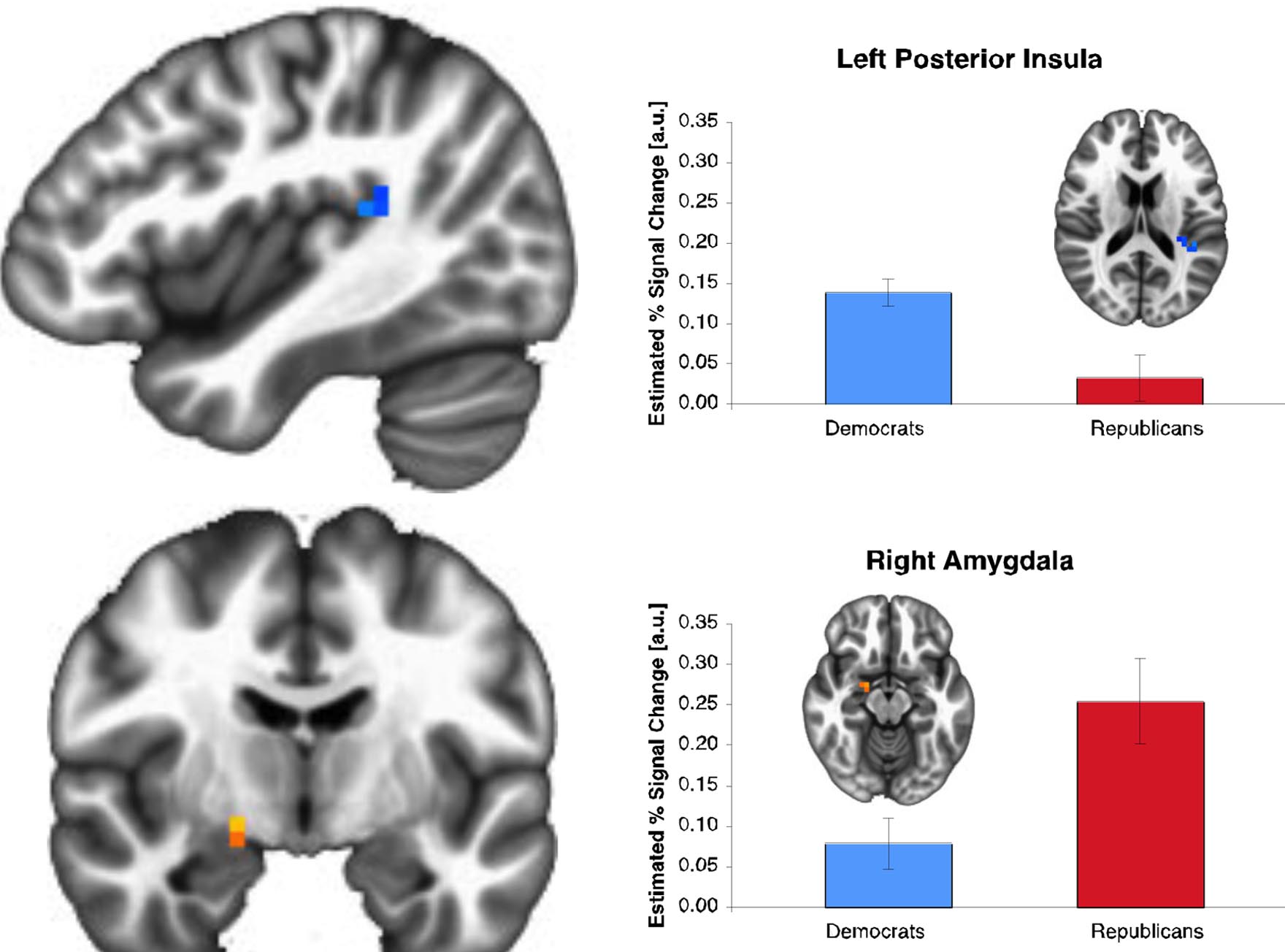
Red brain art

The mariner apologizes for the scientific journal lingo – rather dry reading. He will paraphrase while contemplating what this means in the world of politics and beliefs in general. His comments easily can be interpreted too literally; the reader should consider the mariner’s informal interpretations as parables.

Republicans orient attention to external cues. What this means is Republicans find it less important to understand how they feel inside; more important is their control of potential risk outside.

On the other hand, Democrats orient attention to perceptions of internal feelings – how they feel about the external cues. This orientation also borders the temporal-parietal junction, and may reflect the perceptions of internal feeling and motivation in others as well.

Now the reader has a clear and firm understanding of the difference between a Republican and a Democrat. The mariner perceives this may not be true. Let’s take a real example but remember that simply saying something for clarity may be overstated and may not be wholly true in the first place.

Republicans are good managers because they are risk averse. Republicans are sensitive to anything that blocks their range of decisions in dealing with risk. Therefore, Republicans do not like labor unions because labor unions have the ability to limit what the Republican may want to do regarding job profiles and salary – risk-laden issues in any business. This does not mean Democrats aren’t good managers, too. Remember the statement in the journal lingo: “Although the risk-taking behavior of Democrats (liberals) and Republicans (conservatives) did not differ….” In other words, a good manager will deal with risk appropriately – liberal or conservative.

The Democrat manager, however, is sensitive to his/her feelings about jobs and salary and, because the temporal-parietal junction is nearby, empathy may play a role in how the risk is perceived. As long as labor unions play by fair rules, the Democrat is more likely to accept why being in a union is important to the employees’ perception of risk.

How are we doing? Maybe one more example. But to keep it simple, no elected government folks are allowed:

Bah, Humbug! People have nothing to do with global warming! Republican or Democrat? We don’t really know for certain but several surveys show that this is a Republican. Global warming is nothing if it is not constrictive, behavioral (the right amygdala doesn’t know about behavioral) and interferes with profit strategies across the board. A Republican would run from the restrictive regulations that cure global warming. The same is true of the fossil fuel industry, the banking industry and a myriad of other corporate interests that do not want to be curtailed in their decision making regarding risk to profit.

What is the future of humanity if it all boils down to Left Posterial Insula versus right amygdala?

Ancient Mariner

Labor Unions

It’s time for someone to say something nice about labor unions. Recent generations have forgotten the bloody, indeed murderous conflicts which our grandfathers and great grandfathers fought to gain humane working environments for employees. In those protests, larger companies sent thugs to beat protestors with clubs – even to the point that many died while protesting. That horrendous time was at the turn of the century. Franklin Roosevelt provided cover for twenty years. However, since the 1980’s there has been a concerted effort on the part of corporations and state governments – consider Scott Walker as Governor of Wisconsin who pushed through anti-union laws:

NBC News, March 9, 2015

“Wisconsin Governor Scott Walker signed into law anti-union legislation that prohibits union workers from being required to pay union dues. The so-called right to work law is an effort to reduce the power of unions in the Midwestern state and is one that will give Walker additional conservative bona fides in his likely presidential bid.

Walker refused to indicate during his reelection campaign in 2014 if he would support the legislation. His signature Monday morning makes Wisconsin the 25th state to implement the ban that was passed by the Republican legislature earlier this month.

Opponents of the bill say it will decimate unions and have a ripple effect of suppressing the ability of workers to organize while supporters, including Walker, say that this will lead to economic growth.

“Adjusted for cost of living, employees in forced unionization states have almost $2,000 less in disposable income. Bottom line, this reform is pro-freedom and pro-work for Wisconsin,” Walker wrote in a recent opinion piece for the conservative website Red State. [Still, he did not mention reduced health and retirement benefits and vulnerability to tax cuts affecting jobs.]

This is the second major anti-union legislation that Walker has supported. In 2011, he ushered through highly controversial legislation titled Act 10 that reduced the bargaining power as well as health care and pension benefits of public sector unions. The move led to a recall election, which Walker won.”

Well, Wisconsin gets what it deserves with its vote. But the workers of Wisconsin clearly are not better off when their health care and pensions are cut; their right to negotiate a fair wage and benefits is negated, and the right to work law virtually denies any union votes to organize in the workplace.

Twenty-two states have right to work laws. The name is deceptive. It means one has the right to work for a company without having to join a union. It also means, depending on the language in most states, that unions cannot solicit a worker to join a union.

Just about every common citizen agrees that middle and lower class workers are being screwed. The United States is an oligarchy, not a democracy. There are only so many ways for workers to participate in the profit curve denied them at this time:

  • Have union representation.
  • Have a fair profit sharing system based on hours and tenure, not salary.
  • Have employee-owned corporations with comparable seats on the board of directors.
  • Have unions bid on job creation opportunities.

The first and last options go together. Unions have retirement funds that can be leveraged to bid against corporations. An example, provided by Bill Clinton, is for a union to bid on the reconstruction of LaGuardia Airport in New York. This has moved forward. The reconstruction belongs to the union, not a corporation. Fifteen thousand jobs will be created for a long term project and it will be owned by the union.

There are dangers in this kind of arrangement. The mariner has written in the past that power corrupts. Nevertheless, at these moments in history when income is so imbalanced in the US, maybe it’s better for unions to manage corruption than the Congress and state legislatures.

Ancient Mariner

Advocacy at Home – Local Organizations

In this final section, the point is made that one soldier is a good soldier – even a hero. However, one soldier will not win a war. Toward the end of the last segment, neighborhood organizations were mentioned as a form of vitality, a force that sustains a good gestalt. Many of these local organizations have outreach components that go beyond the neighborhood to address state, national and global issues. Add to the local organizations the many larger organizations that focus on various issues, and one has assembled an army of good soldiers.

Local organizations with established outreach include the majority of churches, particularly connectional denominations, where many local churches contribute to a fund-raising distribution center. Many social organizations adopt a cause beyond the neighborhood from simple causes like the Lion’s Club eyeglass redistribution to widespread campaigns like the Methodist Church’s “No More Malaria” campaign. At the following website, 51 veteran support organizations were listed:

https://www.nrd.gov/other_services_and_resources/veterans_service_organizations/chartered_veterans_service_organizations

For  virtually endless numbers of wildlife organizations, use:

http://www.bing.com/search?q=List+of+wildlife+protection+Organizations&go=Submit+Query&qs=n&form=QBRE&pq=list+of+wildlife+protection+organizations&sc=0-31&sp=-1&sk=&cvid=9fedf1e8b48949c097ef6008f02d68a8

For organizations dedicated to improving the environment, see:

http://www.nrdc.org/reference/environGroups.asp and

http://webecoist.momtastic.com/2008/09/24/25-environmental-agencies-and-organizations/

Further, government agencies abound:

http://www.grinningplanet.com/5005/government-agencies-environmental.htm

If the reader is serious about stemming the tide and extending the day of Armageddon, one is in constant communication with many of these organizations. They are the reader’s army. They will be glad to receive one’s participation and financial support. The mariner endorses all of them as helping in some way although some may be better organized than others. A list of efficient organizations follows but may not cover one’s specific interest:

http://www.fundraiserinsight.org/articles/environmentalfundraising.html

Do not forget the sportsmen organizations. While they may be self-serving in goals, they improve the environment to sustain the wildlife they hunt. Often on counterpoint to sportsmen is:

http://www.humanesociety.org/ which is involved in a plethora of animal rights and abuse issues around the world – not just pets.

To provide a concise wrap up to the series on Advocacy at Home, the list is briefly revisited:

Utilities (water, gas, travel): Virtually all the issues in utilities can be improved by improving your own home. Consider some modern upgrades that will reduce the use of fossil fuel byproducts. If your vehicle has a few years on it or is a larger vehicle for when you had children, consider replacing it with something more efficient. Use cloth shopping bags. Some national issues are the legislative battles between pipelines, oil wells and environment, fossil fuel versus renewable fuel, and international trade agreements that directly affect oil prices.

Global ecology (air, water, use of chemicals):  Water is the most critical resource on the planet. Secondly, carbon emission already is killing sea life. Finally, the Environmental Protection Agency needs triple the budget it has to police the many chemical violators (speak constantly with vigor to each of your representatives at all levels of government). They are all sizes from gasoline stations to Dukes Power Company and the coal, gas and oil industry at large. Advocacy and policing by citizens is very effective in this issue.

Food (water, quality, chemicals, land use): Commercial food production consumes immense, almost unbelievable amounts of water. The greatest reduction of water use is to grow your own vegetables or buy home grown at farmers markets – enough to store in the freezer or can. Purchase protein products from a local butcher/locker or directly from the wharf – an interesting experience if one has never purchased fresh seafood. Finally, cut back on red meat. Land use is legislated in favor of farmers and developers; many regulations are local and hearings are open to your attendance and wise advice.

Specie ecology (Microsystems, estuaries, wildlife): You MUST step out and be an active advocate of your cause. Belong to an organization that will extend your influence. Jump in and “save a whale or a bear or a fox, etc.” with your own hands.

Neighborhood gestalt (trash, abandoned housing, loose pets – and your house!) It takes more than owning a tract in a neighborhood to contribute to a good neighborhood gestalt. Be part of the neighborhood through interaction with neighbors, organizations and charitable behavior.

Local organizations (scouting, youth clubs, nursing homes, PTA, Lions Club): There are many, many volunteer organizations in the reader’s community. In many communities, there are volunteer fire and first responder companies; dozens of volunteer organizations exist from preschool to high school; every neighborhood has unofficial neighborhood watch groups for people in difficulty on the street. Interestingly, the various motorcycle brands publish handbooks full of volunteers within a half hour of wherever the reader’s bike fails. If the reader has a bike, pass it forward and put the reader’s name in the handbook. Lastly, but importantly and entertainingly, get to know one’s police officers on a personal basis. The reader eventually will meet them while on a walk.

The mariner worked many years ago with the Maryland State Police. He joined the Fraternal Order of Police (FOP). At the time, he was an independent consultant in the law enforcement sector and traveled around the country. He was able to use the FOP as his private ORBITZ and once in Washington, DC, was put up on FOP premises and treated like royalty. It takes a village – AKA neighborhood. For broader perspectives, see the list above in this post.

Tools

Many newspapers, even if online versions and especially local newspapers: Read the news headlines from Bing (news not show business), Google (news, not show business), Huffington Post, Atlantic, New York Times and other known and respected news sources. The content is better presented, more relevant, and more diverse than any television station. Local issues will be found only in local newspapers.

Two or three respected soft cover journals, even if they’re at the library: These are the journals that can be boring if the subject is not one you are interested in. However, if the subject pushes your button, there is no better source to become informed. Try:

Agenda (for your reading pleasure – excellent poetry)

American School Board Journal

Education Week

InfoWorld (computer news)

National Journal

Scientific American

The Atlantic

The Economist

Washington Post

Neighborhood walks: Once a week, if not more, walk all the streets of your neighborhood. If nothing else, it’s good for your health. Make a mental note of changes of any kind. Do not hesitate to introduce yourself and start a conversation with individuals you meet who obviously are not in a hurry. Ponder a future conversation that may need to be had with someone in an organization who may be interested in that change. Make note of something you and your family can do to improve a situation.

Discerning eyes: Eyes help during your walk, of course, but discerning eyes look beyond the instance to see emerging patterns and ramifications, even projecting the impact of government and zoning futures. Perhaps a park is needed for children or simply green space for other creatures.

Personal blog and twitter communication: Talk to people all the time! Email, voice, twitter, facebook, your congressmen and other government individuals, your neighbors, your fellow workers, your extended family, your merchants. If a high functioning recluse like the mariner can do it – so can you.

Physical effort (scheduled time, communication, achieve goals): It’s time for discipline. Get out of your #%@$!&!! house and do something.

Ancient Mariner

Advocacy at Home – Neighborhood Gestalt

Remember in the post, “Advocacy at Home – Overview,” an example was to pick up a trash cup in the gutter and having done so, improved the entire street? Neighborhood gestalt is about stuff like that but much more multidimensional. What can the reader do in one’s own neighborhood, even one’s home – that will provide a satisfactory gestalt?

Main Entry:ge£stalt

Pronunciation:g*-*st*lt, -*sht*lt, -*st*lt, -*sht*lt

Function:noun

Inflected Form:plural ge£stalt£en  \-*st*l-t*n, -*sht*l-, -*st*l-, -*sht*l-\ ; or gestalts

Etymology:German, literally, shape, form

Date:1922

 : a structure, configuration, or pattern of physical, biological, or psychological phenomena so integrated as to constitute a functional unit with properties not derivable by summation of its parts.

For example, a neighborhood’s government service infrastructure consists of water, gas, electricity, adequate law enforcement, fire response, education, health services, sewage, trash collection, tree trimming, replacing streetlights, collecting unwanted junk, maintaining streets and sidewalks, clearing street snow and maintaining common space shrubbery and lawns – all of which create a neighborhood that seems orderly and provides a nice neighborhood in which to live. In other words, the gestalt is pleasant and respectable, creating an atmosphere that is greater than just performing government services.

Gestalt is more than government infrastructure. It includes the reader’s home and property. Does the reader care for personal appearance in the same way the city cares for the neighborhood? Does your lifestyle reflect the rest of the neighborhood? Does the reader keep yards and porches free of junk, trash, and odd lot paraphernalia? Trimmed shrubs and cut grass? Does the reader paint and repair the outside of the home?

This tendency to comply with one’s surroundings is an evolved survival behavior that depends on normalization and tribal trust for security. Gestalt turns out to be more than government services. Some communities create Home Owner Associations to assure normalization. The mariner thinks this is a bridge too far, having a sense of the Third Reich looking over one’s shoulder. Free expression, too, is a form of normalization.

It turns out that gestalt is found everywhere, even in the worst slum – although normalization and tribal trust conform to different tribal behaviors. The super rich have gestalt, too. Who dare not have a gardener?

Gestalt includes specific tonal and dialectic differences that signal one’s neighborhood – even within a block or two. The reader could vacation in parts of Baltimore, Philadelphia and Chicago where those from one neighborhood can barely understand those from another. “Skoeet. Whameano?”

Yet, gestalt is even more multidimensional. There are expectations within a neighborhood to behave with a given set of “manners;” the way one steps aside on the sidewalk, or parks one’s automobile carefully to not infringe on the neighbor’s spot, or in a slum neighborhood, ignoring theft charges when a young person (or an old one for that matter) walks by the sidewalk fruit stand and grabs a couple of oranges without paying. Can the reader sense a form of “manners” on the part of the store owner? Life can be tough.

The behavior of the store owner leads to another dimension of gestalt. Set aside the role of government. There is an obligation for the reader to help keep the neighborhood vibrant; keep the neighborhood dynamic and meaningful in society. There is an expectation for neighbors to participate in sustaining the vitality of the neighborhood. In a middleclass neighborhood, one feels the need to participate in babysitting clubs, little league, service organizations like the scouts, Rotary and Lions, support the churches, synagogues and mosques, the local library and even be patrons at local businesses. Are you old like the mariner? Do you participate in meals on wheels or provide transportation to those who cannot fend for themselves?

The reader gets the idea. We are closely involved in the gestalt of our neighborhood. But. But – far out on the horizon, there are greater gestalts which are addressed in other posts in this series. The reader’s obligation is not only to sweep the porch steps, it is to improve the troublesome circumstances on the horizon that eventually will reach the reader’s neighborhood – and perhaps not in a pleasant way.

There are many steps to sweep, many dimensions to repair.

Ancient Mariner

Having a Hog for Dinner

Or maybe a chicken, or leg of lamb or a steak tenderloin. It is the ritual of the farming life. Most of us remember the family farm. It was a good way of life. Farm operation was self-sustained. There was a balance between investment, byproducts (including environmental contamination), and lifestyle.

Those were the good old days. Farmers took pride in their individual efforts and products. The County Fair was big time and winners could boast of best livestock, best crop, and even best harness race horse. Children were encouraged to compete in future farmer contests that required intense engagement with animals, their health and even their happiness.

It isn’t that way anymore. The reader remembers it that way, but that farm is long gone. Even organic farms are run for profit, not for lifestyle. Largely, what exist today are corporate farms. Corporate farms disregard the environmental impact; corporate farms waste water in immense volumes; corporate farms physically torture livestock to increase profit.

And Iowa is the worst state in the United States.

The mariner mentioned once before that he is a member of Food and Water Watch (FWW), which concerns itself with abusive treatment of resources, livestock, pollution, or misrepresentation to the customer. Below is a website that will lead you to a map that shows the concentration of corporate farms in the US. Look at Iowa. The Koch brothers participate in more corporate farms than any other Iowa corporation. They are opposed across the board to humane treatment of livestock and disregard the gross impact of their waste on the environment.

 http://www.factoryfarmmap.org/

 Screw the world, give me my dollars. Does this describe the American dream?

Ancient Mariner


Topic: Environment

Just a day or two ago, the mariner wrote that environmental issues and their solutions will be the largest contributor to new approaches and standards for the economy, jobs, new business opportunities, tax adjustments and infrastructure.

Already the mariner has benefitted from improvement of the environment in his home town. The City Council, as part of funds available from a larger project dealing with soil erosion and pollution in local streams and drainage ditches, eliminated several Ash trees.

In just a year or two, dying Ash trees will be an economic burden on this town and its citizens. The Emerald Ash Borer, a green beetle, kills Ash trees by burying eggs in the cambium layer of the tree. When the eggs hatch, the grubs destroy the cambium layer, eventually girdling the tree. This town has many, many stately old and very large Ash trees.

The mariner had six Ash trees on his property. In front of the house by the street, three Ash trees were within the path of the larger project to upgrade surface drainage ditches. The trees were removed by the City Council. The mariner estimates that each tree would have cost him $1,500 when the time came to remove them. He will attempt to save the three remaining trees with a new root drench product. With luck, maybe the trees can be saved. They may already be infected.

Other homes along the proposed drainage upgrade had Ash trees removed as well.

Of course, the mariner is pleased at the unexpected savings. He also saw the experience as a classic example of how environmental improvement creates unexpected benefits for many people, businesses and ecosystems beyond the specific goal of the improvement.

Taxes can be modified by the many tax rebates available for home improvements designed to reduce energy usage, e.g., improved insulation, renewable energy solutions and weatherized windows. The city will have tangential benefits because road surfaces and shoulders will not erode as quickly – an improvement in infrastructure.

Now on to natural resources and higher standards for their utilization.

Ancient Mariner


Todayland

Some readers of the mariner’s blog are discomforted by the negative tone that often creeps into the mariner’s posts. He admits that sometimes he does not need to share his dissatisfaction with every day nuisances like rabbits and Midwest weather. Grant him the excuse of personal therapy.

Some readers feel the mariner is simply depressed. This is too bad because the reader shoots the messenger and discounts the information. The truth is that the mariner is depressed by the content of his posts – as the reader should be as well. Nevertheless, the mariner has an ethic about the quality of information and the important, though sometimes abstract, revelations put forward.

He knows he is more the skeptic than the poet. The mariner chooses to comport himself with the likes of Gandhi, King, Amos, Joshua, Geronimo and Jane Fonda. Something is grotesquely wrong with the United States today. Every one of us lives defensively – not noticeably day-to-day for most of us but we huddle under the shrub like my friend the rabbit, hoping no predator will pounce on us.

In this post, rather than go on and on about the details of this grotesqueness, the mariner will list topics followed by the primary issue and how it may affect us rabbits. He asks the reader to bookmark these mentally so the reader will notice activity in the news that is related to these topics. In later posts, perhaps he will expand the detail as he did with the bribe money paid to greedy Congressmen by corporations to fast track the TPP. (Incidentally, he just mentioned the primary predators of us rabbits: government and corporations.)


Private money in government. This topic has more snakes than Medusa. At the top, legislation must be enacted that prevents financial contributions from any private source and limits campaign financing to the governments holding elections. We are affected by money in government because it displaces democracy. Adding insult to injury, the Supreme Court recently declared money as speech. Therefore, it’s not one person one vote; it’s one dollar one vote.

Gerrymandering. Mandatory to resolution of redistricting abuse is to remove this function from political influence primarily by removing elected officials and party leaders from the process. The size and population of a district is intended to be based entirely on census data and equal distribution among the districts. There is a new issue that threatens one person one vote: The Supreme Court agreed to hear a case that would determine district population only by registered voters, not the census. Since the Court threw out the Civil Rights Act supervision of election procedures, thirteen states have been purging voter rolls without verification – eliminating many who have been voting for years but are the wrong race, too poor or disruptive to local politics, e.g., college students. Adding this new interpretation will enable gerrymanderers to ignore whole neighborhoods as if they didn’t exist. Gerrymandering is the root cause for needing the term “silent majority.”

Voting. Updating the way we vote is long overdue. We should consider Australia’s model. Voting is mandatory; if a voter fails to vote, he/she is fined. Further, votes should be cast by a mailed ballot. Internet voting opens a completely different set of problems and would be even easier to manipulate (Your vote is supposed to be secret for several reasons; does the reader think Google will respect your privacy? New ads will appear on your computer obviously based on the way you voted.) Mandatory, mailed voting will help with the gerrymandering topic.


The topics listed above must be repaired before we can expect any changes to the way corporations treat employees, the environment, and international business practices. On the government side, the topics must be repaired before there will be citizen-centric policy for entitlements, infrastructure, military objectives, developing new markets using modern technical solutions, and economic policy – just to name a few. Topics that will have the most profound impact are listed below.


Environment. Deceptively, addressing the environment will have a profound effect on every topic on this list. Briefly, many dramatic disasters will be avoided along the coasts, destructive weather, and across all the species of life; reset the domestic economy with new jobs, new policies affecting the oil and gas industry versus other energy sources – creating new areas of industry and development; a massive upgrade of the infrastructure to require less energy and less costly materials, including a resurgence in shipping via rail – a rail that will be based on new, more efficient technologies; all this only skims the surface of what solving the environment issue will generate.

Government control of natural resources. Today, corporations invade, misuse or destroy many kinds of resources from oil spills to backfilling sensitive estuaries to grazing cattle for free on protected land. The issue of control could be seen as a subset of the environment topic. However, government control of natural resources has a strong element of economic policy that is more to the point. It will have a much greater impact on corporate behavior. For example, how livestock is raised, what chemicals are allowed on any natural resource from golf courses to chickens to fish farms. Good examples in today’s food production are the issues of labeling and artificial additives. Holding up the Keystone pipeline because of ancillary US cost, political interference, tax revenue, and a host of local objections related to the disruption of local businesses is another example. If US governments, Federal, State and Local, had more influence and were backed by citizen-centric political power instead of corporate payoffs, the use and development of natural resources would be fair, improve production and be rational.

International control of multinational corporations. This is a scary topic for the mariner. As corporations move into the international markets made possible by computerization and telecommunication, they are moving into an area void of regulations, national law, and human rights. The multinational corporations will create a faux “government” presence that nations will have great difficulty controlling. An EXCELLENT example is the Trans-Pacific Partnership (TPP) agreement. Generally, it grants freedoms to corporations to operate in several nations as they see fit; they can ignore work related regulations because the multinational corporation is not under the jurisdiction of any one nation or, as the mariner suspects the TPP is written, all the nations collectively. They can move profit around to avoid taxes (that already happens often). The structure of international agreements, as they are written now, almost guarantee a culture of skimming, bribes and payoffs. Never forget the purpose of any corporation: profit, profit, profit, and no liability.

US tax structure. Taxes are the tool with which government has the ability to execute its functions. Today, as everyone knows, the tax code has more holes than a screen door. Most of the holes, similar to the TPP payoff, are inserted by interests who own the Congressmen, or Governors, or state legislators. The tax code, along with suppressed payroll practices since 1985, has created the imbalance of personal worth such that 90% of the population does not share in GDP profits. All the profits go to the 10% who own 37% of the country’s stock market shares. Fixing taxes will take lots of time and wheeling and dealing. It won’t begin until the current antagonistic atmosphere surrounding elected officials is normalized.

Don’t be depressed. The mariner feels better already!

Ancient Mariner

Trans-Pacific Partnership (TPP) Corporations Paid Congress Richly for Fast Track Vote

The mariner’s post is a word-for-word copy from thegaurdian, a British newspaper with operations in Australia, Canada and the United States. It was written by C Robert Gibson and Taylor Channing. The links can be identified by an underscore. If you would like to pursue a link, go to:

http://www.theguardian.com/business/2015/may/27/corporations-paid-us-senators-fast-track-tpp

The article contains concerns of organizations, economists, political supporters of Obama and others who fear a fast track of the trade agreement will not represent the best interests of working people in the US and other countries as well. Fast tracking TPP means there will be no opportunity to modify the agreement. Further, how passage was bought in Congress shows how little, how very, very small, is the influence of the common citizen. Candidates stand for election to Congress only for one reason: to become rich – or richer. To be a statesman and show concern for any aspect of the US and its citizenry is intentionally suppressed. The article follows:

“A decade in the making, the controversial Trans-Pacific Partnership (TPP) is reaching its climax and as Congress hotly debates the biggest trade deal in a generation, its backers have turned on the cash spigot in the hopes of getting it passed.

“We’re very much in the endgame,” US trade representative Michael Froman told reporters over the weekend at a meeting of the 21-member Asia-Pacific Economic Cooperation forum on the resort island of Boracay. His comments came days after TPP passed another crucial vote in the Senate.

That vote, to give Barack Obama the authority to speed the bill through Congress, comes as the president’s own supporters, senior economists and a host of activists have lobbied against a pact they argue will favor big business but harm US jobs, fail to secure better conditions for workers overseas and undermine free speech online.

Those critics are unlikely to be silenced by an analysis of the sudden flood of money it took to push the pact over its latest hurdle.

Fast-tracking the TPP, meaning its passage through Congress without having its contents available for debate or amendments, was only possible after lots of corporate money exchanged hands with senators. The US Senate passed Trade Promotion Authority (TPA) – the fast-tracking bill – by a 65-33 margin on 14 May. Last Thursday, the Senate voted 62-38 to bring the debate on TPA to a close.

Those impressive majorities follow months of behind-the-scenes wheeling and dealing by the world’s most well-heeled multinational corporations with just a handful of holdouts.

Using data from the Federal Election Commission, this chart shows all donations that corporate members of the US Business Coalition for TPP made to US Senate campaigns between January and March 2015, when fast-tracking the TPP was being debated in the Senate:

Out of the total $1,148,971 given, an average of $17,676.48 was donated to each of the 65 “yea” votes.

The average Republican member received $19,673.28 from corporate TPP supporters.

The average Democrat received $9,689.23 from those same donors.

The amounts given rise dramatically when looking at how much each senator running for re-election received.

Two days before the fast-track vote, Obama was a few votes shy of having the filibuster-proof majority he needed. Ron Wyden and seven other Senate Democrats announced they were on the fence on 12 May, distinguishing themselves from the Senate’s 54 Republicans and handful of Democrats as the votes to sway.

In just 24 hours, Wyden and five of those Democratic holdouts – Michael Bennet of Colorado, Dianne Feinstein of California, Claire McCaskill of Missouri, Patty Murray of Washington, and Bill Nelson of Florida – caved and voted for fast-track.

Bennet, Murray, and Wyden – all running for re-election in 2016 – received $105,900 between the three of them. Bennet, who comes from the more purple state of Colorado, got $53,700 in corporate campaign donations between January and March 2015, according to Channing’s research.

Almost 100% of the Republicans in the US Senate voted for fast-track – the only two non-votes on TPA were a Republican from Louisiana and a Republican from Alaska.

Senator Rob Portman of Ohio, who is the former US trade representative, has been one of the loudest proponents of the TPP. He received $119,700 from 14 different corporations between January and March, most of which comes from donations from Goldman Sachs ($70,600), Pfizer ($15,700), and Procter & Gamble ($12,900). Portman is expected to run against former Ohio governor Ted Strickland in 2016 in one of the most politically competitive states in the country.

Seven Republicans who voted “yea” to fast-track and are also running for re-election next year cleaned up between January and March. Senator Johnny Isakson of Georgia received $102,500 in corporate contributions. Senator Roy Blunt of Missouri, best known for proposing a Monsanto-written bill in 2013 that became known as the Monsanto Protection Act, received $77,900 – $13,500 of which came from Monsanto.

Arizona senator and former presidential candidate John McCain received $51,700 in the first quarter of 2015. Senator Richard Burr of North Carolina received $60,000 in corporate donations. Eighty-one-year-old senator Chuck Grassley of Iowa, who is running for his seventh Senate term, received $35,000. Senator Tim Scott of South Carolina, who will be running for his first full six-year term in 2016, received $67,500 from pro-TPP corporations.

“It’s a rare thing for members of Congress to go against the money these days,” said Mansur Gidfar, spokesman for the anti-corruption group Represent.Us. “They know exactly which special interests they need to keep happy if they want to fund their reelection campaigns or secure a future job as a lobbyist.

“How can we expect politicians who routinely receive campaign money, lucrative job offers, and lavish gifts from special interests to make impartial decisions that directly affect those same special interests?” Gidfar said. “As long as this kind of transparently corrupt behavior remains legal, we won’t have a government that truly represents the people.” ”


The mariner has advice for anyone living in US-held territory: You’re on your own – finance, health, environment, safety, security, and lifestyle. There are many countries where life is more pleasant and more secure. You may consider moving to another country. In every bulleted item below, the US is dropping in rank.

  • The US ranks 36th in education. At the top of the heap were the usual from East Asia: Singapore, Taiwan, South Korea, and three Chinese cities—Shanghai, Hong Kong, and Macao. Education systems in these countries, including college and post graduate studies, are free. The United States trailed nations such as Estonia and the Slovak Republic.
  • The US ranks 38th in health care, just ahead of the Slovak Republic. France is number one followed by Italy, San Marino, Andorra, Malta and Singapore.
  • The US economy ranks 12th in terms of GDP, population and unemployment.
  • The US ranks 33rd in environment behind Belarus.
  • The US ranks 26th in life expectancy behind the Slovak Republic and Denmark.

Don’t look for improvement any time soon. If all you want is money, run for Congress.

Ancient Mariner

Lingering Themes

The mariner hasn’t written much lately. It’s a combination of spring gardening labor and the tsunami of events around the world. There are several old sayings that go along the lines of “What you think isn’t worth a spit in the ocean.” Sadly, that is true. The only tool any one of us has is our vote and our desire to volunteer beyond a normal commitment.

When Justice Roberts said money is the same as speech, he cleared the last obstacle to oligarchy. Some can speak much more loudly than others.

Well, one has seen the benefit of voting. The mariner wonders how untrustworthy his fellow voters have been given election results and the fact that millions follow Fox Broadcasting, Hannity, Rush Limbaugh and Glenn Beck. Laura Calder doesn’t bother the mariner because all she can do is character assassination; little of what she says has content. Then there’s Sarah and Michele Bachman. Only the presence of Jon Stewart has kept us sane – and Jon ends his show August 9th.

We will see what the future brings as 22 republicans and 1 democrat vie for the next Presidential term. The mariner says one democrat because the few democrats running beside Clinton are more interested in raising liberal issues and keeping Hillary as far left of center as possible. In retrospect, history has shown that the Clintons are survivalists first, pragmatic centrists second, and ideologues last.

If you are a regular reader, you know that the mariner is firmly opposed to fast tracking the TPP (Trans Pacific Partnership). The reason that progressives, unions and liberal organizations like AARP and women’s advocacies are opposed to fast tracking is the fact that no one in the negotiations represents the common man; the worker; the issues of minimum wage and benefits.

The argument presented by Obama is that TPP will create more jobs in the US and provide more opportunity for export – not to mention that most American workers won’t make much more than minimum wage. There is no opportunity to discuss worker issues similar to equal pay, employee-owned, retirement benefits, profit sharing and other economic devices that will lift the middle class to where it belongs.

Another issue in the news, that sadly shows the nasty side of capitalism, is the number of oil wells and railroads built within 1,000 feet of ICBM silos in North Dakota. Properly, this alarming situation can’t be represented here. The mariner suggests you watch Rachel Maddow’s video report at

http://www.msnbc.com/rachel-maddow-show/watch/oil-trains-alarmingly-near-nuclear-missiles-444408387996

Six workers have died due to lax (and illegal) safety regulations.

Lastly, climate change speaks more loudly as the days roll by. Nothing will be done by the United States until the ranking democratic member (Barbara Boxer (D)) becomes chairman of the Senate Committee on Environment and Public Works. Currently the chairman is Jim Inhofe (R) Oklahoma – the senator who threw the snowball in Senate chambers, who scoffed at the existence of climate change. Does the mariner sense the influence of oil contributions? Inhofe received a 5% approval rating from environmental advocates.

Enough of dipping one’s toe into the tsunami wave of current events. Perhaps the mariner is safer just limiting his engagement to spitting.

Ancient Mariner


About Rights

The mariner was skimming through internet news sources when he came upon the following news item:

“For the first time in U.S. history, a supreme court has granted a writ of habeas corpus on behalf of two lab chimpanzees, effectively recognizing them as legal persons. While the future of the chimps has not yet been decided, it’s a huge step forward in establishing personhood status for highly sapient animals.

http://io9.com/a-new-york-judge-has-granted-legal-person-rights-to-chi-1699160192

The chimps, Hercules and Leo, are being used for biomedical experiments at Stony Brook University on Long Island, New York…..Animals granted legal personhood status would be subject to many of the rights naturally afforded to human beings, including the right to not be detained without cause, to not be experimented upon, or to have to perform against their will.”

This is the latest attempt at giving smart animals their rights. Incidents already exist for circus elephants, seals, walruses and whales, pets who are heirs, and, for common animals used for pets or consumption, there are innumerable cases involving specific treatment or abuse. A recent issue is the sow stalls for pigs that are pregnant. A corpse has more room in a casket.gestation cages copy

[A gestation crate, also known as a sow stall, is a metal enclosure used in intensive pig farming, in which a female breeding pig (sow) may be kept during pregnancy, and in effect for most of her adult life. The enclosures measure 6.6 ft × 2.0 ft (2 m × 60 cm) and house sows that weigh up to 900 lbs (408 kg). Source: Wikipedia]

Chris Christie(R) , New Jersey’s Governor, was about to sign a bill banning this practice when he backed off because Iowa Governor Terry Branstad(R) and the American Future Fund (pronounced Koch) asked him to veto the bill. The mariner assumes Iowa pig farmers use sow stalls, too.

Australia has banned the use of sow stalls.

Back to the chimpanzee habeas corpus, the judge removed the habeas corpus language the next day but the lawsuit still will be heard with the original intent. The mariner is befuddled because sapient animals, as smart as they are, don’t read. Further, they don’t speak human languages, although a complaint was filed by a neighbor against a parrot that would not shut up. Does a chimpanzee know its rights? Does a pig know its rights? They are at the mercy of the humans that own them. Would they prefer not to be around abusive humans? Of course. However, preferences are not rights. The mariner imagines that until the African slaves could speak English and observe white behavior, they also had preferences but no rights and likely suffered similar abuses.

He has the thought that if the chimpanzees knew about all the wars of history, all the killing, slavery, stealing, murders, rapes, cheating and family abuse, the chimps may think twice about having human rights. The advantage of being sapient but not human is that bad happenings are more rational than they are for humans. Sapient species don’t need presidents, congress, courts, dictators, terrorists or money. Sapient species don’t need torture or death, either – Homo sapiens’s contribution to their lives.

Abuse goes beyond hands-on maltreatment by humans. Humans also have little regard for the ecosystems that are required by every kind of specie. For many years, developers in Maryland bought estuaries of the Chesapeake Bay, backfilled them and built houses and factories. Finally, but too late, the legislature passed laws that restricted conversion of estuaries. The Chesapeake Bay, once an unbelievably rich source of marine life, is no more.

The mariner had another thought about habeas corpus. It won’t be too many decades before sapient robots exist. Granted, robots will be manufactured with specialized intelligence but in some ways, they may be more sapient then we are. We ourselves may be part robot! Perhaps we should go to the movies and watch a few of these futuristic robot movies. For the mariner, the Matrix is scary enough!

Ancient Mariner