
The Future of Work – IV Slow and Fast

As the United States lives day-to-day, transition to a new world of work will be virtually unnoticed. Evidence will lie in statistics and deep economical analysis. However, in terms of careers and financial security across a lifetime, the financial underpinnings of work will seem to erode quickly; the ability to feel comfort through stable income, savings and retirement will become less secure. The millennial generation already knows that thirty-year jobs have all but disappeared. The millennial attitude is that they are on their own.

The attitude of the millennial generation represents a significant shift in the culture of work. Barely noticeable is a different behavior about job security, accepting short term employment much more casually than their grandfathers who worked in one factory for thirty-five years. Grandfather lived during the period before computers began to have an effect on factory employment and tenure. Those of us twice the age of a millennial watch them with a degree of anxiety; they are living without a net of financial security under them that their elders took for granted.

Today, large corporations like AT&T and General Electric have cut payroll by sixty percent. Google, a world-wide conglomerate, only has 55,000 employees. Google is about to roll out a driverless automobile. Transportation is the largest sector for male jobs in the US. The Swiss start postal service this very day with drones. Further, global corporations have mastered the ability to move to the least expensive labor force without much difficulty – thanks to the power of the Internet and cloud storage. The current labor disruption around the world is international trade agreements which aren’t trade agreements between nations; they are trade agreements between corporate consortiums that erode government authority, human rights and the power of the citizen to vote his or her future.

Slowly, the raggedness of the work culture will increase to a point that having any job may be a whistle in the dark for tens of millions of workers. The alternative is “self employment.” A good example is AirB&B. People list their living room sofa for one night stays; real estate agents have begun to buy houses and keep them for AirB&B income; everyone with a spare room can become a motel; everyone with a car can become a taxicab; dialup services like Angie’s List and Home Advisor have begun to include individuals who can fix a receptacle or weld a broken iron railing; at high profile destinations, AirB&B opportunities are undercutting amortized prices for corporate solutions like timeshares and bundled travel packages.

Two phenomena occur in this self employed market: The income is significantly lower than the income when they had a “job;” the second is that self employed people are happier. It is an irony that most people who have jobs are dissatisfied with them, are not happy with the work environment and find the work boring. On the other hand, these same people are unhappy if they do not have a job – unhappiness related to their inability to contribute to the greater value of society and the wellbeing of their families.

As this jobless society expands, many, if not most, will not have steady income; many will not earn enough to live even a meager lifestyle. Lack of income will come fast upon individuals who lose their regular jobs. The slow part is the transition of public and private institutions to a point where every citizen is available for what today is called a dole. The government must expand ideas similar to Social Security, welfare, paid services like health, and the existence of price controls on most services and purchases. This challenge is a difficult one for a capitalistic society. Change will come slowly.

Institutions already are making adjustments to the new labor market. Government, colleges, and private sector training are growing steadily. Unemployment benefits frequently are extended to eighteen months or more. A few corporations make room for subsidized small businesses that contribute to the corporate productivity. The American automobile industry has used this model for most of its existence.

Normal to the history of change in society, it is the proletariat that will bear the cost of change. We can hope that the change to a jobless society will not last too long. What can we do to ease transition?

Ancient Mariner
 

The Future of Work – III When Jobs End

In the past, all the way back to the earliest beginnings of the Industrial Revolution around 1800, older job opportunities that were eliminated by mechanization reemerged as new opportunity in new production jobs created by the revolution. Without the support of company sponsored training or unemployment insurance, these transitions were hard times for the displaced workers. Still, at some point, a worker could find another job in a new production sector. The same has been true for every turn of automation since.

However, it is a common position among futurists that, moving forward through the 21st century, the number of jobs available will begin to dwindle. It may be that large numbers of citizens will not have the opportunity to find another job. As a rule of thumb right now, economists determine that every major shift in the economy creates a job loss of 15% that will not be recovered in the transition. At some point, automation will increase this loss incrementally – never to be recouped.

It is important to dissect “job” from “work.” A job is the result of hiring by an employer wherein the individual hired receives a salary or some form of recompense. Work is the act of investing personal time, energy, and other resources wherein the individual feels justified in one’s behavior and feels personally responsible for one’s contribution; the individual also derives a sense of self worth from doing the work. A job can fulfill an act of work but work has a broader definition that includes the wellbeing of the individual.
The introduction to an article in The Atlantic written by Derek Thompson expands on the difference between jobs and work and shows that although different, the two are permanently entwined:

“The end of work is still just a futuristic concept for most of the United States, but it is something like a moment in history for Youngstown, Ohio, one its residents can cite with precision: September 19, 1977.

For much of the 20th century, Youngstown’s steel mills delivered such great prosperity that the city was a model of the American dream, boasting a median income and a homeownership rate that were among the nation’s highest. But as manufacturing shifted abroad after World War II, Youngstown steel suffered, and on that gray September afternoon in 1977, Youngstown Sheet and Tube announced the shuttering of its Campbell Works mill. Within five years, the city lost 50,000 jobs and $1.3 billion in manufacturing wages. The effect was so severe that a term was coined to describe the fallout: regional depression.

Youngstown was transformed not only by an economic disruption but also by a psychological and cultural breakdown. Depression, spousal abuse, and suicide all became much more prevalent; the caseload of the area’s mental-health center tripled within a decade. The city built four prisons in the mid-1990s—a rare growth industry. One of the few downtown construction projects of that period was a museum dedicated to the defunct steel industry….”
“….the widespread disappearance of work would usher in a social transformation unlike any we’ve seen. If John Russo1 is right, then saving work is more important than saving any particular job. Industriousness has served as America’s unofficial religion since its founding. The sanctity and preeminence of work lie at the heart of the country’s politics, economics, and social interactions. What might happen if work goes away?”
1 John Russo, Professor of labor studies at Youngstown State University.

The conservative constraints on what constitutes work today, when even government work “is not real work,” is tied to the roots of capitalism and work ethic in American history. Roots bound in hundreds of years of culture suggest that a change in that culture will be resisted just as the transition from slavery to modern civil rights is resisted. It will take generations to restructure the opportunity to work and to establish an adequate financial subsidy. In the case of work, joblessness will require more immediate transition which may not change smoothly if hurried. For example, how hard has it been (and will it be) to redefine Hispanic immigration? There are great grandchildren of undocumented workers living in the US. Whole generations of Hispanics carry an anxiety within themselves: “When will I be found out?”

There will come a moment when a great layoff will occur for which job replacement is not available. In that moment, a new world of work will be born wherein citizens are paid a stipend so that each citizen may continue to work – whether a job definition exists is irrelevant. A society cannot operate except people are allowed expression through work, contribution, and personal gratification. A “job,” on the other hand, is a matter of definition, nothing else.

There is no doubt that the welfare mother who raises her children to be responsible adults is doing valuable work. In the future, this could be considered her job.

Ancient Mariner

The Future of Work – II What is Work?

Future of Work I identified an issue: The definition of work itself will change dramatically by 2050. At the end of the post, it was suggested that we cannot see clearly into the future because it will be so different from what we experience now. Future of Work II ponders who we are now that we cannot see a path to this unknown future.
For the sake of clarity and to limit the scope, this series will deal only with the culture and circumstances of the United States. Other cultures, nations and international politics will be annotated from time to time but the focus is on US circumstances.
Some US labor statistics that reflect the current culture of work:
Americans work an average 47 hours per week – cumulatively 4 more weeks per year than the average in 1979.
In addition, on average, Americans work two weeks longer.
The US is the only nation in the world that does not guarantee paid time off, sick leave and maternity leave.
The US is the only nation in the world that does not link employee income specifically to hours worked or productivity.
The US is the only nation in the world of first-tier nations that does not require cost of living adjustments to income as a national policy or as a culturally mandated reason to do so – collapsed and authoritarian economies excepted.
In spite of increasing demands at work, employees accept salaries that remain not much above 1985 rates. That’s a difference of 40% – nearly half again what workers would be making if their salaries kept up with the cost of living or with statistics on productivity. Further, labor unions have become a pejorative presence that “interferes” with an employee’s opportunity to work; minimum wage is significantly under the poverty line; Federal and State governments continually undercut agencies who oversee the health and working conditions of the American employee; no effort has been made to repair the misuse of retirement funds by corporations – made possible by legislation during the Reagan administration. In short, American workers are so addicted to work that it supersedes any other measure of personal worth or any sense of self value. In the mariner’s resident State, there is a firm prejudice against anyone who isn’t working hard.
It is common knowledge that Americans clearly are the hardest working culture in the world. Only the United States, with its supercharged employees, has a chance of competing with a Chinese economic engine that has the potential to produce 100 times the producing capacity of the US. It may be that the reason we cannot see into the future is that work, as it is experienced today, will not exist. Under control of maleficent employers, and with workaholics, hypertension, widespread job dissatisfaction and workers having a belief that work represents sanctification through sacrifice, the American work ethic as it is today cannot survive the journey to a different world of work.
Psychologists, sociologists and, increasingly, private sector theorists and planners feel that it is a good thing to disrupt the American dedication to work or at least to change the work environment. There is a big world out there that actually is more important to the human psyche than “work” – though many will disagree. For example, workaholics have a different family life profile than “normal” workers. The divorce rate is higher; they do not participate in non-work activity that “restores the soul;” their emotional flexibility declines and empathy, sympathy, and human insight wither from disuse. Yet, in the American culture, they seem happy with what they are doing and who they are inside. Americans admire these dedicated, high performance producers. Personality tendencies aside, are workaholics happy in the wholesome sense? The mariner offers the opinion that excessive commitment to anything is compensation for past experiences, disparate family mores and obsessive-compulsive characteristics.
On the other hand, perhaps it’s the definition of the word “work.” There are two thoughts:
1. In society today, work is part of a triumvirate – time/labor, income, and contribution to the Gross Domestic Product. Working is making something that is wanted by the economy in some way, earning income for the worker and spending personal time and effort to contribute to the success of the work ethic.
2. Work may not be bound by continuous time, income, or economic output. Perhaps work can contribute to society, or to the biosphere, or to any tangential activity compared to today’s perception of the “workplace.” This idea crosses several ideologies. Capitalists consider anything not contributing directly to cash flow and product to be irrelevant – hence, government jobs aren’t real jobs; Socialists consider a workplace to include the home, community activity, and consider a workplace to be mutually owned in principle with the employer – hence profit is a multifaceted product; the American worker considers a workplace a place that provides income and requires investment of personal labor.
Look at a few test cases:
A person gives 5 or 6 hours every other day working at the local car parts store. The rest of the person’s optional time is spent riding a horse along several miles of trail in a forest. The trail is cleared of branches and debris. Hikers benefit from the person’s efforts but certainly not comparable to the scope of time and effort provided voluntarily by the person. Is the person working when maintaining the trail?
A mother is on welfare. She has four children under the age of 12. She spends 8 hours each day caring for the children in some way – before school, after school, homework, meals, chaperons them to and from after school activities. The mother receives welfare income and a few dollars babysitting a working neighbor’s two small children; she contributes time and labor. Is this woman working? Does she work for her community by properly raising her children to be good citizens in that community? Would the economy based workforce be better served if she left her children to work 10 hours a day at Burger King? Don’t worry about the reader’s answers defining him/her. The case is speculative.
A man works two jobs fulltime. He is a bookkeeper and brings work home on weekends to keep abreast of his responsibilities. He makes $125K total annual income. His two children are 12 and 16. His wife works at a local restaurant. She makes $31K total annual income. In one year, the older child, a boy, is arrested for accidental homicide and is sentenced to 10 years in prison. Arrest and pretrial confinement costs the police department $165K. Prosecution and court expenses total $140K. Prison costs $55K/year for each inmate. The daughter has run away twice requiring the police department to look for her a total of three days at $4,000/hour, 8 hours/day times 4 policemen. All administrative costs and benefits included, the searches cost the city $384K. Is the man working if his societal overhead is $744K while he and his wife earn $156K?
The mariner hopes these cases cause speculation and induce personal thought about what else is part of the “triumvirate.” Is work more integrated into society outside the workplace than one sees on the surface? Does the work ethic include another dimension of responsibility to family, neighborhood, friends and most importantly, to self?
Ancient Mariner

The Future of Work – I

The mariner has pondered for decades how human culture would operate in the age of the Jetsons (animated TV show from 1962-1990 sporadically). Everything in the future was automated; automatons were everywhere and performed virtually every job requiring hands and decision-making. What did George Jetson do at work? What was his actual job? What was his product? A humorous cartoon show about the future is not the place to wax culturally about the ramifications of such intense automation.
In the early years of the nineteenth century, it was the Luddites who protested against newly developed, labor-economizing technologies. The Luddites were textile workers that were put out of work by improved methods for making frames and looms. These jobs were lower income jobs and labor-intensive in nature. The Luddites were simply left on a limb without options or income.
At the turn of the twentieth century, it was carriage makers, harness makers, blacksmiths and farriers among many other skilled laborers who were dropped from the work force as the automobile suddenly replaced the horse as the common form of transportation.
Throughout the later years of the century, especially from 1970 to the present, millions of jobs disappeared in the US due to automation and trade policies that sent many surviving labor jobs to less expensive labor markets in less developed nations.
In the twenty-first century, disappearing jobs is a chronic issue that is rising to the surface of the workforce. Automated services already are affecting very large sectors of employment. Consider the following:
• Within fifteen years, fast food restaurants will no longer require counter workers or preparation workers. Perhaps the manager and a helper will be all the humans required to serve the public. Anyone who has visited a fast food restaurant recently can see the transformation to automated service occurring systematically. In the United States alone, 4.4 million workers depend on these jobs.
• Even now, retail sales are undergoing massive conversion to automated service. Simply ordering online instead of shopping at a store is decimating “brick and mortar” outlets, forcing many large and familiar retail chains to go out of business or close significant numbers of stores. The floor sales person is coming to an end as more and more products can be bought or ordered via machines. Many retail sectors will have growth in sales but the number of employees will diminish drastically. Today, retail sales support 42 million jobs.
• Within two decades, the transportation industry will drop millions of transportation jobs because of automated buses, trucks, trains and automobiles. A 2013 study by Oxford University predicts that automation will replace half the jobs in the US by 2040.
Being employed is not the only issue. Since 2000, the average wage of college graduates has dropped over 7%. US wages in general have stalled since 1985 for economic reasons but now face further cuts without relief. In every case the mariner could find, trade agreements have reduced job opportunities in the US. President Obama claims the TPP will return manufacturing jobs to the US but every indicator of future employment suggests that the wages will be low and the opportunities, even as they occur, will be lost to automation.
Setting jobs and income aside for the moment, there are two cultural issues. The first is if vast numbers of men and women cannot find work, what do they do all day? Especially in America, where having a job has become a permanent part of the American psyche, how does one feel successful? What is a person’s worth if they cannot produce income or physical participation in society?
The second cultural issue is class stratification. There will be sectors where jobs escape automation, will likely have better salaries, will be more influential in the evolution of politics, culture, and are able to participate in the benefits that come from financial security. What we consider lower level jobs today will be the common job of everyone whose job has disappeared. Quite likely, a worker will work part-time.
The automation of work is similar to the effect of a tsunami as it comes to land: It comes quickly and silently until it is too late; it literally erases the cultural fabric that binds every citizen to another; it makes present ideas about economy useless.
Yet, it is almost impossible to guess what the future looks like. The future is so different that we cannot envision it. It sits on the other side of a solid wall that blocks our view and our imagination. Like the tsunami, it is approaching us even now – but we have no way to protect ourselves.
What shall we do?
Ancient Mariner

Cuba – Center Stage for a Match Between Capitalism and Socialism

The mariner is intrigued by the likely integration, or perhaps conflagration, of capitalism and socialism in Cuba. In pure philosophical form, the two economic cultures are totally opposite to one another. In the broadest terms, capitalists believe in free enterprise, unbridled entrepreneurship, and fast-profit markets. Socialists believe in cooperative enterprises where the economic engine primarily provides profits for the good of the citizens.

Essentially, capitalists desire to keep the government out of its affairs unless government legislation is helpful in increasing profit. For example, Monsanto lobbied Congress successfully to pass legislation making Monsanto unaccountable for any form of liability; in other words, Monsanto cannot be sued for damages. This legislation slipped through as part of another bill. Monsanto pressed for this bit of favoritism to counter a significant number of citizens who believe gene-modified products are bad for them. If one is an American, one must not be angry with Monsanto. It is the way of capitalism to make every conceivable effort to improve and protect profit. Virtually every sector of private business garners special advantages of one kind or another. Many advantages are simply prevention of regulations and oversight which may be to the betterment of society but reduce profit margin. The reader knows the popular aphorism: “What are the three most important things to a corporation? Profit, Profit, and Profit!”

To one degree or another, socialists desire a classless society where the government assures that everyone is treated the same and in a fair manner. Socialists believe the government is responsible for shaping economic prospects for the nation; usually this means that key enterprises are owned by the government to assure continued prosperity for the citizens. For example, the reader may remember when Hugo Chaves, President of Venezuela, nationalized all foreign oil companies and other parts of the fossil fuel industry. He did this in an effort to keep more profit in Venezuela for use by the government. It also took Venezuela from a minority ownership with foreign owners to a 60% majority ownership. Unlike capitalism, which virtually forbids government ownership of profit-making companies, socialism builds a national business model across three sectors: state-owned, cooperatives, and self-employed.

Hugo Pons Duarte, director of Cuba’s National Economist and Accountant Association, says, “The policy is not to open up the country to just anybody who wants to come, the government has a strategy for guiding investment.”

To have a cultural view of the differences between capitalism and socialism, consider the following examples:

Capitalism – Airlines. Using buy-outs, bankruptcy and mergers, US airline corporations have reduced the number of airlines by more than half. Today there are only four large airlines left. In the process of merger, labor unions are shut out or, at best, are forced to take reduced salaries and benefits. Regularly, fees for every conceivable service increase. Remembering that power corrupts, four airlines make collusion much easier than 12 or 13 airlines. That many airlines will increase competition whereas only 4 can mimic one another easily, coordinate hub flights to assure every flight is full, and, in order to keep profits high, slip down the slippery slope to collusion.

In a capitalist culture, a portion of airline profits goes to individuals who own a share(s) of the corporation’s worth and receive dividends based on profit. This is perceived as a “sharing” of economic wealth. However, in the US today media tells us that 1% of the wealthiest citizens own 37% of all stock on American stock exchanges. In capitalism, money makes more money. “No money? Tough luck. You need to pull yourself up by your bootstraps.” In a purely capitalist economy, there would be no public schools, no state owned or maintained roads and highways, public works, welfare, unemployment insurance, workers compensation, Social Security benefits etc.

Technically, the government structure of the US is a constitutional democratic republic, that is, the ultimate authority over government is vested in the citizens who exercise their authority by voting. Certain rights, ideals and civic protection are within the constitution. It is the constitution that prevents the US from being a pure capitalist government.

The private sector strongly objects every time the government imposes on profit to support the lower classes that will never have sufficient income to sustain healthy lifestyles or afford to have financial security. This disparity has become so extreme in the US that the middle class, the vital component and profit maker in consumer-based capitalism, is badly damaged.

Capitalism depends on its class system to foster desire, commitment, creativity, efficiency, competition and profit. CEOs of the largest U.S. companies made 354 times what the average worker was paid in 2012 — the widest pay gap in the world — according to a new analysis by the AFL-CIO. At S&P 500 companies, CEOs received an average income of $12.3 million, while ordinary rank-and-file workers took home around $34,645 – clearly an example of enforcing a class system. See more information at: http://www.shrm.org/hrdisciplines/compensation/articles/pages/ceo-to-worker-disparity.aspx#sthash.WhZJXNTi.dpuf 

Socialism – Almost too simplified, there are two types of socialism: communist and democratic. Communist socialism is run by a political party (Russia and China are the two largest examples); there may be some limited voting by the proletariat but any undesired outcomes are dealt with by the Communist Party changing rules of order and shifting authority. Further, the ruling class has a tendency toward totalitarianism or authoritarianism.

Most generally, socialism refers to state ownership of common property, or state ownership of the means of production. A purely socialist state would be one in which the state owns and operates the means of production. The private sector would be very small and would not determine market objectives. However, nearly all modern capitalist countries (“the West”) combine socialism and capitalism. Interestingly, the word “socialism” is a bad and scary word in the United States – much more than in any other full-function nation. Partly it is a bad word because the US by far is the most capitalistic nation in the world. Other than the dominance of capitalism, there is more to the plight of socialist representation in politics and why it is ostracized – but that’s for another post.

Ancient mariner

How US Political Concepts will Change Society

The mariner has put aside mass extinction for the time being. He and the reader will have to watch related news for the next 3 or 4 years to see if humanity is responding to this important issue.

In a search for insight into the extinction issue, among other things the mariner researched is how large groups of people, nations’ economies, religions, and political advocates behave and how they have an effect on larger groups.

As an over-simplified example, the extreme right in the US pushes for a Christian theocracy. Other religions or social positions will be suppressed and the line between church and state will be smudged until it is useless. Israel is a good example of this approach.

Again oversimplified, libertarians press for freedom from everything. Regulations are an unnatural imposition on free market economics, which means all entitlements will disappear, business loopholes in tax law and favored status, economic regulations, including those for banks, will disappear, and individual states will be left to their own devices. The Federal government will back the currency, fight wars, deal with foreign governments but with a libertarian posture, and make it illegal for any special interest group (like the theocratic right) to impose on the national citizenry.

The mariner will assume that by now readers know these examples are oversimplified.

Capitalists, regardless of political party, are similar to libertarians except each capitalist wants to leverage profit and market expansion at any cost; loopholes and favored status will stay – including treaties, trade arrangements and control over all costs including labor, for which a minimum cost is the best cost. In short, the only notable difference between capitalists and libertarians is capitalists are less ethical and play a rougher game while libertarians adhere to the ethic of a level playing field and carry guns to assure levelness.

Switching from the conservative side to the liberal side (in the US), socialists press for an enforced level playing field. Unlike the libertarians, the ethic is one that incrementally protects the citizen first, providing for “life, liberty, and pursuit of happiness.” The success of the private sector primarily will be for the benefit of the citizenry. Entitlement programs will multiply considerably. Agencies overseeing environment, health, military, science, and other issues that affect the citizen will multiply as well.

Democratic socialists, often called populists, believe in the absolute authority and right of the citizenry. Democratic socialists are susceptible to current hot button issues and governance by referendum and recall voting will be common. A democratic socialist government will be more under the control of bureaucrats because elected officials, unlike today, will come and go more frequently. A common plea by democratic socialists is the right to vote on budgets and military proposals. Jane Fonda is a well known democratic socialist for obvious reasons. Still, we must consider the likes of Hugo Chavez, Eugene V. Debs, John Dewey, Albert Einstein, Erich Fromm and Bernie Sanders.

Liberals are all about fairness in society. Fairness does not have a specific definition. Liberals believe the primary goal of government is to protect all citizens from abuse, especially from the wealthy and from corporate shenanigans; they also believe that there is a minimum financial status for the proletariat. Liberals expect the government to behave like a giant cultural scale, protecting both supply-siders and demand-siders. Corporations likely will require unions and a COLA compliant with Federal law.

The silent majority is ill-defined – even among themselves. On the one hand, the silent majority is created by pernicious gerrymandering and licentious political campaigning. On the other hand, the silent majority has a low advocacy factor. In great part, the silent majority is comprised of individuals who don’t vote. Their interests are a conglomeration of all the other groups: leave me alone, I have a little league game tonight; leave me alone, the Lakers are playing; just keep my paycheck coming; no new taxes; whatever it takes to have cheap gasoline, kill those bastards in the Middle East or, conversely, let them fight it out – what are we doing over there anyway, etc.

Finally, there is, for want of a TV political pundit’s imagination, the center right. The media often claims that the US is a center right nation. This is a phenomenon rather than a legitimate political position. The center right is comprised of the silent majority when they decide to vote. Insecure about change of any kind, whether out of ignorance or fear of losing the toehold they have on personal security, the center right voter will vote for the conservative candidate and support conservative referendums. However, they are not an accountable, unified group. The left also has its centrists who decide to vote occasionally. It takes a great deal of energy to stir these mostly young nonvoters to become voters. Kudos to Obama for that achievement.

So how does the reader want to improve the US? The mariner has written about political groups but he has not introduced the groups’ reactions to immigration, taxing the wealthy, bank domination of the economy, military philosophy, government funding for infrastructure – including new technological solutions that will help the environment, and, for that matter, avoid extinction. How will each political group address these issues? Answering that question certainly is more entertaining than jigsaw puzzles….

Ancient Mariner

Is Extinction True?

The word about the Holocene Extinction, AKA the Sixth Mass Extinction, is beginning to spread. Lowbrow naysayers have linked together unrelated studies with the attitude, “Here we go again…” Others dismiss the work of the research team by casting aspersions on Paul Ehlrich, who has produced fatalistic studies in the past (which still hold relevant truths). A fair and informative interview with head researcher Gerardo Ceballos can be found at this link:

http://motherboard.vice.com/en_ca/read/we-are-100-for-sure-in-the-middle-of-a-major-extinction-event

Given the naysayers are pooh-poohing the extinction for self gratification, the mariner feels certain that industries and reactionaries who have vested interests in keeping culture and economy the way it is, prefer nothing should change and will take delaying actions beyond the naysayers skepticism.

No one can predict with certainty how long the extinction process will take. This makes it easy for many to sit by the side of the road and wait to see what happens. “Waiting” is self destructive. No one wants to give up automobiles for enforced mass transit; utilities don’t want to shut down electrical plants in favor of distributed non-fossil fuel electricity; the coal industry doesn’t want to be banished; the magic of fracking, which isn’t magic and is a dirty industrial process, doesn’t want tightly controlled regulations that will cut into profits; households still want strawberries in grocery stores in January; travel destinations don’t want transportation restricted; households and industries don’t want to be relocated to restore an endangered habitat….ad infinitum.

The only point that no one except politicians seems to challenge is that global warming is happening increasingly fast. There is too much data to refute that. How fast is a matter of conjecture but it is easy to get into a conversation like, “I remember crabbing for Maryland crabs; I took home a bushel in one day!” The mariner knows firsthand that doesn’t happen anymore. He’s sure the reader can think of a personal comparison where wildlife was more plentiful, beaches were pristine, and water birds, seals and otters weren’t covered in crude oil.

Remember the Passenger Pigeon? It was by far the most numerous bird species in North America at the turn of the 1900’s. There were billions of them across all of North America. Deforestation and commercial hunting wiped out the Passenger Pigeon. The last one died in a zoo in 1914. The Passenger Pigeon is an example of how Homo sapiens expedites mass extinction. In the post, Advocacy at Home – Specie Ecology, posted earlier this month, the mariner provided a list of endangered animals that went on for pages. The mariner provides again a short quote from the Cree Indians:

“Only when the last tree has died, the last river been poisoned, and the last fish been caught will we realize we cannot eat money.”

As Naomi Klein says in her book, This Changes Everything, the Earth’s biosphere is not a for-profit issue. The world’s cultures and priorities must turn away from capitalistic solutions and reinvest – at cost – in the biosphere for our own survival.

The mariner leaves this issue for awhile. Like yeast in bread, the idea of mass extinction needs time to rise. He asks only that the reader pay attention to the news and magazine articles that discuss global warming, water shortage, weather energy and changes to the oceans, polar ice, and disappearing creatures because humans have destroyed their habitat.

Ancient Mariner

Shifting Gears for the Future

Should the reader look forward to see future progress that will knock out extinction – do not look backward for a measure of speed. The reader will be disappointed.

Media news filled additional air time in Charlotte by going down the street to the State Capitol where the Confederate war flag is displayed. Now, all the republican candidates for President can say, “Not my problem,” save two: one who ran last time, Romney, and Jeb somebody. The mariner will not join the fray; it is covered nonstop on 24-hour news stations. There must be some usable information once in a while.

What the mariner finds important is the fact that racism is still a large and unresolved stigma in the American culture and what that means about the speed with which we will take steps to avoid extinction. Consider the following speed:

  • Twenty slaves were the first to arrive on US soil at Jamestown, Virginia on August 20, 1619.
  • In 1641, Massachusetts was the first state to legalize slavery.
  • In 1705, Virginia passes legislation that slaves are real estate.
  • In 1787, it was a better than usual year, relatively speaking. The Northwest Ordinance forbids slavery, except as criminal punishment, in the Northwest Territory (later Ohio, Indiana, Illinois, Michigan, and Wisconsin). Residents of the territory are required to return fugitive slaves. Also in 1787, states (including South Carolina) began putting tariffs on interstate and international slave trade; a few ban trading slaves altogether.
  • In 1788, the newly ratified US Constitution claims that each slave is 3/5 of a person – but only for tax purposes.
  • In 1819, Virginia outlaws the education of slaves and, with North Carolina, removes restraints on interstate trading of slaves.
  • The decade of the 1850’s was not good for slaves. Many states rescinded earlier trade limitations, new laws providing the right to be a free African American were rescinded, and finally, in 1857, The U.S. Supreme Court ruled in the Dred Scott case by denying citizenship to all slaves, ex-slaves, and descendants of slaves and denies Congress the right to prohibit slavery in the territories.
  • In 1861, South Carolina secedes from the Union, followed by Mississippi, Florida, Alabama, Georgia, Louisiana, and Texas. Virginia, Arkansas, Tennessee, and North Carolina also secede. It is the beginning of the Civil War.
  • In 1862, Lincoln signs several acts that, more or less, allow slaves and free African Americans to participate in the Civil War and, indirectly, though no one said so, the 3/5 person law became dysfunctional even if it was still is a part of the Constitution.
  • In 1863, Lincoln signs the Emancipation Proclamation.
  • In 1869, Tennessee passes legislation to create an all white government that opposes racial equality. Many states follow.
  • In 2015, the Confederate War Flag still flies at the Capitol of South Carolina and requires the heinous murder of nine religious African Americans in a hallmark African American church to request that the flag be removed. There is reticence by republicans across the board.
    • The mariner interjects for a moment to point out that it has been 244 years since the first slave arrived, a terrible civil war has transpired, the economic culture of slavery still persisted not through ownership but through outright abuse and tyranny. Any freed slave is fortunate to receive a salary other than a shack without utilities. In 244 years, how has the US culture changed? Virtually not at all; Tennessee’s idea in 1869 for all white government persists to this day. African American voting in government is gerrymandered against quite intensely. While legislation may have shifted a little, the American culture still does not include the African American as an equal citizen with equal rights.
    • In the future, even greater incursions into corporate American power and the consumer culture will be necessary to slow the clock of the sixth extinction. Beyond that, not only is extinction civil war, it is global war. Extinction includes Putin, ISIL, China and its allies, suppressed Africa. Even more troublesome, the United States itself, long a leader in creating the sixth extinction.

The mariner pursued the history of the African American experience as a model that depicts how difficult it is to alter large social, economic and political behavior that has been deeply ingrained for hundreds of years. The African American’s historical plight has become the plight of all mankind. The US has not made much progress with racism. Regarding extinction, is this to be expected for the next 244 years?

Ancient Mariner

Befuddlement

On Friday, Stanford University released a study by internationally prestigious scientists that declared planet Earth is well into the sixth mass extinction (Holocene). The report has charts and other references that indicate the fabric of the planet’s ecosystem is collapsing at an ever increasing rate. The report predicted the collapse would occur in about three human lifetimes (315 years+or-). The report further suggested that humans will be one of the earlier extinctions because of human dependence on so many environmental and specie services, e.g., naturally cleaned water, pollination by bees, and stable weather patterns for vegetation.

The mariner is befuddled that no television outlet grabbed this issue. If the reader hadn’t come across an article on a few websites, the reader would never know that extinction of Homo sapiens has become a statistical reality – near enough that today’s elementary school children will have their lives disrupted in significant if not fatal ways. Despite what the Bible says about Armageddon, it will not occur in one day. It will occur faster and faster over time. For the most part, symptoms will involve starvation, disease, economic collapse, vandalism and true anarchy as governments will not have the resources to quell the collapse of rule by law.

There is a book on this subject published recently by Naomi Klein, This Changes Everything: Capitalism versus the Climate. (The mariner’s town library has a copy as well as a copy of The Sixth Extinction by Elizabeth Kolbert). Klein has written several books on the subject of economic greed destroying the planet. Following is an excerpt from the New York Times book review for This Changes Everything:

“Klein diagnoses impressively what hasn’t worked. No more claptrap about fracked gas as a bridge to renewables. Enough already of the international summit meetings that produce sirocco-quality hot air, and nonbinding agreements that bind us all to more emissions. Klein dismantles the boondoggle that is cap and trade. She skewers grandiose command-and-control schemes to re-engineer the planet’s climate. No point, when a hubristic mind-set has gotten us into this mess, to pile on further hubris. She reserves a special scorn for the partnerships between Big Green organizations and Immense Carbon, peddled as win-win for everyone, but which haven’t slowed emissions. Such partnerships remind us that when the lamb and the lion lie down together, only one of them gets eaten.

In democracies driven by lobbyists, donors and plutocrats, the giant polluters are going to win while the rest of us, in various degrees of passivity and complicity, will watch the planet die. “Any attempt to rise to the climate challenge will be fruitless unless it is understood as part of a much broader battle of worldviews,” Klein writes. “Our economic system and our planetary system are now at war.”

The point is, there is a mountain of resistance to change – especially on capitalist philosophy and the ingrained demand for ever increasing profits. How long will it take Earth’s humans to break the most successful profit engine in history? The Mass Extinction report implies that everything must be corrected in two lifetimes to prevent full collapse of the environment.

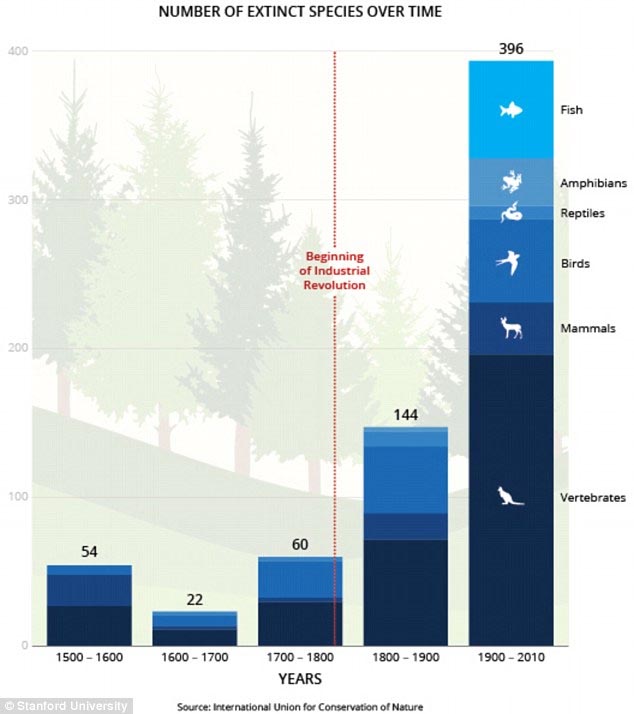
The mariner includes one chart from the report that ties the development of the mass extinction, or conversely, the destruction of the global environment, back to the beginning of the industrial age.

extinct animals

An easy to read article is available at the following link:

http://www.washingtonpost.com/blogs/wonkblog/wp/2014/02/11/there-have-been-five-mass-extinctions-in-earths-history-now-were-facing-a-sixth

As Naomi Klein pointed out (and Pogo), our own perceptions of what is good, better and best for each human, each of all species, and the planet environment itself, is a myth. We do not have a model of human behavior that matches the reality around us – nor will reality accept it. Yet, humans are delinquent and tardy in how they manage their own place on the planet.

How many years will it take for humans to eliminate arrogance and hubris and recognize that we are not the reason for the Earth to exist?

How many years will it take for core cultural values to recognize that Homo sapiens is not, by a high count, the superior species. We are more dependent on many other species than they are on us.

How many years will it take to dismantle capitalism and nationalism? If history serves correctly, once a nation has cured its unstable situation of war and abuse, it won’t be until the third generation thereafter before that nation will have leaders unscarred and unbiased in their decisions about national policy and culture.

The mariner will have more on the Holocene as matters develop. He presents only high level concepts and ideas in this post; he depends on the reader to pursue links and news sources that will add more substance to this issue.

Ancient Mariner

The Sixth Extinction has Begun

An irrefutable and respected report was just published in the Science Advances journal. A blue ribbon team of scientists working at Stanford University, headed by Paul Ehrlich and lead researcher Gerardo Ceballos, a professor of conservation ecology at the National Autonomous University of Mexico and a visiting professor at Stanford University, predicts that humans could be extinct in three lifespans. Three lifespans is three generations each separated by about 25 years plus the average lifespan of each generation – assume 80 years. 75 years plus 240 years = 315 years.

We wouldn’t all expire together at the last moment. Starvation would increase day by day as water, food and environment would take their toll faster and faster over time. The mariner was amazed that this report didn’t take over the news media in every quarter. Other than the browser results, there was no mention of the coming extinction of humans – in only three generations.

The mariner strongly urges that the reader browse “sixth mass extinction” and read the news article on.MSN.com or other news websites.

Ancient Mariner