
Central and South America are Different

Mariner promised many posts ago that Guru would investigate Central and South America, which seem to have a separate world history from North America, the West and even an Asian influence. Understand that Guru is quite theoretical in nature and does not always have documentation. This liberty, however, enables Guru to visualize history in very broad sweeps of insight. Having said that, Guru does his homework by searching for thematic truths that together encompass history, geography, environment, culture and politics.

As Pogo Possum once said, “We have met the enemy and it is us.” The abuse is racism. From the beginning, it is part of our genetic heritage as tribal apes living 100,000 years ago in Africa. Homo sapiens is a tribal ape; there is nothing we can do about that. A point of reference most folks know is how H. Neanderthal was overrun in Europe by H. sapiens. Common reasons for this fratricide were differences in appearance, physical and mental composition, the withdrawal of an ice age, the changing environment, etc. Today, all of us have a few genes that originally belonged to the Neanderthal; rape and pillaging exists in H. sapiens just as it does among indigenous chimpanzees, another brother ape. Ironically, the original H. sapiens was a black skinned variety living in Africa. Today, a late ice age variety with white skin has turned against its black ancestors.

If a phrase may be proposed for the American racial experience, it would be ‘urbanized racism.’ Guru will not digress into the North American experience because it is heavily and continually documented. The focus is Central and South America. Brazil is examining racism in a proactive way. For example, they consider affirmative action an extension of racism. Universities in Brazil are looking for national equalization solutions that are not available except through socialism – a long reach for the plutocracies today.

We must remember that the American continents for eons were not populated by European or modern Asian varieties of H. sapiens. Long, long ago, in the midst of the ice age, the original inhabitants migrated from the Asian continent up through Russia to the Bering Strait, bringing with them not only a different appearance but a different perception of theology and social justice. In North America, these original inhabitants were dealt with in the tradition of the Neanderthal elimination – genocide. In the southern continents, these original inhabitants still exist in enough numbers that an active subculture is a visible part of the society – consider the Amish in the US as an example. Many readers have knowledge of the spiritualist religions remaining in the Caribbean which originally came over with slaves.

The Spanish conquistadors inadvertently cut off the southern continents from North America. Native tribes and cultures were disrupted enough that the Aztec civilization in the southwest lasted only 200 years; trade with North American natives disappeared.

Because the southern continents were isolated from western history for an extended time and because the huge forests of the Brazilian catchment and the foreboding mountains to the west made it difficult to experience North America’s western expansion, South America remained largely undeveloped until the age of fossil fuel early in the twentieth century. The nations of South America remained poor, ill-managed governments that survived primarily on International Monetary Funds (IMF) until the middle of the century. To this day, the southern continents are underdeveloped and suffer the pains of political growth the rest of the western world experienced in earlier times.

The political history often is jaded by economic abuse and class discrimination. Even in today’s news cycles, most of the nations are in financial difficulty and suffer governmental mismanagement.

But a new day is coming for the southern continents. Several minerals that are becoming harder to find around the world lie in wait – especially in South America where beryllium, thorium, lithium, rare-earth metals, and mica are in abundance. Chile, for example, sits on the world’s largest source of Lithium.

Further, the undeveloped nature of southern continent economies is a plum for economic expansion by larger industrial nations. China spends more development money than any other nation – ranging from Mexico to Argentina’s Tierra del Fuego. The coming age of internationalism may be good for the southern continents if colonialism can be kept under control.

There is much more to write about southern continents with regard to environment, culture, social structure and ethics. But that is another post.

Ancient Mariner
 

Watch the European Union

The European Union (EU) is having a more intense disruption with populism, nationalism and a drift toward totalitarianism. We in North America – particularly the US – should pay attention to what’s happening across the pond because the causes of disruption are quite similar.

IMMIGRATION – Donald has heightened the reactions of his base by taking the side of racist politics and exacerbating border issues with his fence initiatives; along with Jeff Sessions (lest we forget Jeff took Strom Thurman’s place as the leader of racist policy in the Senate), has eliminated sympathy, empathy, fairness and every other human instinct from ICE, tearing families apart not only in the Southwest but across the country. Further, Donald is defunding several assistance programs for immigrants, for example, DACA and aid programs for newly arrived legal immigrants. This legislative turmoil is magnified in the EU by confrontation in 28 member nations.

Actually, US citizens statistically are not as upset about global migration as Donald and his followers are. The proportion of immigrants in the US is quite a bit less than the proportions in EU nations; as of 2015 immigrant population in the EU was 19.9 percent of total population (1 of every 5) while the US immigrant population is 14.3 percent (1 in 7). These numbers reflect all immigrants, not just the headline wave in the news. Unlike EU migrations from the Middle East and Africa, US migrations largely are from Central and South America and some from Asia.

Having made this case, it can be seen that Donald did not cause immigration woes; he is the result of a populist condition energized by several circumstances in the US having to do with economic imbalance, technology and cultural transition. Fortunately, the size and democratic philosophy of the US have not permitted totalitarian leaders as in Greece, Turkey and other small nations suffering from the same woes – though Donald wishes it were so.

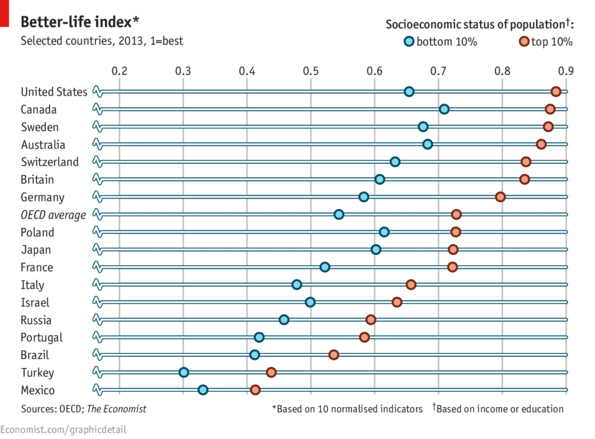
ECONOMY – The following chart from The Economist magazine shows a relative comparison between the US, EU and other nations for the quality of life for the poorest 10% and the wealthiest 10% in each nation. Note not only the relative quality between nations also note the US has the greatest spread between the poor and wealthy groups.


The US does have the widest spread between rich and poor. Further, with middle class income stagnant for forty years and still not climbing today with record profits among the wealthier, it is no surprise that there is a populist reaction in the US. As a philosophical note, the three countries with higher quality for the poor (Canada, Sweden and Australia) have constraints on capitalistic abuse: Sweden has a socialist economy, Canada has socialist policies and, as an entertaining note, Australia keeps capitalism in check with a robust news media!

TECHNOLOGY – While for the moment the US is the leader in several technologies, Europe is no slouch. In fact, the European population is 196,734,765 people larger than the US and is second only to the US in GDP – United States 19,390,600 and EU 17,308,862. The point is, although the US perception is that all countries including the EU are tiny in comparison to ourselves, the EU is a global competitor not only in commerce generally but a competitor in technology and in some ways a leader in responding to the emerging AI global market (witness an EU trade agreement only days ago with Japan, usurping US economic influence (thanks, Donald).

Just as with the United States, EU is struggling with the definition and role of jobs in the future. Although not as thoroughly capitalistic as the US, taxation and industrial strength both are up for reinterpretation in the near future; EU is suffering the emergence of AI as is the US but even more so because of multinational issues among EU member states. An example is the push back on privacy usurpers like Google et al – something the US has not begun to do at Federal levels.

 CULTURAL TRANSITION – Many decades ago, perhaps in the late 80’s, Oldsmobile introduced the world to the slogan, “This is not your father’s Oldsmobile.” No one denied it was a different vehicle with newer technology but many opined that the older versions had more power and comfort. Since then the phrase has become an icon for claiming significant changes in familiar objects and circumstances. We can safely say today a variation: “This is not your twentieth century!”

The millennial generation was the pivot generation to new behavioral forces that today continue to erode our 20th century religion, job security, Federal conservatism (AKA Establishment) and class/race relations. Each generation has put more pressure on social change that is long overdue.

Mariner burns leaves in the fall. The approaching age of artificial intelligence, perhaps only one more generation into the future, has an effect on culture change that pouring gasoline has on a leaf pile.

Perhaps by watching the European Union wander into this vortex, we may have a few weeks lead on what will happen on this side of the pond.

Ancient Mariner


Belonging is a Feeling

There has been an upward tick in visits during the last two posts that dealt with the difference between nationalism and shared personal feeling. It appears that most of us are self-evaluated based on self-adopted, doctrinaire rules that are supposed to yield a successful life. By their nature, these rules of life are self-oriented and place each of us in an isolated role where our own achievement is the measure of our social worth (those without jobs are unworthy; I have a job therefore I am worthy).

This strategy for defining meaningfulness for ourselves becomes aggravated in times of rapid, significant change in society. It seems that our assumed measures of self-value don’t work as well; especially when we see success in other parts of our society. This is the insecure energy that feeds populism and identity politics. We blame our social structures for not accepting what we thought were ‘inalienable’ rights and values. There are real conditions that feed the flame of insecurity; for example, living longer than our generational culture, a drop in financial security, changes in religious culture, and artificial constraints to personal dignity brought on by racism and class stratification.

We forget that we belong. We are charter members of our civic population. We belong despite the fact that we are conservative, liberal, greedy, selfless, ill, jobless, persons of different classes, cultures and races, green card citizens, or immigrants. We belong to a civic organization, from township to nation, which provides a philosophy of life that values every resident as equal. In some civic organizations, belonging may require the experience of commonly applied severe and brutal abuse as in Syria or Venezuela. The United States philosophy, however, stated in our Declaration of Independence and iterated in our Constitution, requires a working democracy where every vote counts and thereby provides life, liberty and the pursuit of happiness for everyone. As the reader may know, life ain’t perfect.

Having a feeling of belonging introduces a feeling of equality which is important to each individual. Despite the inequalities of society and opportunity, one can always say “I am an American citizen – no less important than any other citizen.” Belonging to an idea rather than an artificial doctrine is what Bono’s message is all about.

Mariner, long an advocate of practiced empathy, sees a link between civic-mindedness and empathy. Civic-mindedness acknowledges an equal basic value for every citizen; every citizen is a member of the greater idea – which generates a feeling of belonging even under different individual circumstances.

When a citizen quits belonging and instead identifies with an adopted value system – as the Congress of the United States has – the feeling of citizenship and belonging to the US suffers. Suffered enough, citizens form counter values and adopt populism as a remedy. As the mariner is doing in an effort to find his garden among the weeds, the reader, too, should rummage about looking for the feeling that you belong to your country along with everyone else – despite your personal evaluations.

Ancient Mariner


VOTE with a new Feeling

Mariner’s last post was about an unusually good Global Public Square (GPS) hosted by Fareed Zakaria on Sundays on CNN. Fareed’s subject matter is typically international in nature, dealing with economics and culture. He addresses the US political scene with fairness. To borrow just one quote, Bono said, “Europe is a thought that needs to become a feeling.” Ironically, having feelings for a national ethos is not new. Rodney King said the same thing in 1992. The ‘spirit’ of unity is still around but buried beneath a burdensome amount of nationalism – a lot like mariner’s garden is hidden by humongous weeds.

But there are signs here and there that Homo sapiens has an internal nature that knows there is something important about belonging. It isn’t a feeling that requires one definition but is more like a membership among differently defined participants – differences that ironically contribute to a greater feeling of security and unity.

Mariner has a life example that speaks to Bono’s ‘feeling’. He knows two men who are close in their friendship. Conversation flows freely, events are shared, tools and physical support are shared, families participate in social events. It is clear that each man has the other man’s back. One would not believe this possible comparing the two biographic backgrounds.

Man-A is an intense advocate of Donald Trump; He wants to put Hillary in jail; People without jobs are derelict; Federal discretionary spending is a violation of his rights and obligations. Man-A grew up on a farm and has been a laborer and career big-rig truck driver for 40 years.

Man-B is a liberal who begrudgingly voted for Hillary because she had no vision about the future; Man-B thought Donald would destroy democracy. Man-B grew up in Pennsylvania in a college community; his parents were white collar workers in education. Man-B went to college and earned two graduate degrees; he worked for several government agencies.

How, we may wonder, can these two men be fast friends? Bono the poet had the right word: feelings. Feelings about each other’s worth as a human being determines what is good, as opposed to what is discriminatory, about their relationship.

By its nature nationalism and similar identity postures demand institutional authority sealed in a monolithic block. There is no space for diversity; there is no use for feeling. But feeling is a survival feature for humans; we are tribal down to our genome. As creatures of evolution and as members of the mammalian class, we must belong to other humans, not to an emotionless monolithic block of absolute rules devoid of ‘feeling.’

On November 6 vote with an awareness that the United States has been and will be a leader in the world not because it spends 10 times any other country’s budget on the military but because there is freedom to belong, to participate, to share humanness among our fellow mammalian Homo sapiens friends. The American experiment is at stake. Vote to restore American ethos.

Ancient Mariner


What lies ahead

Mariner recently posted a metaphor relating the status of the United States, its culture and its economy at war with itself. This cultural war is the result of inadequate regulations on wealth. As if this were not enough, another war is horning in on the citizen’s awareness: Artificial Intelligence (AI) – but even more so the domination of daily, personal human life by computers.

Artificial Intelligence will displace our need to perform mundane tasks, even sophisticated tasks. The hidden agenda is that using AI, corporations will know so much about our daily activity, preferences, illnesses, and common daily behavior that computers will decide how much insurance will be available at what cost, how much salary will be permitted, what we can eat, buy or have access to. Where we are permitted to live, how much housing cost we will be allowed and what medical insurance we may have based on our daily behavior, all will be based on monitoring our lives in minute detail. In short, computers will control our choices in life and our routine behavior – the concept of privacy will disappear.

The simple conveniences of talking to ECHO or similar devices will do us in. The data tracking behind ECHO will capture every instruction, every activity, and every movement of daily activity into a complex database that will determine who you are – statistically. Not so much who you are as an individual but who you are compared to everyone else. You will be allowed behaviors commensurate with your statistical relationship with the population – statistically.

Perhaps younger generations see no problem being defined as a statistic somewhere in a database. Mariner is of an older generation, perhaps one that has lived too long given its genetic foundations. Mariner still has a unique persona with its own consciousness, intellectual awareness and the idea that he can be who he wants to be in society. While statistics may describe him, they do not create him; free will is still a dream with which he can build his life.

Ancient Mariner


Of Battlefronts

Mariner hopes dearly that most of his readers have not experienced a battlefront experience. The noise can be truly deafening; there are bombs, tanks, airplanes, field cannons, grenades, machine guns and incessant gunfire; acrid smoke clouds vision; soldiers screaming and dying – some by a soldier’s own hand; good friends are lost; anxiety reaches peaks destructive to the human psyche. It is no wonder survivors of a battlefront choose not to talk about the experience.

Not as life-threatening and not as explosive, the battlefront metaphor can be applied to the battlefront of the United States, its governments, its human values, its economy and the security of every individual citizen. All are at a point of open conflict. There are visible battles like the elections and the battle-hardened party war; there are regulatory battles that fall on industries and individuals alike as if they were hit by a grenade; there are battles involving humaneness and civil rights that are scarred by political strafing; dollars are the ammunition – oligarchs sending ammunition to preferred hot spots in the battle.

As in any war, it is the human casualty that remains afterward. We live today amid the rubble of an active battlefront. What will remain of trusted values, citizen rights and family security? From what values will we, the citizens, build a post-war peace? What new influences will be imposed in a new age?

We are the soldiers. We will suffer the confusion, the irrationalities, the false promises, and the politically motivated leaders who lead us into battle. We will suffer losses. When the smoke clears, what will we soldiers have accomplished?

Ancient Mariner


Everyone’s Main Topic

Mariner receives many emails from news services, magazines and news analysts. Today, with a rapid fire sort of experience, mariner copied the following quotes from his emails and could have copied many more:

֎ Trump won by speaking directly to voters who had the least experience with democratic institutions… A nation of passive observers watching others make decisions is a nation that will succumb to anger and resentment—witness the United States. [Yoni Appelbaum, journalist]

֎ “Whatever may be tolerated in monarchical and despotic governments, no republic is safe that tolerates a privileged class, or denies to any of its citizens equal rights and equal means to maintain them.” [Frederick Douglass, December 1866]

֎ “Human beings are tribal,” says Amy Chua, Professor of Law at Yale Law School. “We’re hardwired that way. We need to belong to groups.” The problem, Chua says, is when tribalism takes over a political system—and that’s just what is happening in America.

In a new video filmed at the 2018 Aspen Ideas Festival in June, Chua explains that, in an unprecedented fashion for America, whites are on the verge of losing their majority status, leading to “destructive political dynamics” that are difficult to curb.

֎A longer article in the Atlantic marked the beginning of tribalism or identity politics to the influence of the Tea Party. Referencing a quote from Adolf Hitler who said early in his political life, “If they stop me early, I will not make it to power; if they don’t act early, they can’t stop me.” The reference alludes to the fragmentation of the citizenry and the government when one clique is allowed to derail normal democratic processes.

– – – –

The disappearance of democracy as a philosophical model producing equality for everyone regardless of tribe has malfunctioned quite dramatically in just 30 years. Today, it is the main topic of writers, thinkers, political practitioners and even many individual citizens.

Who should we blame? Just about everyone from our prominent political and corporate leaders, to Congress, Courts, and especially to the individual citizens who chose not to maintain the American experiment – democracy.

We could blame automation and electronics which make it easier to stay home rather than participating in clubs and civic organizations. We could blame public education for not requiring civics in 12 years of instruction. We could blame capitalism with its tendency to hoard. We could blame the media for championing tribal values, jousting at one another like knights in the lists – thereby creating fake news and alternative news. Each of these examples has, in its own manner, attacked democracy but at the core, it is the public citizen – the electorate. The electorate is Chairman of the Board for democracy.

Above, Amy Chua references an issue deep in this caustic salad bowl: racism. The penchant of the United States to sustain racism is about to turn around and bite the whites in their butts. Certainly a deep and visible characteristic of American culture, the transition may emerge subtlety as a shift toward socialistic governance.

On the other hand, more direct conflict emerges daily between tribes. Consider the following, each one entrenched with an attitude of ‘my way or the highway’:

-Theocratic dominance. The idea that a religion (Christianity???) supersedes state rights. There are several confrontations: abortion, gay marriage, right to deny service because of Christian values and the intent to oppress other religious principles, e.g., atheism, Islam and situational ethics as law (Roe v Wade). Whence the desire for equality?

-Libertarianism and Tea Party conservatism. (Modern libertarians defend the right of productive people to keep what they earn, against a new class of politicians and bureaucrats who would seize their earnings to transfer them to nonproducers.) Government must be kept to an absolute minimum; size and multiplicity are dangerous and unfair to the liberty of individuals to live prosperous, self-managed lives. One can imagine the conflict with a government whose discretionary (transfers to nonproducers) budget is more than half of the entire budget. Harari draws his opinion from this philosophy when he says useless people will not be cared for in the future.

-Progressives. The antithesis of libertarianism. Probably the least wordy description is to borrow Jesus’s words when he says,

“The King will reply, ‘Truly I tell you, whatever you did for one of the least of these brothers and sisters of mine, you did for me.’” [Matthew 25:40]

In other words, equal value among everyone – regardless whether they are producers, nonproducers, wealthy, poor, healthy, sick, etc. An interesting reference, Native Americans were progressives in the sense that everyone was cared for. Of course, survival was more of an issue than it is today unless one is truly indigent.

-Conservatives. Share economic and capitalistic views of libertarians but more important is social order. Change is anathema. A good example is the persistence of racism; it is difficult for conservatives to change social order. The same is true of whatever subtribe is important, e.g., having a job is a universal discriminator, what neighborhood they live in, how the church service is run. In mariner’s town, well-kept lawns are an important demonstration of community unity and, if conservatives have anything to do with it, will be sustained into the future.

-Climate Change. This isn’t really a battle between advocates and deniers; it’s a battle between the massive, global investment in fossil fuel and those who want to shut down fossil fuel. It’s all about dollars and profit versus a slow, inevitable impact on the state of all economic and political circumstances. A characteristic of capitalism is greed – take the profit up front, push the overhead into the future.

Mariner can name several more tribal conflicts but already he is on his third page. No doubt readers understand that when tribal values dominate the overall political condition, fragmentation is bound to happen. The Russians understand this even if the US doesn’t. Remember Rodney King? He was right.

Ancient Mariner.


Observations

In reference to mariner’s recent post about cronyism, a report from Politico shows a racial pattern in Congress reflective of older folk who still have pre-civil rights attitudes:

More than 1,000 top House staffers are white. Out of 1,174 top staffers, 79 are African-American, 45 are Latino, 32 are Asian American/Pacific Islander, one is Native American and four are bi- or multiracial. The report defines top staff as chiefs of staff, legislative directors and communications directors in members’ personal D.C. offices; chiefs of staff, policy directors and communications directors in the top four leadership offices of both parties; and staff directors assigned to full committees.

“This systemic problem matters because Congress cannot effectively create public policy that benefits all Americans if the people making policy decisions don’t look like America,” said Spencer Overton, president of the Joint Center for Political and Economic Studies. The report recommends that House members collect and disclose detailed demographic data on staffers, adopt a rules package in the next Congress that includes measures to increase diversity and inclusion, apply the “Rooney Rule” — interview at least one person of color for each open senior position — in hiring and offer paid internships and fellowships.

– – – –

Mariner was incensed yesterday when he read that Donald reallocated 10 million from FEMA to ICE – even as a strong hurricane approaches the Carolinas. Mariner should not be surprised; Donald has a public record of disregarding the purpose and designations of different accounts. He drew down all the cash from his casino business, driving it into bankruptcy; he uses a charity account as a revolving door to avoid taxes; he has settled multiple times for fraudulent business practices. Now, he is in charge of dispensing the Federal budget. He and his sycophant cabinet must be gleeful at the opportunity for abuse.

– – – –

Three sources have suggested that the next significant socio-political upheaval in the United States will not be the liberals and the progressives nor will it be African Americans. It will be an emergence of Latinos as a major influence in political change. No authors were able to connect the dots from the present but base their assumptions on demographics in the US and the whole of Central America and South America. At some point the politics of immigration will transition away from Europe and the Middle East and turn to the relationships between nations on North and South America.

It has been speculated for more than a hundred years that a mega nation will emerge on the two continents. Mariner asked Guru about this; he said a lot of current history has to adjust to that circumstance. First the new world economy, China emergence and artificial intelligence all must arrive at that opportunity. Still, within the US there are enough Latinos to launch a shift in politics.

– – – –

Patrick J. Egan of New York University writes that identity politics is beginning to shift in US citizens. What led identity politics heretofore was one’s religion, political party, economic class, and race. However, recent surveys by the General Social Survey, a reliable survey of American attitudes, shows that citizens are modifying their root identities to align themselves with an ‘ism’. Examples are liberalism, progressivism, libertarianism, conservatism, etc. Is this the beginning of the end for identity politics?

Ancient Mariner


Conflict in Purpose

Mariner never has been able to fully reconcile the split between church and state in the United States. One can make convincing arguments for the authority of either over the other as a foundation for American culture. Each, in its own way, espouses equality; each endorses spiritual reward for compliance with its doctrine – one the New Testament, the other the Constitution.

The United States was begun in the midst of serious conflict between the Anglican (state) Church and several spiritualist sects that saw the role of faith in a different light. In many instances these sects migrated to North America. Their intent was to have the freedom to practice their religion without Anglican constraints. Freedom for any religion was not the intent – only that sect’s interpretation was acceptable; dissenters were burned at the stake, had noses split, were cast out from the community and suffered other harsh punishments during the early decades of settlement. For about half of the colonies, religion was the only law; governments had not formed independently until later.

The ‘state’ side followed early settlers to the US for economic and political reasons. 150 years after the first settlers arrived, a war broke out between Great Britain and France over who would colonize North America (Seven Years War AKA French and Indian War).

Mariner digresses. If the reader seeks more detail about how church and state began in North America, visit a preferred library or search engine.

The specific enigma about which mariner has difficulty is cultural morality. How can a singular national ethos and inclusive human rights be governed by two masters?

Mariner has personal interest in the conflict over abortion because Roe v. Wade didn’t exist in the 1940’s. No doctor would breach Christian decorum to perform an abortion; abortion was performed on the dark side – if one could find it. Mariner’s mother died at age 26 because she had to carry and give birth to a child doctors said she should not have.

To start, let’s read about Deborah Copaken’s life experience:


A quote from Deborah Copaken – an advocate to keep Roe v. Wade in place.

The day when you find yourself six weeks pregnant at the age of 17, as I did, is not a joyous day, particularly after doing all the right things, birth-control-wise, including getting yourself fitted for a diaphragm at Planned Parenthood. For one, you can’t have a baby. You’re still a baby yourself. You would (you know, even then) cause permanent emotional damage to a child, in not wanting to have one, never mind that you have neither the skills nor the means to raise one properly. For another, you’ve just been admitted to college, and though you love your high-school boyfriend dearly, you have no idea who you are or what you want out of love or life. Plus, raising a baby in a freshman dorm was never part of your plan. Nor your college’s. And adoption—for you, personally—is out of the question. The pain of handing over your child to another person would, you know, become a lifetime of “Little Green” sorrow.[1]

Your parents drive you to the abortion clinic in Maryland. No one in that car is happy, but everyone is nevertheless grateful for one another’s love and for your right to legally choose this option. The clinic makes you answer a bunch of invasive questions to prove you know what you’re about to do, as if you hadn’t been thinking only about this moment for the past week. You’re awake for the entire procedure, which is painful. You cry a bucket of tears into your saltines in the crowded recovery room after, because it hurts and because you’re still 17, the age of emotional roller coasters under the best of circumstances, which this is not. But not one of those tears can be traced back to shame or to regret over the decision to abort the minuscule embryo of cells inside you. In fact, it was not a “difficult decision.” It was easy: the only rational one, to your mind, to make.

– – – –

Deborah made a decision based on her situation. At that moment, a Federal law, Roe v. Wade, ergo a ‘state’ law rather than a religious one, allowed her to choose an abortion. Some would say Roe v. Wade is an affront to religious freedom.

The question always evaded is, doesn’t freedom of religion mean any religion can practice its unique doctrine and ritual but cannot restrict those who have another religion from practicing their doctrine and ritual? Following the Constitution in principle, the answer is yes. What confuses the dialogue is the total dominance of Christian-based religions versus nationally dominant state law; if other world religions had prominence in the US along with Christianity, ‘freedom’ would be better defined. There are dozens of Christian religions from the snake believers in Appalachia to the Mormons in Utah to… on and on. One of the major variations is the Evangelical Christian; there are enough members – particularly in conservative states – to influence legislators. Opportunistic legislators, which abound today, forego state law (Constitution) to placate those who would restrict not only state rights but other religions as well – thereby violating the Constitution. Unfortunately, legislators aren’t selected for their wisdom and ethic.

There is an unhappy truce for the moment because the Supreme Court is bound by the Constitution. Here is a challenge: would it be legal under the freedom of religion clause for some Islamic sects to eviscerate the clitoris of pubescent girls if this were practiced in the United States? Here is a similar challenge: Does the owner of a slave have the right to inflict torture, starvation, rape or religious practices on that slave? How about circumcision? This is relevant today; thousands, including family members, are held in slave relationships not to mention contemporary slave trading almost entirely with helpless women.

As we ponder these challenges, the core human issue is whether someone can impose bodily modification on another person. Is Deborah a slave? Is Deborah an Evangelical Christian? Is Deborah Islamic? Is Deborah a US citizen? It seems the value is one derived from social morality rather than religious doctrine. National statistics suggest social morality says no one can impose physical conditions on another person.

If one is abiding by one’s Christian doctrine, a case may be made that having an abortion is unchristian; if one is not Christian or is of a variety of Christianity where abortion is not an issue, having an abortion is subject to situational ethics which, typically, reflect cultural expectations.

Brett Kavanaugh, a well-known conservative and Roman Catholic is nominated to fill a vacancy on the Supreme Court. In an interview today he said, “A woman has a right to have an abortion but the Government doesn’t have the right to pay for it.” This is an excellent example of why mariner is so confused. With us since ancient times, the Byzantine two-headed eagle[2] is still around.

Ancient Mariner

[1] Song by Joni Mitchell; see lyrics at https://www.lyricsfreak.com/j/joni+mitchell/little+green_20075262.html

[2] The Emperor of Byzantium wore a crown topped by a two-headed eagle. One head represented his supreme authority over the politics and power of the empire; the second eagle head represented his authority over the Gods, of which he was one himself.

About that last post

Please view a very short animated video –

WITH CURSOR ON THE LINK BELOW PRESS CLICK then return to this post.

https://www.theatlantic.com/video/index/567739/universal-basic-income/?utm_source=newsletter&utm_medium=email&utm_campaign=video-series-editors-picks&utm_content=20180901&silverid=NDkwMjIzMjA1Mjg2S0

In the last post mariner mentioned that many issues would be too large for nations to manage well given their current economic structures. As Harari suggested, massive numbers of people will be jobless by current definitions of ‘job.’ Many of today’s nations, especially smaller authoritarian nations, will experience a virtual disappearance of national economy similar to today’s situation in Venezuela where even today a crooked, profit-driven authoritarian government cannot hold an economy together.

The future phenomenon will roll out slowly; there will be time for nations to take several steps in preparation for the economic collapse of the Job Religion. If the reader watched the animated video, it will be clear that, like climate change, slowly a clearly unbalanced economy and its negative impact on the world’s population already is beginning to emerge; especially given the ill-fitting capitalist, oligarchical economy in place in the US at this time.

The current emigration reflects the same issue as millions and millions of humans are displaced by oligarchies, religious and political wars and shifts in the climate on several continents.

Needless to say, there is feedback: Mariner is a socialist; mariner is a communist; mariner is a lazy person who does not want to work. Without gathering numbers, mariner suspects virtually all these criticisms come from members of the Donald Party – rich and poor, entrepreneur and laborer. Mariner’s wife will confirm that mariner is not happy with any –ism. Nor is he happy with the American electorate in general – including all the identity groups across the rainbow.

For the record,

Capitalism works best to fill economic vacuum – like the early US or now, artificial intelligence.

Socialism works best to homogenize and pasteurize a disruptive and unstable culture.

Communism works best to standardize diverse cultures and contentious economies.

Humanism is the best generic umbrella for any –ism.

Somehow, somewhere, Christ’s second commandment, the 6 – 9th commandments in Islam, or achieving dharma in Hindu, will become central principles for governing the populations of the world. Albert would call it reverence for life.

Ancient Mariner