One for Many but Many for One, too

Mariner was a young lad, well, not really young, he had progressed a bit in his career and was working as a staff consultant assisting all state law enforcement agencies in complying with new Federal regulations about reporting law enforcement activities to a State database. Let’s just say he had a full head of hair with a flat top.

The work was both tedious and fraught with conflicts about changing behaviors that had long existed in local police agencies. After a hard Friday, we all stopped after work to enjoy a happy hour at a local pub. It was a good release from a difficult day and, after a couple of hours, mariner had had an uncounted number of half-priced gin and tonics. Needless to say, as he left for home, he had an accident on the interstate. One is supposed to slow a bit when taking a tight exit ramp, which mariner failed to do.

But the accident is only a set-up for a genuine insight that has stayed with mariner throughout his life and sets his belief in what democracy is all about.

Mariner rolled his jeep-like vehicle and totaled it. He crawled out the back window virtually unhurt. The first person to be there as he crawled out of the vehicle was a nurse who checked him for critical injuries, determined he would survive and left. The second person to greet mariner simultaneous to the nurse fed him two breath mints to help ward off law enforcement analysis of his inebriation and left. The third person redirected traffic. There was no judgment of mariner’s behavior; there was no judgment of inconvenience; there was no judgment of moral principles. Mariner was a fellow interstate traveler. Further, because he was in law enforcement and reported to the Secretary of Public Safety, police officers saw to it that there were no ticketing or other law enforcement transactions as a result of the accident.

This tale has nothing to do with regulatory justice, alcohol, or nuisance among interstate travelers. What mariner learned is that he belonged. He was a fellow interstate traveler; he was a fellow law enforcement employee; he was a fellow human being. He belonged. Not only that, he was accountable to other travelers for the same concern about wellbeing. He learned that judgment and prejudice are not the rules for living together. Just the opposite, it is compassion and understanding that hold us together.

At this time we are confronted in our nation with a despot president, an unjust economic system and many citizens suffering from innumerable injustices in daily life. Democracy is at risk. Our nation is not so far from the cliff not to be concerned about abject collapse into a so-so nation that will be left behind in the artificial intelligence age. Already our allies are drifting away.

The solution is to feel that we belong. We are one of many. Also, we are among the many that care for the one. Democracy requires unity and mutual participation without judgment.

Ignore the fake news concerned about prejudice and malfeasance. Go outside and look for someone who needs to belong. While you’re at it, let yourself belong to the nation as well – without judgment.

Ancient Mariner

When Men only were Men

Mariner is on a holiday break, that is, current news is not an item of interest. Rather, he has taken his own advice from his last post: take a break. Nevertheless, one has curiosity about things – perhaps more so because one is not stuck on the current events train.

Mariner has an ongoing interest in those eras of civilization when humans were on their own, ‘when men only were men’ so to speak. This means that Homo sapiens had no oil, no plastic, no corporations producing chemicals, no seed catalogs, no banks, no cash, only scant precursors of small band government, and languages of limited but pragmatic nature. Writing was simplistic and glyphic in nature. These times were the original good old days.

When one searches for these simplistic times, one is painfully aware of the abuse that destroys their existence as civilization moves from one era to another. The Native American is a clear example of a culture that still was balanced with its environment and its culture was based on what the environment provided day to day. Then a later ‘advanced’ civilization discovered this simple culture and, as always, trashed it.

There aren’t many places on the planet where we can observe that time when men only were men because their simple artifacts don’t last very long and easily are run over by later ‘civilized’ necessities. Perhaps the defining aspect of these primitive cultures is that the cultures were bound by an ethical relationship with the environment called net-zero: in the long run, nature was not permanently destroyed; nothing was taken from nature that could not be returned to nature.

One area of the planet which still reflects its ancient mores and practices is the region known as The Steppe. The Steppe is a belt of grassland that extends 5,000 miles from Hungary in the west through Ukraine and Central Asia to Manchuria in the east. Mountain ranges divide the Steppe into three regions and three different weather conditions. The one of most interest to mariner is the easternmost portion, running from the Altai Mountains in the west to the Greater Khingan Range adjacent to China. A small part of the region is Mongolia. Weather in eastern Steppe is among the severest on Earth encompassing desert-like summers, deep frozen winters and yearlong winds comparable to the Santa Ana winds in California. Among several geographically isolating features, weather is a major factor causing retardation of major industrial advancements found elsewhere.

The critical development that eventually distinguished life on the Steppe was the domestication of horses which occurred in prehistoric times and prevails today. In fact, the Silk Road traveled the southern areas of the Steppe through most of the ‘–stan’ nations. Using horses and later camels, the natives of the Steppe were the first trucking company – sans 18-wheelers.

Natives away from the few modern cities still are nomadic. The only improvement allowed by them is the portable yurt, an improvement over skins and poles. Despite this modern improvement, their culture remains very much as it has across the centuries. Even with the inundation of electronic communication, the eastern Steppe remains virtually unchanged. Wikipedia facts: The poor access to the Internet in the countryside has been a reason behind designating Mongolian countryside as a digital detox location for the tech-tired tourists. Internet users: 16.4% of the population, 152nd in the world (2012).

There are seven ‘-stan’ nations: Pakistan, Afghanistan, Turkmenistan, Uzbekistan, Kazakhstan, Kyrgyzstan, and Tajikistan. Because of their location amid deserts and harsh weather, modern dissolution of the cultures is minimal. Two of them, Pakistan and Afghanistan, have not been so lucky.

If one wishes to learn something entirely new about the Earth’s cultures and is tired of Western Civ, ancient Greeks, Romans, tsars and dynasties, visit the Steppe.

Ancient Mariner


On Lack of Literary Greatness

Mariner has one comment on the results of the 2018 midterm elections:

Republicans expanded their majority in the Senate to 51+ seats — even though 10 million more people voted for Senate Democrats than for Republicans. The Senate was never intended to be a democratic institution. Today it is a hurtful political influence when our nation, indeed the world, needs desperately to deal with human issues, scruples and a new democratic vision.

– – – –

Of more immediate interest, Mariner will never be an author of insightful literary works. The post, “A Future of Oneness,” was written as an allegorical work depicting life without human friendship, love, bonding, compassion and even argument and disagreement – between authentic human beings. Alas mariner’s crude prose left readers only with a literal interpretation of the future, either a gushy basketball or extinction.

In truth, the distant future doesn’t matter much if at all. Our only relationship to the distant future is our disregard for our own wellbeing today. What is missing from this allegory is physical, three dimensional, person-to-person respect and affection, and a desire to participate in these intimate experiences above the need to engage in electronic distraction and convenience.

Many times mariner has witnessed couples sitting beside one another foregoing mutual conversation and the exercise of hippocampus engagement in favor of some nondescript, certainly inhuman distraction on an electronic device. Allegorically, we are adapting to a future as gushy basketballs needing only a port connection to the gushy network.

Similarly, foregoing real experiences intertwined with real human beings, even loved ones dear to one’s heart, so that one can talk to an electronic box full of faux confederacies interested only in manipulation, seems headed for gushiness as well.

Mariner read a psychologist’s article that said android devices are an escape from the energy and commitment required to relate to fellow humans. Yet, that is what living as a human is all about. The commitment we choose to escape is the authentic experience of being human.

As to the second allegorical reference of extinction, two elements are of supreme importance: breeding and environment. One won’t have many children copulating with various sex toys and realistic androids. It is easy even to include smart phones as a distraction from human interaction and the commitment required for foreplay or just having an interesting conversation. Surely, after ninety million years of evolution, the intimate practices between humans has become the most important experience we can have and to which we owe priority over electronic circuitry no matter how disguised.

On the matter of environment – just as with the ease of preferring the convenience and laziness provided by electronics – wealth, physical comfort, and the avoidance of what a real human life is all about, distract humans from their obligation to maintain their environment. A major premise in the study of creatures of all kinds, including humans, is that there must be a net zero relationship with the source of life – environment. Only humans can deliberately alter the net zero relationship: we burn oil for money, convenience, distractions like war, the convenience not to physically weed millions of acres of crops, and so forth – even though our environment is no longer under our control. The planet itself has taken charge. Will the planet allow us to survive or will it choose extinction?

Ancient Mariner


A Future of Oneness

Mariner mentioned that he took a trip recently to visit friends and family. He has been traveling the Pennsylvania Turnpike for many, many, many years. Do any readers remember the service stops alongside the turnpike where one did not have to exit the toll road? If the reader hasn’t traveled I-76 recently, these service stops have been upgraded to modern facilities. They are pleasant, much roomier, with up-to-date restrooms and the stop incorporates several chain stores chief among them Starbucks and Burger King along with tourist trap stores and gasoline stations.

This was mariner’s first experience with order kiosks at Burger King. A customer doesn’t need to interact with another human being to have a meal; just push buttons and pay with one’s transaction-tracked credit card. Mariner chose to interact with a fellow human being and ordered lunch at the traditional counter by talking with a pleasant older woman who shared in an aside that she didn’t like the kiosks, either.

This isolation of human beings appears to be a trend. No longer does one need a checkout clerk to kibitz with or an aisle clerk to tell one where Mexican catsup is. Increasingly, a customer checks themselves out now with the conversation limited to a muttering to one’s self about checking out alone. Even more isolationist is the ability to order one’s groceries over the telephone and have them delivered to one’s home. The US claim of “In many one” will soon be “In many none.”

Walmart and Amazon are well on the way toward social isolationism. What happened to a human’s natural relationship to environment, time invested and store clerks visited? Then there’s Facebook. Lack of government regulation about privacy and security aside, there are members of mariner’s family whose only family relationship across years of time is digital; digital photographs are shared to remember what a human lifeform looks like.
And of course the smartphone and Alexa. Mariner is quite sure that soon humanlike robots will be purchased so real humans will have someone to dance with when they ask Alexa to play some oldies.

Mariner has read some marginal futurists who claim the human being will evolve into a brain with a few key visceral organs – all of which are sustained by AI food supply, medicines and communication – a lot like Facebook now but much more sophisticated and very, very, communist. Even the five senses will be replaced with electronic sensory imitations. In other words, the end of Homo sapiens is a gushy basketball attached to a port in a massive network of gushy basketballs.

But mariner doubts this scenario. He listens to Amos, who says the entire Planet is in a death spiral; the Sixth Extinction means humans too, not just tigers and giraffes.

Have a pleasant election.

Ancient Mariner


Travel isn’t Broadening – It’s Frightening

Mariner grows disinterested after hearing hour after hour day and night the same statistics, speculations and campaign ads intent on assassinating the character of the other candidate. Today he focused on the rest of the world. He should have stayed home.

We live in an age of rapidly growing nationalism. Most countries have had a form of nationalism but today it is the democratic nations that are switching rapidly. To name just ‘a few’: every member of the European Union (EU), most dramatic are England (Brexit), Poland, Hungary, Serbia, Turkey, Greece and Germany – just a quick list. South America is awash in nationalism with Brazil and Venezuela in great disarray. Central America has long had several abusive, crooked governments but even there dictatorship is on the rise.

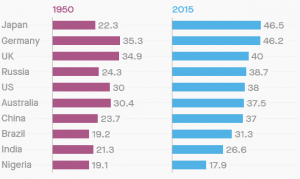
Drivers of nationalism include a slow economic recovery, an increase in people displaced across borders, and anxiety about terrorism, according to Harun Onder, an economist at the World Bank. Another factor, which perhaps is not as appreciated, is age. Many rich nations are in the grips of a big demographic shift toward older populations, and aging populations experience economic pressures that can lead to more nationalistic tendencies. Most frightening is that the newly elected nationalists in these democracies act and sound exactly like Donald! Racism and religious oppression are rampant around the world and are used to incite even more fear in stressed populations.

Median Age [qz.com]

On a more theoretical level, our global economy is 170 years old and shows signs of wear as oligarchical practices gather more and more wealth to fewer and fewer people. In the US, despite apparently good unemployment statistics, general wage levels are half of what they would be if wages kept up with inflation. Corporate power expands ever more rapidly as new digital technologies emerge.

Regarding migrations, mariner has noted that major migrations occur periodically throughout history. Humans moved out of Africa because food was becoming scarce; two very long droughts drove large numbers of humans further into Europe and Asia. Today, the reasons are war, violence and abject poverty. Ironically, the human population is growing to such an extent that soon there will be no room to migrate.

Global culture is in a state of severe turbulence. Change is everywhere and in everything. Is nationalism a solution? Is nationalism similar to a storm cellar during a tornado? Can democracy survive during hard times; during times of uprooted society and morality? Coming back to the US this evening, mariner is concerned about the state of western society. China may not know what it is getting into.

Ancient Mariner

On Being Manic/Depressive

According to mariner’s favorite bookie Nate Silver, “Republican chances of holding the House are only about 1 in 1,000.” He is not as kind to Democrats taking the Senate: only 1 in 6 (16%)

The imminent election induces one to be manic/depressive. If you’re a Donald advocate, you revel in Donald’s pompous attacks on the establishment and in the process seemingly untouchable by anyone. Conversely, it’s the invasion of the nonwhites who will rob, rape and take jobs – oh, and eliminate white people.

If you’re a Donald critic, the anticipated change in Congress, especially the House, provides a sense of relief and joy that US governments will become functional. Conversely, the lame duck Congress, especially McConnell, will ingrain Republicanism in the courts and agencies regardless of the election. Then there’s Donald playing dirty tricks with the Department of Justice to trash the Mueller investigation.

Voting on Tuesday will be like taking an analgesic for pain but the headache, AKA Donald et al, will return. As long as the Senate exists, especially if it is controlled by the GOP, the big issues of our time will continue to go unresolved. Speaking in manic voice, we may expand and secure ‘Obamacare’ and even expand Medicaid with the help of a democratic House but still, speaking in depressive voice, guns, taxes, modern constraints for runaway corporatism, and a new vision for international economics and cooperation will not be resolved.

Mariner doubts Donald will be impeached because of the Senate. Mariner doubts Donald will face criminal charges while in office.

There’s another election in 2020 . . . .

REFERENCE SECTION

Although many kids’ apps may seem innocuous, filled with bright colors and loud noises, they actually contain loads of advertising targeted at children ages 5 and under, writes the Atlantic staff writer Joe Pinsker. Researchers characterized the methods that advertisers and app makers use to influence young children as “manipulative and disruptive,” with one scholar even calling the practices “abominable.” For full article see:

https://www.theatlantic.com/family/archive/2018/11/kids-apps-ads-smartphones/574588/?utm_source=newsletter&utm_medium=email&utm_campaign=family-weekly-newsletter&utm_content=20181103&silverid-ref=NDkwMjIzMjA1Mjg2S0

National Public Radio is touting the country western song “Will the Circle be Unbroken” as the new national anthem. The lyrics allude to the importance of continuity and generational bonding. For a Grand Old Opry rendition, see:

https://www.npr.org/2018/10/30/662203468/will-the-circle-be-unbroken-connects-musicians-generation-american-anthem?utm_source=npr_newsletter&utm_medium=email&utm_content=20181103&utm_campaign=music&utm_term=#

Ancient Mariner

News of the Day

National Public Radio (NPR) is launching a new newsletter all about China. When reading the first reports, it became blatantly obvious to mariner that China, while a communist state, also is an aggressive capitalistic state. Not having to mess with sloppy democracy, China’s leadership (Xi Jinping, elected for life) can dictate the priorities of its economy, its culture, its international behavior and its ethics. One example of China’s aggressiveness is its invasion of other nation’s economies; the old idea of international trade is not the major strategy. China simply joins the target nation’s production economy – starting businesses without mentioning the link to China and hiring away the best and brightest from that nation’s existing workforce. Mariner highly recommends the NPR series especially because US TV news media is useless.[1]

– – – –

Yesterday, mariner returned to watching TV news broadcasts after a four-month self-imposed hiatus. If reality is anything like the content of news programs, our nation is doomed to the trash heap. Mariner felt he needed to track more closely the coming election next week so he watched a full day accessing every broadcasting source. As they say today, OMG.

Watching the various broadcasts, mariner felt he was watching an Asian table tennis tournament. No, perhaps it was more like whack-a-mole. In any case, in four months, broadcast news has begun to ignore ideological differences and simply engage in discounting competitors’ news stories. It is a blood battle for market share. Mariner blames broadcasting corporations for making news a profit center.

Add to this a President intent on destroying the unity of the United States, its culture, its democratic ethos and its sense of fair play and equality of life. Mariner now knows firsthand the feelings of an individual trapped in a horror film.

His advice to his readers is to join the growing number of newsletters that pride themselves on quality research, unbiased reporting and covering news worldwide in every subject. Augment digital sources with a few quality magazines that provide in-depth articles about reality.

If there is even a remote chance of returning to civility and international leadership, and mariner must be honest and repeat ‘remote’, that chance hangs on whether the reader will vote on November 6.

VOTE

Ancient Mariner

[1] To receive NPR newsletter, see:

https://www.npr.org/newsletter/best-of-npr

US has Cultural Issue with Education

No way, Jose: Like many expensive cities, San Jose, California, is struggling to keep its teachers. Of the 1,400 classroom teachers employed by the San Jose Unified School District, one in seven have to be replaced each year. In the heart of Silicon Valley, the towering gap between housing prices and teacher salaries is now so extreme that the school district has considered another idea: building apartments for teachers on school grounds.

 The idea is still in its earliest days, but it’s already being met with outrage that this housing might be located near some of the wealthiest neighborhoods in the country. One superintendent told CityLab’s Sarah Holder how perplexed he was about the resistance: “I’m a person who works with your kid every day—you trust me with your student in my classroom, but I’m not good enough to be your neighbor?” Read Sarah’s story: Why Are So Many People in San Jose Fighting Housing for Teachers? [CityLab] See:

https://www.citylab.com/equity/2018/10/san-jose-trying-build-low-cost-housing-teachers/572665/?silverid=%25%25RECIPIENT_ID%25%25&utm_campaign=citylab-daily-newsletter&utm_medium=email&utm_source=newsletter

– – – –

The average Public School Teacher salary in the United States is $56,103 as of September 28, 2018, but the range typically falls between $48,978 and $64,766.

For comparison Truck Driver average salary = $63,250 per year

Factory Worker average salary = $24,881

Computer Programmer average salary = $69,620

Welder average salary = $37,590

Clerical/administrative average salary = $32,675

All US workers average salary = $44,564

These comparisons suggest that teachers are doing well compared to other workers. However, taking into account education, social skills, impact on professional society and responsibility for the wellbeing and meaningful education of children and indirectly reinforcing the moral fabric of American culture, teachers carry a large influence worthy of better paid managers in business whose influence extends only to monetary influence – without the responsibility to build a better society.

The American attitude toward education, that is, train our children to read, write and count so they can function in basic society, evolved out of the combination of a long period of agricultural economy and the no-nonsense economics of Adam Smith. As the nation moved toward the industrial revolution, it didn’t require much education to work in factories.

Leap forward to today. Colleges, especially small liberal arts colleges, are gutting any subject related to liberal arts. Excepting privately funded colleges and wholly state-funded universities, colleges are falling back into the community college model, offering only high level trade training, e.g., nursing, criminal justice and administrative skills. One doesn’t need Proust, Hemmingway, Nietzsche, Plato or second languages; one doesn’t need the French Revolution, Magna Carta or the mechanics of American civics. One doesn’t need to understand the dynamics of Hamilton, Madison and Franklin. One misunderstands how the spirit and scruples of the American Experiment evolve over time.

Eliminating the educated, the intellectuals, the graduate degree professionals and successful business owners/entrepreneurs, forty percent of US citizens are culturally deprived of the process and understanding needed for living in a democratic society. This forty percent is Donald’s base including twelve percent who are hard core conservatives. Without a functional education system, all they have is emotions; neither awareness nor reasoning is available.

How does one know one sees a public school? Because it looks like a factory. Once the building, utilities and ancillary responsibilities are acquired, e.g., busses, cafeteria and educators, the fun dollars go toward sports facilities. It is blatantly obvious that school architecture expresses no awareness of adventure, importance, or even community personality. Our nation has never wanted to pay for pleasantries for its citizens (God bless the Reformation). Teachers do the best they can decorating the walls and creating a fun atmosphere in an otherwise barely utilitarian room. For virtually every primary and middle school, science facilities and event centers that encourage liberal arts awareness do not exist. Even libraries in too many elementary schools, to the chagrin of mariner’s wife and librarian, do not allow children to peruse the shelves but are limited only to a text that the teacher said they must read – a practice based on ranking reading skills sans any joy of personal learning and adventure. American society still considers education only in the pragmatic sense and a responsibility of lesser importance for government – aside from inherent babysitting services.

Ironically, the concept of education for US citizens, despite some spit polish here and there, remains the same model as it did for a nation of farmers, hunters and tradesmen during the nineteenth century. Only in the last fifty years has industry slowly discovered that available employees are missing technical, social and reasoning skills for jobs that have broader responsibility and problem-solving required by this modern era. Sadly, the cultural richness that would provide a happier and productive lifestyle for our nation’s citizens still is ignored. As mariner often has lamented, business considers a human being only as a profit source. Lucky pets have better lives than culturally oppressed humans. Where is Mr. Rogers when you need him?

Several education journals and education books are trying to imagine the direction of an education methodology that will match a new century whose cultural and educational demands are totally different from today’s pragmatic and unimaginative model.

Already, we live in an age where knowledge is no longer a measure of significant importance to society. Information is free, immediately available, does not require reading printed publications or text books, and is available on any subject one can imagine – considering only Wikipedia and YouTube among tens of thousands of sources. This digital access will reduce the importance of test scoring, incremental grades (based more on age than comprehension) and ranking individual students statistically.

What will emerge in very small steps is an education program that takes advantage of a child’s natural inquisitiveness; desire to experience reality; and normal mental aptitudes. Instead of tests, children will receive group assignments consisting of group cooperation, investigative skills and problem solving. The ‘score’ will be the quality of the entire group’s solution. While individuals may not be scored per se, as groups are rearranged, various natural skills will emerge; putting together winning groups will be the teacher’s role – just as an athletic coach puts together a winning team.

The qualities of each group will be recognized and students will be fully prepared to join employment in similar situations. For example, one group may emerge with quality construction as an earmark, another may be artistic and strong in design, another in science or mathematics, etc. There will be little new to a student who is fully familiar with the work environment he or she enters.

Already there are attempts by public schools to create this new ‘group’ model. Most examples are in the trades, e.g., home construction, automobile repair and utilities. The score is how well the product is completed by the group, not how well an individual student scored. Would it be possible to put together an income tax prep team? How about a math team that configures real life computer solutions or a production team to promote plays, movies and other art forms in the community. A student would have a reputation based on the group’s achievements rather than carrying a resume full of individual statistics. As a manager for forty years, mariner has longed for employees who are well rounded socially, comfortable in their ability to achieve and aware of the responsibilities inherent in their work.

There is more to explore but that is for another post to pursue.

Ancient Mariner



Merger of CVS and Aetna

In what was a disturbing interview on PBS NewsHour between Judy Woodruff and Larry Merlo (CVS CEO), Judy pressed Merlo several times about how the merger will benefit individuals. Continually, Merlo ducked that specific question by advocating better procedures, better integration of services and a number of platitudes all of which reflect a larger corporate-driven control of market, profits by collusion and most disturbingly, the point Merlo ducked, was quality control of corporate costs by managing patients directly.

This is an article/video that is very important for the reader to read/watch. It speaks clearly to the control factor that large data clouds and massive records of daily life are being integrated for corporate benefit, not for personal benefit. Go to:

https://www.pbs.org/newshour/health/what-the-cvs-aetna-merger-could-mean-for-you

The reader may recall a recent post in which mariner mentioned John Hancock converting it policies to a program called “interactive policies” where insured will be screened and if selected, must participate in the interactive program.

John Hancock, one of the oldest and largest North American life insurers, will stop underwriting traditional life insurance and instead sell only interactive policies that track fitness and health data through wearable devices and smartphones, the company said on Wednesday.

 The move by the 156-year-old insurer, owned by Canada’s Manulife Financial, marks a major shift for the company, which unveiled its first interactive life insurance policy in 2015. It is now applying the model across all of it’s life coverage.

It works like this:

Policyholders score premium discounts for hitting exercise targets tracked on wearable devices such as a Fitbit or Apple Watch and get gift cards for retail stores and other perks by logging their workouts and healthy food purchases in an app. In theory, everybody wins, as policyholders are incentivized to adopt healthy habits and insurance companies collect more premiums and pay less in claims if customers live longer.

Privacy and consumer advocates have raised questions about whether insurers may eventually use data to select the most profitable customers, while hiking rates or not accepting those who do not participate.

Hancock says customers do not have to log their activities to get coverage even though their policies are packaged with the Vitality program. The insurer will begin converting existing life insurance policies to Vitality in 2019, it said.

As mariner understands it, your insurance company knows if you eat three strips of bacon instead of one or skip a morning run when Grandma visits and will have the right to raise your premium or even drop you for someone else who helps the company’s profit margin. As regular readers know, mariner is extremely sensitive to corporations telling him what to eat, know, or do with his life – especially if it is for the benefit of the corporation.

– – – –

To wax philosophically for a moment and promising not to be verbose, we are watching capitalism leverage a changing technological society for profit. The way to tell the difference between capitalism and other isms is that the wellbeing and advantage in other isms is driven by the individual or by government in the individual’s behalf – not using the individual foremost as a controlled instrument for profit. If there is no profit in an individual, buzz off. Who cares?

The beginning of this post mentioned the merger of CVS and Aetna. Leverage gained will be through combined databases about customers. Then, just like the book 1984, the customer will have to do what the corporation says to do – which cuts overhead and locks in pharmacy prices based on each individual’s profit value instead of what the market in general will bear.

And to top it off, one’s life is not managed by one’s own decisions.

More disturbingly, these corporate controls smell of Harari Yuval’s belief that in the future unwanted humans will not be cared for by society. Is the future now?

Ancient Mariner


The United States Senate

Virtually everyone in the US agrees that things are not what they should be for the common citizen. First glance criticism points at inbred party politics; others are concerned about the shifting economy that takes growth and reward from working classes and feathers the nests of capitalistic oligarchs; others worry that the cash-rich special interests own Congress through donations, favors and intense lobbying.

All these issues are real and burdensome. But they are political in nature, that is, these issues affect the rituals of governance. There are larger issues that affect the doctrine of our nation, its Constitution, its court systems and the relationship between State governments and the Federal government. Some doctrinaire issues are:

֎The US Supreme Court is the only ‘appointed for life’ court among other nations with similar high courts. When times change slowly, as they did before the telegraph, telephone, television, and computerized decision making, perhaps life time appointments were satisfactory. Today, as everyone is aware, culture, science, technology and economics are changing at lightning speed. Given the constraints of knowing most about one’s own developmental years and less about current society as one grows older, is it relevant that lifetime, politically anointed appointments degrade the decision quality of the Supreme Court? Thinking differently, should judges be rotated?

֎Gerrymandering and a politically controlled census process seem to be just political at first glance but coupled with voter suppression not only at the polls but not allowing voting via modern techniques e.g., mail-in and email ballots, party or government manipulation of voter registration records and the idea of an Electoral College – together permit a virtual plutocracy to exist hidden beneath a plethora of manipulative laws and regulations. Mariner need only point out that he and his wife were not allowed to vote for their candidate in the last Presidential primary. One person, one vote has not existed for a century or more.

֎The United States Senate is an old fix to encourage the original States to go along with new Federal powers that impinged on the independence of states at the time. In fact, voters did not have a say in their Senator’s appointment until 1913 when the 17th amendment was ratified. Still, the representation stayed at two senators per State rather than integrating their election into a population-based representation. As a consequence, today, 12% of the US population elects 60% of the Senate. Ironically, the fewer citizens a State has, the more powerful is their voice in the Senate. Politically this means that farm states, low population states like Idaho, Montana and North Dakota – all typically conservative because of the lack of industrial cities and population density – are able to sway the Senate voting power in a way that does not genuinely represent the common US voter.

One wonders why the gun issue cannot be resolved – could it be the Senate with 60 % of the vote coming from rural and underpopulated states that do not have inner city gun murders on a daily basis, does not care so much? Mariner suspects hot issues like guns, prioritized education and comprehensive discretionary funding similar to welfare, health and career opportunity will remain unresolved because the Senate is intrinsically biased.

It was a man in West Virginia recently who said to a reporter that it was time the Senate was eliminated. Perhaps he is right.

Ancient Mariner