Why Migration

Mariner had a closed door conversation with Guru. Amos wasn’t invited because he is deeply affected by the Donald reality. Mariner doesn’t know where Chicken Little is hiding due to the Russian military arriving in Venezuela.

Guru and mariner delved into the broader ramifications of the migration issue. They had to have some distance from the ravaging of the issue by Donald; his leadership is inadequate and he cannot process socio-political evolution.

As always in a discussion with Guru, the question of ‘why’ had to be answered first. Mariner started with some statistics to determine the scope of the issue:

  • Worldwide, there is an estimated 191 million immigrants;
  • The last 50 years has seen an almost doubling of immigration;
  • 115 million immigrants live in developed countries;
  • 20% (approximately 38 million) live in the US alone, making up 13% of its population;
  • 33% of all immigrants live in Europe;
  • 75% live in just 28 countries;
  • Women constitute approximately half of all migrants at around 95 million;

Between 1990 and 2005 ◦There were 36 million migrations (an average of approximately 2.4 million per year);
◦33 million wound up in industrialized countries;
◦75% of the increases occurred in just 17 countries;
◦Immigration decreased in 72 countries in the same period;[1]

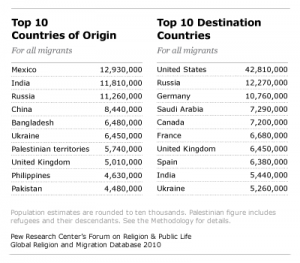
An interesting factoid from PewResearch.org is that the Mexico-to-U.S. link is the most popular bilateral migration path in the world. As of 2013, more Mexican immigrants (13 million) were living in the U.S. than all immigrants to Russia combined (11 million). Russia has the second largest number of total foreign-born residents, after the United States, which has a total foreign-born population of about 46 million.

Also from Pew Research, Countries with the fewest resources send lower shares of migrants. Although international migration is intrinsically tied with the search for jobs, people in the most impoverished countries may not have the money to finance a trip. The Central African Republic, the Democratic Republic of the Congo and Niger – countries with some of the lowest U.N. Human Development Index ratings and GDP per capita – all have less than 3% of their population living outside their borders.
Then mariner and Guru focused on why migration happens. The first notable migration was the one 80-100 thousand years ago from Africa into the Middle East and Europe. A popular theory among paleontologists is simply that Homo sapiens, like any species, migrated because it could. Mariner is reminded of the French who have a larger percentage of citizens living around the world than any other nation. There must be a statistic somewhere that describes the high rate of citizen relocation within the US – just because they can. Some years ago, there was a statistic that said Americans move an average of every five years – for various reasons of course – but the bottom line is because they can. The first reason migration occurs: because it can.

Competing for the second reason for migration are economic hardship/opportunity, religious freedom, education, family ties, tyranny and war, famine and disease, and whimsy. All these reasons, save whimsy, can be listed in two groups of migrants: political reasons and economic reasons; the overlap is significant.

Lest one dismiss whimsy lightly, the migrations to the Caribbean, Central America and the South Pacific affect local political and economic circumstances in those regions. Years ago mariner sailed the islands of the Caribbean when virtually every island had a unique culture and distinctive value. In less than ten years, big time commercialism wiped out the colorful, fragile and balanced nature of these islands.

Another top-down migration occurred in Puerto Rico in the early 2000s when billionaires seeking to reduce taxes bought all the good shoreline and built magnificent castles they called ‘resorts.’ This in no way benefited the Puerto Rican economy and put out of reach the better shorelines that Puerto Rico could have leveraged.

Corporations migrate as well and are pushing the world economies into a new age of international finance. And, oddly, the Internet allows migration without ever leaving in the first place but, as the 2018 US election proved, Russian political influence affected US politics as much as a cruise ship docking at a small island in the Caribbean – without ever leaving Russia.

Given the discourse above, whether hardship or whimsy, migration happens because it can. The next post will look at migration from the opposite side, immigration.

Ancient Mariner


[1] http://www.globalissues.org/article/537/immigration#Whydopeopleemigrate

How someone can live your life for you

The following article from CityLab’s Kriston Capps expresses the exact fear that mariner cites continually and why he is a privacy advocate:

[CityLab] Ben Carson mentioned you: The U.S. Department of Housing and Urban Development announced today that it is charging Facebook for violating the Fair Housing Act. According to the charges, Facebook’s ad delivery system discriminated against users by screening who can see ads for housing on its marketplace listings. The site gives advertisers—including lenders, real-estate agents, and landlords—the tools to target potential buyers or renters and block others based on specific characteristics.

The charges from HUD describe how that can translate into housing discrimination. One example in the complaint says users can block people from seeing housing listings if they’re categorized as “moms of grade school kids” or “foreigners,” or if their interests include “hijab fashion” or “service animals.” “Using a computer to limit a person’s housing choices can be just as discriminatory as slamming a door in someone’s face,” said HUD Secretary Ben Carson in a statement.[1]

–> Most people are not aware that data mining corporations like Facebook, Google, Yahoo, Microsoft and many others already slice and dice a person’s profile and sell it to other interests. Internet users do not get offers for the better credit cards if their credit history is too low; every time someone uses a search engine, their selections are marketed and the user begins getting advertisements related to that search; does anyone receive only one seed catalogue? And on and on.

While commercial profiling is a nuisance, the HUD violation against Facebook points out the dark side: interfering in one’s private life and intimate issues like health (Insurance companies already are converting policies to require the insured to participate in electronic tracking of everything about the insured; if one didn’t jog today, their premium may increase). As mariner has mentioned many times (and readers know this), if the public isn’t stringent about privacy law, someone else will live their lives for them – saying where they can live, what they can eat, select their spouse, create their budget, limit debt ceilings, alter the cost of retail items – all without the authority and without the awareness of the individual.

Profiling data has the largest profit margin of any industry. It is inexpensive to create and generates political and economic power by suggestion. It takes no effort to slip from suggestion to manipulation by controlling the perceived reality of the individual.

Ancient Mariner

[1] CityLab’s Kriston Capps has the story: https://www.citylab.com/equity/2019/03/facebook-discrimination-policy-housing-ads-hud-charges/585931/?utm_campaign=citylab-daily-newsletter&utm_medium=email&silverid=%25%25RECIPIENT_ID%25%25&utm_source=newsletter

More about Swamps and Glaciers

If you can make it there, you’ll make it anywhere
[CityLab] “Don’t sneeze: It looks like New York may finally become the first city in the United States to introduce congestion pricing on its streets. The New York Times reports that state leaders have reached a consensus to put electronic tolls in place for drivers entering the most heavily jammed parts of Manhattan. Politically speaking, the idea has come a long way since 2008, when then-Mayor Michael Bloomberg floated a version of congestion pricing that was seen then as a non-starter.”
–> Anyone who travels major highways around the US has observed electronic toll gates where a driver does not need to pay cash but has a pre-paid pass that reads the pass as the vehicle drives through the turnstiles. Some toll roads don’t want any cash but photograph the license plate of non-pass drivers; the driver gets a bill via the US Postal Service.
New York City has a two-fold issue: Manhattan traffic jams last all day and the solution is supposed to be a modern, civilized subway. The congestion toll will help pay for subway construction that is over budget in astronomical numbers. If one has need or simply plans to visit NYC, definitely use commercial transportation – leave the car at home.
– – – –
Mariner has a few friends who are preparing to move into retirement communities. One easily can relate to the confrontation of which books to keep, which memorabilia, large and small and dear to the heart and maybe belonged to a beloved grandmother, to dispose of or to keep. Will there be room to keep the entire collection of photograph albums, LPs and 45s? And clothes, and yard equipment, and furniture and . . . The agony of it all.
It occurs to mariner that changing a life style is as difficult as changing from one cultural age to another. Much faster, of course, than the decades it takes to make cultural changes in perceived ethics, economics, and life values in every family and business that is affected.
Many consider the decades after World War II to be the Golden Age of American history, the time when ‘The Greatest Generation’ lived. WWII expedited change by bombing every nation from Norway to Mozambique and from France to the islands of the Pacific. Mariner has mentioned before that many sociologists believe there is a fifty to sixty-year life cycle to a given culture – give or take a few years. This includes small towns, cities, nations and today many nations at once. The sixty-year cycle seems to hold up in recent history:
– From the War of 1812 to the Civil War (58 years).
– From the Civil War to World War II (75 years).
– From World War II to the Vietnam War (50 years).
– From the Vietnam War to the Iraq War (45 years).
It is a shame that cultural life cycles can be measured loosely as the time between wars. It seems the entire planet is at war right now; in fact that’s true. Only 11 nations out of 182 are not at war. The advantage living humans have is that they are aware that more is happening than just war. War is a simplistic and cruel way to respond to insecurity but in the midst of the gunpowder and espionage, people are changing their values. As the values change, increasing pressure is brought to bear on government, business, economic law and daily life to change as well.
And so it is that the US is in a bipolar state: what cultural behaviors and rules will be kept? Which will be thrown out? What are the new rules? Like it or not, the US is at a time similar to mariner’s friends; the nation is moving to a new culture.
Ancient Mariner

Progress is hard to define when walking through a swamp

But that’s how progress moves through a giant culture. Consider:

NPR] 55 Years Later, Lawyer Will Again Argue Over Redistricting Before Supreme Court

“Emmet Jopling Bondurant II knew about the civil rights movement when he was a student at the University of Georgia in the 1950s. . . As a 26-year-old lawyer, he took part in one of the most important voting rights cases before the Supreme Court in the 1960s — one that ultimately required states to put equal numbers of people in congressional districts.

“55 years later, in a case that bookends his legal career, Bondurant is returning to argue before the high court in a case that asks whether politicians can draw political boundaries to benefit their own political party at the expense of the other party. In 1964, the Supreme Court ruled in favor of Bondurant’s side. In states with more than one House representative, districts must have the same population.

“This time he’s asking the court to block partisan redistricting in North Carolina. Although the state is closely politically divided, the legislature ensured that Republicans would dominate the congressional delegation.

“Bondurant has no plans to retire, or quit trying to improve democracy in the country through the courts.”

–> Unsung heroes are hard to find but that they exist somewhere in our culture is a blessing. Three cheers for Emmet Jopling Bondurant II at 82 years of age.

On Public Shaming

In his March 17 show, Last Week Tonight, John Oliver dedicated his subject to the destructive nature of public shaming – the kind of commentary that is excessive and often well beyond the real facts. A third of his air time was spent interviewing Monica Lewinsky, the subject of national shaming for an affair with Bill Clinton. Her life was interfered with on a brutal scale that lingers today. John’s interview was sympathetic, even to chastising old Jay Leno jokes that were incessant.

Then yesterday, the CBS Sunday Morning show interviewed Kathy Griffin who was publically shamed for holding a bloody, chopped off head of Donald Trump. It cost her contracts and appearances to a point that Kathy had to recreate her career via 1,300+ comedy bookings in Europe – a crowd more understanding of her motives regarding Donald. The CBS interview also was sympathetic.

Guru ponders whether the glacier of identity politics may have started cracking.

Ancient Mariner

The State of Things

6 days

Just six days after the attacks on two mosques that killed 50 people, New Zealand’s prime minister announced that the country had banned military-style semiautomatic weapons and assault rifles. The country will oversee a buyback program for the guns, and owners who don’t get rid of theirs will be subject to fines. [The Washington Post]

–> Now if the US had a functioning government, it could do the same thing. . .

– – – –

2,500,000 miles per hour

Livescience.com has an article today about a pulsar (spinning sun) traveling through space at 2.5 million mph! Fortunately, it isn’t heading toward Earth but will leave the Milky Way Galaxy soon. How about ten minutes from now?

– – – –

Our Ozian future

The plot of the movie ‘The wizard of Oz’ comes to mind. Our nation (in fact many nations) are skipping along on the Yellow Brick Road. Like the characters, the US citizenry has deep-seated issues, e.g., a missing heart, no courage, and no brain. So off to the Ozian world of the future. No one knows what’s behind the curtain. Can Future Oz give us a heart, courage and a brain – or – will Oz simply ignore the nation’s plight and impose an Orwellian future upon the citizenry?

There are many futures: the Artificial Intelligence future, largely still behind the curtain but bits and pieces escape. Will the citizens be nothing more than tools to sustain an economy, buying what they’re told, doing what they’re told, living where they’re told?

What has caught international attention in economic sectors is that a deep recession is bound to happen soon. The first absolute indicator comes from Europe where bond sale prices are dropping.

There is a growing rift of reality between those over 55 years of age and those less than 55; the rift grows larger as the age drops – especially to those under 30. Why are young people not having children at a rate that will replace the population? Why is the new democratic surge using the word ‘socialistic’?

The Planet Earth is fed up with humans. Scientists predict that sea levels, strong weather, droughts and flooding will increase to levels that will bankrupt human economies.

Let’s just pray that Oz gives the citizenry a heart, courage and a brain. We’re going to need them.

Ancient Mariner

Peace by any Means

The following story copied from mariner’s newsletter from The Atlantic deserves to be distributed as widely as possible. It speaks to the joy of human compassion; it is a giant example of Pass It Forward.

Peace by Chocolate

Mar 06, 2019

For decades, Issam Hadhad ran a chocolate factory in Syria, the second-largest in the Middle East. In 2012, it was destroyed in a bombing. Hadhad and his family fled war-torn Damascus soon thereafter. After spending years in a Lebanese refugee camp, they were granted asylum in Canada. When they arrived in Nova Scotia in 2016, they had little more than the clothes on their back.

Hadhad, a chocolatier at heart, hoped to resume his profession once he was settled in his new country. But he spoke no English and had no resources. That’s when the community around him stepped in. Locals noticed Hadhad at the farmers’ market, where he sold sweets baked in his home kitchen. When they learned of his ambitions, plumbers, electricians, carpenters, and other skilled workers from the community rallied around Hadhad to help build a factory. The family even received a loan to kick-start the business. “I was welcomed as [if] Canada was my homeland,” Tareq Hadhad, Issam’s son, has said.

One of those friendly and solicitous locals was Frank Gallant. “Rather than viewing Issam as an outsider, Frank simply saw him as a friend going through a tough time,” Jonathan Keijser, who made a short documentary about the pair, told The Atlantic. Keijser’s film Brothers premieres on The Atlantic today. It follows Gallant and Hadhad on the latter’s first-ever camping trip. “Frank told me about how he’d been wanting to introduce Issam to some ‘real Canadian experiences,’ and mentioned how Issam had never been camping before,” Keijser recalled.

Gallant was initially skeptical about the prospect of being filmed. “He questioned what would be so interesting about following the two of them around,” Keijser said. “To Frank, the friendship that developed between [him and Hadhad] and their families was nothing out of the ordinary.”

Though Gallant and Hadhad cannot communicate fluently, the language barrier doesn’t seem to have impeded what is a palpable connection between the two men. “It was profoundly moving to witness firsthand the effortless friendship between Issam and Frank, despite their inability to speak the same language,” Keijser said. “It was clear by their interactions that they have an inherent understanding of each other—something many people search their whole lives for and still never achieve.”

Gallant frequently works alongside Hadhad in his chocolate factory, Peace by Chocolate. The company has pledged to hire 50 refugees by 2022.

– – – –

[CityLab] As AI Takes Over Jobs, Women Workers May Have the Most to Lose

Women, especially if they are Hispanic, may be at most financial risk from the automation of jobs says a new report from the Institute for Women’s Policy Research. (Sarah Holder)

– – – –

This is a blatant, unabashed promotion by mariner: His go to news channel is NEWSY (283 on DISH and available on many other outlets). The following is copied from a search engine list:

“For news networks like CNN and Fox News Channel, about 70% of the viewership is over 55. By contrast, about 70% of Newsy’s audience is 25-54, according to E.W. Scripps.”

Nevertheless, if those over 55 checked the program, they may become regular viewers.

–Straight news, no gossip, no manufactured reality. Sean Hannity would have nothing to say.

–Conversational style directly to the viewer. Chris Matthews would never make it.

–Very appropriate special interest coverage.

–Get it all: world news, US news, local news, weather – each in a crisp, two or three minute presentation.

–Newsy also offers an email newsletter covering top stories.

–Website is friendly. See: https://www.newsy.com/

Ancient Mariner


Leash Laws for America

Mariner lives in a small town. There are many children and many senior citizens. There is a fear that dogs on the loose will run in packs, defecate everywhere, bite everyone, destroy gardens and otherwise frighten the populace. Hence there are dog leash laws. Having lived in the town for years, mariner has noticed that there are very few dogs that weigh more than their leash. If one is to fear anything, it may be that feral shih tzu will roam the vastness of the town’s back yards competing with squirrels, chipmunks and birds for meager garbage. Rabbits need not be afraid.

However, when it comes to American society, our corporations, our governments and our moral liberties, nothing seems to be restrained, fair, compassionate or rational. This is because very little is on a leash. It is not dogs that are the issue; it is humans who should be on a leash. Humans quickly can pillage nature, greedily destroy balanced economies, and form angry packs not to bite but to kill and all the while, piss on everything.

Just like dogs, humans have special breeds. The Government Breed has two classes: elected and professional; the Corporate Breed also has two classes: small business and profiteer; The Intellectual Breed has two classes: ideological and technical; then there is the Mongrel Breed divided into four unequal classes: conservative-poor, conservative-rich, liberal-poor and liberal-rich. While dogs are not concerned with coloration, humans are not as mature as dogs and tend to flaunt color. As a last description, all human classes bite, form packs at the slightest provocation and are absolutely territorial.

Those who manage the leashes are called ‘the electorate’. It is the electorate’s job to attach or remove leashes to the Government, Corporate, Intellectual and Mongrel Breeds. Attaching leashes is difficult because the spirit of the founding Constitution says, in a phrase, “There are no leashes – freedom for all; guns for all; pursuit of wealth for all – oh, and women can’t vote and it takes five blacks to equal 3 blacks for the purposes of counting population to be represented in Congress.” Fortunately, the last limitations have been unleashed – not including guns which never have been on a leash.

Because the electorate has been derelict in its duties, the Breeds have decided for themselves whether to be leashed or not – in almost all cases, not. What meat is to a dog, money is to human Breeds. The Breeds have become voracious ‘carnivores,’ garnering more and more money and not letting disadvantaged Mongrels have any and just as importantly, not taking care of the human park.

It is past time for the electorate to get off its derriere and rearrange leash laws. It also is time for every government entity that has dog leash laws to provide a good dog park as well.

Ancient Mariner

Discovering America

Yes, America still exists. The real America. Recently, mariner and his wife travelled across the Southwest sector of the US. Mariner’s wife put together a passage with ports of call and waypoints that avoided large cities, and as much as possible the Interstate highways. Our intent was to travel the forgotten routes to the villages, towns and history that are the true fabric of the nation. Referencing a recent post, we were intent to not drive a bus but actually travel the byways of culture and diversity that compose this fine nation.

Many travelers cannot put aside a vain, judgmental attitude; this attitude leads to a trip that misses the richness of diversity, the strength of freedom of choice. One must brush the dust off unused attitudes similar to sympathy and acceptance.

Up front, mariner wishes to correct any presumptions that small independent motels, small towns and villages and one-owner restaurants lack cleanliness, full-functionality and professionalism. Nonsense. They are five-star in their own right. Not five star like the plastic, sterile world of chain motels and machine-stamped restaurants but like the responsible humanness of unbleached reality. Quaintness is not another word for unacceptable.

Mariner and his wife visited several distinct cultures. One stop was in a town of 547 residents. It was on an original strip of Route 66 and the town remains as it was in the heyday of that highway in the 40s and 50s. For those who have traveled the Southwest, they know it is a vast region of little change in terrain. Deserts are common. Through this long, wide open region, Route 66 became the only road to transverse from the Midwest to the Pacific coast avoiding the travails of Rocky Mountain weather. It started in 1857 as a collection of Indian trails and sporadic wagon trails. Nothing was paved. Today with modern highways and speeds hovering around 75 or better, it still takes three days to travel the distance. Even the Santa Fe Chief takes two nights and three days by rail.

Mariner visited an American Indian neighborhood by the highway. There was very little in the way of a village, just travel services, Indian tourist items and a handful of small homes. (Most live out on the desert flats in very small shacks.) Mariner estimates that the economy on Indian reservations is about one-tenth the income per person of what the general economy represents. Bound by vindictive treaties, many established more than a century ago, American Indians largely are poverty-stricken but still very proud of their heritage. America has not treated American Indians very well.

Mariner visited a town whose economy was based on transportation – an immense truck stop and shipping center with all the retail and commercial resources that support this small city. At another stop the motel was managed by Hindus. As different economies and cultures were experienced, mariner and his wife became aware of the strength of diversity. At the same time, they felt the unity that gives the US its power. The two together are what made the US the wealthiest and most influential nation in history. It is sad commentary that US citizens and its governments have forgotten, even rejected the democratic engine that unites diversity and unity into a powerful alloy.

Ancient Mariner


Important but Unheralded News

2 times as often

[Wall Street Journal] Philadelphia has become the first major U.S. city to ban cashless stores, which have become a mini-retail fad in recent years. Stores say it saves them time; the city says it locks out poorer residents. The poorest Americans are nearly twice as likely to use cash as the richest ones.

Keep the change: Uber. Sweetgreen. Amazon Go. More businesses are opting to go cashless, and trends show Americans are hopping on board: In 2017, debit and credit card payments made up 48 percent of all transactions. Even more conventional restaurant and retail establishments have cut cash, citing increased efficiency and safety. But lawmakers at the local level are concerned that the cash-free economy will discriminate against low-income people. Philadelphia recently became the first city to ban cashless businesses, and San Francisco and D.C. are eyeing similar measures.

New York City is the latest to consider such a bill. With nearly 12 percent of its residents living unbanked—often people of color and undocumented immigrants—the policy brings a bigger question to life: Is refusing to accept cash a form of racial discrimination? “In the end, I think the need for equity outweighs the efficiency gains of a cashless business model,” says the city councilmember sponsoring New York’s legislation. “Human rights takes precedence over efficiency gains.” [1]

– – – –

27 universities

[The Wall Street Journal] At least 27 universities — including MIT, the University of Washington and the University of Hawaii, according to cybersecurity intelligence group — have been targeted by Chinese hackers on the hunt for research “about maritime technology being developed for military use.” The hacking group may be the same one that hacked Navy contractors last year, stealing submarine missile plans and other data.

– – – –

Cars are killing us. Within 10 years, we must phase them out.

[The Guardian] Let’s abandon this disastrous experiment, recognise that this 19th-century technology is now doing more harm than good, and plan our way out of it. Let’s set a target to cut the use of cars by 90% over the next decade.

Yes, the car is still useful – for a few people it’s essential. It would make a good servant. But it has become our master, and it spoils everything it touches. It now presents us with a series of emergencies that demand an emergency response.[2]

– – – –

40 Years After The Vietnam War, Some Refugees Face Deportation Under Trump

The Trump administration is trying to convince Vietnam to repatriate some 7,000 Vietnamese immigrants with criminal convictions who have been in the United States for more than 30 years.[3]

[1] For full article see: https://www.citylab.com/equity/2019/03/cashless-cash-free-ban-bill-new-york-retail-discrimination/584203/?utm_campaign=citylab-daily-newsletter&utm_medium=email&silverid=%25%25RECIPIENT_ID%25%25&utm_source=newsletter

[2] For full article, see: https://www.theguardian.com/commentisfree/2019/mar/07/cars-killing-us-driving-environment-phase-out?utm_campaign=citylab-daily-newsletter&utm_medium=email&silverid=%25%25RECIPIENT_ID%25%25&utm_source=newsletter

[3] For full article see: https://www.npr.org/2019/03/04/699177071/40-years-after-the-vietnam-war-some-refugees-face-deportation-under-trump?utm_source=npr_newsletter&utm_medium=email&utm_content=20190304&utm_campaign=breakingnews&utm_term=nprnews

The indifferent Species

[BBC] “The world’s most endangered orangutans could be pushed towards extinction after an Indonesian court approved a controversial dam project, say campaigners.

The 22 trillion rupiah ($1.5bn) dam will be built in North Sumatra’s Batang Toru forest.

The region is home to the Tapanuli orangutans, which were only identified as a new species in 2017.

Only 800 of them remain in the wild and they all live in this ecosystem.

One scientist, who acted as an expert witness in the case, told the BBC the move would “put the orangutans on a firm path to extinction”.

‘Worst area of the forest’

The billion-dollar hydropower dam, scheduled for completion in 2022, will be constructed in the heart of the Batang Toru rainforest, which is also home to agile gibbons and Sumatran tigers.”

–> There is no doubt in mariner’s mind that the human species is disassembling the Age of Mammals. And sea life. And birds. Elizabeth Kolbert, author of The Sixth Extinction – An unnatural History[1], documents the human’s childlike abuse of climate, habitat, and an alarming, almost unbelievable and unending list of extant species caused directly by human disregard for life.

Humans have assaulted the Planet’s willingness to harbor all life forms in a balanced and, albeit it competitive, a fair sharing of Earth’s global habitat. But humans, to paraphrase Winston Churchill, have met nature by population, by chemistry, and by destruction.

Even as the human species sits in the midst of a man-made climate disaster that kills from the deepest parts of the deepest ocean to the highest peaks of the highest mountain each and every day, humans, like little children, have no perspective on reality. What is important to Homo s. is insatiable consumption of resources for convenience and an artificial asset system consisting of economic engines that destroy the planet rather than heal it, force combative asset challenges on an environment that is not designed for continuous destruction in the name of meaningless, artificially measured profits.

In a past post, mariner listed the species that have disappeared by the hand of man. It ran for pages. Every human being should take Elizabeth Kolbert’s tour around the world to see the obnoxious behavior of humans as they deliberately destroy the planet’s evolutionary balance – at the cost of living creatures.

Dare mariner suggest our attitude toward our planet is similar to that of an incompetent, destructive, uncaring, selfish President of the United States?

Ancient Mariner

[1] The Sixth Extinction, An Unnatural History, Elizabeth Kolbert, 2014, Henry Holt and Company