
The Great Barrier of Nationalism

In the last post, Today is Earth Overshoot Day, the mariner wrote of global issues that are ignored by governments around the world. Water and minerals have reached an end game and face inadequacy during this century. Food is both abused by waste and unavailable to millions because of political obstruction. Ecosystems of all kinds are wantonly destroyed to increase profit. One-third of the Gulf of Mexico is a dead sea because of the toxicity flowing off the Mississippi River. 90% of Monarch butterflies have disappeared. Coral reefs around the world are dying. Coral is the bottom of the food chain; without coral whole species of fish and mammals will disappear. Much of Micronesia will vanish beneath the sea in 50 years. Although we know deforestation of great forests is not good for our atmosphere, yet the clearing continues.

The mariner knows he sounds like Chicken Little but the ramifications of not caring about our planet or ourselves already are measurable. While there is a futile attempt by multiple nations to limit Carbon Dioxide, that effort miserably falls short of functional change, let alone actually modifying global circumstances. Still, governments feign ignorance about global warming and converting to alternative energy now and deny passing legislation to prevent profit taking at the expense of everyone’s biosphere.

Why is each nation so reticent to join with others to avoid terminal catastrophes for humanity? The answer is nationalism. The twenty-first century presents issues that can only be solved if the world politic changes its priorities. These priorities are not nation-sensitive. The type of government does not matter be it communist, socialist, capitalist, authoritarian, monarchy or tribal. In every case, the wellbeing of the nation, its economy, its culture, and its advantage among nations, are the first priority.

The one new nation that has evolved without nationalist priorities is corporations. Focused on profit as a first and last cause, corporations glean unfathomable amounts of cash and assets from the world economy. This cash is used to grow and acquire more assets or it is parked in long term investment. Corporate profit is sufficient to take serious steps toward global rejuvenation but does not for the sake of profit. If the sums stored away by corporations were taxed for the benefit of global issues, relatively simple issues like fossil fuels could be bought outright – diminishing the pressures against Earth’s biosphere in short order. Although the solution is simple, the process is tangled in worldwide nationalism – nations who benefit from their corporate contributors.

Operating largely outside the jurisdiction of nations, corporations are in effect today’s pirates – not roaming the seas but roaming the Internet that allows rapid reorganization and fast-dollar marketing and to move to nations that are more amenable and enable larger profits. The Trans-Pacific Partnership in Congress right now will make participating corporations virtually impervious to nation-based human rights and labor law. Corporate payoffs to legislators and kings are huge and difficult to resist.

To a small degree, one can understand greed as a goal. Certainly, it is personally rewarding. On the other hand, fairness is a tangible factor. If one makes a mess in a friend’s home, one pays the price of cleaning the mess rather than leaving it for the friend. Somehow, governments have forgotten fairness. Some of this forgetfulness can be attributed to outdated government concepts. The founding fathers of the United States left fairness to the individual so that there can be freedom for all, freedom to pursue happiness, etc. This liberated the new country from the abuses of colonialism but it provided no structure for fairness. If one could pick a single issue why the US and State governments are broken, one would have to say the governments don’t enforce fairness – hence the ease with which the US has become an oligarchy and allows the fast-buck, under-taxed marketplace.

Humanity has been unfair to Mother Earth. All of human history has been an expansion of skimming Earth’s riches but not cleaning human mess, not restoring or respecting what Earth has given toward our arrogant sense of success. Not only has humanity been thoughtless, humanity has been wanton. Without Earth, there would have been no success; without Earth now, there will be no humanity tomorrow. A respected ecologist has put the end 600 years from now.

Ancient Mariner
Today is Earth Overshoot Day

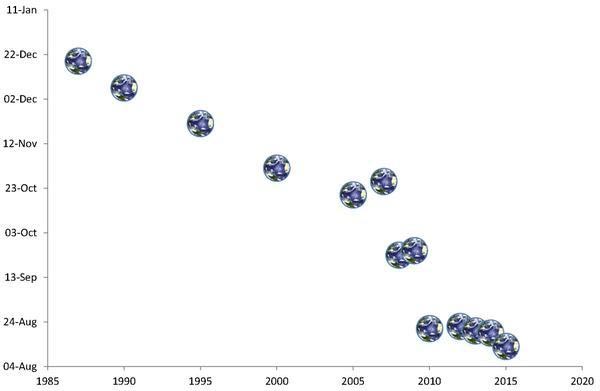
Many may not know this term. It is the day of the year that humanity requires more of the Earth’s resources than Earth can provide for that year. In 2015 that day fell on August 14. From now until December 31, humanity is borrowing against future years. An example is the use of aquifers – water stored deep in the Earth. We are rapidly draining aquifers dry. What will happen when we have drained all the water? It took hundreds of thousands of years to create aquifers; humanity is draining them dry within 200 years. The chart below shows that earlier each year, humanity consumes more than the Earth can provide:

The latest population projection shows that by 2100, 85 years from now, the number of humans will grow from 7 billion+ to 12 billion+. That number is approaching double today’s population. Ecological resources are a global issue. It is larger than one nation, or the many international coalitions. It affects every nation on every continent. Every day the world dickers with economic and military wars, and ignores bellwether changes like global warming and creating dead seas that used to provide large quantities of life, global issues loom closer. Solving global issues will require every nation’s participation and will take decades to accomplish.

On a more imminent topic, the United States and most of the temperate climate nations will be affected by the strongest El Nino since 1950 – the first year records were kept. Southern California likely will get the rain it needs, albeit via heavy storms and flooding; Northern California and the top tiers of states all the way to the great lakes will be drier and warmer through the winter; the Upper Mississippi Valley and the Ohio Valley will have drier weather, perhaps even drought-like. The South, coast to coast, will have much wetter weather again via large storms. A second jet stream will come from Alaska and pass over the Great lakes into New England and the Middle Atlantic states.

The degree to which this strong El Nino will disrupt agriculture or cause flooding is still unknown but NOAA advises “above average” changes to our weather patterns. A tip to how much above average is in the name given by the cable weather channel: Godzilla El Nino. Crudely bilingual but a tip. If one remembers 1997-1998, El Nino produced snowstorms in New England that fell in feet per hour, rainstorms across the South that fell in inches per hour. Iowa and Missouri flip-flopped from very cold to very warm to very cold again.

Many planetary events have heightened profiles. In the mariner’s opinion, global warming is an indirect cause of stronger weather patterns and may, along with a weakening magnetic field, exacerbate plate tectonic activity. Because of the Sun’s cycle, scientists predict a small ice age in mid-century. Times they are a-changing!

Where will we put another 5 billion people? Not on islands or seashores – they will be underwater.

Ancient Mariner

The Candidates for Nomination

The mariner is watching the early campaign for President with dissatisfaction more than anything else. The press is chasing easy news with Donald Trump. There is little substantive interpretation of what all this folderol means and no one seems to know how republican candidates respond to democratic intentions. So far, the republicans simply are bickering among themselves. It is true that the republicans are stretched across a broad spectrum of conservative ideology; real primaries likely will not unify easily behind one candidate – except perhaps the empty mind of Donald who, at least, speaks what he really feels. The mariner thinks Donald’s popularity is due to the phenomenon of honesty and lack of beholding to lobbies and money. Certainly, an aphrodisiac or perhaps a long needed rain falling on a drought-stricken voter desert.

In the long run, however, Donald is a deal-making pragmatist at best and an impulsive decision maker who will not fare well in international affairs. The mariner often is reminded of Cesar Chaves.

On the democratic side, the contest between Hillary Clinton and Bernie Sanders seems to mirror the ideological struggle on the republican side. As far right as candidates like Rubio and Scott are, Bernie is to the far left. It would be a fascinating measure of the state of our culture if Bernie actually wins the nomination to run against a bona fide republican nominee. It also would be scary.

Almost unmentioned are old school republicans and democrats sitting in the midst of new ideological intensity. By the way, Hillary is one of the old schoolers. First, old schoolers are survivors; second pragmatists; and third hide behind the mundane party line. Ideology isn’t really their game. Just give them their paycheck and campaign funds. Bernie’s original intention, the mariner believes, is to keep Hillary as far left as possible but he has been surprisingly resilient and is approaching Hillary’s poll numbers.

The scariest combination is Donald versus Bernie – bullying versus intellect. Intellect has never fared well in the history of the United States. Considering Donald versus Hillary, Donald is likely to lose. His alienation of special subgroups will be his downfall – especially against the first woman President; women are not joining Donald with enough numbers to win. Then there are “the” blacks and “the” Hispanics.

This week, the mariner has begun to hear a speculative press. The fun of catering to empty assassinations by Donald is wearing thin. Further, the republican party is trying desperately to undermine him. Finally, the primary season will come into play despite the meddling of Fox News. Again, Donald’s style will threaten local activists and his results will diminish. The mariner hopes the real conservative will be identified early enough to speculate how well Hillary or Bernie will match the conservative candidate.

Ancient Mariner


Return to Iowa

Return to Iowa

Yesterday, the mariner and his mate returned from cross-country visits with their children. It is good to see them; we see them seldom and one can see how they have changed. We cannot help but notice they have taken charge of their lives and evidence of apron strings is long gone. Still, their lives are interesting to observe, frequently stirring moments in our own memories of taking life in hand. We shall gather again this winter.

While visiting the son, two events occurred worth mentioning to readers. First, the republicans, perhaps the mariner should say Fox News, held their first debate. It was a sad affair with little of consequence emerging from the event. Four years between National elections is long enough for the mariner to forget that politicians don’t have debates. In fact, the art of avoiding answers to any question no matter how direct has been mastered by politicians. It is not a debate. Were the politicians sixteen years old, we may be able to call them debutantes – it is more a cotillion than anything else. Will it forever be that the electorate votes for personality rather than content? As the mariner has mentioned in the past, citizens get what they vote for. It is interesting that the inquisitors from Fox News posed questions based solely in conservative ideology and right-wing divisive issues. Not one question was posed in a liberal context to be countered by candidates. Where has the primary season gone? What is the US missing that we cannot match the British campaign season virtually untarnished by money and lasts but a few months rather than a few years?

The second event was the passing of The Daily Show. Jon Stewart’s last broadcast was August 6, 2015. Millions of viewers will miss him, including the mariner. It was frequently mentioned by associates that he helped us survive the craziness and incompetence of politics and news broadcasting. Yet, despite his claim that he presented “fake news,” his show became a source of truth, fact and accountability that was not adhered to by those he admonished. Jon Stewart is a man of moral strength and emotional sensitivity – a leader in our times. The mariner wishes Jon the best in his next adventure.

Also within the scope of our vacation visitation, are some experiences that may be of use to the reader. For example, driving time quickly becomes the major pastime as we drive about from one event to another. We later realized that each day should have one major event to which the family is committed. The challenge arises when there is an event during the day and an evening dinner or a secondary activity. Driving about to collect and discharge members of the family and arriving at various venues morning, noon, and night quickly transitions into a chauffeuring experience – a busman’s holiday so to speak.

Another experience is walking. Not that walking is difficult; it is that what one member considers a quick jaunt through the park may be another family member’s trip to Mount Everest. The disparate response to many different events is something to be considered. For example, Grandpa and little Becky may not respond in kind after a ride on the Tilt-a-Whirl. Taking a horseback ride may be fun to the teenagers but a fearful nightmare for Mom. Walking all day through a forty-acre garden may be a pleasant experience but everyone will know it is not pleasant for 18-month old Johnny. The reader gets the point.

Our coterie of family members is small and dividing the group by age, fitness, interest and time would have been difficult. Nevertheless, consider simultaneous events, e.g., send Mom et al to the gardens while the adventurous ride horses. This divides driving among different groups – somewhat preventing the driving vacation.

To top off the vacation, the mariner and his mate spent the last two days driving over 1,000 miles back to their small Iowa town.

Ancient Mariner


Flying

“WASHINGTON – Transportation Secretary Anthony Foxx said Friday the government has opened a price-gouging investigation involving five airlines that allegedly raised airfares in the Northeast after a deadly Amtrak crash in Philadelphia in May disrupted rail service.
The Transportation Department sent letters on Friday to Delta, American, United, Southwest and JetBlue airlines seeking information on their prices before and after the May 12 train crash.” (Newsday July 25 2015)
In a recent blog about the confrontation between capitalism and socialism in Cuba, the mariner demonstrated capitalist behavior by using airlines as an example: ….whereas only 4 [airlines] can mimic one another easily, coordinate hub flights to assure every flight is full, and, in order to keep profits high, slip down the slippery slope to collusion….
From a capitalist point of view, the airlines did nothing wrong by raising prices to the Northeast. It’s a matter of supply and demand. With the train option eliminated, demand rose for airlines, making a seat more expensive because supply had not changed. All’s fair in love, war and capitalism.
When the mariner was working for others, he constantly had to use airlines. For two years running, he belonged to United’s 100,000 mile club. This recognition provided easy upgrades to first class and access to the United club room at the airport where waiting was more pleasurable. Nevertheless, the mariner did not like flying because it was an experience very close to hog gestation cages. More than once, a drink sitting on the fold down tray went flying when the person in front pushed their seat back within six inches of his face. When he had a contract in Madison, Wisconsin, he calculated that the entire trip by air took eight hours door to door. It also took eight hours to drive to Madison, door to door – so he drove instead. And this experience was before TSA! On the way to a Caribbean sailing trip after he retired, the mariner stood in Orlando airport for two hours just to pass through TSA. He retired just in time.
But now he faces the airlines again. He must fly from Denver to Los Angeles and back. The mariner is not afraid of flying; he has 22 hours toward a private pilot’s license, a project that was interrupted by a career move. However, he is afraid of the airline corporations! Corporate greed is never on display more than when flying – unless you fly internationally and have LOTS of money. But that is flaunting one’s wealth – another form of greed.
This is the first post to the mariner’s blog associated with his trip to see his progeny. He will make every effort to share the good times….
Ancient Mariner

Cheap Drives Out Quality

When the mariner was sixteen, he finished his high school education at night. He took an economics class that provided him several insights into the motives of society and individuals. He was fortunate to have an instructor that was willing to talk cultural ramifications as well as economic ones. One of the insights he gained from that economics class is that there is an unbreakable rule that cheap value will displace quality value in every case.
A simple example is the toy fire engine. In the mariner’s childhood, the fire engine was made of steel with realistic features, rubber tires, and paint that included firehouse logo, four small painted firemen and other finely traced detail. His children did not have a steel fire engine; they had a plastic, mold-stamped one with little attention to the aura of a real fire engine. There were no finely painted firemen. Plastic drove out steel. It was less expensive – at the cost of quality, detail, permanence, and material.
Reducing cost through new inventions, materials and processes is, largely, a good thing. Even in its best light, however, quality is minimized. One may say that new technology can produce better results. For example, an mp3 song is better than a 78 record – both in quality of sound and in production. The price paid for this efficient production is not in the quality of the sound but in the value of the recording as a significant, endearing purchase. At 99¢ per song, it is easily discarded or lost in thousands of other songs collected because collecting is easy and inexpensive. Even a 45 rpm collection is more durable and more revered – if one still has a 45 turntable.
Turning to more important examples, the mariner wonders if the tea party is a cheaper version of the republican party. Intellectually, it is easy to replace complex, multifaceted issues with visceral, overly simplified but “feel good” reactions. The republican party has an ideological premise based on conservative, capitalistic ideals. Under Representative Boehner, the tea party has captured the republican party and drawn it away from legitimate dialogue with democrats into a paranoid and extremist advocacy which will not stand up against an organized, middle-of-the-road campaign by the democrats. True, gerrymandering and republican governors will offer resistance but the attendance at Bernie Sanders’s events plus the low key campaign of Clinton suggest that the tea party brings a poison pill to the republicans for the 2016 election.
The phenomenon of sixteen candidates in the republican presidential campaign also suggests that the republican party has lost its rudder, its sails and its compass. That a destructive candidate like Trump can turn the useless media into a circus rather than covering serious issues is more evidence that the republican principles have been replaced by a cheap sideshow. Turning a valued election process over to the Fox network is the final nail. Cheap has driven out quality.
Ancient Mariner

The Future is Here

The first mate and the mariner will soon depart to visit our far-flung children. He will do his best to post moments of interest. Of particular interest, to the mariner at least, is to imbibe fresh seafood other than the occasional never-frozen catfish – a fine plate in Iowa but the only one. Leaving a small quiet town, we shall thrust ourselves into the urban society of large megacities, traffic, and cultural phenomena unseen on the gravel roads and cornfields of Iowa.
We find that options offered by AirBnB are quite satisfactory, certainly on par with four star accommodations, and affordable at 1/3 the price. Already we have reserved a home in Phoenix for our winter retreat and a reunion of said children and families.
The mariner recently posted a series on the future of work, suggesting that automation will erase whole job sectors in a few decades. He sees the current AirBnB movement as an example of redistributing income based on individual resources and skills rather than depending on business resources. Eventually, businesses will revolt against income distribution to independent workers – first trying to outlaw them or force them to comply with peripheral law and regulation, then being forced by market pressure to reduce product cost to reasonable levels that do not provide the degree of profit available to businesses today. In any case, it should be interesting to watch the future of AirBnB and other self-financed efforts as a spearhead movement toward the future of work.
A long time friend of the mariner had a career in utility management. When the friend retired, he set about doing renovation work. He specializes in turning attics into finished rooms. His only promotion is word of mouth. Yet, for many years, he is as busy as he wants to be.
Another friend has retired to do consultant work with newspapers and dictionaries along with publishing detailed accounts of movie house history. He is as busy as he wants to be and travels frequently. Over the years, the mariner has come across numerous craft persons who maintain a modest cash flow as artists, cabinet makers, making knick-knacks, colored glass glaziers, and family builders and renovators. With a few dollars to invest, one can open a simple store front specializing in a high quality product – one as simple as cupcakes. Already, the desire to find contentment in what one does, along with a contribution to the marketplace in return for income, has become a job sector to be noticed and an example of the future of work.
Ancient Mariner

Farewell Jon Stewart Hello John Oliver

For sixteen years, the mariner has been a fan of Jon Stewart. There are millions of fans who truly will miss his self-deprecating humor, his wild impersonations of the Jewish dialect, the New Jersey style of banter, and particularly his turtle impression of Senator Mitch McConnell. It is hard to imagine how he sustained his energy for so long as a counterpoint to mediocre news media, especially Fox News, and pusillanimous politicians. His humor was sharp, insightful, educational, and despite his ‘fake news’ moniker, was a legitimate source of truth. His last broadcast of The Daily Show will be August 6 with President Obama as his guest. We truly shall miss Jon.

However, Jon has left an apt successor in John Oliver who appears in Last Week Tonight, The John Oliver Show at 9:30PM on HBO. John is a spinoff from Stewart’s staff. His episodes also can be viewed at

https://www.youtube.com/watch?v=i8xwLWb0lLY

Oliver is at his best when delivering an accusatory tone about the inadequacies of human nature and American values. John certainly will fill Jon’s shoes as the official muckraker of TV.

The link above will take the reader to a show about food waste. According to Oliver, food waste – only food waste – can fill 740 NFL-sized football stadiums each year. The mariner is aghast at our personal food habits and shared with John Oliver his disbelief about how charity tax breaks for small businesses do not survive Congress. Small business needs a tax break to cover the expense of charitable distribution which costs as much as normal distribution. The food episodes are truly enlightening. Write to your Congressional representatives requesting a charity tax break for all businesses that process food – from the farmer to the distributor to the retailer.

An odd but dependable observation: Why won’t we buy the last head of lettuce or the last peach?

Ancient Mariner

Euthanasia versus States Rights

Recently, the television news program Sixty Minutes aired a rerun of the Barbara Mancini case about euthanasia. Mancini’s father asked her for a bottle of morphine used for measured applications and drank the bottle. Barbara Mancini was arrested and charged with assisting a suicide. Ultimately, months later, a judge dismissed the charge for lack of independent investigation. On the day she was arrested, the father was taken to a hospital where the very experience he vehemently deplored played out. He died of morphine toxicity four days later incurring a large hospital bill.
The interview can be viewed at https://www.youtube.com/watch?v=MAHey2LjA6c
The first and best known advocate of assisted suicide for terminally ill individuals is Jack Kevorkian. He devoted the later part of his career traveling the US helping 130 terminally ill patients end their lives. Eventually, he was arrested for second degree murder and served eight years in prison.
Opinion about euthanasia is polarized similarly to the abortion issue. There is no ground for compromise – a person dies or doesn’t die – at the hand of fellow human beings. Only three states have laws permitting euthanasia; two states have determined that euthanasia is legal under the state constitution; two states have a medical procedure based on living wills that permits euthanasia. Interestingly, the six states involved are a mix of notably liberal and conservative states and are geographically spread around the United States.
The mariner could continue to write about either euthanasia or abortion ad infinitum but he is not a physician and does not have the Wisdom of Solomon. His opinion is moot, as a jurist might say.
What strikes the mariner as a national issue is whether state rights in our democratic republic always serve the best good for the nation and its citizens. Recently, the rebel battle flag Stars and Bars, a state rights issue, was superseded by national opinion about prejudice and the heinous murder of nine church members. The question to ask is whether the individual states with history as a confederate state should be permitted in any case to sustain oppressive racist practices – the same question for other issues like euthanasia and abortion, all of which have prominent national opinions and outcomes. Simply said, how can helping a person die be okay in one state but not be okay in another? The ethical argument is not associated with state terrain, economy, or local culture. Rather, it is a US Constitution civil rights issue and a religious denomination issue but it is managed state by state.
The conflict between local state prerogative and Federal mandate was demonstrated recently by a Supreme Court opinion mandating states to practice and recognize homosexual marriage. Some southern states still are struggling to escape the Court’s opinion. If one opens this Pandora’s box, one discovers arguments leaning toward erasing separation of church and state, social segregation by businesses that looks very much like racial segregation did vis-à-vis the right not to serve African Americans, and the same illogical dissonance about a behavior being okay in one state but not okay in another.
Other areas related to infrastructure (oil pipelines and electrical grids), medical costs and medical insurance, tax codes, entitlements, and other issues entwined with Federal law and national opinion, are manipulated by state level interests to prevent Federal law or national opinion. For example, the Affordable Care Act is a Federal mandate for health care but medical insurance costs and policies are a state-by-state application – to the advantage of the insurance companies.
The mariner suspects that the founding fathers had to deal with very independent states who still, in some respects, considered themselves independent countries bound together at best like the European Union. Just as the second amendment was created for reasons of national defense but today is interpreted in a paranoid way by anarchists and isolationists, so too were states allowed independent constitutions, independent civil police authority, and today are allowed to create a disparate moral culture.
Some readers may say there is strength in diversity; some may say morality is based in universally accepted truths. The mariner would suggest that it is no longer beneficial for states to behave like individual countries just as it is troublesome to continue to tolerate an eighteenth century interpretation of the right to bear arms. Drawing the line as to where a state may be independent or not is a difficult assignment; the need today – especially with international economic consortiums, global environment issues and the fragmentation of what the American spirit represents – requires us to consider more strongly national rights. One nation. One people. One vision.

Ancient Mariner

The Future of Work Revisited

A reader posted a reply to The Future of Work – III When Jobs End. It is copied below:

“Does it only count as a job if you get paid for it? Or does a job also imply some kind of accountability? If you don’t do your job you don’t get paid. How is the welfare mother held responsible for the outcome of her ‘work?’ It seems that she gets paid whether she ‘works’ or not. Maybe that is the frustration of the working class against the welfare loafers–that those with regular jobs are held accountable to a standard which feels very judgmental–the dreaded performance review. Hence, the workers are judgmental against those who aren’t held accountable and still get paid. How do we remove accountability from the equation?”

Living in a Max Weber world (wrote “The Protestant Ethic and the Spirit of Capitalism,” in 1904) and also under the influence of the protestant ethic itself which emphasizes that hard work and frugality are the result of a person’s salvation in the Protestant faith, it is hard to envision a society that is based on other virtues than capitalism and sanctification by work.

There are places where capitalism survives but is subsumed into socialism as the primary ethic. One thinks of the Nordic countries but the top ten socialist nations in the world includes Canada. Reference:

http://blog.peerform.com/top-ten-most-socialist-countries-in-the-world/

This website has a short paragraph about each country and is a good place to start one’s investigation of socialist ideals and how GDP functions in a socialist culture.

What is important to us as we contemplate the future of work is individual happiness. If happiness or at least contentment is a dominant ethic, the workplace must accommodate that ethic – rather than first accommodating personal profit and success over others. Microsoft Corporation in Redmond, Washington has made the physical workplace one which induces contentment in the employees. A Microsoft employee has a liberal leave policy, flexible hours, babysitting services, picnic and exercise space, 24-hour food services and a host of smaller conveniences. Microsoft is rated the best among peer companies for its profit sharing/401K retirement program. One will never say that Microsoft does not support capitalist principles and does not have profit in mind. Still, the working individual is allowed to integrate the reality of living an individual human life with accountability to the corporation.

Despite the expense of an employee’s contentment, Bill Gates is the wealthiest man in the world. Gates is an exception in a country known for its capitalism; he is known for his liberal philosophy and is one of a handful of billionaires actively supporting human welfare around the world. However, if one is not so wealthy, putting individual happiness first is virtually impossible in the competitive environment of capitalism. Culturally, it will be immensely difficult for today’s political and business environment to adopt contentment as a requisite in the future of work. The economy of today’s culture also will require mind-bending adjustment. It is common knowledge that the US is an oligarchy; wealth is the first measure of a person’s value – even in the little town where the mariner lives. Putting profit first leaves behind a broken and insecure middle class and an underclass comparable to 19th century India.

It is virtually impossible to move a person embedded in the current work culture to the future work culture – particularly a person older than a millennium who has worked a lifetime in the labor class. Referring to the three cases in FOW II, this person still would call the part time worker lazy, still would call the welfare mother lazy, and would fault the children as much as the parents for not accepting responsibility; the person would give credit to the parents for their work ethic. Being embedded in today’s capitalist culture is why it is difficult to imagine the future of work.

To address the issue of accountability, the future of work is based on the principle that “it takes a village,” if the mariner may borrow a term. The reason the welfare mother is seen as a risk to the work ethic today is that she is isolated, has virtually no peer support, and does not have enough income to pursue a normal life; in other words, she is programmed to fail then she is blamed for the failure. If the culture around the mother included her as a resource and supported her as if she were an asset to the “village,” she likely will be judged in a better light by others and could be depended upon to do a better job. The social pressure on her would be as strong as being wealthier than one’s neighbor is today.

Ancient Mariner