China

The mariner hasn’t posted much about China. China is constantly changing. The US-Sino relationship is a lot like a human working with an elephant. The elephant has some shortcomings that permit some malleability but whenever the elephant decides to rebel, it can do so without recourse. We must never forget that as an economic entity, China has a population that is projected to reach 1.39 billion by the end of 2015; it is the world’s most populous country. The US population is 320.5 million. The Chinese nation is 4.3 times the size of the United States. China’s back country, noted at the moment for its primitive society, is almost the same size land mass as the US – 50 states included. The disparity of culture between China’s large cities with international commerce and that of the back country is an overhead in terms of bringing millions of Chinese into the 21st century. On the other hand, the opportunity for growth and expansion has no limits.
To the western world, China was an unknown, mysterious nation until the Second Sino-Japanese War, 1937-1945. Two western nations, Germany and the US, along with Russia, provided military support to China. This provoked Japan to bomb Pearl Harbor in 1941 – starting the Pacific arena of the Second World War. WWII engulfed the Sino-Japanese war.

Before and during WWII, China also was in a civil war between the Kuomintang Party and the Communist Party of China (CPC). Leading the CPC was Mao Zedong, a follower of Marxist-Lenin philosophy. In 1949, Mao won the civil war and unified China under communist rule. The Kuomintang retreated to form the nation of Taiwan.

Mao’s aggressive leadership quickly made him a notable personality around the world. His supporters say he drove imperialism out of China, modernized China, turned the nation into a world power, raised the status of women, and improved education and health care. China’s population grew from 550 million to over 900 million during the period of his leadership.

His detractors consider him a dictator who severely damaged traditional Chinese culture, a perpetrator of systematic human rights abuses who was responsible for an estimated 40 to 70 million deaths through starvation, forced labor and executions, making Mao the worst example of genocide in human history.

As part of a strategy to defeat Japan in WWII, Korea was divided into North Korea and South Korea along the 38th parallel. Russia used North Korea while the US used South Korea. After WWII, North and South each claimed to be the official government of a united Korea. Eventually, the two Koreas went to war. Russia and China backed the North; the US backed the South. The claim to be the true government has never been settled; to this day, the 38th parallel is a militarily secured no man’s land between North and South Korea.

Mao died in 1976. China’s government changed the nation’s name from The Republic of China to The People’s Republic of China. In 1982, the office of President was created but with greatly reduced authority – although the President is in charge of the military and, in the case of Xi Jinping, the current President, chairman of the Communist Party as well. Since 1982, the current government is constrained by the need to keep the communist government popular. The President is nominated by the National People’s Congress. China has and still is experiencing a difficult metamorphosis.

Today, China is second only to the US in economic power. China has formed an international bank to compete with the International Monetary Fund (IMF). The bank will use the Chinese dollar, the Yuan. This is a direct challenge to the US dollar as the world currency. However, China has overreached itself by going into heavy debt – even for China. Recently, China had to let the Yuan float against other currencies, which forced a depreciation of the Yuan by 2.5%. China had maintained a false value for the Yuan that improved its trade balance.

China still has momentous issues with income disparity, poverty, illiteracy and developing a viable domestic economy. Everyone around the world knows that if China can overcome its internal growth issues, it will be the big kid on the block.

More on China in a future post.

REFERENCE SECTION

The New York Times has an excellent international news staff that stays focused on China. See http://topics.nytimes.com/top/news/international/countriesandterritories/china/index.html

For an array of opinions about China and the US that are not simplistic, visit

http://www.naturalnews.com/china.html

For authentic Chinese food recipes, see

http://rasamalaysia.com/chinese-food-recipes-chinese-recipes/

For a video library on Chinese history, visit

http://chinahistorypodcast.com/

 Ancient Mariner

 

Among the People

The mariner had the privilege of visiting an adult Sunday school class. The class, however, met on Monday. Why can’t things just remain as they always have? There’s a reason Sunday school is called Sunday school! This disregard for tradition, however, is the hallmark of the class. It is a small class of about six to eight members; the class members typically are women. Instead of studying the Bible, the Monday school studies contemporary thoughts provided by religious authors and speakers.

Having just written a couple of posts on church and state, the mariner visited the class to observe the subject discussed in a real environment by real people. Being a new visitor, the mariner didn’t say too much. The dynamic for discussion is provided by a retired professional from the national Methodist Church, a reformed Texas Baptist, two existentialist Christians, a skeptic, an ontologist, and a traditional Bible-based Christian. On second thought, perhaps their church insists they meet on Monday. . .

The combination of excellent congeniality and disparate backgrounds allows for creative discussion. The DVD played on this occasion was a lecture about the conflict raised between a Christian and a US citizen. The speaker accepted that one had to survive both in God’s Kingdom and in man’s existential world at the same time. The primary point was that the existential world depends on the influence of Christians for society’s morality and purpose. The mariner would have liked to hear more about the state as juxtaposed to Christianity.

He observed that the class had difficulty sorting out the balance between church and state because the speaker framed both in the context of religion. Perhaps the class would have had an easier time if the speaker had provided more about the state side of things. In his May 25 2013 post, the mariner cited Christianity and the Encounter of World Religions by Paul Tillich. The world religions are capitalism, communism, socialism and authoritarianism. Tillich said that Christianity morphs into a hybrid combined with the prevailing form of society. In the US, the prevailing society is capitalist. Hence, a balance of behavior evolves accommodating the two religions.

In this age of information, Paul Tillich can add another world religion: secularism. Secularism is void of religious reason. It is the mariner’s opinion that the emergence of secularism is reworking the definition between church and state – a definition which was more or less adequate until Norman Rockwell stopped painting and Pablo Picasso, Marcel Duchamp and Henri Matisse popularized the Cubist movement. Stretched across fundamentalist Christians, traditional Christians and existentialist Christians, it will take a couple of generations to sort the balance between Christianity and secularism.

Ancient Mariner

Sustaining Social Creativity

Over the years of www.iowa-mariner blog, the most common theme has been to share information and opinions that promote thought – particularly lateral thinking, which is the ability to absorb new information and process it into a brand new idea. Lateral thinking is the best tool by far for reconciling knotty problems of any kind, whether something as broad as fundamentalism versus democracy or as simple as creating a vacation schedule that satisfies the whole family.

Recently, the mariner has written many posts with this theme in mind. Starting today, he will add a permanent section to every post which suggests outside viewing or reading that is entertaining in its topic and will broaden every reader’s knowledge as an aid to lateral thinking. The mariner still will write opinion and topical pieces but the reader should take advantage of the new section called ‘Reference Section.’ This post in particular will focus on this new section.

REFERENCE SECTION

The current issue of Scientific American (October 2015) is entertaining from cover to cover not with obscure scientific jargon but with shorter articles that have to do with how science and technology are changing the way we live from morning to night – today! There are pieces about how horses behave in the wild, how important sleep is, servant robots similar to those on the Jetsons TV series soon will be affordable for the middle class home, a new gene to control obesity, the next war will be in space, changing the home vegetable garden, etc. Most articles also can be accessed on the Scientific American website: www.ScientificAmerican.com .

An informative website that covers many current issues that are not covered adequately if at all on television or in newspapers can be found at: http://www.c-span.org/ . c-span has an extensive library of videos covering a wide spectrum of current events and what can be termed ‘important page 4 news,’ for example, the story that the Federal Government will underwrite $39 billion in unpaid college tuition loans. Most speeches given by presidential candidates are available. In all, c-span has 197,163 videos.

The mariner subscribes to two other magazines besides Scientific American: The Atlantic Magazine http://www.theatlantic.com/magazine/ which is the premier magazine for contemporary ideas in culture, industry and politics along with many book reviews and in depth articles. A staff writer is Ta-Nehisi Coates, the new voice for black America. Did you know that Chris Rock and Jerry Seinfeld refuse to do comedy on college campuses? (September 2015).

The last magazine is Smithsonian http://www.smithsonianmag.com/?no-ist published by Smithsonian Institution – the large national museum along the mall in Washington, D.C. This is a pleasant magazine that covers the human experience through culture, nature, biography and special interest stories.

None of the websites or magazines listed is an advocacy journal but rather makes an effort to present apolitical information without regard to any particular point of view. These magazines provide the easiest source by which to remain a liberal arts individual throughout life. The reader will be more than capable of lateral thinking.

Ancient Mariner

Behind the Headlines

The mariner is working hard to avoid the mindless traps of television pundits, mindless presidential candidates, old-fashioned attitudes about major professions and institutions (old-fashioned meaning since 2005), and mindless bickering about cultural icons. One almost must turn off communication with the commercial information world and search the back roads to find reasoned evaluations of the real world today. What follows are a few counterpoints to the common press insights that most of us live by. Certainly, we must always remember that thoughtfulness is washed away by the race to have the most viewers, the most readers, and the most acceptable opinions.

Economy

The mariner has reviewed several respected economic journals and even a few foreign reports to determine how the US is faring economically on the world stage. It turns out the US is not doing too bad. In fact, compared to the Euro zone, the BRIC nations, and the Middle East, even Mexico, Japan, India and other trading allies, the US has grown in economic power around the world. The US has come out of the recession faster and with more growth than any other nation on the planet. This opinion does not dismiss the disparities of oligarchy, wage suppression and blatant pressure to diminish citizen rights nor does it take into account the environmental cost that grows by the year. Still, Donald is wrong. America is already great and beating other countries in the game of economics.

Middle East

All the Middle East nations comprise very much a hodgepodge of foreign policy issues. The Iran nonnuclear agreement appears to be accepted by citizen majorities in both the US and Iran. Those objecting to the deal are the US hawk conservatives and the Ayatollah Khomeini in Iran. Reports indicate that the agreement will survive resistance.

The Syria/Kurd/Turkey/Iran/Iraq/Isis/US/Russia/Shiite/Sunni/mass emigration conflict is in free fall, obviously. Russia has come into Syria to support Bashar al_Assad, which suggests Assad is weakening. Russia’s presence puts a new spin on speculation about escalation of war. The mariner suspects that Russia does not want escalation but somehow must sustain influence with Syria and indirectly, demonstrate that Russia can’t be forgotten as an influence in the region. Again, the Obama administration remains publicly silent but US intelligence is active.

The emigration into Europe is an issue all its own, acknowledging that the migrants are fleeing the aforementioned war zone. The United Nations count is 4.1 million refugees. Germany may benefit more because it took a large number that will offset aging population in Germany. Other European countries also have aging populations and aging economies. Perhaps this is the reason Europe is more willing than not to receive large numbers of Syrian immigrants. Perhaps, as well, the US should bump its number significantly since the United States also has an aging population. It should be noted that the US is the largest contributor of funds to the migrant crisis.

Proper Leadership is Lacking in US Culture

The mariner was checking out the book The Silo Effect, The Peril of Expertise and the Promise of Breaking Down Barriers by Jillian Tett (Simon and Shuster). Today on Global Public Square, Fareed Zakaria featured the same Book and Chris Hayes, MSNBC anchor, reviewed the same on his website. Great minds. . . .

The mariner is intrigued because so much of the text reflects his own career experience as a consultant who, by the nature of his assignments, was constantly battling highly territorial departments that did not want to change or share their information. Tett calls these vertical departments ‘silos.’ Tett’s point is that specialization – both of organizations and personal ambition – prevents innovation, creativity, and intelligent interpretation of reality. Historically, these open-minded attributes are the edge that made the United States a premier nation among nations. (Reference mariner’s posts about the demise of liberal arts education.)

Tett cites a number of institutions that deliberately reorganized to improve corporate functionality, customer service, innovation, and efficiency. Tett is a PhD anthropologist; her explanations tend toward behavioral modification rather than the management modification prominent in Deming, Drucker, and others popular in the 60’s and 70’s. An example at the Cleveland Clinic is not only to reorganize medical departments but also to renovate the building so that meeting spaces, casual spaces, and medical processes draw mixed teams and managers into an open space concept. Tett uses SONY as an example of death by specialization; the company was tightly organized and highly specialized at the worker level. SONY lost its top-of-the-heap position selling SONY Walkman music devices – failing to read new market pressures. In the meantime, Steve Jobs stepped in with the IPod. SONY hasn’t been at the top since.

Politics, Religion and Economics

Thinking about Jillian Tett’s book and its emphasis on creative problem solving, and the desire to integrate values to better predict future reality, turns the mariner’s mind to the battles of church and state, conservative right versus progressive left, oligarchy versus democracy, etc. All these issues and many more are bound by their belief systems. One cannot share absolute principles – only defend them. One cannot merge polarized attitudes – only seek to destroy opposites. Today, suffering our dysfunctional governments, our religious institutions that long ago forgot Christian principles, and our descent into greed, we are at a huge intersection in the nation’s history. An open question: How can we introduce innovation into an age of specialization?

Ancient Mariner

2016 – An Historically Laden Moment

Chicken Little is at it again. There is chaos about and the sky will do something. A life changing vote is coming in 2016. You guessed it; the mariner tried to watch the republican debate. He purposefully assumed a conservative mindset so he could understand the points that will be made on planned parenthood, declaring war, cutting taxes on the superwealthy, dismantling any and all social programs, and shutting down the EPA and any other inconvenience to corporate profit.

He was not successful. An hour and fifteen minutes into the debate, he turned off the TV. As the mariner has said in the past, there is no debate – only politicians trying to get as many stock phrases as possible in their allotted time and, of course, never answering any question put to them.

Remember that chaos has no rules. As a balloon approaches the point where air pressure inside bursts the balloon, predictability fails and the balloon will rupture when it pleases, how it pleases. So it is with American politics today. Something will rupture. No matter which party wins, it may be that 2016 elections, both Federal and State, will act as a needle to burst the political scene and set the nation’s course in a different direction. There is no guarantee about that; chaos will have its way.

The mariner is not concerned about the republican sideshow. The primaries (the real way we pick candidates) will sort the herd. What concerns the mariner is the state of the nation’s citizens. Every day that passes, it seems there are increasing numbers of polarized, non-thinking people on both sides. Many voters use thread worn euphemisms to guide their preferences – words like no new taxes, rebuild the military, stop immigrants, close coal burning factories, save the Arctic, etc. The mariner warns voters that there are no applicable euphemisms for 2016. What is a republican? What is a democrat? Truth be told, the cultural and international issues will impose on either party’s policies. Issues about environment, infrastructure, economy, civil rights, corporatism, and foreign relations have been brewing since the first half of the last century; today, these issues approach us like stampeding cattle. Whoever becomes President in 2016 will have a chaotic agenda facing them. We must pick our leaders carefully and with required thoughtfulness.

However, the electorate at large will not think about policy and leadership for any candidate anywhere. The mariner has been burned many, many times throughout his life, not by the candidates but by the citizens themselves. Nearly half will not participate in the election process – the true silent majority – and those who vote, conservative or liberal, will vote for the best personality, not the best leader for the times nor the candidate who will solve real problems – Donald notwithstanding (don’t we all fear Donald? Chicken Little says not). The mariner has lived in three states. In each state party regulars, a tiny number of the entire party, vote pretty much the way they’re told or they won’t be party regulars very long. Kudos to the Iowa caucus for its ability to draw a mixed bunch representing several candidates – a true debate environment. Nevertheless, candidates everywhere are selected to be on the ballot by party machinery that heavily favors incumbents. For example, voters give the 113th Congress a favorable rating under 10%. Yet, the return rate of incumbents is 98%. Someone didn’t “throw out the bums!” Voters get what they vote for.

The United States is approaching a fork in the road. The 2016 election, Federal and state, will set the country in one of two very different directions. Events forced upon us in the near future can easily become cataclysmic if our government is not up to measure.

Ancient Mariner

Marriage

Marriage. A cause for war or peace, a furtherance of power, an icon for the act of proliferation, a guarantee of lineage and wealth, something nice if it is affordable, a device of psychological need, a hobby – perhaps an act of genuine love.

Marriage is much in the news recently with an abundant set of examples that suggest marriage has its own niche aside from church versus state bickering. The mariner read an extensive book review of The Marriage Book, Centuries of Advice, Inspiration and Cautionary Tales from Adam and Eve to Zoloft, edited by Grunwald and Adler, published by Simon and Shuster. The Marriage Book is a deep collection of marriage history, photographs, charming and entertaining examples of marriage by famous couples in history, and some serious thoughts that marriage as an institution is becoming class centric.

There is no need for the mariner to recite the details of several marriages in current events, he will just name the keyword; the reader will remember. There is a set of Monarchy weddings: Andrew, Charles, William (Great Britain), Madeline (Sweden), Philippe, Laurent, Armedeo (Belgium), Frederik (Denmark), Sophia (Greece)……

There is a set of Hollywood marriages. No, there is a superset of Hollywood marriages, second marriages, third marriages, etc. There are even remarriages.

There are notable marriages in families like Clinton, Kennedy, Nixon, Eisenhower and too many iconic wealthy marriages to note.

There are religious marriages. Roman Catholic, Fundamentalist Protestant, Baptist, generic Protestant, Jewish, Muslim Sunni, Muslim Shiite, Greek Orthodox, Latter Day Saints, Hindu, Buddhist, atheist, and Scientology.

There are nationality weddings. Polish, Israeli, Greek, Italian, Icelandic, Sudanese, American courthouse…..

There are shotgun marriages, good idea when drunk marriages, underwater marriages, skydiving marriages, “The baby is two years old; should we consider marriage” marriages…..

There are minority marriages: interfaith, interracial, homosexual, international and underage.

Finally, there are non-marriages. Statistically, the number is far larger for African American women and senior citizens. Next in line are young people under the age of 27.

Increasingly, there is no marriage. This is the point of discussion. In the United States, the median age at which women marry is now 27, the highest it’s been in a century. The same trend exists in Europe. That’s according to a new report by Bowling Green State University’s Julissa Cruz, published by the National Center for Family and Marriage Research. Not only are marriages occurring later, marriages are occurring less frequently. Note the table below.


Year Marriages Population Rate per 1,000 total population
2012 2,131,000 313,914,040 6.8
2011 2,118,000 311,591,917 6.8
2010 2,096,000 308,745,538 6.8
2009 2,080,000 306,771,529 6.8
2008 2,157,000 304,093,966 7.1
2007 2,197,000 301,231,207 7.3
20061 2,193,000 294,077,247 7.5
2005 2,249,000 295,516,599 7.6
2004 2,279,000 292,805,298 7.8
2003 2,245,000 290,107,933 7.7
2002 2,290,000 287,625,193 8.0
2001 2,326,000 284,968,955 8.2
2000 2,315,000 281,421,906 8.2

Despite an increase of 32.5 million in population, there were 184 thousand fewer marriages. Generally speaking, upper classes are marrying late, while poorer women are deciding that they’re better off single.

Consider the following:

The decrease in the divorce rate reflects later marriages more than anything else. However, the later average age of marriage rising to the late twenties and thirties is more controversial. Economists note that the increase in the age of marriage and falling divorce statistics are only a small part of the phenomenon. Economists say these statistics reflect the increasing tendency of the well-off to marry similarly well-off partners; those marriages are more likely to last at any age.

Class-based behavior is the dominant factor driving the statistics. On the one hand, male and female college graduates will marry and stay married. On the other hand, marriage is disappearing from the poorest classes. Also increasingly, women across the board are marrying men who aren’t the natural fathers of their children.

The later age of marriage for college graduates is caused by a new middle class behavior: Women are investing in their own education and earning potential, which extends the age of marriage and childbearing. For men, it takes a two income family to live a middle class life. Further, men must pursue not only college and post graduate education, career success often depends on relocation, job changes and personal investment in qualifications beyond college. Once established, men, and the women who wait to marry them, are ready for a stable family life. As the economy becomes more difficult for any working adult, early marriage is inconvenient until as late as the thirties. Commonly, children aren’t born until the early forties.

Changes in the last quarter century indicate that marriage is increasingly becoming a marker of class — the delayed marriages of the middle class produce steadily lower divorce rates, very few non-marital births, and substantial resources to invest in a falling number of children. For the rest of the country, the statistics may simply confirm a greater move away from marriage altogether.

The conflict between church and state in Kentucky provides volatile news and skirmishes among advocacy groups but the larger scope of marriage as a social phenomenon is not about church and state – it is about economics and the future job market for all young adults.

[Some contribution to the above analysis is provided by June Carbone, the Edward A. Smith/Missouri Chair of Law, the Constitution and Society at the University of Missouri-Kansas City.]

—-

Just a side note on the series about achieving the reader’s liberal art education online: CNN often is criticized for chasing time-filling non-news instead of working harder to produce genuine news that affects everyone more directly. However, amid the Tower of Babel produced by pundits, there is one journalist who produces top-drawer information, explains more deeply the what, how and why of events, and offers opinions for those who think a bit more than others. His name is Fareed Zakaria. The mariner admits he is a fan and counts Fareed among his favorite authors. Nevertheless, Zakaria is college and graduate level in his presentations. A self taught liberal art major will have an excellent sense of current events that will lead to mysteries for the search engine. See:

http://globalpublicsquare.blogs.cnn.com

Watch his Sunday morning show, Global Public Square, at 10AM Eastern on CNN. Definitely worth copying to the DVR for more convenient viewing. Of importance to those tracking Presidential candidates, Fareed had an opening opinion piece on the Sunday, September 13 broadcast. If you missed it, check his blog.

Sharing Fareed’s investigative style is Frontline on PBS. This series covers larger, substantive issues in many subject areas. Many topics relate to the wellbeing of each of us in an often conflicted world. See:

http://www.pbs.org Frontline.

Finally, California passed legislation that makes physician-assisted suicide legal. California joins Oregon, Washington, New Mexico, and Vermont. Montana has legislation that protects physicians from liability when providing assistance at the patient’s request. The mariner suspects age has a lot to do with one’s opinion about euthanasia in ways that may surprise us. Replies are welcome on the mariner’s website.

Ancient Mariner


Weekend News

Occasionally, weekend news shows fill empty air time with meaningful coverage. On Saturday, two pundit panels actually discussed topics using first hand information and intellectual value. The first is about Donald and whether the religious right will support him (Tony Perkins from Family Research Council is interviewed). The second, perhaps more substantive, is about the county clerk (Kim Davis) who was jailed for contempt of court. Her attorney, Matthew Staver, is interviewed.

Several video clips were run of Donald that implied he wasn’t too religious. One clip showed Donald being very uncomfortable when asked if he had ever asked God for forgiveness; Donald hemmed and hawed finally saying he doesn’t ask for forgiveness, he tries to make it right. Another clip from 1999 showed Donald clearly supporting pro-choice; today he supports pro-life. The questions posed to Tony Perkins wondered whether the religious right would support Donald.

Perkins’ answers dodged the heart of the questions. Instead, he took the position that evangelicals were so frustrated with failed politics and politicians who refuse to take action that they are attracted to anyone who demonstrates a different approach to leadership – even if the politician’s record is less than perfect. Perkins said that religious conservatives understand that a person’s heart can change over time. In the end, however, Perkins had to acknowledge that Donald’s dismal religious commitment likely will be his downfall with evangelicals voting in the primaries. The mariner felt that Tony Perkins, both a republican leader and an evangelical leader, was caught in the middle trying to defend a republican candidate and evangelical principles at the same time. Due to good interviewing, Perkins finally had to sacrifice Donald.

The refusal of Kim Davis to issue government marriage licenses to homosexuals raises conflicts on several levels. One level is the interpretation of the first Amendment as a genuine separation of church and state not to be in conflict – the position Thomas Jefferson took (see mariner’s post “Church or State?” for a review of secularism versus religious opinion). In his interview, Matthew Staver avoided this interpretation. Instead, he talked about the legal shutdown caused because Davis cannot be fired and will not quit – which is legal regardless of the contempt of court citation.

This level of argument is not broad enough to revisit the historical trends that have allowed government to perform what the church calls sacraments but which are performed by the state without religious opinion. Precedent for recognizing civil marriage was justified early in the 1800s because a couples’ relationship with the state changes due to race, different tax law, divorce settlement, child ownership, citizenship, abuse and many other legal acts managed by government. The government also manages equal rights.

Tony Perkins also was asked about this issue and took the point of view that there are many occasions where the state grants leniency through local law and regulations when there is a conflict in roles, that is, the line of separation between church and state is smudged. The mariner believes “smudging” does not resolve the oil and water relationship between religion and secularism.

The Founding Fathers knew from personal experience that there are many religions – some demanding both civil authority and religious authority, some with different definitions of God, some preferring different opinions from others about polygamy, race, etc. – but there can only be one government guaranteeing freedom for all religions to have their religious opinions and at the same time assure equal justice for all citizens. The Founding Fathers chose a government run by the people, by all the people. One nation, one set of laws, thereby bestowing liberty for all people in their opinions about religion and bestowing equal liberty for all through democracy. One person, one vote. Religious opinion does not work this way hence the separation of church and state as expressed in the Bill of Rights.

It has been a good weekend for meaningful news.

Ancient Mariner


Donald, Ben and Hillary

Does the reader remember when the County Fair opened how much anticipation there was to roam the midway, ride the rides, eat the obligatory funnel cake, stroll ignorantly through the livestock barns, and gamble for a prize? Then, after four hours, it was the same old tiring experience with nothing left but to retrieve one’s car from a nightmare parking lot? That’s how the mariner feels about the 2016 election. He anticipated a fun ride with as many as twenty republican candidates and the backdrop of a failed Congress – not just for one year but for eight years! Surely, the campaign trail would be tantamount to a ride on the Tilt-A-Whirl.

Sigh. Already the mariner is willing to face the parking lot from hell. Sitting in his car – which has not moved for six months – the mariner cannot wait for the real campaign to begin in February. We have been watching the freak show for too long. This is what happens when everyone has a loaded PAC. What was the Supreme Court thinking? Money is not speech; money erodes speech. For the moment, at least, there are three anomalies on stage at the freak show: Donald, Ben and Hillary. If the reader doesn’t know who I’m talking about, you are blessed.

Donald. The mariner grows more confident by the day that Donald is similar to the asteroid that sails into the Earth’s atmosphere: A bright light flying across the sky that distracts and entertains. But it lasts only two seconds before it burns out, leaving nothing to see. Donald is popular for the same reason Ben is popular: they aren’t professional politicians. It is extremely obvious that the American electorate has no respect for professional politicians. John Boehner is now paying the price for stonewalling Obama for eight years. It is a mistake to re-elect him as Speaker of the House for the 114th Congress. Samo, samo.

 Ben. It is so bad that the republican party, AKA the “white” party, is paying attention to a black candidate. Ben is very much to the right and would be a darling of the tea party if he didn’t have rational arguments for some of his positions. Rational is not good. Ask Glenn Beck. Ben’s shtick is to have manners and let his successful career as a neurosurgeon carry him – at least he isn’t a professional politician. But alas, Ben will not make it, either. Ben is a holding place for voters. When the real race starts, Ben will fade. After all, the republican party is the “white” party.

Before we leave the republican side, keep in mind the Republican National Committee is just beginning to flex its muscle in state primaries. Note that yesterday Donald signed a pledge not to run as a third party candidate. That was a big power card for him; why did he throw it away? The RNC has started pulling strings in South Carolina: Pledge or you can’t run in the primary. Good bye, Donald. Good bye, Chris. Good bye, Scott. Good bye, at least ten more. The last mystery is whether Jeb! will be in the mix. The republican party, AKA the “white male” party, still has Carly. Good bye, Carly.

Hillary. The House Committee dragging out the Benghazi investigation has added the email issue and continues to have the job of slowing Hillary by increasing her negative numbers – not the job of reconciling Benghazi. This will not stop Hillary from being the democratic nominee but it makes the republicans feel good. The Bill and Hillary Clinton record is spotty in the first place having proved many times that winning is more important than ideology. Nevertheless, Hillary has built such a juggernaut for the nomination and beyond to the election that it will be Hillary versus the last standing republican nominee.

Sigh. The election is so far away. It’s like sitting in the parking lot for forty minutes before that car that blocks your way moves four feet….

Ancient Mariner


Church or State?

The mariner thought he understood the legal and philosophical intent of the separation of church and state. However, when he reads the news of the day, confusion seems to reign over the subject and affects everything from getting married, to pro-choice or pro-life, to the rights of execution and euthanasia – not to mention many other conflicts between citizenry and the Constitution of the United States. Consequently, the mariner is confused as well.

For the benefit of the reader as well as the mariner, he will go back to the beginning. As a legal basis, the Constitution of the US, written in 1787 and the Bill of Rights, written in 1788, says exactly:

Congress shall make no law respecting an establishment of religion, or prohibiting the free exercise thereof; or abridging the freedom of speech, or of the press; or the right of the people peaceably to assemble, and to petition the Government for a redress of grievances.

Denis Diderot was a French philosopher, art critic, and writer. He was a prominent figure during the Enlightenment and is best known for serving as co-founder, chief editor, and contributor to the Encyclopédie. Diderot was a partisan of a strict separation of church and state, saying in 1747, “the distance between the throne and the altar can never be too great“.

In English, the exact term is an offshoot of the phrase, “wall of separation between church and state”, as written in Thomas Jefferson’s letter to the Danbury Baptist Association in 1802. In that letter, referencing the First Amendment to the United States Constitution, Jefferson writes:

Believing with you that religion is a matter which lies solely between Man & his God, that he owes account to none other for his faith or his worship, that the legitimate powers of government reach actions only, & not opinions, I contemplate with sovereign reverence that act of the whole American people which declared that their legislature should ‘make no law respecting an establishment of religion, or prohibiting the free exercise thereof,’ thus building a wall of separation between Church and State.

Jefferson was describing to the Baptists that the United States Bill of Rights prevents the establishment of a national church, and in so doing, they did not have to fear government interference in their manner of worship. The Bill of Rights was one of the earliest examples in the world of complete religious freedom. [Wikipedia – church and state]

For our purposes, make note of the phrase, “…that the legitimate powers of government reach actions only, & not opinions…” meaning that the government will not interpret or reinforce religious definition and will limit government action to matters of governance. The inverse of this, applying the intent to religion, means that there is freedom for any religion to practice and believe as they choose but religious opinion will not apply to matters of governance.

On the surface, the separation appears to be clear and distinct. Why, 277 years later, is the citizenry having so much difficulty?

At this point, the reader must tolerate the mariner’s meandering. To state the conflict succinctly, the confusion is caused by secularism. Secularism excludes religious opinion. This seems to be in concert with the 1st Amendment and Jefferson’s letter. But this is simpler said than understood. If we can travel back to the time of the Mayflower landing at Plymouth Rock (1620), we would be in the midst of the Reformation (1517-1685). The established church still was the law of the land in most intra-human activities. In fact, the Pilgrims combined religious opinion and governance into one authority. The political leader also was the interpreter of the faith.

Ever so slowly, it became clear that there must be some separation so that government could govern without having to judge every opinion raised by the common folk. There had to be rules applied to situations that were stolid and did not change with every change in opinion. This slow, evolutionary process continues today. We are not finished with the separation of church and state.

The role of government, with its authority to govern without opinion, has expanded to include virtually all elements of intra-human activity. One can get married in a government agency – without opinion, mind you. But one may also be influenced by opinions of faith. The religious element takes umbrage that the government can perform the same ‘action’ as the religion but without the religious opinion.

The mariner now understands why there is conflict. For the conclusion, we must wait for the movie version – perhaps released in 2150.

Ancient Mariner


Reverence is not Advocacy

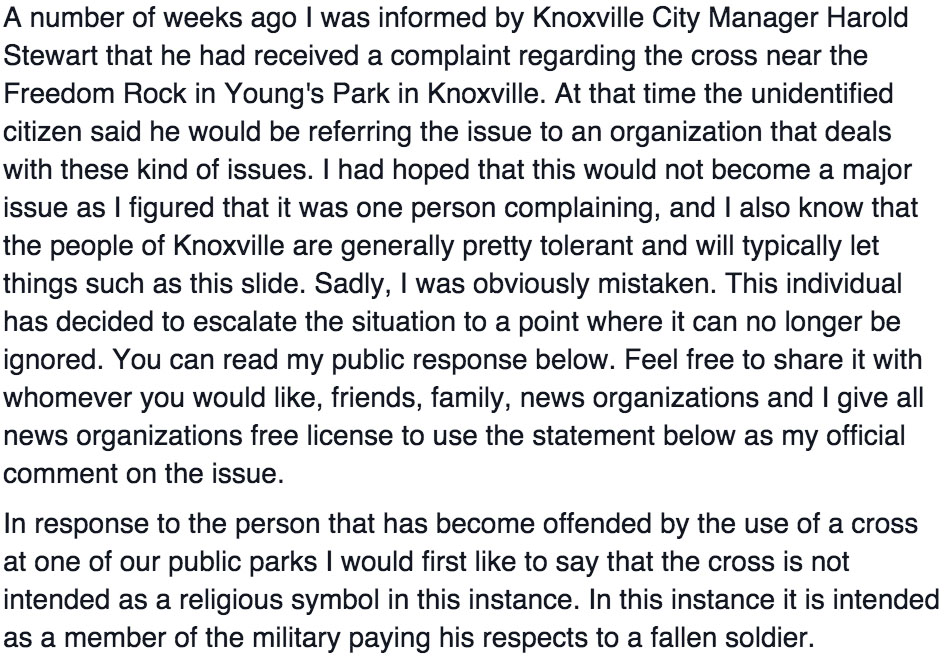
Tim Pitt, City Council member in Knoxville, Iowa, recently wrote an angry article on facebook denouncing the intent of Americans United for Separation of Church and State. The atheist organization was challenging the decision of the City Council to place a memorial art piece in Young’s Park – a government sponsored park – that included a cross similar to the crosses familiar in military cemeteries.

Knoxville

In Part, Councilman Pitt wrote:

Knoxville IA

Concilman Pitt continued at length to berate the organization for its disrespect of valid and reverent feelings for fallen soldiers. There is conflict in the atheists’ case because similar crosses are in many government cemetaries around the Country – including Arlington National Cemetary. Clearly, this is headed for the court system – if the courts choose to hear the case.

Broadly speaking, the atheists are a counterpoint to those who would establish a Christian theocracy, primarily religious conservatives fighting similar battles from the opposite side of the issue. Similar conservative events are Chick-Fillet, Hobby Lobby, the clerk in Kentucky who refuses to grant marriage licenses to homosexual couples in spite of high court injunctions against the clerk, the insistance of creation history as valid history in public school books, vocal prayer in schools, etc.

The mariner believes those tangled in symbolic issues like crosses, Stars of David and even secular memorials, are distracted by irrelevant idol worship. Memorials, regardless of their shape, are simply memorials, perhaps suggestive of a legitimate association with religious reverence but certainly not a tool of proselytizing and, as Tim Pitt contends, not representative of a state church.

It is insane to separate church and state with a cataclysmic act like removing crosses from graves or religious icons from past sites of remembrance. Such an act would be comparable to ISIL destroying temples and historical artifacts. The rows and rows of white crosses only speak loudly of a long age of human desecration.

In 1982, a Vietnam Veterans Memorial was built in Washington, D.C. commemorating 58,272 killed in that war. There is no cross, yet the “wall” is one of the most powerful commemorations ever dedicated to soldiers killed in action. When it was built, a mother refused to believe that her son would be remembered among the tens of thousands who died. Her friends traced his name from the wall and took it to her; she clutched the drawing as if it were the American Flag at a military funeral. A simple wall as powerful as 58,272 crosses.

The point is this: The role of religion in society is changing as secular awareness grows in an age of information. There is no blame in this transition nor is there permanence in religious beliefs – else we still would worship the Gods of the Pantheon. The separation of church and state is a Constitutional requirement assuring religious freedom for all – and thereby preventing a “State Church” from existing.

It is not the crosses or Stars of David that are sacrosanct. It is the soldier buried in his time, in the way of his faith. The crosses, Stars of David and non-religious memorials are for us to remember the heavy price we asked them to pay.

Ancient Mariner