Where is God?

The eloquence of Reader Fred in his reply to The Greatest Sin is Prejudice has sparked responses that reflect the same plight in others. The Christian faith, among many, has not answered the need of “secular” individuals who, despite the rejection of classic doctrines and Biblical mythology, still want a place in a divine world. Where is God?

Many theologians try to address this; Dominic Crosssan, Marcus Borg and Walter Brueggeman are three prominent writers. Marcus Borg in particular has focused on transferring Christian values to a new Christian paradigm not dependent as much on Biblical mythology.

In the last post, mariner referenced a YouTube site showing several videos central to Joseph Campbell’s interpretation of myths as a tool to explain something we cannot understand or a value important in our lives but difficult to describe. The importance of Campbell’s work is that it allows us to observe how other ages and cultures used myths as a means of having faith. Campbell’s insight places faith and belief in a more understandable light.

As secularists pursue faith and doctrine that is meaningful, they must be willing to accept new beliefs of divine forces that replace inadequate beliefs; new beliefs that provide an understanding of extra-human realities that, for the individual, are not subject to human interference.

Six thousand years before Christ, the earliest cultures had no scientific basis for anything. These cultures, most found around Western Turkey, believed that an obese woman, quite fecund like a queen bee, was the source of all creation and for centuries was the origin of human beings. Clearly, we today consider this belief to be in error. However, it was the story that explained creation; faith in it was strong and lasted millennia.

How did we travel from a fecund woman as the source of life to Adam and Eve, to sorcerer powers like separating the Red Sea and turning a snake into a stick, to the belief in a personal god that manages our lives, to Jesus, to the source of love and grace and to an amorphous, impersonal god as the source of creation? Millions of pages have been written about the changing of spiritual icons and the power behind a universe we still are discovering.

After Saint Augustine, the story of love and giving became accepted as the true, central principle of Christianity. All other stories expressed lesser, but still important virtues that were meaningful to many believers. However, true faith lies in the two great commandments. Today, love itself as the power of creation is becoming popular. Could a secularist believe love – in whatever form – is the power behind the universe? Love is a power that humans can use that somehow has the ability to ameliorate a situation. Is amelioration a form of creation? Once asked in an earlier post, is love the true measure of evolution rather than intellectuality? Further, is “God” constrained by anthropomorphic assumptions?

The natural adoption of meaningful theological principles is relatively easy. It may take time but the process is simple. Continue to search for overarching ideas that cannot be disturbed by human knowledge but are a dynamic influence in your life. Your ideas must support a reality that explains how the universe was created, how the universe works – including all elements of evolution, both stars and bacteria.

There are many social behaviors that leave open questions: Will computers be the ultimate evolution of humanity? Is Stephen Hawking right that Homo sapiens will be extinct within ten thousand years? Whatever your belief, it must encompass all potential events.

The Book of Revelation in the New Testament speaks of an Armageddon that will end all life save the righteous. Interestingly, the end indeed will be an Armageddon when the Sun begins to die. The theological question is: what is the definition of “righteous?”

Ancient Mariner
Donald

Chicken Little was hyper after Donald’s acceptance speech at the Republican Convention. The entire speech provided no solutions, no specific resolutions, only promises that Donald will do something. In later interviews with Donald Junior, it turns out that Donald doesn’t intend to oversee Federal Policy; that job, described as domestic and foreign policy, is Pence’s job.

What disturbs Chicken Little is the fact that the entire speech sat on a foundation of authoritarianism. It’s Reaganism all over again but run with less voter input. Donald sees himself as a CEO, not the Executive Branch representing public policy. How close can a President get to dictatorship in a Republic?

The mariner feels the TV polls are not accurate. If cell phone users share the mariner’s habit of not answering calls that he doesn’t have in his directory, or not answering phone numbers on a land line with caller ID, any poll will not reflect the opinion of a large section of voters. The mariner does not listen to polls. He listens to Nate Silver, who has a stellar reputation collecting valuable information that affects betting odds. See:

http://www.bing.com/search?q=nate+silver+2016+presidential+predictions&qs=LS&pq=nate+silver&sk=LS1&sc=8-11&sp=3&cvid=187BAD3BDABD4840A57B41C4C8464FC6&FORM=QBLH&ghc=1

If the reader would like an analysis of how Donald may win, see from Nate’s website:

http://www.newsweek.com/2016/07/29/donald-trump-can-win-481404.html

Also, check out http://fivethirtyeight.com/politics/feed/ probably what the reader wants to know in the first place. The article covers everything in the world of polls.

Finally, if you want to poke around in trends, see:

http://fivethirtyeight.com/politics/features/

The point is this: This is a culture-changing election. It’s comparable to FDR, Kennedy, Johnson and Reagan. The voter is required to think beyond the news, beyond the political ads, beyond the water-cooler advice, and beyond the reader’s clique of friends. There is a lot at stake in this election that is not covered in news media. The reader has an obligation to think hard – not something the American citizen is often required to do in a general election.

REFERENCE SECTION

The mariner’s wife has contributed an excellent website that is focused on the spiritual side of life’s experiences – not spiritual in a religious doctrine sense but the website provides a rich collection of short essays about the fragile side of our species and how empathetic roles are important to our survival. For liberal arts readers, it is an excellent site. See:

http://www.onbeing.org/program/xavier-le-pichon-the-fragility-at-the-heart-of-humanity/transcript/8832#main_content

The Olympics is days away. This is an unusual Olympics fraught with Zika and Russian doping. Type ‘2016 Olympics’ into your search engine to catch up not only on the sport aspects but the politics and health issues.

Ancient Mariner


What is Empathy?

In the mariner’s last post, “The Greatest Sin is Prejudice,” it was suggested that the real measure of successful evolution was not intellectual prowess but empathy. The post prompted notable interest in the midst of confusion about the differences between sympathy, pathos, compassion, empathy, etc. It is important to understand empathy as a unique experience because the post suggests that empathy is a positive phenomenon capable of shaping evolution.

This post will focus on words that often are mistaken for empathy and a focused note about empathy as an evolutionary influence.

Aware – On the scale of emotional interaction, being aware of human behavior in others is more a result of the five senses behaving normally. At best, ‘sensitive’ may mean the same. For example, ‘I am aware that you are a democrat. Being aware of that opinion helps me adjust my sociability when interacting with you.’

Pathos – Often used to express ‘sympathy,’ it is not the same. Pathos is an intense response to a situation usually intensified by art or other imagery.

Pity – While pathos can be an intense response, it lacks personal engagement. Pity, on the other hand, suggests that you are aware that the person(s) do not deserve their difficulty; you have a perspective about the circumstances in which they find themselves but rarely stop to involve yourself in easing their plight unless they already have a bonded relationship with you.

Passion – The key to recognizing passion is that you are at the center of the emotion. Passion is a self-serving response which drives your focus to accomplish something that has captured your emotions. Examples are infatuation, personality tendencies, response to a perceived threat, perseverance to modify an important social situation, etc.

Sympathy – Surprisingly, rather than being focused primarily on one person, sympathy is an allegiance to a group ethic or morality. Sympathy means your reality is intertwined with values and experiences of others. Sympathy is the feeling that binds you to what is important to others – enabling you to experience the ebb and flow of group or individual values. Often used erroneously in place of pity, a closer synonym would be ‘loyalty.’

Compassion – A common expression among married couples of long standing is “Passion turns into compassion.” The meaning of the phrase represents the replacement of personal passion with a commitment to the wellbeing of the spouse, that is, your personal emotions become integrated with your spouse’s emotions such that neither stands alone. This same allegiance, when applied to social situations, means you and others experiencing that situation are bound to support the well being of others involved, engaging physically in real time response to achieve solutions. A popular distinction in literature follows the theme, “A warrior has passion; a hero has compassion.”

Empathy – Empathy obviously is derived from the same Greek root as pathos. Empathy carries the same intensity as pathos but has an added dimension: empathy also means the ability to infuse one’s understanding of another’s inner feelings so amazingly that it seems as if you could become that being. One becomes so obsessed with the other being’s gestalt that the two beings appear twin-like in behavior, motivation and awareness. This does not suggest magic or weird music; rather, you become so aware of the internal feelings and values of the other person that you can fully represent their gestalt.

A simplified example of not exercising empathy by choice is common among dog owners. Animal psychologists have determined the following:[1]

Dogs do not like to be hugged. They feel trapped and unable to escape if necessary.

Dogs are born to run. They are hunters very much like their wolf ancestors – even if it is a Shih Tzu. Life in a pocketbook or at the end of a chain or locked up in a house all day must be hard.

A great experiment (and something that will probably have your dog sighing with relief) is to try to spend a whole day not saying a word to your dog, but communicating only with your body. You’ll realize just how much you “talk” with your body without realizing it.

Most humans think that dogs like being patted on the head. The reality is that while many dogs will put up with this if it’s someone they know and trust, most dogs don’t enjoy it. You may notice that even the loving family dog might lean away slightly when you reach for her face to pet her. She’ll let you because you’re the boss, but she doesn’t like it.

Fortunately, over thousands of years of breeding, we have made dogs more empathetic than we are.

The future for the current environment and all its inhabitants is not bright. Homo sapiens has overrun the planet in a savage way and every day is driving species of every kind into extinction. Already humans consume more than the Earth can provide each year; the oceans show rates of depletion that suggest the oceans will be fished out by the end of this century. The Earth itself is slowly shifting to a warmer environment that in time will stress all living creatures.

The philosophical question is, how will whatever is still alive continue to exist? Futurists are suggesting competition between species and between ourselves will only hasten extinction. The opposite of conflict is empathy – living in close harmony with the best interest of any living thing as closely managed as we can. That may grant our biosphere a few more centuries.

Empathy is a parallel behavior to what religions have been espousing for 8,000 years: love and giving is the true key to survival. There will be no room for expensive idiosyncrasies, greed, or waste. Love and giving, i.e., empathy may be our best chance to evolve properly for the end of our age.

Ancient Mariner

[1] From Jaymi Heimbuck, http://www.mnn.com/family/pets/stories/11-things-humans-do-that-dogs-hate

The Greatest Sin is Prejudice

For Christians specifically but referenced similarly in virtually every religion, there are two Great Commandments in the New Testament. One is about loving your God and the other is about loving others. Insofar as they instruct humans, they are wise instructions. Written in Matthew some time before 99AD, the quote is:

Hearing that Jesus had silenced the Sadducees, the Pharisees got together. One of them, an expert in the law, tested him with this question: “Teacher, which is the greatest commandment in the Law?”

Jesus replied: “‘Love the Lord your God with all your heart and with all your soul and with all your mind.’ This is the first and greatest commandment. And the second is like it: ‘Love your neighbor as yourself.’ All the Law and the Prophets hang on these two commandments.”

The mariner has pondered this quote ever since he was a young boy. There was something too neat, too overarching to be applicable to reality. It seemed too much like a plug-in. In recent decades, perhaps as long as a century, reality has pressed us with questions that seem not targeted on the wellbeing of humans but nevertheless incessantly grow more urgent.

The stories that supported the early Western religions, namely, Islam, Judaism, Christianity, and also Buddhism, are not capable of supporting today’s boundaries of knowledge. The stories do not reconcile the reality or the confrontation that 21st century humans face. Today’s Christian advocates, clinging to the old beliefs, look in disdain at the “non-believers.” They call them “secularists.” Indeed the era of change is upon us. So many scientific breakthroughs; so many industries and conveniences. Today, right now, medicine can change our genetic code to cure vulnerabilities. “Who,” the secularists ask, “needs Adam, Eve, Cain, Able, magic swords, brothers surviving in a fiery oven or a flying Son of God?”

No longer do the myths from two thousand years ago hold relevance. There was a time early in the last century when apologists attempted to validate the myths by reinterpreting them as figures of speech or story telling devices not intended to be literal. Still, the theology was laid bare without meaning.

That the church liturgy has lost much of its sacredness is only one cause of dwindling attendance at religious institutions. Perhaps more important is that modern society has not begun to replace the mythic values that underlie faith and commitment. Modern society may not be able to accomplish a new value structure for humanity for some time. The entire planet is at a crossroads. Frontiers of science and technology have ripped through the time lines that would have helped us transition across eras; we are thrust unprepared into an alien society. The tearing of cultural meaning can be seen in politics, where values are jumbled if not missing altogether. In some ways we have met the devil and he is us. We wander in rudderless ignorance as we destroy Earth’s environment and fail to repair the prejudices that lead to war, gluttony, and ecological destruction.

There is no way to escape prejudicial attitudes without a myth greater than ourselves – larger than our alien computer culture. Without a sanctified value that is permanently valued more than any earthly phenomenon, we will drift into extinction leaving behind a planet covered in human trash – unable to present a transcendent achievement for the path of evolution.

Run all religious faiths together through a homogenizing process and two principles are common: love and giving. Each of these principles, in their purity, prevents prejudice; each prevents judgment; each promotes holistic unity on the scale of the universe.

With introspection, one realizes that love and giving are rich in mythic origin. Reorganizing our understanding of evolution, where does love and giving fit in? In evolutionary terms, only recently has empathy emerged in mammals. Empathy for nursing and raising suckled young was a great leap forward in brain awareness. We often think of man’s development of abstract problem solving as the core mark of progress in evolution but the simple ability to empathize permits family awareness, sharing, and cultural understanding. Without communal empathy, humanity’s great achievements could not have been accomplished.

Using empathy as the measure of evolution’s key objective suggests there may be a future in human evolution for something similar to the “single soul” element of pantheism: “God” is the universe. Therefore, each human is a part of God. Perhaps the Islamic definition of soul as an interactive awareness between all living things including plants is the goal. Including similar ideas across philosophy implies indirectly that empathy may be spread across more than the mammalian branch of creation.

Has religion, with its empathetic two great commandments, been struggling to correct the misconception that intellectual problem solving and invention are the primary goal of evolution? Is the new myth for love and giving derived from the universe itself? Is oneness through empathy with all things the path to eventual transformation?

Rome captured the western world and dictated from that time the focus of the church, government, cultural progress and economics. Has the west been too concerned with the physical, combative models learned from the Romans? Is it time to look to another emphasis to guide us?

Let’s practice empathy. It may be more transformative than we think.

Ancient Mariner


Darts

The mariner is embarrassed to live in the same state as Steve King (R-4th) because Iowan people actually chose him as a Federal Representative. Already identified by analysis of his work as the worst representative in Congress, Steve has stepped forward to block Harriet Tubman as the face on the $20 bill. The NY Daily News said:
“Republican Steve King had claimed that putting the abolitionist in place of President Andrew Jackson, most famous for the Trail of Tears, would be divisive.
He had attempted to block any attempt to change up currency by sneaking an amendment into a bill about Treasury Department funding, though the Republican-controlled Rules Committee shot down the measure Tuesday night.” (King has never had one piece of legislative language survive his Congressional Committee)
If only to rub salt in the whole “face on money” issue, we aren’t too good at selecting our premier statesmen and citizens. As mentioned above, Andrew Jackson was responsible for the “Trail of Tears.” PBS wrote:
“In 1838 and 1839, as part of Andrew Jackson’s Indian removal policy, the Cherokee nation was forced to give up its lands east of the Mississippi River and to migrate to an area in present-day Oklahoma. The Cherokee people called this journey the “Trail of Tears,” because of its devastating effects. The migrants faced hunger, disease, and exhaustion on the forced march. Over 4,000 out of 15,000 of the Cherokees died.”
Note that racism isn’t a harsh issue in white, plain state Iowa; Steve King’s career as a do-nothing Congressman was not at risk over this issue. To the mariner, this is one reason an aptitude test must be passed for those wishing to represent the citizenry.
Even Steve’s own Republican Representatives kicked this one out.
But to further impugn Steve, Huffington Post covered this gem:
For crying out loud, whether it was a good or bad thing to drag human beings across the ocean to serve as slaves is still, for some reason, a matter for debate. But somehow, perhaps incorrectly, I’d come to accept that America was pretty clear about the matter of pitting dogs against each other for amusement. Dogfighting equals terrible advocates for dogfighting equals reprehensible humans — I figured that this was, by now, axiomatic.
But, lo, here comes Rep. Steve King (R-Iowa) with a bee in his bonnet over the Humane Society and its stance on animal torture. Various state measures have been enacted to limit “several horrific farming and food practices,” including Maryland’s prohibition against arsenic being added to chicken feed, which seems eminently reasonable, given the fact we are talking about, well, arsenic.
How does dogfighting get wrapped up into these deliberations? Well, as Scott Keyes reports today, King took a question at a “tele-townhall” about “his opposition to animal rights and recently introduced legislation that would undermine local standards preventing animal torture.” And part of King’s response declared it strange to be so concerned about dogfighting, when humans are allowed to step into a ring and fight for sport themselves.
KING: When the legislation that passed in the farm bill that says that it’s a federal crime to watch animals fight or to induce someone else to watch an animal fight, but it’s not a federal crime to induce somebody to watch people fighting, there’s something wrong with the priorities of people that think like that.
Keyes added in his column: “Manny Pacquiao chooses to step into the ring. Michael Vick’s dogs did not.”
Steve King is 67 years old. By the mariner’s standards, he should have met term limitations seven years ago. Steve has been serving in Congress since 2003 (13 years). Though he isn’t competent enough to cause harm, it might be nice to have a productive representative for the 4th District.
Ancient Mariner

Liberal Arts on Cable TV still exist.

For those who have not been exposed to liberal arts and to those frightened away by the word ‘liberal,’ let the mariner assure the reader that liberal arts means the study of humanity and is neither liberal nor conservative. It is open-minded – which may be frightening to any close-minded person conservative or liberal.

Many TV viewers are moving on to the new marketing format available through HULU, NETFLIX, HBO, SPORT networks and even social networks. The channels rich in liberal arts are not the reason for this move; rather it is less costly and provides more personal control over channel selection although not much. To be honest, most viewers consider liberal arts channels the ones they don’t want to pay for.

Still, there is a growing need for some percentage of the American population to understand that mental sophistication and insightful judgment are critical both to our enjoyment and to our future. Liberal arts sources grow scant and even unavailable as college after college drops liberal art majors and humanities requirements from its curriculum. It is a dangerous time for dismissing sophisticated thinking about humans and what may be important digressions from the powers of artificial intelligence.

For an accounting of Liberal Arts in past posts, use the search box to recover posts containing the term liberal arts.

In this post, the mariner will point out a number of broadcast and cable TV channels that give generous time to thoughtful programming across the spectrum of insight, education and art. Cultural events are available as specials, for example, “The Kennedy Center Honors” is primarily entertainment but the program’s tone acknowledges cultural style and cultural significance – artificial intelligence unnecessary. News specials appear regularly on all the broadcast channels: ‘Special Reports’ programming typically focuses on important events more deeply and insightfully; Frontline on PBS always is on the frontline…; calendar specials – recent broadcasts were informative about Jackie Robinson and Martin Luther King; another was about the mindset of the founding fathers. There is a bit of burden on the reader to peruse broadcast listings and promotions to identify thoughtful presentations about any subject. Even CNN and MSNBC broadcast good ones once in awhile.

Of notable contribution to liberal arts is PBS. Viewed in collaboration with PBS on line, a veritable library of liberal arts topics is available from Pushkin to Pythagoras to Emerson. Add NPR on the radio and all programming is treated as serious, personal and event oriented. Did you say goodbye to Garrison Keillor and A Prairie Home Companion? President Obama did with an on-the-air telephone call.

BBCHD and BBCAHD contribute a good amount of broadcast time to humanities programming. On Saturdays there is a series of programs that are enjoyable yet targeted around topics one would think have little of consequence. Try Studio-1 and Brilliant Ideas.

CSPAN1 and 2 are rich in humanity programs. The library of videos on line has tens of thousands of programs. Not all are based on book reviews with authors; they include interviews with world leaders, US politicians, government actions and human interest in all the humanities. One never knows when a particular author interview may spark enough interest to buy or borrow the book at the library. Mariner can attest to dozens of interviews that led to further research.

Discounting Fox channels because they reinforce close-mindedness with their already close-minded audience, there is little left to represent humanity’s political ideology. Two liberal channels, LINK and FSTV, present material close to the positions of Bernie Sanders but their material frequently is out of date and may not match current reality. Still, liberal figures whose ideas represent mainstream socialism appear in their broadcasting; examples are Chomsky and Ralph Nader plus activists and personalities participating in current activity. Mariner watches occasionally to keep his ship’s keel in line. (If all the reader does is watch news on TV, one will be led quickly away from reality. Humanities is not a strength of news media.)

Then there is the champion of free information on any subject one can imagine. Unlike TV, which feeds the viewer a pre-researched topic, the viewer can know everything plus more if the viewer does all the research about a topic of personally determined interest. Mariner has said in the past that Wikipedia is a playground for liberal arts.

The point is this: Every element of our species that we hold dear is vulnerable to displacement by the digital takeover of “big data.” Computers already have learning algorithms that teach them to form their own functional solutions to computer-determined needs; give computers access to all there is to know about you, your environment, your motivations and the patterns of human behavior, and the computers will live your life for you and do the work that once needed you. Humans will be displaced to the point that economic rules will collapse and humans will have no way to produce income. Only the enrichment of liberal arts in the minds of leaders will have any chance to divert pure digital solutions from displacing humanity. Chicken Little, Amos and the Guru all agree on this outcome. Further, you can find television programs and books already describing this future. Even Stephen Hawking feels computers will dislodge the human species  as humans give up human functionality. Care to consult a digital psychologist for counseling? That function already exists.

– – – –

There are two ‘third party’ options for the 2016 election: The Libertarian Party and the Green Party. The libertarian party promotes a harmful, draconian view of government that would destroy today’s culture; it allows only military, printing money and international relations as Federal functions. There is no room for anything else. All other matters are left to the fifty states. The other party, the green party, has Jill Stein running for President. The Green Party is left-center but notably more progressive. The political platform can be read at http://www.gp.org/four_pillars_10_kv . If the two major candidates don’t fit the bill for you, check out the Green Party manifesto. The mariner personally does not recommend Donald.

REFERENCE SECTION

The latest Atlantic Magazine has a good lead article, “How American Politics Went Insane.” Check out the September issue or read it on line at

http://www.theatlantic.com/magazine/archive/2016/07/how-american-politics-went-insane/485570/

Even more insightful is to watch “The Greeks” on PBS TONIGHT (Tuesday, July 05, 2016). Everyone will recognize the similarity of American history to Greece’s path to democracy.

Ancient Mariner

Humans are not Creators, they are Stuff

It is wise to listen, not to me but to the Word, and to confess that all things are one.

Alas, Heraclitus was not a theist for he also said:

This Universe, which is the same for all, has not been made by any god or man, but it always has been, is, and will be an ever-living fire, kindling itself by regular measures and going out by Heraclitus smallregular measures.

Heraclitus, who lived from 535-475 BC in Ephesus Iona (Turkey), predates Socrates and Plato by a century and was not part of the mainline Greek philosophical revolution although he was commonly quoted by many later Greek thinkers and shows up as a quote in books about other philosophers.

Heraclitus appeals to the mariner because he established the principle that the law of the Universe is the only law and all things that exist in the Universe must obey the same law. Too often the creative genius of H. sapiens is attributed to itself when in the broader view it is, as Heraclitus suggested, a child playing with blocks.

It is difficult for humans to associate with the Universe. The Universe has no recognizable goals. The Universe does not show responsiveness, preference, appreciation, personality, possessiveness, vengeance, favoritism, or kindness. There is only astronomical stuff, chemical stuff, unending space and two unending energy resources: time and gravity – immeasurable time, pervasive gravity and all the space the Universe needs. These eternally present things are called Universe stuff. It isn’t easy to talk with the Universe over a breakfast muffin and coffee; trying to get the Universe’s attention by discovering how to fly to the stars with the Universe’s own stuff doesn’t score, either – less than a spit in the Milky Way.

Before we begin dissecting how humans fit into Earth’s stuff, it will be easier to have a consolidating word for all Earth’s detailed activity, cause and effect, and interactions between elements of Earth’s environment: let’s call it all “stuff.” Specialized stuff. For example, anything created, altered or thought about by humans is “human stuff;” things like orbit changes, volcanoes, earthquakes, geologic ages, atmospheres and magnetic fields are “Earth stuff.” There’s also environmental stuff that includes weather, living things, gold, diamonds, sulfur, critical stuff like water, oxygen and other stuff as may be required.

From a few miles in space, human stuff right now looks very much like a colony of disturbed ants long resident under a large rock. Like the ants, humans are racing about blindly, trying to conjure what is going on; what shall we do? Experiencing reality like an ant but on a human scale, consider the following:

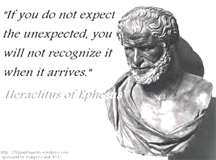
Environment stuff is increasingly unstable – some unstable because of human stuff but most because of Earth stuff. Observant, thinking humans acknowledge that Earth’s surface stuff is growing warmer. Even indifferent humans acknowledge that humans have accelerated warming with excessive release of Carbon into Earth’s atmosphere and oceans. As Heraclitus suggested above, if you do not expect the unexpected, you will not recognize it when it arrives. Such is the case with carbon pollution, which arrived unnoticed and unexpected shortly after the Civil War.

The use of the word “stuff” is an important tool; viewing the Universe on the scale of normal human cognition quickly exaggerates the importance of human stuff. It isn’t really important at all – except to humans. Similar to ants, reality is greatly distorted by personal experience. Brazilian farmers continue to deforest the Amazon rain forest despite the suggestion that removing the forest will change environment stuff. The farmers’ reality is distorted by personal gain; they are incapable of expecting severe changes in their weather so the true scale of their reality is much like an ant’s. On the scale of Universe stuff, ants and humans are closely related.

Humans keep track of mathematical versions of stuff. An arctic fox may have a sense that it is unusually cold but it seems not to care that not only is it unusually cold, it is minus 120 degrees Fahrenheit cold – now that’s cold! Humans mathematically track a lot of phenomena about other stuff; that’s how humans know the environment is growing warmer on Earth’s surface.

A reputable scientist wrote an article in Atlantic Magazine about a year ago. He was ridiculing humans’ plan to reverse climate change: “They think they will fix the problem in a lifetime or two. What they can’t see is the scale of global warming. It may take the Earth 30 thousand years to reset its global environment!” Many scientists agree and also believe that the Earth will enter a long ice age at that time. Each set of stuff has its own scale of size and time. We forget how small human stuff is when compared to environment stuff and Earth stuff. A simple example is we count our lifespan in years; environment stuff easily can count lifespan in centuries, i.e., how many years does it take for the Fertile Crescent to come and go through a desert cycle? Earth counts lifespan in eras; an era has two or three cycles called periods – the length of time during which rock formations appear, e.g., the Rocky Mountains.

If human stuff is messing around with Earth stuff, the results may take so much time they never will be known. On the other hand, looking down the scale of different stuff, say solar system stuff messes with environment stuff, things can change rapidly. Remember the meteor that helped wipe out the dinosaurs? That meteor may have been floating around the solar system’s inventory of asteroids for billions of years then POP! If we had been alive at the time, we could have watched the entire global environment change within a week.

Mariner can hear the reader complain, “What’s all this stuff about? What’s the point?” This always happens when Guru is allowed in the room. What it’s all about is that the twenty-first century confronts humans in a new and unpredictable way. Like the ants, Earth stuff is changing our reality: our comfortable rock has been lifted to expose new, larger issues that force H. sapiens to realize it is not as much in charge as it thought. Further, time is short enough to be relevant to our psyche. Stephen Hawking is confident H. sapiens will be extinct within ten thousand years. Our line of ascendency began nearly 90 million years ago as a simple primate. We’ve only 10,000 years left to come to terms with the relative value of our messy human stuff as a part of Universe stuff. One example: Are we a benevolent species or a predatory one?

This Universe, which is the same for all, has not been made by any god or man, but it always has been, is, and will be an ever-living fire, kindling itself by regular measures and going out by regular measures.”

POST SCRIPT

Mariner’s in-laws, nine cousin families strong, are celebrating their eighth quinquennial this week. Posts may be scant during that time.

Ancient Mariner

Signs of the Future

Remember those spooky science fiction shows when you watched the actor (and yourself) walk into a dense, mysterious cloud where something unimaginable will occur? Well, dear reader, we are at that moment in real life. You, the mariner, and every other speaking soul, approach a dense cloud where everything will be different.

What does this cloud look like? Not just a water vapor cloud or a disrupting chemical cloud – this cloud is a montage of things, behaviors, environment, and different lifestyles. Okay, it doesn’t look like a “cloud.” It looks more like a roaming, tumbling garbage dump with zombies roaming around; nevertheless, the mysterious unknown will envelope you. What will you become?

From a distance, we see in the cloud a disappearance of written and spoken language capable of specific expression and defined meaning. With the use of text abbreviations, compressed spellings, and rolling enunciation, much of our speech will be comprehensible to seals, whales, beagles and subordinate primates – but it will not be useful for finite, articulated ideas or correlations of fact. What seems probable is an erasure of the history of speech – leaving us expressing little more than our ancient predecessors to express emotions, satisfaction or dissatisfaction, and pain.

Back in 1980, as the mariner’s son was being born in York Pennsylvania, mariner was working as a project consultant in Roswell New Mexico for a small group of men who wanted to build a new jail. Typically, a consultant would have to prepare about five wordy documents to describe in detail the goal, scope, cost, staffing, project plan and delivery dates. In Roswell’s case, even a blueprint would be appropriate.

These men wanted none of that. The general attitude was “I wouldn’t read it if you wrote it” and “How is doing that building a jail?” These men were brick and mortar types with trowel in hand! After a lengthy meeting discussing how in a productive manner we should move ahead, we arrived at the use of one document to handle the ideological and regulatory aspects of building a jail: the blueprint itself. Instead of articulating the purpose and description of a space, we had a discussion which reached consensus and agreed to move a room’s wall two feet farther to the west. Room by room, door by door, plumbing fixture by plumbing fixture, regulation by regulation, we finished the design to the point it could be turned over to the builders. Notes about the blueprint process were on the margins of hundreds of previous versions of blueprints; every meeting started with a newly updated blueprint. Call the process “document writing via storyboard” or “social dissolution of a conundrum;” however unusual, the jail was built on time, under budget and ready to function;” a project consultant and five men in Roswell couldn’t be more proud. It is in use today.

What mariner did not realize was that he had participated in creating and using a hieroglyphic with three-dimensional scripting. The Egyptians, Syrians and Hittites had nothing on the Roswell project! The Roswell team had abandoned letters and words for glyphs! We had gone back in time 4,000 years – and Hawking said it couldn’t be done.

It was then mariner realized he had an experience near ‘the cloud.’ People would speak and write something like ‘LOL,’ even speaking it. Not a true Egyptian hieroglyphic – it required some knowledge of word usage and spelling. Soon afterward, words, letters, even paragraphs were unnecessary when emojis were created. Mankind was moving deeper into the cloud.

Will we become an illiterate creature – depending on monks to document our lives and articulations? Will we have to draw a picture to ask for Pseudoephedrine? (What will the emoji be?) It is true that the mariner had a mother-in-law many years ago who drew a stick figure of a man, a plus sign and 2 eggs on a piece of paper so her husband would not forget to buy mayonnaise. This was necessary because, despite the wise woman she was, she was illiterate. Hmm – aren’t we all….

Ancient Mariner

The Republic versus the Parties

The mariner is not sure about the reader but the mariner has been tossed about on the deck of the 2016 election for President. Since the very beginning of the process, the voter hasn’t had much of a say. The Republic (Federal, State and Local) has not modernized itself since Lyndon Johnson freed the slaves again in 1964. Richard Nixon, socially clumsy as he was, had an intuition for international policy; with the aid of Henry Kissinger, a bright Secretary of State, he established a relationship between China and the US. The two nations were absolutely unknown to each other and were blocking a move toward globalization.

Jimmy Carter introduced kindness to the language of politics but it washed off as soon as he left office.

Reagan became President in 1981. Everyone remembers “Gorbachev, tear down this wall!” but that event was already ordained by European and Russian economics – Reagan was just the toastmaster. What Reagan really did was stop cold the center-left culture that took root under FDR and flourished until Reagan (Eisenhower never was an ideologue but was favorable to business interests).

That center-left culture included voters as an influence in politics. Reagan and his kitchen cabinet put together a list of policies which put the Republic back in the hands of Plutocrats. Wealth and upper class became the drivers of the Republic. This group is known today as the “Establishment.” It still is controlling things. With the mental acuity of a worm, the Supreme Court finally and legally turned the Republic over to the Plutocrats with Citizens United. Voters no longer drove the Republic – unless one voted with money. The Supreme Court is not allowed to consider cultural values. Consequently there is no issue with calling money speech. If dogs were a political force, they would qualify as having free speech. In fact any creature would qualify. If you doubt that, watch ‘The Birds” with Rod Taylor and Tippi Hedren (1963).

Since then, the Republic’s gestalt has been left adrift. 41, Clinton and 43 were no more than keepers of Reagan’s list. All three left the heart of the Republic on its own while improving the world of corporations and unsavory tax and banking interests, releasing them to become the modern version of buccaneers in the fifteenth century who robbed cargo ships from Jamaica to Yemen and India. The new world economic model was the same – except lust need not be satisfied by raiding a ship at sea, it was satisfied by wage suppression and manipulation, by moving labor to the cheapest country allowing the tax-free hoarding of cash and, as Bernie may say, sending 90% of the Republic’s GDP to 1% of the population.

Finally, there was enough dissatisfaction about how the plutocracy was treating its citizens that the Reagan gestalt began to splinter both in the conservative citizenry and in the liberal citizenry. On the one hand, blue collar conservatives had had enough of salary suppression and the newly legal opportunity for manufacturing to move out of the US destined for cheaper labor markets. Once manufactured, the products were sold in the American markets at higher prices. Enough is enough, said the blue collar conservatives. Joining the blue collar dissatisfaction, the fundamentalist conservatives had had enough of a “no comment” Congress who had ducked religious issues since the last generation. LGBT had blossomed overnight, abortion would not die and State’s Rights were constantly overridden by the courts.

On the liberal side, it was the same story. The same types of folks suffering from unfair labor practices on the right were suffering the same dilemma on the left. The college educated were faring no better. Graduated and truly deep in debt, jobs for the graduates were disappearing rapidly. The biggest culprit was computerization. Unless a grad could get a job in technology or invent some odd thing that turned into a billion-dollar buyout, times were just as rough as on the labor class. By April of 2015, still not recovered from the recession of 2008, grumbling was afoot everywhere. Conservatives wanted to throw the bums out and return the Republic to 1970. Liberals wanted to restructure the overly capitalistic oligarchy and turn the Republic back to the voters.

The time was right to join a political party!

Join to what end? Voters quickly realized both parties were controlled lock stock and barrel by the “establishment” – Reagan’s plutocracy. By April 2015, The Dems knew it would be Hillary; the Reps knew it was Jeb→. Who needs primaries and caucuses? In the early going, the two presumptive candidates were raking in money from contributors and PACs.

But strange statistics were emerging: 47% of previous full time workers still were working part time. Government reports said there were no more jobs. Wages were dropping every month. These statistics revealed a churning, irritated electorate the plutocrats had underestimated.
In the last Presidential election, times were peaceful. Party Rules Committees agreeably changed Convention Rules to accommodate favored candidates. In April 2008, the Establishment thought the election would be status quo. Was the plutocracy surprised when Jeb → and Hillary were joined by 16 serious candidates for the reps, a talented and experienced Governor from Maryland and an independent Senator from Vermont? Oh, by the way, enter the Donald. The voters (and the Establishment) knew by now that things were going screwy in a hurry. To complicate matters, broadcasting companies thought they could improve market share if they marketed debates. Now five distinct groups were in the game: nineteen candidates, two parties, four broadcast companies, the Reagan Establishment (R+D), and the discontented voters (R+D).

To shorten this account of the Republic versus the Parties, a few quotes will suffice to describe how both parties slowly had squeezed out public participation:

Donald says, “The primaries are crooked. Every time I read ‘Bernie wins!’ then I read ‘Bernie loses.’ I win the majority of voters then I’m told, Lyin’ Cruz wins.”

Bernie says, why are we having a debate on a Saturday night during an important basketball game?”

Bernie says “The delegate system is designed to control the vote. It is not democratic.”

It was too obvious that primaries were tightly controlled by the two parties. The plutocrats were caught in the open playing puppeteers. The resultant split between the Republican Establishment and its party members threw the whole Republican process into disarray. Donald saw a hole in the line and charged through it for a touchdown. Mariner and the reader will have to wait for the Republican Convention to see how things turn out but however they turn out, the Republican Establishment has been stopped dead in the water. The role of the party primary must change what it represents ideologically and procedurally in 2020. Let’s hope the voter is included.

As to the Democratic Party, it is in shambles, too. Democrats will win the Presidency if only because the Tea Party and Senate Majority Leader Mitch McConnell shut down the Congress for the last 7½ years.

The delegate process will be under close scrutiny.

There are still seriously damaging behaviors by each party. The most serious is gerrymandering. Redistricting must be removed from any hint of political influence. Primaries will never represent the true intent of every voter until the districts are a matter of census rather than a description of political and class preferences that intentionally falsify representation.

Also serious is money in politics. There should be none except what the Republic provides and what can be raised within the scope of one’s jurisdiction. After all, the Party is not the Republic, the reader is the Republic. Broadcast corporations don’t collect profits for campaigns, the Republic requires educational programming for campaigns.

Ancient Mariner

This and That

The Midwest, between parallels N35° and N43°, has suffered temperatures in the high nineties with humidity above 70% for a good while. It isn’t pleasant. If you work outside, dehydration, sunburn and heat stroke lurk nearby. Still, plants and seeds cannot delay their required attention. The garden experience has transitioned from digging, hoeing, planting seeds, little pots and large pots, to an activity more akin to reconstructing frames for cucumbers and string beans, laying brick walks, processing compost, layering mulch in the gardens and weeding, weeding, weeding. As the mariner tells his town friends, “Anymore it takes me eight hours to work a four-hour day.”

In August, there are wedding bells in the mariner’s family. The wedding is in Los Angeles with many show business neophytes in attendance.

Every August mariner also hosts a neighborhood fete called “The Turkey Fry.” Mariner provides two large turkeys – one for roasting and serving sliced in gravy, the other dipped in dangerously hot and open cooking oil which could easily spill onto the propane burner under the pot. This year mariner planted sweet corn timed to be ready for picking for the Turkey Fry. About thirty neighbors attend. He assumes a fortress of electrified wire around the12x12 foot corn crop using a 13-acre AC charger will deter raccoons.

The mariner has a tip for tomato growers who invest time, money and frustration with tomato cages: don’t use them! The mariner’s model is to grow each plant about eight inches apart in a square configuration. The tomato plants prop each other just fine. It is still possible to tread carefully among the plants when harvesting. Another benefit is the plants help suppress weeds among the plants.

In a manner of days, hordes of in-laws arrive at a park down the road for their quinquennial, weeklong gathering. It has occurred every five years since 1981. They look old now but one can easily tell the new ones are continuing the tradition.

Readers are advised of these events to warn them of other gaps in post writing. The mariner will do his best to be regular.

A piece about Muhammad Ali is in the Reference Section. What set Muhammad apart was his statesmanship. He wasn’t just another boxer among boxers; he had class, empathy and intelligence. True, he played a buffoon as part of the show but he had a quick and caring mind. His feelings about the wellbeing of others were the basis for his conversion to Islam – an act that was spiritual and was distant from more rebellious sects.

REFERENCE SECTION

Muhammad Ali was a gentleman in the boxing community. He had an extra sense of grace that translated from his pugilist profession to one of awareness, care for the common man and a sharper mind than most in his profession. Oh, that more statesmen could be in politics! Muhammad had the courage to defy the draft and serve his punishment; the courts plucked him from that fate but still he would lose three years of income, age and prestige before the military was behind him.

His extra sense of grace allowed him to quote poetry about himself more succinctly with entertaining braggadocio. Note this one before the “Rumble in the Jungle” against Joe Frazier:

Last night I had a dream

Last night I had a dream. When I got to Africa,

I had one hell of a rumble.

I had to beat Tarzan’s behind first,

For claiming to be King of the Jungle.

For this fight, I’ve wrestled with alligators,

I’ve tussled with a whale.

I done handcuffed lightning

And throw thunder in jail.

You know I’m bad.

Just last week, I murdered a rock,

Injured a stone, Hospitalized a brick.

I’m so mean, I make medicine sick.

I’m so fast, man,

I can run through a hurricane and don’t get wet.

When George Foreman meets me,

He’ll pay his debt.

I can drown a drink of water, and kill a dead tree.

Wait till you see Muhammad Ali.

–      –   –   –

Add another one to the list of extinctions occurring during the Holocene, the period in which humans trashed the biosphere: Melomys rubicola — Bramble Cay Melomys, a species of mouse that remained in existence only on an island in the Torres Straight near Queensland Australia. The rodent, also called the mosaic-tailed rat, was only known to live on Bramble Cay, a small coral cay, just 340m long and 150m wide off the north coast of Queensland, Australia, which sits at most 3m above sea level.

mousex

–  –   –   –

Mariner stopped by the Forbes Magazine to review an article. The first screen had a display that said:

Quote of the Day

“You will never own the future if you care what other people think.“

Cindy Gallop

Each of us could write three of four counterpoints to Cindy’s comment – which is  required to be a capitalist. Assets do not normally flow up hill; they deliberately must be acquired. Capitalism unbridled by compassion will make few rich, most poor, and the capitalist, protected by layers of wealth, will be indifferent to environment, fairness, contribution to the point of meaningful sharing and a twisted sense of self-worth.

“Only when the last tree has died, the last river been poisoned, and the last fish been caught will we realize we cannot eat money.”

                        – A  Cree Indian Saying

Ancient Mariner