Religion Starter Kit – III

There are a few satanic religions and a few pragmatic religions, for example, capitalism, communism, socialism, Nazism, etc. But many hundreds of standard religions have the premise that a religion is here to do some spiritual good; god in whatever form is a positive force from which followers can draw positive influence or at least perform ethical behavior.

What every devout practitioner must possess is a feeling of liberation from negativity and failure and in addition a sense of being in a singular state of being – knowing one has transcended duality if even for a microsecond. In order to move on from the Starter Kit, one must experience positive buoyancy from one’s faith. Buoyancy gives one conviction in the day-to-day tumult of duality.

The traditional religions were documented at a time when there was little scientific knowledge and mythical explanations filled the gaps. Further, cultures have come and gone and our planet spins around with a different set of issues. It is not suggested that the religions have failed; the altruistic intent is as pure and valid as it has ever been. What is required in today’s society, one of technical solutions to every issue without perseverance, without obligation to biosphere or human value – or a bond to singularity and Grace (a church word meaning basking in goodness), is a travel pack that has resonance in situational ethics and a solution backed by god’s influence – as Father Fletcher said in his book, an act of love. Religion today is executed on the run.

One of mariner’s favorite ‘executions’ is the act of benefitting another person’s life without reparation of any kind – just making it a nicer day for someone; it has a street term: pass it forward, implying that the person who benefitted from your execution will execute one of their own. Note that both of you had a liberating experience.

Returning religion to society, however, is a large challenge. The past election illustrates clearly that the common citizen does not possess the confidence, the religiously reasoned morality, the unbiased ability to judge duality, or any obligation to the singularity intrinsic in our planet and our own species. These absences are of the spirit of life, not technology or the importance of machine rules.

Just the disorder for religion to repair!

Continuously use the measuring sticks like divining rods to find good duality and avoid reinforcing bad duality. A simple phrase is “two wrongs don’t make a right.” There are eight measuring sticks:

  • Is this event, thought or motive good duality or bad duality?
  • How much of god’s singularity is present?
  • How much beauty?
  • How much love?
  • How much order?
  • How much truth?
  • How much empathy?
  • How much compassion?

Some steering suggestions: Don’t fall into the trap of compensating for negative duality; one will end up fixing situations with more negatives and machine rules. Stick to using positive duality and acts of god to enhance the good things that need help. Joseph Campbell, another favorite of mariner, said the arc of life, the path of the hero, flows from negative circumstances (negative duality) into achievement (positive duality) and ultimately into a state of perfection (singularity).

Good luck.

Ancient Mariner

Why a Starter Kit is attempted.

As mariner suspected, suggesting the definition of pieces that together comprise a base for religious practice is challenged by many who have unique beliefs already in place. Mariner has no business disturbing established religious practices. He attempted this complex issue because in our current global state our ethics, morals, scruples, whatever one would choose to call them, are in disarray. Global society operates entirely under a moral base that humans can change whenever they desire. The difficulty is identical to people desiring, quite sincerely, to lose weight and improve their physical condition. Why is it that perhaps only one person in 1,000 or even 10,000 achieves the goal and the rest fail? The one achiever believed the rules were beyond modification and were mandated.

The shift from a singular, untouchable source of rule began with the book ‘Situation Ethics’ written by the priest Joseph Fletcher in 1966. His intent was to say no written or believed set of rules can be the source of faith; only love, the actual act of love qualifies as a measure of faith. His point was that written material or habitual behavior was not qualified to represent God – only love was authorized to do that – only an act of love could represent God. Fletcher said only love could be exercised best in a situational event.

Needless to say, readers picked up on the idea of an ethic that is relative to the situation but overlooked the hard part: loving God’s world, especially God’s people; to emphasize again, the act of loving. Several religious leaders and theologians took up the cause of situational ethics as a means of fine tuning moral behavior but that was not Fletcher’s intent.

Fifty-one years later, situational decision making prevails but the love part hasn’t been around for years. In fact, as an influence on general society, even religious institutions look more like dried figs – believing participants notwithstanding.

The first part of the Starter Kit tried to share some principles about how belief in a perfect entity works. Perfect entities can’t change. One would think they could change like a chameleon but in fact, a perfect being is perfect – nothing is able to change or perfectness would not have been. The mariner also spoke of seeking a non-anthropomorphic perfection; humans after all, are not perfect.

But it is from an ethical source that cannot be changed by any human or any participant in the state of duality that our instructions must come. Like the one successful person who achieved weight loss, believed in the unchangeable principle; to be true to their ethic they couldn’t change if they wanted to change.

The last part of the Starter Kit will be posted in a few days. Perhaps by then the reader will find a divine source of wisdom in which to root their stable and righteous morals. Perhaps like Fletcher you will be able to love.

Ancient Mariner


Religion Starter Kit – II

Review your accomplishments.

You are aware that there is a different kind of existence than you know in your current life; your current life exists in a state of duality. The different existence is a state of perfect being, perfect in the sense that decisions are not required as in duality. There is only one experience: perfectness. Therefore, having only one experience, this existence is a singularity.

You use the word ‘god’ which is a metaphor for singularity; saying or thinking god means you are saying or thinking about the meaning or influence of singularity in your life; god is neither the manager nor an emissary – god is a word that identifies the fact that the state of singularity is on your mind. Briefly, your relationship between duality and singularity is to shape your understanding and habitual behavior in a way that improves your experience of singularity – an experience of perfection replacing the turmoil of constant duality.

This is only a starter kit. On a relative religious completeness scale the kit is similar to a flashlight with bad batteries at midnight versus the Sun at Noon.

A few ideological/theological comments to help you start thinking about the role of religion:

The naturalist and empiricist dilemma.

Humans were born into a combative, sinful world AKA born into duality. Humans are cursed to have superior brains capable of making human centric decisions. Therefore humans can violate god’s balanced creation and continually do. God’s balanced reality is constantly unbalanced by disregard for nature and the cosmos. Humans demonstrate their lack of divine morality even among themselves with wars, violent abuse and disregard for the quality of H. sapiens wellbeing.

The ritualist conflict.

Every organized religion has the ritualist conflict. In sum, god handed down rules of obedience, humans are to adhere to these rules and thereby be rescued from duality. The conflict is that to a great degree, it is the same dilemma the naturalists and empiricists have – humans keep changing god’s rules. Disciplining structures are based on negative duality AKA machine rules (machine rules are rules that have ulterior motives not related to god’s perspective on things; rules are more about the wellbeing of the machine).

The spiritualist’s and conspirator’s escape.

Spiritualism and conspiracy theories are pursued because in their hearts these folks know the rest of us don’t know what we’re doing. They avoid dualistic conflict by believing in a back door that looks like reality but is beyond their ability to alter – a kind of faux singularity.

Atheism, humanism, deism and other deniers of god – life without singularity.

Simply put for atheism, no gods exist. Repeat no gods exist. It is difficult, in the whole universe, to adopt an authoritative ethic not subject to human frailty but atheists can live with that. Humanists live by a cocktail of ideologies which include traditional religious practices and verbal commitment to holistic Grace but refuse to conjure dominance over human competence. Pantheists believe god was here for a while but left when creation was complete.

There are other ideologies but these are the most common. Before you move on in the Starter Kit, ponder these to decide what relationship seems to influence you as you put together your theology and how you may accommodate your role between duality and singularity – or not.

Your religious purpose, ethics and social behavior are built on your theology.

Ancient Mariner


Do we at least still love our mothers?

In one way or another, the past three posts deal with H. sapiens’ relationship with the physical world. Other post series deal with H. sapiens’ treatment of fellow humans and some deal with how H. sapiens has allowed the machine ethic to take over theology, government, economic priority over life, and morality.

Just to highlight each subject:

Humans have started the sixth major extinction of life in the history of the planet.

Humans have destroyed the orderliness of the planet’s biosphere to the point humans will join other creatures in unnecessarily becoming extinct with them.

Humans have chemically altered the chemistry of the planet sufficiently to receive their own geologic epoch – the Anthropocene Epoch; Geologic epochs usually last two or three million years but humans ended the Holocene Epoch after just 11,500 years.

Economics continually grows more abusive to the planet population as international scope and computerization focus on an intense gathering of wealth for the few and in addition, without conscience increase the hardship on the quality of life for the rest.

Similarly, governments support corporate interests and refuse to openly and fairly care for all their citizens equally.

The measure of human worth and virtue is measured in dollars.

In sociology, a machine is any entity that is used to more easily achieve a goal. Machines can be a hammer, sunglasses, nuclear weapons, governments, organizations and prejudices. Humans have replaced religion with machines. Life according to a higher plane of existence and transcendent ethos is disappearing very rapidly. Today, it’s the machines that dictate morality.

Mariner believes this is overwhelming evidence that religion has been obliterated in the West; the East is catching up quickly. People today have lost faith in themselves which is what religion is all about. People chase the machines. It is a plastic world with no ethos, no reward for life, and no intrinsic value for achievement.

Consequently, the mariner will offer a generic religion starter kit for those who feel the absence of spiritual happiness.


RELIGION STARTER KIT

First, you need a god. How you envision god is very, very important. Many of you are aware that several practicing religions forbid any image of god – not even writing a name for god. There are two reasons for this: first, god has no shape; god is not a thing. God is a state of perfect being. Second, you can’t worship images, not even presumptions of images. The Jews call this Baal worship. The Christian Bible cites god in several places saying “you will have no other gods before me.” That includes pictures and words of god; they truly don’t look like god at all[1]. God is a singularity. This will have meaning in a moment.

Many religions have the same creation story where god creates a perfect world in a special location. God puts a male and most often a female at the location and they do something they aren’t supposed to do. This creation story is very important to the manner in which we utilize god in our lives. The story establishes something called ‘duality.’

Duality is a condition of existence. Everything – everything – has two or more sides or values. Examples: start and stop; top and bottom; light and dark; far and near; man and woman; good and evil, and so on. Do not try to find an exception. There is only one exception: god. In perfection, god cannot have more than one state of being. God by definition is a singularity.

Duality is our opportunity to sense more than one value for something. To move through life, we are constantly bombarded with things which require us to judge the correct value. In the area of religion, this judgment is about good or evil values; whether something is right or wrong in merit. There is an affinity between singularity and good judgments; there is a rejection of singularity when judgments are bad.

Now you must add an item to the starter kit: faith that a state of perfect being exists. You should seek feelings of perfection and what that does to your feelings of self. A hint about what perfection feels like is a transcendent sensation that lifts you above duality and is very, very peaceful. It isn’t so important that you imagine some literal moment; remember god isn’t a thing; god is a state of perfection. Further, your human desires likely do not reflect perfection – you exist in a dualistic reality. Speaking anthropomorphically, god draws you to be like god – to exist in a state of singularity. But first you need a god.

In the starter kit is a set of measuring devices which you use to measure the amount of perfection in an event, thought or motive in your life. These measuring tools are sort of like handy decision aids like a pregnancy stick or a ruler to measure legal fish or the air pressure in your tires. The scale on each of these tools has words to help with measuring:

Is this event, thought or motive good duality or bad duality? How much of god’s singularity is present? How much beauty? How much love? How much order? How much truth? How much empathy? How much compassion? This set of words determines the quality of an event that is created by humans. It is not advised that you invent your own sticks. Usually they measure bad duality. For example, common measuring sticks of bad duality are opportunism, prejudice, pride, greed and avarice. When you think about it, a state of perfection doesn’t have much that can be measured. However, all of dual reality can be measured for compliance with a state of perfection.

When you have this much of the kit assembled, it is time to practice your religion. Always carry your measuring sticks with you; your measurements will help you focus on god’s singularity and to live a happier and more satisfying life. The remaining parts of the starter kit require some seasoning on your part before you can assemble them.

Ancient Mariner


[1] Religion is about answering ‘why’ we exist and ‘what’ provides goodness in our lives. The mariner references old religions to help with understanding; the starter kit is quite transparent when it comes to sanctification, ritual, interpretation of goodness and what a transcendent being looks like or how it is identified. The generic identification of god is up to you. Joseph Campbell suggested that the term ‘myth’ always gets in trouble because people place their faith in the myth rather than in what the myth represents (Baal worship). Campbell said, “A myth is a metaphor for things we cannot easily explain or articulate.” So it is with the term ‘god.’ A common metaphor is “Goodness is godliness.”

A Few Small Things

Increasingly, but now only a lightly utilized technology that soon will alter dramatically our economic theories of value, solar energy unbelievably will modify every nation’s model of what it costs to live a daily life. Put a few solar panels up in deep Africa and electricity will convert every human activity to an unexpectedly wonderful life style. Put a few panel arrays up in our backyards and the electric bill will disappear – electricity for free after installation. Electricity will be so free that home gas furnaces virtually will disappear.

Automobiles, trucks and boats already are moving toward solar. Industrial factories already are maximizing solar. The issue with solar energy is that it is provided free by our Sun. This does not sit well with fossil fuel investors. Interestingly, fossil fuel is so in charge of global economy right now that any shift to something else will cause significant disruption to world economy. It will settle out in a decade or two but the many investors who ride on fossil fuel will have to sing and dance a bit. Fortunately, both political parties are in favor of improving the US infrastructure; mariner doesn’t think the Donald party is happy about the upgrade to solar; his party is standing in oil up to their buttocks and can’t wait to remove all the Russian sanctions so Exxon, Donald and Rex can make a billion or two….

Given the displacement by free electricity of oil as an international commodity standard and further, the massive drop in the number of jobs that are dependent on the combined transportation and oil economies, does the reader think these changes will force a philosophical shift in how governments deal with work in general?

– – – –

Speaking of work, another question: Will the US finally concede to a required universal draft for a couple of years of young people to do government work? Even more necessary, how about a required universal draft for a couple of years of folks when they start retirement? The mariner ponders whether this could be a permanent solution to keep the voracious US budget under control AND confront joblessness while the culture eases into a new work concept? (Don’t tell anyone that FDR already did this to lift the US out of the Great Depression)

– – – –

The mariner worries about the abortion issue. There are valid human values about not having an abortion – there are valid human values about the right to have an abortion. The US principle of freedom to worship seems not to be a sufficient ethic to sustain the right to either one. The same applies to euthanasia although six States have begun to regulate the right to die. The mariner would be interested in new, untried solutions to abortion and euthanasia. He is NOT interested in lectures or advocacy about current opinions.

Speaking of population control, another question: sitting at seven billion people, there already are far more than the planet can support – evidenced by the quickening day each year the Earth can no longer provide replacements for what seven billion people consume.[1] When will the imbalance of wellbeing be addressed? This question must be answered long before humans reach twelve billion.

– – – –

A clear example of the opinion that governments aren’t run like businesses is visible in the manner which Donald and his cabinet are dismantling unwanted policies in the Departments. With one instruction, Global Warming no longer exists and therefore has no need of resources currently working on its policies; only one rationale exists for the Environmental Protection Agency: don’t interfere with fossil fuel. No doubt the same attitude will follow with regard to Agricultural chemicals. Department of Treasury is taking longer because Congressional jurisdiction is more direct.

Mariner opines that some lawsuits are forthcoming because one cannot run a government the same way one runs a business. The lawsuit mariner waits for with desperation is one with the word emolument in it.[2] It must be a lawsuit rather than impeachment – with this Congress?


REFERENCE SECTION

Mariner was browsing quote websites. It is quite entertaining and insightful as well. Try it sometime. On this occasion, he was reading Winston Churchill who has many pages of quotes. Here’s one:

I like pigs. Dogs look up to us. Cats look down on us. Pigs treat us as equals.

Remember Bob Edwards? He said one of mariner’s favorites:

Now I know what a statesman is; he’s a dead politician. We need more statesmen.

Ancient Mariner

[1] See: http://www.overshootday.org/

[2] See: https://www.theatlantic.com/politics/archive/2016/12/trump-could-be-in-violation-of-the-constitution-his-first-day-in-office/509810/

Too Smart

As a creature on this planet, we weren’t supposed to be super smart. We were supposed to be the smartest primate, perhaps, but not super smart. We’ve always known it was a mistake. To be honest, as a primate, humans aren’t developed enough intellectually to mess with their biosphere. The Jewish Bible has a story about it; it is carried forward from an older version from ancient Babylon. God built his earthly garden and all that was in it obeyed God without question.

God created two last primates, a man and a woman, who were his pride and joy. In the story, a snake represents improper behavior (If we modernize the myth, the snake represents unexpected genes). The snake encourages the woman to eat a fruit she is not supposed to eat. It is the fruit of the tree of knowledge and awareness of good and evil, that is, ethics and morality on the one hand and disingenuous and immoral behavior on the other. Being aware of intellectual judgment, suddenly the two primates become super smart; they know things only God should know. God’s earthly garden is about to be trashed. Passing centuries have exposed the truth: this primate can’t handle super smartness. Super smartness must coexist with super sensitivity to orderliness – one of four words used to describe God’s presence (love, truth, beauty and order) and required to sustain God’s garden. Had the man and woman also eaten of the tree of Eternal Life in the garden, maybe human history would have been better off.

Physiologically, there is no difference between the human primate and other primates. Habitat is identical consisting of vegetation, insects and meat and similar landscape and weather. Humans behave no differently than other primates except they are a little less demonstrative than chimpanzees and more like silverbacks and gibbons. As a rough comparison, adult simian (ape branch of primate evolution) primates behave like adult humans but demonstrate the comprehension of a five-year old human.

But humans have awareness; we have judgment; we have choice; we can choose disorder.

At first, humans didn’t disturb the biosphere. About 12,000 years ago humans began tinkering with their habitat: seed casting was discovered to increase preferred vegetation; domesticating animals already was part of migrating lifestyles; weapons and tools were made of stone, antler and other natural resources. The first disturbance of the natural environment occurred when humans combined tin with copper to make bronze, then soon after discovered iron and carbon combined make steel. By 7000 BC it was de rigeuer and moral for this super smart primate to use the surface of the Earth willy-nilly for human activities. We have refined this behavior, of course, so that today it is moral to have open tin mines that cover several miles in diameter. Profit making activities like a combined energy zone in Alaska seems perfectly moral to entrepreneurs. The energy zone will cover hundreds of miles and literally destroy several major species of animals by poisoning or destroying habitat.

By human standards, this is acceptable but is it orderly? Are we disregarding the fact that this is God’s garden not ours? Which comes first, God’s intentions[1] or that of a super smart primate who cannot respect the intrinsic requirements for a garden of love, truth, beauty and order? The traditional choice between God and mammon is avoided by the super smart primate; apparently we cannot control our desire for disorder. Perhaps we should not be so smart.

Examples of human disorder abound and will not be listed here. The point is that humans have pretty much destroyed order across the planet. Nowhere, absolutely nowhere the super smart primate has gone, has touched, has tinkered with, remains orderly and functioning properly within this biosphere. But there are signs our disorderliness will not be tolerated much longer in Earth time. The super smart primate emerged six million years ago and by all measures has around 10 thousand years left before the garden will oust all primates. It could have lasted longer in an orderly garden.

Ancient Mariner

[1] Interpret laws belonging to the universe rather than to humans in any theological model that is comfortable. Mariner uses the Judeo-Christian model because it is familiar and practiced widely.

The Real News

Tom Friedman, a prolific writer of politics and economy, has a favorite phrase to describe the behavior of human society. In regards to our attention to really important issues like global warming, environmental destruction, over population and critical resources like water, he says, “Humans are really enjoying the golden age of doing anything we want to the Earth to indulge our overconsumption and indifference about the planet’s resources. It’s like jumping off a tall skyscraper and saying, ‘Look, I’m flying!’ which is enjoyable until the first floor where everything goes splat.”

From the Earth’s perspective, we are easily distracted by bright lights and noise – things like war, Donald, flagrant disregard for the side effects of mass destruction of irretrievable habitat and disruption to the Earth’s sensitive balance of our biosphere. Despite severe warnings from our birth mother, we are trashing ourselves into extinction. “Yes, old news – I’ve heard all this before.” That indifference is the very issue!

We are no more sensitive to the finer threads of existence than our brother monkeys, who in ignorance at least follow the rules. Lust and primitive satisfaction are all we can handle. The dollar bill, an ignorant interpretation of intrinsic value, dominates our self-control. We have no feeling of debt to our planet and in Trumpian fashion, don’t hear what we don’t want to hear.

Our planet is in charge, however, and will tolerate only so much obnoxious abuse and destruction. It will have the last say.

So the primitive and simplistic economy of capitalism – a mistake sanctified only by the industrial age near the end of the 1800’s because it was easy and self-serving – will permit the dollar wealthy to fly in first class to the first floor.

Martin Luther started the Protestant Reformation in 1517. It wasn’t the first attempt but this time it succeeded. For the first time in western civilization, man’s spiritual core was no longer bound to theological virtue. Western Christianity hadn’t always been the wisest ethical guide, what with wars, murder and intense judgmental abuse but still, it was theological and as such had a place for planet stewardship – if only by reference and not by obligation; Adam and Eve had to alight somewhere.

If one thinks about the entire history of religion and faith covering 12,000 years, one is aware in the beginning that the faith part was more the guide to our ethical lives than mortal achievement. Of course it wasn’t perfect but religion played the role of managing our morals from beyond our petty perimeter of day to day life. Then, it still was God’s world; we had an obligation of some sort to planet stewardship and the living environment on it.

Then steam and oil were discovered and new ways through chemistry and engineering were found to increase the cost to the planet for each human. But the big deal was the discovery of the Americas. Humans had their own brand new planet – a blank canvas that God hadn’t mentioned. Western civilization needed a new bible for this opportunity. In 1904, Max Weber wrote the new bible: The Protestant Ethic and the Spirit of Capitalism and in 1915 the new testament, The Theory of Social and Economic Organization. Max Weber was no intellectual slouch; he was well educated and has an impressive bibliography. Max, along with Karl Marx and a few others, emulated Martin Luther in that they opened a new era of human-managed ethics called ‘sociology.’ In very broad terms, according to Guru, ‘sociology’ is a term that implies that human behavior is human-managed behavior.

At that moment in western history, we became our own god. “Why do we behave this way?” Just ask Freud or Yung or Max or Karl – our new set of apostles. What little obligation we had to care for God’s world was replaced by a profit spirited pocketbook in a godless world. It was a Trump moment.

Today, despite many different theologies, disciplines and practices, there is no way for us to reach beyond our belief in our own social behavior. We are our destiny; we need no validation at the Holy Gate.

It was Madeleine Albright who commented, “You can’t expect Congressmen to tackle global issues; they were elected to bring home the goods today.”

The mariner has mentioned in the past many, many times that we are in the midst of great universal change – greater even than just the Earth’s biosphere. We are on increasingly stormy seas. Where is our compass? Is it whatever provides us the most dollars? Is it even more humans? Is it war? What device among us is not tarnished by us? What will give us guidance to focus on issues of humanity and not on issues of our ego? Dare we restore discarded religious virtues cast in a modern perspective? Where is our compass to show us the way to care beyond our simian prerogative?

ADDENDUM – Mariner received an email from his advocacy organization, Food and Water Watch.; a very above board, independent and serious group that looks out for our wellbeing:

Food & Water Watch

Everett,

We just got our hands on Trump's to-do 
list for the EPA - and as expected, it's 
horrifying. Starting today, the Trump 
administration will start trying to methodically 
gut the Environmental Protection Agency.

On inauguration day, the Trump 
Administration took all references to climate 
change off of the White House website. Now, 
they're beginning a months-long rollout of 
budget cuts and roll backs of key regulations 
designed to protect our air, water and climate 
from corporate polluters.
The leaked to-do list makes it clear that 
Trump will follow through on promises to gut 
the agency.
*  The document identifies opportunities to 
cut programs, including $513 million from 
"state and tribal assistance grants," $193 
million from ending climate programs and 
$109 million from "environmental programs 
and management."
*  The administration outlines initiatives 
they want to stop, including "Clean Air Act 
greenhouse gas regulations," clean car 
standards and clean water protections.
*  The to-do list also includes a plan to 
permanently change how the EPA uses 
science to prevent the agency from returning 
to "its bad old ways as soon as an 
establishment administration takes office."

Ancient Mariner


The Power of Mentors

Usually, in our late teens and early twenties, each of us comes across a special person. This person is a mentor; not a teacher from school but someone who enters your life in a direct way – perhaps someone you golf with or meet on the job or perhaps just an older neighbor you never really talked to before.

You learn some special wisdom from this person. Something that helps you finish growing up with a bit more wisdom and maturity; someone who may have enlightened you to what courage is about or what it means to be gracious or what it really means to take responsibility. Sometimes it’s a book or a trip. Sometimes, you just watch a special person perform in a special way that changes you for the rest of your life.

The mariner actually had two or three mentors. One, named Mike, was more or less a surrogate father for about five years. Being a scratch golfer, Mike taught him to play a decent round; he and mariner were leaders in the Explorer Scouts. We fished in the rushing rivers of the Appalachians. But most intensely Mike taught the mariner what courage was all about. At the age of 41, Mike had a massive heart attack. He was bedridden and limited to the first floor of his home. After a month or so, he advised his wife and children that he could not live like an invalid any longer. Knowing he was not going to live long, he asked the doctor to grant him a release. Mike went back to work; He played nine holes with his son and the mariner; He went to an Orioles game with friends; a week later he took off for two days of deer hunting with friends. It was a typical regimen for him. Two weeks later he died of a fatal heart attack.

Mike was greatly missed by many people. He was a gracious and caring person. He has remained mariner’s benefactor to this day. He taught mariner the value of sharing; he taught confidence; he taught the power of the human spirit.

– – – –

Mariner came by another mentor via public reading sources, books, and old timey movie clips. The reader likely knows him, too: Will Rogers. Will was a traveling humorist and writer. He was very popular with the national audience – constantly full of funny quips and derisive comments about any institution, especially government. Will had a way of making you laugh at yourself despite the sarcasm. He lived from 1879 to 1935, dying in a private airplane crash at 55 on the way to Alaska with Wiley Post. Will was born to Cherokee parents in Oologah, Oklahoma on a Cherokee reservation. In his young days he performed in Wild West shows, becoming an expert at cowboy skills and especially enjoyed doing tricks with lariats. He moved to Broadway shows, movies and writing – truly becoming a world famous author and speaker.
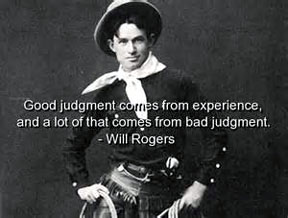
“Rogers increasingly expressed the views of the “common man” in America. He downplayed academic credentials, noting, “Everybody is ignorant, only on different subjects. Americans of all walks admired his individualism, his appreciation for democratic ideas, and his liberal philosophies on most issues. Moreover, Rogers extolled hard work and long hours of toil in order to succeed, and such expressions upheld theories of many Americans on how best to realize their own dreams of success. He symbolized the self-made man, the common man, who believed in America, in progress, in the American Dream of upward mobility. His humor never offended even those who were the targets of it.”[1]
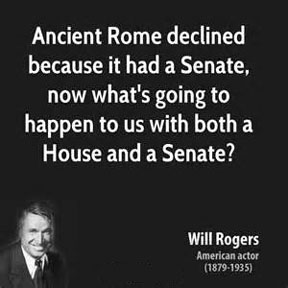
It was Will’s personal economic philosophy of life that caught the mariner’s attention. In various periods of his life, Will lived on a ranch in California. He had his family and a number of Indian workers. Will followed the American Indian philosophy: The hunters go out on a hunt and when they return with the kill it is given to the tribe to distribute. The hunters do not own or control the kill; it belongs to the tribe and there are no requisites for anyone to have access to the kill. Simply, the kill belongs to everyone.

Will worked hard for his income; similar to tribal procedure, the profits of Will’s labors were, as simply as the hunters, turned over to the family. Will didn’t pay his workers, their sustenance was provided the same as with everyone – family, Indians, food, clothing, materials in general. Everyone on the ranch received the same benefits and was cared for in like fashion.

Conservatives call this a dole. Profit is earned and owned by the one who earns it. Handouts are unfair and signify laziness, cheating, and unworthiness. Note that the Indian culture, along with Will, did not confuse individual worth as a scale of value equal to the amount of profit at hand. Mariner remembers the day he had this insight. How novel, how caring, how fair, how sustainable. This economy which belonged to no one and everyone had immense capacity to sustain far more participants (not just the 1%).

Without hearing, mariner knows the selfish will lash out at those who seem to be working less than the mighty profit makers. Alas, conservatives, it is a complex world and not everyone has the same profile.

Will wrote during the depression: “Now everybody has got a scheme to relieve unemployment, but there is just one way to do it and that’s for everybody to go to work. ‘Where?’ Why right where you are, look around and you see lots of things to do, weeds to be cut, fences to be fixed, lawns to be mowed, filling stations to be robbed, gangsters to be catered to.…”

In reality, the variance in work capacity or in amount of income is not an issue. On Will’s ranch, no one was told they had to assist with sustenance; they knew it – without intimidation or belittlement. Everyone saw to it that some part of the ranch labor was attended to without condescension. The trick is to not bind hunting to self-worth.

Mariner is pleased to note that Sweden, as a nation, as everyone’s government, has just passed legislation to experiment with Will’s way. Several thousand people will receive about $600/month and not be required to work at a defined ‘job.’ It is not seen as a dole; it is seen as a way to stretch the kill across everyone even when resources become lean. Sweden understands that humans have been scarfing down the Earth’s wealth far beyond what will be available as humans expand their population by another 40% in 100 years. Don’t worry about working at a defined job – everyone will be working at something to better the tribe.

Isn’t it fascinating that a Stone Age civilization is showing modern man the right way to do things?

Ancient Mariner

[1] James M. Smallwood, “Will Rogers of Oklahoma: Spokesman for the ‘Common Man'”. Journal of the West 1988 27(2): 45-49. ISSN 0022-5169


The Relentless Presence of Donald.

With great resistance, mariner must turn his attention to Donald. It has become a spiritual duty. The mariner prides himself on not following policy backed by ulterior motive, hearsay rumors, unjustified gossip, fake news, inadequately thought out if not childish tweets, Facebook abuses and a campaign of empty commentary based on vapors of nothingness backed only by petty, childish name calling. In cultural reality, this makes the mariner old fashioned and increasingly irrelevant to the essence of American culture in 2017.

Mariner vets his information first by reliable sources, then by cultural valuation, then by his own twisted rationale. Mariner has the assistance of his three reliable cohorts, Chicken Little, a compulsive alter ego, Amos, a skeptic of the first order, and Guru, incapable of evaluating an opinion without tracing it out to its ultimate end – usually the end of the Earth or beyond.

All three requested a meeting yesterday to complain about Donald. Chicken Little said, “I’m afraid of him.” Amos said, “Don’t these idiots in government understand he’s a sham? Why won’t they just trash him?” Guru said, “If you value what’s left of decent human values in government and an economy that can launch any positive future, his narcissism, his identity with wealth and his fetish with gold are inadequate to make the transition.”

Well, what can the mariner say? He agreed to make Donald the subject of a post even though he believes it will be tantamount to urinating into a 100 mph gale.

– – – –

After listening to and reading all feasible news sources, reading a few relevant books, and applying his unique cultural valuation, the mariner arrived at this overarching view: Donald is a symptom, not a cause. The Christian caveat about casting the moat from one’s own eye before judging other people applies absolutely to the American citizen’s philosophy of government. “Americanism,” the spirit our founding fathers sought to underwrite freedom, democracy, liberty and prevent oppression, tyranny and populism, the mariner fears, has run its course. A civil war, four significant failures of the nation’s economy, internationalism of economy and a planet that has never balanced its global population with reality in any manner, has eroded the spirit (meaning the spirit of the individual) to the point that the US has retreated to the classic mores of the Roman Empire: leaders of any ilk make their own rules, have their own rights and privileges, are not responsible for the wellbeing of citizens except to stratify liberties to given classes; the common good is an extraction of “What’s good for me?”

This has become a nation (and an international community) that folks like Donald can thrive in. He is in his element. Ethics, morality, practicality and the job of caring and sharing left a few decades ago. Righteousness is found in “the deal.” Donald has only two platforms to sustain morality: Whatever happens, it must have an element to it that benefits him personally; second, he must glean an image of egotistical success and supremacy – even if it is only in his own mind. This second principle is a weakness that smart leaders will take advantage of in areas that truly affect morality and fairness but are of no interest to Donald. As the mariner said, among us, he is among his kind.

Debris lies all around.

Just recently, it was mentioned that the nation who fostered modern democracy ranks 27th out of 35 functioning democratic nations; out of every 100 voters, 43 don’t and 16 are denied the privilege.

The nation’s economy is at its peak and expanding as an oligarchy; out of every 100 voters, one shares in 90% of the nation’s wealth. Turned around, 99 voters share .001% of the nation’s wealth.

The cultural engine, business, aggressively moves away from any cultural responsibility; taxes are avoided to the point of hiding massive profits like pirates in places outside the world of visible commerce and salaries are at their lowest as a percentage of GNP for as long as such records have been kept.

The ethos of religiosity and the divine worth of a soul are but a skeleton, a memory of their worthiness. The driving factors of organized religion are rife with the distractions of ritual and selfishness. The individual soul is not worth saving at the expense of self-gratification or sacrifice. For every deal made by Donald, religion makes a hundred deals to avoid the responsibilities of compassion, sharing, and weaving the fabric of empathy.

So our culture has come to this in 2017. Acknowledging that a thread, a residue of graciousness still exists, our body of faith, of compassion, of industriousness, of sharing, of tempered discipline, lay on the planet’s trashed floor looking like a carcass picked over by our vulturous selves.

There is little left in man’s coffers. The mariner speaks occasionally of ‘world bounces.’ What is left to bounce to? The bread of life needs a starter but searches an empty refrigerator.

Welcome, Donald. Make us a deal.

Ancient Mariner

The Path to World Peace

This post qualifies as something for the musing category but if the world’s circumstances happened to shift in a different direction, this musing could well be a literal event in the future of human beings.

For the last 40 years, technology, computers, robots, escaping into space, growing variations of totalitarianism, stratified economies, all have controlled the center lanes of our attention – of the way H. sapiens may gain control of the runaway culture that has slowly emerged over millennia.

Reading about recent mosquito diseases and how the most promising solutions come from changing mosquito DNA set the mariner thinking that genetics is the best source to find an effective solution for many of the dilemmas mankind faces. Society is busy trying to retrofit technology to help with these dilemmas when, in fact, paying more attention to genetics may be the better option.

This will be perceived as radical, of course. Let’s learn a bit about how genetics has been an active player in our lives since primates came into existence.

Most of us know that our genome, the map that creates each individual human when they are conceived, controls every thought, motion, reflex, emotion, and appearance, all of our physiology as a creature on this Earth. Even our beliefs, whether we are democrat or republican, a psychopath or a romantic pacifist – all can be blamed on our genome, our DNA.

As the works of Charles Darwin enlightened us 150 years ago, the genome has a partner: evolution. Evolution is the teamwork of finding the best way to survive within a given environment. Readers have hundreds of ready examples: some brown bears became polar bears; some weasels became seals; some notably short people were ancestors of Shaquille O’Neill (7’1”, 305 lbs) but his mom Lucile was 6’ tall at the age of 12. More directly, human ancestors climbed out of trees to walk because the Serengeti suffered an endless drought so long that what used to be forest became grassland with trees few and far between. It became easier to walk from tree to tree. Moving from tree to tree as safely as possible became important to survival so more walking predecessors survived to breed than four-footed predecessors. Did you know during those early times our ancestors could walk and jog all day without stopping while requiring fewer calories than a continental breakfast?

If you are interested in delving further into the details of genetics, visit a good library or the Wikipedia. Now that we’ve had a 5-cent tour about genetics and evolution, here’s the insight:

Bonobos. Yes, Bonobos. Zillions of years ago, long before the drought on the Serengeti, There was no Congo River coursing through the middle of the African continent. Dozens of ape species lived across the continent. Some were large, like the Silverback and Mighty Joe Young; some were small like chimpanzees and Bonobos. Eventually, the simians had to compete for food and, as individuals, began to become territorial and even a bit nasty – growing large fangs for fighting one another. The meanest, toughest male became the leader of the local troop.

The dry years dragged on eliminating many ape species. Only one species survived in the southern plains: Bonobos. Eventually the rain came. It was a lot of rain and formed the Congo River. All the large apes lived above the Congo and the smaller species still had to compete with the large ones. Fighting for food and territory had been bred into the northern species via the evolution partnership with DNA.

South of the Congo, Bonobos had it pretty easy. Food was plentiful. As it turns out, Bonobos do not have brash egos, territorial attitudes or gang fights. In fact, they don’t fight at all. Bonobos are quiet, even shy. Interestingly, Bonobos have matriarchal troops; the females are political but not inclined to fight. Authority and troop allegiance is maintained by continuous touching, nurturing and protecting. Sharing inadequate food and territory is a non-issue. Consequently, Bonobos have no inbred need to fight; Bonobos have no belligerent personality profile; bonobos have no masculine need to use violence as an expression of sexuality like most other mammals.

So the path to peace is not Roman domination; it is not automation; it is not greed, prejudice, avarice or the other Ten Commandments. These disruptive attitudes can be traced back to the North African apes. No wonder religion is so testy. No wonder corporations are territorial to a fault and lack empathy. Territory, however, is another issue in 2017 – 7,000,000,000 living on a space designed for 1,000,000,000 at most – and projected to be 12,000,000,000 by 2200.

Nevertheless, reproduction can be controlled by the genome as well as belligerence.

The path to peace lies in planned change to the human genome. Find out what genes in us are missing from the Bonobos genome then remove them from the human genes. In a compassionate manner, begin reengineering our genomes to lack belligerence. Pretend we are mosquitoes that carry bad genes and fix them.

Afterward

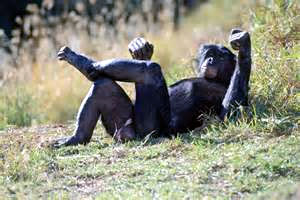
Immediately, pro-aggression types leap forward to claim without aggression, belligerence and domination, humans would not have made scientific progress, etc. The question is does Mr. Bonobo above need a computer?[1] That is a cop out; progress and lack of belligerence are cohabitant.

World peace is at hand.

Ancient Mariner

[1] Do not stop here. We must know more about the Bonobos. They are an endangered species living only in The Democratic Republic of the Congo. They are reduced in number daily by hunting and logging of their habitat. Please read on at http://www.bonobo.org/bonobos/what-is-a-bonobo/