
The Power of Mentors

Usually, in our late teens and early twenties, each of us comes across a special person. This person is a mentor; not a teacher from school but someone who enters your life in a direct way – perhaps someone you golf with or meet on the job or perhaps just an older neighbor you never really talked to before.

You learn some special wisdom from this person. Something that helps you finish growing up with a bit more wisdom and maturity; someone who may have enlightened you to what courage is about or what it means to be gracious or what it really means to take responsibility. Sometimes it’s a book or a trip. Sometimes, you just watch a special person perform in a special way that changes you for the rest of your life.

The mariner actually had two or three mentors. One, named Mike, was more or less a surrogate father for about five years. Being a scratch golfer, Mike taught him to play a decent round; he and mariner were leaders in the Explorer Scouts. We fished in the rushing rivers of the Appalachians. But most intensely Mike taught the mariner what courage was all about. At the age of 41, Mike had a massive heart attack. He was bedridden and limited to the first floor of his home. After a month or so, he advised his wife and children that he could not live like an invalid any longer. Knowing he was not going to live long, he asked the doctor to grant him a release. Mike went back to work; He played nine holes with his son and the mariner; He went to an Orioles game with friends; a week later he took off for two days of deer hunting with friends. It was a typical regimen for him. Two weeks later he died of a fatal heart attack.

Mike was greatly missed by many people. He was a gracious and caring person. He has remained mariner’s benefactor to this day. He taught mariner the value of sharing; he taught confidence; he taught the power of the human spirit.

– – – –

Mariner came by another mentor via public reading sources, books, and old timey movie clips. The reader likely knows him, too: Will Rogers. Will was a traveling humorist and writer. He was very popular with the national audience – constantly full of funny quips and derisive comments about any institution, especially government. Will had a way of making you laugh at yourself despite the sarcasm. He lived from 1879 to 1935, dying in a private airplane crash at 55 on the way to Alaska with Wiley Post. Will was born to Cherokee parents in Oologah, Oklahoma on a Cherokee reservation. In his young days he performed in Wild West shows, becoming an expert at cowboy skills and especially enjoyed doing tricks with lariats. He moved to Broadway shows, movies and writing – truly becoming a world famous author and speaker.
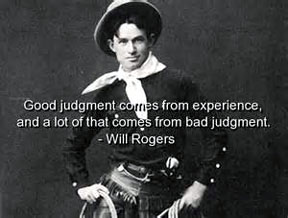
“Rogers increasingly expressed the views of the “common man” in America. He downplayed academic credentials, noting, “Everybody is ignorant, only on different subjects. Americans of all walks admired his individualism, his appreciation for democratic ideas, and his liberal philosophies on most issues. Moreover, Rogers extolled hard work and long hours of toil in order to succeed, and such expressions upheld theories of many Americans on how best to realize their own dreams of success. He symbolized the self-made man, the common man, who believed in America, in progress, in the American Dream of upward mobility. His humor never offended even those who were the targets of it.”[1]
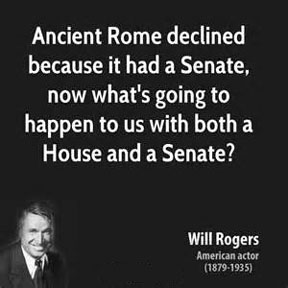
It was Will’s personal economic philosophy of life that caught the mariner’s attention. In various periods of his life, Will lived on a ranch in California. He had his family and a number of Indian workers. Will followed the American Indian philosophy: The hunters go out on a hunt and when they return with the kill it is given to the tribe to distribute. The hunters do not own or control the kill; it belongs to the tribe and there are no requisites for anyone to have access to the kill. Simply, the kill belongs to everyone.

Will worked hard for his income; similar to tribal procedure, the profits of Will’s labors were, as simply as the hunters, turned over to the family. Will didn’t pay his workers, their sustenance was provided the same as with everyone – family, Indians, food, clothing, materials in general. Everyone on the ranch received the same benefits and was cared for in like fashion.

Conservatives call this a dole. Profit is earned and owned by the one who earns it. Handouts are unfair and signify laziness, cheating, and unworthiness. Note that the Indian culture, along with Will, did not confuse individual worth as a scale of value equal to the amount of profit at hand. Mariner remembers the day he had this insight. How novel, how caring, how fair, how sustainable. This economy which belonged to no one and everyone had immense capacity to sustain far more participants (not just the 1%).

Without hearing, mariner knows the selfish will lash out at those who seem to be working less than the mighty profit makers. Alas, conservatives, it is a complex world and not everyone has the same profile.

Will wrote during the depression: “Now everybody has got a scheme to relieve unemployment, but there is just one way to do it and that’s for everybody to go to work. ‘Where?’ Why right where you are, look around and you see lots of things to do, weeds to be cut, fences to be fixed, lawns to be mowed, filling stations to be robbed, gangsters to be catered to.…”

In reality, the variance in work capacity or in amount of income is not an issue. On Will’s ranch, no one was told they had to assist with sustenance; they knew it – without intimidation or belittlement. Everyone saw to it that some part of the ranch labor was attended to without condescension. The trick is to not bind hunting to self-worth.

Mariner is pleased to note that Sweden, as a nation, as everyone’s government, has just passed legislation to experiment with Will’s way. Several thousand people will receive about $600/month and not be required to work at a defined ‘job.’ It is not seen as a dole; it is seen as a way to stretch the kill across everyone even when resources become lean. Sweden understands that humans have been scarfing down the Earth’s wealth far beyond what will be available as humans expand their population by another 40% in 100 years. Don’t worry about working at a defined job – everyone will be working at something to better the tribe.

Isn’t it fascinating that a Stone Age civilization is showing modern man the right way to do things?

Ancient Mariner

[1] James M. Smallwood, “Will Rogers of Oklahoma: Spokesman for the ‘Common Man'”. Journal of the West 1988 27(2): 45-49. ISSN 0022-5169

The Relentless Presence of Donald.

With great resistance, mariner must turn his attention to Donald. It has become a spiritual duty. The mariner prides himself on not following policy backed by ulterior motive, hearsay rumors, unjustified gossip, fake news, inadequately thought out if not childish tweets, Facebook abuses and a campaign of empty commentary based on vapors of nothingness backed only by petty, childish name calling. In cultural reality, this makes the mariner old fashioned and increasingly irrelevant to the essence of American culture in 2017.

Mariner vets his information first by reliable sources, then by cultural valuation, then by his own twisted rationale. Mariner has the assistance of his three reliable cohorts, Chicken Little, a compulsive alter ego, Amos, a skeptic of the first order, and Guru, incapable of evaluating an opinion without tracing it out to its ultimate end – usually the end of the Earth or beyond.

All three requested a meeting yesterday to complain about Donald. Chicken Little said, “I’m afraid of him.” Amos said, “Don’t these idiots in government understand he’s a sham? Why won’t they just trash him?” Guru said, “If you value what’s left of decent human values in government and an economy that can launch any positive future, his narcissism, his identity with wealth and his fetish with gold are inadequate to make the transition.”

Well, what can the mariner say? He agreed to make Donald the subject of a post even though he believes it will be tantamount to urinating into a 100 mph gale.

– – – –

After listening to and reading all feasible news sources, reading a few relevant books, and applying his unique cultural valuation, the mariner arrived at this overarching view: Donald is a symptom, not a cause. The Christian caveat about casting the moat from one’s own eye before judging other people applies absolutely to the American citizen’s philosophy of government. “Americanism,” the spirit our founding fathers sought to underwrite freedom, democracy, liberty and prevent oppression, tyranny and populism, the mariner fears, has run its course. A civil war, four significant failures of the nation’s economy, internationalism of economy and a planet that has never balanced its global population with reality in any manner, has eroded the spirit (meaning the spirit of the individual) to the point that the US has retreated to the classic mores of the Roman Empire: leaders of any ilk make their own rules, have their own rights and privileges, are not responsible for the wellbeing of citizens except to stratify liberties to given classes; the common good is an extraction of “What’s good for me?”

This has become a nation (and an international community) that folks like Donald can thrive in. He is in his element. Ethics, morality, practicality and the job of caring and sharing left a few decades ago. Righteousness is found in “the deal.” Donald has only two platforms to sustain morality: Whatever happens, it must have an element to it that benefits him personally; second, he must glean an image of egotistical success and supremacy – even if it is only in his own mind. This second principle is a weakness that smart leaders will take advantage of in areas that truly affect morality and fairness but are of no interest to Donald. As the mariner said, among us, he is among his kind.

Debris lies all around.

Just recently, it was mentioned that the nation who fostered modern democracy ranks 27th out of 35 functioning democratic nations; out of every 100 voters, 43 don’t and 16 are denied the privilege.

The nation’s economy is at its peak and expanding as an oligarchy; out of every 100 voters, one shares in 90% of the nation’s wealth. Turned around, 99 voters share .001% of the nation’s wealth.

The cultural engine, business, aggressively moves away from any cultural responsibility; taxes are avoided to the point of hiding massive profits like pirates in places outside the world of visible commerce and salaries are at their lowest as a percentage of GNP for as long as such records have been kept.

The ethos of religiosity and the divine worth of a soul are but a skeleton, a memory of their worthiness. The driving factors of organized religion are rife with the distractions of ritual and selfishness. The individual soul is not worth saving at the expense of self-gratification or sacrifice. For every deal made by Donald, religion makes a hundred deals to avoid the responsibilities of compassion, sharing, and weaving the fabric of empathy.

So our culture has come to this in 2017. Acknowledging that a thread, a residue of graciousness still exists, our body of faith, of compassion, of industriousness, of sharing, of tempered discipline, lay on the planet’s trashed floor looking like a carcass picked over by our vulturous selves.

There is little left in man’s coffers. The mariner speaks occasionally of ‘world bounces.’ What is left to bounce to? The bread of life needs a starter but searches an empty refrigerator.

Welcome, Donald. Make us a deal.

Ancient Mariner

The Age of Acceleration.

A new book is out worth a trip to the library. It is Thomas L. Friedman’s newest book, Thank You for Being Late: An Optimist’s Guide to Thriving in the Age of Accelerations. The book recognizes the fact that as we depend more and more on technology for every kind of interface with others and the active world, we grow lonelier and our interactions have less value.

The best way to review the book is to watch a video interview by Aspen Institute President and CEO Walter Isaacson.[1]

The issue addressed in Friedman’s book centers on the explosion of technical capacity in 2006-2008. It is the time of the iPhone, the tablet, the cloud, big data, a dozen processing platforms that accelerate transaction speeds off the charts. Then it was 2008. Without warning, people lost jobs, homes, and whole lifetimes of savings. It was a double whammy which left our culture overwhelmed with isolation, defeat and loneliness. Friedman focuses on the battlefront that will exist in our culture for the next couple of decades: those who want to build walls against the hurricane of change and those who want to learn how to live in the eye of the hurricane.

Part of living in the eye is to associate again with people in groups and activities that are socializing in nature and help develop empathetic skills. As an example, Tom mentions a new, rapidly growing business that sponsors paint-by-number painting in bars. Our society yearns for the camaraderie that existed fifty years ago. We are squeezed dry by faster and faster transactions in everyday living.

Tom often is seen on Global Public Square, Fareed Zakaria’s Sunday show on CNN. He is an eclectic writer who easily crosses from one segment of society to another and has won three Pulitzers.

This is another critical read similar to Eric Metaxas’s book, If You can Keep it, which discusses the lost spirit of our nation.

– – – –

Each of these books reminds us that history moves at blurring speeds today. Even as an athlete trains constantly to keep his place in his sport, so we must constantly train to stay in Tom Friedman’s eye of the hurricane. Life will not be successful without constantly learning about new ideas, different life situations, even constantly preparing to keep one’s work skills current – at any age.

New cycles of careers and life patterns no longer move along generational lifetimes. They move in months or a few years; waiting while we plod along through kindergarten to college will leave us behind, falling into the hurricane. It is a new lesson we must learn – even to learn again how important empathy is to a happy, healthy life.

Ancient Mariner

[1] See https://www.aspeninstitute.org/blog-posts/thomas-friedman-human-interaction-digital-age/ .

The Citizens asked for Change. They got Calamity.

It’s a truly rare moment in a person’s life when they can bring a life’s work to a close in an instant in front of 20,000 people with a simple statement: “Yes we can.” One thing is certain: Barack is a skilled speaker.

The Obama administration passes into history. Already the thoughtful, gracious manner is missed. We walk out onto the street – which is noisy, unfocused, ungracious and taking actions in secret – whether because the new administration doesn’t know what they are doing or because it doesn’t want us to know. Likely both.

Large, complex cultural structures are at risk of collapse because new Department Heads are antagonistic toward the safeguards provided our citizens by their Departments. Science, health, human resources, social justice, the economy, and common cause are facing a bashing.

The 115th Congress, having stopped and denied legislative progress for eight years already has demonstrated it has forgotten how to pass meaningful legislation. Among many piecemeal efforts aimed at shrinking discretionary funding, Congress passed legislation eliminating the Affordable Care Act – but not really; some time in the future the Republicans will come up with a replacement but for now they don’t have one. Since the ACA has been eliminated, however, it can’t be improved. In the midst of sensitive, even volatile times, a racist is made the nation’s top law enforcer.

There were two positive actions Donald could have performed: derail the establishment – both democratic and republican – so a new direction could begin or as a double negative effort, prevent the Republican Congress from ravaging the Obama legacy. Unfortunately, there is little ‘law and order’ in our Federal Government. Mariner is reminded of the shootout at OK corral.

Mariner often has lamented the laisse-faire attitude of American voters. Among all democracies, the US ranks 27th out of 35 functioning democracies with only 53% of eligible voters participating. Further, only 84% of eligible voters are allowed to vote. Yes, allowed to vote. It is no secret that nearly half the active political people in the US do not want people of color, young, or disadvantaged social classes to be able to vote.

However, as debilitating as low voter turnout is, the most damaging abuse to our democratic process is gerrymandering. Gerrymandering alone blocks the influence of half of all voters. Gerrymandering exists in your State. Redistricting will be performed by the next election of Governors and State Legislators.

Some of the oldest readers may remember the zeal, the fervor, the energy of the US citizen during World War II. Coming out of the Great Depression and combining that commitment to recovery with the nationalist fervor elevated by the War, political responsibility was palatable. Every precinct had a political club as active as any neighborhood association today. Where it mattered, ethnic groups had fund raisers and additional neighborhood networks.

Today, no matter where in the fifty states one may live, political clubs are kept small until campaign time and managed by incumbent politicians so as to assure their reelection.

In addition to your card club or hobby club, join a political party club. We have a war on our hands.

Remember what he said: Yes We Can.

Ancient Mariner

Totalitarianism is Here.

In the book 1984 written by George Orwell in 1949, the evil element is totalitarianism. Orwell was afraid of the suppression of individual thought and individual expression – both empirically and emotionally. His fear came from communist movements in Spain and Russia which were using communistic (totalitarian) practices to control citizens. Orwell was afraid communism would cross the Atlantic and overwhelm democracy and capitalism. Some older readers may remember in the movie version the large screens that educated all citizens with the same information and may have noticed that everyone was wearing identical outfits.

George had the right insight about totalitarianism but the latent oppression would not come from political forces, it would come from computers.

The mariner devised a new measure of eras called a World Bounce. The World Bounce lasts about 120 years more or less. He determined this length of time based on a quick survey of large changes in global culture. (See the post, “Whither We Go,” published recently.) Using the zooming capability of 120-year chunks, we can envision some degree of context about the World’s life and times. It seems increasingly that a lot is changing or preparing to change in the culture of the world’s population. Without going into a litany, global warming, and global extinction of species, changing weather patterns, international economic imbalance, and specifically, artificial intelligence – all are forcing the hand of our political structures, our economics, and what the experience of a lifetime feels like. We are about to bounce.

The least examined force of change by the person on the street is the impact of artificial intelligence. It spawns totalitarianism. Not with evil intent, mind you, but inadvertently; the large screens of Orwell’s book are identical to what is called “Big Data”. Within a decade or two – thanks to Google, Microsoft and other data snoopers, massive databases will know all about each of us. A working term being sold right now primarily to businesses is “The Cloud.” Clouds are extremely large amounts of data accessible by an endless number of processors.

Add to this endless data computers that know how to scan, sort, merge, match, equate, and deduce Big Data; it is the same as you performing a search on Google except we don’t need you anymore. “Google” will do its own search, thank you.

One of the first functional examples of this new artificial intelligence is a program called ALICE which you load into your own computer. It has a ‘person’ who talks to you in normal conversational style. You may have seen Alex Baldwin order a new pair of socks without touching anything – just saying, “Get me a new pair of socks.” The computer responds nicely saying it will do so right away. Without input from Alex about what the socks will look like, their quality or size, ALICE already knows by searching a database with previous purchases of socks made by Alex likely collected from a credit card database.

Another ubiquitous example: ALICE, buy me a car. Again, Alice already knows your income level, credit card score, neighborhood and geographic region, the size of your family, the value of your home, the types of driving you do, what kind of gasoline you buy, what kind of car you own now and resale value. It knows this because certain companies are in the business of building as complete a profile as possible about everything and everyone. They sell access to Big Data so that sellers and buyers can do business together automatically using only computers matching requests to solutions.

Did a few of you notice how, suddenly, a few years ago it seemed that  virtually everyone bought SUVs? Car manufacturers did a marketing blitz. Now, all a car manufacturer will need do is buy an algorithm in Big Data which will steer your computer to their product given that your profile matches. If you are interested in making a choice yourself, your computer will offer only choices that fit your economic profile; you won’t be able to find that luxury car no matter how hard you search. This is an example of totalitarianism; eventually everyone will be subject to one choice.

George was fearful of this unintended effect: In the mariner’s home town for example, it appears everyone is driving the same model car, wearing the same style and manufacturer’s clothing (which by the way will carry in its fabric how long you’ve owned it) and oddly, how everyone wears the same socks. Even aware of the totalitarian effect, people still would appreciate the convenience. It’s identical today when a viewer ties themselves to Netflix or other entertainment packages: the odds are you simply will use the offerings available to you through Netflix. Note the other effect: No subscriber can see offerings that Netflix doesn’t want to carry.

Now shift this pattern of retail compliance to the morals, thoughts, philosophies and behaviors that make up your religion, political party, candidate choices for public office, individual creativity, whether you can find a different kind of job, etc. Already dating firms select candidates to be your spouse; right now you can just say, ALICE, get me a spouse….. Shades of Stepford Wives!

In following posts the mariner will address other changes likely in the coming World Bounce.

Ancient Mariner

New frontiers which will change our world in the next Global Bounce.

The subjects in this post can be considered ‘new ideas’ but like all new ideas, they have been percolating through thinkers and tinkerers for decades. Just now though, these ideas are emerging into the public consciousness as having both a means of production and a cultural purpose. The first idea is about what motivates our willingness to work and the second is about the fact that science already has the capability to change any, even most of any creature’s DNA – including humans.

PBS News Hour covered both topics in one edition of the program on January 5, 2017.[1]

The mariner wrote a post about what motivates us to work and the manner in which we can sustain our livelihood if ‘jobs’ aren’t available.[2] Mariner quotes three cogent paragraphs which apply specifically to this topic:

“It is important to dissect “job” from “work.” A job is the result of hiring by an employer wherein the individual hired receives a salary or some form of recompense. Work is the act of investing personal time, energy, and other resources wherein the individual feels justified in one’s behavior and feels personally responsible for one’s contribution; the individual also derives a sense of self-worth from doing the work. A job can fulfill an act of work but work has a broader definition that includes the wellbeing of the individual.”

“There will come a moment when a great layoff will occur for which job replacement is not available. In that moment, a new world of work will be born wherein citizens are paid a stipend so that each citizen may continue to work – whether a job definition exists is irrelevant. A society cannot operate except people are allowed expression through work, contribution, and personal gratification. A “job,” on the other hand, is a matter of definition, nothing else.”

There is no doubt that the welfare mother who raises her children to be responsible adults is doing valuable work. In the future, this could be considered her job.

In the PBS interview of Dan Ariely,[3] he says that many experiments have been performed with unsuspecting workers to determine the overall effect of a bonus cash reward versus a personal gift or even just a genuine ‘great job.’ Surprisingly, except for workers with financial hardship, more workers preferred a gift or good job bonus. Also interesting, once a cash bonus was paid, the potential for another one did not motivate worker productivity to the same level – in fact, productivity was lower!

At the speed with which computerization replaces human beings, it is time to begin serious discussion about how citizens will find jobs, or by modern definition how they will find work. Mariner suggests that we will have to wait until the electorate elects a full slate of contemporary and forward-sensitive government representatives – a far, far cry beyond the interest or competency of the in-coming President, most State governments and the Congress.

Another discussion is how the electorate will elevate its understanding of what a government is supposed to accomplish. Will our school systems have to include civics classes again?

– – – –

On to the second topic: total ability to change any aspect of any creature for any reason. It is possible you may not even recognize your grandchildren because they look like a movie star or have muscles the reader never had – to say nothing of the hyper intelligence the reader never had either. When have we ever seen two-foot long hummingbirds? Sounds silly and likely is but if the reader can think of a reconfiguration of any kind, it won’t be long until it is possible.

Michael Specter, the individual interviewed by PBS, suggested the slightest change in mosquito DNA could turn it into a global weapon affecting only humans with a predetermined DNA strain. Is it possible that the weapons of war will no longer need explosives and explosive weapons? Will it not be necessary to employ zombies when we can create endless numbers of specifically targeted humans that look like Arnold Schwarzenegger?

The interview with Michael Specter is enlightening and uses excellent demonstrations. Mariner recommends checking out the January 5 News Hour program.[4]

Ancient Mariner


[1] See http://www.pbs.org/video/2365927144/

[2] See The Future of Work – III When Jobs End, July 12 2015

[3] Book: Payoff – The Hidden Logic that shapes our Motivation, Dan Ariely. Dan Ariely is the James B. Duke Professor of Psychology and Behavioral Economics at Duke University and is the founder of The Center for Advanced Hindsight.

[4] See footnote 1 and also http://www.bing.com/videos/search?q=dan+ariely+motivation&qpvt=dan+ariely+motivation&FORM=VDRE Also check your library in a week or two or ask the librarian to use ‘Interlibrary Loan’ for Rewriting the Code of Life by Michael Specter. It is in the New Yorker magazine or Annals of Science Journal.

Whither We Go?

Welcome to 2017. As we roll into our new year, the entire world is beginning a new bounce. Politics is part of the bounce but looks more like blowing trash; economy is part of the bounce but looks more like a vacuum cleaner; environment is part of the bounce but looks more like a starving dog; technology is part of the bounce but looks more like an algae bloom sucking all the oxygen out of a pond; human management is part of the bounce but looks more like Times Square on New Year’s Eve and the attendees have no home to which to return.

American party politics looks like it did in 1890: What are democrats? What is democracy? Aristocracy, oligarchy and authoritarianism are America’s choices as we ride the current bounce to its end. Donald has emulated Ronald by appointing a Cabinet with harsh ideologues who are philosophically opposed to the existence of their own Departments. Do not look for egalitarianism any time soon – like maybe a generation or more if ever again.

International politics are more frightening. The European Union was wobbling under a unification intended to be a transition to a more solid cultural and economic relationship. But the EU was shot down like a flight over Lockerbie by massive immigration from Northern Africa and everywhere in the Middle East. A slowly growing effort by EU to strengthen the economies of Moldovia, Romania and Albania among others were trampled to nothing by the immigration.

China’s solution to inadequate food and a seacoast of threatening internationalism is to take over and own the whole geographic area – not very different from the relationship between the US and the Caribbean and Gulf islands if the US decided to make them part of the United States of America. It’s bad enough pirate-minded billionaires are stealing these wonderful islands and their economies – and kicking unique cultures into the sea. The mariner has sailed most of these islands; it is a tearful thing to watch.

To his fellow citizens, mariner apologizes to say that the top ten socialist democracies are in better shape to ride the world bounce than the top ten capitalist or authoritarian nations. Unlike capitalist and authoritarian nations, socialist nations pay for health, education, and enforce financial and social equality. As the world bounce continues, work for greater profit and the indifference of socially controlling corporatism will run out of playing field. Mariner never wanted his sports arena named after a corporation anyway. (Apologies for the flood of metaphors)

Regarding the global economy, this is how it works: If you own something, I’ll give you a faster depreciating something if you let me be a partner with you in your longer lasting personal worth; if you have wealth, partner with me to maximize our joint wealth; if you are in a position to help me increase my wealth faster than yours, I will give you money. This economy underwrites aristocracy, plutocracy and oligarchy and undermines democracy and favorable treatments of the environment and human management.

There has been a recent spate of technologies, shifts in economic opportunity and, importantly, even some political decency toward environmentally friendly intentions. The appropriate response to these intentions is “show me the money; show me the real change.” Still, the oil industry’s next frontier is destruction of Canada’s Great Northern Wilderness where oil drilling will expand 300 percent in the next few years; the pure, clean rivers are becoming toxic just like the salmon breeding grounds in Northern Alaska and Canada near the Arctic Circle. And Donald is opposed to wind power because windmills are unattractive – mariner suspects he never visited a coal burning power plant or sailed down the Mississippi River past endless fuel fabricating factories.

As the world writes off 600 mammalian species because of habitat abuse and the oceans increase acidity in ocean water to the point that uncounted hundreds of species disappear every year and climate change will likely swamp major edifices of humanity like London, Manhattan, Hong Cong, Miami, and Rio de Janeiro, a starving dog is about the norm as an icon for the planet to survive the bounce.

Human management is the issue that no one wants to manage. Talk about overhead! We’re talking about our own species – talk about troublesome! It’s a lot easier to manage money, brutalize nature and fight wars.

What does mariner mean by a bounce? He mentioned “part of the bounce.” A world bounce is 120 years long, give or take a few years. For example, it is clear that momentous things are about to happen; 120 years ago was around 1900. That’s when a lot of stuff was invented that launched the bounce that’s ending now; a belated part of the current bounce was the invention of the transistor in 1948 by German scientists – the beginning of the Technical Age. 120 years before 1900 was 1780. The start of the industrial age is pegged to 1790; the USA popped up on the world scene about then (1776-78) which clearly contributed to a new bounce and 120 years before that was 1660 – a significant event reflecting on Christianity in America: Jun 1 1660 Mary Dyer is hanged for defying a law banning Quakers from the Massachusetts Bay Colony. The Christian commandment to love everyone clearly has survived until today’s bounce; Jamestown Virginia was established; England returned to being a monarchy with the return of Charles II; Thirty Years War began between Protestants and Roman Catholics. Galileo made science news observing the moons of Jupiter. And so on.

So what changes can we anticipate in the next bounce? It appears to be starting in good form for a bounce: lots of commotion, misunderstood decisions, growing populism, growing wealth of the few, failing international associations, inadequate statesmanship all over, new and old religious beliefs filling cultural voids, etc.

In other words, the world’s peoples will know why change is not wanted. It’s the same as changing a baby’s diapers – a real mess. So this is our mission in 2017: Get rid of junk in your life, streamline your circumstances similar to preparing for a tornado, have your financial future secured as much as possible, get a valium prescription, and then don’t forget to have a good time!

REFERENCE SECTION

Some Notable Quotes.

“The ballot box in itself is not enough to render a system a ‘democracy.’ A true democracy needs separation of powers, rule of law, freedom of speech, women’s rights, LGBT rights, free and diverse media and independent academia. Without all these institutions and values you can only have ‘majoritarianism.’ And majoritarianism is not the same thing as democracy.”

–       Turkish novelist Elif Shafak

“Companies like Google profit enormously from data mining of your personal searches, behavior and habits,” he said. “There is more money in selling that data than in selling a product. It’s surveillance capitalism. It really is a new kind of totalitarianism.”

–       Writer and director Oliver Stone

In the 2015 WorldPost Year-End Roundup, we observed that we were then “on the cusp of a tipping point” in the race between a world coming together and one falling apart. In 2016, we have indeed tipped over into a new era.

The profound upheavals of this year were anticipated in an essay we published in March titled “Why the World Is Falling Apart.” In that piece I wrote, “The fearful and fearsome reaction against growing inequality, social dislocation and loss of identity in the midst of vast wealth creation, unprecedented mobility and ubiquitous connectivity, is a mutiny, really, against globalization so audacious and technological change so rapid that it can barely be absorbed by our incremental nature….The determination to “take back control” across the Western democracies among those dispossessed by change was explosively expressed in 2016 in a widespread revolt against the elite custodians of the status quo through Brexit, the Trump victory and the ongoing anti-establishment insurgency in Europe.

–       Editor-in-chief, WorldPost, Nathan Gardels

Ancient Mariner

The Steamroller of Culture

On the Live Science website this week are a number of news items about the nativity in the Christmas Story.[1] The findings depict accurately the story of the nativity but are 3000 years older. It is no wonder that faith often rejects science. On the one hand, faith accepts wisdom in any form as valid and eternal. On the other hand, science depends entirely upon facts and logical assumptions based largely on facts. Over the decades, mariner has found this confrontation to be the most complex and convoluted relationship – that is of dependence on faithful beliefs in good, life-saving theological and behavioral ideas versus the forever emerging accumulation of facts, discoveries, and the pressure of changing cultures.

What is good? What is divine? What is the behavior that will save humanity? The answers to these kinds of questions require a mythic premise – one that is not influenced by human history, one that is valid beyond human behavior and abuse. This is a good way in which to secure our religious ritual; it is beyond the reach of daily life and is based on heroic goodness.

Alas, it seems science is dedicated to disassembling myths. Still, humans are created to be sensitive to forces beyond human achievement. Since the earliest times 12,000 years ago there is evidence that H. sapiens has incorporated the powers of God as part of the management of life. If one could take a snapshot every 1000 years to assess the role of God, one will find remarkable modifications in who God is and how God contributes to human quality.

God must do some fancy dancing to keep up with the latest in cultural changes. Not only does science keep changing the rules, humans keep reinventing the way humans interact and find meaning in life. Whoever thought God would have to deal with memes? How will God find a path through the electronic games, devices and preoccupation with capitalism? How will God reintroduce for the umpth time that love and respect, not possessions, is the core value to happiness and sublime life?

We know science has no interest in inculcating spiritual value; that is not its job. But given the results of science – certainly knowledge is beneficial – how do we construct a new myth that is meaningful today? How do we return divine essence to the forefront of humanity’s values?

There are fragile signs. It is a topic of conversation that we have lost, among ourselves, the soul and spirit that is required to manage our political and economic life. There are growing concerns about matters beyond our own comfort and pocketbook: the environment of an entire planet is beginning to fail. There are conversations about how to elevate this issue to daily levels of awareness in our destructive oil economy. There are so many humans on this planet that the basics of why we have an economy must change dramatically.

Unfortunately, you and I are in the generation of basic labor and sacrifice. It is we who must pull hard on the reins of a diverse and self-indulgent world. It is we who will pay the price of change in our comfort, our faith and our pocketbook. Our job is to stop further degradation for we are approaching something akin to Armageddon (largely a metaphor but nevertheless inevitable).

It has become your turn to step up and take charge.

Ancient Mariner

[1] See http://www.livescience.com/57311-5000-year-old-nativity-scene-found.html

Election Postscript

The 2016 election has left the nation deflated. A citizen, no matter their ilk, can take only so much wear immersed in politics, morality, philosophy, culture and other esoteric, massless issues none of which ever produce absolutes a citizen can count on. Alas, the wear has only begun. One segment of the nation’s politic, a narrow one, will feel positive about the outcome of the election: the upper and middle class far right. One pundit on CBS television said “We have a President with no ideological direction appointing intense ideologues as Secretaries, supported by the most conservative and dominant Republican Congress since before the Great Depression.”

The largest losers are the faithful who voted for Donald. There’s an old saw that goes, ‘Why would a working class person ever vote Republican’? Fareed Zakaria had it right before the holidays: the electorate votes for the personality most like themselves; policy is not a factor. It is normal for voters to select preferable bits of gossip and campaign noise to support their opinion; 2016 saw uncontrolled abuse from the social media – Donald among them.

A tonic for the general public – and an important lesson in civics – is an interview of Jon Stewart by Charlie Rose that ran last November and was rerun on Bloomberg channel last week. Jon is no one’s court jester. His wit made him a leading personality in serious politics. Jon has a no-nonsense attitude about politics and feels all’s fair in love and war as the spirit and purpose of our democratic republic is hammered out by the electorate. “It’s a messy business,” he said, “but it’s our job to keep this country free rather than let it slip into something else.” He commented on his intense campaigning for the passage of a bill that would pay the medical bills of first responders on 9/11 by saying that if the government is doing something immoral or abusive, it’s everybody’s job to take action to set things right.

Mariner suspects not every political activist has the loyalty to the nation that Jon has. Typically, political activists are warriors for a cause; anyone with another opinion is a dangerous enemy. Once a voter absorbs his personal opinion, not even ISIL can change that opinion. Jon said this firm attitude is what it takes to run this country. However, it isn’t very intellectual. Donald said he could shoot someone down in the middle of Broadway, NY and not lose a vote. So it seems….

What our country is left with in the game of nations is a jump ball. Fortunately or unfortunately each nation has its own ball. The nation with the best overall game will win. Trouble is, our team just drafted teammates of Jerry West.[1]

Jon also said the democrats no longer represent the hometown citizen, the people each of us know next door or in our family. Every time a labor union is busted or a right to work law is passed by state and local governments, it continues to weaken an already bad situation for the working class. The only solution is to strengthen the local democratic presence in order to elect democratic candidates who will support labor friendly legislation; in other words remove redistricting completely from party-sensitive control. Accomplish that and the rest will be easy.


REFERENCE SECTION

Mary Noble interviews Arlie Russell Hochschild

THE MORNING AFTER Trump’s victory, The New York Times recommended “6 Books to Help Understand Trump’s Win.” Number two on the list was Strangers in Their Own Land: Anger and Mourning on the American Right, by Berkeley sociologist Arlie Russell Hochschild. The book takes us to Louisiana, where Hochschild spent five years among Tea Party voters who have suffered at the hands of the oil industry. It’s people like these that have become Donald Trump’s most ardent supporters. Hochschild explores the emotional logic behind what she calls their “deep story”: they believe that the government helps minorities “cut ahead of them in line,” while liberal America mocks their values[2]

This book and the interview are a humanistic and thought provoking look at the intimate experiences of those citizens who have nowhere to turn for a future. We may think of them as misguided or uneducated. But the truth is, the truth is, they have come to us and discovered there is nowhere to turn. If Donald can rock the boat and make a crack in the vast unresponsive firmament, maybe there will be a place to go. It was their last hope.

Ancient Mariner

[1] Jerry West played basketball for the Los Angeles Lakers in the 1950’s and 60’s – the implication being the new nation’s leaders still abide by political philosophies and problem recognition that existed over sixty years ago.

[2] Quote from Los Angeles Review of Books, https://lareviewofbooks.org/article/reaching-out-not-backing-down-an-interview-with-arlie-russell-hochschild