The Arrested Donald and other Important Matters

Mariner has been overwhelmed by the presence of Donald in a twenty-first century Presidency. Mariner hasn’t said much this past year other than a few asides in the midst of other topics. It has become blatantly obvious as Donald’s term runs past a year in office, that Donald has two dysfunctional attributes: Donald is a victim of arrested development. Donald has developed a narcissistic personality.

Mariner isn’t sure what causes arrested development, whether its nature or nurture or both. (Some breeds of dogs are deliberately bred not to ever mature) In any case, its mariner’s opinion that Donald stopped developing around the age of eight. An eight year old is familiar with few policies other than loyalty and deflecting blame. If those readers who are parents can think back to when their child was eight years old, the child’s vocabulary and sentence structure, the simplistic view of behavior, the inappropriate bravado, the shortsighted reasoning, the dependence on fantasy, one will realize Donald is an eight year old.

It is unfortunate that Donald was raised in an intensely strict family. From birth his behavior was irregular; flaunting his prowess by bullying, challenging rules of behavior and, like his father, using belittlement as a weapon, Donald was a problem child from birth. At thirteen, Donald was expelled from his family by the father, sending Donald to a military school where discipline was harsh.

The father was obsessed with winning. If a child didn’t win, the child was belittled. How does a small child survive in this destructive situation? Become narcissistic. Regardless of reality, regardless of the father’s derision, regardless of growing difficulty in social situations, Donald saw himself as a successful child and always a winner. Being narcissistic, Donald easily can assume that Donald and winning is the same thing. He truly believes in his own mind that bad news and lack of performance are the fault of someone else – fantasy is a handy tool provided by being eight years old. Defaming and belittling others is a defense mechanism typical of an eight year old.

The simplistic ethical structure of an eight year old combined with the absence of empathy in narcissism, yields one Donald Trump. Donald has been and will continue to be destructive. It is difficult to imagine Donald’s motivations for his behavior. His motivations are far simpler than normal adults would imagine; pundits, journalists and the press in general fall into this trap: overthinking Donald. Donald’s ‘loyalty’ to Russia and all that entails, likely is based on the simple idea that his election may be overturned if it is proven that Russia hacked the election. Otherwise, following the money and uncovering shady business deals reveals Donald’s normal environment – he is a member of the oligarchy run from Russia preying on most of the old USSR. Donald wants the sanctions lifted for the same reason Putin does – sleazy profits.

– – – –

Nevertheless and regardless and to any length – Donald will cause damage to the intellectual force of the United States. But Donald is not the real danger. The real danger is Congress – and by default the Republican Party. Due process, mediation of any kind, civic mindedness – all have disappeared even before Donald came on the scene. Adding Donald to the selfish whims of the GOP has exposed the party for the self-righteous, money-driven, and fragmented entity it has become. Several of mariner’s more thoughtful resources have gone so far as to call for dissolving Congress, holding a special election for every seat in both houses. An article in The Atlantic makes an uncharacteristic plea to the electorate: do not vote for a republican!

A sound, public minded Republican Party would have squeezed Donald out of election politics when he provoked birtherism. Racism always has been an Achilles heel for republicans but using racist remarks on the campaign trail is not helpful in winning a majority of voters. Additionally, a struggling right wing of the party has been able to bring the Republican-held House to a standstill. With audacity, Congressional leaders (Republican) turn to the democrats seeking votes for legislation antithetical to democrats.

Who can fix Russian intervention in US elections? Congress.

Who can fix gerrymandering? Congress.

Who can eliminate cash-driven elections? Congress.

Who can remove lobbyist control of legislation? Congress.

Who can assist transition from fossil fuels to alternative energy? Congress.

Who can regulate banks and Wall Street to play fair? Congress.

Who can mediate international politics? Congress.

Well, perhaps not.

Ancient Mariner


REFERENCE SECTION 1-26-18

Today’s post is all reference section. It is composed of three distinct areas of interest: Gerrymandering, Philip K. Dick, fiction writer, and successfully cloned monkeys.

– – – –

Gerrymandering

It is excellent news that Nate Silver, mariner’s preferred statistician and odds maker at www.fivethirtyeight.com, is sponsoring a detailed look at gerrymandering. His staff has launched a project called “The Gerrymandering Project.” It made its first splash today and is, in typical 538 style, loaded with insight and detail that is free of political nuance. For example, it states that there are many ways to skin a rabbit when it comes to new thoughts about how to fix gerrymandering. The ‘Project’ looks at six models:

To maximize the number of usually Democratic districts

To maximize the number of usually Republican districts

To make the partisan breakdown of states’ House seats proportional to the electorate

To promote highly competitive elections

To maximize the number of districts in which one minority group makes up the majority of the voting-age population in the district (what we’ll refer to as a majority-minority district)

To be compact while splitting as few counties as possible

If ever, ever, ever mariner wished his readers would click on a link, this is the one: http://fivethirtyeight.com/tag/the-gerrymandering-project/?ex_cid=TheGerrymanderingProject . Load this website in your favorites.

֎

Philip K. Dick

Our overall attitude about life is blended with many current events that defy definition. Philip Kindred Dick was an American science fiction writer who wrote during the psychological turmoil of the sixties – the Age of Aquarius. Dick explored philosophical, social, and political themes in his novels with plots dominated by monopolistic corporations, alternative universes, authoritarian governments, and altered states of consciousness. His work reflected his personal interest in metaphysics and theology, and often drew upon his life experiences in addressing the nature of reality, identity, drug abuse, schizophrenia, and transcendental experiences. Dick is chronicled in an article in the Boston Review, a literary magazine online and on Facebook. An excerpt is reproduced below:

“Standard utopias and standard dystopias are each perfect after their own particular fashion. We live somewhere queasier—a world in which technology is developing in ways that make it increasingly hard to distinguish human beings from artificial things. The world that the Internet and social media have created is less a system than an ecology, a proliferation of unexpected niches, and entities created and adapted to exploit them in deceptive ways.

Vast commercial architectures are being colonized by quasi-autonomous parasites. Scammers have built algorithms to write fake books from scratch to sell on Amazon, compiling and modifying text from other books and online sources such as Wikipedia, to fool buyers or to take advantage of loopholes in Amazon’s compensation structure. Much of the world’s financial system is made out of bots—automated systems designed to continually probe markets for fleeting arbitrage opportunities. Less sophisticated programs plague online commerce systems such as eBay and Amazon, occasionally with extraordinary consequences, as when two warring bots bid the price of a biology book up to $23,698,655.93 (plus $3.99 shipping).

In other words, we live in Philip K. Dick’s future, not George Orwell’s or Aldous Huxley’s.”

֎

China has cloned Long-Tailed Macaques – a fellow primate. Let’s jump right to hyper speed paranoia. Artificial Intelligence will control society; now, computers, if they need a human, can make their own! How long will it be before naturally bred Homo sapiens will be extinct? Get a job in 2085? Hah! The NFL needn’t worry about dementia; just clone another left tackle! Harmony.com will offer spouses made to order from a catalogue. Forget those antique mechanical Stepford Wives; get the real thing at Macy’s!

Like we don’t have enough change already.

The cloning is in the news right now. Most major newspapers cover the event. Try online at http://www.chicagotribune.com/news/nationworld/science/ct-clone-monkeys-20180124-story.html

Ancient Mariner


Whence Compromise?

Below is a ‘two feet on the ground’ quote from the National Public Radio (NPR) website:

“….Democrats call them “American dreamers,” Republicans call them “illegal immigrants.” Democrats say they should be allowed legal status. Republicans say no, they are here illegally and need to go — or their status should be part of a larger immigration overhaul that limits and controls future immigration.

Who Will Carry The Blame For The Shutdown? Maybe No One.

Both sides say they have the American people with them as they struggle to end the government shutdown, and both are right — in a way.

Polls show at least three Americans in four agree the DACA population should have legal status to stay. But a clear majority of Americans also think it was not worth shutting the government down over DACA. That’s true too, and the shutdown is the issue of the moment, right?

Truth be told, neither party is ever in touch with all the American people, or even most of them. They are in touch with the people who voted for them or gave them money (or both) — or who are most likely to do so going forward.

They may say they hear America singing, but they are really only listening to their own section of the choir….”[1]

If we stand back far enough, we notice that the Federal Government is not capable of compromise; there is no dominance by a common-sense political center. From the end of WW II until about 1986, citizens were accustomed to common sense governance when the likes of Fulbright, Byrd, Kennedy, Baker, Humphrey, Dole, Biden, Rockefeller, Daschle, Bradley, Chaffee, LBJ, Dirksen and other moderates controlled the Senate. Deals were pragmatic, in the interest of the citizen majority, and (we may miss this more than anything) a half-hour breakfast between party leaders guaranteed a civic minded bill. It may be important to mention that until Nixon in 1968, Reagan in 1980 and Trump in 2016, Presidents were not demagogues.

Civic minded. Is that what is missing? It is true that an elected body reflects its electorate; are we not civic minded? We are not. We are cleaved by color, wealth, environment, entitlement, guns, religion, drugs, economy, war and basic human value. There is no common cause; there is no way to walk a straight line through all these differences – there is no common definition of America. It is no wonder other nations have begun to look askance at our leadership.

Today, as mariner writes this post, the Senate backed away from civic minded legislation. Both parties chose to salvage their party interests rather than step forward to a compromise that would move anything forward except a continuation of samo-samo: duck reality for another three weeks. The democrats caved rather than stand for moral principle; the republicans caved to the fringe right (Steve Miller) rather than stand for moral principle.

– – – –

Like changes in weather caused by global warming, government suffers increasing incompetency as it is overwhelmed by fragmented factions that do not represent the pragmatic center of our nation. Who is to draw the straight line across a fragmented populace? It is, of course, the citizens.

Start with state governments by eliminating gerrymandering. Political parties, as today’s news suggests, are not centrist in nature. The party comes first and any neutral process is challenged to serve the party’s best interest. Redistricting is severely abused by parties to control specific interests regardless of generic public interest. As a first step in restoring control of our democracy back to the electorate, and having the electorate at large decide what civil mindedness means, make redistricting an apolitical process.

Remove monetary influence from campaigns and from Congressional rules for appointment to important positions, which currently go to members who can raise the most party contributions to go along with length of membership. Monetary privilege will be difficult to stop. Like the proverbial snake, its head must be cut off. Eliminate political action committees; eliminate private donations from outside the district; require promotional advertising to be funded locally. In other words, force the candidate to come to the people, not to the special interests. This will stop corporate privilege in legislative processes and make citizens the more important influence.

Make voting tax deductible. As the leading democracy in the world, we are 27th in terms of voter turnout; only 47% of eligible voters voted in the Trump/Clinton election. Further, allow dropping voters from the roles if they didn’t vote in the two most recent sequential Presidential elections. Further, in addition to in person voting, permit 30-day early voting, voting by mail, email, and links to election sites.

Require civics education in high schools; require election overviews in community colleges; mandate universal holiday for all Federal and State elections. Prohibit campaign promotional sources outside the district.

Slowly, special interests have eliminated the common voter. If the voters want civic minded government, they must assure that their involvement in elections is the dominant influence.

Perhaps a strong moderate legislative process can return…

Ancient Mariner


[1] For full article, see: https://www.npr.org/2018/01/22/579397310/shutdown-question-who-s-out-of-touch-with-the-american-people?utm_source=npr_newsletter&utm_medium=email&utm_content=20180122&utm_campaign=breakingnews&utm_term=nprnews

Our Life of Constant Upheaval

Many historians and political writers have identified the Bernie Sanders movement, the Donald trump movement, and the tea party movement, among many lesser movements, as populist movements. This is not a new phenomenon in US history. In fact, populist rebellions have emerged regularly since the founding of the nation.

Mariner has written many posts addressing populism. There are a few common issues that are present in all populist movements: Most common is the belief that ordinary citizens should have authority over the elitist class; the cause is common to many uprisings – Bernie, for example, is a rerun of the 1890’s uprising that protested the existence of an elitist class and income inequality. Donald Trump sounds exactly like the ‘Know-Nothing’ rebellion – in more ways than one. The rebellion was due to immigration and threats of job security.

In the 1880’s corporations were charging excessive fees to farmers and other labor level citizens (an issue that has a familiar ring in today’s world where corporations are excessively hoarding wealth at the cost of salaries in general) a situation that led to the creation of the ‘People’s Party.’ William Jennings Bryan led this movement through three presidential campaigns and is famous for the quote, “You shall not crucify mankind upon a cross of gold.”

It is obvious that populist uprisings occur when significant change to the culture is necessary. It is also true that at the voting booth, populists always lose – almost always.

– – – –

Standing to the side of history and watching populism not as a process but what the impact is on about a fourth of the population, the disruption to stable daily life is not pleasant. To willingly suffer insecurity, a growing doubt about the future and a willingness to physically challenge authority with little rationality suggests maltreatment by the core society that gives them personal definition. Why does this happen? Why does society drift away from fairness and the psychology of teamsmanship?

Many will surmise that it is the innate nature of Homo sapiens to be competitive and possessive – two characteristics that improve security and survival. This suggests that mitigating these behaviors is why humans created governments. There are only three philosophies of government that can pretend to mitigate base behavior: socialism, communism and democracy. There are many cultural variations, of course, but why hasn’t the world mastered any of these philosophies?

Perhaps we never will. But the current conflict of change includes populism, capitalism, democratic authority, displacement by artificial intelligence, environmental constraint and a world population wavering on dysfunctionality. Governments will not reconcile this massive change by next Christmas.

What is new in context is that an informed and personally responsible electorate must take charge. Not the familiar party-driven, lobby-funded, class-defined society thus far. Not the faux citizenry of Robespierre. It will take management by collective population to stabilize government inadequacy. Unfortunately, we who are alive today will not see success in our lifetimes. Nevertheless, continuous improvement toward that day rides on you. Vote wisely.

Ancient Mariner

Only So Much is Tolerable

Like millions of folks, mariner is a fan of the late shows on television: Trevor Noah, Brian Williams, Jimmy Kimmel, Jimmy Fallon, Seth Myers, James Corden, Carson Daly, even the weather channel and CBS Overnight News if mariner is still awake.

One show mariner doesn’t watch much anymore is Stephen Colbert. His opening remarks are just too much over the top. This evening, Colbert trashed the North Koreans with full blown character assassination misrepresenting the quite legitimate skating pair that may come to the Olympics. This intense character assassination occurs in every show. Mariner is no friend of Donald but making fun of Donald in a uselessly destructive way does not help the audience understand reality. Not even Fox News goes to the lengths of Colbert. Mariner agrees with Anna Faris, star of the sitcom Mom, who told Colbert in a Late Show interview that she would not date him because he was a narcissist. Strong judgment perhaps but in mariner’s view, Colbert is not entertaining.

– – – –

On to legitimate news, two issues are rising in Congressional dialogue: The critically important fact that Russia is meddling in US elections – under reported by the media who are entranced with the Donald show. Donald, of course, still pretends that nothing is wrong. Surely this attitude alone leads to criminal neglect by the office of President and, to spread neglect, the Congress is so wrapped up in the survival of their careers that the validity of our election system does not matter as long as they are reelected. On the horizon is the Supreme Court hearing two cases about gerrymandering – keep an ear.

The second is the raping of policy and regulations that protect citizenry from big money abuses. The issues are slow to rise in the news cycle but the 2018 election will focus on the destabilization caused by Donald’s cabinet.

Mariner is in a sour mood. Best he ends it here.

Ancient Mariner


Fruited Plains

Guru is with us today to consider international roles, political leadership and global cultural influence in the 21st century. Guru, you may recall, is the futurist among mariner’s alter egos; very much a theorist, his conclusions often have no traceable documentation and often depend solely on logic and the limitations of reality.

– – – –

All Americans know the mantra about the new nation called the United States: Freedom, liberty, equality, justice for all, one person, one vote. Stated in the Declaration of Independence, the Constitution and the Bill of Rights, this was in 1776 to 1791 – 227 years ago. The United States rapidly became a nation among nations; indeed, the United States became the nation around the world. The United States was unbelievably blessed: an entire continent to itself with two vast, profitable and protective oceans on its borders; fruited plains, temperate weather, majestic purple mountains, multinational migrations to energize its culture and economy, and a philosophy of government belonging to its citizens. No aristocracy, monarchs or dictators here – the nation belonged to its citizens. It was a democracy.

The nation is to be lauded for its ability to keep the ship of state on course despite wars (Revolutionary, American Indian, Mexican, Spanish-American, Civil, WW I and II, Korean, Vietnamese, and in recent years a multitude of incursions to protect the world and its capitalist economy, five major economic depressions and 13 notable recessions, two economically devastating droughts in the 1930’s and 50’s, cultural erosion caused by the industrial revolution, technical revolution and information revolution, and last but not least, the birth of investment capitalism in the mid nineteenth century.

Now, as the Nation finds itself in the midst of global changes in economics, environment, computerization, shifting populations, and international transition, the ship of state sails on uncharted seas. The ship of state, like all ships, must endure active wear and tear and eventually take its place in its era to be replaced by newer versions and newer purposes. There are signs this moment approaches. It is time to stop looking backward to the way it was and longing for that time; it is time to reset the sails to fresh winds that will bring a new era.

– – – –

Always wealth has brought change. It was so in prehistoric times when the invention of the spear or mastering fire provided new levels of economic superiority over those without. On the first farm, the first field was planted with a crop that extended momentary security into future security; new wealth in agriculture created a massive change in human population and raised the need for a new polity to manage the wealth. It was the politics of nationalism. Speeding through the history of dynasties and empires, the Roman Empire often is used as a model that contemporary society can understand. The power to pursue more wealth came with a very important but subtle authority: the authority to change culture. Enough wealth existed that some could be spent on ancillary subjects like art, music, science, running water and sewer systems, religion, health, technical research from better Roman cement to American trips to the Moon. The ancillary subjects continue today to rewrite cultural understanding and expectation. But always, change rides on the back of wealth.

Wealth, despite its powers, is not well organized. Wealth has no bully pulpit, no respected military, and no ability to organize human motivation. Wealth is motivated only by profit, both real and perceived. Below is a list of nations ranked by their current gross domestic product (GDP) in millions of dollars – a measure of their ability to affect change:

1 United States                    18,624,450

— European Union                16,408,364

2 China                                11,232,108

3 Japan                                 4,936,543

4 Germany                            3,479,232

5 United Kingdom                  2,629,188

6 France                               2,466,472

7 India                                  2,263,792

8 Italy                                   1,850,735

9 Brazil                                  1,798,622

10 Canada                              1,529,760

11 South Korea                       1,411,042

12 Russia                                1,283,162

13 Australia                             1,261,645

14 Spain                                  1,232,597

15 Mexico                                1,046,925

16 Indonesia                               932,448

17 Turkey                                   863,390

18 Netherlands                            777,548

19   Switzerland                          669,038

20 Saudi Arabia                           646,438

Quick assumptions would suggest that the top five or six are the key players in how the future will be shaped economically and culturally. However, due to advances in computerization and telecommunications, wealth is no longer constrained by geography or nationalism. Members of this list are inclined to pursue consortiums of nations that will multiply their ability to pursue greater wealth. Further, a new phenomenon made available by instantaneous telecommunications allows corporations to pursue wealth independent of national influence – at least under current legislative policies. Will the independent wealth of corporations, many of which rank high in the above list, control political issues related to human rights, support of indigent populations and leveraging wars to their advantage? Will corporations even be interested in human issues beyond labor profitability? These questions are at hand today as corporations garner wealth at amazing speeds nations cannot match or control.

Addressing the US perspective, its old Democratic wealth and its culture have waned as corporate wealth drains the natural wealth of the nation, its fruited plains, etc. That Donald Trump has withdrawn the United States from its privileged role as world cultural leader is detrimental to the US position among other nations already responding to the new economic game – and the right to lead cultural change in the future.

– – – –

Moving quickly down the GDP list, The United States still is the largest economy in the world but it is not growing very fast. Laxity in cultural discipline has led to business practices that are not beneficial to the US. Many tout the stock market as a sign of a robust economy but significant portions are owned by overseas interests. Further, very large corporations have expanded beyond the nation’s shores not only to pursue profits but to avoid taxes – not only in the US but in any nation around the world. Inside the US, the nation suffers from increasing inefficiency as Federal and state legislatures linger in economic perceptions designed in the 1980’s. These old perceptions do not work in a world of international consortiums, artificial intelligence and instant global markets.

After dozens of international agreements beginning in 1909, the European Union created a visionary, international powerhouse in 1992 when 28 European nations combined their markets and cultural practices, military obligations and political clout. Unfortunately, the EU was not able to unify its economics. Individual nations did not benefit from a combined marketplace and several nations like Greece and Great Britain suffered recessions alone. The fragmented economy cannot respond easily to modern trends in global economics. Like the US, the EU economy is not growing at competitive speeds; individual nations like Germany have had growth but their association with the cultural commitments of the EU will interfere with Germany’s economic future. Germany is taking steps to seek new consortiums to sustain future growth – excluding the Trump-led US.

Similar to the United States in the 1700’s, fate has delivered to China a global advantage in today’s economic world. China has human resources of immense magnitude, a large land mass, the focus of a communist state, and a geographic archipelago of small contiguous nations with which to launch the world’s largest economy. Even at today’s level of wealth, China is investing significant amounts in the aforementioned areas of cultural growth. China likely will be the largest provider of infrastructure services in the world (mariner mentioned in a previous post that China is building Chicago’s new subway system) and has the labor force to build super highways and rapid transit as a means of linking China to Eastern nations including Russia. (China’s Belt and Road plan is a multi-billion initiative aimed at linking Asia with Europe and Africa, and the countries in between.) China is moving rapidly to the top of high tech markets, e.g., the nation already is the largest exporter of drones and competes aggressively for each airline contract. Finally, China is a sophisticated player in world politics. In today’s news, North and South Korea are willing to try peace talks without the United States – something North Korea would not do except with China’s urging.

India is a sleeping giant but is so far behind in culture, infrastructure and government sophistication that it will take time to become a top international player. Some futurists calculate that as India grows in economic power, it may be the nation that unifies nations like Pakistan, Afghanistan, Iran, Myanmar, Thailand and Cambodia but that consortium is highly speculative. India also has interests in Africa.

Japan, long dependent on its relationship with the US, must seek an economic relationship with a major consortium in order to spread its productivity across other markets. The US remains the primary nation if a rewrite of the twelve-member Trans Pacific Partnership (TPP) can be reintroduced successfully.

Russia pretends to be a world player but it lost the ability to play with super nations when the USSR collapsed and some key nations affiliated with Europe. Still, fate has cursed Russia with troublesome leadership for centuries. The economy in Russia today is thwarted by oligarchic domination led by Vladimir Putin. Without true economic power, Russia can only meddle in the success of other nations. Russia has agreed to participate in China’s Belt and Road initiative which may benefit Russia in the short term but long term Russia increasingly will be dependent on the Chinese economy.

Aside from Australia, South Africa and a few lesser nations, the Southern Hemisphere did not live the history of the Northern Hemisphere. It benefited from early contributions during and after the exploration age during the 14th-18th centuries but seems not to have escaped Colonialism. Southern Hemisphere countries soon will benefit from consortium relationships – which may be similar to colonial times.

– – – –

The silent partner in all this is artificial intelligence (AI). AI will change current perceptions of assets, national intelligence, description of work, and the ways of daily life – but that’s another post.

Ancient Mariner

Gun Violence

Americans must concede that they tolerate gun violence. Every attack with a gun of any kind raises concern and even angst. Nothing, however, is ever done about gun violence. That gun violence continues lies at the feet of every American Citizen. Australia and Great Britain, two very similar cultures, have banned guns. Of course there will be violators. But consider this:

Gun deaths per 100,000 in 2017-

Australia                         .93

United Kingdom              .23

United States              10.94

The US ranks 31st among developed nations in least domestic gun deaths. The US has about 350 million citizens; this means there is likelihood in 2018 of 32,000 domestic gun deaths.

The only solution, short term, is to elect Federal and state candidates to legislatures on a single issue vote. Even a single issue election cannot guarantee changes in gun laws as long as elected officials float in a sea of corporate cash.

– – – –

Gun culture is embedded in US culture much as it is in Australia. Geographically, the US lacked organized government in the early days so self defense was an issue. Then, as pioneers moved westward, they chose to live in large areas where government control again was absent, thus making it necessary to protect one’s self. Unfortunately, this freedom to protect one’s self was glorified in the twentieth century.

Back in the day, when a citizen took the responsibility to defend against threats, the attitude was that each of us was augmenting the government in its duty to protect its citizens. Again unfortunately, the attitude now is that one owns a gun to protect themselves from the government.

One can lay incompetence at the feet of legislators who did not increase gun control as conditions warranted. One must also ask, “Who elected these legislators?”

– – – –

The Second Amendment to the Constitution, proclaiming ‘the right to bear arms,’ is one of many examples that the government founded in 1778 suffers from entropy. In many ways, our government doesn’t fit the reality of the 21st century. Let’s examine the Second Amendment as an example:

The North American territory was a literal battleground at the time our founding fathers decided to break away as a colony and member of the British Commonwealth. There were the North American Indians – a Trumpian adversary. There were the French and Spanish still claiming rights to most of the North American continent and certainly there were the British who didn’t give up until 1812. Even as late as after the Civil War, brigands roamed the countryside performing robbery, town piracy and terrible violence on homesteads. Think of William Quantrill and Jesse James.

The founding fathers came to two conclusions. First, because the geography was so expansive, the new nation could be invaded from anywhere on the continent. It was decided in the spirit of the Minutemen in New England that all citizens had the right to bear arms – thereby allowing faster organization of resistance anywhere an invasion may begin. The second conclusion was that there was no government presence in most of the continent; citizens could not be protected. The solution again was that every citizen had the right to bear arms.

While not a complete answer, the lower classes have returned to self survival not because of the absence of government but because of the presence of a government that expects them to take care of themselves. In their view, we dare not take their guns; guns are for self survival against the government and the Constitution says they have the right to bear arms.

– – – –

All this history and speculation aside, citizens have forgotten that our responsibility in a nation espousing democratic freedom is that each of us shares loyalty to our fellow citizens that freedom will be assured through our democratic right to vote.

REFERENCE SECTION

554,000 – The number of homeless people in the U.S. — 193,000 of whom have no access to nightly shelter, and one percent higher than 2016. It’s the first increase in the homeless population since 2010. [The Associated Press]

– – – –

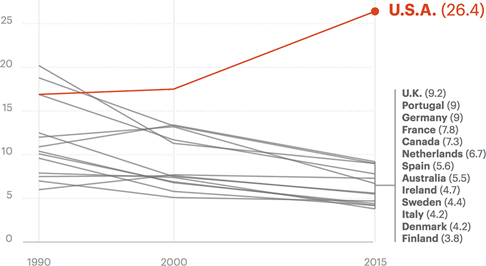
Maternal Mortality Is Rising in the U.S. As It Declines Elsewhere

Deaths per 100,000 live births:

For complete NPR article, see: https://www.npr.org/2017/05/12/527806002/focus-on-infants-during-childbirth-leaves-u-s-moms-in-danger

Ancient Mariner


Governance in Flux

Like many, many folks around the world today, mariner notices not just a few but a majority of nations suffering from disruptions to their cultural and national ideology. Examples of disruption are environment, technology, computerization, population, globalization, shifts in energy sources, and other international product markets affected by political and entrepreneurial winds.

Mariner asks the reader to indulge the following description of nations and their status in the world of nations.

With 197 nations in the world, government concepts could be a real jigsaw puzzle. But it isn’t. If the nations can be categorized only by overall philosophies of government, there are not too many concepts. Consider:

Democracies – United States and many other nations. Mariner found that democracies in general are struggling with competing philosophies of governance. In the US, the nation is very close to being a cross between democracy and corporatocracy wherein a republic form of government exists with legislators and judges but the direction of policy is controlled by corporate interests. Further, many democracies struggle with succession, for example the collaboration of democracies called the European Union, independents like Syria, Turkey, and Iraq in the Middle East, and all the sub-Saharan nations of Africa.

Dictatorships, including variations on the theme such as totalitarianism, Plutocracies, autocracies, and Anarcho-capitalists (Saudi Arabia, Kazakhstan). Africa is overrun with dictatorships preventing affected nations from stabilizing and establishing institutional functions.

Stratocracies (ruled by military) – As one would expect, nations under severe duress often are taken over by military juntas. Recently, a duly elected government in Egypt was thrown out by a military coup. It ruled until another election could be held. Myanmar (Burma) has become a stratocracy where the military has taken control of a powerless government still in place.

Communist Republics – Like democracies, the few communist nations that remain (primarily China) are experiencing philosophical changes in governance. China, while still ruled by one party and one very powerful president, struggles with socialist policies in an effort to improve society enough to compete in the new age of the 21st century.

Socialist Republics – Socialism was a common philosophy at the turn of the 20th century but today only a few socialist governments remain among the Nordic nations. Otherwise, the criterion for being a socialist nation is self-determined. Virtually all active socialist countries actually are variations on communism (Russia and China) or awkward descriptions claiming the rights of citizens as the primary goal of government (Albania, Viet Nam, Laos, Afghanistan and other –stans.

Theocracies – The Holy See or Vatican City is not the only theocracy. Also governed strictly by religious doctrine are Afghanistan, Iran, Mauritania, Saudi Arabia, Sudan, and Yemen. In a muted way, religious influence exists in most nations and frequently can cause difficulty in governance. The United States has an active minority hardening against the secularist nature that pulls the nation into the 21st century. Islamic nations suffer even more difficulty as 8th century dogma fails to fit modern cultural demands.

Aristocracies and monarchies – Great Britain is a democracy that retains a very weak role for a national monarchy. Monaco is free of French control as long as the royal family in Monaco can produce a male heir. Sweden is a constitutional monarchy but the monarchy has little authority in legislative processes. There are several other nations that have this pattern.

Corporatocracies and oligarchies – In every case where this category has a presence, it is conjoined with another philosophy of government; it doesn’t stand alone because it needs an organized source of cash. Nevertheless, Corporatocracies and oligarchies have a growing advantage as global markets emerge. The new world economy can easily lose nationalist authority as traditional rules of commerce and outdated concepts associated with Gross National Product lose meaning.

Beyond this list, one wanders into heavily crossbred variations.

– – – –

Mariner thanks readers who suffered reading this litany about the changing philosophy of most governments in the world. It is a necessary task to grasp the unbelievably large phenomenon that is washing away old standards of authority in governance and, amid unending change in technology, international relations, free range economies and shifting populations, there are neither precedents to follow nor a part of the world stable enough to be an example for troubled nations.

Always through the history of nations, destabilizing change was local. Even the Roman Empire and the Ming Dynasty were local compared to today’s universal, planet-wide upheaval.

Add to the high storm waves that wash over a nation’s culture the battle for supremacy among the giant nations, e.g., Russia, United States, European Union, China and, in the near future, continental consortiums like Mexico, Canada and the US, or China, South America and the Pacific Rim, or Russia, Brazil and Eastern Europe, or India and Africa.

Then add economic wars like oil versus alternative energy, international control of information, and dozens of money versus culture conflicts (Greece et al). Finally, add the gross changes in jobs and family sustenance affected by artificial intelligence and the control of thought represented by the novel 1984 and the movie, Matrix – already beginning to control our personal decision-making. Beware that piece of candy called a smartphone – it’s the Matrix connection to your life. Yes, mariner is old fashioned but he is intellectually independent.

Well. Don’t expect a solution from mariner. This conundrum reminds him of a gift he received during Christmas. It’s a nine-piece puzzle with imagery so highly redundant that there are over 50 million possible placements for each piece – but only one solution for all nine pieces.

As Roy used to say, “Happy Trails…..”

Ancient Mariner

Gifting – Again

Mariner has written a time or two about gifting. He thinks gifting, as a core habit among daily life, will correct the world’s preoccupation with money, indifference, social abuse, and the pall of inadequacy hanging over each of us. Feel free to use the mariner’s search box to find other posts using the word ‘gifting.’

A quick description of giving versus gifting: Giving is when one authorizes a perfunctory distribution of one’s physical or fiduciary assets for personal reasons; gifting is when one deliberately distributes one’s physical or fiduciary assets founded on a desire to be compassionate and a desire to create positive relations within human nature. Mariner’s frequent example is the behavior known as ‘passing it forward.’ That act is intentional in its desire to make another person’s life a bit better; not because one is aware that it is a form of courtesy.

This seems easily understood. A single individual could alter one’s attitude with practice and become a kinder, gentler and self-confident person while simultaneously improving the lives of others. But this is a global issue. Lack of compassion has infected whole cultures, societies, governments and even belief systems that explain the universe. One cannot simply say, “Everyone . . . be more compassionate!”

We will know compassion is part of American society when –

Health services cease to be a profit market and becomes an obligation to those in need of health services.

Immigration is considered a chance to help those who come to assimilate and receive from them their gift of knowledge and life experience that will enhance the nation.

Commerce has returned to its understanding that commerce has an obligation not to greed but to the wellbeing of communities.

Class prejudice is replaced by a desire to consider every citizen equal in value and importance.

Every citizen maintains loyalty to each other through the machinations of government.

Tax policy is a tool to fairly share the wealth of the nation with every citizen.

Mariner could go on but the reader has the basic idea.


REFERENCE SECTION

Now may be a good time to recommend some exceptionally insightful sources:

֍When it comes to theology, religion and its role in society, one cannot find a more enlightened individual than Reza Aslan. Mariner learned of Aslan a few years ago watching an interview on Fox television which tore into him from the outset about how could an Iranian Hindu understand Christianity. He never had the chance to speak about his book or any of his ideas. Aslan has educated himself around the world not only by gaining a stellar educational résumé but by personally visiting every acknowledged religion, every religious culture and with surprising insight, understanding the effect of religion from a sociological perspective. The book mariner recommends is:

God: A Human History, Reza Aslan, Random House, 2017

on iPhone, iPad, iPod touch, and Mac from Barnes and Noble and Amazon.com $13.99; text hard copy $17.63

One can pass on the book to watch a first class interview about the book on CSPAN. See: https://www.c-span.org/video/?437532-2/god

֍It is more difficult than one may think to find a moderate thinker in the United States today. Mariner has found one in the most unexpected place: CNN – Fareed Zakaria, host of Global Public Square (GPS) on Sunday morning. Mariner recommends his television show on CNN, his column in the Washington Post and his twitter account, @fareedzakaria; his website is https://fareedzakaria.com . Fareed is particularly keen on the subject of a fading United States, suggesting other nations will step in to fill the gap of a dysfunctional US. The recommended book, a nice read, is:

The Post-American World, Release 2.0, Fareed Zakaria, W.W. Norton, 2011

Also available on digital readers.

֍For those with a liberal arts bent, put the following website in your favorites list and subscribe to the email service. Each week you are offered interesting sources from literature and other esoteric subjects:

https://us9.campaign-archive.com/home/?u=8cbd654fc43afe6be9455ae3b&id=bcec0a1a30

Ancient Mariner

Philosophy of Health Management in the United States

Mariner is really old. He is a prime example of why the fiscal conservatives in government don’t like him. He is a drain on the world of dollars. One is not worth existence if one doesn’t generate dollars in some way. Insurance companies and the health industry have found a way to generate dollars in unhealthy people – especially old unhealthy people; the health industry has developed a cash producing model even for useless, expensive old folks like the mariner.

The model is: keep old folks alive for a few more years until their disabilities exceed insurance coverage and they must spend down their assets to continue treatment. Once the health industry has all the patient’s money and the patient is bankrupt, treatment ceases and the patient, who perhaps lived another few years than they might have, dies. After all, the patient is no longer a source of dollars.

Mariner recently had the experience of being prescribed a medicine that would slow the advancement of his disability, giving him another few years before the end. The prescription was administered in a matter of fact way by the physician with no warnings about the prescription being irregular in any way. Mariner and his wife stopped by the pharmacy to have the prescription filled.

“We can’t fill this prescription,” the pharmacist said. “It must come from a special pharmacy.”

Turns out the prescription will cost ten thousand dollars each month! That’s right – $10,000.00 each month. This is a good service because now the mariner can accurately project his life expectancy by dividing $120,000.00 per year into his total assets.

Even Big Pharma realized the cost was a bridge too far. A special charity will pay the monthly fee less copay. Mariner was advised by his insurance company that the copay is just under $3,000 each month. Whew!

To the mariner, this is blatant disregard for human value and respect. Jimmie Kimmel had it right when he admonished the health industry and Congress for making dollars more important than human life. Mariner researched the annual salary of CEOs for Big Pharma. They receive an average annual salary of $42 million. Apparently, health management has reverted to its mid-19th century practice of applying leeches.

Because of religious reasons, that is, believing in human life as the measure of supreme value, he will not take this drug – especially he will not allow anyone, charity or otherwise, to send this many dollars to prop up a leech’s salary.

Ancient Mariner