
Discovering America

Yes, America still exists. The real America. Recently, mariner and his wife travelled across the Southwest sector of the US. Mariner’s wife put together a passage with ports of call and waypoints that avoided large cities, and as much as possible the Interstate highways. Our intent was to travel the forgotten routes to the villages, towns and history that are the true fabric of the nation. Referencing a recent post, we were intent to not drive a bus but actually travel the byways of culture and diversity that compose this fine nation.

Many travelers cannot put aside a vain, judgmental attitude; this attitude leads to a trip that misses the richness of diversity, the strength of freedom of choice. One must brush the dust off unused attitudes similar to sympathy and acceptance.

Up front, mariner wishes to correct any presumptions that small independent motels, small towns and villages and one-owner restaurants lack cleanliness, full-functionality and professionalism. Nonsense. They are five-star in their own right. Not five star like the plastic, sterile world of chain motels and machine-stamped restaurants but like the responsible humanness of unbleached reality. Quaintness is not another word for unacceptable.

Mariner and his wife visited several distinct cultures. One stop was in a town of 547 residents. It was on an original strip of Route 66 and the town remains as it was in the heyday of that highway in the 40s and 50s. For those who have traveled the Southwest, they know it is a vast region of little change in terrain. Deserts are common. Through this long, wide open region, Route 66 became the only road to transverse from the Midwest to the Pacific coast avoiding the travails of Rocky Mountain weather. It started in 1857 as a collection of Indian trails and sporadic wagon trails. Nothing was paved. Today with modern highways and speeds hovering around 75 or better, it still takes three days to travel the distance. Even the Santa Fe Chief takes two nights and three days by rail.

Mariner visited an American Indian neighborhood by the highway. There was very little in the way of a village, just travel services, Indian tourist items and a handful of small homes. (Most live out on the desert flats in very small shacks.) Mariner estimates that the economy on Indian reservations is about one-tenth the income per person of what the general economy represents. Bound by vindictive treaties, many established more than a century ago, American Indians largely are poverty-stricken but still very proud of their heritage. America has not treated American Indians very well.

Mariner visited a town whose economy was based on transportation – an immense truck stop and shipping center with all the retail and commercial resources that support this small city. At another stop the motel was managed by Hindus. As different economies and cultures were experienced, mariner and his wife became aware of the strength of diversity. At the same time, they felt the unity that gives the US its power. The two together are what made the US the wealthiest and most influential nation in history. It is sad commentary that US citizens and its governments have forgotten, even rejected the democratic engine that unites diversity and unity into a powerful alloy.

Ancient Mariner
 

The Broadening Value of Travel

Mariner and his wife were motivated to travel across the United States in their well-organized van; it is comfortably outfitted with a bed, efficient living quarters, and three van seats as well. On the road, it is a comfortable environment. On the road or just as importantly when one is off the road, broader, more challenging issues arise.

Mariner will not go into lurid details. Suffice it to say, one must understand the broadening opportunity behind one’s travel: peace and tranquility, exploration, cultural learning, new territories and new weather, but not just to get somewhere. As grossly dissatisfied as mariner is with all forms of commercial travel, if one wished only to be transplanted to another set of coordinates, fly, or take a train, or even a bus; use taxicabs and Uber. Do not plan on using your vehicle as a bus.

There is a tendency, if one is traveling with a tight schedule and a definite event at the end, to streamline the travel. Do not assume one is traveling; one is driving a bus – a bus with a schedule. If one is traveling farther than two days will allow, consider a commercial solution even if it means those waiting to greet one on the other end must go to great lengths to retrieve one from the nearest commercial point of disembarkation.

Some simple rules that will prevent one from busing:

Do not plan a daily itinerary from city to city. It seems efficient but it isn’t and often is more expensive. If one must endure several days driving a bus, do what mariner’s wife does: Make the first day a half day; travel only a few hours to an extra-city location. The next morning schedule a normal day’s travel so that rush hours are avoided and the next night’s stay also will be extra-city. In fact, horror of horrors for most folks, minimize interstate highways.

Determine a pleasant objective if nothing more than to see the world’s largest ball of string. Arrange lodging with that location in mind. One need not worry as often about the dreaded orange signs of road construction or the disaster of road closings that the GPS does not know about. One will not be bothered by traveling the world’s largest, most confusing interchanges while caught in rush hour. One need not be in the left lane of a busy, truck-laden, six-lane highway when suddenly the GPS suggests that one should be in the far right lane to take an exit in one quarter mile.

If, in fact a city is the destination for educational reasons, for example touring New York City, use commercial transportation – especially within the city. Leave consternation to the cabbie. (In NY, there is tourist trepidation in the subways; be sure to be adventuresome in one’s attitude)

Limit the range of daily travel. If one notes that the GPS says anything more than six hours, be wary of becoming a bus. Even if one is looking forward to touring a unique Aztec site, rearrange one’s schedule or perhaps insert an extra day and visit another spot of interest to keep daily travel to a minimum. Especially in the Southwest, deserts prevail and can place one in an awkward position without human support.

Never have a commitment within three days of the end of one’s projected travel. This leaves room to deliberately avoid busing. If one has an extra day, find some local characteristic to visit – even if it’s a discontinued seminary or a rundown gemstone store. (Mariner found the makings of a fine necklace for his wife in a gem and rock store where the front door could not open fully because of overgrown vines)

If one becomes tired, insert a stop at a tourist trap or take a tour of a small town. Do not travel tired. If the trip hours that day are properly short, extra stops will not endanger arriving at the last stop of the day; if they do, one is driving a bus. This also means bring entertainment along – more than one thinks they would need. Diversity is important: CDs, DVDs, laptop with wi-fi, books and magazines. Traveling with children and pets takes travel to another level; be sure to include entertainment and necessities for them, too.

Give serious planning to onboard capabilities. Keep food to prepared items. A very small cooler will suffice for perishables lasting a day or so. If the cooler must be replenished, use this as an excuse to stop at a local grocery. Further, be aware of vehicle environment, note the region one is traveling in and have a variety of clothing available. Also important is to carry all the items specified in an emergency travel kit. Mariner knows about needing a simple pair of cheap pliers to reconcile an issue.

In recent decades, commercialism has trained us to seek standardized expectations. For example, brand hotels and restaurant chains supposedly are the only places to use while traveling. Nonsense. Nonbrand businesses won’t hurt a traveler and provide a different kind of pleasantness that is much more memorable. Ever stay in a six-unit motel where one is wakened by a bleating goat? Can’t beat it for non-bus travel.

Finally, make a thorough list of toiletries, lotions, medicines, reading glasses, toothpicks, penknife, aids like hearing aids and batteries of all kinds; check it twice when loading for the trip.

Remember, the trip is for education, inspiration, enjoyment and fellowship – oh and yes, don’t forget one has a final destination at some point.

And really finally, don’t forget your bathing suit.

Ancient Mariner

While Traveling

Mariner was traveling along the Kansas Turnpike a few days ago. It is a lovely stretch of highway that runs from near Topeka to Oklahoma City, mariner’s drop off point. For hours on end, traffic was light and the drivin’ was easy. As many road travelers know, long periods without distraction can put one to sleep – not a good thing behind the steering wheel. Mariner decided to think about what to write in the next post but decided to be more creative and write a treatment for a light movie.

SO what to write about. Mariner decided to write a story about three young men who wanted to start a pop trio. One was a Latino who could play the guitar and sing; the second, also a Latino, played the keyboard and had written a few songs for friends and the third was an Asian who was a drummer; he had played in a band that played at informal high school events. The boys decided to call themselves the “LLAMAS.”

They practiced diligently for almost a year. Occasionally, they would get a small gig at a big party or a talent contest. They felt they were respectable and decided to go for the big time – go pro. The LLAMAS decided to write a couple of songs to play for a record agent. They practiced diligently and enjoyed the experience and anticipation of a show business future. Their hopes were high. They even bought matching outfits with a hot maroon jacket emblazoned with “THE LLAMAS” across the back, a white shirt and black pants.

The big day came and they met with a record agent. They played three songs they had written. The agent was impressed and showed special interest in one of their songs. “Would you be interested in selling a song to get started? You could make serious money if you sold the song.”

No, they wanted to bring their own sound and image to the market. “Buying our song means buying the LLAMAS”, they said.

The agent left, still encouraging them to stick with their dream but if they wanted some good money to get started, let him know about the song.

They went on practicing and honing their songs. About a month later, the LLAMAS had a dry spell, getting only a few gigs and they were far enough away to drain their meager funds. Around that time, the record agent called to see if they had changed their mind. No, they said, they were a package – the LLAMAS.

Six months went by. The LLAMAS couldn’t scare up scratch. No agents were interested and the gigs were insignificant. The boys had taken jobs to make ends meet. They made a fateful decision. They called the record agent to see if he still wanted to buy their song. “Of course,” he said. “It’s a great song. I’ll sell this to a headline singer and maybe get some cover acts, too.”

The boys received a nice check for selling the song. Three weeks later, the record agent called them to let them know Barry Manilow had contracted rights to the song and was singing it on a national TV show.

The boys watched as Barry launched into their song:

“Can’t Smile Without You
You know I can’t smile without you
I can’t smile without you
I can’t laugh, and I can’t sleep
I don’t even talk to people I meet
And I feel sad when you’re sad
I feel glad when you’re glad
And you must know what I’m goin’ thru
I just can’t smile, without you”

They knew they had made a mistake. It wasn’t about money – never would be. The song wasn’t Barry’s creation; it was the LLAMAS’. It was the reward and recognition for creative success; they belonged on that stage, not Barry. It was the attention and respect that their talent would command. It was big time show business. It wasn’t about the money. They should have held out and been true to the glory of the LLAMAS. . . .

We’re in Oklahoma City, now. Traffic demands mariner’s attention.

PS: In reality the song was written by CHRIS ARNOLD,DAVID MARTIN,GEOFF MORROW © Universal Music Publishing Group

Ancient Mariner


Caught between Old and New

Agriculture scientists report that the weaker one’s scientific knowledge, the angrier they are about genetically modified crops. Previous studies have found that, while genetically modified organism (GMO) opponents demand more research into the foods, no amount of science can convince them the products are safe. “We have to get people to recognize gaps in their knowledge before we try to teach them new things and have a meaningful discussion,” one researcher said.

Mariner notices that the phenomenon of rebelling because something is not familiar or seems to countermand established values is common across any discipline including behavior seemingly not becoming to the standard of the day. For example, mariner, a registered old fogey, resists the use of smart phones and social media. He claims social interaction is minimized, human importance is trivialized, and the loss of privacy also means the loss of independent thought. Yet, smart phones are universally used around the world and social media is how millions communicate – to the extent that POTUS uses Twitter to issue national policy, without talking to any human.

Similar to the detractors of GMO, mariner will never accept the values of future technology no matter how hard Neil Degrasse Tyson tries to persuade him. Mariner suggests Neil watch the Matrix movies. Mariner stands his ground as a primate, not as a digitized asset. Yes, he knows already he is becoming an anachronism but he is comfortable with that.

The pattern of resistance demonstrated by the GMO resisters and mariner is universal. One wonders how the Amish survive. The Amish are a group of traditionalist Christian church fellowships with Swiss German Anabaptist origins. They are closely related to, but distinct from, Mennonite churches. The Amish are known for simple living, plain dress, and reluctance to adopt many conveniences of modern technology. They place their beliefs on the Holy Bible, isolating themselves from the rest of society is one of the key Amish beliefs. They think secular culture has a polluting effect which promotes pride, greed, immorality and materialism. Therefore, to avoid the use of television, radios, computers, and modern appliances, they do not hook up to the electrical grid.

A hardy culture that equates religious value to physically working hard, it offers a slap at the “English” (non-Amish): “If a dollar doesn’t do what it used to, remember that hardly anyone else does either.”

Finally, in the midst of worldwide turmoil in politics, economy and human equality, one sees rebellion for similar reasons – shattered beliefs and protocols, cultural imbalance in economy, and ignorance of the reality represented by modern advances in science and technology. The reader is free to place blame on numerous causes both for ignorance and unpreparedness for new concepts.

Mariner chooses education. One cannot blame education in isolation because it is subject to politics and other resistance to newness by conservative reactions to radical thought. But one must take note that the core knowledge, that is, the curriculum, is no longer appropriate to the world that its students face. If one is to be up-to-date on scientific knowledge, one must at least be aware of the difference between Einsteinian reality and the reality of quantum theory. See, most of you don’t know but it is easily understood and sets the direction for all future science. Check your smartphone.

Ancient Mariner


Changing World

Mariner suspects that Venezuela may go the way of Cuba. In the future G5 computer world, liaisons between nations will become necessary for survival (TPP was an early experiment and the European Union even earlier). The continents form a natural divergence that suggests how future liaisons may develop. It is important to utilize continental influence; China with its Belt Road program already has made inroads including Russia, the Balkans, the Pacific Rim and Southeast Asia. Putin will participate with China as a subordinate unless he is able to reconstruct the Soviet Union. It behooves the US to be cooperative with Canada, Mexico, Central America and South America. The following news item puts the US on its heels in South America.

20 tons of gold

Venezuela, according to a lawmaker there and a Bloomberg source, has set aside 20 tons of gold, worth about $840 million, ready to load into a Russian Boeing 777 in Caracas. Where is the haul headed? No one seems to know. Venezuela does owe billions of dollars to Russia and China, and “also needs hard currency to buy food for its starving people.” [Bloomberg]

Which way is North?

It’s no news that the North and South poles are moving; long-term records from London and Paris (kept since 1580) show that the north magnetic pole moves erratically around the rotational north pole over periods of a few hundred years or longer, Ciaran Beggan, a geophysicist with the British Geological Survey who is involved in WMM updates, told Space.com in an email. He cited a 1981 study from the journal Philosophical Transactions of the Royal Society of London.

Will Santa have to move to Antarctica? This is a thought to consider if the Earth’s magnetic field continues to become more active. Mariner has written about pole reversal in previous posts, covering the news item that compasses in the South Atlantic don’t work accurately for airliners flying there. Note this news item from LiveScience, among many other sources, makes note of the phenomenon. For the reader’s search engine: earth magnetic field reversal.

But what’s really catching attention is the acceleration in movement. Around the mid-1990s, the [North magnetic] pole suddenly sped up its movements from just over 9 miles (15 kilometers) a year to 34 miles (55 kilometers) annually. As of last year, the pole careened over the International Date Line toward the Eastern Hemisphere.

 Ancient Mariner

Just to be Human

Mariner and his wife moved to this small town when they retired about ten years ago. Culturally, they were dropped into a foreign country. Fortunately, mariner’s wife grew up in the town and had a sense of the culture. Mariner had been a consultant project manager who assisted corporations when they converted their management structures to take advantage of the new capabilities of multidimensional database technology.

His work took him all over the US and even to Taiwan for a computer upgrade so the Taiwanese could build modern jet fighter airplanes. Mariner and his wife owned a number of properties that kept them busy as well; and two children who took root far away. All this description is provided to give the reader some insight into the culture shock of moving to a small Iowa town of 900 folks in the middle of endless cornfields.

Let mariner say up front that the town folk are quite friendly and supportive. The town moves at a slow pace; the conversations and concerns do not march to a time schedule; a better term may be ‘timeless’. There are no complex responsibilities. Mariner had to learn how to live in his new town.

One interesting adaptation was to understand how residents referred to house and family locations. Large portions of the town can trace families back to the end of the 19th century. One is identified by their relatives and where they live or lived and whose house it was before that and before that when someone married someone else. Most older residents grew up in the town before it had street signs. Mariner, however, habitually mapped and organized the town by street names and sections so he could find his way around.

When mariner had conversations, the resident would say, “You know where Martha lives; she lives in Frank Merten’s house over a block from Aunt Dorothy’s house.”

“You have an Aunt Dorothy?” mariner inquires.

“No, everybody just calls her “Aunt.’

Mariner is further helped by the resident describing the color of the roof across the street. Haltingly mariner tries to convert the descriptions to a location with a street name, which block and intersection. It has taken some time for mariner to adapt to a new interpretation of both people and location. Even cemeteries are identified by who is buried in them rather than the official name of the cemetery.

To this day mariner is aware that he is not a ‘townie.’ But his independent view of the culture allows him to experience its charm and to understand what the national culture has sacrificed in the name of progress. Most notable is the importance of people as the primary definition of the town. One is not defined by terms like suburbanite or ‘west side’ or neighborhood class. The prime identifier is an individual and that individual’s role in the life of the town: “Remember when Frank worked at John Deere?” sets a timeline. There still is a residue of past generations when townie and farmer were discriminatory and whether one’s ancient town ancestors were movers and shakers but this is noticeable only among the town’s most elderly.

There is an advantage to growing up in this rural culture; it provides time just to be human. There’s an old tale about the plough horse, now retired and replaced by a young horse, who every morning still comes to the barn door to be harnessed. How one grows up is a life-setting experience. Do today’s young families have time just to be human?

Ancient Mariner


Another Episode of Brain v Gorilla

When mariner moved to his current residence in a small Iowa town, he noticed that many families had leaf blowers. It is also true that town families have affection for any kind of two cycle engine some of which are cultivators, lawn mowers, leaf blowers, chain saws, air compressors, lawn trimmers, car washers, paint sprayers and generators. In recent years some two cycle engines have been replaced by battery-driven power using Lithium. All these devices save (avoid) physical labor.

When he was younger mariner remembers old timers saying, “Back in the day we had to cut grass with push mowers” or “When I was seven, I had to rake leaves with a rake and burn them” and of course the classic, “When I went to school, it was uphill both ways.” Many more examples of saving labor can be conjured. Technology has changed the level of labor-saving opportunities: “Back in my day we had to forge and shape our pistols on an anvil.” Today, of course, just turn on your 3D printer and one will be made for you.

Mariner observes this tendency to avoid labor as a universal characteristic of all living things. The squirrel in mariner’s back yard raids the bird feeder rather than hunt for food; monkeys in Bangladesh raid street market fruit stands with the precision of a navy seal team rather than hunt for food in the surrounding trees; chipmunks greatly prefer a life of pilfering to a legitimate relationship with nature; Raccoons prefer the corncrib to rummaging in the forest.

In response, most folks would say, “And?” Being retired and of an idle mind, mariner has time to speculate on this important dichotomy in evolution. Imagine that evolution did not have a fluid-like motion of change and a cause and effect adaptation over eons of time. Imagine that evolution was a result only of serendipity and otherwise was a defined marching order set forth by a permanent genome. Mariner dares to say evolution would fail and species would disappear even faster than humans have succeeded in expiring them.

Humans in particular are quite adaptive to their own circumstances. Humans even have created their own environmental reality far beyond the influence of two-cycle engines – to the chagrin of Mother Earth, also subject to planetary evolution. It is evident that the conflict between Brain and Gorilla grows more intense. (If the reader must be prompted, Brain is the grey matter in our skulls that has an extraordinary imagination unbound by anatomical ethics; Gorilla represents our physiologic constraints as a primate on evolution’s tree. Brain has no difficulty, in fact, enjoys manipulating anything and everything it can from atoms to global atmospheres. Gorilla is bound to follow the current constraints of its body and an environment favorable to that body.)

Too slow to notice, there is a cause and effect phenomenon created by our supple brains. The simplest example mariner can think of at the moment is the ability of the brain to control fire. Before Brain, fire was a cleansing function, born of the Solar System itself that reenergized an environment. The recent fires in California demonstrate how violent and indifferent fire cleansing can be. But Brain turned fire into an every day experience used to keep warm, cook, and incorporate into chemical processes (oil, explosives, herbicides, nuclear bombs and most important, electricity) that are to the advantage of human ingenuity. These new processes go far beyond any physiological requirements held by Gorilla – and often are in conflict with those physiological requirements.

Those who are concerned about the state of Gorilla, e.g., physicians, physical therapists and the like, lament an invention by Brain: the chair. Gorilla has a skeleton and musculature that is ruined by sitting in a chair. For the vast majority of us, sitting in a chair is the dominant activity of the day. Sitting in a chair leads to general back pain, stooped posture, bulbous abdomen, accelerates atrophy of leg muscles and arthritis. Compression of the viscera along with fat caused by sitting all the time interferes with kidney function, digestion and oxygenation. Functionally, the chair deters Gorilla from performing the exercise needed to remain fit.

Mariner offers the chair conflict as a simple metaphor for all the divergent issues between Brain and Gorilla. The most important effect of these conflicts lies in the unnoticed process of evolution. In recent centuries, as conflicts increase both in number and impact, Brain has begun to have visibly negative effects on Gorilla. Further, Gorilla’s environment has serious problems. Gorilla and its fellow creatures are not doing well and constitute a modern major extinction of species.

It is the inventiveness of Brain that forces scientists to rename the present Holocene Epoch as the Anthropocene Epoch because Brain has such an impact on Earth’s environment.[1] Evolutionary activity typically follows a significant change in environment. Briefly, the primary demise of dinosaurs and the beginning of mammals and birds was caused by destruction of the Earth’s environment by a meteorite. While Gorilla hasn’t changed much in a million years and its needs have been met by the environment, Brain has separated its environmental needs from the traditional habitat of Gorilla.

Brain requires above all else a controlled, electrically-based environment. To emphasize this transition, the next era of Brain (AKA human) progress will be artificial intelligence (AI). AI will enable Brain to replicate human behavior in robots and androids, including perception through the five human senses (Gorilla senses?). Relative to all the immense changes of the next age, how long will it take for Brain to cohabitate with its new friends and not need Gorilla or Gorilla’s habitat?

Ancient Mariner


[1] An excellent and easy to read reference about Brain’s impact on Earth’s history can be found at https://www.livescience.com/28219-holocene-epoch.html

Transported Back Through Time

Mariner watched the NetworkKnowledge (PBS) broadcast of Neil Diamond’s concert performed in 2012 at the Greek Theater in Los Angeles. Mariner and his wife are big fans back to the time they saw him on television in the sixties. They’ve been to the concerts. There’s something about Neil Diamond that draws his audience together. One isn’t there to enjoy a star performer; fans are there to be with Neil while he sings. Mariner and his wife have been to other concerts, too, and each has their special attraction. But Neil has the ability to draw fans to him in a way that not every bigtime singer can.

Fans are aware that Neil has allegiance to his band and the three singers who have been with him throughout. In the broadcast mariner watched, the old guys were there, Ron Tutt on drums, Dave Moscoe on keyboard, Reinie and Linda Press (bass and background singer). This concert has been a big winner over the years with all the old songs and an unbelievably errorless, high energy performance by everyone – including the audience.

Watching this concert tonight was different. It wasn’t mariner just listening to the oldies and reminiscing about young times. He sensed a time warp back to a time when America held itself together. There was no Donald, no selfish, derelict political parties, no oligarchical dominance, no ignorance about who we were or how we identified with our nation, no concern that the next generation will be poorer than the last. True, there was turmoil caused by an unpopular war, racism was deeply suppressed until the Civil Rights Act. Conversely, tribalism and identity politics did not dominate the daily news. Computerization still was a pleasant, safe element in society.

Mariner sensed how life was back then – sure, reality required maturity and responsibility – but there was no incessant angst. Generally, people had time to live a day without constant confrontation. Abuse and insecurity caused by government and self-centered corporations was not daily news; churches still were the same churches that had anchored neighborhoods and moral virtue.

Angst. That’s the difference. The twenty-first century has begun with fragmentation of who we think we should be, how we depend on our economy, and even if there will be jobs, affordable education and secure retirement – all at once. Computerization has become a tool of manipulation and slowly separates wealth between classes. “Footloose and fancy free” has a new inference: we don’t know who we are or where we’re going.

Angst. Mariner escaped it for a brief moment tonight, escaping back through a time warp with Neil.

Ancient Mariner


On The Atlantic and other Things

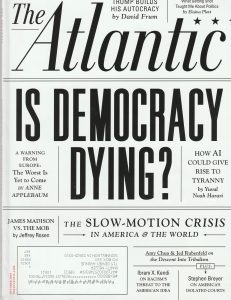
Regular readers will know that mariner’s favorite magazine is The Atlantic (TA). He has added a few to his personal library. There are several other magazines in its class that provide cogent insights in the social sciences and can be trusted to deliver balanced reality based on studied facts. TA often approaches scholarly levels in its presentation of the human experience.

Not everyone would want to spend the time and focus required to read TA. When TA focuses on an issue, it is a 3-credit course on the subject. An excellent example of this pattern is the October 2018 issue. The cover headline asks, “Is Democracy Dying?” Nine articles are referenced right on the cover that provides an excellent base for understanding the turmoil of contemporary society, politics and governance.

Reading TA cover to cover in one sitting is not recommended. Mariner keeps copies of recent magazines on his dining room table to be perused an article at a time. When the October issue is completely read, one is knowledgeable, capable of thematic reasoning about democracy, and aware of the human experience dependent on democracy.[1]

– – – –

Writing about life experiences often drops to melodramatic levels which  certainly are valid but limit the reader’s ability to contemplate broader views. One magazine that is unique in presenting holistic articles about reality that give a reader room to ponder is Smithsonian Magazine (SM).

Like TA, SM often promotes a theme for its articles but SM also includes articles about the world, interesting individuals, nature, and often, articles based on the Smithsonian Museum collection in Washington D.C. SM is a pleasant read.

The September 2018 edition focuses on moments in American history that have been forgotten or that provide insight into unknown situations. The issue also includes articles about Rhinos in Washington and a toy school bus.[2]

– – – –

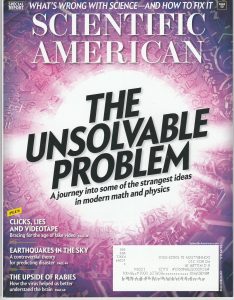
There are several magazines about science. Most are focused on one kind of science like astronomy or health or agriculture. Three magazines, Science, Nature and Scientific American, are widely read. Over time mariner has chosen Scientific American Magazine (SA) because it is totally comprehensive in its range of science and technology and at the same time provides reader-friendly articles and references. Every edition has an endless insight into diverse – and often surprisingly humanistic – branches of science that enrich the reader’s familiarity with science.

Like other recommendations, SA often sets a theme for an issue. In the October 2018 copy, the theme is “How to fix Science” It covers funding, enforcing the ability to reproduce research claims, dealing with government denial, and increasing interdisciplinary research. There is an article preparing us for fake videotape and fake audio.[3]

– – – –

Each of the above magazines has a strong Internet presence. Mariner and his wife enjoy reading books and magazines in print form but for many who are too busy or who prefer to pick and choose what to read, mariner recommends both the official websites and subscribing to their newsletters that arrive in your email.

Another source for intelligent, dependable dialog is the collection of National Public Radio (NPR) products and broadcasts. If one is more interested in good fiction than nonfiction, there is no better place to look for a good book than NPR’s Book Concierge at https://apps.npr.org/best-books-2018/ . On the other hand, the NPR news page avoids the hysterical advocacy of TV news; see https://www.npr.org/ . This home page will lead you to broadcasts, podcasts and other entertaining – and rational – information.

Remaining informed is similar to keeping fit. It requires commitment.

Ancient Mariner


[1] Fortunately, TA has an excellent archive. To read the articles in the October 2018 issue, see:

https://www.theatlantic.com/magazine/toc/2018/10/

[2] Find SM archives at https://www.smithsonianmag.com/issue/archive/

[3] Find archive issues at https://www.scientificamerican.com/store/archive/?magazineFilterID=Scientific%20American%20Magazine

When Men only were Men

Mariner is on a holiday break, that is, current news is not an item of interest. Rather, he has taken his own advice from his last post: take a break. Nevertheless, one has curiosity about things – perhaps more so because one is not stuck on the current events train.

Mariner has an ongoing interest in those eras of civilization when humans were on their own, ‘when men only were men’ so to speak. This means that Homo sapiens had no oil, no plastic, no corporations producing chemicals, no seed catalogs, no banks, no cash, only scant precursors of small band government, and languages of limited but pragmatic nature. Writing was simplistic and glyphic in nature. These times were the original good old days.

When one searches for these simplistic times, one is painfully aware of the abuse that destroys their existence as civilization moves from one era to another. The Native American is a clear example of a culture that still was balanced with its environment and its culture was based on what the environment provided day to day. Then a later ‘advanced’ civilization discovered this simple culture and, as always, trashed it.

There aren’t many places on the planet where we can observe that time when men only were men because their simple artifacts don’t last very long and easily are run over by later ‘civilized’ necessities. Perhaps the defining aspect of these primitive cultures is that the cultures were bound by an ethical relationship with the environment called net-zero: in the long run, nature was not permanently destroyed; nothing was taken from nature that could not be returned to nature.

One area of the planet which still reflects its ancient mores and practices is the region known as The Steppe. The Steppe is a belt of grassland that extends 5,000 miles from Hungary in the west through Ukraine and Central Asia to Manchuria in the east. Mountain ranges divide the Steppe into three regions and three different weather conditions. The one of most interest to mariner is the easternmost portion, running from the Altai Mountains in the west to the Greater Khingan Range adjacent to China. A small part of the region is Mongolia. Weather in eastern Steppe is among the severest on Earth encompassing desert-like summers, deep frozen winters and yearlong winds comparable to the Santa Ana winds in California. Among several geographically isolating features, weather is a major factor causing retardation of major industrial advancements found elsewhere.

The critical development that eventually distinguished life on the Steppe was the domestication of horses which occurred in prehistoric times and prevails today. In fact, the Silk Road traveled the southern areas of the Steppe through most of the ‘–stan’ nations. Using horses and later camels, the natives of the Steppe were the first trucking company – sans 18-wheelers.

Natives away from the few modern cities still are nomadic. The only improvement allowed by them is the portable yurt, an improvement over skins and poles. Despite this modern improvement, their culture remains very much as it has across the centuries. Even with the inundation of electronic communication, the eastern Steppe remains virtually unchanged. Wikipedia facts: The poor access to the Internet in the countryside has been a reason behind designating Mongolian countryside as a digital detox location for the tech-tired tourists. Internet users: 16.4% of the population, 152nd in the world (2012).

There are seven ‘-stan’ nations: Pakistan, Afghanistan, Turkmenistan, Uzbekistan, Kazakhstan, Kyrgyzstan, and Tajikistan. Because of their location amid deserts and harsh weather, modern dissolution of the cultures is minimal. Two of them, Pakistan and Afghanistan, have not been so lucky.

If one wishes to learn something entirely new about the Earth’s cultures and is tired of Western Civ, ancient Greeks, Romans, tsars and dynasties, visit the Steppe.

Ancient Mariner