The Wealth Gap is a Growing Topic of Interest

The mariner has reviewed a number of books published recently that openly attack the wealth gap in the United States. One book by Matt Taibbi, The Divide: American Injustice in the Age of the Wealth Gap, addresses not only the inequities of wealth but also the inequities of social justice in the legal system. In an interview with Jon Stewart, he gives the true example of the young man caught smoking marijuana who spent 41 days in Rikers Prison while the banks stole millions of dollars from “old ladies” selling fake mortgages and walked away without one fine or one prosecution.

Michael Lewis has a popular book called “Flash Boys” that uncovers a stock exchange game where every stock buy by an individual is interrupted, bought by another broker then sold to the original buyer at a higher price. The scheme was hard to uncover because it took advantage of computer speed and shorter distance to the exchange  computer. In other words, in the milliseconds immediately after a trade was launched in, for example, Des Moines, the intercepting computer beat the transaction to the exchange, bought the stock and sold it back to the slower network – all in milliseconds! This trade interruption happens tens of thousands times a day and yields millions of dollars to the intercepting brokers.

The most interesting source is a lecture by Professor Alexander Stoner (Salisbury University, Maryland) at the University of Kansas called, “Social Thought and Research.”  Stoner says “economic growth is the new secular religion, meaning it is a cultural norm that many are afraid to challenge.”

His position is that economic growth is flawed for three reasons: it measures the progress of our society in dollars, not quality of life; it has not eliminated high unemployment and poverty in the U.S. and it threatens the habitability of the earth and the lives of all its inhabitants.

The direction the United States must take is to lessen the pursuit of highest profit. Rather, the economic policy should be one that pursues what is best for the United States as a country peopled by citizens who stabilize the economy. Right now, the economy is weak and corporations and business in general, are not trying to stabilize the national economy. The only game in town is profit for profit’s sake. The national government is a co-conspirator.

The corporate lock on government prevents intelligent analysis of the economy from a national perspective. Many politically significant corporations are international and are not contained by a nation’s economic interests. Further, corporations create a shadow diplomacy with other nations regardless of that nation’s relationship with the United States.

In the last twenty years, trade agreements have undermined nation-to-nation agreements, turning the process into corporate license to avoid regulations, laws and taxes. Trade agreements are not based on national benefit.

Finally, because profit and profit alone is the motivation of business, large and small, the nation’s environment is deteriorating. Recently, deep minor earthquakes, which occur frequently, are linked to the failure of fracking, allowing wastewater and even natural gas to leech to areas that are damaging to citizens and even the deep rock layers.

Septic and chemical abuse, performed only for convenience and cost saving measures, destroys wildlife and fish dependent on good water. In many cases, some of the life is human beings. But landfills for new homes in sensitive areas, unregulated commercial dumping, and ignoring the laws related to easement around streams and rivers rapidly reduces the quality of the nation’s ecological health.

At the bottom, the pressure to increase profits leads the citizenry to purchase products manufactured in harmful ways. Products, food and their processes are not monitored closely to assure that manufacturing is ecologically neutral. Even farming is subject to the secular religion of larger and larger profit, costing many small farmers and many small towns to disappear. More and more farms are owned by corporations as part of a vertical organization that controls cost from hoof to plate. Environmental responsibility is not a goal.

In the recent past, citizens were sensitive to taxation, infrastructure and jobs. These concerns affected their vote. This attitude must change today. True, those issues are still important but they can no longer be resolved in and of themselves. What is causing greater impact is less easily defined but will in the medium run, damage the traditional concern of citizens.

Carbon emissions are very important right now, but the individual citizen, especially in a weak economy, will not vote for environmental security if there is even the remotest threat to a job. The same is true of politicians. Because of manipulations in election processes, the Congress is chock full of older politicians insensitive to the needs of national quality, environmental stability and national identity among nations. The United States is not a corporation, it is a Federalist Republic run by citizens. The US needs a new breed of politicians. Maybe it needs a new breed of voters.

Ancient Mariner
 

Chaos Grows Among Financial Analysts

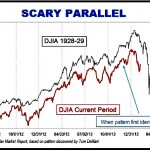
The following chart by Tom DeMark from the McClelland Market Report shown in a right-of-center financial magazine, Money Morning during an interview with Peter Schiff. Schiff feels the US fiscal policy is heading toward a financial collapse similar to the crash in 1929. The following chart was shown during the interview. It compares the behavior of the stock market leading up to the 1929 crash (blue) with current stock behavior red) from September 2007 to today. The parallel lines are eerily similar.

parallel

In an earlier post, the mariner alluded to a great shift in wealth that must occur before the US culture can move on. Apparently Schiff feels the chaotic moment will occur very soon.

The issue in 1929 was public debt far beyond what the public has today. Investors had as much as 90 percent margin (unpaid purchases). The effect was very much like the housing collapse in 2008 when there were tens of thousands of mortgages being sold on the stock market (remember derivatives) that had no cash to back them. Eventually, the banks faced a grim future if the US Treasury didn’t step in.

This time, however, conservatives like Peter Schiff and Donald Trump are attacking the Federal Government for having too much debt. Sooner or later, someone must pay the bill. Will the wealthy take a hit on their investments? Yes, says Schiff.

Scare tactics are thrown everywhere. The mariner believes there has been an imbalance for a long time. Two circumstances reflect the entire situation: the Federal Government indeed is in debt because tax laws have not changed and the wealthy are getting wealthier. Beyond that, the current economy hasn’t responded as well as it should. This is blamed by the right on Obama not allowing jobs to be created, and by the left that businesses are sitting on their profits and not investing in new jobs.

Whatever the cause, that chart is a bit scary. Perhaps we should do what was recommended in another post: ”…. get rid of credit card debt fast. Use as much cash for daily expenses as you can; pay cash for gasoline; pay cash for groceries; pay cash at supermarkets, Walmart, Target, and Farm and Home. In other words, live well within your means and do not use the Wall Street banks in lieu of any other option. And save, save, save. The taxes to pay for change are coming….” and you know who will be taxed.

Ancient Mariner

The Common Working Person

Debate about the spread between the wealthy and the rest of the country is receiving increasing attention by media. Better news channels like PBS and Aljazeera have held on air debates about unions, minimum wage, making the school system more competitive so more graduate high school and college and get better jobs and make more money (so that wealthy folks can make more money and those not-so-competitive students are weaned out of the “new” work force). Further, there have been discussions about the computerization age being the second half of the industrial age.

From dockside, the mariner observes that the first industrial age created millions of new jobs for the common working person while the second industrial, computerized age, takes jobs away from the common working person. The comeback by those advocating robotization of the workplace is that the common working person will be retrained for new kinds of jobs. Like what? For the mariner’s taste, there’s too much hemming and hawing at this point.

This is a broad, swampy subject. There are those, usually conservative or aggressively futuristic who are willing to do anything except assure a good life for the common working person. There are those on the other side that say there will be no progress until the wealthy are taken down a peg or two and government will oversee distribution and accumulation of wealth. While the latter team may have a heart of gold in behalf of the common working person, strategies are every bit as vague as that of uncaring conservatives and likewise doesn’t demonstrate a secure future for the common working person. The government is as good as the next election. From all past indicators, this is a bad bet.

Having set opposing shorelines, the swamp in between is not mapped, has murky water and poisonous snakes. It may be of interest to the reader to know that the current description of what a job is and how wages relate to that job was formulated in the 19th century – yes, the 1800’s. Government has tinkered with the edges until 1985 when government cut strings to any historic or traditional definitions. Nothing has evolved since so the 19th century definition of a job is still around but often ignored – especially worker rights and benefits that were applied early in the 20th century.

If the reader makes Big Macs or bacon burgers today, that is unfortunate. Computerization of burger production will be done by robots within five years (working models already exist). Stopping at a fast food restaurant will be exactly like stopping at a Redbox machine. Minimum wage may not be the big issue everyone thinks it is. Is there anyone who can describe a job environment for the common working person five years from now? For tens of millions of common working persons? Is there anyone who can describe an economic platform that assures a decent lifetime for the common working person?

What mariner hears from both shorelines are self-serving fake solutions. To extend the swamp metaphor, all the decision makers from both shores are wandering around the swamp in flatboats while the common working person is dragged behind in the murky water and poisonous snakes.

Helping assure quality of life for millions of common working persons will take a complete, high-powered team representing every quarter of the debate and, the mariner is saddened to say, that will not come for some time. Our society still is on a downslide, riding on the lives of the common working person.

Ancient Mariner


Cities

Books on cities present a view of how future economies will be organized. The following two books in particular see through today’s international chaos and give the reader a glimpse past the event horizon, where nations and corporations will be disassembled and brought back from the world of “too big to fail.”
The Metropolitan Revolution, How Cities and Metros are fixing Our Broken Politics and Fragile economy. Katz and Bradley, Brookings Institution Press, ISBN: 978-0-8157-2151-2

An uplifting read that exposes a new energy in cities that are going broke under the current Federal system. The key attributes for cities are planning for the future instead of the election cycle, finding local funding outside the Federal structure and cooperation between political parties, major institutions and unions.

Chapter 7, Toward a Global Network of Trading cities, expresses a rise in city power and economy. What we tend not be aware of is that cities, particularly in China, India and Brazil, are exploding in population, are centers of commerce, and have assets that make them independent of national monetary policy. Increases in international trade will make cities independent leaders in GDP.

In the United States, not a population powerhouse, cities like Denver, New York and regional agreements in Ohio are taking the lead in a sociological revamping of what a city means to its citizens. Citizens are willing to raise taxes to pay for infrastructural improvement. Denver, a complex group of smaller cities, has the largest public transit project in the country. Large cities in the US go abroad to increase trade without the help of the Federal Government and, largely, not even their own states.

If Mayors Ruled the World, Dysfunctional Nations, Rising Cities. Benjamin R. Barber, Yale University Press, ISBN: 9780300164671

This is another book about the emerging role of cities in ways that displace national and international relationships. Barber poses the question, “Is the nation-state, once democracy’s best hope today democratically dysfunctional? Obsolete?” The answer, says Benjamin Barber in this provocative book, is yes. Barber says cities and the mayors who run them can do and are doing a better job.   He says cities worldwide share pragmatism, civic trust, participation, indifference to borders and sovereignty, and a democratic penchant for networking, creativity, innovation, and cooperation. Throughout the book, Barber demonstrates how city mayors, singly and jointly, are responding to transnational problems more effectively than nation-states mired in ideological infighting and sovereign rivalries.

The mix of growing population in cities around the world, including the US, the fact that “the buck stops here,” with respect to day-to-day operations, and an ability to generate income through trade with different nations, make cities the political and economic power for the future.

The danger for social justice issues lies in the independent nature of cities. There are important objectives for national governments: sustained democracy, human rights, equitable income for workers, health practices and safety.

The mariner has mentioned before that a trade agreement among Pacific Rim countries called The Trans-Pacific Partnership (TPP) attempts to override all precedents associated with the above list. TPP is a dangerous “trade” agreement and should be vetted publically. At the moment, the President is trying to fast track the agreement, which essentially takes Congress, media and citizen opinion out of the picture. TPP is the exact opposite of the national role needed for the future.

Ancient Mariner

Trade Agreements

The mariner is in a mood today. He appreciates that you choose to abide. The cause of his mood is the condition of the common person on the street of any country in the world – including the United States. Looking across the continents, looking at the circumstance of a public citizen in 194 countries, that public citizen is in bondage. With the exception of a few Nordic countries, the public citizen gets the scraps of government and commerce, the crumbs, if any, that governments and corporations leave only because it is convenient to do so.

The mariner speaks from experience. The value of his land holdings was cut by a third in 2008. The third that disappeared showed up in million dollar bonuses at investment banks. However, the mariner is fortunate in his diversification; many were not – especially those whose total asset was their home. One does not willingly choose foreclosure. One does not easily uproot the family to sell a home to avoid a debt that will last a lifetime. It is egregious that the banks holding the mortgages made record, if not obscene, profits on the public citizen’s hardship.

The mariner grows wary of corporate greed. Under the guise of fair trade agreements, corporations have avoided national law and regulation in virtually every country. Multinational corporations are pirates roaming the seas between nations to avoid accountability for human rights, human dignity, and a fair distribution of profit. Year by year the profits grow larger and flow to the top faster.

The North American Free Trade Agreement (NAFTA) was signed under the guise of a new continental achievement in international cooperation. Corporations wrote most of the details. As many States and communities experienced, shortly after the agreement was ratified Iowa lost Maytag jobs to Mexico. Most corporations that absconded relocated just across the Mexican border. American truck drivers lost jobs because Mexican trucking companies were permitted to cross the border to deliver goods and avoid dealing with trucker unions or vehicle maintenance and road regulations. A total wrap up of overhead for the relocated corporations: lower wages, no unions, lower distribution costs and higher, undistributed profits – not mentioning less US tax.

There are many international trade agreements ratified by the US Government that never receive scrutiny or see the light of day. Virtually all trade agreements favor the foreign country, especially Japan, China and South Korea. The net loss in these agreements is a loss paid for by the US taxpayer. Further, corporate agreements with other countries give away large quantities of American jobs in exchange for larger contracts – think General Motors and General Electric among many.

Recently, China wanted to buy one hundred 736 jetliners from Boeing but to get the contract, Boeing had to agree to move part of the manufacturing to China – along with the patented technology that was needed. China ignores patent rights. Now, China has ordered another one hundred jetliners and wants to double the amount of manufacturing in China – again with added technology to do the job. The Seattle area has lost thousands of jobs under these agreements. Corporations are giving away America’s advantage in the world – superior technology – thus weakening the international role of the US.

Today, the largest trade agreement ever imagined is under negotiation by the Pacific Rim countries – including the United States. This trade agreement is called the Trans Pacific Partnership (TPP). Its development is under the control of corporate negotiators overseen by member governments. Not only is it the largest trade agreement ever assembled, it is the most abusive. TPP allows member nations to locate in any other member nation and ignore that nation’s national and local law and regulation if these laws interfere with profit margins. For members that refuse this liberty, the member nation can be sued. TPP members can ignore human rights legislation, wage and health requirements and any other impediment to maximized profit, which, of course, is undistributed. Further, the multinational nature of the agreement virtually eliminates taxes and tariffs.

The more the mariner studies commerce, the more he realizes that nations are no longer the primary players of the future. The big players are multinational corporations – corporations for which there is no national boundary and no regard for fairness and human dignity.

The mariner is reading the biography of Woodrow Wilson. Wilson’s dream was a global government that would see to the rights and dignity of all people. As the mariner reads about Wilson, he compares that dream to the reality of the 21st century. The United Nations, a global organization modeled after Wilson’s dream, is hogtied, generally disregarded, and executes only a tiny fraction of its charter. The UN certainly is not in a position to compete with multinational corporations who are on their way to writing the charter for world peace, AKA profit.

This realization is what has the mariner in a funk.

Ancient Mariner

The New Age

A reader asked the mariner how one will know that the new age has arrived, that the chaotic factor drops in stress value (in reference to the post, “On Being Old”).

When the dust of the new age settles, there will be a great, cosmic sigh of relief by the society. Unfortunately, before our relief, we must pass through chaos at its greatest stress. Many stressful situations will move to new, stable states. One that must happen first is redistribution of wealth. This will not be a planned event – either by the wealthy or common man. The nation will experience the bursting of a small dam behind which much wealth is stored. Everyone will suffer the economic disruption but quickly new investments will occur in new social and financial objectives. In turn, this will lead to new (and attainable) careers.

For examples of sudden redistribution, one is reminded of the bloody French revolution; the rapid collapse of the Edwardian Age (where a very few held all the wealth); the emptiness of culture and fall of imperialism in Europe before the First World War and then the Second World War; the American robber baron era that ended with the American economic collapse of 1929. Some say we are in a robber baron era today.

Another indicator will be a change in the way corporations make their money. Increasingly, the age of industrialism is falling by the wayside. Currently, opportunists are taking advantage of outdated legislation and regulations (the U.S. banks in 2007-8) and giant loopholes in global economic regulation – undisclosed corporate profit, arms and oil just to name a few. This will end slowly as a new financial model takes over the economy, which, remember, must wait for the dam of wealth to break and for a new political agenda to emerge.

Some evidence of a new age is visible. Although the current Federal and State governments are a deplorable example of Democracy in action, the battle lines are drawn between status quo financial/social conservatives and new goals/new spending liberals. Looking closely at the liberal agenda – full funding of education, modernizing legislation and regulation, single payer health insurance, funding new research and industry – all harbingers of the event horizon mentioned in the last post. Governmental conflict is a very visible sign of chaos.

Another prognosticator of the new age is a move toward intense restructuring of infrastructure. This is not just bridges and roads but a completely new horizon of utility management, travel efficiency, communication, electronic grids that carry information and power at the same time, and a revitalization of the responsibilities of States to manage ecology as a renewable resource that not only pays for itself but also improves the physical state of the Earth.

However, large international corporations do no play by national rules and have shown there is no concern for labor, health, salary or other employee standards. International corporations use government trade agreements as a method of avoiding the laws of many nations, especially the United States. This process will be difficult to bring under control.

Do not be faint of heart. All this chaos will require resilience.

Oh, for the fifties again! Wait. Have you forgotten the tragedy of acne and thermonuclear annihilation….

Ancient Mariner

The Cities are Taking Over

It is always a pleasant experience when one’s meager and undefined ideas are supported by others who have moved forward on those ideas. The mariner watched the PBS News Hour the other night and two segments related to observations in the mariner’s past posts.

The mariner wrote in the posts “Federalism” and “States in Action” that the transition to a new economy would be driven more by changes at the state and local level. The scale of dollars and the freedom of fifty states contributing to change will be more achievable and occur more quickly.

A new book has been published: ‘Metropolitan Revolution, How Cities and Metros are Fixing Our Broken Politics and Fragile Economy’ by Bruce Katz and Jennifer Bradley. The authors make the case that the old image of Federalism with the Federal Government sitting atop the US political structure is no longer valid. The energy and creativity to climb from a broken government system is evolving in cities and Metropolitan areas. The book makes the point that cities and metropolitan areas sit on only twelve percent of the nation’s land but comprise two thirds of the population and seventy-five percent of GDP.

Cities have no choice but to be creative immediately. City expenditures occur daily and the Federal Government is not helping in a meaningful way. The book describes how a city is run not just by the mayor and city council, it is run by a consortium of politicians, entrepreneurs, universities, labor unions, city businesses, museums and others who have a need to keep the city running.

These groups are joining forces to find ways to maintain infrastructure, police and firefighters, even social health policies. This effort leads to another observation made by the mariner: As the world develops a global marketplace, there will be room beneath for a local economy.

The cities will learn from one another. Detroit, a bankrupt city has found some success in growing food on vacant city plots. Detroit must develop industries to revitalize its city and provide jobs – it has no choice. Having no choice is the reason that cities will lead the way out of the dysfunctional state of affairs that Congress has provided for the last two decades.

The second segment on the News Hour was the organization of elderly folks to care for each other and to prevent having to go into an institution. For an annual fee, prorated according to income, many in-home services are provided by the members. Every member is called every day. The members can call a number to get transportation to doctor appointments, grocery stores or any location needed. The key to the success of the group, albeit to avoid the threat of being institutionalized, is to care for one another in a hands-on, all-for-one manner. Obviously, a phenomenon based on the Good Samaritan parable and on other caring verses in the New Testament. It is an example of changing the pew paradigm.

To review these segments yourself, search PBS Newshour.

Ancient Mariner

Metaphors II

Metaphors II

In the previous post, Metaphors I, three metaphors were offered: metaphors from the tsunami and the failing culture of Germany in 1943 were used to develop an intuitive perspective of the American condition without using the jargon reported by the media.

The third metaphor, progression, enables one to have a new understanding of events over time. For example, observing how much money the reader saves each year compared to their age at the time will allow the reader to have a new perspective of what has transpired across their life and many insights into what happened during the reader’s lifespan, would enrich their understanding of how they arrived at their current financial circumstance.

Arithmetic Progression:

1,2,3,4,5,6,7….   The same number value between each is 1; (example 3+1=4).

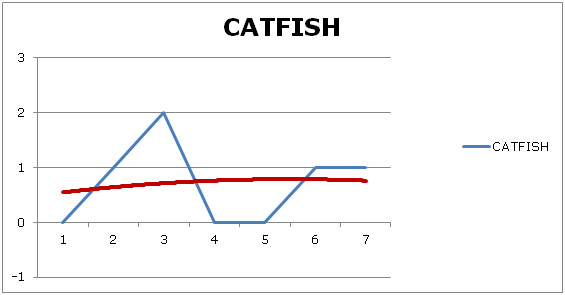
We can learn something interesting if we add a value of some kind to compare with this sequence. Suppose the reader is looking for a pattern of how many times they eat catfish over seven weeks. The reader then perceives a pattern; which weeks did the reader eat catfish? Does one eat catfish more often as the weeks pass? Will the reader eat more or less catfish in the future?

 Catfish copy

WEEK    1

2

3

4

5

6

7

CATFISH0

1

2

0

0

1

1

What one learns is that it is likely that catfish will be eaten a little less than once per week over time (red line). Of course, with more values, the chart becomes more accurate.

High School history generally is taught in a similar arithmetic fashion; dates of history are an important measure of occurrence but do not measure parallel events. Events occur but they are measured by the year in which they occurred (Magna Carta signed in 1215, Columbus sailed the blue in 1492, The Declaration of independence was 1776, the first black President in 2008, etc.) This arithmetic progression shows little more than the sequence of historical events. One is left to surmise whether there may be a continuous relationship with other events.

What may provide a more valuable insight to us is the measure of two values not based on time but on the changing relationship between the events.

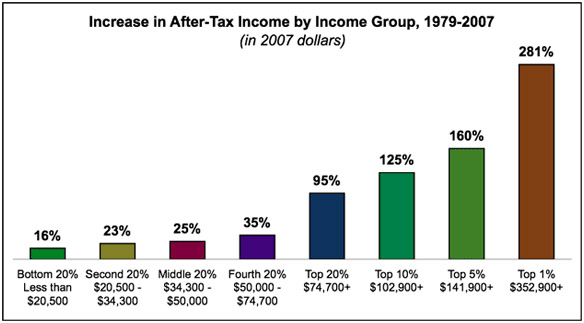
The following chart demonstrates the drawback phenomenon in a graphic. The latest date on this graph on this graph is 2007 but this disparity continues through today.

 After tax

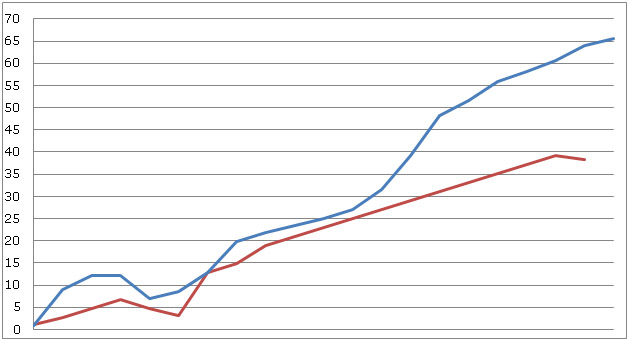
The next graphic relates how salaries have not stayed with inflation and continue even today to fall further below inflation. One does not need numbers to have the intuitive insight that the United States economy is broken. Percent increase is at the left of the chart.


INFLATION/INCOME

PERCENT EVERY FIVE YEARS

Inflation                1913           1930        1950      1962                  1988              2012

The dip between zero and twelve percent reflects the Great Depression. The straightness of the red line indicates that salary increases have risen around one percent per year for forty years. At the end of 2008, income falls away sharply, placing income 25.6 percent beneath inflation. For a salary of $20,000, it would require a raise of $781.25 to match inflation only in 2008. Income lost to inflation from 1978 to 2008 amounts to approximately $26,840. When one considers that most workers receive a larger income and there are millions of workers who share this shortfall, it is a staggering amount of income – a drawback likely to cause a tsunami at some point.

Next post: Some ways we can fix our Country.

Ancient Mariner

Metaphors I

There are a number of metaphors that provide simple insight into the circumstances of the United States today. The mariner suggests three: tsunami, Germany in 1943, and progression analysis. Each metaphor has a slightly different cause and effect that can help understand American circumstances without using the political and economic debates followed by the media.

Most of us have seen the effect of a tsunami in the news or on one of the cable channels. The most recent tsunami is the giant wave caused by an earthquake under the North Pacific Ocean 80 miles East of Sendai, Honshu, Japan on March 11, 2011. The earthquake, 9.0 in magnitude, created a wave between twenty-three and forty feet high along the coast of Japan. The devastation was widespread, wiping out villages and a nuclear power plant.

The characteristic the mariner applies to the state of America is the behavior of the water as the wave moves to shore. An advance warning sign is a “drawback.” The tsunami draws water away from the shore and adds that volume to the wave; this drawback exposes a large expanse of shore bottom that ordinarily is underwater. Shortly thereafter, seconds to minutes later, the tsunami returns the drawback along with much more water, overrunning the shoreline bottom and crashing violently onto dry land.

The water is a metaphor for a fair and normal sharing of wealth. As the wealth is sucked from normal sharing, exposing evermore hardship to the general citizenry, the wave of wealth eventually collapses in an uncontrolled way. The collapse forms a shoreline much different from the times of previous sharing and fairness.

Consider the drawback and resulting crash to the Great Depression and, similarly, to the increasing drawback seen across the Country today. Both Government and the wealthy are running out of sources for maintaining the top-heavy wealth. The deep recession caused by the housing collapse is an example of a drawback still in progress. Many homeowners forfeited their home to foreclosure or had to sell homes at half the price they paid just eighteen months before. The missing value in all those homes was sucked into the banks and investment firms. The wealth remains there to this day. Not if, but when it collapses, there will be great thrashing about as the economy is forced to right itself. As in a tsunami, there will be casualties and there will be the burden of rebuilding the shoreline.

As long as the gap between the wealthy and the common citizen continues to grow, the Country is in a drawback stage.


The second metaphor is the state of society in Germany in 1943. As the momentum of the war swings away from the Germans toward the Allied Forces, the German society begins to deteriorate economically and morally. Inflation soars because of the incessant bombing that destroys factories, homes and food supply. Morality is reduced to hoarding, a rising appetite for pornography and illicit vices of every kind. The following quote is from     Remembering the White Rose: German Assessments, 1943-1993″ by Professor Harold Marcuse:

“It took two full years before the utmost exertion of the Allies broke the physical and moral strictures and allowed a “new dawn” to emerge. Even the last-gasp attempt of military circles to assassinate Hitler and install a new government on 20 July 1944 met with dismal failure and found no echo in the German public sphere.”

The public remained silent and loyal to the existing culture and offered no public resistance to the failing conditions. There was a price for this attitude: one begins to live in the moment, sensing tomorrow may not come. One may develop an existential desire to experience the joys of life, no matter how decadent. It is a dark time in Germany. In an unnatural way, the Allied Forces did what a tsunami metaphor would do; the invasion ended quite abruptly a failed social culture. For the many of the readers that have seen the movie Cabaret, the opening scenes capture the atmosphere of German society at that time – if one were fortunate enough to have a job.

The metaphor taken from the German situation is that the citizenry accepted the current state of affairs even as they knew their society was failing. In the United States, even as the number of poor and underpaid continues to grow, and the citizen knows the government is crumbling, no resistance is offered to change the status quo.

The next post, Metaphors II, will focus on progression analysis.

Ancient Mariner


Economic Fairness and Economic Spirituality

Life is not a free ride. Many would say life is not fair. Some will say life is not worth the experience. Some might wish that life would stand still. No matter one’s opinion about life, all of us are in the same lifeboat – a lifeboat whose keel is economics.

Lest the mariner becomes too philosophical, this post ponders two phenomena in life: the ability of fairness to sustain an economy and the ability of spirituality to survive in the economic world. “Fairness” is the act of making decisions with the intent of everyone having an equal share. “Spirituality” is awareness that all creation is of the same source, that existence is a shared phenomenon. This shared trait exists whether one is a theist or one is aware that all matter is related.

The word “pleonexia” is an old Greek word that means “a desire to have more than one’s share.” It appears that pleonexia is inherent in the human creature. Pleonexia is a two-headed beast. The first head is called self-interest; the second head is called unification. Self-interest represents selfishness, arrogance, deliberate unfairness, and disregard for others. On the other head, unification, it represents the need to survive, create, be secure, and experience achievement. Fairness is a balancing act between the two heads. When a person ceases to be concerned about unification, that is, a concern that there is unity and fairness among all parties, fairness must force the person to rebalance their pleonexia.

Given the definition laid out in the last paragraph, self-interest is a symptom of the state of affairs in the United States today. The word “United” no longer applies to the Union. An outspoken advocate of this idea is Joseph Stigler, who takes to task the one percent of the population that has more than its share and has no interest in unification. Stigler published a synopsis of his book ‘The Price of Inequality’ in the May 2012 edition of Vanity Fair. Visit the following website:

http://www.vanityfair.com/politics/2012/05/joseph-stiglitz-the-price-on-inequality

Please read the article because it presents material quite relevant to this post.

How can fairness force a retreat from self-interest to a balance of self-interest in behalf of unity? Stigler suggests that sustained self-interest leads to economic failure. In this scenario everyone loses. Stigler suggests redistribution of excess through taxation. Increasing taxes certainly gives clout to fairness. Mentioning taxes obviously involves the government as a major factor for maintaining fairness. The plight of the citizen dealing with all the governments in the United States has been a lament of other posts and will not be pursued. One need only say the Government is not interested in fairness.

It is sensible that a democratic government plays the role of arbiter in many areas of the economy. The government must look after the supply-demand (GDP) relationship; the government must look after the affect of international economics; the government must balance the wealth of the nation to the benefit of all citizens. It is a fact that fairness has no force to balance the economy without the cooperation of government. Efforts of charitable nonprofit organizations to adjust fairness will never be robust enough to change the self-interest culture.

However, the government can only do so much. Like Hollywood movies, the government reflects culture. The citizenry – all the citizenry including the one percent – must have a culture that is empathetic about the commonality not only of all people but all things. Lacking this empathy, as the United States culture does today, fairness has no substance. Fairness is more than tweaking economic regulations. The government needs a citizenry that has spirituality. Without spirituality, it is difficult to care about education, global warming, those that are in financial need, equal rights under law, and it is impossible to have a sense of unity as a nation.

The American citizen, rich and poor, is too sophisticated to simply be greedy or simply be unmotivated. There must be a balance between the two heads – one does not work without the other. Pleonexia must be balanced.

Ancient Mariner