About Baby Boomers

Some excerpts from The Atlantic magazine:

“Unlike younger generations, they [boomers] have largely been able to walk a straightforward path toward prosperity, security, and power. They were born in an era of unprecedented economic growth and stability. College was affordable, and they graduated in a thriving job market. They were the first generation to reap the full benefits of a golden age of medical innovations: birth control, robotic surgery, the mapping of the human genome, effective cancer treatments, Ozempic.

… “But recent policy changes are poised to make life significantly harder for Baby Boomers. “If you’re in your 60s or 70s, what the Trump administration has done means more insecurity for your assets in your 401(k), more insecurity about sources of long-term care, and, for the first time, insecurity about your Social Security benefits,

… “even those with more financial assets may depend on Social Security as a safety net. It’s important to understand that many seniors, even upper-income seniors, are just one shock away from falling into poverty,

… ”Middle-income seniors are also likely to feel the impact of a volatile market. “They tend to have modest investments and fixed incomes rather than equities, so that is the type of wealth that will erode over a high-inflation period,”

… “In the near future, older Americans might find themselves paying more for medical care too. Trump’s “big, beautiful bill,” which has passed in the House but awaits a vote in the Senate, would substantially limit Medicare access for many documented immigrants, including seniors who have paid taxes in the United States for years. The bill would also reduce Medicaid enrollment by about 10.3 million people.”

Mariner remembers when most factory jobs provided a full retirement until the Reagan administration deleted the legislation requiring businesses to do so. He remembers full college tuition for veterans. He remembers when unions had equal political clout to corporations. Viewing those special decades, they really were the peak of good times for workers.

Mariner already posted about the sucking of cash out of the American economy and being stuffed into jammed pockets of the wealthy class. Systemically, this leaves less cash in the public square. More than ever, pay down credit card debt; balance the family budget; don’t gamble; sit down with the family and pretend there has been a ‘cash crash’ – what items, activities and utility-based costs can be reduced or eliminated? Don’t extend long term debt to get by today.

1970 is no longer around.

Ancient Mariner

 

I am a refugee

Mariner cannot be found today so his wife graciously submitted one of her insightful essays. We get tied up in numbers and policies, growing insensitive to the fact that these refugees are individuals in the midst of their own lives.

I am a refugee.   Before you judge me, hear my story.  You may have been a refugee once, too.  When my husband’s employer laid off 400 employees in one day, due to a downturn in the economy, our family had to leave our home and travel a thousand miles to a new land and, we hoped, a better job and a new home.  Our children were in school at the time, but they had to say goodbye to their friends and teachers and travel by caravan, with all of our belongings, and the family dog and cat across half of a continent.

When we got to the border of our new country, there was not a wall in place to stop us, and no one questioned our documents.   The border was not guarded and we were able to cross it freely.   I was able to enroll the children in a new school without any hassle.  The children had the advantage of speaking the language and they were the same race as most of their classmates.   Still it was not easy for them to make friends right away, as we were strangers from far away.

We all missed our family and friends in our country of origin.  We grieved the loss of the life that we loved, but we were determined to make the best of our new surroundings.  Even though we looked like we fit into our new community, it took years to feel like we were part of it.  When I first went to the grocery store in the new town, I knew no one and spoke to no one except the checkout clerk.  I looked forward to the next trip to the store, when I could say hello to her again.  It was very lonely in the beginning.

The people in our new town kept to themselves for the most part, although we were welcomed at the local church.  Thank goodness for the church!  Other refugees had sought shelter there as well and helped us to learn the ropes of a new community.  It was wonderful to have a group of friendly people to meet with every week.  It wasn’t that the rest of the townspeople were unfriendly–they just weren’t aware of a new family in their midst who might have trouble finding their way.

We have lived in this new land for a number of years now.  The children eventually made new friends , grew up and moved away.  The dog and cat died and are buried here.  We have put down roots.   I don’t feel like a refugee anymore.  But I will never forget what it felt like to be a stranger in this land.  I hope I will never take it for granted how easy it was for my family to be accepted because we were the right color and spoke the right language.  We had the right papers.  We had resources.   We were never in danger.  I am very grateful that Iowa was here when we needed a job and a home, and there were no walls to keep us out.  We found good jobs and made new friends.  I wish the same for refugees everywhere.

Mrs. Ancient Mariner


About the Gen Zs

The Gen Z generation is comprised of children born between 1997 and 2012 or today aged 13 to 28. A number of polls and an associated study have been performed by Walton Family Foundation focused primarily on expectations for the future and the degree for discerning possible career routes. Some general observations:

High school students primarily trust their parents for guidance about their futures after graduation but also rely heavily on teachers and other school resources.

Parents are having limited postsecondary conversations, particularly about alternatives to college or a paid job.

Gen Zs and their parents know relatively little about most postsecondary options.

Schools are an important resource for postsecondary guidance, but they are not adequately informing or preparing many students.

Despite limited knowledge and conversations, many Gen Z students are at least somewhat interested in non-college alternatives.

Most high school students, including seniors, do not feel prepared to pursue their preferred pathway.

Some statistics:

One in four high school students feel very prepared to succeed in college or
apply for a job, and those who don’t plan to pursue higher education are notably less
optimistic and prepared than their peers.

47% of parents — including about one-third of parents of high school seniors — say they are not frequently discussing post graduation plans with their child.

Only 15% to 25% of parents know a great deal about any other postsecondary option besides college and paid salary positions.

  The plight of Gen Z is like a fish knowing where to go in muddy water. Their useless government is bouncing into a dictatorship; education has been underfunded for decades and does little to prepare a student for the real world; career jobs are not only scarce, whole industries are disappearing in the arts, white color desk jobs, and iterative labor industries like factory work and truck driving; the economy is definitely in trickle down mode. Property in Hawaii is being bought up by billionaires – local citizens are being forced to migrate; job tenure is no guarantee for fringe benefits.

In 1938 the minimum wage was begun at $1.00/hour. Had the minimum wage kept up with inflation, the minimum wage would be $22.35. Today it is $7.25. If the U.S. doesn’t end up as a dictatorship, it definitely will be an oligarchy – with the help of computers.

A Gen Z stands looking across the horizon of this battered society and has to wonder, “What is my role?” . . . “What is there to believe in for a lifetime?” . . . “How will I survive?”

Smoking among Gen Z has been dropping for the last several years; Gen Z are beginning to trade in smartphones for flip phones; marriage and children are being delayed. The future is hitting them in the face.

The ‘ocean of life’ looks pretty stormy right now.

Ancient Mariner


Oh, to be a gardener

Mariner hasn’t been a “dig your fingers in the dirt” gardener for two years. He has been too busy. Nor has he planted vegetables or engaged in the sport of keeping ahead of weeds – and rabbits for that matter. He has been busy with what Monty Don (popular gardener on YouTube) calls ‘hardscape’. Hardscape has to do with garden design and  making that design actually exist. It has nothing do do with actually handling plants.

Hardscaping involves identifying where garden beds and other activities will be laid, It involves preparing those beds by amending soil, perhaps laying borders and walkways, maybe even putting up barriers to ward off deer and rabbits. It involves building fences and storage sheds. The design may even call for arbors, gates and laying water systems. It may require moving massive amounts of dirt to establish tiered gardens.

This hardscaping has dragged on because mariner can no longer lift a 2x12x8 piece of lumber; he used to pick up two cinder blocks and chuck them in the truck, now he needs a hand truck just to move one cinder block along the ground. He has a trope he tells everyone: “Mariner belongs to a union that requires him to work eight hours a day but he has 2½ days to do it.”

For all that introduction about hardscape, this post is about paying homage and respect to those plants that already exist in his gardens. Some plants like lilies, iris, spirea, rhododendron, peonies, cone flowers and evergreens have carried on since he moved to the property a over a decade ago.. They bloom and grow in their seasons despite rambunctious weeds, punishing rabbits and disturbed soil. Spiderwort, found in a nearby park, is a slender plant with a small, lovely blue flower. It has expanded in its place despite overcrowding by other spreading plants that should have been pruned.

Cone flowers carry the untended beds through the summer as if they were part of a first-class public garden. Even Joe Pie Weed (a misnomer) grows to a splendid six feet and blooms into the fall.

Every tree has cared for itself despite lack of pruning. There are apple, pear and cherry trees; there are dozens of shrubs holding forth without TLC. Despite the grotesque abuse by humans over the centuries, plants demonstrate why they’ve been around a lot longer than animals!

Ancient Mariner

Why mariner dislikes smartphones

Mariner apologizes to readers, family and friends who have heard enough castigation by alter ego Amos against smartphones and associated displacement of human interaction. But he has been challenged (frequently) again. So here is why smartphones are dangerous, then mariner will rejoin Nosey Mole:

Smartphones have a high convenience factor similar to air conditioning and automobiles, that is, it would be difficult to do without them. However, air conditioning and automobiles actually may contribute to improving Homo sapiens behavior. Smartphones will not.

In recent posts mariner has adopted the term ‘social accountability’ to represent the natural need for, dependence on and collaboration with other humans. These behaviors are in line with anthropological and psychological descriptions accepted universally today. Briefly, we are primates, we are mammals, we are capable of imagination.

Hundreds of thousand of years ago, primates were simple forest creatures whose social life did not go far beyond being responsible for supporting offspring until the child could go on its own. It didn’t take long before the mammalian instincts led to herding – yes, just like cows, horses and monkeys. Herding (let’s switch to tribes) is a defensive behavior to achieve several things: sharing threats and defeating them; sharing the burdens of raising offspring; identifying the best behavior to continue to be accepted by the tribe; and to have a realistic understanding of the world around them – a term used in psychology is ‘agency’.

To translate the last paragraph into conversational words, it is important to be engaged continually in interpersonal activity, engage with tribe members to resolve simple matters like food gathering, emotional balance not sustainable in isolation, learning what is currently important to the tribe, and exercising a complex brain to understand what is real and what is fantasy. A failed example today are the few who still believe the world is flat.

What everything written above means is ‘socializing with the tribe is what pulls together and identifies something called ‘reality’. Reality is not just an outside assumption, it also is an assumption of the subconscious brain, which must interpret whether to run, to watch or to take a pee. The tools of tribe association are our emotions, e.g., love, compassion, ritual, defensiveness and survivability. Communication with other humans is mandatory to identify a functional reality.

Mariner has experienced several families where Alexa has more conversation time with a person than their spouse has with them. It is a national news item that teenagers especially have emotional difficulties because the smartphone defines their reality and even tells them what they look like or how they should behave – without validation from the tribe. The smartphone has no ability to educate an individual with respect to their mental and personal reality. Yet it is so tempting that a brother and sister will sit on a sofa and communicate through an emotionless devise rather than actually use their own natural interpretations (AKA reality) based on tone of voice, facial expression, muscular tension or internal brain interpretations.

Another defect of the smartphone is personal isolation. Mariner attended a 100th birthday celebration recently. He sat at a dinner table with six chairs; the other chairs were filled by immediate family to the birthday celebrant. There was vibrant conversation about the times and experiences of the family – except for one person. She never spoke a word, never looked up and had no interaction with her own immediate family. Without interruption, she thumbed her way through an hour and a half of centenary celebration.

A similar dysfunction is the individual who will engage the smartphone at every pause in conversation to ask for detailed information from the smartphone then assuage their ego by expressing unnecessary information.

As to tribe relations, psychologically it is beneficial to acknowledge the tribe and its importance to reality. By doing grocery shopping at a supermarket, unconsciously one is aware that it takes a lot of tribe members to provide food and other essentials, that there is a unified reality that subconsciously builds self confidence and assures safety within the shopper’s reality. Shopping on the smartphone provides no tribe bonding and offers no way to sustain a person’s awareness of the world around them.

Which leads to the greatest danger of smartphones: interpreter of a person’s reality. Readers may recall that Mark Zuckerberg’s fantasy was to have everyone live in an online village designed just for them. Using publicly available data, the kinds of stores, recreational activities and even family members were all available at this online ‘reality’. Mariner can’t avoid saying it – this is identical to the lives buried in caskets in the movie ‘Matrix’.

Is domination by computers inevitable? Bill Gates thinks so. For what it’s worth, mariner does, too.

Ancient Mariner


We all need new top down awareness

Especially the world’s governments but that’s another story.

Even more important is that you, me and every individual around the globe must stop living by the daily ethics of life that may have been true forty years ago. Computers are no longer smart typewriters and no longer fantastic libraries; computer technology has created a subhuman species capable of telling us what we should know and what to think. In a few years, computers, as our medical advisors and primary care physicians, will decide whether you continue to live or not. What is scary is that computers already think for themselves – technicians no longer solve ethical positions. Today a majority of stock market trades never see a human mind. Who tells you the truth – Mom or the smartphone?

We must cast aside the romantic image of farming as a rural life style with cute lambs and mooing cows and amber waves of grain and purple mountain majesties above a fruited plain. Worldwide we keep clearing to make room for more farms to make more food. The image of a romantic farm should be replaced by the relentless spread of crops and pastures that already cover two of every five acres of land on Earth, obliterating the wild landscapes that soak up carbon dioxide from the atmosphere.  Further, it is propelling the worst extinction since an asteroid wiped out the dinosaurs 66 million years ago..

We must look beyond a world made of nations. Any nation, including the US and China, is incapable on its own to stabilize industrial development, international supply chains, artificial intelligence, humanitarian obligations and, importantly – open warfare. At the least, smaller nations, especially in Africa and the Middle East, must adopt a model similar to the European Union. On a global scale, it is time to make war less important than management of the planet and all its human disasters. It is time for one nation, indivisible, with liberty and justice for all – including Mother Earth. It is time for the United Nations to be authorized as the ethical authority – including the right to wage international war.

The ethics of human society must leave behind the age of nationally defined variations of humans; it is of no consequence whether Italian, Brazilian, South African, Indian, Polish, Chinese . . . The issue is eight billion humans and growing. There are only two choices: let the population grow until there is a tragic, horrible collapse of controlled civilization, or take control of birthrates. Sardonically, computers may help us with the population issue. The Dixie style of birth control is simplistic. The following is an extract from a post mariner wrote last April:

“A tremendous change occurred with the industrial revolution: whereas it had taken all of human history until around 1800 for world population to reach one billion, the second billion was achieved in only 130 years (1930), the third billion in 30 years (1960), the fourth billion in 15 years (1974), and the fifth billion in only 13 years (1987).

  • During the 20th century alone, the population in the world has grown from 1.65 billion to 6 billion.
  • In 1970, there were roughly half as many people in the world as there are now.”

Immediately, one grasps the idea that population and natural resources are the two issues that can’t remain under control given the ethical image we carry from the 1970’s. So, are we willing to go the way of the dinosaurs using our homemade asteroid or will humans have the wherewithal to live according to a new top down awareness?

Ancient Mariner


Old folks are like annuals.

The advantage of living in Nosey Mole’s tunnels is that it is quiet. The environment is stable and unchanging. Just as once in a while Nosey pokes his head above ground to check on things, so to has mariner. But they are brief moments to check that normalcy prevails around the tunnels.

What mariner sees is his small town. True, normalcy seems to prevail; citizens are living lives within the scope of normalcy, all the houses are still there and the pleasures of electricity, water and labor-saving inventions prevail. But what mariner perceives as normalcy across his lifetime no longer exists.

For folks born in the 1930s and 1940’s, the world of the 21st century is not ‘normal’. The big war ended while these folks were still young. What emerged was an era of bright sunshine, happiness and stable family life. Things like amusement parks, movie theaters and shopping districts were every day outings. Pleasantness often pushed the realities of existence aside. True, the realities of haves and have-nots existed but what was different was the sunshine. It seemed brighter. When the Sun rose in the morning, it was a new day to be experienced.

The first disruption to the sunshine was the Viet Nam war which, in hindsight, was the first sign of imbalance in the world’s political/economic situation. Now there are clouds in the sky – clouds that are omens of change and disruption. In mariner’s town, the sixties were the last years of a town-centric economy, a bustling social environment and a self-contained feeling of living in the sunshine.

Clouds gathered over the next twenty years then Reagan introduced cold weather. Those war-years folks weren’t at the center of society anymore. Unions were forced out of existence, corporations became gigantic but were no longer required to provide full retirement to their employees, democrats became white collar and forgot their roots. Farms became too large to be based on a single family economy. Computers began their march against social dependency.

The first hard frost was the disruption by the virus followed by a withering Congress, then came the age of Trump – the beginning of winter.

The sunshine is gone today. There is no warm, invigorating sunrise. Children of the war years are not indigenous. Culturally, they are withering – even as they continue to live their own reality.

Children of the big war are like annual plants – a life experience that does not extend into the present winter.

Ancient Mariner

As the world turns

Remember that soap opera? Well, the world is turning for sure. There are only two issues  in this post: The liberties of a plutocracy and the cash model of a dictatorship. First, liberties of a plutocracy:

Ever heard of ‘The Villages in Florida – Active Living Retirement at its best’?

This is a cheaper home listed at $314,900. Occupants must be fifty-five or older and have a nest egg of about $1½ million and the elitist behavior to go along with it. Mariner knows, he has relatives in The Villages.

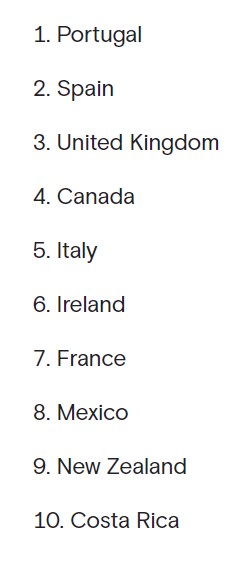
But the world has turned. The President has threatened the comfort of the white collar class to the point that the only safe place to retire is outside the United States. The list shows the most popular nations picked by the white collar folks:

Now on to the Dictator President and his influence on the financial well being of the American citizen.


The Week

12 US billionaires gained almost $1 trillion in wealth in 2024 as the stock market delivered another year of massive returns.

Millionaire investors have boosted cash to 19% of their total assets, up from 12% prior to pandemic.

Top 10 wealthiest American men collectively earned extra $1B a day, report says, as Trump pushes tax cuts.

Despite market turmoil caused by Donald Trump’s tariffs, the group saw an increase in their collective wealth of $365 billion over the last 12 months.

On March 18, 2020, Tesla CEO Elon Musk had wealth valued just under $25 billion. By May 2022, his wealth had surged to $255 billion.  As of March 18, 2024, Musk is at $188.5 billion, more than a seven-fold increase in four years.

Over four years, Amazon founder Jeff Bezos has seen his wealth increase from $113 billion to 192.8 billion, even after paying out tens of billions in a divorce settlement and donating tens of billions to charity.

Throw in the effects of AI on the workplace and the future for the average American may not be a predictable one.

Ancient Mariner

Take a vacation

Mariner and his wife have just returned from a ‘dash in, visit, dash out’ vacation plan. We don’t recommend it. The pleasures of visiting with family and friends is diminished while packing, unpacking, repacking and driving become the dominant experience.

We did indeed enjoy our time with friends and family (and the Maryland crab cakes, gardens and an excellent restaurant overlooking a classic inlet full of sailboats). It is a bit of tradition for mariner and his wife to stop at a Cracker Barrel when we travel. His order of fried shrimp was so large it served as lunch and dinner the next day! As to gardens, every visit had a garden! He confiscated some Sweet Woodruff plants when visiting one of his friends.

It is too bad that driving dominated our vacation experience  It is mariner’s opinion that driving, with all its consternation, still is better than airplanes or trains – haven’t tried rockets yet because they are too expensive. We have sailed on cruise ships but that is subject to “been there, done that”. Instead, charter a 40-foot sloop and sail to your destination.

Back to driving, it is so intense on the interstates one dare not reach for a drink or snack on the console. There are trucks that gather in groups to dance a strange square dance; there are left-lane abusers staying in the fast lane while driving five miles under the speed limit; there are drivers darting in and out of lanes at very high speed and within inches of other vehicles; change lanes at your own risk; on some interstate routes traffic has reached the saturation point. If one likes high speed, drive in Kentucky – the slow lane crawled along at eighty miles an hour!

But the real distraction is road construction. It was so bad along route 70 across every state between Iowa and Maryland that he and his wife chose to return home through West Virginia and Kentucky, crossing the Mississippi at St. Louis. It was even worse – between Lexington and St. Louis, one side of the highway was being rebuilt from scratch; backups were close to a dead stop for twenty miles!

Unlike other future prospects which mariner sees as uncertain, he relishes the day when all cars are driverless and must obey the instructions of the interstate computer. Will the speedsters even want to drive when forced to a predetermined speed limit?

All this considered, the time with friends and family was worth it. However, we won’t try another ‘dash in, visit, dash out’ vacation plan.

Ancient Mariner

Before Zoro there was Zoroaster

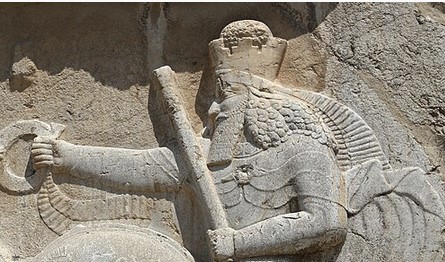
Attracted to rediscovering ancient Kyrgyzstan religions by a friend mariner visited while vacationing, he discovered that Judaism and Christianity didn’t invent anything – they copied ritual and theology from Zoroastrianism. Even Jesus rising on the third day was a standard belief for everyone. When a person died, their soul hung around for three days before being evaluated by Ahura Mazda, the unchallenged creator of all things, and then were raised to their afterlife.


Ahura Mazda


Mariner urgently recommends that the reader watch on YouTube, Zoroastrianism Origin by Book of World History.

Ancient Mariner