
The Future of Work Revisited

A reader posted a reply to The Future of Work – III When Jobs End. It is copied below:

“Does it only count as a job if you get paid for it? Or does a job also imply some kind of accountability? If you don’t do your job you don’t get paid. How is the welfare mother held responsible for the outcome of her ‘work?’ It seems that she gets paid whether she ‘works’ or not. Maybe that is the frustration of the working class against the welfare loafers–that those with regular jobs are held accountable to a standard which feels very judgmental–the dreaded performance review. Hence, the workers are judgmental against those who aren’t held accountable and still get paid. How do we remove accountability from the equation?”

Living in a Max Weber world (wrote “The Protestant Ethic and the Spirit of Capitalism,” in 1904) and also under the influence of the protestant ethic itself which emphasizes that hard work and frugality are the result of a person’s salvation in the Protestant faith, it is hard to envision a society that is based on other virtues than capitalism and sanctification by work.

There are places where capitalism survives but is subsumed into socialism as the primary ethic. One thinks of the Nordic countries but the top ten socialist nations in the world includes Canada. Reference:

http://blog.peerform.com/top-ten-most-socialist-countries-in-the-world/

This website has a short paragraph about each country and is a good place to start one’s investigation of socialist ideals and how GDP functions in a socialist culture.

What is important to us as we contemplate the future of work is individual happiness. If happiness or at least contentment is a dominant ethic, the workplace must accommodate that ethic – rather than first accommodating personal profit and success over others. Microsoft Corporation in Redmond, Washington has made the physical workplace one which induces contentment in the employees. A Microsoft employee has a liberal leave policy, flexible hours, babysitting services, picnic and exercise space, 24-hour food services and a host of smaller conveniences. Microsoft is rated the best among peer companies for its profit sharing/401K retirement program. One will never say that Microsoft does not support capitalist principles and does not have profit in mind. Still, the working individual is allowed to integrate the reality of living an individual human life with accountability to the corporation.

Despite the expense of an employee’s contentment, Bill Gates is the wealthiest man in the world. Gates is an exception in a country known for its capitalism; he is known for his liberal philosophy and is one of a handful of billionaires actively supporting human welfare around the world. However, if one is not so wealthy, putting individual happiness first is virtually impossible in the competitive environment of capitalism. Culturally, it will be immensely difficult for today’s political and business environment to adopt contentment as a requisite in the future of work. The economy of today’s culture also will require mind-bending adjustment. It is common knowledge that the US is an oligarchy; wealth is the first measure of a person’s value – even in the little town where the mariner lives. Putting profit first leaves behind a broken and insecure middle class and an underclass comparable to 19th century India.

It is virtually impossible to move a person embedded in the current work culture to the future work culture – particularly a person older than a millennium who has worked a lifetime in the labor class. Referring to the three cases in FOW II, this person still would call the part time worker lazy, still would call the welfare mother lazy, and would fault the children as much as the parents for not accepting responsibility; the person would give credit to the parents for their work ethic. Being embedded in today’s capitalist culture is why it is difficult to imagine the future of work.

To address the issue of accountability, the future of work is based on the principle that “it takes a village,” if the mariner may borrow a term. The reason the welfare mother is seen as a risk to the work ethic today is that she is isolated, has virtually no peer support, and does not have enough income to pursue a normal life; in other words, she is programmed to fail then she is blamed for the failure. If the culture around the mother included her as a resource and supported her as if she were an asset to the “village,” she likely will be judged in a better light by others and could be depended upon to do a better job. The social pressure on her would be as strong as being wealthier than one’s neighbor is today.

Ancient Mariner
 

The Lobby Economy

Mind you, the mariner observes the world from dockside. He is a generalist and an idealist and his assumptions, while based on factual research, may not be simpatico with all readers. That is fine with the mariner. He wants only to inform on all matters of interest, leaving the reader to receive the information as the reader chooses. This has been a public service announcement.
The mariner is finished with the future of work. It is an alien world to our capitalist society; only large numbers of unemployed will force change in the Federal and State Governments. Fortunately, we have a foot in the door to future work with the existence of entitlement programs and safety net programs like Social Security, Welfare, Medicaid, and unemployment insurance. It is important in coming elections not to let entitlements slide backward. Generally speaking, this means democrats must control Congress.
The topic in this post is to ponder the economy the US has today given that a handful of major industries control both social and economic priorities for our daily life, cost of living, and what the policies portend for the future. Specifically, the mariner will look at banking, fossil fuels, agriculture, alternative resources, guns, and an overview of issues related to personal rights. This is another series requiring more than a single post.
In this post, we will look at banking.
No doubt, the reader remembers the recession that began in 2007 and, in some respects, continues today. The noisy headlines of media focused on the Federal Government bailing out Chrysler, General Motors and Wall Street. The phrase commonly heard was, “The banks are too large to fail!” but fail they would if fiscal conservatives and libertarians had their way. The reader may remember that shady dealings with subprime mortgages bundled and rated AAA were priced accordingly and sold despite the fact that the mortgages in too many cases were sold to homeowners under false pretenses and were bound to be foreclosed when balloon payment came due. A domino effect ran through the mortgage industry calling in loans that were under water. 1.2 million families lost their homes and any equity they may have had. Real estate values plummeted.
Interestingly, from the beginning Goldman-Sachs purchased insurance against failure of the derivatives – knowing that the derivatives were overrated and likely will not hold the price. Some large investors went so far as to put short orders on the derivatives and when the derivatives fell, made tens of millions of dollars.
Some analysts were shrewd enough to ask the real question: Why had these mortgage shenanigans caused a recession? The basic banking answer is the banks did not hold enough liquid reserve to cover their losses and compensated by covering risk with their own insurance which still was charged against the bank’s bottom line. But there is more.
Unfortunately, the banks were gambling with depositor savings, something the Glass-Steagall Act in 1933 prohibited until it was repealed in 1999 when President Clinton signed the Financial Services Modernization Act into law. The battle continues today as Congress tries to dismantle the Dodd-Franks bill passed in 2010 that restored the separation mandated by the Glass-Steagall Act. Note: Of all lobbying contributions, the banking industry is the by far the largest.
The real question remains. Why are the banks running the economy? Why is the idea that banks are too big to fail even a catch phrase?
The answer is that the banks are filling a vacuum. In a healthy economy, the Gross Domestic Product (GDP) is driven by companies that produce something – manufacturing, agriculture, oil, technology, etc. In recent decades, corporations have moved manufacturing overseas; agriculture has a dysfunctional economy heavily underwritten by government subsidies and loans; oil is not a meaningful export; technology is international. What theses normal GDP industries have in common is that they hide profits overseas and may be unnecesarily leveraged to banks. Being in debt to a bank, as is often quoted, is like having a partner.
This is an overly simplified analysis; it identifies the fact that banks need regulation by governments as much as any industry. There are other fiascos like the power of eight people on the Monetary Policy Committee in Great Britain that determines worldwide interest rates; collusion abounds. Still, the banks have power because they are the big boys on the cash flow field. The US and private enterprise are on the dime to restore manufacturing, correct hidden profit schemes, to stop moving corporate headquarters to places like the Cayman Islands, and to reorganize agriculture.
At the consumer level, credit cards are a profit tool for banks. Interest rates are exorbitant – pushing as much as the consumer market will bear. As consumers move into a non-cash world, they are susceptible to interest rates as high as 29%. What happened to usury laws? The mariner recommends strongly that un-indebtedness is the most important family policy; it can make the difference between a quality life and being owned by the banks like a tick owns a dog.
Ancient mariner

The Situation between Us and Our Planet

The mariner wishes to remove the political bickering by our elected officials. Their motives are tied more to the science of profit-making and job security than to the real situation of the relationship between Homo sapiens and Earth. Below is a link that the mariner urges you to read. There is no political banter; there is no liberal-conservative bias; there is no corporate or socialist slant; there is no nationalist defense. It is short and has pictures.

http://www.livescience.com/

51280-the-new-dying-how-human-caused-extinction-affects-the-planet-infographic.html


By the time the reader reaches the end of this post, extinction, climate change, an ice age, polar magnetic shift, and plate tectonics will be discussed. Lest the reader be confused, the topics actually are relatively independent of one another but Mother Nature is playing games with our adversarial political style. Poor Congress will be tied in knots for years!

The Planet Earth has some very large and slow-to-change processes that are not necessarily visible to humans. They are not visible because the impact of humans upon themselves may not be felt for decades or centuries. Nevertheless, the Earth does notice – if the mariner may be anthropomorphic. Slowly, the Earth changes its behavior. The first signs that the Earth has noticed is Earth adjusts its biosphere by eliminating species that no longer fit the Earth’s global ecology. This is the mass extinction of species called the “Sixth Extinction.” The second sign that the Earth is adjusting to reality is the change in subsystems like ocean temperature and acidic oceans, which begins to eliminate the very bottom of the protein chain – coral, plankton, simple land life like lichen, moss, and other simple plant life both in the water and on land. This elimination process already has begun.

Like many, the mariner feels that there is too much carbon dioxide. Evidence among growing things is too obvious. Excessive carbon has haunted us since the iron mills in Indiana and Ohio were spewing smoke that was killing trees in Pennsylvania and New York and coal mines poisoned rivers in the Appalachians.

However, the Sun is the most powerful influence on Earth’s weather and global temperature – easily trumping even Homo sapiens’s mischievousness. In just the last few days, solar scientists, armed with the best data yet regarding the activities of the Sun, say the Earth is headed for a “mini ice age” in just 15 years — something that hasn’t happened for three centuries. Early predictions are that it will last until 2045. The drop in Sun activity is called a Maunder Minimum; deeper currents in the Sun are moving in an opposite direction to the currents on the surface. The mariner mentioned a probable ice age in a post in June 2013 when he mentioned an ice age will occur in the 21st century. It isn’t his insight; he had been reading what solar scientists were saying about Sun cycles and the timing seemed correct.


Climate change versus the ice age. If there is confusion and disbelief now, think what both together will do to politics, international anti-carbon agreements and many environmental improvements riding the financing of climate change. Perhaps it should be made clear that there are two issues: ice age and excessive carbon – climate change notwithstanding.

Every 200,000 years or so, the magnetosphere switches poles, that is, the North Pole becomes the South Pole and vise versa. Presently, we are experiencing the very early phases of a polar switch. Scientists have determined that the strength of the magnetosphere has dropped 15% since 1840. There is nothing cataclysmic about the switch. The North and South magnetic waves push through each other around the globe. For example, today the South Atlantic and the Bering Sea have very weak magnetic spots such that a compass can be seen to vacillate as North and South magnetic waves move back and forth. “It may take another 2,000 years,” said physicist Phil Scherrer of Stanford University.

The real danger in a magnetosphere shift is twofold: First, the magnetic waves shield us from strong radiation from the Sun that is capable of causing cancer and other radiation ills; the Earth’s magnetosphere is weakened considerably during a shift and the Sun’s radiation can reach the surface of the Earth. At some point, all satellite communications will be interrupted.

Second, every creature that depends on a compass to get around will experience a topsy-turvy effect that turns everything backwards. Many creatures may be disoriented: Monarch butterflies, geese, whales – anything that migrates great distances without mapping terrain.

Switching to plate tectonics, the media covers stories about earthquakes and disturbed volcanoes on a regular basis. Statistically, the number of larger earthquakes per year has not changed but the energy or intensity has. The Earthquake that hit Japan recently moved that nation 12 feet closer to North America and caused a shift in Earth’s axis of 6.5 inches. Scientists worldwide focus increasingly on the Pacific Rim by Washington State. New evidence suggests that a small fault, Juan de Fuca, is currently pressing against the North American Plate causing uplift and stress. Eventually, it’s expected that the ground will break perhaps causing another “mega-thrust” earthquake that could rival the recent Japanese disaster. In addition, there is increased activity in the Chile/Peru fault and Los Angeles’s San Andreas Fault. Based on geologic data, a major earthquake has hit the Los Angeles area approximately every 200 years. The last major quake was about 300 years ago.

The mariner has written much about extinction. Peruse recent posts for more information or use the reader’s browser. To the mariner, extinction is both probable and within hundreds of years unless severe modifications are made to mankind’s treatment of the biosphere. We may not need to worry about earthquakes, magnetosphere shifts, ice ages, or Congress.

Ancient Mariner


The Future of Work – IV Slow and Fast

As the United States lives day-to-day, transition to a new world of work will be virtually unnoticed. Evidence will lie in statistics and deep economical analysis. However, in terms of careers and financial security across a lifetime, the financial underpinnings of work will seem to erode quickly; the ability to feel comfort through stable income, savings and retirement will become less secure. The millennial generation already knows that thirty-year jobs have all but disappeared. The millennial attitude is that they are on their own.

The attitude of the millennial generation represents a significant shift in the culture of work. Barely noticeable is a different behavior about job security, accepting short term employment much more casually than their grandfathers who worked in one factory for thirty-five years. Grandfather lived during the period before computers began to have an effect on factory employment and tenure. Those of us twice the age of a millennial watch them with a degree of anxiety; they are living without a net of financial security under them that their elders took for granted.

Today, large corporations like AT&T and General Electric have cut payroll by sixty percent. Google, a world-wide conglomerate, only has 55,000 employees. Google is about to roll out a driverless automobile. Transportation is the largest sector for male jobs in the US. The Swiss start postal service this very day with drones. Further, global corporations have mastered the ability to move to the least expensive labor force without much difficulty – thanks to the power of the Internet and cloud storage. The current labor disruption around the world is international trade agreements which aren’t trade agreements between nations; they are trade agreements between corporate consortiums that erode government authority, human rights and the power of the citizen to vote his or her future.

Slowly, the raggedness of the work culture will increase to a point that having any job may be a whistle in the dark for tens of millions of workers. The alternative is “self employment.” A good example is AirB&B. People list their living room sofa for one night stays; real estate agents have begun to buy houses and keep them for AirB&B income; everyone with a spare room can become a motel; everyone with a car can become a taxicab; dialup services like Angie’s List and Home Advisor have begun to include individuals who can fix a receptacle or weld a broken iron railing; at high profile destinations, AirB&B opportunities are undercutting amortized prices for corporate solutions like timeshares and bundled travel packages.

Two phenomena occur in this self employed market: The income is significantly lower than the income when they had a “job;” the second is that self employed people are happier. It is an irony that most people who have jobs are dissatisfied with them, are not happy with the work environment and find the work boring. On the other hand, these same people are unhappy if they do not have a job – unhappiness related to their inability to contribute to the greater value of society and the wellbeing of their families.

As this jobless society expands, many, if not most, will not have steady income; many will not earn enough to live even a meager lifestyle. Lack of income will come fast upon individuals who lose their regular jobs. The slow part is the transition of public and private institutions to a point where every citizen is available for what today is called a dole. The government must expand ideas similar to Social Security, welfare, paid services like health, and the existence of price controls on most services and purchases. This challenge is a difficult one for a capitalistic society. Change will come slowly.

Institutions already are making adjustments to the new labor market. Government, colleges, and private sector training are growing steadily. Unemployment benefits frequently are extended to eighteen months or more. A few corporations make room for subsidized small businesses that contribute to the corporate productivity. The American automobile industry has used this model for most of its existence.

Normal to the history of change in society, it is the proletariat that will bear the cost of change. We can hope that the change to a jobless society will not last too long. What can we do to ease transition?

Ancient Mariner


I Can’t Find That Person’s Shoes

It often is impossible to understand why another person believes the way they do. Sometimes it is impossible to understand a person’s motivation to act as they do. Empathy can stretch only so far before it evaporates, leaving a total blank as far as understanding a person’s ethical judgment. Walking a mile in someone else’s shoes is much more difficult than one may think. From different perspectives, one religious and one physiological, the mariner touched on this difficulty in past posts:
On the moral conflict between Christianity and capitalism, he wrote –
(Is Christianity Still Christianity? May 22, 2013)
Paul Tillich, a popular theologian in the 1960’s, said that Christianity is vulnerable to being subsumed by other forms of religion, very much as a chameleon changes its color to match its background. The other forms of religion, which Tillich defined as “quasi” religions, are capitalism, socialism, fascism, and authoritarianism. In the United States, the competing quasi-religion is capitalism. To be a Christian in a capitalistic society means that it is likely that a “Christian” is a Christian only to the extent that capitalism is not inconvenienced.
And –
On the fact that republicans and democrats use different parts of the brain to make decisions about risk, he wrote –
(Red Brain, Blue Brain June 19, 2015)
Republicans orient attention to external cues. What this means is Republicans find it less important to understand how they feel inside; more important is their control of potential risk outside.
On the other hand, Democrats orient attention to perceptions of internal feelings – how they feel about the external cues. This orientation also borders the temporal-parietal junction, and may reflect perceptions of internal feeling and motivation in others as well.

  • A genuine capitalist cannot understand why a person would give up financial security or relinquish authority to follow Christian principles that, to the capitalist, leave one defenseless against the world.
  • A genuinely compassionate person cannot understand why a capitalist can ignore people who are starving and homeless.
  • A genuine socialist cannot understand why a wealthy person objects to a one or two percent hike in taxes when it is an amount that will not alter lifestyle in any way and never be spent in the wealthy person’s lifetime.
  • A wealthy person cannot understand why a socialist doesn’t respect wealth as a societal right.
  • A genuine naturalist cannot understand why developers want to destroy sensitive habitat to build houses when there is plenty of reusable property elsewhere.
    An oil entrepreneur cannot understand why people want to stand in the way of progress.
  • A genuine populist cannot understand why banks intentionally gouge their customers.
  • A banker cannot understand why a populist wants to constrain opportunity with regulations.

We could go on….
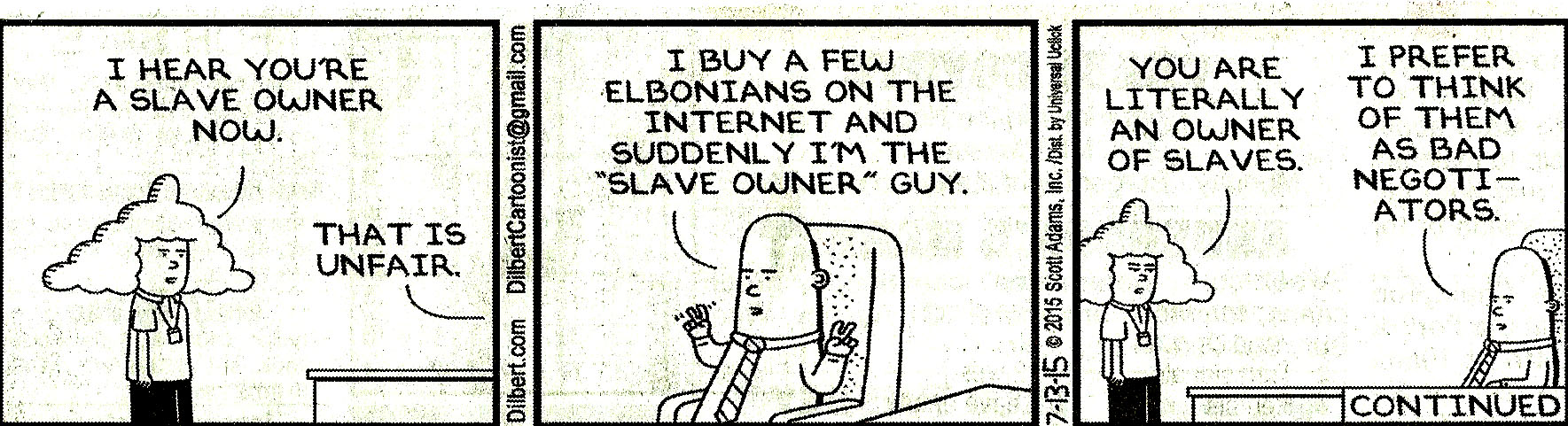
The mariner has maintained throughout his life that comic strips and single-pane cartoons are the most important section of the newspaper. The comics have a sly way of slipping through one’s prejudice, ignorance, and lack of emotional maturity to plant the seed of a new insight. Consider the following Dilbert strip:

Dilbert_001Were the strip in real life, we would not laugh so easily. The strip shows how every one of us is vulnerable to redefining reality to fit our personal preferences. It is easy to overlook how our decisions affect others, even abuse or kill them. It is easy to avoid acts of sharing or choose not to act in behalf of someone or something because it is simply inconvenient or uncomfortable.
Sometimes, in our hearts, we don’t really want to walk in the other person’s shoes.
Ancient Mariner

The Future of Work – III When Jobs End

In the past, all the way back to the earliest beginnings of the Industrial Revolution around 1800, older job opportunities that were eliminated by mechanization reemerged as new opportunity in new production jobs created by the revolution. Without the support of company sponsored training or unemployment insurance, these transitions were hard times for the displaced workers. Still, at some point, a worker could find another job in a new production sector. The same has been true for every turn of automation since.

However, it is a common position among futurists that, moving forward through the 21st century, the number of jobs available will begin to dwindle. It may be that large numbers of citizens will not have the opportunity to find another job. As a rule of thumb right now, economists determine that every major shift in the economy creates a job loss of 15% that will not be recovered in the transition. At some point, automation will increase this loss incrementally – never to be recouped.

It is important to dissect “job” from “work.” A job is the result of hiring by an employer wherein the individual hired receives a salary or some form of recompense. Work is the act of investing personal time, energy, and other resources wherein the individual feels justified in one’s behavior and feels personally responsible for one’s contribution; the individual also derives a sense of self worth from doing the work. A job can fulfill an act of work but work has a broader definition that includes the wellbeing of the individual.
The introduction to an article in The Atlantic written by Derek Thompson expands on the difference between jobs and work and shows that although different, the two are permanently entwined:

“The end of work is still just a futuristic concept for most of the United States, but it is something like a moment in history for Youngstown, Ohio, one its residents can cite with precision: September 19, 1977.

For much of the 20th century, Youngstown’s steel mills delivered such great prosperity that the city was a model of the American dream, boasting a median income and a homeownership rate that were among the nation’s highest. But as manufacturing shifted abroad after World War II, Youngstown steel suffered, and on that gray September afternoon in 1977, Youngstown Sheet and Tube announced the shuttering of its Campbell Works mill. Within five years, the city lost 50,000 jobs and $1.3 billion in manufacturing wages. The effect was so severe that a term was coined to describe the fallout: regional depression.

Youngstown was transformed not only by an economic disruption but also by a psychological and cultural breakdown. Depression, spousal abuse, and suicide all became much more prevalent; the caseload of the area’s mental-health center tripled within a decade. The city built four prisons in the mid-1990s—a rare growth industry. One of the few downtown construction projects of that period was a museum dedicated to the defunct steel industry….”
“….the widespread disappearance of work would usher in a social transformation unlike any we’ve seen. If John Russo1 is right, then saving work is more important than saving any particular job. Industriousness has served as America’s unofficial religion since its founding. The sanctity and preeminence of work lie at the heart of the country’s politics, economics, and social interactions. What might happen if work goes away?”
1 John Russo, Professor of labor studies at Youngstown State University.

The conservative constraints on what constitutes work today, when even government work “is not real work,” is tied to the roots of capitalism and work ethic in American history. Roots bound in hundreds of years of culture suggest that a change in that culture will be resisted just as the transition from slavery to modern civil rights is resisted. It will take generations to restructure the opportunity to work and to establish an adequate financial subsidy. In the case of work, joblessness will require more immediate transition which may not change smoothly if hurried. For example, how hard has it been (and will it be) to redefine Hispanic immigration? There are great grandchildren of undocumented workers living in the US. Whole generations of Hispanics carry an anxiety within themselves: “When will I be found out?”

There will come a moment when a great layoff will occur for which job replacement is not available. In that moment, a new world of work will be born wherein citizens are paid a stipend so that each citizen may continue to work – whether a job definition exists is irrelevant. A society cannot operate except people are allowed expression through work, contribution, and personal gratification. A “job,” on the other hand, is a matter of definition, nothing else.

There is no doubt that the welfare mother who raises her children to be responsible adults is doing valuable work. In the future, this could be considered her job.

Ancient Mariner

On a July Saturday

The mariner often emulates two champion naysayers from history: Old Testament prophet Amos and Children’s literary avatar, Chicken Little. True to their warnings of doom, the mariner has railed against political, cultural, economic and environmental trends.
But in the last three weeks, the mariner has felt tremblers. The tremblers have been subtle but they have been widespread. The rumbling has moved through FIFA women’s soccer, allowing a new sport and a women’s league to burst from the Earth in full bloom. Combined with the arrest of FIFA management for classic mob behavior, world soccer will never be the same.
The Earth shook when the Supreme Court ruled in favor of LGBT marriage, struck down a law that eliminated Women’s health centers in Texas, and upheld the Affordable Care Act. The theocratic right was wounded but didn’t die. Nevertheless, their leash was shortened significantly regarding attacks and pillaging of State laws and blackmailing elected politicians with their reelection if Tea Party legislation was not forthcoming.
President Obama updated the overtime regulations to make it more likely that workers will be paid for their extra hours. Minimum wage is on the increase in States ranging from $10/hour to $15/hr.
Bernie Sanders introduced American citizens to a forgotten word: socialism. Running ideologically as a democratic socialist, Bernie’s speaking events draw many more than any other candidate, including authoritarian candidate Trump.
Senator Lindsey Graham (R-SC), a rare combination of conservatism and sentimentality, challenged the Fox News version of candidate selection claiming it eroded the primary process put in place by both parties. The Fox News popularity contest has put Donald Trump at the top of the pile because of name recognition in national polls.
If the mariner may be Amos for a moment, beware the popularity of Trump. He stays at the front not only because he is unabashedly a showman, but because he speaks the specific words that many, many citizens have wanted to hear for a long time. He may seem a clown to 95% of the public but he is spot on with the other 5%. Lest you think 5% is insignificant, only 57% of eligible voters voted in the last presidential election. Given all the extremists will vote, that raises their influence to about 9% – enough to throw a close election – especially in primaries and State elections.
The mariner accompanied his wife to her 50th high school reunion. The turnout is better than expected. The restaurant is crowded and very, very noisy. Imagine riding in an automobile with one of those super loud sound systems. Everyone is deeply engrossed in conversations about who, where and when – at great length. It is difficult to move around in any case but a crowd of about eight people stands crunched together blocking the path into the room; further, they block access to the appetizer bar. Why is it, the mariner asks, that people will stand and talk in a space obviously needed for passage? The mariner calls this phenomenon the “doorway syndrome.” Doorway syndrome occurs in one’s home, after church at the exit, in grocery aisles, in driveways, and any other space where a group of people can camp and be as potent a blockage as Hoover Dam. The mariner has no couth so he loudly shouts for them to move out of the doorway and let people through. It’s okay; they don’t know who he is and even as he pushes through, they don’t move anyway. Frankly, they never stop talking.
Sunday, at 9:00A Eastern on ESPN, Djokovich will play Federer for the Wimbledon title in men’s tennis. It is a battle of Titans. This is as it should be British complaints notwithstanding.
The reader should be pleased that when the mariner began to look at work as an issue, the popular press followed suit. The latest The Atlantic has a major article by Derek Thompson, “World without Work” and a new book is out by Erik Brynjolfsson and Andrew McAfee, “The Second Machine Age.” The mariner will review these publications.
Today, the mariner’s town is awash with flooded streets and drains after 2+ inches of rain fell on an already soaked town. Tragically, the rain turned the midway at the County Fair into a creek with a firm current; the demolition derby scheduled for tonight is cancelled due to a flooded infield.
The setting Sun is out now as the day ends. Except for the Fair, it is a good day, tremblers and doorway blockers included.
Ancient Mariner

The Future of Work – II What is Work?

Future of Work I identified an issue: The definition of work itself will change dramatically by 2050. At the end of the post, it was suggested that we cannot see clearly into the future because it will be so different from what we experience now. Future of Work II ponders who we are now that we cannot see a path to this unknown future.
For the sake of clarity and to limit the scope, this series will deal only with the culture and circumstances of the United States. Other cultures, nations and international politics will be annotated from time to time but the focus is on US circumstances.
Some US labor statistics that reflect the current culture of work:
Americans work an average 47 hours per week – cumulatively 4 more weeks per year than the average in 1979.
In addition, on average, Americans work two weeks longer.
The US is the only nation in the world that does not guarantee paid time off, sick leave and maternity leave.
The US is the only nation in the world that does not link employee income specifically to hours worked or productivity.
The US is the only nation in the world of first-tier nations that does not require cost of living adjustments to income as a national policy or as a culturally mandated reason to do so – collapsed and authoritarian economies excepted.
In spite of increasing demands at work, employees accept salaries that remain not much above 1985 rates. That’s a difference of 40% – nearly half again what workers would be making if their salaries kept up with the cost of living or with statistics on productivity. Further, labor unions have become a pejorative presence that “interferes” with an employee’s opportunity to work; minimum wage is significantly under the poverty line; Federal and State governments continually undercut agencies who oversee the health and working conditions of the American employee; no effort has been made to repair the misuse of retirement funds by corporations – made possible by legislation during the Reagan administration. In short, American workers are so addicted to work that it supersedes any other measure of personal worth or any sense of self value. In the mariner’s resident State, there is a firm prejudice against anyone who isn’t working hard.
It is common knowledge that Americans clearly are the hardest working culture in the world. Only the United States, with its supercharged employees, has a chance of competing with a Chinese economic engine that has the potential to produce 100 times the producing capacity of the US. It may be that the reason we cannot see into the future is that work, as it is experienced today, will not exist. Under control of maleficent employers, and with workaholics, hypertension, widespread job dissatisfaction and workers having a belief that work represents sanctification through sacrifice, the American work ethic as it is today cannot survive the journey to a different world of work.
Psychologists, sociologists and, increasingly, private sector theorists and planners feel that it is a good thing to disrupt the American dedication to work or at least to change the work environment. There is a big world out there that actually is more important to the human psyche than “work” – though many will disagree. For example, workaholics have a different family life profile than “normal” workers. The divorce rate is higher; they do not participate in non-work activity that “restores the soul;” their emotional flexibility declines and empathy, sympathy, and human insight wither from disuse. Yet, in the American culture, they seem happy with what they are doing and who they are inside. Americans admire these dedicated, high performance producers. Personality tendencies aside, are workaholics happy in the wholesome sense? The mariner offers the opinion that excessive commitment to anything is compensation for past experiences, disparate family mores and obsessive-compulsive characteristics.
On the other hand, perhaps it’s the definition of the word “work.” There are two thoughts:
1. In society today, work is part of a triumvirate – time/labor, income, and contribution to the Gross Domestic Product. Working is making something that is wanted by the economy in some way, earning income for the worker and spending personal time and effort to contribute to the success of the work ethic.
2. Work may not be bound by continuous time, income, or economic output. Perhaps work can contribute to society, or to the biosphere, or to any tangential activity compared to today’s perception of the “workplace.” This idea crosses several ideologies. Capitalists consider anything not contributing directly to cash flow and product to be irrelevant – hence, government jobs aren’t real jobs; Socialists consider a workplace to include the home, community activity, and consider a workplace to be mutually owned in principle with the employer – hence profit is a multifaceted product; the American worker considers a workplace a place that provides income and requires investment of personal labor.
Look at a few test cases:
A person gives 5 or 6 hours every other day working at the local car parts store. The rest of the person’s optional time is spent riding a horse along several miles of trail in a forest. The trail is cleared of branches and debris. Hikers benefit from the person’s efforts but certainly not comparable to the scope of time and effort provided voluntarily by the person. Is the person working when maintaining the trail?
A mother is on welfare. She has four children under the age of 12. She spends 8 hours each day caring for the children in some way – before school, after school, homework, meals, chaperons them to and from after school activities. The mother receives welfare income and a few dollars babysitting a working neighbor’s two small children; she contributes time and labor. Is this woman working? Does she work for her community by properly raising her children to be good citizens in that community? Would the economy based workforce be better served if she left her children to work 10 hours a day at Burger King? Don’t worry about the reader’s answers defining him/her. The case is speculative.
A man works two jobs fulltime. He is a bookkeeper and brings work home on weekends to keep abreast of his responsibilities. He makes $125K total annual income. His two children are 12 and 16. His wife works at a local restaurant. She makes $31K total annual income. In one year, the older child, a boy, is arrested for accidental homicide and is sentenced to 10 years in prison. Arrest and pretrial confinement costs the police department $165K. Prosecution and court expenses total $140K. Prison costs $55K/year for each inmate. The daughter has run away twice requiring the police department to look for her a total of three days at $4,000/hour, 8 hours/day times 4 policemen. All administrative costs and benefits included, the searches cost the city $384K. Is the man working if his societal overhead is $744K while he and his wife earn $156K?
The mariner hopes these cases cause speculation and induce personal thought about what else is part of the “triumvirate.” Is work more integrated into society outside the workplace than one sees on the surface? Does the work ethic include another dimension of responsibility to family, neighborhood, friends and most importantly, to self?
Ancient Mariner

The Future of Work – I

The mariner has pondered for decades how human culture would operate in the age of the Jetsons (animated TV show from 1962-1990 sporadically). Everything in the future was automated; automatons were everywhere and performed virtually every job requiring hands and decision-making. What did George Jetson do at work? What was his actual job? What was his product? A humorous cartoon show about the future is not the place to wax culturally about the ramifications of such intense automation.
In the early years of the nineteenth century, it was the Luddites who protested against newly developed, labor-economizing technologies. The Luddites were textile workers that were put out of work by improved methods for making frames and looms. These jobs were lower income jobs and labor-intensive in nature. The Luddites were simply left on a limb without options or income.
At the turn of the twentieth century, it was carriage makers, harness makers, blacksmiths and farriers among many other skilled laborers who were dropped from the work force as the automobile suddenly replaced the horse as the common form of transportation.
Throughout the later years of the century, especially from 1970 to the present, millions of jobs disappeared in the US due to automation and trade policies that sent many surviving labor jobs to less expensive labor markets in less developed nations.
In the twenty-first century, disappearing jobs is a chronic issue that is rising to the surface of the workforce. Automated services already are affecting very large sectors of employment. Consider the following:
• Within fifteen years, fast food restaurants will no longer require counter workers or preparation workers. Perhaps the manager and a helper will be all the humans required to serve the public. Anyone who has visited a fast food restaurant recently can see the transformation to automated service occurring systematically. In the United States alone, 4.4 million workers depend on these jobs.
• Even now, retail sales are undergoing massive conversion to automated service. Simply ordering online instead of shopping at a store is decimating “brick and mortar” outlets, forcing many large and familiar retail chains to go out of business or close significant numbers of stores. The floor sales person is coming to an end as more and more products can be bought or ordered via machines. Many retail sectors will have growth in sales but the number of employees will diminish drastically. Today, retail sales support 42 million jobs.
• Within two decades, the transportation industry will drop millions of transportation jobs because of automated buses, trucks, trains and automobiles. A 2013 study by Oxford University predicts that automation will replace half the jobs in the US by 2040.
Being employed is not the only issue. Since 2000, the average wage of college graduates has dropped over 7%. US wages in general have stalled since 1985 for economic reasons but now face further cuts without relief. In every case the mariner could find, trade agreements have reduced job opportunities in the US. President Obama claims the TPP will return manufacturing jobs to the US but every indicator of future employment suggests that the wages will be low and the opportunities, even as they occur, will be lost to automation.
Setting jobs and income aside for the moment, there are two cultural issues. The first is if vast numbers of men and women cannot find work, what do they do all day? Especially in America, where having a job has become a permanent part of the American psyche, how does one feel successful? What is a person’s worth if they cannot produce income or physical participation in society?
The second cultural issue is class stratification. There will be sectors where jobs escape automation, will likely have better salaries, will be more influential in the evolution of politics, culture, and are able to participate in the benefits that come from financial security. What we consider lower level jobs today will be the common job of everyone whose job has disappeared. Quite likely, a worker will work part-time.
The automation of work is similar to the effect of a tsunami as it comes to land: It comes quickly and silently until it is too late; it literally erases the cultural fabric that binds every citizen to another; it makes present ideas about economy useless.
Yet, it is almost impossible to guess what the future looks like. The future is so different that we cannot envision it. It sits on the other side of a solid wall that blocks our view and our imagination. Like the tsunami, it is approaching us even now – but we have no way to protect ourselves.
What shall we do?
Ancient Mariner

Lindsey Graham – Political Philosopher Extraordinaire

Liatris 002In the mariner’s garden, one can always tell when it’s the fourth of July. The sparkler-like Liatris stalk lights its flame within a day or two of the holiday. As any gardener will attest, gardens require labor intensive commitment. The small moments of reward stay for awhile. The delicate purples and blues of Liatris, Scheherazade Japanese Lilies, Alium, Blue Phlox, and the tall Dianthus grow among robust Black-Eyed Susans, naturalized Stella De Oro lilies and large, bright yellow Marigolds. The colors are brightened even more by scatterings of white Phlox, Impatiens, and Verbena. It is a special time in the garden and one must pause for the reward.

Back to the world outside the garden, the mariner is in a wait state. The Supreme Court recently provided a flurry of activity with its decisions on homosexual marriage, the Affordable care Act, and Arizona’s redistricting process. Now we wait while a new set of events unfold: the nuclear program of Iran, the resurgence of activity in Ukraine, the unveiling of TPP, Greece’s economy versus the EU, and the oddly under-covered wars in Iraq, Syria and Nigeria.

Then there is the US campaign by Presidential hopefuls. In all the mariner’s years, there has not been a more entertaining national campaign. There are representatives from every form of democratic philosophy. Guess the appropriate name(s) for the following: libertarianism; democratic theocracy; capitalism; pragmatic democracy; liberalism; democratic socialism; and egocentric authoritarianism.

In spite of himself, Senator Lindsey Graham has revealed a significant change in the importance of primaries for the republicans. Graham says that the control of the debate process should never have been given to Fox News. The measure of who will attend the debates is dependent on national polls, not state by state primaries. The Senator is right when he says the debate selection criteria diminish the importance of Iowa, New Hampshire and South Carolina, as well as later primaries if Fox oversees subsequent debates. “Who wants to go to Iowa if the important decision is based on national recognition?” the Senator said.

The mariner tends to agree with Lindsey. Graham reached into a bush to retrieve a bone of contention and grabbed a philosophical rhinoceros. The flaw in the US primary system is that no one state represents the political demographic of the entire nation yet the states vote in sequence by calendar date rather than by a meaningful demographic approach. In its current sequence, the early, more conservative states have undue influence in media, fund raising, and the ratio of conservative to liberal ideas that drive the campaign.

A lot of the smoke has cleared by the time a demographically representative state like Florida has its primary; it is even less meaningful for California.

For many reasons, this rhinoceros will not go away. The democrats, too, are part of how we stack primaries among liberal and conservative states. Certainly, the mistake of turning control of the process over to an unbiased media outlet won’t happen again…

Lindsey didn’t intend to open the whole manner by which states participate in a national campaign. He was just trying to keep South Carolina as a key decision maker once Iowa and New Hampshire had their primaries. His other motivation is not to allow Brad Pitt to be President. The mariner should have counted from the beginning the number of times the Senator mentioned his name.

Ancient Mariner