A Nice followup

This is a nice followup to mariner’s post, ‘Good News’. It is published by Axios:

It’s Giving Tuesday — the annual day when people across America and around the world donate to the causes and organizations they care about.

  • It also kicks off the holiday giving season, and charities see donations continue to roll in through December.

📈 The big picture: Americans are giving more. Last year, Giving Tuesday donations hit $3.6 billion, a 16% jump from 2023.

  • The generosity didn’t stop at cash: The number of Americans who donated goods jumped 32% and the number who volunteered ticked up 4%.

Zoom in: Writing a check isn’t the only way to participate in the season of giving:

  • Here are four other powerful ways to give back:
  1. 🩸 Donate blood. “Of the approximately 62% of Americans eligible to donate blood, only 3% do so each year. But someone needs blood every few seconds in America,” Vox reports.
  2. 🥫 Donate food. Many food banks and pantries across the country say they’re still seeing surging demand even after SNAP benefits have been restored. Check out Feeding America’s list of items to donate to food banks and which ones to skip.
  3. 📚 Donate your skills. If you can code, ask local charities if they need website help. If you love to read, pick up volunteer shifts at your library. If you’re on top of your own shoveling, offer to clear an elderly neighbor’s driveway.
  4. 💌 Donate your good cheer. Several organizations are seeking volunteers to spread joy — especially during the holidays. A Million Thanks mobilizes people to write letters of gratitude to service members and veterans. Love for our Elders collects letters for older adults. Cards for Hospitalized Kids distributes handmade cards to children in hospitals in all 50 states.

Try it! Many families weave giving back into their holiday traditions. Consider a group volunteer outing or spend a Sunday afternoon writing letters and cards together as you gather with your loved ones this season.

Bottom up is best!

Ancient Mariner

Good News

Over the last month or so, mariner has seen a notable increase in efforts to save water. What is even better, water projects frequently are implemented at the ‘grass roots’  level. These efforts are documented in newspapers, gardening magazines, clips on YouTube and even on the search engine advertising strips. Even local public libraries have garden books that show how to build everything from a downspout system to self sustaining ponds. A local fire company has taken steps to catch roof water into a huge beer barrel like one would see at a brewery, which it uses as the primary water to put out fires.

The good news is this: If you want to change or improve a societal circumstance, the best and fastest way is from the bottom up. Saving water, it turns out, is easy and effective if only in your own back yard.

Another rapidly growing change at the neighborhood level is solar-based electricity.

The same is true in politics,  The situation is a broken government with little insight how to prepare it for the 21st century. Perhaps if you were to visit campaign activities and elect a sound, local mayor or state representative, this may be the fastest and best procedure to pull our government together again – start at the bottom.

Economics is a tough one to change from the bottom. When mariner had a contract in Taiwan, the culture there, while not running the national economy, was still run by family businesses. The local citizens ran a plethora of businesses at street locations and night market setups. Even light manufacturing was family run.  While there was no motive by the Taiwanese to change the Nation’s economic policies, it occurs to mariner that family run retail using local resources, would be a good method for  pushing back on the economy – a fact that may become real as AI changes the concept of workforce.

The current fear in the US that prices are rising generally for the common citizen has led to a resurgence of farmer’s markets in many suburban and rural areas – meaning that corporately processed vegetables are being augmented by home grown gardens.

Mariner’s grandmother was an excellent example of bottom up modification; this time because WWII demanded it. She was a full time seamstress for a large department store and further augmented her income by making clothes, draperies, rugs and any other sewing requests she could find. Plus she made most of the clothes for the family who at the time had very low income.

It will be difficult to tame electricity, computer, oil versus solar and manufacturing (although his neighbor rebuilt an early farm tractor to create a marketable item displayed in parades and his wife started a house cleaning service).

Bottom up is the best way to go to fix societal issues. Here’s the hard part: You must, with your own gumption, disrupt your staid lifestyle, get out of the house and use your smart brain and physical body to get things started.

Ancient Mariner


Faster than a speeding genome

Evolution has left the human body.

First Aboriginals in Australia. Using a diverse database of DNA from ancient and contemporary Aboriginal people throughout Oceania, researchers have determined that people began to settle northern Australia  60,000 years ago

America’s big robotaxi rollout. As of November 2025, robotaxis are operating in 5 markets: San Francisco, Los Angeles, Phoenix, Atlanta and Austin, Texas. They are coming to 10 markets in 2026, mostly in the South, and 5 markets some time in the future. Once the stuff of science fiction, robotaxis are now regularly plying the streets of Atlanta, Austin, L.A., Phoenix and San Francisco, and will be coming soon to at least a dozen more cities. Brought to mind is the lightning fast change in the life experience of the Homo sapiens – from using reins to steer to passing time communicating with Alexi or Roblox while the ‘team’ decides which way to go.

The telegraph. The Morse system was adopted as the international standard in 1865, using a modified Morse code developed in Germany in 1848. Before that time, humans could not speak to any human beyond the human voice range or line.of sight. it was a noticeable, rapid shift in human activities and lifestyle. Even more mental restructuring occurrs when the entire string of telegraphic inventions is included: telephone, radio, television, internet with social media, and now, suddenly, other electronic things even do our thinking and communicating for us – whether we authorized it or not.

The next step is to not need the planet environment at all. As soon as Mark Zuckerberg gets his artificial reality working, we will have arrived at  the world of Matrix.

Ancient Mariner


Measuring the fog

Readers are aware of mariner’s concerns about the future. Specifically, there are four global phenomena that are trying to make serious changes to the status quo of human life and to the planet.

The first to be measured is population. It was estimated by the United Nations to have exceeded eight billion in mid-November 2022. It took around 300,000 years of human prehistory and history for the human population to reach one billion and only 218 more years from there to reach 8 billion.

The global population is still increasing, but there is significant uncertainty about its long-term trajectory due to changing fertility and mortality rates.The United Nations projects between 9 and 10 billion people by 2050 and gives an 80% confidence interval of 10–12 billion by the end of the 21st century with a growth rate by then of zero.

This pattern of accelerated birth rates hits a point of psychosomatic collapse where the population begins to fall. This behavior also was proven in population studies with mice back in the 1960s. Those mouse studies also showed a societal collapse into two classes: a few very stable families where some family members served as border guards and, by mouse cage standards, were very wealthy. The other class being subject to mob violence, constant fighting, killing and an indifference toward newborns.

If population were an isolated phenomenon, it would be comparatively simple to manage. However, it becomes part of today’s fog because population is related to economics, habitat and behavior of the planet – as each of the four are integrated with the other three.

Hence the fog. Will the planet ignore human viability and destroy the balance of the surface with heat, storms and mass extinction or will the planet be influenced by dollars because there aren’t enough worldly resources to sustain modern economics as we have known it? The relationship between habitat and population is close.

Have humans made it too expensive to be the only creature who needs a fancy toilet, a water tower and septic system along side piped in fresh water just to pee? The industrial/technical age has created large economies at great expense to the habitat. It used to be instead of consuming millions of acres for grazing giant herds of beef, transportation and factory processing at local populations, that a person could buy fresh beef, lamb and chicken from a local butcher shop requiring only a dozen or so workers from farmer to customer.

Which causes are hurt the most of the four – economy, habitat or over population? Mariner hasn’t mentioned global warming.

Climate change is big in the news today because in just a few years, big cities, massive industrial centers and land itself will be destroyed.

So which should humans fix first? It looks like AI will tell the remaining pseudo humans the answers.

It’s all a big fog.

Ancient Mariner

Back by popular demand

Indeed so! By popular demand, mariner’s wife submits one of her witty poems:

Housekeeping

Company was coming so I thought I should clean up a bit
Those dusty windowsills, for instance,
Not that they ever bothered me before.
My mother’s philosophy of housekeeping
Was ‘See it, do it’

So I tackled the windowsill with a damp rag.
Then I noticed the window needed cleaning, too
So I got the spray and cleaned the inside of the window
Which made the outside look really dingy
As it was covered with spiderwebs.

I went outside to clean the outside of the window
And noticed that the door could use a wash, too.
In cleaning the top of the outside of the door
I noticed the underside of the porch roof
Draped in spiderwebs. So I got the broom and swept them away.

As I stepped back to admire the underside of the porch roof
Which no one ever sees
I noticed the stair railing needed to be wiped down.
So since I saw it, I did it–because really
When was I ever going to do it if not now?

All this because company was coming
And I noticed the dust on the windowsill.
I am so grateful that I do not notice things
On a daily basis–dust is safe in my house
As are spiders.

If I saw things to be done all day long
When would I ever have time to write?
Better by far to think it and write it
Than see it and do it–
except, perhaps, when company is coming.  MKM 11-22-2025

Some issues are more important

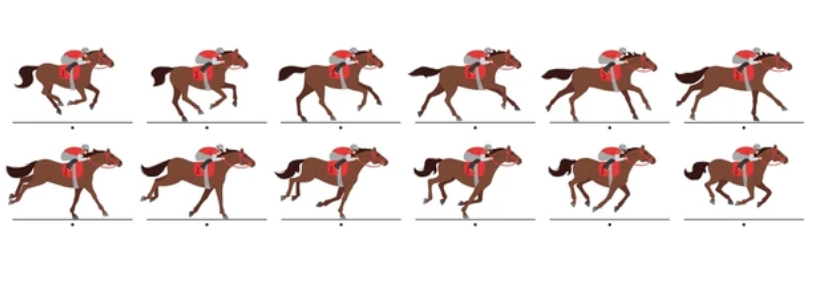
For example, in one stride, how many clop sounds does a galloping horse make? In the past this has been a troubled issue that folks went to a lot of trouble answering. How many clop sounds does the reader think a galloping horse makes?

Here are a couple of tools:

William Tell Overture –

Images of a horse at full gallop –

Film analysis has proven that at one point all four hooves are off the ground – but, a skeptic might ask, how many hooves in a stride make an audible ‘clop’ noise?

It has been proposed that if a horse is wearing shoes, it is possible to hear only the largest moment of clop volume and less strenuous  clops may not be heard. This is because the experience of clops is a combination of expectation, hearing and visual senses all responding together.

One theory is that the lead hoof starting another stride may not make a clop because it is a landing step rather than an acceleration step. What could contradict this comment is the familiar slang of ‘clipity-clop’ which suggests the opposite, that the lead hoof is actually the super-thrust of the next stride and the other the hooves land with less ‘clop’.

If you take on this quiz, you will be an expert onomatopoeist. On the other hand, if you search YouTube which has thousands of examples, you are a cheater and not willing to stand on your own beliefs.

This is important because, for the moment, nothing else is important.

Ancient Mariner

Jesus scrolled

Mariner’s local church is having difficulty sustaining its congregation. This is a common phenomenon across the nation. But the inevitable has happened – Jesus, meet Chatbot. Mariner cries in his heart as the true faith fades from practice: Use God’s love to spread Grace throughout the world.

An unnamed church was meeting to decide how to disperse leftover money upon closing. It was suggested to give it to charity. The response was “absolutely not!”

See you somewhere in the universe, Jesus, but not on this planet.

Here is an excerpt from the Axios article:

1 big thing: Chatbot Jesus saves souls and time
By and
Photo illustration of Jesus holding a cell phone in the painting
Photo illustration: Lindsey Bailey/Axios. Photo: Wikimedia Commons
A new digital awakening is unfolding in churches, where pastors are turning to AI to reach worshipers, personalize sermons, and power chatbots that resemble God.

Why it matters: AI is helping some churches stay relevant in the face of shrinking staff, empty pews and growing online audiences. But the practice raises new questions about who, or what, is guiding the flock.

  • New AI-powered apps allow you to “text with Jesus” or “talk to the Bible,” giving the impression you are communicating with a deity or angel.
  • Other apps can create personalized prayers, let you confess your sins or offer religious advice on life’s decisions.
  • “What could go wrong?” Robert P. Jones, CEO of the nonpartisan Public Religion Research Institute, sarcastically asked.

State of play: The U.S. could see an unprecedented 15,000 churches shut their doors this year as a record number of Americans (29%) now are identifying as religiously unaffiliated.

  • Megachurches are consolidating the remaining faithful, but even the most charismatic pastors struggle to offer private counseling with such large congregations.

Zoom in: In recent months, churches have been deploying chatbots to answer frequently asked questions such as service times and event details, and even to share scripture.

For the full report, see:

https://www.axios.com/newsletters/axios-ai-plus-d22a8098-9105-4548-8975-1aeb376eb9f0.html?utm_source=newsletter&utm_medium=email&utm_campaign=newsletter_axioslogin&stream=top

Alexa, write a bedtime prayer for me for tonight.

Amen.

Ancient Mariner

He is back

Mariner. Nobody special, just mariner. He has been visiting for a few days with long-time friends who live on a gorgeous property among the mountains of Arkansas. One could write tomes about the differences between Arkansas and Iowa. The most memorable difference is roads. In Iowa, one can be lost on long, unending gravel roads in the midst of endless fields without a home in sight. In Western Arkansas, the roads are first wrapped around a stick a lot like a spool of wire and then, in that curly state, they are laid down in a continuously elevated and sunken series of very tightly curved roads. Homes are scattered along the road but typically are hidden in the continuous forests.

While visiting, his friend Tom brought up a Biblical issue mariner had not come across in all his years of rummaging in religious tales: The holiday name ‘Easter’ is derived from an early Assyrian goddess Ishtar, a goddess of birth and fertility. Her symbols were an egg and a rabbit, hence Easter. The Roman Catholics firmly deny this, of course, but there is no smoking gun in the history books – just gossip. If the reader is interested, there are many web sources. Just type ‘Ishtar and Easter’ in your search engine.

Another piece of scholarly information mariner retrieved from his search engine was that dark chocolate and red wine trigger freshened brain attentiveness. Maybe over the ages that was a DNA patch so you could remember where the cork is. Similar to Ishtar, type ‘red wine and chocolate’ in your search engine.

On to a more important observation mariner noticed from a comfortable chair and a glass of red wine within the tunnels of alter ego Nosey Mole, is that Trumpians, other republicans and the democratic party and progressives, too, all are beginning to fragment. This situation could move three different ways: 1- The government will continue to crumble, most likely leaving political control with the Trumpians after the 2028 election 2- delete current election practices to the point that the outcome will be unstable and debatable 3- Corporate domination of society will be entrenched enough to virtually stop any democratic precepts from moving forward – AKA money wins.

Please, please be very careful who you vote for in 2028.

Ancient Mariner


Sailing

Sailing is an excellent metaphor for many of life’s experiences. There are the times when preparing to sail is overwhelming in its endless detail and distractions; there are times, while underway, when the weather changes a sailor’s plans; there are long periods of time when there is no one about except the sailor, the boat and the sea. If ever humans lived a sailing life, it is now.

A course on the ocean of reality has unpredictable weather, even hints of hurricanes and monsoons. Reality is driven by unknown weather confronted by a boat built in the past on dry land. Our boat’s energy and purpose comes from using the boat’s sails to interact with the waves and winds of reality – providing purpose, function and survivability.

How easy it is to use the sailing metaphor in the daily life of humans. We learn early in life that reality is not often kind and may even be determined to cause difficulty at the daily level. Yet humans must sail on, destined to fulfill purpose in life and even to physically survive.

Where is a sailor’s security while on the ocean? It is the boat, of course. It is also true that a human’s psychological self needs a ‘home base’ to feel secure. What is home base for a sailor? the boat. What is home base for a human? family and friends. It is family and friends across a lifetime that have helped build your boat. It is your family and friends that have shaped your sails and built a rudder to steer you through reality. But don’t feel life is their burden – you built the hull and mast. Yet, family and friends are a known and integrated base in the midst of the storms of reality.

If there were only one tool a sailor could take on a sail, it would be a compass. How would one know they were sailing in large circles? It is quite fortunate that sailors have a compass. It’s like using a GPS to get to the port of Maragogi, Alagoas in Africa. Fortunately for humans, the planet has an online network that can tell someone in what direction they are going just by using magnets.

If only such dependability were so with human culture. Just like a family provides direction and stability, one would think society would help, too, being a derivative of friends and family. Perhaps, every once in a while in some short sixty year period, society is stationary enough to live a pleasant life knowing where a person is and who they are supposed to be.

Such a time is not today. The disruptions, storms, abuses and ignorance that lie about today are like a miles-wide plastics and trash dump floating on the ocean of reality. No one knows where to go or when. No social identity is secure. Our rudders, whether boat or person, are clogged.

Now is one of those times when a sailor is alone with his boat for long stretches. The sailor must have a bonded relationship with his boat from which to draw confidence. Yes, the same is the situation for a human today. Only from our bonded relationship with family and friends can we draw confidence and security while sailing the oceans of today’s reality.

Ancient Mariner


Paint your lifetime in a picture

Isn’t this an interesting thought? Imagine you are in a class of some kind and the assignment is to present your life experience in a painting. What would you paint? Perhaps some of your major events either of pain or joy? Perhaps a montage of the birthing day of all your children? Maybe a more bleak painting of conflicts in life. Your painting could have a theme, for example, Pablo Picasso always found a way to include breasts. Claude Monet’s expressionist paintings were never focused enough to see any detail – you wouldn’t have to name names.

Pretend we are Bob Ross. We could build a painting in layers. First, what color would you paint the blank canvas? Something bright but not too strong? Perhaps a pale, neutral color? It could be darker to reflect a canvas of disturbances, or a plain white which would permit multitudinous little images all over the canvas.

The next layer is the background. Inevitably Bob would paint mountains. Perhaps there was a suspended time when you lived in a different background like row houses or a college campus. Take note, though, that this background may limit what can be painted closer to the eye – Bob always painted trees and a road.

Now you have to pick the close up scene. Is it a bunch of small portraits? Is it a big event like joining the Army? What is the frequent style of events that shows your life? Your skills? Your family? Your job? Your romances? Your favorite pets? Don’t hold back – Pablo didn’t!


Ancient Mariner