For example, in one stride, how many clop sounds does a galloping horse make? In the past this has been a troubled issue that folks went to a lot of trouble answering. How many clop sounds does the reader think a galloping horse makes?
Here are a couple of tools:
William Tell Overture –

Images of a horse at full gallop –
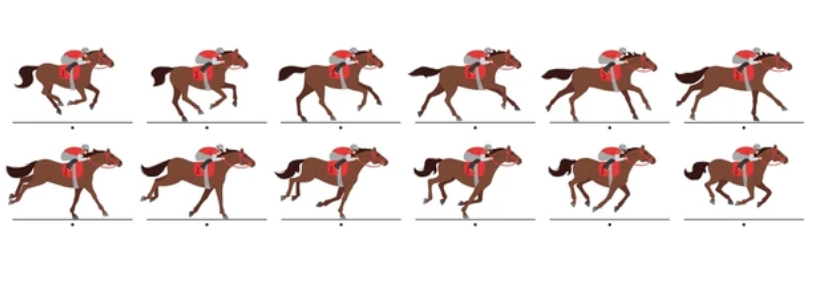
Film analysis has proven that at one point all four hooves are off the ground – but, a skeptic might ask, how many hooves in a stride make an audible ‘clop’ noise?
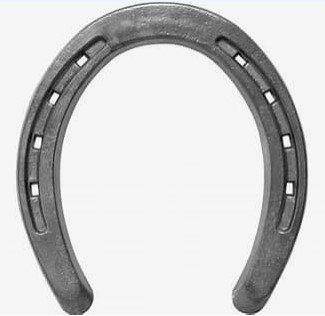
It has been proposed that if a horse is wearing shoes, it is possible to hear only the largest moment of clop volume and less strenuous clops may not be heard. This is because the experience of clops is a combination of expectation, hearing and visual senses all responding together.
One theory is that the lead hoof starting another stride may not make a clop because it is a landing step rather than an acceleration step. What could contradict this comment is the familiar slang of ‘clipity-clop’ which suggests the opposite, that the lead hoof is actually the super-thrust of the next stride and the other the hooves land with less ‘clop’.
If you take on this quiz, you will be an expert onomatopoeist. On the other hand, if you search YouTube which has thousands of examples, you are a cheater and not willing to stand on your own beliefs.
This is important because, for the moment, nothing else is important.
Ancient Mariner
I think 3. Will there be an answer? Also, if a horse gallops through a forest and no one hears it, did it clop at all?
I agree with your approach. Reality suggests that having four legs requires four clops. However, a clop is ill defined and subject to opinion and undefined physiology – is the first leg after being airborne a ‘cane’ to carry momentum forward to another stride or is it a final thrust from the current stride? My choice is to go with William Tell – I love his overture and the rhythm strongly suggests three clops.
But if you are intrigued by onomatopoeia, log on to YouTube for endless renditions or search for professional studies of horse physiology.
Now, you’ve done it. I got trapped on this page, forced to think about the problem. AAAAARGH. Now I can’t get it out of my head. How could you?
So sorry, Robert. Welcome to my world – everything is a puzzle. Read my response to Marty; the puzzle is a bit of Schrodinger because one rear hoof and one front hoof frequently make a simultaneous sound and unless one consults an equine specialist, we can’t be sure.
Share your answer with mariner’s: William Tell Overture is a favorite with you, too, right?
Maybe you are a natural onomatopoeist . .
skipper