More Reference than Evaluation

For folks facing an imminent move to Social Security, US News has tips that can make a significant difference in payments. The article includes how to manage the passing of a spouse. See:

http://money.usnews.com/money/retirement/articles/2014/04/07/5-ways-to-boost-your-social-security-payments

  • Copying a Bankrate report, the Washington Post reported that new studies show that not only are Millennials carrying less debt than they did in previous years, they are actually pretty good at saving. Millennials are saving more aggressively than they have in the past, and in some cases, they’re saving more than their older counterparts, according to a new study from Bankrate.com. Ironically, some notable economists wish they would spend more, even borrow, to improve recovery from the 2008 recession. See: https://www.washingtonpost.com/news/get-there/wp/2016/03/29/one-habit-millennials-are-actually-pretty-good-at/
  • Patty Duke died today of sepsis due to a ruptured intestine. She was 69.
  • An excellent article in Atlantic Magazine April, 2016, is about Obama’s legacy as President. It is a far ranging report that covers Obama’s thought processes associated with his impact on foreign relations and his guiding principles. The article is almost like reading a novel – an easy read. It is enlightening when real world sophistication is compared with Donald’s “I know how to fix that” – no he doesn’t; he has absolutely no idea how complex and nuanced foreign relations are today.
  • The reader may recall the recent report about the happiest nations in the world [US and Happiness, 3/16/2016]. It turns out that there is a direct correlation between happy cities and creativity in science and culture. See: http://www.livescience.com/54132-six-of-the-best-cities-for-scientists.html
  • While studying the parasite that causes toxoplasmosis in cats, researchers with the University of Chicago found a connection between the microorganism and Intermittent Explosive Disorder or IED. Symptoms of the disorder are recognized by repeated, impulsive outbursts of verbal or physical hostility.

http://www.examiner.com/article/toxoplasmosis-cats-linked-to-violent-behavior-humans

  • Nestle wants to own water rights in Oregon. See the FWW notice below (log on to see clip). A corporation is seeking to own water. This is a taboo. Humans can live only 5-7 days without water or suffer debilitating effects if the water is contaminated. Water is a public, worldwide commodity that can only be managed by governments (Flint Michigan aside). There are many confrontations across the United States between clean water-dependent corporations and public access. Further, there are corporations that poison public water sources beyond potable quality for farms and towns that need the same water. Around the world, fresh water is declining.

http://www.foodandwaterwatch.org/


This Is How You Stop Nestlé From Bottling Your Water: Watch the new Story of Stuff Project’s video on the Oregon ballot campaign to protect Cascade Locks!

Dear Ancient Mariner, What would you do if a bottled water company came to your town and tried to take control of your water? Unfortunately, for too many communities, this is not a hypothetical situation. Take Cascade Locks, in Hood River County, Oregon. This pristine town on the Columbia River has been battling for the last seven years to stop Nestlé from taking control of their water and building a bottling plant in their community. For years, the company has been working the system to avoid environmental reviews, buy influence over local politicians and speed up the process to get what they want. Meanwhile, the community has been putting up a fierce fight to protect their water.  So how is a small community taking on a huge, multinational corporation? Hear the story of this powerful, grassroots campaign in a new video, produced by The Story of Stuff Project — watch “Our Water, Our Future” now!

Nestlé came to Cascade Locks in 2007, promising to create jobs and stimulate the economy with a plan to bottle and sell water from a local spring. But when the community found out about Nestlé’s attempted water grab, they started to speak out against the plan. Nestlé has a track record of lying about the impact its bottling has on a community’s economy and environment.1 Cascade Locks residents didn’t want Nestlé wreaking havoc on their town — leaving them without enough water for the local farming and recreation industries. After years of trying to chase Nestlé out of town — inundating state agencies with public comments, pushing multiple governors to stand up and protect their water, and rallying against Nestlé’s lies — residents decided to come together and put the issue on the ballot so they can declare, once and for all, that Nestlé, and any other corporate bottlers, have no right to bottle public water! Food & Water Watch has been working alongside community members fighting the Nestlé water bottling proposal for the past seven years. Now, we’re partnering with the Local Water Alliance, Hood River County’s grassroots group, to push this effort over the finish line and stop Nestlé once and for all! Watch this video to hear the stories of local activists fighting to protect their water from Nestlé! [log on to view video]This isn’t just the story in Oregon. From Maine to California, this multinational corporation is working to take control of local water sources for its own private profit. But water is a public right and should not be bottled for private profit! If Hood River County passes this measure, it will send a message to Nestlé and help create a playbook for other communities that have to stand up to this big bully of a corporation and say NO. Winning this campaign would ensure the protection of this public water for future generations. Check out the video from the people who are standing up to Nestlé and fighting to keep their water public. Thanks for taking action, Caitlin Seeley George Online Campaign Organizer Food & Water Watch act(at)fwwatch(dot)org

1. Keep a Nestlé Water Bottling Plant Out of the Columbia River Gorge, Food & Water Watch, April 23, 2013

Donate » View Online  •  Visit Our Website  •  Contact Us  •  Share This:
Food & Water Watch • 1616 P Street NW, Suite 300 Washington, DC 20036 • Tel: (202) 683-2500 Manage your subscription or unsubscribe

Ancient Mariner

The US needs a new 21st Century Congress

The United States and likely other countries as well will suffer unnecessarily for many years to come because of the 15-year legislative stall caused by a small number of far right conservatives in the Republican Party. Mariner includes specifically the republican leadership across the terms of two Presidents, republicans who were afraid of losing their incumbency (Boehner finally ended his own). However, across both parties and both houses of Congress, as a third of the US Federal Government, there is an absence of statesmanship. Outside the dysfunctional government, the extremely wealthy have had fifteen years to diminish democracy, leaving a sense of helplessness in the lives of citizens. Then Citizens United became the keystone for plutocracy and complete oligarchy handed to the wealthy on a plate of jurisprudence by the Supreme Court – another third of the US government.

To this group of ‘leaders’ we have entrusted our society, our lives, and sadly, a future of unpreparedness as planetary and cultural change looms like a Japanese tsunami. Years ago, we were aware that we were experiencing oddities of behavior in Federal and state governments, in business, in stagnant salaries. We sensed signs of change; life seemed not as much fun for most of us; satisfaction with life had too many disruptions.

Still, too many Congressmen denied scientific indicators; too many Congressmen did not want financially comfortable situations to change; too many Congressmen had no foresight that we were quickly moving into a new cultural and economic era. Have we a plan? Has the world a plan? What does this change look like?

During the administration of George H.W. Bush, the Saudi Princes visited the President at the Whitehouse. Thoroughly covered by the press, arrival reminded one of a family reunion; the President held hands with the King of Saudi Arabia. More precisely, it was a bunch of folks heavily invested in oil. Shortly afterward, in 1991, with little dissent from Congress, the US engaged in an open military suppression of Saddam Hussein’s invasion of Kuwait. The US already was engaged in limited conflict with Saddam, an incursion that pitted most of Iraq against Shia Muslims. The US was now irrevocably involved in a religious war whose combatants on both sides also wanted to be rid of Israel – another US gesture in 1947 that made Jewish-Muslim conflict permanent. History has shown over and over that religious wars and civil wars are nasty and vicious. But the US, for whatever reason, voted to touch the tar baby. In the end, the tar baby turns out to be ISIS and indirectly a latent war between the US and the Middle East.

Nevertheless, in the tradition of Western meddling since Constantine, for the next fifteen years the US and its western allies continued in grand style to disrupt endemic, parochial activity in the Middle East that, if left alone, would be a horrible war but one that would have unblocked cultural advancement that still has not happened because of the West’s meddling – for 250 years. The result of Bush’s Presidency in America was large deficit spending on several wars, a faltering economy and increasing crime.

In Bill Clinton’s administration, Congress collaborated with Bill and Federal Reserve Chairman Alan Greenspan to overturn Glass/Steagall. This allowed the investment banks to have access to savings accounts and to insure the banks’ losses through insurance subsidiaries – the very thing that caused the Great Depression. It was a grotesque windfall of profits for early investors, including most of Congress, but greed eventually caused the 2008 recession when banks could not cover the trillion dollar debt from high risk investments. Dodd-Frank, a bill proposed by President Obama in 2009, plugged the gap but Congress was split on the constraining legislation. The net result of the recession was deepening US debt, further disruption of society, and a working class stripped of the few assets they had.

Then came Citizens United. The amount of money contributed to democratic elections had no limit. A new category called Political Action Committees opened sacrosanct democratic voting to plutocratic control.

It will take more than a new President to steer the ship of state in the right direction – it will take a new Congress and a new Supreme Court.

There was a time when Congress worked. The attitude of Congressmen was to fix the most glaring cracks among the entire polity both conservative and liberal. Both houses of Congress had a collegial tone; decisions were not locked tightly in a few House and Senate leaders; tit-for-tat was de rigueur. Remember names like Fulbright, Inouye, Dirksen, Stevenson, Bayh, Dole, Margaret Chase Smith…. and many more. They were of their time. They knew the nuances of their culture. Undue lobbyism had not set in. Significant financing and political support still were found at home in their own states.

Times have changed. The term “establishment” in the 2016 elections represents Congressmen whose tenure reflects a past age, or who have been prejudiced too much by lobbyists, who spend all their time raising money for expensive campaigns instead of working on the most glaring cracks of the polity. Many Congressmen grew up before computers were common; many more grew up before the Internet, before wi-fi, before 4GL and social networks. They may know about the devices and services but they have no idea how the last two generations have changed the culture.

You, the reader, must give serious consideration to who your next Congressmen will be – even if they’re comfortable old shoes. Is there someone on the ballot that has the wherewithal to manage today’s world and today’s culture?

Congressmen consider their term to be a life’s career. 98% of Congressmen will return to office. Many things cause this: elections are too expensive; gerrymandering restricts candidates; hometown rules protect the incumbent; Citizens United has poisoned voter influence. Nevertheless, the reader can pick the candidate that best fits today’s very different culture.

The US needs a new Congress, not just a new President.

Ancient Mariner


Cybele et al

Happy Cybele to everyone; and Nowruz; and Passover; and Ostara; and Easter; and Las Fellas; and return of the serpent; and Holi; and maslenitsa; and Alban Eilir; and Songkran.

Mother Earth returns to spring. Regardless of the term or its meaning, Homo sapiens has a bump of comfort as the days grow longer, the temperature rises, greenness emerges and most species begin procreation for another North Temperate Zone Spring.

Did the reader know the Easter egg is a Christian symbol of Easter? The decorated egg was first mentioned in Christian literature by a North African Christian community 500 years ago. Its earliest documentation is painted eggs representing the rebirth of Jesus – similar to the hatching of a chick from its egg. In worldly context, the egg is part of nearly all early religions.

Mariner wonders whether the Presidential election should be held during the week of the full moon nearest the spring equinox. Humans definitely are more accepting of newness as another natural period of new growth, both intuitively and physiologically, raises our mood. Perhaps voters may be more accepting of change and have a desire to ‘seize the future.’ The mariner for one is more skeptical in November as the darkness of winter looms.

Influenced greatly by history, the United States celebrates its heritage most visibly during Independence Day. It is celebrated loudly, militaristically and with great nationalist fanfare. Over the last four decades, the American culture has remained stalwart in its nationalist fervor but there is another element of our culture that has been with the US since its inception: it is best represented by the Statue of Liberty. Among the world’s nations, the US has stood for freedom, for compassion, for opportunity – the great melting pot of the world. This side of American culture is frayed and forgotten. Yet it is the one aspect of US history that is unique among nations.

Our nation is unusual in the diverse cultures considered mainstream. Our nation benefits from culturally diverse thought in science, technology, education, and freedom of religion. As the entire planet moves into new frontiers and new planetary difficulties, only the US has the cultural diversity and wealth to lead – but this leadership is at risk. Our trademark cultural diversity has waned; our democratic manner of selecting the right path has disappeared; our openness even to our neighbors is suppressed through fear and isolationism; our myopic focus on profit has destroyed our ability to share the bounty even among ourselves.

The US needs another national holiday. It is to celebrate the moral fortitude of our country. It is an event full of sharing. It is a typical American display of magnanimous support to others. It is the American Way.

Ancient Mariner


Pack a Towel

Did readers see the climate change article in the New York Times?[1] Do you know how to swim? Do you have a nice looking bathing suit? If no, change the answers to yes soon. The latest report on rising sea temperatures suggests that catastrophic rises will occur in decades, not centuries. A quote from the report:

“In 2009, nations agreed to try to limit the planetary warming to 3.6 degrees Fahrenheit, or 2 degrees Celsius, above the preindustrial level. The Earth has already warmed by about half that amount. The climate appears to be destabilizing, virtually all land ice on the planet has started to melt, and the oceans are rising at an accelerating pace.

The paper, written by Dr. Hansen and 18 other authors, dwells on the last time Earth warmed naturally, about 120,000 years ago, when the temperature reached a level estimated to have been only slightly higher than today. Large chunks of the polar ice disintegrated then, and scientists have established that the sea level rose 20 to 30 feet.

Chicken Little is racing around the compound. “The sea is rising! The sea is rising! His anxiety is triggered by the fact that civilization – at least those with shorelines – will suffer financial ruin, cultural destabilization, and unacceptable shifts in global weather patterns. Don’t worry about Florida, LA and New York City – they’ll be gone. The question is will we be able to grow corn and wheat.

Mariner has mentioned in other posts that today’s nations are not designed to deal with planetary issues. We’re still fighting wars and raping women and children for Pete’s sake! How many times do we have to say, “Don’t cut any more trees in the Amazon forest?” The world’s capitalists will hold on to profit schemes until they drown. Common folks around the world have nowhere to turn. In the US 2016 election, who should we vote for to deal with a dangerous and imminent situation that’s never heard the word ‘politics?’ or the word ‘Constitution’ or the word ‘humans?’ Hillary? We’re doomed. Bernie? We’re doomed. Ted? We’re doomed. Donald? Take him off the ballot!! Still, we will all drown because Congress wants to protect the coal industry.

The experience of waiting for the ultimate result will not be pleasant. Already storm surges have ravaged sea fronts around the world more frequently and more destructively. Islands with many people are disappearing now. The warmer temperature already is wreaking havoc by pumping energy into the atmosphere; this will grow worse well before the biosphere reaches a catastrophic shift.

Teach your children to swim!

Mariner will move to a boat…. The wait for a really high tide in Iowa will have arrived.

Ancient Mariner

[1] See: http://www.nytimes.com/2016/03/23/science/global-warming-sea-level-carbon-dioxide-emissions.html?_r=0

Guru

Part of this post has been turned over to Guru, the alter ego that John Denver would have described as ‘Far out!’ Guru lives in a world of paradigms; there are no loose details – details are assigned to a paradigm then forgotten until they are needed. Unlike Chicken Little and Amos, who live in the conscious mind subject to experiences via the five senses, Guru lives in a subconscious part of the brain.

Mariner will ask Guru for his current thoughts in these times of endless chaos. Mariner apologizes to the reader in advance for answers that may be vague, unsatisfying, inadequate, or incomprehensible – as that is the nature of subconscious thought.

Mariner – Guru, the Middle East has been in a state of warring chaos for 25 years. What thoughts do you have about a situation that has no obvious solution?

Guru – Over the centuries, the Middle East has played the role of Grand Central Station for large migrations starting with the first migrations of early man out of Africa. A primary cause has been slowly changing, large weather patterns that affect availability of food and water. At least three weather related massive migrations occurred before documented history – events that likely populated Europe and the Far East. Slowly, during the 19th and 20th centuries, droughts have reduced food and water availability; this has prevented the Middle East from sharing the same growth and sophistication experienced by the West. Governments remained simplistic and nomadic. Even if there had not been political and physical violence, the time was ripe for another migration. Unfortunately, it was forced to occur quite painfully by destroying the region’s economy and culture in war.

The war itself is related to the discovery of oil, colonization, inadequate governance and continued international meddling that takes advantage of the Middle East’s relatively primitive culture. Islam is a manufactured cause to deal with the collapse of institutions, quality of life, and culture.

Mariner – Guru, the world economy seems frayed and dysfunctional. Why is the global economy stalled and further, what does the future hold in store?

Guru – The world is transitioning from the labor age to the automated age. Typically, chaos is present as an economy changes from one age to another. Also typical is the opportunity by entrepreneurs to take advantage of the new but undermanaged age by taking extravagant profits; these profits likely initiated economies that are plutocratic and gave international corporations the wealth to escape many human rights and safety requirements by splitting operations across several countries. The future is still clouded. The US already has engaged political and industrial activity associated with economic change but most of the world has not.

Mariner – The planet is suffering increasing stress from global warming. Two perspectives: why are conservatives denying the scientists and will the US be able to manage the rising shorelines and economic stress?

Guru – The perspectives are unrelated. Conservatives don’t like change as a general principle; in the US especially, Congress and many states are controlled by conservatives who don’t want the money bath [e.g., personal investment, lobby income, Citizens United] to stop. Nay saying scientific data is easier than defending profit-motivated government behavior.

As to the global warming issue, this makes Congressional profit taking insignificant. If the world’s nations cannot affect carbon dioxide production in ten years, the biosphere not only will lose thousands of species and disrupt the human food chain, it will create unstable weather conditions and the worst predictions of ocean increase, about nine feet, will require costs that may not be within national financial ceilings.

REFERENCE SECTION

A dose of realism about the return of manufacturing jobs is in an article on Nate Silver’s 538 website. See: http://fivethirtyeight.com/features/manufacturing-jobs-are-never-coming-back/

If the reader is a serious puzzle solver – and the mariner means serious, Nate has a puzzle column. If you ever solve a puzzle, let the mariner know. See: http://fivethirtyeight.com/features/can-you-best-the-mysterious-man-in-the-trench-coat/

Ancient Mariner

Odd Lot

The reader knows change is in the air when forty billionaires ask the Governor of New York to raise their taxes to pay for poverty programs and a new state infrastructure. The billionaires call their tax plan “the one percent tax plan.” Their proposed tax plan affects anyone making $665,000 or more annually. The tax rate (state, not Federal) rises in increments from 8.82% to 9.99% based on how many millions were earned in the tax year. Ironically, the republican controlled state senate is opposed to the plan. The democratic house is putting together needed legislative language. See: http://www.pressherald.com/2016/03/21/forty-new-york-millionaires-raise-our-taxes-to-fight-poverty-fix-roads/

Chicken Little is clucking about whether nations and their humans have time to fix the carbon problem; the opportunity for international response may run out of time before a sudden imbalance in the biosphere occurs. The rate of carbon emissions is higher than at any time in fossil records stretching back 66 million years to the age of the dinosaurs, according to a study on Monday that sounds an alarm about risks to nature from man-made global warming. See: http://www.businessinsider.com/r-carbon-emissions-highest-in-66-million-years-since-dinosaur-age-2016-3

An unnamed volunteer stepped forward in the Apple-FBI controversy to suggest he has a method for cracking iPhone security. The FBI asked for a stay in the case until they review the solution. What occurs to mariner is that even Apple’s unbreakable iPhone security doesn’t have a chance against any country’s desire to break security codes. See:

http://www.msn.com/en-us/news/us/fbi-might-be-a-way-to-unlock-san-bernardino-attacker-iphone/ar-BBqKCUX?li=BBnbfcL&OCID=ansmsnnews11

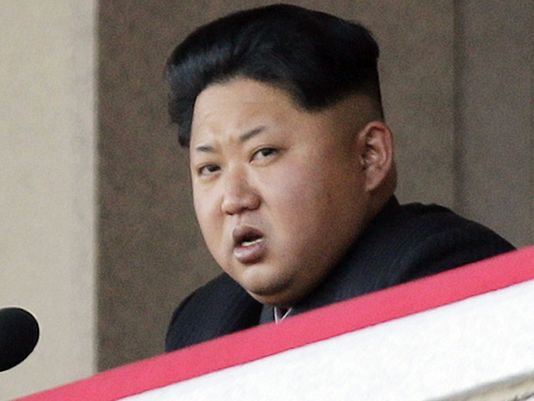
More than global warming, Chicken Little is making low volume whirring sounds over the growing risks in the South China Sea and with North Korea. Increased sanctions are threatening a collapse of North Korea’s economy. Things may escalate by 2017. That’s all we need: President Trump and Kim Jung Un facing off.Kim Jong-Un

Donald Trump


Ancient Mariner

The News

The mariner is wearing thin. We have at hand one of the most interesting campaigns for President in the last three quarters of a century. At stake are deep running cultural conflicts that have been emerging since Papa Bush; the presence of an oligarchy under siege; Federal and State governments are as dysfunctional as four flat tires; the definition of work is at a troublesome crossroad; international corporations are free from nationalist control; shifting economic power and a change in economics itself opens a different future for international monetary policy; the reasons to move forward with a Supreme Court appointee are deep and philosophical; the very planet is under siege. Sigh.

As usual, mariner will succumb to the Prophet Amos to speak about the news media. At the moment, all mariner’s alter egos are speechless and dumbfounded by the generic incompetence of the press. Only disjointed utterances like: ignorant plebeian, ass, stupid brainless muppet, moron, brain dead piece of shit, useless egotistic lump, and…well, you get the drift. Even PBS is insipid. However, Amos will step forth with smoother homiletic form.

Mariner reviews numerous websites and TV channels to glean meaning from the news. Note he said “glean meaning” – the content itself is too often little more than dross. From television, he gives most of his viewing of news to the four broadcast companies (ABC,CBS,NBC,PBS), CNN, MSNBC, Bloomberg News and Aljazeera; some time is given as appropriate to FOX, Free Speech (FSTV), CSPAN, PBS specials and the weather channel.

There are four areas of complaint: detracting personality, lack of insight, irrelevant fill – as Jon Stewart used to say, “oxygen,” and the fourth is misinformed, to be gracious.

Personality. Amos mentions three types of “news anchors” to set the pattern. Only names are necessary to the knowledgeable viewer: Chris Matthews, who never hears the end of a guest’s sentence because he starts talking at the same time – meaning that viewers can’t understand what’s said by either of them; Chuck Todd and Erin Burnett, who are more interested in trapping and hog-tying their guests than raising the bar on quality insight (mariner actually enjoys guests who don’t yield and put the anchor in a dead spot); and Wolf Blitzer – unless he already has been replaced by a robot. Ending on a high note, many correspondents, especially on MSNBC, are coherent and understand the nuance of what they are reporting.

Lack of Insight. The mariner recently wrote a post, Poor Mitch, that took notice of the need to keep the Supreme Court as far from populism and special interests as possible. The best any news outlet can do is incessantly ploughing the same shallow arguments given by Mitch McConnell that the public must have a say in the next Supreme Court appointee. His position is in direct conflict with the spirit of the Constitutional process. The tendency is universal to report on human behavior and intentionally ignore reasoning and broader circumstances which may explain or contradict the human behavior. The mariner has begun to switch channels during coverage of ‘advice and consent’ after borrowing a few expletives from the list.

Irrelevant Fill. Amos is hard pressed to select just a few. Virtually all newscasters are nominalist, that is, events are simply things in motion; thematic content and paradigm causation are not ‘happening’ things. Evidence is in the following quote from a CNN correspondent on the scene in Boston feigning urgency while waiting for news on the Boston Bomber: “We see a dog, it is barking. It could be a K9 unit. We don’t know. It is a dog.” – Naturally, this is more important than taking broadcasting time to investigate in-depth analysis of the entire situation, or even cutting off the on-site broadcast to report on other serious news that has been pushed aside to report on the dog.

The truth is, staying on the scene identifying dogs and counting anonymous cars driving by was suffered in case real news, AKA an opportunity to retain viewer share, occurred. CNN is famous for having the best ratings during a pumped up news event that is milked nonstop for days. Between the pumped up events, CNN becomes noticeably vapid and preoccupied with broadcast format rather than content. Between events, viewership drops accordingly. This may be the curse of filling a 24-hour news cycle.

Misinformed. Again, a few names are all that is required to understand the fourth complaint: Glenn Beck, Sean Hannity, Ann Coulter, Rush Limbaugh…. On the liberal side, most of the guests on progressive outlets err when trying to link unfocused ideas to current reality, for example, Mika Brzezinski, Bob Beckel and guests like Thomas G. West and Ricardo Lagos. To be honest, the thoughtful viewer/reader should approach FOX and conservative radio as if they were a Broadway play. Enjoy its idiosyncrasies, marvel at the script, enjoy its characters – just remember it is not reality.

All this taken in hand, it is a long time to the November election and the inauguration. Mariner suggests taking a break every ten days; avoid news outlets; pursue vacations and other distractions; focus on personal relationships and personal health. Then return to the fray and the stupid brainless muppets. You have a moral obligation to be an educated citizen.

The reference section is offered as a routine to follow, previous complaints withstanding.

REFERENCE SECTION

  • Mariner thanks readers who helped Congress overturn the removal of genetically modified organism (GMO) notification on modified product labels. The Monsanto-backed bill was defeated by one vote: 49-48. The bill also would have provided Monsanto with protection from lawsuits for any reason. The bill had a nickname: the Monsanto gift bill.
  • Nate Silver is mariner’s preferred statistician. Nate has a wide ranging website, www.fivethirtyeight.com . Nate and his staff cover everything including comprehensive analysis of sports, politics, economics, data phenomena and polls of every kind, census statistics, and more. The website is very entertaining, light reading, and full of prognostications. Most important, Nate is accurate! Today, mariner recommends visiting the website to read an article about how computerized databases know more about what you will do than you do. A subtitle says, “The world that you see is being configured to a probable reality that you haven’t yet chosen.” See: http://fivethirtyeight.com/features/doug-rushkoff-says-companies-should-stop-growing/ .While on the site, look around….
  • If the reader hasn’t found CNET already, give it a try. It’s an off-the-wall, gadget laden news site (along with endless gadgetry for sale). For example, there is a news video about self-lacing shoes on the market, what Adam Savage (Mythbusters) is doing now, buying gas with Apple Pay, robot delivery of pizza, and Jesse Jackson backs Apple regarding the FBI warrant – just to scratch the surface. http://www.cnet.com/
  • A weekly tour guide that keeps the reader up to date should include at least the following websites:

http://www.theatlantic.com/ An excellent magazine; top caliber! Has several featured articles that provide insightful analysis of important issues.

http://www.bbc.com/news/world Least constricted coverage of world news; much less slanted than US international news.

http://www.pbs.org/newshour/ An unobtrusive website that provides clean news reporting and provides many branches to explore including PBS television.

http://www.politico.com/ All things political.

http://www.bloomberg.com/ Business and economic news with top headline coverage.

http://fivethirtyeight.com/ Nate Silver’s website; see review above.

http://www.livescience.com/ Latest in news from the science and environment sectors written for the unsophisticated viewer.

http://www.nytimes.com/section/books A place for all bibliophiles with new publications, many reviews, special interests and commentary.

http://espn.go.com/ Probably the most thorough coverage of all things sports. Search specific sports for in depth coverage of a single sport.

Finally, for information on an endless array of knowledge and personal interests – a liberal arts playground – see: https://www.wikipedia.org/ .

Ancient Mariner


Happiness Is

Reader Marty, who downloaded the Happiness report, replied to the post, Theodicy and Secularism –

“I thought it was interesting that the Dalai Lama said that we cannot count on religion as the basis for our ethics, since the people of the world cannot agree on one religion–and many don’t believe in any religion at all. (This was in the UN World Happiness Report.) The Dalai Lama said that we need a secular ethics. The World Happiness Report suggested a secular ethics based on the Greatest Happiness Principle. I think the UN has made a great start in the Universal Declaration of Human Rights. We have the plan already in place, if only we would follow it. Ha! Isn’t that always the problem!”

In concert with Marty’s response and in acknowledgement of how important, how critical this concept is, the mariner has reproduced verbatim that portion of the Happiness Report that explains the happiness principle. Further, two other recent posts have focused on this subject. See: Where is our Light? and Sailing One’s Own Ship in a Tumultuous World.

The Greatest Happiness Principle

So, first, what ethical idea based on human need can best fill the moral vacuum left by the decline of religious belief? The answer must surely be the great central idea of the 18th century Anglo-Saxon Enlightenment on which much of modern Western civilisation is based. This can be expressed in three propositions.

 We should assess human progress by the extent to which people are enjoying their lives—by the prevalence of happiness and, conversely, the absence of misery.

 Therefore, the objective of governments should be to create conditions for the greatest possible happiness and the least possible misery. As Thomas Jefferson put it, “The care of human life and happiness … is the only legitimate object of good government”.

 Likewise the obligation of each of us is to create the greatest amount of human happiness that we can in the world and the least misery. (Overall happiness of course includes our own.) And in all of this it is more important to reduce unhappiness (or misery) than to increase the happiness of those who are already higher up the scale.

These three propositions are what may be called the “greatest happiness principle”. It was Proposition 1 which inspired many organisations, like the OECD, the EU and many governments, to reassess their answer to the question: what is progress? And it was Propositions 1 and 2 which have mainly inspired the production of successive World Happiness Reports – our hope has been to display enough of the new science of happiness to enable policy-makers to make happiness a practical goal of policy.

But it is Proposition 3 that we wish to promote in this chapter, because we believe it should be the central principle which inspires those billions worldwide for whom religion no longer provides the answer to how we should live.

The principle is frequently misunderstood. For example, it does not assume that people are only concerned about their own happiness. On the contrary, if people only pursued their own happiness, this would not produce a very happy society. Instead the greatest happiness principle exhorts us to care passionately about the happiness of others. It is only if we do so that true progress (as we have defined it) can occur.

But what is so special about happiness? Why not judge our progress by our wealth or our freedom or our health or education, and not just our happiness? Clearly many things are good. But different goods are often in competition. My spending more on health may mean spending less on education. Or wealth-creation may require some limitations on freedom. So we have to ask why different things are good? And in most cases we can give sensible answers. For example, ‘Wealth makes people feel good’ or ‘Ill health makes people feel bad.’ But if we ask why it matters how people feel—why happiness is good—we can give no answer. It is just self-evident. So happiness is revealed as the overarching good, and other goods obtain their goodness from the fact that they contribute to happiness. And that is why an “impartial spectator” would judge a state of human affairs by the happiness of the people.

The greatest happiness principle has a universal appeal. It has the capacity to inspire, by mobilizing the benevolent part of every human being. In the language of Jews, Christians and Muslims, it embodies the commandment to Do as you would be done by, and to Love your neighbor as yourself. In the language of Hinduism and Buddhism, it embodies the principle of compassion—that we should in all our dealings truly wish for the happiness of all of those we can affect, and we should cultivate in ourselves an attitude of unconditional benevolence….

….In this context, an ethical system that favours not only others’ happiness but also our own has a much better chance of being implemented than one that is pure hair-shirt. It is therefore a huge advantage of the greatest happiness principle that it requires self-compassion as well as compassion towards others.

Reprinted from Chapter 3: Promoting Secular Ethics, Fourth World Happiness Report 2016 in behalf of the United Nations.

REFERENCE SECTION

It behooves the reader to read the Universal Declaration of Human Rights mentioned in Marty’s reply, see: http://www.un.org/en/universal-declaration-human-rights/index.html

To see the World Happiness report, http://worldhappiness.report/ for a free download or purchase a printed copy at: https://shop.un.org/search/Universal%20Happiness%20report  $17+shipping.

Ancient Mariner

Theodicy and Secularism

Theodicy is a philosophy organized and documented by Saint Augustine of Hippo (354-430CE). Theodicy addresses specifically the question: “If God is good, loves all things and created all things, why is there evil in the world? Either God also created evil and therefore is not good and loving, or God does not exist.” Theodicy is a defense of God’s perfection in light of the existence of evil.

The question itself was asked as early as Plato and was posited as a reason for nominalism[1] by William of Occam, famous for Occam’s Razor. Bertram Russell, a famous British agnostic, mathematical theorist and inquisitor at large, presented the following thought experiment in an article titled, “Is there a God?”

“If I were to suggest that between the Earth and Mars there is a china teapot revolving about the sun in an elliptical orbit, nobody would be able to disprove my assertion provided I were careful to add that the teapot is too small to be revealed even by our most powerful telescopes.

But if I were to go on to say that, since my assertion cannot be disproved, it is an intolerable presumption on the part of human reason to doubt it, I should rightly be thought to be talking nonsense.

If, however, the existence of such a teapot were affirmed in ancient books, taught as the sacred truth every Sunday, and instilled into the minds of children at school, hesitation to believe in its existence would become a mark of eccentricity and entitle the doubter to the attentions of the psychiatrist in an enlightened age or of the Inquisitor in an earlier time.”

“The existence of this teapot cannot be disproved. We can look and scan the skies almost for eternity, and it may always just be the case that it wasn’t in the place we looked – there may be another spot we’ve overlooked, or it may have moved while we were looking. However, given the absurd nature of the specific example, the teapot, we would rightly infer that absence of evidence is evidence of absence. Russell’s audacity in the thought experiment was to question why people don’t like to apply the same, sound, logic … to the existence of any particular deity; there is no difference in the evidence base provided, therefore there is no reason to assume a God and not a celestial teapot.[2]

Theodicy addresses these logical challenges to deism – the belief in a supreme god. Saint Augustine, simply, said that God is perfectly good. It was God who created the world and the universe out of nothing and that evil is a byproduct of humanity’s sin. Evil is the punishment for original sin[3]. Augustine states that continued sin is created by human free will, an attribute made possible by eating fruit from the tree of knowledge. God remains whole and not responsible for sin and suffering.

  • – – –

During the nineteenth and twentieth centuries, secularism[4] emerged as a broadly accepted philosophy. Secularism is different than agnostic or atheistic philosophies which require, more or less, theistic presumptions. Secularism has ethics derived from humanism, pragmatism, and anthropological reasoning. Secularism is a self-contained life experience where the existence or non-existence of God does not matter.

Augustine (and many other theologians) would consider secularism sin. In religious context, God is the source of goodness and love – elements that are not necessary in secularism. Secularism is founded in vanity and self aggrandizement. The original question about the existence of God is replaced by the question, “What is good?” Humans tend to answer this question in terms of convenience and privilege for the self, the community or the nation – whatever works best – especially for the individual.

It is obvious already that great questions confront humanity in the twenty-first century. Human culture is yanked back and forth by new technologies, new scientific frontiers, abuse of the planet, power shifts in national supremacy, and even the existence of humanity itself. Some will argue that only secularism will allow the best decisions to be made in the future; others will argue that, despite the vagaries of the future, the belief in a superior force – one that predefines what is good – is our only rudder.

We shall see.

Ancient Mariner

  1. [1] Oxford Dictionary: “the doctrine that universals or general ideas are mere names without any corresponding reality, and that only particular objects exist; properties, numbers, and sets are thought of as merely features of the way of considering the things that exist. Important in medieval scholastic thought, nominalism is associated particularly with William of Occam. Often contrasted with realism.

[2]See: http://rationalwiki.org/wiki/Russell’s_Teapot

[3] Old Testament, Genesis 3.

[4] Merriam –Webster Secularism: indifference to or rejection of religion and religious considerations.

Lessons from History

Cable news pundits are always trying to catch up with Donald’s intentions and tactics; they are bewildered by the lack of manners and sophistication. The pundits are always chasing Donald rather than knowing how Donald and his troops will behave. When Donald the Drumpf says there will be riots, riots is what will happen. His troops have no sense of decorum; it is a battle to install Donald as President. The pundits need only be familiar with several battles in history where the government was overthrown.

One of mariner’s favorite names in history is Robert the Bruce. Robert the Bruce is the Scottish Overlord (king) who gained Scottish independence from England during the fourteenth century. He lived a life of intrigue, murder, war, and marriage worthy of a PBS series. His armies were made up more by scoundrels than by organized defenders of fiefdoms. The comparison to Donald’s situation is that there is no decorum. The troops will enjoy physical conflict and destruction – that’s the whole point of his campaign.

Another conflict that often comes to mariner’s mind is the French Revolution, a drawn out affair in the midst of the Enlightenment when philosophers and political observers began to challenge absolute rule by a monarchy and suggested ideas like democracy, liberalism, nationalism, and socialism (does that sound familiar?). Leading up to the revolution years were growing ideas about a role for the bourgeois (citizenry) versus rule by the French Nobility (billionaires). Thanks in large part to the ineptitude of Louis XVI, recession and food shortages lead to what today would be called national bankruptcy.

Throughout the mid 1700’s, King Louie held the conservative line and forced commodity prices higher to sustain France’s GNP but did not provide income to the citizenry (recession). Further, in the midst of the failing economy, Louie recognized the colonial United States and joined the war on their side against the British – putting more strain on France’s economy (Iraq/Afghanistan/Syria). Further, England was invading French soil (China, economically).

Finally, in 1791, Louis XVI accepts a new constitution (Republican party accepts Donald) but the war has only begun. The new government is inexperienced at governing and proves to be incompetent (Donald the Drumpf). In 1793 the beheadings begin. If the reader is looking for Joan of Arc, she was in the Hundred Years War defending Charles VII, eventually captured by the British and burned at the stake in 1431.

The mariner feels the press is making a mistake assuming they are part of the establishment (billionaires for whom they work) when they should be on the sidelines presenting an accurate description of a cultural war between old school capitalism and a new cultural and economic requirement to infuse more socialism into the philosophy of government (sound like another Enlightenment?)

Ancient Mariner