2018 Observations

    Speak to a member of Donald’s base and they will say “Donald is doing exactly what we want him to do.” The populist base wanted a grenade thrown at the Establishment. It did explode and has upset the status quo to a great extent – especially in Cabinet policy. In fact, the grenade exploded so strongly that it exposed the GOP for what it is: Republican Senators living foremost for selfish reasons; Senators holding on to Reagan economics which don’t work in today’s international economy; GOP Senators are conservative tribalists rather than national statesmen. Could a blue wave wash over the Senate in 2020? Mariner believes a few new democrats may make it but not enough to overturn the GOP majority. The Senate doesn’t work correctly in today’s Government consisting of 50 states, 350 million citizens and a modern computerized society. Mariner’s observation is to abolish the Senate completely or at a minimum combine the two houses thereby making every representative subject to proportional representation. And toss out the Electoral College while we’re messing with the Constitution.

   January 2018 had bouncy temperatures ranging from below zero to days in the sixties in the Southeastern part of Iowa. El Nino is forming in the Pacific; it appears the winter jetstream will offer slightly warmer weather in January 2019 than we had last year. If one lives in the Carolinas or New England, the same jetstream won’t be so nice with increased rain, snow and energetic storms. It is a fact that one cannot predict climate change with weather forecasts over a short time. However, mariner agrees with the observation of scientists who study the Earth in geologic terms: the climate change thing already is out of the bag and will have its way with us. Even if the international community meets the requirements of the Paris agreement, the Earth is a big place and large, slow moving planetary phenomena have too much momentum for us to steer. The main worry is what will rising seas, floods and droughts do to our economy?

   According to a Senate Intelligence Committee report, Instagram “was a significant front” in Russian election meddling, eclipsing even Facebook itself. Between 2015 and 2018, there were 187 million interactions with Instagram content from the Internet Research Agency, the Russian trolling operation, compared with 77 million interactions on Facebook and 73 million on Twitter. [Bloomberg]

A popular quote is in frequent use at the moment. The quote is Ben Franklin’s response to a woman’s question about what the founders had delivered: “A republic, if you can keep it.”

A democratic republic requires constant maintenance by its citizens. This means that managing our government at Federal, State and Local levels is a necessary chore that we must continually exercise by voting (but today only 47 percent vote), attending town hall meetings and other events that provide access to our representatives, participating in political causes and party affiliations (only 12 percent of citizens participate even minimally in civic activities). This is sophisticated stuff that requires an educated understanding of citizen responsibilities (civics is not taught in public schools).

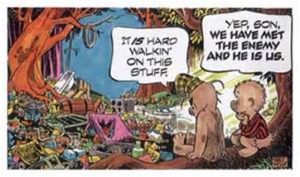
It is mariner’s observation that US citizens duck responsibility and blame Russian influence on the Russians. There’s nothing stopping any citizen from taking ownership of their democratic republic at a cultural level and at a political level. Stop blaming others a la Donald and step up to ownership of a nation. If we Americans did that, the Russian issue wouldn’t exist.

Ancient Mariner


Bowling and Politics

In this post mariner promotes two books. The first one is a sociological view of American behavior particularly as it relates to how Americans have changed how they socialize. The second is by a memorable US Representative from Michigan, John Dingell, who was an active liberal during his tenure – the longest of any Representative serving from 1955 to 2015.

֎ Bowling Alone, Robert Putnam, 2001, Simon and Schuster

The premise is that Americans have, as a total population, withdrawn from community activities and civic life. The popularity of TV reflects people’s desire to wind down and relax in a setting over which they have total control. Many people may feel that socializing with neighbors is taxing, while TV is in one’s home and it’s always available. The national average across all segments of the population is eight hours per day.

Add to TV the phenomenon of smartphones. Mariner has noted in past posts how the smartphone eliminates extended or serious conversations in family life. Children aren’t admonished for using the smartphone too much because the parents are busy using the smartphone too much. A Silicon Valley executive once admitted he requires all electronics to be left by the door when family members return home. Just like in the Wild West days when guns were left at the door – will both harm us?

Another distraction to interactive human life is social media. Why visit family when one can pretend to visit on Facebook?

“Putnam contends that participation in collective activities such as bowling leagues and other leisure, faith and political associations, fosters norms of reciprocity through which people develop an orientation to cooperate with and trust others. Surveys have consistently shown that members of associations tend to trust others and have more friends in the neighborhood than non-members. Such norms and networks of civic engagement constitute what sociologists have called ‘social capital’. Drawing on theoretical insights developed in his previous book Making Democracy Work, Putnam argues that social capital is important because the high levels of trust and cooperation that characterize socially and civically engaged communities are positively associated with the performance of social institutions, economic prosperity, and individuals’ wellbeing and longevity.”[ResearchGate]

Since the 1960s Americans increasingly have moved to socially and ethnically homogeneous, car-dependent suburban areas. Obviously this arrangement limits open, public discourse on matters of the day with others who may be from different social situations. This neighborhood isolation leads to false assumptions that are counterintuitive to democratic concepts, for example, “NIMBY” – not in my backyard!

֎ The Dean – The Best Seat in the House, John Dingell, 2018, HarperCollins.

John Dingell always has been known for calling a spade a spade. Speaking to the terrible shape our nation is in:

“There are many reasons for this dramatic decline: the Vietnam War, Watergate, Ronald Reagan’s folksy but popular message that government was not here to help, the Iraq War, and worst of all by far, the Trumpist mind-set. These jackasses who see “deep state” conspiracies in every part of government are a minority of a minority, yet they are now the weakest link in the chain of more than three centuries of our American republic. Ben Franklin was right. The Founders gave us a precious but fragile gift. If we do not protect it with constant vigilance, we will most certainly lose it.”

How does John suggest we restore our political ethos?

“An electoral system based on full participation. At age 18, you are automatically registered to vote. No photo ID, no residency tests, no impediments of any kind. Advances in technology can make this happen effortlessly. Yes, voting should be restricted only to American citizens. Strict protections against foreign meddling are also necessary.”

Further:

“The elimination of money in campaigns. Period. Elections, like military service—each is an example of duty, honor, and service to country—should be publicly funded. Can you imagine if we needed to rely on wealthy donors to fund the military? I know there are those who genuinely believe in privatizing everything. They are called profiteers.”

Restructuring the Federal branches of government:

“The end of minority rule in our legislative and executive branches. The Great Compromise, as it was called when it was adopted by the Constitution’s Framers, required that all states, big and small, have two senators. The idea that Rhode Island needed two U.S. senators to protect itself from being bullied by Massachusetts emerged under a system that governed only 4 million Americans.”

“Today, in a nation of more than 325 million and 37 additional states, not only is that structure antiquated, it’s downright dangerous. California has almost 40 million people, while the 20 smallest states have a combined population totaling less than that. Yet because of an 18th-century political deal, those 20 states have 40 senators, while California has just two. These sparsely populated, usually conservative states can block legislation supported by a majority of the American people. That’s just plain crazy.”

“With my own eyes, I’ve watched in horror and increasing anger as that imbalance in power has become the primary cause of our national legislative paralysis. In primaries, the vocal rump of a minority of obnoxious asses can hold the entire country hostage to extremist views. This insanity has sent true public servants fleeing for the exits. The Electoral College has the same structural flaw. Along with 337 of my colleagues, I voted in 1969 to amend the Constitution to abolish it. Twice in the past 18 years, we’ve seen the loser of the popular vote become president through the Electoral College formula, which gives that same disproportionate weight to small states, each of which gets two automatic votes for its two senators.”

There is a solution, however, that could gain immediate popular support: Abolish the Senate. At a minimum, combine the two chambers into one, and the problem will be solved. It will take a national movement, starting at the grassroots level, and will require massive organizing, strategic voting, and strong leadership over the course of a generation. But it has a nice ring to it, doesn’t it? “Abolish the Senate.” I’m having blue caps printed up with that slogan right now. They will be made in America.

If mariner were motivated to write a book, he would not need to – John wrote it for him.

Ancient Mariner

Another Episode of Brain v Gorilla

When mariner moved to his current residence in a small Iowa town, he noticed that many families had leaf blowers. It is also true that town families have affection for any kind of two cycle engine some of which are cultivators, lawn mowers, leaf blowers, chain saws, air compressors, lawn trimmers, car washers, paint sprayers and generators. In recent years some two cycle engines have been replaced by battery-driven power using Lithium. All these devices save (avoid) physical labor.

When he was younger mariner remembers old timers saying, “Back in the day we had to cut grass with push mowers” or “When I was seven, I had to rake leaves with a rake and burn them” and of course the classic, “When I went to school, it was uphill both ways.” Many more examples of saving labor can be conjured. Technology has changed the level of labor-saving opportunities: “Back in my day we had to forge and shape our pistols on an anvil.” Today, of course, just turn on your 3D printer and one will be made for you.

Mariner observes this tendency to avoid labor as a universal characteristic of all living things. The squirrel in mariner’s back yard raids the bird feeder rather than hunt for food; monkeys in Bangladesh raid street market fruit stands with the precision of a navy seal team rather than hunt for food in the surrounding trees; chipmunks greatly prefer a life of pilfering to a legitimate relationship with nature; Raccoons prefer the corncrib to rummaging in the forest.

In response, most folks would say, “And?” Being retired and of an idle mind, mariner has time to speculate on this important dichotomy in evolution. Imagine that evolution did not have a fluid-like motion of change and a cause and effect adaptation over eons of time. Imagine that evolution was a result only of serendipity and otherwise was a defined marching order set forth by a permanent genome. Mariner dares to say evolution would fail and species would disappear even faster than humans have succeeded in expiring them.

Humans in particular are quite adaptive to their own circumstances. Humans even have created their own environmental reality far beyond the influence of two-cycle engines – to the chagrin of Mother Earth, also subject to planetary evolution. It is evident that the conflict between Brain and Gorilla grows more intense. (If the reader must be prompted, Brain is the grey matter in our skulls that has an extraordinary imagination unbound by anatomical ethics; Gorilla represents our physiologic constraints as a primate on evolution’s tree. Brain has no difficulty, in fact, enjoys manipulating anything and everything it can from atoms to global atmospheres. Gorilla is bound to follow the current constraints of its body and an environment favorable to that body.)

Too slow to notice, there is a cause and effect phenomenon created by our supple brains. The simplest example mariner can think of at the moment is the ability of the brain to control fire. Before Brain, fire was a cleansing function, born of the Solar System itself that reenergized an environment. The recent fires in California demonstrate how violent and indifferent fire cleansing can be. But Brain turned fire into an every day experience used to keep warm, cook, and incorporate into chemical processes (oil, explosives, herbicides, nuclear bombs and most important, electricity) that are to the advantage of human ingenuity. These new processes go far beyond any physiological requirements held by Gorilla – and often are in conflict with those physiological requirements.

Those who are concerned about the state of Gorilla, e.g., physicians, physical therapists and the like, lament an invention by Brain: the chair. Gorilla has a skeleton and musculature that is ruined by sitting in a chair. For the vast majority of us, sitting in a chair is the dominant activity of the day. Sitting in a chair leads to general back pain, stooped posture, bulbous abdomen, accelerates atrophy of leg muscles and arthritis. Compression of the viscera along with fat caused by sitting all the time interferes with kidney function, digestion and oxygenation. Functionally, the chair deters Gorilla from performing the exercise needed to remain fit.

Mariner offers the chair conflict as a simple metaphor for all the divergent issues between Brain and Gorilla. The most important effect of these conflicts lies in the unnoticed process of evolution. In recent centuries, as conflicts increase both in number and impact, Brain has begun to have visibly negative effects on Gorilla. Further, Gorilla’s environment has serious problems. Gorilla and its fellow creatures are not doing well and constitute a modern major extinction of species.

It is the inventiveness of Brain that forces scientists to rename the present Holocene Epoch as the Anthropocene Epoch because Brain has such an impact on Earth’s environment.[1] Evolutionary activity typically follows a significant change in environment. Briefly, the primary demise of dinosaurs and the beginning of mammals and birds was caused by destruction of the Earth’s environment by a meteorite. While Gorilla hasn’t changed much in a million years and its needs have been met by the environment, Brain has separated its environmental needs from the traditional habitat of Gorilla.

Brain requires above all else a controlled, electrically-based environment. To emphasize this transition, the next era of Brain (AKA human) progress will be artificial intelligence (AI). AI will enable Brain to replicate human behavior in robots and androids, including perception through the five human senses (Gorilla senses?). Relative to all the immense changes of the next age, how long will it take for Brain to cohabitate with its new friends and not need Gorilla or Gorilla’s habitat?

Ancient Mariner


[1] An excellent and easy to read reference about Brain’s impact on Earth’s history can be found at https://www.livescience.com/28219-holocene-epoch.html

Transported Back Through Time

Mariner watched the NetworkKnowledge (PBS) broadcast of Neil Diamond’s concert performed in 2012 at the Greek Theater in Los Angeles. Mariner and his wife are big fans back to the time they saw him on television in the sixties. They’ve been to the concerts. There’s something about Neil Diamond that draws his audience together. One isn’t there to enjoy a star performer; fans are there to be with Neil while he sings. Mariner and his wife have been to other concerts, too, and each has their special attraction. But Neil has the ability to draw fans to him in a way that not every bigtime singer can.

Fans are aware that Neil has allegiance to his band and the three singers who have been with him throughout. In the broadcast mariner watched, the old guys were there, Ron Tutt on drums, Dave Moscoe on keyboard, Reinie and Linda Press (bass and background singer). This concert has been a big winner over the years with all the old songs and an unbelievably errorless, high energy performance by everyone – including the audience.

Watching this concert tonight was different. It wasn’t mariner just listening to the oldies and reminiscing about young times. He sensed a time warp back to a time when America held itself together. There was no Donald, no selfish, derelict political parties, no oligarchical dominance, no ignorance about who we were or how we identified with our nation, no concern that the next generation will be poorer than the last. True, there was turmoil caused by an unpopular war, racism was deeply suppressed until the Civil Rights Act. Conversely, tribalism and identity politics did not dominate the daily news. Computerization still was a pleasant, safe element in society.

Mariner sensed how life was back then – sure, reality required maturity and responsibility – but there was no incessant angst. Generally, people had time to live a day without constant confrontation. Abuse and insecurity caused by government and self-centered corporations was not daily news; churches still were the same churches that had anchored neighborhoods and moral virtue.

Angst. That’s the difference. The twenty-first century has begun with fragmentation of who we think we should be, how we depend on our economy, and even if there will be jobs, affordable education and secure retirement – all at once. Computerization has become a tool of manipulation and slowly separates wealth between classes. “Footloose and fancy free” has a new inference: we don’t know who we are or where we’re going.

Angst. Mariner escaped it for a brief moment tonight, escaping back through a time warp with Neil.

Ancient Mariner


On The Atlantic and other Things

Regular readers will know that mariner’s favorite magazine is The Atlantic (TA). He has added a few to his personal library. There are several other magazines in its class that provide cogent insights in the social sciences and can be trusted to deliver balanced reality based on studied facts. TA often approaches scholarly levels in its presentation of the human experience.

Not everyone would want to spend the time and focus required to read TA. When TA focuses on an issue, it is a 3-credit course on the subject. An excellent example of this pattern is the October 2018 issue. The cover headline asks, “Is Democracy Dying?” Nine articles are referenced right on the cover that provides an excellent base for understanding the turmoil of contemporary society, politics and governance.

Reading TA cover to cover in one sitting is not recommended. Mariner keeps copies of recent magazines on his dining room table to be perused an article at a time. When the October issue is completely read, one is knowledgeable, capable of thematic reasoning about democracy, and aware of the human experience dependent on democracy.[1]

– – – –

Writing about life experiences often drops to melodramatic levels which  certainly are valid but limit the reader’s ability to contemplate broader views. One magazine that is unique in presenting holistic articles about reality that give a reader room to ponder is Smithsonian Magazine (SM).

Like TA, SM often promotes a theme for its articles but SM also includes articles about the world, interesting individuals, nature, and often, articles based on the Smithsonian Museum collection in Washington D.C. SM is a pleasant read.

The September 2018 edition focuses on moments in American history that have been forgotten or that provide insight into unknown situations. The issue also includes articles about Rhinos in Washington and a toy school bus.[2]

– – – –

There are several magazines about science. Most are focused on one kind of science like astronomy or health or agriculture. Three magazines, Science, Nature and Scientific American, are widely read. Over time mariner has chosen Scientific American Magazine (SA) because it is totally comprehensive in its range of science and technology and at the same time provides reader-friendly articles and references. Every edition has an endless insight into diverse – and often surprisingly humanistic – branches of science that enrich the reader’s familiarity with science.

Like other recommendations, SA often sets a theme for an issue. In the October 2018 copy, the theme is “How to fix Science” It covers funding, enforcing the ability to reproduce research claims, dealing with government denial, and increasing interdisciplinary research. There is an article preparing us for fake videotape and fake audio.[3]

– – – –

Each of the above magazines has a strong Internet presence. Mariner and his wife enjoy reading books and magazines in print form but for many who are too busy or who prefer to pick and choose what to read, mariner recommends both the official websites and subscribing to their newsletters that arrive in your email.

Another source for intelligent, dependable dialog is the collection of National Public Radio (NPR) products and broadcasts. If one is more interested in good fiction than nonfiction, there is no better place to look for a good book than NPR’s Book Concierge at https://apps.npr.org/best-books-2018/ . On the other hand, the NPR news page avoids the hysterical advocacy of TV news; see https://www.npr.org/ . This home page will lead you to broadcasts, podcasts and other entertaining – and rational – information.

Remaining informed is similar to keeping fit. It requires commitment.

Ancient Mariner


[1] Fortunately, TA has an excellent archive. To read the articles in the October 2018 issue, see:

https://www.theatlantic.com/magazine/toc/2018/10/

[2] Find SM archives at https://www.smithsonianmag.com/issue/archive/

[3] Find archive issues at https://www.scientificamerican.com/store/archive/?magazineFilterID=Scientific%20American%20Magazine

How to know how much is Actual News

Mariner finds it difficult to ascertain actual news from ramblings, speculations and gossip on all the 24 hour news channels. He has borrowed a formula from geometry to help identify the true news content from the smoke and mirrors of news broadcasting. Where are Huntley, Brinkley and Walter Cronkite when we need them?

Normally, the formula is used to determine the radius of a true circle when only the chord length and distance from the chord to the arc are known. What is intriguing about this formula is that it is totally relative in its solution; it makes no difference what the values of the chord and arc are, a correct radius always will be defined. The formula:

Radius = 4h2 +l2
                8h

Redefining variables for our purposes,

Radius = Total News broadcast which is a constant of 100
Height = Actual News
Length = Number of Pundits

Solving for unknown height instead of unknown radius, the formula becomes:

h = r – √r2 – l2

Assume 4 pundits

h = 100 – √ (10,000 – 16)
h = 100 – √ 9984
h = 100 – 99.92
h = .08   In other words, Actual News is 8/100ths of Total News when there are 4 pundits – less than five minutes of an hour-long broadcast.

What’s important is that actual news takes so little time.

Ancient Mariner


Compassion, Damn It!

Well, well. Wasn’t the fur flying because young mariner had no traffic ticket for his accident. An entire article about compassion as the root of democracy was trashed because mariner did not get a ticket. So much for compassion over judgment.

Mariner understands that in these uncertain times citizens are chary and become judgmental about due process. Nevertheless, he stands by the principle that compassion without judgment is both restorative to personal happiness and productive as well. One thinks of the abused folks who constitute Donald’s base: The US economy has squeezed them for decades; there is little that comes easily to them. These folks are left only with defensive mechanisms similar to pride, judgmental attitudes, intense populist ethics that are destructive – in their minds as it should be – and intensely protective of what little they have.

Mariner assumes that most readers have read the parable about the Good Samaritan so he won’t repeat it here. Perhaps, though, you just might check out Luke 10:25. The context surrounding the Samaritan’s compassion is identical to the social conflicts present today. The US population has become increasingly conscious of class, even fragmented versions of class (identity politics). In the Samaritan’s situation, he was considered less than a proper Jew because Samaritans did not adhere to the racial requirements of proper Judaism; Samaritans allowed mixed marriages even though otherwise they practiced the Jewish faith.

Mariner’s wife read a book written by a homeless person, Lars Eighner, who walked across the country with his dog Lizbeth.[1] From the book she remembers a time when Lars, who had no source of income, would save the bit of change he came by to purchase dogfood for Lizbeth. Many times others in the stores would buy his dogfood for him. No one said “He ought to get a job” or “He should be picked up by the police.”

Often mariner has touted the practice of “Pass it forward.” It is a practice based on having a compassionate insight into another person’s need without judgment or prejudice. Use this simple gesture to practice compassion. What’s more important than ever is to look for ways to be compassionate toward someone from a different class – even a different political class.

Ancient Mariner


[1] Travels with Lizbeth, Lars Eighner, Ballantine Books, 1993

One for Many but Many for One, too

Mariner was a young lad, well, not really young, he had progressed a bit in his career and was working as a staff consultant assisting all state law enforcement agencies in complying with new Federal regulations about reporting law enforcement activities to a State database. Let’s just say he had a full head of hair with a flat top.

The work was both tedious and fraught with conflicts about changing behaviors that had long existed in local police agencies. After a hard Friday, we all stopped after work to enjoy a happy hour at a local pub. It was a good release from a difficult day and, after a couple of hours, mariner had had an uncounted number of half-priced gin and tonics. Needless to say, as he left for home, he had an accident on the interstate. One is supposed to slow a bit when taking a tight exit ramp, which mariner failed to do.

But the accident is only a set-up for a genuine insight that has stayed with mariner throughout his life and sets his belief in what democracy is all about.

Mariner rolled his jeep-like vehicle and totaled it. He crawled out the back window virtually unhurt. The first person to be there as he crawled out of the vehicle was a nurse who checked him for critical injuries, determined he would survive and left. The second person to greet mariner simultaneous to the nurse fed him two breath mints to help ward off law enforcement analysis of his inebriation and left. The third person redirected traffic. There was no judgment of mariner’s behavior; there was no judgment of inconvenience; there was no judgment of moral principles. Mariner was a fellow interstate traveler. Further, because he was in law enforcement and reported to the Secretary of Public Safety, police officers saw to it that there were no ticketing or other law enforcement transactions as a result of the accident.

This tale has nothing to do with regulatory justice, alcohol, or nuisance among interstate travelers. What mariner learned is that he belonged. He was a fellow interstate traveler; he was a fellow law enforcement employee; he was a fellow human being. He belonged. Not only that, he was accountable to other travelers for the same concern about wellbeing. He learned that judgment and prejudice are not the rules for living together. Just the opposite, it is compassion and understanding that hold us together.

At this time we are confronted in our nation with a despot president, an unjust economic system and many citizens suffering from innumerable injustices in daily life. Democracy is at risk. Our nation is not so far from the cliff not to be concerned about abject collapse into a so-so nation that will be left behind in the artificial intelligence age. Already our allies are drifting away.

The solution is to feel that we belong. We are one of many. Also, we are among the many that care for the one. Democracy requires unity and mutual participation without judgment.

Ignore the fake news concerned about prejudice and malfeasance. Go outside and look for someone who needs to belong. While you’re at it, let yourself belong to the nation as well – without judgment.

Ancient Mariner

When Men only were Men

Mariner is on a holiday break, that is, current news is not an item of interest. Rather, he has taken his own advice from his last post: take a break. Nevertheless, one has curiosity about things – perhaps more so because one is not stuck on the current events train.

Mariner has an ongoing interest in those eras of civilization when humans were on their own, ‘when men only were men’ so to speak. This means that Homo sapiens had no oil, no plastic, no corporations producing chemicals, no seed catalogs, no banks, no cash, only scant precursors of small band government, and languages of limited but pragmatic nature. Writing was simplistic and glyphic in nature. These times were the original good old days.

When one searches for these simplistic times, one is painfully aware of the abuse that destroys their existence as civilization moves from one era to another. The Native American is a clear example of a culture that still was balanced with its environment and its culture was based on what the environment provided day to day. Then a later ‘advanced’ civilization discovered this simple culture and, as always, trashed it.

There aren’t many places on the planet where we can observe that time when men only were men because their simple artifacts don’t last very long and easily are run over by later ‘civilized’ necessities. Perhaps the defining aspect of these primitive cultures is that the cultures were bound by an ethical relationship with the environment called net-zero: in the long run, nature was not permanently destroyed; nothing was taken from nature that could not be returned to nature.

One area of the planet which still reflects its ancient mores and practices is the region known as The Steppe. The Steppe is a belt of grassland that extends 5,000 miles from Hungary in the west through Ukraine and Central Asia to Manchuria in the east. Mountain ranges divide the Steppe into three regions and three different weather conditions. The one of most interest to mariner is the easternmost portion, running from the Altai Mountains in the west to the Greater Khingan Range adjacent to China. A small part of the region is Mongolia. Weather in eastern Steppe is among the severest on Earth encompassing desert-like summers, deep frozen winters and yearlong winds comparable to the Santa Ana winds in California. Among several geographically isolating features, weather is a major factor causing retardation of major industrial advancements found elsewhere.

The critical development that eventually distinguished life on the Steppe was the domestication of horses which occurred in prehistoric times and prevails today. In fact, the Silk Road traveled the southern areas of the Steppe through most of the ‘–stan’ nations. Using horses and later camels, the natives of the Steppe were the first trucking company – sans 18-wheelers.

Natives away from the few modern cities still are nomadic. The only improvement allowed by them is the portable yurt, an improvement over skins and poles. Despite this modern improvement, their culture remains very much as it has across the centuries. Even with the inundation of electronic communication, the eastern Steppe remains virtually unchanged. Wikipedia facts: The poor access to the Internet in the countryside has been a reason behind designating Mongolian countryside as a digital detox location for the tech-tired tourists. Internet users: 16.4% of the population, 152nd in the world (2012).

There are seven ‘-stan’ nations: Pakistan, Afghanistan, Turkmenistan, Uzbekistan, Kazakhstan, Kyrgyzstan, and Tajikistan. Because of their location amid deserts and harsh weather, modern dissolution of the cultures is minimal. Two of them, Pakistan and Afghanistan, have not been so lucky.

If one wishes to learn something entirely new about the Earth’s cultures and is tired of Western Civ, ancient Greeks, Romans, tsars and dynasties, visit the Steppe.

Ancient Mariner


Give Thanks, It’s Thanksgiving

A bit of serenity can be felt in the weather. Thanksgiving is one of those holidays that embrace ‘the way we were’ to steal lyrics from Barbra. Since the 2016 campaign, which actually started early in 2015, it’s been a lot like driving a road with terrible potholes, constant construction signs, gridlock and detours. In other words, the last four years have not been an easy trip. Let’s stop at a truck stop with a good restaurant, have a good meal and gas up for the rest of the trip.

Mariner will have family visiting. Turkey week is a big buildup in his home. Family is a vital shelter from the storms of changing culture. Many of us must accommodate difficult relatives and diligently ignore politics and religion, but the security of one’s family, the shared history and reassuring familiarity are undeniable.

We should note that many, many more folks will not have a family shelter; many will be incapacitated in one way or another, denying the genuine participation one desires from family. If it is possible, invite a guest or two to share your shelter. It may be a single person far from home; a couple in a difficult situation or even someone who has no real home. Think about that as an act of thanksgiving. Sharing is part of Thanksgiving.

In Iowa, the weather has turned decidedly chilly. One thinks of Christmas just down the road. Stay in the mood by celebrating the spirit of the season. This doesn’t require expensive gifts or a lot of overhead – just tune your mood to the joy around you – ‘sleigh bells ring, are you listening?’ to steal lyrics from Andy’s annual Christmas show. Instead of watching the news, watch all the traditional Christmas shows and even a few new ones. Spend some time looking for real carol presentations at church, the mall, even the street corner.

The grim reality of our nation and its situation will not change until after the New Year. Take a break.

Ancient Mariner