
The Western States – Independence versus Federal Management

Everyone who follows the reality of our times is aware of the complex priorities surrounding the nurturing of the Earth and its biosphere. The priorities range from global issues like chemical contaminants that destroy the ozone layer and the destructive effects of excessive Carbon on the environment, to more political and philosophical issues like international agreements to slow Carbon discharge and whether the Federal Government has the right to own and manage land in behalf of a balanced biome in the western states of the US. To understand the scope of this issue, the Federal Government owns fifty percent of the land in eleven western states; Federal Government owns over fifty percent of Nevada land – the State where Cliven Bundy took issue with the Federal Government over his “right to use Nevada’s land.”

This last issue, an argument today about the right of a national government to seize and hold land in behalf of a larger objective, provides an unusually clear dialogue about a person’s right to pursue life, liberty and the pursuit of happiness versus global values required to sustain human wellbeing in a global context. Right now, a test case is playing out – regarding the Cliven and Ammon Bundy confrontations with the Federal Government over the right to use Federally preserved property for farming and other private enterprises and, in Ammon’s case, the right of the Federal Government’s justice system to prosecute individuals for abusing “Government property.”

Beside the conflict between private enterprise and Federal control, this case provides a clear picture of the cultural shift in Federal objectives over time. Originally, very large sections of land were acquired by the Federal Government to assure that it would not be divided into disorganized uses that would prevent using the land for its natural resources, primarily lumber and grazing. The original intent, as the west became settled, was to sell off the Federal land in large acreages to private owners who would continue to pursue renewable practices for lumber and grazing. Later, around 1880-1890, there was a fear that private enterprise would strip the western resources of a ready supply of wood – as important then as oil is today – that would lead the nation into a natural resource crisis. As a result of this concern, the Federal Government’s attitude toward a sell-off faded.

In 1947, the Federal Government created The Bureau of Land Management (BLM) – the agency that attempted to seize Cliven Bundy’s cattle in 2014. The BLM is tasked with multiple and different interests, many of which conflict with each other. Objectives managed by the BLM include commodity production, grazing, recreation, ecological functioning, endangered species habitats, and revenue.
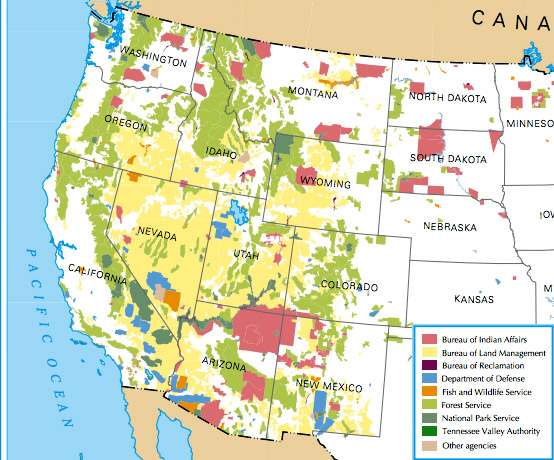
Fed Land west

In Cliven Bundy’s case, he refused to honor the rights of the Federal Government as owners of the land where he grazed his cattle and never paid over one million dollars in fees for the right to graze there. Fees began in 1993 when the BLM moved to reduce grazing to protect the endangered Desert Tortoise. When the BLM began removing cattle to be auctioned to pay overdue fees, the situation became an armed standoff as militant groups arrived ready to defend Bundy with weapons if necessary. BLM did not want this kind of escalation so they withdrew. Currently, the BLM plans to move through the Federal Court system. This is a slow process. The Bundy family, including Ammon, who is leading a takeover of a firehouse in Oregon, feels they won in Nevada and plan to expand their resistance as opportunities arise.

However, the case has much broader ramifications than a family feud with the Federal Government. Does the Federal Government have the right not only to seize and manage property, but to threaten citizens/businesses with confiscation of property if they fail to comply with Federal regulations? Substitute cap and trade for coal burning companies; can the Federal Government enforce environmental policy with the threat of a takeover? Hugo Chavez thought so when he nationalized Venezuela’s oil industry. Can the Federal Government take over power companies like Duke Electric in Georgia because of blatant and severely damaging abuse to local water resources? Can the Federal Government stop production of automobiles outright if Carbon standards and miles per gallon are in violation of Federal regulations? There are several precedents for government takeover in one form or another; remember prohibition? Remember the Keystone pipeline?

The Bundys have turned over a huge rock! The mariner suspects our capitalist-dominant culture is not ready for this much governmental authority. Nevertheless, science and technology are defining a path that leads to catastrophic disruption of Earth’s biome within a comparatively short time.

Who can make unbiased – and enforceable – decisions in this increasingly chaotic situation?

Ancient Mariner
Data is Free – Insight, Logic and Deduction is Not

Occasionally, a reader may comment to the mariner that he must know a lot to be able to post so frequently and about so many different subjects. That is a nice compliment but the truth is the Internet is only a click away; the Internet has not failed mariner in providing voluminous detail about even the most arcane and obscure subject. The reader’s compliment should go to the Internet.

A common term is that we live in the information age. This is true. As Ed McMahon used to say, “The [Internet] has everything a person would ever want to know….” If all human data were on paper, as it used to be, we would be living between mountainous hills of paper that would put an old fashioned dump to shame. The amount of electronic information collected today has outpaced the places to store it. Here is a quote from Economist Magazine:

“Hal Varian, Google’s chief economist, predicts that the job of statistician will become the “sexiest” around. Data, he explains, are widely available; what is scarce is the ability to extract wisdom from them.” (Note that mariner did not know this quote until he looked for related information on the Internet. Incidentally, the whole article will explain more about information than mariner chooses to cover in this post – thanks to Economist Magazine online – a magazine mariner recommends for every household coffee table. See:

http://www.economist.com/node/15557443 ).

Not too long ago, the best search engine was a sharp reference librarian at the local library. Sometimes, customers had to wait a week or more if the information were complex or obfuscated or had to be retrieved by inter-library loan. The function of a reference librarian still is needed but more at assisting with the relationship between subjects and sorting and the data that may link the subjects together. When a strategy has been mapped, everyone goes over to the Supreme Master and God of Reference – the computer and the Internet.

Traditionally, one would marvel at memory gurus, people with photographic memories and lots of education. Now, one can still marvel – would we all be blessed with photographic memory – but the Internet is a classic example of cybernetic symbiosis. Anyone can collect large amounts of data in a dozen different ways without having to memorize the data; the Internet memorizes data for us. What is difficult is the ability to know what specific data one needs and how that data can be used to achieve the goal; further, how does one draw meaning from raw data?

Just having a ton of data in a database does not make one knowledgeable or more functional. Even if one could memorize the entire table of data, it would be of no use unless one can process the data properly. The simplified steps for leveraging our symbiotic relationship are:

  1. Why do you need data? This step assures that you have a specific need that requires data. This step sharpens focus; identifies the topic, subject, or problem that will be resolved.
  2. What don’t you know that would be known if you had specific data? This step clarifies data element requirements.
  3. At the end, what objective will be resolved? This step uses answers to the first 2 steps and often is the source of the query posted with your search engine.

In the information age, there is plenty of data. What does it imply? Which data is important to provide the values for many different types of decisions? How does one invent ancillary data to augment the data table? We may be able to generate enough data to match the number of grains of sand on the planet but if we don’t know the definition of ‘beach,’ all the sand in the world is useless.

Responding again to the compliment at the beginning, mariner knows little about where data comes from; what mariner contributes is the question and subsequent reasoning. Once having the data to support comparative reasoning, the mariner will offer the reader his reasoning of the objective.

REFERENCE SECTION

Religion – While scanning the news of the day, mariner came across some interesting issues. An article in the Denver Post covered a labor dispute between Muslims and Cargill. The Muslims walked off the job and were subsequently fired because eleven wanted to pray together. What the mariner found interesting is that this situation is quite similar to that of Kim Davis, the county clerk who went to jail rather than approve homosexual marriage licenses. In both cases, workers chose religious principles over economic opportunity. See:

http://www.denverpost.com/news/ci_29330180/cargill-tried-resolve-issues-before-firing-colorado-muslim

Other religious news is a poll taken by the Christian Science Monitor on the issue of freedom of religion (protected by the First Amendment). The poll says 82% of Americans believe it is important for Christianity to practice freely but only 61% say the same is true for Islam – an oxymoron it seems to mariner. See:

http://www.csmonitor.com/

Ancient Mariner

A Short Reminiscence

Image

In a day or so, the mariner and his family are gathering in Phoenix for a vacation get together. Mariner and his wife are escaping the harsh winter of the plains while offspring are gathering for celebrations of various sorts. It is a time to relax in a blissful place – mentally, spiritually and physically.

So today, there will be no complaining, no panicking, and no passing of judgment. A forgotten object in a corner of a dusty bookshelf on the second floor landing has called up memories of a unique character in mariner’s life – his father-in-law.

He went by the name “Bos” (Boz) and owned the town’s hardware store for 50 years, finally retiring at the age of 81. Bos had a quirky sense of humor that entertained folks across the entire county. One of the mariner’s favorites goes as follows:

Around Christmas, Bos placed a galvanized bucket with a barren tree branch resting in it on a prominent spot on the counter. From one of the twigs on the branch, he tied a string; at the bottom of the string hung a bullet. Bos would sit back and, like a cat eager to pounce, watch customers come in, see the bucket, branch and bullet and ask, “What is that, Bos?” With great delight in the moment, he would say, “That’s my cartridge in a bare tree.”

Back in the sixties, when we all were younger, Bos played golf once a week like clockwork with three cronies. The foursome was a sorry lot as far as scores were concerned but the keen game for them was to be the first to hole out so they could race off to the trash can at the next tee. The prize was soda cans redeemable for five cents. The winner of the round was the one with the most soda cans. Having the most cans was nice but Bos relished the nickel refunds, which, characteristically, he stored away in a multitude of cigar boxes, pouches and tins. When the Hunt brothers were buying all the silver they could to push up the price and make a profit, the price of silver skyrocketed enough that Bos gathered his silver dimes, cashed them in and bought a new Ford truck for cash. That was Bos.

This tight fisted nature was common among the oldies in the town. Bos was always holding up the foursome while he searched for golf balls lost by others. He boasted that he had never bought a ball in all his times on the links. Bos had five-gallon buckets full of all brands, new and old. Most of the balls had seen their day and with a mighty swing may have traveled 125 yards.

One day, we were sitting in the parlor after dinner. Bos was fiscally conservative and would not invest in the stock market. Most of his invested holdings were in EE Bonds. He mentioned that he had to find somewhere to reinvest the bonds because they were maturing. The mariner suggested rolling them over into HH Bonds tax free. Bos was reticent to believe the government would offer such a favor that evades taxes. Mariner reassured him it was so but Bos still did not believe it. The mariner bet him a new, store bought golf ball that it was true. Sure enough, the rollover could be done tax free.

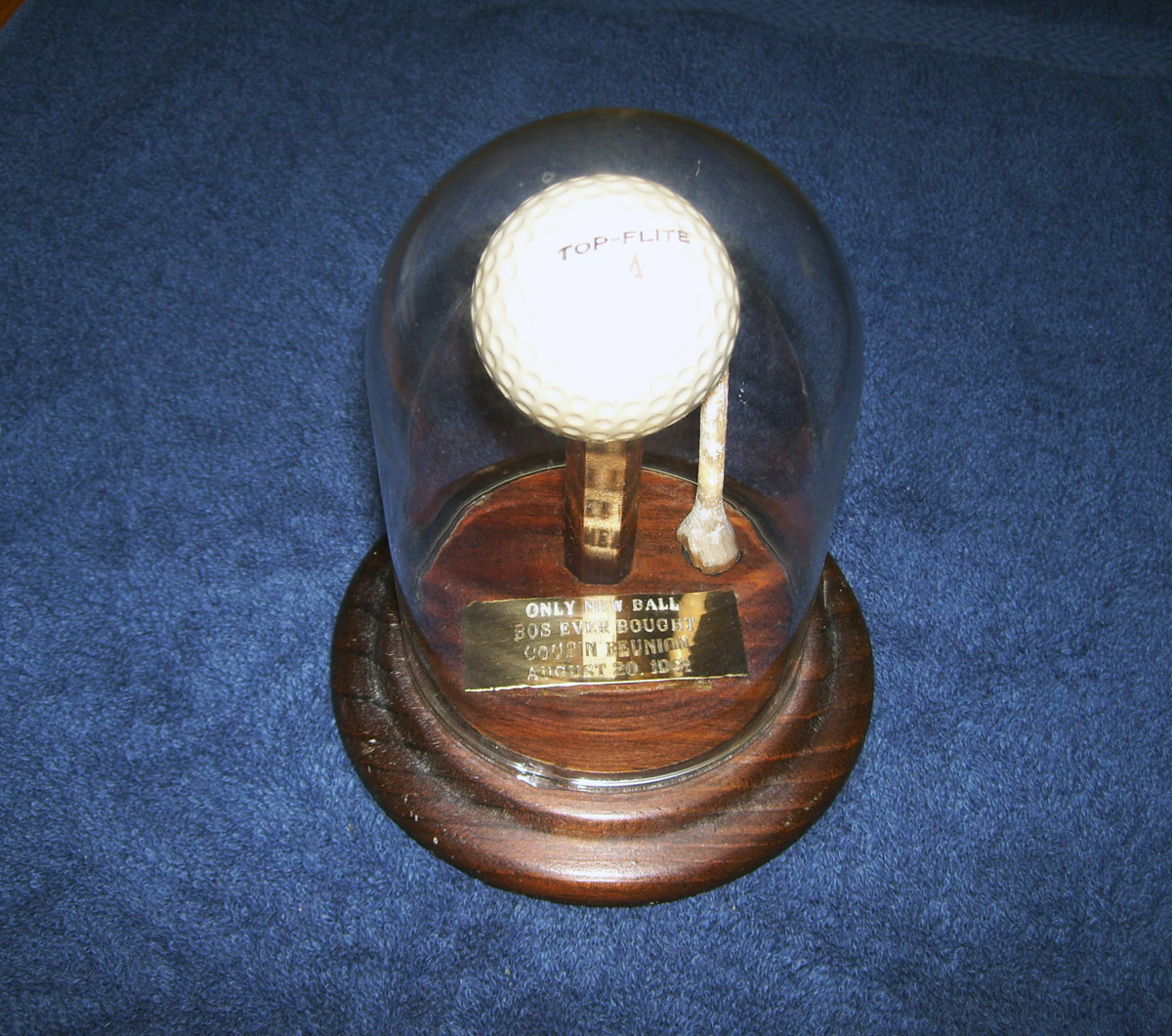
The object found on the second floor landing was the only golf ball Bos ever bought BosBall-2enshrined on a wooden base with a bell jar cover. A brass plate reads, “ONLY NEW BALL BOS EVER BOUGHT – Cousin Reunion August 20,1981” The ball has a patina now but it still retains the fun and sport from 35 years ago.

Bos passed on in 2001. Folks who knew him still remember his quirky humor and how active he was in the life of their small Iowa town.

Ancient Mariner