
The Four Horsemen of Religion in the 21st Century

The mariner has written many times about the increasing chaos that already is in progress and increases in intensity as the world moves through transition to a new age. Such a transition has occurred under many names: the mastery of fire; organized language, the Greek age of wisdom; the Roman Empire; discovery of the Americas; the Enlightenment; colonialism; the industrial age, etc.

While easily encapsulated in a phrase, each new age took generations to emerge into a new state that was stable and understood by the masses. Each new age catapulted over old mores about culture, faith and productivity.

For simplicity, the mariner limits this treatise to the western hemisphere but acknowledges that the entire world suffers the same chaos. Further, he limits transition to religion, using it as a model for any subject.


In the western hemisphere, Christianity is the dominant religion. Once Henry the Eighth (and Elizabeth I) split from the Holy Roman church to form the Church of England, Christianity began moving into a new age that gave rise to reformation and an era of theological and liturgical freedom that continues today. Until the age of communication began with the introduction of the telegraph, telephone and television, religion was free to redefine itself parochially as the Baptists do and organizationally as the Methodists and other denominations do. Even cultural differences exist side by side. For example, the Mennonites and Amish, and the cultish branches that test faith with snakes, etc. Faux Christian groups are more or less accepted as well. For example the Mormons, Scientology and mega churches are part of the “normal” range of religious practice.

As the transition to a new age quickens, religion will lose its ideological independence. In the twenty-first century, religion will accommodate three wholly different disciplines: secularism, quantum mechanics and technology.


Secularism is founded primarily on the separation of state and religion. In the United States, James Madison is credited with the establishment of secularism. Secularism was slow to grow into a major “movement” because religious institutions remained influential in ethical and moral behavior. Still, the state and its citizens were free to improvise outside religious doctrines.

The state developed capitalism into a valid religion of its own. Today, capitalism so predominates that the ethics and morals of religion are virtually irrelevant except for those still active in congregations who, nevertheless, are capitalists first, religiously ethical and moral second.

The secular movement has fostered ethics and morality outside the precepts of faith. Secularism has permitted regionalization of ethics. The American South has changed little during the twentieth century. Other regions emphasize middle class morals and false Christian religions such as Mormonism, Scientism and mega church organizations with the trappings of Christianity but actually worship capitalism more than Christianity. The accommodation of capitalism into Christian practices is an excellent example of the move to a new age. The transition is far from over as religion struggles for a new identity.


Quantum Mechanics is the study of the smallest pieces of energy and matter – many magnitudes smaller than one atom. At these nanoscopic levels, physicists discovered that particles of existence behave differently than the assumptions accepted by classical physics. For example, one quark (a very small piece of energy or mass) can appear in different places at the same instant. The mariner could run on with many examples but he will leap to the oddly confusing assumption in Quantum Mechanics that there are eleven simultaneous dimensions and you and the mariner can be living different lives in each one. Do not feel inadequate about lack of understanding; only the rare few can perceive this possibility – and they likely are quantum scientists. Further, astrophysicists grow more certain that there are other universes as well.

Religion is in the same circumstance it had with Copernicus and Galileo hundreds of years ago. Science makes advances that blatantly challenge the Old Testament description of creation, Adam and Eve, Noah and the ark, the divine nature of humanity and many other biblical assumptions. The combination of religion, secularism and scientific advancement puts pressure on religion to reconsider the divine nature of Jesus.

As Copernicus and Galileo challenged the theological importance of man (the church) by clarifying that the Earth was not the center of the solar system nor was the solar system unique among others in space, Quantum Mechanics will challenge the vertical inheritance that flows from God to Jesus to man. Religion is bound at the moment to a singular focus between God and humans. Multiple dimensions and universes along with the growing acceptance of other life in the universe will stretch the vertical – perhaps reinventing the role of Jesus and increase the potential for Aryanism, teleology and determinism to be incorporated into religious ideology.


Technology is the engine that accelerates the end of this age. It propels us toward global relationships that are bound together not by geography, economy, culture or race – but by the ability to be part of the unity of all individuals via the Internet. Technology is a force that eventually will equalize human importance across the planet. Neil deGrasse Tyson has a term for this unification: Type One Planet. (Tyson was the host of the Cosmos series and an early advocate of Quantum Mechanics.)

Medical technology in particular will press religious definitions of birth and death as humans live longer and longer, eventually capable of virtually permanent life. The sanctity of work will be altered as more and more technical inventions change the way we live. Consider the impact of the automobile, airplanes, availability of food, and the atomic bomb. Technology can easily redefine what is important in our lives. It will continue to do so.

Put them all together and you have the knowledge base that will redefine faith, that which is sacred, and the manner by which we define our ethics and morals. There is still a way to go in this chaotic environment. We must reign in the corporations, entrepreneurs and others who are leveraging the chaos to their own benefit. In the end, as we adjust to the new age, the four horsemen will forge a new religion.

Ancient Mariner
 

Guns – Economics, Politics and Reality

In many ways, this post is about the inability of the brain to process probability. The reader may want to reference “Our Brain and Probability” posted on July 4 2013. It is also related in principle to a recent post “A Cup of Water” posted on July 10 2014 that referenced a desire for short wins in spite of long term loss.

The mariner had a twenty minute discussion with a good friend about (1) possession of guns (2) gun legislation and (3) economic politics. Mind you, this friend is one of the most caring individuals I know. The friend is continuously going beyond the norm in sharing time, energy and concern for others. In every conversation the friend is courteous and polite. In addition, it should be known that the friend is politically conservative and is a hunter.

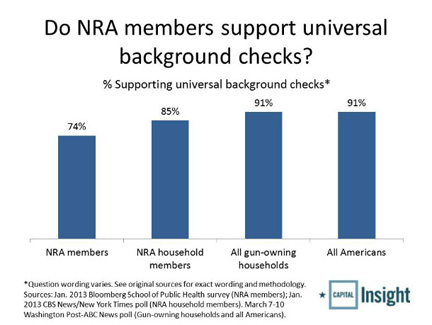
In April 2013, a Washington Post/ABC News poll was taken of members of the National Rifle Association (NRA):

NRA CHART

In addition to the poll above, 90% of public citizenry favored restrictions on assault weapons. Yet, no legislation has passed in this regard.

For a comparison to give behavioral weight to these statistics, each year 1 in 492 will die in a traffic related accident. 1 in 356 will be assaulted by a firearm but the chance of suffering from a firearm discharge is 1 in 6,509. The mariner gleans from these probabilities that assaults involving firearms is more common than dying in a traffic accident but actually dying or being injured by firearms is relatively rare. Perhaps the reason assault is so common is because too many individuals own guns – especially those we don’t know own guns and likely are the individuals we would prefer not own guns.

These statistics suggest that, given the second amendment, everyone has the right to own guns. However, we should know they have a gun. Assuming bureaucratic processes are effective, those we prefer not to own a gun can be weeded out of the gun-owning citizenry. The least intrusive and most effective policy to reduce assaults is to (a) have fewer people carry guns and not have ‘stand your ground’ defenses (b) decide who can carry a gun. Both require gun registration.

The reader now has enough background to move on with his conversation with his friend.

The mariner first broached the gun issue by asking whether the friend supported a policy that everyone has the right to carry a loaded weapon – even into churches and places of employment. He was in absolute agreement and immediately cited the second amendment, particularly the phrase “right to bear arms.”

“How would you like it,” he said, “if someone ran up to your wife at gunpoint, knocked her down and stole her purse? She has the right to protect herself and the thief should learn right away that crime doesn’t pay.”

The mariner’s brain was spinning in several directions. He had the courtesy not to immediately suggest, “But the gun is probably in the purse.” The mariner was considering, too, that this type of assault is why assault by a firearm is more common than fatal car accidents. It is quite likely the thief truly did not want to fire the gun and risk the engagement of witnesses, let alone twenty years in prison for taking a purse. Should the wife actually pull her gun and fire, she would be judge and jury and the thief would get an execution on the spot for taking the purse. It’s okay, though, because she stood her ground.

The mariner’s mind flashed back to the wild west of the nineteenth century where there was little law enforcement and one literally had to defend one’s self because no one had cell phones.

The news programs on television carried a story about a man who shot his soon-to-be bride through the front door with a shotgun without knowing who was at the door. The mariner asked about this phenomenon of shooting underserved family members and friends, especially about the small daughters who were instructed by their father to shoot through their bedroom door if anyone tried to open it. Of course the daughters killed their father.

The friend’s solution is that no one should be allowed to carry a firearm without full training in how and when to use a gun. The fallacy in this response is that assault and death are blamed on anything except the gun itself. Further, the assumption that there are individuals left who have yet to own a gun suggests not many would submit to training because they already have their guns.

The mariner inquired about a compromise, say, anyone can carry a gun but society should know that person has a gun.

“That is gun registration,” he said. He was more resolute in his objection to registration than the hypothetical circumstances we had been talking about. “If they [the government] know I have a gun, they can come and take it from me.”

“But the second amendment…” He cut the mariner short saying no one was ever going to take his gun. If they know, they can do whatever they want. He was growing irate at this point so I shifted to politics.

The mariner said, “Did you know that most of the money for NRA comes from arms manufacturers? It seems registration would expose their profits and the extent of manufacturing.”

“I don’t care where the money comes from. Without the NRA lobby, the common citizen would lose their right to bear arms.”

Knowing the conversation had to end soon, the mariner asked one last question about data from the chart above, that a majority of NRA members feel that gun registration should be passed. The friend shut off that line of thinking by saying everyone has a right to their own opinion.

It is obvious that probability, logic and practical solutions are not part of a discussion on firearms. The mariner felt the conversation went in circles, casting off conflicts by disassociating the gun at every turn. Whatever is in question, there is an excuse. The mariner is reminded of the phrase, ‘guns don’t kill people; people kill people.’ The appropriate phrase would be …’people with guns kill people.’

Like any strongly held opinion, belief becomes stronger than practicality or truth. Everyone has beliefs that are sacrosanct and will not change their beliefs for reasonable solutions. The best example right now is the Israeli-Palestinian conflict. Hamas (and many other Arab sources) believe Israel should not exist. They will never change their minds about this. As adamant, the Israelis will never give up Jerusalem.

It’s the short win that counts, not long term rationality. It’s the natural mind-state that does not process probabilities but instead says, “You gotta play to win.”

While not understanding the devotion to a gun, or the paranoia about not having a gun, the mariner understands the power of belief. Belief most often is a barbiturate for our genuine, perhaps unknown anxieties. The mariner has a strong reaction to matters of privacy and personal security. He is reminded of primitives who thought a photograph stole their soul. He is irritated that his profile, location, personal matters and buying habits are taken without permission and sold. He was never asked for permission nor was there recompense. The mariner uses secured web browsers that prevent his computer IP address from being known. Still data is gleaned for tendencies and preference even without a name, so eager are data hucksters to fill their clouds. No data is omitted, including medical records, family history and friends.

The mariner is aware that in the future, integration of personal data is what will enable a much richer life. Culture is changing such that society is better served with unification of human data. Still, the mariner is old fashioned and considers his private self his own definition of who he is and does not trust others telling him who he is. It is disturbing that others know what car he will buy before the mariner does. Have hucksters stolen his soul?

Does this sound similar to the friend who does not trust others without a gun by his side? Does the gun advocate cling to a culture long faded from the true fabric of the twentieth and twenty-first centuries? Do privacy advocates cling to the concept that there is no real definition of themselves in society other than their own perceptions, that one has the right to create one’s own, independent life?

What belief will you not change despite overwhelming reasons to modify your belief? There are none among us without beliefs that give us meaning and protect each of us from our insecurities.

Ancient Mariner


BRIC

The following material is quoted from Globalsherpa.com.

“The BRIC countries label refers to a select group of four large, developing countries (Brazil, Russia, India and China). The four BRIC countries are distinguished from a host of other promising emerging markets by their demographic and economic potential to rank among the world’s largest and most influential economies in the 21st century (and by having a reasonable chance of realizing that potential).  Together, the four original BRIC countries comprise more than 2.8 billion people or 40 percent of the world’s population, cover more than a quarter of the world’s land area over three continents, and account for more than 25 percent of global GDP.

BRIC Countries’ Path to 2050

A country’s population and demographics, among other factors, directly affect the potential size of its economy and its capacity to function as an engine of global economic growth and development. As early as 2003, Goldman Sachs forecasted that China and India would become the first and third largest economies by 2050, with Brazil and Russia capturing the fifth and sixth spots.

Growing BRIC Middle Class

The rapid economic growth and demographics of China and India are expected to give rise to a large middle class whose consumption would help drive the BRICs’ economic development and expansion of the global economy.  The increase in the middle class population of the BRIC countries is forecasted to more than double that of the developed G7 economies.”

By 2050, China and India will surpass the United States and European Union by sixty-one percent, that is, the economic production will be $105 billion compared to $65 billion for the US and EU. Brazil and Russia will add another $25 billion to the BRIC economy.

The BRIC plans to base its financial standard on a different currency than the US dollar, which is the global standard today. Further, China and India are investing billions of dollars in science and technology. By 2050, China will invest $20 billion per year. Even if the US wanted to emphasize investment in science and technology, it cannot match these numbers.

It is likely that the US will not be the center of invention and innovation.

There is a danger that the US dollar will deflate in relative value when confronted by BRIC’s enormous growth. Travel and imported goods will be more expensive.

The Trans-Pacific Partnership (TPP) is a massive trade agreement that will benefit corporate investment in the Pacific Rim with less expensive costs and unhindered by many human rights standards.  The trade agreement will bind the economies of most Pacific Rim countries to China’s economy – using a different financial standard than the US dollar.

The United States (and the European Union) cannot change the economic tidal wave representing forty percent of the world’s population. Further, the US is in a financial bind caused by the Federal Government’s poor management of the economy. The EU is struggling with a euro that does not have common value across Europe and has not established a powerful central bank to control the euro value.

Knowing all this, one is forced to realize that recovery from disparate income between the rich and poor, thereby reestablishing a strong middle class, will take much longer than we may envision. As the years go by, the dysfunctional Federal Government leaves the Country further behind each year it does nothing about education, investment in leading edge ideas and technology, and revising the tax laws – including corporate loopholes. Still today, the major banks control too much of the economy, earning billions in profit that do not enrich the US economy.

By 2050, there may be more opportunity for manufacturing in the US because the US dollar will have less value internationally. One looks for scraps of hope as the golden age of the United States begins to fade.

Ancient Mariner


A Cup of Water

The mariner hasn’t posted for some time. As a reason, a good metaphor would be how you may feel if you have one cup of water and the uncontrolled forest fire rapidly approaches. You may “stand your ground” and throw the cup of water with great ferocity. Then. . .

So that is the circumstance: the mariner fills his cup of water and tosses it into the raging selfishness and stupidity of humanity. Pope Frank was right when he said the world worships the religion of capitalism when it should be worshiping the sanctity of every individual life – human and otherwise.

A book was published recently with a premise that every living creature, including humans, always will take the short win rather than act in behalf of the longer term circumstance. A clear example was the unwillingness to tackle global warming for fear of less profit, higher taxes, more regulations, and a redistribution of power across national boundaries. In other words, today’s short win profit counts more than tomorrow’s greater loss. Individual examples are eating the doughnut now and worrying about obesity later – if ever; using a credit card to satisfy immediate reward and worrying about debt later. The author predicted the demise of species, including humans, and a world ill fit for the current ecosystem.

A microcosm of that premise is the Mississippi River. The mariner was fond of the river even before he moved to the Midwest. The Mississippi is an amazing creature of nature that has flowed endlessly through the millennia. The ecosystems supported by the river make it come to life. The river has its own natural behavior, considering the floodplain part of its prerogative as a big river. The Mississippi River has been shackled by humans with hydroelectric dams, estuary-killing levees, greedy developers and disrespectful farmers and corporations that deliberately allow damaging chemicals to flow into the water, destroying many different ecosystems. There is a three mile stretch along the Louisiana shoreline that is not fit for painted hulls. Between the Mississippi delta and that of the Rio Grande, one third of the Gulf of Mexico is a dead sea.

The mariner’s lamentations will do no more good than the lamentations of the prophet Amos.

The mariner thinks he will go to the river’s edge to watch wildlife struggling as he to exist in the mire.

 Ancient Mariner