
Part IV – Part III revisited

Before we evaluate Escapist behavior, the mariner must address Part III.

More than a few made it clear that the mariner was lost wading in the cattail patch. The most common difficulty expressed was identifying a greater reality. Perhaps we should stop using the word reality altogether. Instead, we will use “situation.” There are smaller situations and larger situations. The act of enabling harmony is finding the most harmonious solution between the two situations. The rain forest is a larger situation than clearing trees. It still can be said that clearing trees seems not to be in harmony with the larger situation that the forest is part of a global ecology.

A person is always the smallest situation. Any interaction involving another person or anything outside the self is a larger situation.

For example, you are listening to someone who likes to talk too much and has a way of never giving you a chance to talk. This is a larger situation. Focusing on the larger situation, you will make a better decision about how to act to resolve the dissonance between your lesser situation and the larger situation. You will act in a way that more likely enables harmony. In this example, harmony is enabled by politeness and concern that you do not hurt or embarrass the talker. Depending on your personality, several solutions can be imagined. The most common solution is to interrupt in a polite way and excuse yourself from the larger situation with some polite word about having to move on.

Can the reader sense that using a solution in the best interest of the larger situation prevents you from making an internal judgment that likely would be self-serving and may cause dissonance rather than harmony between your smaller situation and the larger situation? Just silently walking away from the talker, which may be the judgment you prefer in your mind, would be rude.

To answer the question about jaywalking, the larger situation is respect for moving vehicles and one’s own safety.  Jaywalking is a common judgment that does not consider the larger situation of someone in a vehicle who doesn’t expect a person to be in the street in the middle of the block. That is dissonance; crossing at the corner is more harmonious.

The question about the animal trap demonstrates that an individual could identify a larger situation and have multiple ways to enable harmony. In fact, every person will identify a larger situation in their own way and enabling harmony may be different from yours.

The answer to the question about payroll is the owner should not make an internal judgment to determine the solution. She should look outside herself to identify a larger situation, that is, what is the most harmonious thing to do for the twenty employees. There are many solutions.

The most harmonious solution may be to have everyone in on the problem solving and essentially let the employees determine a solution that resolves the financial circumstance. This is a good place to point out that enabling harmony is not mediation or arbitration, used to divide the pie or establish a different definition of dissonance. Fairness is an important element when enabling harmony. Sadly, many managers determine a solution without looking outside to identify a larger situation. The common response is, “I will make this decision because I have authority and it will be made in my best interest.” Internalized solutions are prone to creating dissonance.

A misconception that crept into readers’ ideas about harmony is that enabling harmony is the same as enabling bliss and happiness. This response may appear in one-to-one solutions but harmony is not tied to bliss. D-Day in the Second World War was in pursuit of harmony regarding the larger situation of human abuse and disregard for due process on a grand scale by the Third Reich in Germany.

Enabling harmony means, quite simply, going outside the self to identify a larger situation and then act in a way that minimizes dissonance and enhances harmony between the lesser situation and the larger situation. Sometimes, as in the example of the Brazilian rain forest, the lesser situation is the state of Brazil’s economy, not a person. What can be done that enables harmony between the needs of Brazil and the world’s need of many effects attributed to the rain forest?

Stepping back into the reality word, there are political realities, financial realities, international realities, etc. This discourse about harmony is just another reality: harmonious reality – the reconciliation of two situations using harmony as the measuring stick.

Perhaps it is wise to leave escapist behavior for the next part.

Ancient Mariner
Part III

Part III

Taking both Part I and Part II combined, we learned that humans have vices and by definition in Part II, vices are dissonance in a relationship between a lesser reality (the person) and a greater reality. Further, we learned that oneness is the pursuit of harmony between realities. Finally, we learned that oneness does not judge anything as right or wrong. The goal is harmony among many realities, indeed among all realities. If the reader needs to refresh the meaning of greater and lesser realities, read Part II again. The dynamic of oneness hinges on relationships between realities.

The mariner resists adding further trappings to an interpretation or to the behavior of oneness. He knows that readers will recognize ideas and virtues that are part of their own religion, especially moralistic ideas and rules of behavior. This is because ethics and morality are by nature universal. However, the mariner makes a special effort not to be drawn into judgmental elements of religion or its specialized practices.

Part I took issue with many human behaviors. Quoting Part I:

“Any, ANY activity pursued for the sake of personal gain or stature – whether mental, spiritual, physical, pursuit of success or pursuit of empirical reward. This statement eliminates thousands of pseudo-virtuous activities.”

Humans have active minds. In addition, genealogically humans are not far removed from apes. In fact, humans are classified as part of the family tree. This evolutionary mix produces an ethical behavior prone to empirical gratification and self-guided pragmatism.

Yet humans feel a need to organize, to overcome obstacles, and to achieve consciously some definition of superiority. The trouble is that the simplistic urges passed to us by our ancestors move more easily to greed and chest thumping than to the finer elements of oneness.

Following the spirit of oneness, an individual must not consider themselves a completed product; one must assure there is harmony between themselves and the greater reality of their neighborhood, town and neighbors. As an afterthought, harmony in the family might be nice. Further, a sense of absolute oneness is required as a tool to evaluate lesser realities.

The moral act of oneness is enabling harmony. Therefore, an individual must identify a greater reality that will provide requirements for harmony. It can be civic, as mentioned a moment ago; it can be an organization; it can be any institution from a religious one to a special activities club. There is virtually no limit to greater realities. Greater realities can be as simple as rules for crossing a street, as complex as one’s national ethic and culture, or awareness of nature and planet centric realities.

The mariner will not examine the unending list of pseudo-virtuous activities. It is easier to restate the principle of oneness:

In this moment, doing what you’re doing, saying what you’re saying, thinking what you’re thinking, what greater reality will guide you to harmonious behavior? In other words, do not approach life from within yourself. That process leads to judgmental, pseudo-virtuous behavior. Instead, approach life from the outside, consciously knowing you are enabling harmony within a greater reality.

Pretend you need a map to go from your home to some distant, unknown place. The rational person would acquire a map and follow the path to the destination. The process of knowing that you did not have an answer within yourself but looked for guidance outside yourself is precisely how oneness works. You are always the lesser reality. Enabling harmony comes from outside and is a greater reality that shows you the way to the most harmonious behavior.

A few insightful questions are provided. Trying to invent exceptions to the obvious answers is not helpful.

You are walking on a sidewalk on a street that has moderate vehicle traffic with gaps every so often. You want to cross the street. Do you time your crossing to jaywalk between vehicles or do you walk to the corner? Jaywalking is dissonance to what greater value?

You are walking through the woods. You come upon an animal trap of the kind that is illegal. The trap is set. What do you do? This is a trick question. Any number of greater values can be applied. Maybe the animal is food for a destitute person. Maybe it was set by an uncaring, pseudo-virtuous person with no empathy. Maybe you should report the trap to the authorities. Maybe you should take the trap with you. Maybe……

Each of these actions enables harmony from slightly different greater values. No one said life was easy! The correct behavior is not to be judgmental about the illegal trap. Oneness does not judge right or wrong; only determine what the most harmonious behavior should be.

A business is having financial difficulty. The situation has come to a point that labor costs are too high to pay the twenty people who work for the owner. What greater reality provides her with the most harmonious solution?

Part IV will address escapist behavior.

Ancient Mariner


Part II

To refresh our minds about Part I, it begins a discourse on oneness.  The mariner chose the word oneness to represent absolute holism.  Holism is the belief that all things are connected in an orderly fashion. It is common to mention holistic medicine, which goes beyond the mechanistic treatments of common medical practice. It is also said of holistic belief that the whole is greater than the sum of its parts. Using a term like oneness allows the mind to deduce lesser realities in context.

An example of greater and lesser reality would be the issue of leveling the Brazilian rain forest. The greater reality is that the forest is part of a global ecology; the lesser reality is the economic imperative to cut down the forest.

Oneness, like any philosophy or religion, has rules for interpretation and rules for behavior. For example, oneness interprets reality as the sum of all human knowledge – both proven and perceived. This interpretation is not as broad as it could be because it is limited to human knowledge; there is no limit to knowledge in general.

Oneness measures behavior in the context of harmony. For example, the intentional abuse of fossil fuels is not in harmony with the natural environment required by living creatures all over the planet – a greater reality. Similarly, cutting the Brazilian rain forest is not in harmony with a greater reality.

One easily can be drawn into a maze of judgments about behavior. Oneness does not denounce any object or circumstance in reality. The example of abusing fossil fuel is not judged as wrong; rather, it seems not to be in harmony with a greater reality.

One cannot role back history or foretell the future. However, one can deduce harmony and dissonance between greater and lesser realities. The moral foundation of oneness is pursuit of harmony.

Often, it is difficult to determine which may be the greater or lesser reality. In the United States today there is dissonance. What is the source of the dissonance? What is the greater reality? One cannot pursue harmony without identifying the greater reality.

Often, there is confusion between similar realities. For example, consider the following: computers, motorcycles, milk jugs, credit cards, electricity, Justin Bieber CDs. What is common to these objects is they are made of plastic, which consumes fossil fuel or they burn fossil fuel directly. How does one accept one object but denounce another? The example given earlier that abuse of fossil fuel is not harmonious with a greater reality seems untidy when very small realities seem to be in harmony with human enterprise and possibly may be measured against another greater reality before arriving at the dissonance found in abusing fossil fuel.

This conundrum is similar to the old question about how many angels can stand on the head of a pin. This arbitrariness is behind the creation of different religions, sects, denominations, countries, provinces all the way down to the dissonance between the Hatfields and McCoys.

Oneness avoids these judgments by not judging right or wrong. If one gives some thought to this issue, one realizes that “right” and “wrong” are never absolute. There are dozens of sayings about right and wrong: “There’s always two sides to the story;” “Everyone does the best they can;” “Time heals all wounds,” etc.

The mariner knows Part II is heavy reading. Philosophical reasoning is difficult at best. Part III, however, investigates the list of human behaviors in Part I. It will be an easier read.

Ancient Mariner


Part I

Part I

The mariner is an old guy. Too old to run and play. Too old to have any motivation for work or for that matter any inconvenience. Too old. Having nothing else to do but be old, he is liberated from ambition, competitiveness, rampant emotion, and has a great desire to allay accountability to any purpose. This leaves him with an amazing amount of physical and mental freedom.

Being similar in age to wizened elders of several religions that pursue unification with a world beyond four dimensions, he understands now that a different worldview comes to mind when one is not obligated to four-dimensional success. Others may call this mindset escapist, lazy, demented or delusional but there is an order of comprehension beyond the mundane.

One must eliminate false interpretations. Obviously, this means eliminate every faux religious or self-righteous activity. The list is immense but a few examples are provided:

  • Any, ANY activity pursued for the sake of personal gain or stature – whether mental, spiritual, physical, pursuit of success or pursuit of empirical reward. This statement eliminates thousands of pseudo-virtuous activities.
  • Escapist behavior pursued for benefit of the self. Eliminate any attempt to elevate self-importance for positive or deranged reasons.
  • Compassion as an act in the moment. Compassion will be evaluated in further detail later. Examples at this point are compassion for kittens and puppies, I’m-better-than-these-people compassion, He/she-is-ugly compassion, I-feel-better-now compassion, He/she-is-like-Kennedy/Reagan compassion, they-are-a-teammate compassion, etc. It is compassion derived from any external perspective.
  • Allegiance to anything. Allegiance constricts the mind more completely than any other behavior. The art of advertising is the art of shaping one’s belief that a certain product, concept, or behavior is the best choice. Surely you have met someone who buys only Ford vehicles. The supreme example in the twentieth century is Nazi allegiance. Other countries, though less brutal, are quite the same in allegiance by their citizens. Some countries may be too broken for citizens to have allegiance typically because of war or tyranny.
  • Homocentric gluttony is the practice of consuming beyond normal necessity – taking into account that the Earth is a finite source with a lot of people. The wealthy are especially prone to gluttony. Homocentric gluttony is the act of consuming earthly materials, earthly fresh water, earthly energy, and earthly space for no other purpose than to consume. A few of the most egregious are corporate farming, construction, real estate, travel and home consumption of all forms of energy. In the United Kingdom, basically made up of islands, there are homes that were built four hundred years ago or older – not because the Brits are virtuous, it’s the limitation imposed by limited real estate.

Oneness is chosen as the word to describe an understanding of the universe, life on Earth and one’s lack of need for the mundane world beyond the constraints of one’s need to survive. By its nature, oneness invites exceptions. However, to claim exceptions implies a misunderstanding of oneness. Perceived exceptions will be reviewed later.

Using oneness avoids talking about six dharsanas, four yogas, five virtues, salvation, miracles, naturalism, humanism, six pillars of faith, two parts of the human soul, and being impervious to snake bites and other superiorities. Oneness accepts belief however it is ordained by any human being. To believe is an unavoidable human characteristic – even if it’s a momentary belief that one will win the lottery.

As an aside, the supreme contribution of the Internet is that one can major in any subject in one day instead of taking fifteen college credits over three years – meaning if you want to learn more about religions of the world or any topic you may have in mind, visit the Internet. It saves the mariner from writing a thick book and saves you a lot of money needed for college tuition.

Ancient Mariner


Chaos Grows Among Financial Analysts

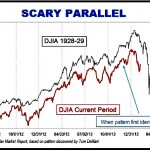
The following chart by Tom DeMark from the McClelland Market Report shown in a right-of-center financial magazine, Money Morning during an interview with Peter Schiff. Schiff feels the US fiscal policy is heading toward a financial collapse similar to the crash in 1929. The following chart was shown during the interview. It compares the behavior of the stock market leading up to the 1929 crash (blue) with current stock behavior red) from September 2007 to today. The parallel lines are eerily similar.

parallel

In an earlier post, the mariner alluded to a great shift in wealth that must occur before the US culture can move on. Apparently Schiff feels the chaotic moment will occur very soon.

The issue in 1929 was public debt far beyond what the public has today. Investors had as much as 90 percent margin (unpaid purchases). The effect was very much like the housing collapse in 2008 when there were tens of thousands of mortgages being sold on the stock market (remember derivatives) that had no cash to back them. Eventually, the banks faced a grim future if the US Treasury didn’t step in.

This time, however, conservatives like Peter Schiff and Donald Trump are attacking the Federal Government for having too much debt. Sooner or later, someone must pay the bill. Will the wealthy take a hit on their investments? Yes, says Schiff.

Scare tactics are thrown everywhere. The mariner believes there has been an imbalance for a long time. Two circumstances reflect the entire situation: the Federal Government indeed is in debt because tax laws have not changed and the wealthy are getting wealthier. Beyond that, the current economy hasn’t responded as well as it should. This is blamed by the right on Obama not allowing jobs to be created, and by the left that businesses are sitting on their profits and not investing in new jobs.

Whatever the cause, that chart is a bit scary. Perhaps we should do what was recommended in another post: ”…. get rid of credit card debt fast. Use as much cash for daily expenses as you can; pay cash for gasoline; pay cash for groceries; pay cash at supermarkets, Walmart, Target, and Farm and Home. In other words, live well within your means and do not use the Wall Street banks in lieu of any other option. And save, save, save. The taxes to pay for change are coming….” and you know who will be taxed.

Ancient Mariner

Sailing Through Life

The mariner frequently writes of doom and gloom. He writes because he cares about the reader’s exposure to those issues that may hurt the reader and all people for that matter, reader or not. He writes to make sure the reader knows of troublesome things that the reader may prepare for them or take steps to address them. The mariner is a weather service for ships at sea.

Yet, it is not the clarion call of the mariner that is important. It is the reader’s satisfaction with his or her own spot in life. Can the reader, in that warped, beaten, abused soul that defines you, feel accomplished? That you have done the best you can. Are you able to find pleasantness on a daily basis? Importantly, have you done something quite frequently that brings you joy? Joy is such a curative that it is required to be an intentioned purpose in life.

Every stage of life, from an infant to a centenarian, must deal with the rainbow of happiness, sadness, laughter, tears, fear, pride, satisfaction, grief, and the sense of self that is our consciousness. Each decade, each generation, makes different demands on these emotions.

When one is trained in sailing, one is taught that all reality is seen from the boat as the center of that reality. That is why wind is expressed not in terms of its absolute direction but the direction from which it approaches the boat. Listen to the TV weather announcer; the wind is described as coming from someplace to the viewer, not the direction it is moving to. The relationship to other boats underway has 37 different rules for right of way. How one’s boat relates to these rules always is seen from one’s perspective: their own boat. There are no traffic lights or stop signs at sea.

This analogy applies to life in general. The world is always seen from the reader’s position. If your life is moving in a certain direction, you will feel reality pushing into you while another person may feel the same reality pushing them forward. It is a telling thing if one wishes to be on the other boat and its reality. You have let your boat drift without direction and it has lost its position relative to reality. You will have no joy, no satisfaction, no accomplishment in your life. Indeed, the reader may have difficulty living according to the numerous rules of right of way for living a good life.

Stay at your own helm, whether it is a dingy or a 100-foot schooner. Set your sails, that is use your attitude and smartness, to catch as favorable a wind as you can. You may have to tack against a headwind but at least you have confidence that you are making progress.

Fair winds, mate.

Ancient Mariner

Snow

The mariner has windows in his home. Outside every window is snow. He is a distinct minority among his family, friends and acquaintances. He holds great disdain for snow, sees no use for it and considers it quite a monochrome. Indeed, one must shovel it out of the way, slide uncontrollably on it with an automobile, and he finds snow too cold to be of any comfort. Snow causes heating bills, heart attacks, broken bones and one can die from exposure. Deep enough, it brings functional life to a standstill. In this winter, the mariner has sympathy for those in the south who seldom see snow and find it alien to normal life.

Where are the greens of summer? Where are the reds of flowers and a warm breeze with a blue sky and the hopefulness of a multicolored sunrise? Where are the palm trees and lush bromeliads? Where is that moment when one cannot feel the temperature at all because it is just right as it touches the skin?

The mariner believes that if the human species were limited to a natural state of existence, that is, no clothes, no heated homes, and restricted as other creatures are to a specific habitat, Homo sapiens would exist only between parallel N25° and S25°. For landlubbers, roughly speaking that is a line between Mexico City, Daytona Beach, the Bahamas, the Canary Islands, Saudi Arabia, Bangladesh, and Hong Kong in the northern hemisphere and in the southern hemisphere Asuncion, Paraguay, Rio de Janeiro, Pretoria, South Africa, Shark Bay on the western coast of Australia and Brisbane on the Eastern Coast.

Granted, weather patterns would allow Homo sapiens to be migratory but like the Monarch butterfly, who by atmospheric standards may be smarter than Homo sapiens, returns to warmer climes. How many creatures can you name that are migratory – including life in the oceans? They need not kill other animals for protective clothing; they need not consume great resources to keep warm; they need not invade alien habitats in search of large quantities of food. Homo sapiens is not so wise in its ability to conjure unnatural means of survival that are necessary because the species has moved out of its natural habitat.

All the population issues would have been solved long ago. We may have died as a species, or, more likely, we would have adapted to less abundant procreativity. Other species would have their space on this planet.

Oh well, the mariner dreams of better days. Meanwhile, his wife is out shoveling the walk.

Ancient Mariner

The Common Working Person

Debate about the spread between the wealthy and the rest of the country is receiving increasing attention by media. Better news channels like PBS and Aljazeera have held on air debates about unions, minimum wage, making the school system more competitive so more graduate high school and college and get better jobs and make more money (so that wealthy folks can make more money and those not-so-competitive students are weaned out of the “new” work force). Further, there have been discussions about the computerization age being the second half of the industrial age.

From dockside, the mariner observes that the first industrial age created millions of new jobs for the common working person while the second industrial, computerized age, takes jobs away from the common working person. The comeback by those advocating robotization of the workplace is that the common working person will be retrained for new kinds of jobs. Like what? For the mariner’s taste, there’s too much hemming and hawing at this point.

This is a broad, swampy subject. There are those, usually conservative or aggressively futuristic who are willing to do anything except assure a good life for the common working person. There are those on the other side that say there will be no progress until the wealthy are taken down a peg or two and government will oversee distribution and accumulation of wealth. While the latter team may have a heart of gold in behalf of the common working person, strategies are every bit as vague as that of uncaring conservatives and likewise doesn’t demonstrate a secure future for the common working person. The government is as good as the next election. From all past indicators, this is a bad bet.

Having set opposing shorelines, the swamp in between is not mapped, has murky water and poisonous snakes. It may be of interest to the reader to know that the current description of what a job is and how wages relate to that job was formulated in the 19th century – yes, the 1800’s. Government has tinkered with the edges until 1985 when government cut strings to any historic or traditional definitions. Nothing has evolved since so the 19th century definition of a job is still around but often ignored – especially worker rights and benefits that were applied early in the 20th century.

If the reader makes Big Macs or bacon burgers today, that is unfortunate. Computerization of burger production will be done by robots within five years (working models already exist). Stopping at a fast food restaurant will be exactly like stopping at a Redbox machine. Minimum wage may not be the big issue everyone thinks it is. Is there anyone who can describe a job environment for the common working person five years from now? For tens of millions of common working persons? Is there anyone who can describe an economic platform that assures a decent lifetime for the common working person?

What mariner hears from both shorelines are self-serving fake solutions. To extend the swamp metaphor, all the decision makers from both shores are wandering around the swamp in flatboats while the common working person is dragged behind in the murky water and poisonous snakes.

Helping assure quality of life for millions of common working persons will take a complete, high-powered team representing every quarter of the debate and, the mariner is saddened to say, that will not come for some time. Our society still is on a downslide, riding on the lives of the common working person.

Ancient Mariner


Sixth Extinction

When the mariner was about twelve, he was reading one of his father’s textbooks that had a chapter on Thomas Malthus, a British economist who, in 1798, said that population growth would be destructive and would be the end of the human species. Being impressionable at that age, the mariner never forgot that warning. He has not thought about Malthus for a while but has always been aware of the impact of overcrowding on the earth in general and on the human race in particular.

Malthus based his prediction on the fact that population was a geometric growth pattern (1,2,4,8,16..…) and food sources grew arithmetically (1,2,3,4,5…..). Eventually, he reasoned, people would die of starvation. Among several opinions about how to control human population, the most memorable was to increase the death rate. Little did he know that science would not shorten lives but would extend them; now, on the horizon, people will live greatly prolonged lives. Further, science would boost food production to keep up with population growth.

All this came back to mind when Elizabeth Kolbert was interviewed on television. She is the author of a new book titled The Sixth Extinction, An Unnatural History. (Henry Holt & Company). Readers may be able to watch the interview on Jon Stuart’s webpage, http://www.thedailyshow.com/videos

The title derives from the fact that five great extinctions have occurred in the history of living things on Planet Earth. Most know about a meteorite that hit Earth in Mexico and ended the era of dinosaurs. Check Wikipedia or search “five great extinctions” for more information. Kolbert portends that humans are the cause of the sixth great extinction.

The book is drawn from scientific research and trips around the world with experts on climate, oceanography, ecology, animal and plant specialists and others who study living things and their habitats.

To make a detailed analysis brief, Kolbert’s point is that our species once existed only on the plains of Africa and now has spread to every spot on Earth, that is, every habitat of every plant, animal, fish, invertebrate, bacteria, and has altered every single ecosystem. The result of this overpopulation, especially by a species that is extremely high maintenance in its use of food, space, materials and energy, is that tens of thousands of species are falling into extinction on a continuous basis.

Not only are there so many humans that other species are crowded out (cities and sensitive estuaries filled in for the benefit of real estate development to name two), humans are a dirty and careless bunch. Humans are the cause of innumerable destructions of habitat by deliberately invading them (farming and river dams to name just two). Humans carry diseases that kill not only humans but other plant and animal life as well, spew chemical damage into every habitat on Earth, and alter climates to such a massive degree that animals from whales and polar bears to tiny fish, bees, coral species and plant life over the entire Earth are dying or being deliberately killed.

We are an uncaring lot. However, what goes around comes around. No longer can our profit be measured solely by spreadsheets and bottom line profit and loss. We are undermining ourselves day by day, even as the riverbank slowly gives way to its river. Is life in the matrix* our future, where robotic life forms are the only survivors?

Malthus would be horrified.

Ancient Mariner

*reference to movie The Matrix, where humans live unknowingly in a matrix of coffin-like life support units and are used as batteries to generate electric power for a lifeless robot reality.

Cities

Books on cities present a view of how future economies will be organized. The following two books in particular see through today’s international chaos and give the reader a glimpse past the event horizon, where nations and corporations will be disassembled and brought back from the world of “too big to fail.”
The Metropolitan Revolution, How Cities and Metros are fixing Our Broken Politics and Fragile economy. Katz and Bradley, Brookings Institution Press, ISBN: 978-0-8157-2151-2

An uplifting read that exposes a new energy in cities that are going broke under the current Federal system. The key attributes for cities are planning for the future instead of the election cycle, finding local funding outside the Federal structure and cooperation between political parties, major institutions and unions.

Chapter 7, Toward a Global Network of Trading cities, expresses a rise in city power and economy. What we tend not be aware of is that cities, particularly in China, India and Brazil, are exploding in population, are centers of commerce, and have assets that make them independent of national monetary policy. Increases in international trade will make cities independent leaders in GDP.

In the United States, not a population powerhouse, cities like Denver, New York and regional agreements in Ohio are taking the lead in a sociological revamping of what a city means to its citizens. Citizens are willing to raise taxes to pay for infrastructural improvement. Denver, a complex group of smaller cities, has the largest public transit project in the country. Large cities in the US go abroad to increase trade without the help of the Federal Government and, largely, not even their own states.

If Mayors Ruled the World, Dysfunctional Nations, Rising Cities. Benjamin R. Barber, Yale University Press, ISBN: 9780300164671

This is another book about the emerging role of cities in ways that displace national and international relationships. Barber poses the question, “Is the nation-state, once democracy’s best hope today democratically dysfunctional? Obsolete?” The answer, says Benjamin Barber in this provocative book, is yes. Barber says cities and the mayors who run them can do and are doing a better job.   He says cities worldwide share pragmatism, civic trust, participation, indifference to borders and sovereignty, and a democratic penchant for networking, creativity, innovation, and cooperation. Throughout the book, Barber demonstrates how city mayors, singly and jointly, are responding to transnational problems more effectively than nation-states mired in ideological infighting and sovereign rivalries.

The mix of growing population in cities around the world, including the US, the fact that “the buck stops here,” with respect to day-to-day operations, and an ability to generate income through trade with different nations, make cities the political and economic power for the future.

The danger for social justice issues lies in the independent nature of cities. There are important objectives for national governments: sustained democracy, human rights, equitable income for workers, health practices and safety.

The mariner has mentioned before that a trade agreement among Pacific Rim countries called The Trans-Pacific Partnership (TPP) attempts to override all precedents associated with the above list. TPP is a dangerous “trade” agreement and should be vetted publically. At the moment, the President is trying to fast track the agreement, which essentially takes Congress, media and citizen opinion out of the picture. TPP is the exact opposite of the national role needed for the future.

Ancient Mariner