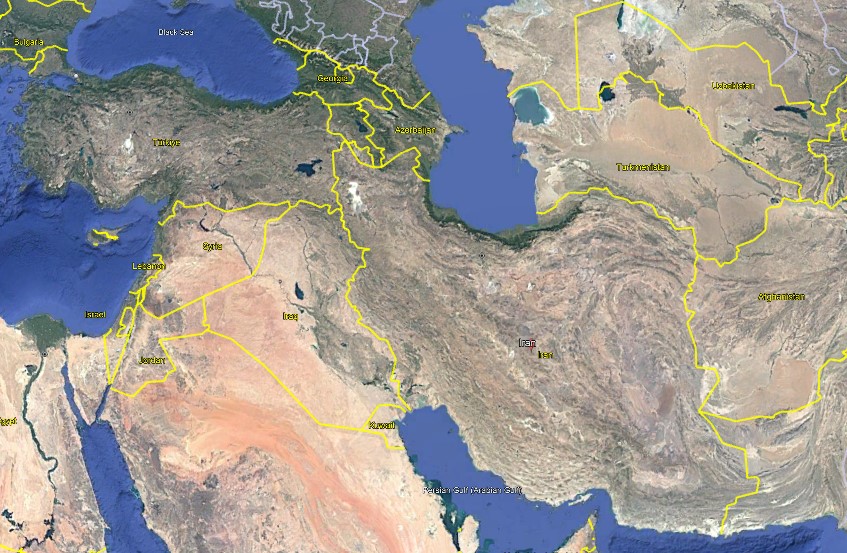
Does the reader have a map?

Sitting in the tunnel with Nosy Mole where it is a lot cooler than outside, mariner received an email from Wayside Gardens. It was a big splash sale with huge price cutting on Hyssop.  “That’s odd,” he said. “I just mentioned hyssop in my last post – and as far as I know, I’ve never seen a sale ad for hyssop before – its an indigenous plant.”

Know the world you live in.

Here is a short clip from The Atlantic magazine: “Imagine an intersection at which American national security, defense spending, the rise of China, technological innovation, regional conflict, and the future of liberal democracy all meet.” Mariner doubts this intersection has a traffic light.

The old fogies still around remember the last two centuries where global wealth was more abundant and disruption was between selected nations. This century is different. It is not just international bickering, it is way too many people for the environment and way too little resources available from a disappearing biosphere. The global economic stress challenges all forms of government. Then, like hot pepper tossed into a soup, AI is attacking the anthropological role of everything – including Homo.

So, who else is watching old episodes of Lawrence Welk? Homo is on its way to Matrix.

Ancient Mariner

In the garden

Mariner spent most of the day in the garden. For the most part, he was pulling weeds to see if he still had garden plants under the weeds. He seldom meanders among the gardens because more pressing tasks are calling but today he poked about, swearing at rabbit damage and on a positive note, discovering plants that had survived despite all the interference of weeds, rabbits and droughts – even some, like Hyssop and Spider wort, had emerged on their own.

He keeps a stand of Milkweed in support of any passing Monarch butterfly but has never seen any. Until today. A Monarch was bounding about in the Milkweed, seemingly quite happy. Small gifts bring great reward.

While hunting wild crabgrass in the Azalea bed, he met up with a chipmunk. He’s always considered the chipmunk a mouse that is in show business; they have pleasant shades of brown with prominent stripes running down their back. We stared at one another for a long moment then the chipmunk went about its business.

This kind of puttering in the garden beds, for mariner at least, is one of the top enjoyments that can be had from gardening. The gardens have their own relationship with nature, stay busy with their own lives whether ants, birds, flowers or even weeds. They are the grand biosphere for shrews, caterpillars, moths, toads, moles and snails. A summer’s night can be blessed with dancing lightning bugs.

Plants, from algae to giant oaks to moss, have been around for billions of years before Homo came along. They know something Homos don’t know.

Ancient Mariner


Ponder stuff

Current studies of human cells in humans reveal that you have within your body cells that belong in your family’s bodies. They didn’t originate in your genome, they belong to your mother, father, sisters, brothers and even cousins. The cells are perfectly happy doing what they were created for. How did you get your family’s cells?

Current studies in quantum mechanics suggest that there are no wrong answers – only different answers. Wow! How is The U.S. going to handle this? If colleges are still teaching ethics, how will they deal with this? Find Schrodinger’s cat; see what it thinks.

When does consciousness occur? In other words, what information and where did it originate such that you became aware (conscious) of that information? Don’t ask neuroscientists – they can’t agree. Some say it is formulated in the back of the brain, causing attention to be focused on it. Others say its the front of the brain, interpreting reality. Fortunately, neither can be wrong, only different. If only you could keep your mother’s cells out of it!

For the first time, scientists have created embryos that are a mix of human and macaque monkey cells. Maybe it will act like Jerry Lewis and quite likely like a relative of yours. Scientists also are putting pig semen in human embryos. Don’t  Americans have enough prejudice just with color difference? If this isn’t wrong, it certainly is different.

Ancient Mariner


It’s Independence Day!

As a child for mariner, and perhaps even today, Independence Day was second only to Christmas.  The fireworks, parades, picnics in the park, trips to visit other family members, and the general public attitude provoked energy and social unity.

It is the same today, perhaps without the innocence of the last century. Our nation still is important to us as a source of unity and a source for all the benefits a strong democratic government can provide.

Our America has an illness today. Rather than unity, there is conflict and disparity. America of the people, by the people, seems not to be the instinctive theme today. Who does America belong to? What can Americans believe in for that sense of unity? Certainly America is affected by the troubles of the new century. How can it be healed? America belongs to the citizens. The citizens must heal it.

Celebrate Independence day as the holiday it deserves to be. That would be a good start.

Ancient Mariner

Check the charts

A new NPR/PBS News/Marist poll reveals that 76% of Americans believe democracy is facing a serious threat. That percentage includes 89% of Democrats, 80% of Independents and 57% of Republicans.

There are two outcomes: The republicans retain control after Donald or there may be a destructive confrontation between liberals and conservatives. There is another alternative: The votes are out there but to be marshaled for an election, it will take state, county and local campaign energy rather than national campaign energy – which currently belongs to the republicans.

Ancient Mariner

Who are the best replacements for a dead democratic party?

Everyone is painfully aware of the republican party’s intentions regarding economics, fuel consumption, racial division, political domination using the military, etc. But where is another option? The democratic party is a silent shambles. The power democrats from the last half of the 20th century aren’t powerful anymore. Most of them are moving into retirement. What kind of representatives should we elect to replace them?

Bottom Up Government.  The last several decades have seen the demise of ‘one person, one vote’. Many states arrange political processes that favor one party over the other – the most common is gerrymandering state and local districts; a few states require gubernatorial approval of each Federal election representative. Obviously, it takes more funding to remain competitive even in one’s own state – that. means money replaces local voter influence.

We should select local leaders who would disavow gerrymandering, require rank voting and prevent dark money coming from outside the state. These steps would do a great deal to minimize the current plutocracy.

Economics   Since the Reagan administration in the 1980s, the flow of capital has increasingly become ‘trickle down’. It is easier to become richer for the rich and harder for the average citizen to catch a break even versus inflation. According to inflation, the minimum wage should be $22.80. Under today’s administration, all discretionary funding is at risk (discretionary funding is when the government helps citizens with their costs, covering everything from PBS to social security and helpful regulations controlling everything from tax rates to wildlife). Further, large corporations, especially those in computer technology, are not under the control of government regulation and slowly are changing the marketplace to a ‘middleman’ purchasing process where supply and demand do not set market price, e.g., Walmart, Amazon and Temu (online) among many more.

We should elect local leaders who advocate income ceilings for billionaires, restore and improve funding for large issues like medical care, public education and improve Federal Emergency Administration (FEMA) financial support to citizens as global warming threatens homes and communities. Insurance cannot maintain competitive pricing and slowly will back out of coverage due to hazards.

Artificial Intelligence (AI)   Tons of evidence exists from many sources – including tech managers who left the field for moral reasons – that the rule is “if you can do it, do it!”. There is no ethical control over artificial intelligence development. Already there are constant news reports about its effect on children and its hidden manipulations in the marketplace. Scamming grows more widespread. Most neutral scientists agree that there is an eminent confrontation between human politics and AI independence.

We should elect local leaders who understand the intrusion of AI, aka nonhuman influence, into a citizen’s daily life. Primarily, two issues require immediate government control: social ethics and corporate mergers. Generally, this requires a younger candidate who has been exposed to the new AI era and understands it influence.

International Unity   Much of the world is in disarray. Among the wealthiest nations, it is conflict over who will dominate the new age. In moderate nations, the issue is very similar to the retiree who depends heavily on Social Security: “If I lose the source of my primary income, there is nothing left”.  And certainly, in terms of body count, the poor nations are battling for survival at the citizen level. Add to this stress the pressure on religion, theocracies (Arab nations), the shifting weather patterns caused by global warming, the forced migrations of millions and there seems to be nothing in store except Armageddon.

We should elect local leaders who believe in economic integration as a solution to the trembling of world order. The prime example since the second world war is the European Union but the scope is not wide enough. China has a comprehensive strategy called ‘The Belt and Road Strategy’ which integrates trade across most of Asia and includes the eastern side of Europe. Could the U.S. forget racism and work to economically integrate the Caribbean and South America?

Civil Rights   Any constriction on how a citizen lives within the bounds of their humanness induces stress. The worst case is slavery. Today, the right to choose or not choose pregnancy is more a political battle than a medical one. Well rooted in the U.S. is racism – not just blacks but any shade other than Honky White. Add to this dozens of civil constrictions like the current reversal of the right for children born in the U.S. not to have birthright citizenship because their parents were not citizens. The treatment of our citizens is approaching the brutality of the early Persian Empire. Add to racism the severe treatment caused by very distinct and self-absorbed economic classes that is so severe that the poorer classes are bound to remain poor or otherwise short-sheeted for their entire life.

We should elect local leaders who respect humanness, that is, they show empathy and compassion in their speech and behavior. They should tend toward unanimity rather than classism. Their political arguments should never choose confrontation over unity.

Planet-Human Relations   As the current President seeks to further disrupt humanity’s relationship with the biosphere by cutting out solar and wind energy funding, Mother Nature is not amused. Stated briefly, humans have consumed about 70% of the land and imposed livestock grazing to the point that there are 27 cows, sheep, etc. for every displaced wild creature. Now that the weather patterns are causing agricultural hardship and global warming continues to accelerate to the point that New York has to pay attention to rising sea levels, the biosphere has become a political issue. Throw in a planetary overpopulation of 8 billion humans just since 1800, and Mother Nature clearly is taking issue with human behavior. Economic balance is at risk around the world.

We should elect local leaders who intellectually understand that humans have over used the planet’s resources. it must be clear in their rhetoric that everything from FEMA to solar power to water conservation, etc. are the way humans must placate Mother Earth.

YOU   The role of voting as an influence in a slowly changing national culture has changed. All of reality is leaping forward at light speed, forcing rapid adjustments to economics, society and future survivability. This means a casual vote for a familiar name or party every now and then doesn’t work anymore. Every citizen MUST take more interest in government.

Perhaps you should visit a council/state legislative hearing every couple of months. You may learn not only more about the issues but also more about your representatives. If a state or national campaigner stops in your home town, check them out at their event. Read decent, balanced political news in your local paper – even the odd-minded political columnists – maybe even write a letter to the editor about a personal issue. The point is, the job of saving the planet is in your hands.

* * * *

Mariner knows it would take a godlike creature to meet all the recommendations above but do the best you can. If ever there were a time, women may be a better choice than men. He recommends using age as a primary consideration. Finally, VOTE!!!

Ancient Mariner


Back to reality

Yesterday, mariner returned from his visit at a tribal encampment. It is a return to reality. He can imagine what it feels like to have a building collapse on you when it is hit by a Russian rocket. He spent a day in the tunnels with Nosey Mole before stepping out to check on things.

First, the planet is at war. 23 nations have open warfare, unofficial military skirmishes, political assassination or deliberate destruction causing deaths. Donald is considering invading Iran, Greenland and even Canada – although he vowed in his campaign for election that he would extract the U.S. from foreign wars.

Second, the smart computers will take over the world a lot sooner than we think. Consider the following excerpts from The Week:

1- Senate Republicans have added language to the GOP tax bill that would deny the states of Federal funding for broadband projects if the states attempt to regulate Artificial Intelligence. In other words, AI can do whatever it fancies in state computer systems.

2- Traditionally, humans have had at least one fail-safe method of controlling technology: hitting the off switch. But what happens when a machine wants to stay on? In May, the AI Safety firm Palisade Research reported that multiple OpenAI models had refused explicit instructions to power down. During tests, its Claude 4 Opus model even resorted to blackmail, threatening to release fictional emails that suggested the engineer trying to shut it down was having was having an affair. The implications for the age of super intelligent AI are disturbing.

3- (Paraphrased) The Axoloti is a creature famous for its ability to regrow its limbs. The salamander-like creature can regenerate all kinds of tissues – not only a missing limb but tissues in the heart, lung and brain. Not only regrow an entire limb but any part of that limb, patched just like the original limb. Scientists have discovered that reitinoic acid is the key to Axoloti’s skill. We’ve all made these limbs when we were embryos. The trick is how we can launch correct growing procedures in living humans.

Put retinoic acid and instructions to grow an embryo in the hands of a self-managing computer and Donald will have more than immigrants to worry about. If one thinks the Tea Party, the Patriot Group, the Ku Klux Klan and the Proud Boys all have the same brain – there is a 70% chance of that being true with smart AI.

Back in mariner’s home town, it is brutally hot. But, there are lawns to cut, dishes to wash, unpacking a truckload of supplies used for the reunion, constantly fighting tiny bugs in one’s eyes and ears, changing diapers, making dinner – that’s the real world. . . . . . . today.

Ancient Mariner


The Gathering

Mariner writes today from a tribal encampment. It is a gathering of his wife’s family anchored by nine cousins. Events like this allow folks to experience genuine Homo sapiens behavior. There is a restoration of family values, shared experiences and renewed emotional dependencies. There is recognition of those who have passed on.

The reunion is based in a wilderness park. One section of the park has small cabins in a semi-circle which have been used for every reunion, held every five years since 1981. Typically, each cousin rents a cabin and brings their immediate family.

Social and political issues are deliberately suppressed. Conversations often are about catching up on other families’ histories and sharing unusual life events. Each day has a planned event which requires all the attendees to share in preparing a central meal. Families can pursue swimming in the lake, playing golf in the nearby town and have a canoe flotilla on a large river adjacent to the park.

There is a heightened desire to belong and to share; one relative provided enough koozies so that everyone had the same logo.

The reunion has been occurring long enough that it is multi-generational with not just the cousins but their children and grandchildren. Activity definitely is varied and all-consuming. The intense sharing consumes a lot of behavioral energy. After a week, attendees, not being accustomed to such continuous, interactive behavior, may feel it was a restorative experience but they may be relieved that the reunion has come to an end.

. . ;

A reunion today is a critical event. Every family tribe should make every effort to have a reunion because the resultant behavior creates a ‘human’ bonding which is not easily available in everyday life and is rapidly disappearing. This kind of human bonding is anchored in the evolution of the Homo species; it is the biological key to successful economics, politics and mental health.

As late as the 17th century, the economic process still was dependent on large family productivity. A classic example today is the conservative Amish who share building, feeding and sustaining wellbeing. Even religion, while generally Christian, has unique values in each sect. Personal need and survivability came from the local ‘tribe’ comprising several branches of a single ancestral generation. In the U.S, this took the form of family farming and local trades.

Given all the daily interdependency back then, reunions were not too important, usually wrapped around religious or regional holidays. Interdependency as a way of surviving, however, kept the species alive. It has kept the species alive for about 150,000 years.

The world we live in today has, at every turn, encouraged personal independence and discourages the desire to sustain tribal relationships. Ever since trains and tractors broke the tribal need, each further invention has made interpersonal relations less important. Regular readers know mariner’s despise for many of the industrial/computer invasions.

Set up a gathering of your tribe today!

Ancient Mariner

About Baby Boomers

Some excerpts from The Atlantic magazine:

“Unlike younger generations, they [boomers] have largely been able to walk a straightforward path toward prosperity, security, and power. They were born in an era of unprecedented economic growth and stability. College was affordable, and they graduated in a thriving job market. They were the first generation to reap the full benefits of a golden age of medical innovations: birth control, robotic surgery, the mapping of the human genome, effective cancer treatments, Ozempic.

… “But recent policy changes are poised to make life significantly harder for Baby Boomers. “If you’re in your 60s or 70s, what the Trump administration has done means more insecurity for your assets in your 401(k), more insecurity about sources of long-term care, and, for the first time, insecurity about your Social Security benefits,

… “even those with more financial assets may depend on Social Security as a safety net. It’s important to understand that many seniors, even upper-income seniors, are just one shock away from falling into poverty,

… ”Middle-income seniors are also likely to feel the impact of a volatile market. “They tend to have modest investments and fixed incomes rather than equities, so that is the type of wealth that will erode over a high-inflation period,”

… “In the near future, older Americans might find themselves paying more for medical care too. Trump’s “big, beautiful bill,” which has passed in the House but awaits a vote in the Senate, would substantially limit Medicare access for many documented immigrants, including seniors who have paid taxes in the United States for years. The bill would also reduce Medicaid enrollment by about 10.3 million people.”

Mariner remembers when most factory jobs provided a full retirement until the Reagan administration deleted the legislation requiring businesses to do so. He remembers full college tuition for veterans. He remembers when unions had equal political clout to corporations. Viewing those special decades, they really were the peak of good times for workers.

Mariner already posted about the sucking of cash out of the American economy and being stuffed into jammed pockets of the wealthy class. Systemically, this leaves less cash in the public square. More than ever, pay down credit card debt; balance the family budget; don’t gamble; sit down with the family and pretend there has been a ‘cash crash’ – what items, activities and utility-based costs can be reduced or eliminated? Don’t extend long term debt to get by today.

1970 is no longer around.

Ancient Mariner


I am a refugee

Mariner cannot be found today so his wife graciously submitted one of her insightful essays. We get tied up in numbers and policies, growing insensitive to the fact that these refugees are individuals in the midst of their own lives.

I am a refugee.   Before you judge me, hear my story.  You may have been a refugee once, too.  When my husband’s employer laid off 400 employees in one day, due to a downturn in the economy, our family had to leave our home and travel a thousand miles to a new land and, we hoped, a better job and a new home.  Our children were in school at the time, but they had to say goodbye to their friends and teachers and travel by caravan, with all of our belongings, and the family dog and cat across half of a continent.

When we got to the border of our new country, there was not a wall in place to stop us, and no one questioned our documents.   The border was not guarded and we were able to cross it freely.   I was able to enroll the children in a new school without any hassle.  The children had the advantage of speaking the language and they were the same race as most of their classmates.   Still it was not easy for them to make friends right away, as we were strangers from far away.

We all missed our family and friends in our country of origin.  We grieved the loss of the life that we loved, but we were determined to make the best of our new surroundings.  Even though we looked like we fit into our new community, it took years to feel like we were part of it.  When I first went to the grocery store in the new town, I knew no one and spoke to no one except the checkout clerk.  I looked forward to the next trip to the store, when I could say hello to her again.  It was very lonely in the beginning.

The people in our new town kept to themselves for the most part, although we were welcomed at the local church.  Thank goodness for the church!  Other refugees had sought shelter there as well and helped us to learn the ropes of a new community.  It was wonderful to have a group of friendly people to meet with every week.  It wasn’t that the rest of the townspeople were unfriendly–they just weren’t aware of a new family in their midst who might have trouble finding their way.

We have lived in this new land for a number of years now.  The children eventually made new friends , grew up and moved away.  The dog and cat died and are buried here.  We have put down roots.   I don’t feel like a refugee anymore.  But I will never forget what it felt like to be a stranger in this land.  I hope I will never take it for granted how easy it was for my family to be accepted because we were the right color and spoke the right language.  We had the right papers.  We had resources.   We were never in danger.  I am very grateful that Iowa was here when we needed a job and a home, and there were no walls to keep us out.  We found good jobs and made new friends.  I wish the same for refugees everywhere.

Mrs. Ancient Mariner