“WASHINGTON – Transportation Secretary Anthony Foxx said Friday the government has opened a price-gouging investigation involving five airlines that allegedly raised airfares in the Northeast after a deadly Amtrak crash in Philadelphia in May disrupted rail service.
The Transportation Department sent letters on Friday to Delta, American, United, Southwest and JetBlue airlines seeking information on their prices before and after the May 12 train crash.” (Newsday July 25 2015)
In a recent blog about the confrontation between capitalism and socialism in Cuba, the mariner demonstrated capitalist behavior by using airlines as an example: ….whereas only 4 [airlines] can mimic one another easily, coordinate hub flights to assure every flight is full, and, in order to keep profits high, slip down the slippery slope to collusion….
From a capitalist point of view, the airlines did nothing wrong by raising prices to the Northeast. It’s a matter of supply and demand. With the train option eliminated, demand rose for airlines, making a seat more expensive because supply had not changed. All’s fair in love, war and capitalism.
When the mariner was working for others, he constantly had to use airlines. For two years running, he belonged to United’s 100,000 mile club. This recognition provided easy upgrades to first class and access to the United club room at the airport where waiting was more pleasurable. Nevertheless, the mariner did not like flying because it was an experience very close to hog gestation cages. More than once, a drink sitting on the fold down tray went flying when the person in front pushed their seat back within six inches of his face. When he had a contract in Madison, Wisconsin, he calculated that the entire trip by air took eight hours door to door. It also took eight hours to drive to Madison, door to door – so he drove instead. And this experience was before TSA! On the way to a Caribbean sailing trip after he retired, the mariner stood in Orlando airport for two hours just to pass through TSA. He retired just in time.
But now he faces the airlines again. He must fly from Denver to Los Angeles and back. The mariner is not afraid of flying; he has 22 hours toward a private pilot’s license, a project that was interrupted by a career move. However, he is afraid of the airline corporations! Corporate greed is never on display more than when flying – unless you fly internationally and have LOTS of money. But that is flaunting one’s wealth – another form of greed.
This is the first post to the mariner’s blog associated with his trip to see his progeny. He will make every effort to share the good times….
Ancient Mariner
Monthly Archives: July 2015
Cheap Drives Out Quality
When the mariner was sixteen, he finished his high school education at night. He took an economics class that provided him several insights into the motives of society and individuals. He was fortunate to have an instructor that was willing to talk cultural ramifications as well as economic ones. One of the insights he gained from that economics class is that there is an unbreakable rule that cheap value will displace quality value in every case.
A simple example is the toy fire engine. In the mariner’s childhood, the fire engine was made of steel with realistic features, rubber tires, and paint that included firehouse logo, four small painted firemen and other finely traced detail. His children did not have a steel fire engine; they had a plastic, mold-stamped one with little attention to the aura of a real fire engine. There were no finely painted firemen. Plastic drove out steel. It was less expensive – at the cost of quality, detail, permanence, and material.
Reducing cost through new inventions, materials and processes is, largely, a good thing. Even in its best light, however, quality is minimized. One may say that new technology can produce better results. For example, an mp3 song is better than a 78 record – both in quality of sound and in production. The price paid for this efficient production is not in the quality of the sound but in the value of the recording as a significant, endearing purchase. At 99¢ per song, it is easily discarded or lost in thousands of other songs collected because collecting is easy and inexpensive. Even a 45 rpm collection is more durable and more revered – if one still has a 45 turntable.
Turning to more important examples, the mariner wonders if the tea party is a cheaper version of the republican party. Intellectually, it is easy to replace complex, multifaceted issues with visceral, overly simplified but “feel good” reactions. The republican party has an ideological premise based on conservative, capitalistic ideals. Under Representative Boehner, the tea party has captured the republican party and drawn it away from legitimate dialogue with democrats into a paranoid and extremist advocacy which will not stand up against an organized, middle-of-the-road campaign by the democrats. True, gerrymandering and republican governors will offer resistance but the attendance at Bernie Sanders’s events plus the low key campaign of Clinton suggest that the tea party brings a poison pill to the republicans for the 2016 election.
The phenomenon of sixteen candidates in the republican presidential campaign also suggests that the republican party has lost its rudder, its sails and its compass. That a destructive candidate like Trump can turn the useless media into a circus rather than covering serious issues is more evidence that the republican principles have been replaced by a cheap sideshow. Turning a valued election process over to the Fox network is the final nail. Cheap has driven out quality.
Ancient Mariner
The Future is Here
The first mate and the mariner will soon depart to visit our far-flung children. He will do his best to post moments of interest. Of particular interest, to the mariner at least, is to imbibe fresh seafood other than the occasional never-frozen catfish – a fine plate in Iowa but the only one. Leaving a small quiet town, we shall thrust ourselves into the urban society of large megacities, traffic, and cultural phenomena unseen on the gravel roads and cornfields of Iowa.
We find that options offered by AirBnB are quite satisfactory, certainly on par with four star accommodations, and affordable at 1/3 the price. Already we have reserved a home in Phoenix for our winter retreat and a reunion of said children and families.
The mariner recently posted a series on the future of work, suggesting that automation will erase whole job sectors in a few decades. He sees the current AirBnB movement as an example of redistributing income based on individual resources and skills rather than depending on business resources. Eventually, businesses will revolt against income distribution to independent workers – first trying to outlaw them or force them to comply with peripheral law and regulation, then being forced by market pressure to reduce product cost to reasonable levels that do not provide the degree of profit available to businesses today. In any case, it should be interesting to watch the future of AirBnB and other self-financed efforts as a spearhead movement toward the future of work.
A long time friend of the mariner had a career in utility management. When the friend retired, he set about doing renovation work. He specializes in turning attics into finished rooms. His only promotion is word of mouth. Yet, for many years, he is as busy as he wants to be.
Another friend has retired to do consultant work with newspapers and dictionaries along with publishing detailed accounts of movie house history. He is as busy as he wants to be and travels frequently. Over the years, the mariner has come across numerous craft persons who maintain a modest cash flow as artists, cabinet makers, making knick-knacks, colored glass glaziers, and family builders and renovators. With a few dollars to invest, one can open a simple store front specializing in a high quality product – one as simple as cupcakes. Already, the desire to find contentment in what one does, along with a contribution to the marketplace in return for income, has become a job sector to be noticed and an example of the future of work.
Ancient Mariner
Farewell Jon Stewart Hello John Oliver
For sixteen years, the mariner has been a fan of Jon Stewart. There are millions of fans who truly will miss his self-deprecating humor, his wild impersonations of the Jewish dialect, the New Jersey style of banter, and particularly his turtle impression of Senator Mitch McConnell. It is hard to imagine how he sustained his energy for so long as a counterpoint to mediocre news media, especially Fox News, and pusillanimous politicians. His humor was sharp, insightful, educational, and despite his ‘fake news’ moniker, was a legitimate source of truth. His last broadcast of The Daily Show will be August 6 with President Obama as his guest. We truly shall miss Jon.
However, Jon has left an apt successor in John Oliver who appears in Last Week Tonight, The John Oliver Show at 9:30PM on HBO. John is a spinoff from Stewart’s staff. His episodes also can be viewed at
https://www.youtube.com/watch?v=i8xwLWb0lLY
Oliver is at his best when delivering an accusatory tone about the inadequacies of human nature and American values. John certainly will fill Jon’s shoes as the official muckraker of TV.
The link above will take the reader to a show about food waste. According to Oliver, food waste – only food waste – can fill 740 NFL-sized football stadiums each year. The mariner is aghast at our personal food habits and shared with John Oliver his disbelief about how charity tax breaks for small businesses do not survive Congress. Small business needs a tax break to cover the expense of charitable distribution which costs as much as normal distribution. The food episodes are truly enlightening. Write to your Congressional representatives requesting a charity tax break for all businesses that process food – from the farmer to the distributor to the retailer.
An odd but dependable observation: Why won’t we buy the last head of lettuce or the last peach?
Ancient Mariner
Euthanasia versus States Rights
Recently, the television news program Sixty Minutes aired a rerun of the Barbara Mancini case about euthanasia. Mancini’s father asked her for a bottle of morphine used for measured applications and drank the bottle. Barbara Mancini was arrested and charged with assisting a suicide. Ultimately, months later, a judge dismissed the charge for lack of independent investigation. On the day she was arrested, the father was taken to a hospital where the very experience he vehemently deplored played out. He died of morphine toxicity four days later incurring a large hospital bill.
The interview can be viewed at https://www.youtube.com/watch?v=MAHey2LjA6c
The first and best known advocate of assisted suicide for terminally ill individuals is Jack Kevorkian. He devoted the later part of his career traveling the US helping 130 terminally ill patients end their lives. Eventually, he was arrested for second degree murder and served eight years in prison.
Opinion about euthanasia is polarized similarly to the abortion issue. There is no ground for compromise – a person dies or doesn’t die – at the hand of fellow human beings. Only three states have laws permitting euthanasia; two states have determined that euthanasia is legal under the state constitution; two states have a medical procedure based on living wills that permits euthanasia. Interestingly, the six states involved are a mix of notably liberal and conservative states and are geographically spread around the United States.
The mariner could continue to write about either euthanasia or abortion ad infinitum but he is not a physician and does not have the Wisdom of Solomon. His opinion is moot, as a jurist might say.
What strikes the mariner as a national issue is whether state rights in our democratic republic always serve the best good for the nation and its citizens. Recently, the rebel battle flag Stars and Bars, a state rights issue, was superseded by national opinion about prejudice and the heinous murder of nine church members. The question to ask is whether the individual states with history as a confederate state should be permitted in any case to sustain oppressive racist practices – the same question for other issues like euthanasia and abortion, all of which have prominent national opinions and outcomes. Simply said, how can helping a person die be okay in one state but not be okay in another? The ethical argument is not associated with state terrain, economy, or local culture. Rather, it is a US Constitution civil rights issue and a religious denomination issue but it is managed state by state.
The conflict between local state prerogative and Federal mandate was demonstrated recently by a Supreme Court opinion mandating states to practice and recognize homosexual marriage. Some southern states still are struggling to escape the Court’s opinion. If one opens this Pandora’s box, one discovers arguments leaning toward erasing separation of church and state, social segregation by businesses that looks very much like racial segregation did vis-à-vis the right not to serve African Americans, and the same illogical dissonance about a behavior being okay in one state but not okay in another.
Other areas related to infrastructure (oil pipelines and electrical grids), medical costs and medical insurance, tax codes, entitlements, and other issues entwined with Federal law and national opinion, are manipulated by state level interests to prevent Federal law or national opinion. For example, the Affordable Care Act is a Federal mandate for health care but medical insurance costs and policies are a state-by-state application – to the advantage of the insurance companies.
The mariner suspects that the founding fathers had to deal with very independent states who still, in some respects, considered themselves independent countries bound together at best like the European Union. Just as the second amendment was created for reasons of national defense but today is interpreted in a paranoid way by anarchists and isolationists, so too were states allowed independent constitutions, independent civil police authority, and today are allowed to create a disparate moral culture.
Some readers may say there is strength in diversity; some may say morality is based in universally accepted truths. The mariner would suggest that it is no longer beneficial for states to behave like individual countries just as it is troublesome to continue to tolerate an eighteenth century interpretation of the right to bear arms. Drawing the line as to where a state may be independent or not is a difficult assignment; the need today – especially with international economic consortiums, global environment issues and the fragmentation of what the American spirit represents – requires us to consider more strongly national rights. One nation. One people. One vision.
Ancient Mariner
The Future of Work Revisited
A reader posted a reply to The Future of Work – III When Jobs End. It is copied below:
“Does it only count as a job if you get paid for it? Or does a job also imply some kind of accountability? If you don’t do your job you don’t get paid. How is the welfare mother held responsible for the outcome of her ‘work?’ It seems that she gets paid whether she ‘works’ or not. Maybe that is the frustration of the working class against the welfare loafers–that those with regular jobs are held accountable to a standard which feels very judgmental–the dreaded performance review. Hence, the workers are judgmental against those who aren’t held accountable and still get paid. How do we remove accountability from the equation?”
Living in a Max Weber world (wrote “The Protestant Ethic and the Spirit of Capitalism,” in 1904) and also under the influence of the protestant ethic itself which emphasizes that hard work and frugality are the result of a person’s salvation in the Protestant faith, it is hard to envision a society that is based on other virtues than capitalism and sanctification by work.
There are places where capitalism survives but is subsumed into socialism as the primary ethic. One thinks of the Nordic countries but the top ten socialist nations in the world includes Canada. Reference:
http://blog.peerform.com/top-ten-most-socialist-countries-in-the-world/
This website has a short paragraph about each country and is a good place to start one’s investigation of socialist ideals and how GDP functions in a socialist culture.
What is important to us as we contemplate the future of work is individual happiness. If happiness or at least contentment is a dominant ethic, the workplace must accommodate that ethic – rather than first accommodating personal profit and success over others. Microsoft Corporation in Redmond, Washington has made the physical workplace one which induces contentment in the employees. A Microsoft employee has a liberal leave policy, flexible hours, babysitting services, picnic and exercise space, 24-hour food services and a host of smaller conveniences. Microsoft is rated the best among peer companies for its profit sharing/401K retirement program. One will never say that Microsoft does not support capitalist principles and does not have profit in mind. Still, the working individual is allowed to integrate the reality of living an individual human life with accountability to the corporation.
Despite the expense of an employee’s contentment, Bill Gates is the wealthiest man in the world. Gates is an exception in a country known for its capitalism; he is known for his liberal philosophy and is one of a handful of billionaires actively supporting human welfare around the world. However, if one is not so wealthy, putting individual happiness first is virtually impossible in the competitive environment of capitalism. Culturally, it will be immensely difficult for today’s political and business environment to adopt contentment as a requisite in the future of work. The economy of today’s culture also will require mind-bending adjustment. It is common knowledge that the US is an oligarchy; wealth is the first measure of a person’s value – even in the little town where the mariner lives. Putting profit first leaves behind a broken and insecure middle class and an underclass comparable to 19th century India.
It is virtually impossible to move a person embedded in the current work culture to the future work culture – particularly a person older than a millennium who has worked a lifetime in the labor class. Referring to the three cases in FOW II, this person still would call the part time worker lazy, still would call the welfare mother lazy, and would fault the children as much as the parents for not accepting responsibility; the person would give credit to the parents for their work ethic. Being embedded in today’s capitalist culture is why it is difficult to imagine the future of work.
To address the issue of accountability, the future of work is based on the principle that “it takes a village,” if the mariner may borrow a term. The reason the welfare mother is seen as a risk to the work ethic today is that she is isolated, has virtually no peer support, and does not have enough income to pursue a normal life; in other words, she is programmed to fail then she is blamed for the failure. If the culture around the mother included her as a resource and supported her as if she were an asset to the “village,” she likely will be judged in a better light by others and could be depended upon to do a better job. The social pressure on her would be as strong as being wealthier than one’s neighbor is today.
Ancient Mariner
The Lobby Economy
Mind you, the mariner observes the world from dockside. He is a generalist and an idealist and his assumptions, while based on factual research, may not be simpatico with all readers. That is fine with the mariner. He wants only to inform on all matters of interest, leaving the reader to receive the information as the reader chooses. This has been a public service announcement.
The mariner is finished with the future of work. It is an alien world to our capitalist society; only large numbers of unemployed will force change in the Federal and State Governments. Fortunately, we have a foot in the door to future work with the existence of entitlement programs and safety net programs like Social Security, Welfare, Medicaid, and unemployment insurance. It is important in coming elections not to let entitlements slide backward. Generally speaking, this means democrats must control Congress.
The topic in this post is to ponder the economy the US has today given that a handful of major industries control both social and economic priorities for our daily life, cost of living, and what the policies portend for the future. Specifically, the mariner will look at banking, fossil fuels, agriculture, alternative resources, guns, and an overview of issues related to personal rights. This is another series requiring more than a single post.
In this post, we will look at banking.
No doubt, the reader remembers the recession that began in 2007 and, in some respects, continues today. The noisy headlines of media focused on the Federal Government bailing out Chrysler, General Motors and Wall Street. The phrase commonly heard was, “The banks are too large to fail!” but fail they would if fiscal conservatives and libertarians had their way. The reader may remember that shady dealings with subprime mortgages bundled and rated AAA were priced accordingly and sold despite the fact that the mortgages in too many cases were sold to homeowners under false pretenses and were bound to be foreclosed when balloon payment came due. A domino effect ran through the mortgage industry calling in loans that were under water. 1.2 million families lost their homes and any equity they may have had. Real estate values plummeted.
Interestingly, from the beginning Goldman-Sachs purchased insurance against failure of the derivatives – knowing that the derivatives were overrated and likely will not hold the price. Some large investors went so far as to put short orders on the derivatives and when the derivatives fell, made tens of millions of dollars.
Some analysts were shrewd enough to ask the real question: Why had these mortgage shenanigans caused a recession? The basic banking answer is the banks did not hold enough liquid reserve to cover their losses and compensated by covering risk with their own insurance which still was charged against the bank’s bottom line. But there is more.
Unfortunately, the banks were gambling with depositor savings, something the Glass-Steagall Act in 1933 prohibited until it was repealed in 1999 when President Clinton signed the Financial Services Modernization Act into law. The battle continues today as Congress tries to dismantle the Dodd-Franks bill passed in 2010 that restored the separation mandated by the Glass-Steagall Act. Note: Of all lobbying contributions, the banking industry is the by far the largest.
The real question remains. Why are the banks running the economy? Why is the idea that banks are too big to fail even a catch phrase?
The answer is that the banks are filling a vacuum. In a healthy economy, the Gross Domestic Product (GDP) is driven by companies that produce something – manufacturing, agriculture, oil, technology, etc. In recent decades, corporations have moved manufacturing overseas; agriculture has a dysfunctional economy heavily underwritten by government subsidies and loans; oil is not a meaningful export; technology is international. What theses normal GDP industries have in common is that they hide profits overseas and may be unnecesarily leveraged to banks. Being in debt to a bank, as is often quoted, is like having a partner.
This is an overly simplified analysis; it identifies the fact that banks need regulation by governments as much as any industry. There are other fiascos like the power of eight people on the Monetary Policy Committee in Great Britain that determines worldwide interest rates; collusion abounds. Still, the banks have power because they are the big boys on the cash flow field. The US and private enterprise are on the dime to restore manufacturing, correct hidden profit schemes, to stop moving corporate headquarters to places like the Cayman Islands, and to reorganize agriculture.
At the consumer level, credit cards are a profit tool for banks. Interest rates are exorbitant – pushing as much as the consumer market will bear. As consumers move into a non-cash world, they are susceptible to interest rates as high as 29%. What happened to usury laws? The mariner recommends strongly that un-indebtedness is the most important family policy; it can make the difference between a quality life and being owned by the banks like a tick owns a dog.
Ancient mariner
The Situation between Us and Our Planet
The mariner wishes to remove the political bickering by our elected officials. Their motives are tied more to the science of profit-making and job security than to the real situation of the relationship between Homo sapiens and Earth. Below is a link that the mariner urges you to read. There is no political banter; there is no liberal-conservative bias; there is no corporate or socialist slant; there is no nationalist defense. It is short and has pictures.
51280-the-new-dying-how-human-caused-extinction-affects-the-planet-infographic.html
By the time the reader reaches the end of this post, extinction, climate change, an ice age, polar magnetic shift, and plate tectonics will be discussed. Lest the reader be confused, the topics actually are relatively independent of one another but Mother Nature is playing games with our adversarial political style. Poor Congress will be tied in knots for years!
The Planet Earth has some very large and slow-to-change processes that are not necessarily visible to humans. They are not visible because the impact of humans upon themselves may not be felt for decades or centuries. Nevertheless, the Earth does notice – if the mariner may be anthropomorphic. Slowly, the Earth changes its behavior. The first signs that the Earth has noticed is Earth adjusts its biosphere by eliminating species that no longer fit the Earth’s global ecology. This is the mass extinction of species called the “Sixth Extinction.” The second sign that the Earth is adjusting to reality is the change in subsystems like ocean temperature and acidic oceans, which begins to eliminate the very bottom of the protein chain – coral, plankton, simple land life like lichen, moss, and other simple plant life both in the water and on land. This elimination process already has begun.
Like many, the mariner feels that there is too much carbon dioxide. Evidence among growing things is too obvious. Excessive carbon has haunted us since the iron mills in Indiana and Ohio were spewing smoke that was killing trees in Pennsylvania and New York and coal mines poisoned rivers in the Appalachians.
However, the Sun is the most powerful influence on Earth’s weather and global temperature – easily trumping even Homo sapiens’s mischievousness. In just the last few days, solar scientists, armed with the best data yet regarding the activities of the Sun, say the Earth is headed for a “mini ice age” in just 15 years — something that hasn’t happened for three centuries. Early predictions are that it will last until 2045. The drop in Sun activity is called a Maunder Minimum; deeper currents in the Sun are moving in an opposite direction to the currents on the surface. The mariner mentioned a probable ice age in a post in June 2013 when he mentioned an ice age will occur in the 21st century. It isn’t his insight; he had been reading what solar scientists were saying about Sun cycles and the timing seemed correct.
Climate change versus the ice age. If there is confusion and disbelief now, think what both together will do to politics, international anti-carbon agreements and many environmental improvements riding the financing of climate change. Perhaps it should be made clear that there are two issues: ice age and excessive carbon – climate change notwithstanding.
Every 200,000 years or so, the magnetosphere switches poles, that is, the North Pole becomes the South Pole and vise versa. Presently, we are experiencing the very early phases of a polar switch. Scientists have determined that the strength of the magnetosphere has dropped 15% since 1840. There is nothing cataclysmic about the switch. The North and South magnetic waves push through each other around the globe. For example, today the South Atlantic and the Bering Sea have very weak magnetic spots such that a compass can be seen to vacillate as North and South magnetic waves move back and forth. “It may take another 2,000 years,” said physicist Phil Scherrer of Stanford University.
The real danger in a magnetosphere shift is twofold: First, the magnetic waves shield us from strong radiation from the Sun that is capable of causing cancer and other radiation ills; the Earth’s magnetosphere is weakened considerably during a shift and the Sun’s radiation can reach the surface of the Earth. At some point, all satellite communications will be interrupted.
Second, every creature that depends on a compass to get around will experience a topsy-turvy effect that turns everything backwards. Many creatures may be disoriented: Monarch butterflies, geese, whales – anything that migrates great distances without mapping terrain.
Switching to plate tectonics, the media covers stories about earthquakes and disturbed volcanoes on a regular basis. Statistically, the number of larger earthquakes per year has not changed but the energy or intensity has. The Earthquake that hit Japan recently moved that nation 12 feet closer to North America and caused a shift in Earth’s axis of 6.5 inches. Scientists worldwide focus increasingly on the Pacific Rim by Washington State. New evidence suggests that a small fault, Juan de Fuca, is currently pressing against the North American Plate causing uplift and stress. Eventually, it’s expected that the ground will break perhaps causing another “mega-thrust” earthquake that could rival the recent Japanese disaster. In addition, there is increased activity in the Chile/Peru fault and Los Angeles’s San Andreas Fault. Based on geologic data, a major earthquake has hit the Los Angeles area approximately every 200 years. The last major quake was about 300 years ago.
The mariner has written much about extinction. Peruse recent posts for more information or use the reader’s browser. To the mariner, extinction is both probable and within hundreds of years unless severe modifications are made to mankind’s treatment of the biosphere. We may not need to worry about earthquakes, magnetosphere shifts, ice ages, or Congress.
Ancient Mariner

The Future of Work – IV Slow and Fast
As the United States lives day-to-day, transition to a new world of work will be virtually unnoticed. Evidence will lie in statistics and deep economical analysis. However, in terms of careers and financial security across a lifetime, the financial underpinnings of work will seem to erode quickly; the ability to feel comfort through stable income, savings and retirement will become less secure. The millennial generation already knows that thirty-year jobs have all but disappeared. The millennial attitude is that they are on their own.
The attitude of the millennial generation represents a significant shift in the culture of work. Barely noticeable is a different behavior about job security, accepting short term employment much more casually than their grandfathers who worked in one factory for thirty-five years. Grandfather lived during the period before computers began to have an effect on factory employment and tenure. Those of us twice the age of a millennial watch them with a degree of anxiety; they are living without a net of financial security under them that their elders took for granted.
Today, large corporations like AT&T and General Electric have cut payroll by sixty percent. Google, a world-wide conglomerate, only has 55,000 employees. Google is about to roll out a driverless automobile. Transportation is the largest sector for male jobs in the US. The Swiss start postal service this very day with drones. Further, global corporations have mastered the ability to move to the least expensive labor force without much difficulty – thanks to the power of the Internet and cloud storage. The current labor disruption around the world is international trade agreements which aren’t trade agreements between nations; they are trade agreements between corporate consortiums that erode government authority, human rights and the power of the citizen to vote his or her future.
Slowly, the raggedness of the work culture will increase to a point that having any job may be a whistle in the dark for tens of millions of workers. The alternative is “self employment.” A good example is AirB&B. People list their living room sofa for one night stays; real estate agents have begun to buy houses and keep them for AirB&B income; everyone with a spare room can become a motel; everyone with a car can become a taxicab; dialup services like Angie’s List and Home Advisor have begun to include individuals who can fix a receptacle or weld a broken iron railing; at high profile destinations, AirB&B opportunities are undercutting amortized prices for corporate solutions like timeshares and bundled travel packages.
Two phenomena occur in this self employed market: The income is significantly lower than the income when they had a “job;” the second is that self employed people are happier. It is an irony that most people who have jobs are dissatisfied with them, are not happy with the work environment and find the work boring. On the other hand, these same people are unhappy if they do not have a job – unhappiness related to their inability to contribute to the greater value of society and the wellbeing of their families.
As this jobless society expands, many, if not most, will not have steady income; many will not earn enough to live even a meager lifestyle. Lack of income will come fast upon individuals who lose their regular jobs. The slow part is the transition of public and private institutions to a point where every citizen is available for what today is called a dole. The government must expand ideas similar to Social Security, welfare, paid services like health, and the existence of price controls on most services and purchases. This challenge is a difficult one for a capitalistic society. Change will come slowly.
Institutions already are making adjustments to the new labor market. Government, colleges, and private sector training are growing steadily. Unemployment benefits frequently are extended to eighteen months or more. A few corporations make room for subsidized small businesses that contribute to the corporate productivity. The American automobile industry has used this model for most of its existence.
Normal to the history of change in society, it is the proletariat that will bear the cost of change. We can hope that the change to a jobless society will not last too long. What can we do to ease transition?
Ancient Mariner
I Can’t Find That Person’s Shoes
It often is impossible to understand why another person believes the way they do. Sometimes it is impossible to understand a person’s motivation to act as they do. Empathy can stretch only so far before it evaporates, leaving a total blank as far as understanding a person’s ethical judgment. Walking a mile in someone else’s shoes is much more difficult than one may think. From different perspectives, one religious and one physiological, the mariner touched on this difficulty in past posts:
On the moral conflict between Christianity and capitalism, he wrote –
(Is Christianity Still Christianity? May 22, 2013)
Paul Tillich, a popular theologian in the 1960’s, said that Christianity is vulnerable to being subsumed by other forms of religion, very much as a chameleon changes its color to match its background. The other forms of religion, which Tillich defined as “quasi” religions, are capitalism, socialism, fascism, and authoritarianism. In the United States, the competing quasi-religion is capitalism. To be a Christian in a capitalistic society means that it is likely that a “Christian” is a Christian only to the extent that capitalism is not inconvenienced.
And –
On the fact that republicans and democrats use different parts of the brain to make decisions about risk, he wrote –
(Red Brain, Blue Brain June 19, 2015)
Republicans orient attention to external cues. What this means is Republicans find it less important to understand how they feel inside; more important is their control of potential risk outside.
On the other hand, Democrats orient attention to perceptions of internal feelings – how they feel about the external cues. This orientation also borders the temporal-parietal junction, and may reflect perceptions of internal feeling and motivation in others as well.
- A genuine capitalist cannot understand why a person would give up financial security or relinquish authority to follow Christian principles that, to the capitalist, leave one defenseless against the world.
- A genuinely compassionate person cannot understand why a capitalist can ignore people who are starving and homeless.
- A genuine socialist cannot understand why a wealthy person objects to a one or two percent hike in taxes when it is an amount that will not alter lifestyle in any way and never be spent in the wealthy person’s lifetime.
- A wealthy person cannot understand why a socialist doesn’t respect wealth as a societal right.
- A genuine naturalist cannot understand why developers want to destroy sensitive habitat to build houses when there is plenty of reusable property elsewhere.
An oil entrepreneur cannot understand why people want to stand in the way of progress. - A genuine populist cannot understand why banks intentionally gouge their customers.
- A banker cannot understand why a populist wants to constrain opportunity with regulations.
We could go on….
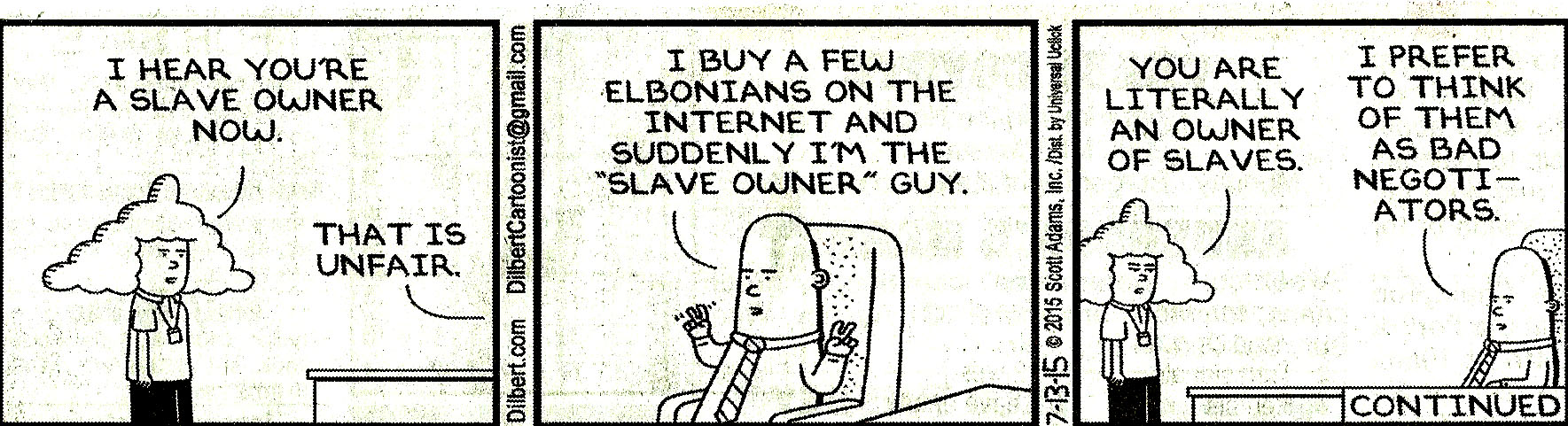
The mariner has maintained throughout his life that comic strips and single-pane cartoons are the most important section of the newspaper. The comics have a sly way of slipping through one’s prejudice, ignorance, and lack of emotional maturity to plant the seed of a new insight. Consider the following Dilbert strip:
Were the strip in real life, we would not laugh so easily. The strip shows how every one of us is vulnerable to redefining reality to fit our personal preferences. It is easy to overlook how our decisions affect others, even abuse or kill them. It is easy to avoid acts of sharing or choose not to act in behalf of someone or something because it is simply inconvenient or uncomfortable.
Sometimes, in our hearts, we don’t really want to walk in the other person’s shoes.
Ancient Mariner