
The Seasoned Retiree

The statistics on the mariner’s blog show that most readers are between the ages of 23 and 50. This post is advice to them from an old sailor whose participation with those 23-50 youngsters is long cast in bronze never to come again.

The mariner lives in a small town where many are, well, seasoned retirees. He has been able to watch himself age in others; he is fully aware how aging itself tugs the elderly further into isolation. Friends and family pass on; society has less need of the elderly; injuries and decrepit bodies limit flexibility and strength. The mind falls into disuse that is not related to dementia but weakens mental agility just as a muscle is weakened from disuse.

In many cases, there is a hard choice to make between daily pain and drugs that ease pain at the cost of cognitive clarity. As one confronts one ailment after another, drugs are piled on drugs, smudging the line between how healthy the body is versus how ravaged the body’s subtle functions are for living normally.

Often, the elderly live waiting for the illness they cannot afford, the illness that will incapacitate them, the illness that will be their end – a feeling similar to waiting for the second shoe to fall. Yet, faced with these circumstances, they survive. They rise each morning to face the day with self-respect and purpose.

To the vast majority of you in younger generations, these feelings and circumstances are alien. You have too much to do, too much to discover, too many dreams and goals – there is no room for the sensations of aging to coexist. You are blessed with natural exuberance. You are in the prime of your life. This is as it should be. Every seasoned retiree has had their turn at your lifestyle.

Many seniors, more than you may think, overcome isolation and fight pain and injury tooth and nail. Many are socially and intellectually active. Many by necessity or by choice work beyond circumstances where it may be better to ease off. And many seniors, more than you think, have healthy and enjoyable lives well into seasoned retirement. However, the norm is a daily battle against isolation and not letting their fading vitality prevent them from enjoying life.

The mariner’s advice to the younger set borrows an old phrase: “Respect your elders.” The elderly have fought well battles you do not yet face at odds that grow against them every day. Yet they live. They buy groceries. They have feelings and friends. Be in awe of them for winning the battles that you, too, will encounter.

The immense desire in our society to make the fast dollar, cut losses, and prefer the younger applicant, too many times is at the cost of a fine mind and proven dependability. The American culture in particular must embrace the age of wisdom. The elderly are like tempered steel, shaped by long experience. The elderly have demonstrated perseverance, persistence and dependability. They are a tempering influence. Their years are golden.

Ancient Mariner
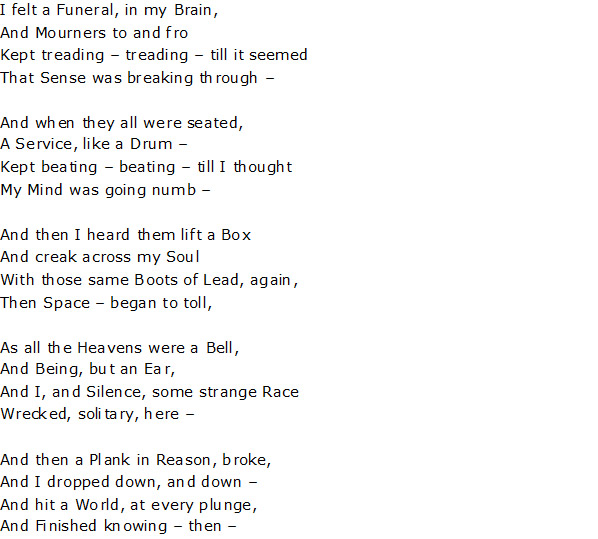
I Felt a Funeral in my Brain

I felt a Funeral, in my Brain

by Emily Dickinson

Dickinson copy

Emily Dickinson takes us on a trip through our own funeral. To that last moment when there is nothing left to know. Nothing to participate in. nothing to share. Nothing to feel. It is finally over.

It is that moment with which we all are familiar. It is a moment we all know will come to pass. Will we feel, as Emily suggests, the drop down and down…and finish knowing?

Some may in their hearts seek this joy. The joy that will leave pain behind. A joy that replaces insecurity, inadequacy, anxiety, depression and defeat.

Some may in their hearts not care about that last moment. There is no joy, no sorrow, and no loss. There is no feeling, too. Nothing of value to miss. The drop down and down to finish knowing is not a step away from before.

When some may feel that funeral in their brain, they bring great anticipation of release into a believed existence far away, that upon finished knowing, move through that moment to paradise unknown.

Some may, in the service of others, have arrived by fire or bullet or starvation or oppression in behalf of those unknown, will they have regret? To those still knowing, the vanquished that drop down have great meaning. To the one that drops down and down, do they wonder the worth?

Perhaps as we feel the funeral in our brain, we look back at what is still knowing, still not finished. As we drop down, we become free of the bonds that held us. Do we see, at that moment, what life ought to be? Is our last knowing of the living finally filled with divine insight and understanding? Is Grace upon us as we finish knowing?

We will be missed by those who love us, who knew us, who knew our place in the world. That, too, will drop down, down and finish knowing beyond our own. It is then that we entirely pass from knowing and being known – then an ancient stone or an urn unknown or ashes cast back to the earth and never known.

To those of us waiting our turn at the funeral, are there things that must be done? Are there rights to be righted? What prepares you for the trip down, down and to finish knowing?

Ancient Mariner

Weighing In

Oh my. The mariner weighed himself this morning. 222 pounds. He has been growing like a potato, perhaps with the potato’s help. Quickly he has moved from 198 pounds last autumn.

No guilt involved. The mariner, as many others may do, blames it on the frigid weather, the terrible winter just now showing signs of faltering. Further, the mariner has a troublesome back condition that hurts just enough to deter normal activity. However, winter is over, the garden is stirring and spring labor cannot be avoided.

The vegetable garden will be doubled in size this year plus a fence must be built around that garden to deny access to rabbits. Rabbits are the scourge of gardeners, especially in the mariner’s small town where there are no predators. He has encouraged bow hunters to kill a few. That has worked well but with minimum effect on the hoards of rabbits still prevailing. The garden walk must be paved. It has sat undone for two years.

So there is a plan afoot to lose weight. It involves more exercise despite his back’s complaint and it involves selecting a diet plan.

The mariner believes any diet plan requiring special ingredients or exercises he could not do when he was fifteen should be discarded.

Promoters selling “better” diet methods can claim better success by using a mathematical process known as base expectancy analysis (BEA). This is a large table of selected items that may affect other items in the table. A successful use of BEA tied mesothelioma to asbestos. Lung cancer and smoking were linked using BEA. Base expectancy analysis, believe it or not, is the same analytical model as Bingo. The players (experiment participants) are given a limited population ∑ (the cards) then random values (balls) are applied that are restricted to the values within ∑. Eventually, a truth table emerges (someone shouts “Bingo.”) Many games are played until a pattern of winners emerges. These winners have something special that enables them to win more than others. Their cards are examined to determine which sequence of balls was most productive. That sequence of balls is the new insight that provides for better living.

Have you noticed there is a new result from some study every month that seems contradictory to a former study? The diet promoters are playing Bingo. Someone else may win Bingo more times on Thursday than they did on Wednesday.

For those who want to know more about bingo, the formula is Σ xiP(xi).

Back to the weight issue, the mariner’s history of weight gain/loss may provide insight into how to lose weight. When the mariner retired at age 63, he weighed 249 pounds. His work environment contained many meetings with donuts, similar sweet products and many lunches, dinners and lounges that were not exactly crackers and skim milk.

Once retired, the mariner lost 25 pounds in six months. The secret is to have major surgery like a knee replacement, which puts you on drugs that suppress hunger as well as most other activities in life. Then the mariner went on a diet; it was the Atkins diet. This diet requires that one eat nothing but meat. The mariner lost steadily to 200 pounds at a rate of 2 pounds per week. Since then, his weight has bounced around this number plus or minus 5 pounds. Until the winter made him gain weight.

Last night on the Aljazeera channel, a Doctor reported that a study showed that saturated fat did not cause heart and cardiovascular disease. Based on this round of Bingo, I have decided to start Atkins again.

This does not mean that the seemingly more rational diets like vegan, supplement and enzyme diets do not work. People on these diets are quite thin. Anyone who has the willpower to eat less than they wish will be thin. Try the canned sardine diet. One can have one tin each for breakfast lunch and dinner. One is allowed one different vegetable at each meal – preferably to provide fiber. You will lose weight. We can go on and on about antioxidants and other chemical analyses but it boils down to less eating. Here’s another diet: eat a hard boiled egg for breakfast, a small bowl of mixed fruit for lunch, and for dinner, have ½ cup each of two vegetables and 4 ounces of meat. Snacking is cheating. That should work. The point is we can invent endless diets if we had the time and desire to do so.

So the mariner has settled on Atkins until 190 is reached. Atkins worked before; it should work again. After all, the Doctor on Aljazeera said it was okay.

No one mentions that a sustained diet only of meat will not only lose weight, one will also lose a liver. Well, last time the mariner lost a knee. I guess losing something other than weight is part of the diet.

Ancient Mariner


Nebraska Revisited

This post is in response to an offline retort to the last post, Nebraska, where the mariner suggested there is a mindset associated with one’s age, not one’s activity:

Each of us is required by the order of our genetic code to move along through these generations as we age.”

The respondent’s objections were examples of activity. The mariner agrees with the examples offered as demonstrative of a given age. All were activities appropriate to an age related behavior. The respondent is on the right track, however, with the suggestion that wisdom is an element of old age.

Is wisdom dependent on IQ? Is wisdom dependent on extroversion or introversion? Is wisdom dependent on wealth? Is wisdom dependent on what kind of activities one performs? No. Wisdom is a constant among all older folk. The relative value of a given person’s wisdom may change just as the size of a circle changes the relative value of PI. It is generally accepted that “wisdom” is a constant with older age. Wisdom is not smartness. Homo sapiens is smartest in the late teens and early twenties. Countless studies have shown that smartness has an exponential downturn through the rest of the lifespan. Still, wisdom emerges.

If a five-year-old cannot be wise, perhaps they are innocent. They do not know that they are innocent, they just are – it comes with the age.

The teenager, awash in chemicals and self-examination, is in a state of discovery – without trying. They just are.

By the time one is thirty-five, discovery diminishes as maturity becomes the physiological phase. It is the age of accomplishment. How well one accomplishes is a measure of activity (see activity theory). Nonetheless, it is the age where Homo sapiens has the best mix of experience, knowledge, and self-assuredness – without trying.

It is the mariner’s feeling that, holistically, our species is not designed to live much longer than the age of accomplishment as strength and health become issues. Without artificial life extension provided by clothing, artificial heat, improvements in health and medicine, etc, most would increasingly fail and die. Should one live beyond the prime age of accomplishment, participation in accomplishment begins to wane. Yet if one lives beyond critical usefulness, one is considered “wise” simply because they have survived the vagaries associated with long life.

In years gone by, it was interesting that Johnny Carson would invite centenarians to be guests on his television show and inevitably ask them what the secret to longevity was. The answers were often funny but seldom, if ever, scientifically correct.

Wisdom is a constant among all old folk. It means that old folk feel less of a primordial need to accomplish as their mindset has moved on to “be wise”. This can be depressing to some and a relief to others. No matter the emotions or “activity,” physiologically, one is old – just as the child is innocent, the youth discovers, the mature accomplishes, the old are wise. And none of the above even knows that their physiological clock is controlling these underlying patterns.

Perhaps, with another millennia or two, our bodies will catch up with our brains.

In earlier history, the Japanese had an interesting approach to leaders who grew too old. They were given absolute authority to pass judgment on a situation – when asked. They were given supernumerary status because of their wisdom but did not have to don helmets or swords. Consider the U.S. Supreme Court….

Ancient Mariner


Thoughts Beyond Nebraska


The mariner saw the movie Nebraska recently. Bruce Dern provided an excellent performance portraying oldness, isolation and social conflict that often comes with old age. The mariner was pleased with Woody Grant’s (Dern’s character) ability to deal with these elderly issues. It was a good movie. The mariner recommends the movie particularly to those who have a lifetime behind them.


The simple plot and observation of Woody Grant opens the mind to refreshed empathy about senior citizens. The passing of time is a passage through many phases of life from infancy to the centenarian. There is a general assumption that there are four generations in a meaningful lifetime, the growing generation, the creative generation, the accomplishment generation and the retirement generation. Each of us is required by the order of our genetic code to move along through these generations as we age.


Living in the generations of creativity and accomplishment are self-rewarding and enable us to feel that we are important to society whether we are engineers and politicians, or factory workers or engaged in retail, whether we are engaged in social and health services. However, toward the end of the third generation, our bodies tell us that things are changing. Our attitudes begin to shift into a feeling that accomplishment becomes hollow and maybe our roles are a bit out of tune with the creative generation.


Finally, we are retired or at retirement age – it doesn’t matter, we are bound by our genetic instructions. Out of the creative and accomplishment phases of society, we begin to feel that we are not the first team anymore. A few of the elderly have either the money or the opportunity to continue to participate but the underlying genetic structure will not deny that we are passing beyond the dynamic moment in society when newness is created and enforced by productivity.


Because of medical advances, the fourth generation is living longer, on its way to creating a fifth generation: the very aged. What is the impact of old people living longer and longer? Medical research promises trouble free life until you literally wear out around 159-200 years of age.


Yet society’s idea of the work span is not respected beyond the age of 55. Older folk do not fit into the requirements of creativity or accomplishment. They are fit for lesser and lesser roles in the productive generation. Were it not for the few surviving pensions, Social Security and Medicare/Medicaid, the elderly would have no financial basis for continuing to survive – not considering the requirement to live to 150 years.


There are government roles in this situation. Some form of tax increase must be applied to the aging issue. The boomer retirement bulge does not make it easier. Let’s face the fact that we are an aging population. This is a disadvantage in international politics, where India, China, Argentina and Brazil have rapidly increasing populations in the creative and accomplishment range. Still, the United States has the creative edge and must find ways to integrate the wisdom of the fourth generation into the fabric of a productive role.


Ancient Mariner


Spring comes in May – then +100°

There are a few who say spring is coming, then summer. The mariner is wary of these prognostications. Changing the time back to standard does not fool him. There is ice and snow all about and as he and his wife walked to the Post Office and back, the 2-knot wind had a sharp bite to it.

It was three years ago that summer came in February. It was 75 to 85 degrees for at least two weeks. Trees and bulbs began to bloom. The grass had to be mowed. Then March came. Coldest March in recent memory; killed many plants and all the buds and blooms. No apples, cherries or pears that year and no narcissus, either. Cost the mariner over a hundred dollars in ornamentals and landscape shrubs. Two years ago, the summer brought nine straight days of +100° weather – more plant kill-off. It is an old saying that owning a boat is like pouring money into a hole in the water. Try gardening in Iowa. Warning: you have to dig your own holes.

The mariner has always proclaimed that the Midwest, undisturbed for thousands of years, was a vast grassy plain because nothing but grass can tolerate the vagaries of the weather. In the southern plains, all the way to northern Texas, there wasn’t much of anything because of the frequent droughts. Visit Kansas, Nebraska, the Dakotas and Montana – and Iowa. Thomas Jefferson called the area The Great Western Desert alluding to the fact that nothing grew but grass.

Nevertheless, the mariner has hoisted his 17-foot Daysailer off the trailer for repair to a dozen spots. The poor thing has been in drydock for three years in an implement shed and is as dirty as a pig in _ _ _ _.

The first job is to put new lines on the centerboard so it can stay locked in the down position. Then it is a matter of giving the boat a bath in Ketone to remove streaks, stains and scum. Then its time to heal wounds and minor cracks with fiberglass work. Finally, the whole boat gets a 1000 grit sanding. Then the hull receives new paint trim and finally a complete waxing. That’s just the hull and deck. Working on masts, booms, deck hardware, new sails, and new sailing lines is another process.

This work will not be done by the spring equinox. There is hope, once the garden work diminishes, that the boat will be sail-ready for shakedown exercises at Lake Rathbun before it’s too late to sail in the Midwest.

If there’s time in October when the mariner visits the Annapolis Boat Show, the boat will be free to run on the Chesapeake Bay.

Screw the weather. Reef the mainsail and cast the mooring lines. He has a heated workshop.

Ancient Mariner

It’s not Whether, It’s Weather

It’s been very, very cold for a long time. It is not the mariner’s season with its incessant snow, bitter winds and short days. He, too, has a cold that has lingered for weeks. Where are the palm trees, green grass and colorful flowers? He’s asked that before but repeats it for emphasis.

The mariner has conjured a theory that the big brain in Homo sapiens, perceived to be a benefit, is actually a time bomb to manage the population of our species. Butterflies, for Pete’s sake, are smarter than arrogant super-thinkers like Homo sapiens. They know to migrate south when the weather shifts.

The human physiology, a hairless ape adapted to the subtropics, is not very far removed from its fellow creatures on the Serengeti. Other creatures driven north for whatever reason have had an eon or two to adapt to colder zones and in reduced numbers for obvious reasons. Think how long it must have taken the whale to return to the sea. We are young punks who do not know our true limitations. Hence, the time bomb.

That we overcame cold weather that is not our natural habitat is nothing to be proud of. Nature is patient. What goes around comes around. Now Homo sapiens is called the Sixth Extinction. Indeed, there is no question about that as we squeeze more and more creatures out of existence. There are soon to be twelve billion hairless apes roaming over every inch of space on the planet, consuming every resource that can be squeezed from Planet Earth – and having little regard for the trash and global instability left behind, all the while wearing longjohns and snowsuits. However, only with the aid of artificial hides, artificial heat and unnatural methods of transportation have we accomplished this unnatural act.

Nature is patient.

In the grand scheme of things, we are beginning to suffer social breakdown similar to crowded rat experiments performed decades ago. Did we not learn? As the rat culture broke down there was needless greed, theft, rape and deliberate denial of normal rat behavior. Today, it has become more and more necessary for not-so-smart humans to carry a weapon – not only as a deterrent for family and neighborhood violence but just in case the social fabric does indeed collapse. Ask any number of people living in the northwest for fear of their lives.

Did you know our African relatives had fake wars, not real ones?

Nature is a grim reaper. We little smart-assed ants are no match. Even real ants know their place and will survive human Armageddon. Even a world overrun with dinosaurs cannot avoid Nature’s little trick called a meteorite. We should have remained in the subtropics and allow Nature to mind our reality for us. Think how nice it would be to sit under a palm tree, smell the ocean breeze and see the tropical flowers in colorful abundance, with a cocoanut in hand instead of a Mounds bar.

It is a race to the death as humans try to turn themselves into humanoids before their abuses catch up with them.

As for the mariner, he’s going back some day, come what may, to blue bayou…

Ancient Mariner