
The Evolution of Faith

Whether one evaluates faith through anthropology, history, or biology, it is a bit of a guessing game. Ask a fish about water and one will not receive an objective and thorough understanding about water. When we investigate the evolution of faith, we are as the fish – examining ourselves, biased by our own experience. Nevertheless, the evolution of faith is an entertaining, thoughtful, and always revealing topic.

Dacher Keltner, Director of the Greater Good Science Center at the University of California at Berkeley, recently published “Born to be Good, The Science of a Meaningful Life” The book begins by paying tribute to Jen, a Confucian state of mind that promotes goodness. Jen is expressed through the good emotions we all have in our genes when we are born: compassion, awe, respect, graciousness, empathy, sympathy, kindness and other feelings that not only improve one’s own wellbeing but also the wellbeing of others who are the recipients of your Jen behavior. Confucius said we have the ability to bring goodness to completion in ourselves and in others; we have the choice to bring badness to completion as well through harmful, nasty, disrespectful, and condescending emotions. Keltner makes the point that all mammals have some degree of emotional goodness; otherwise mammalian species would not have survived.

Joseph Campbell, a famous anthropologist, studied human behavior in terms of the cultures within which people experience life. An excellent interview on the experience of release, otherwise called “salvation” in the Christian faith can be found on the Internet at

http://www.youtube.com/watch?v=Zzj8aE1KPPQ

This short interview is one of the most insightful interpretations the mariner has ever heard. It is a must see experience.

The point of both these writers is that goodness is built in at the beginning. We are prone to seeking the will of God and the “release” that God provides. Yet we are flesh and bone; we have limitations in our intelligence, in our hearts and in our actions. We are tempted at every turn to find comfortable, self-serving solutions that give us physical comfort and undeserved authority; we are bringing badness to completion in ourselves and in others. As both writers explain, negativity diminishes life; goodness expands life. In fact, we wouldn’t exist if it weren’t for goodness.  Walking the path that Jesus walked may take no more effort than always seeking goodness in our lives. Always use good emotions; good acts will follow.

Is Christianity still Christianity?

Paul Tillich, a popular theologian in the 1960’s said that Christianity is vulnerable to being subsumed by other forms of religion, very much as a chameleon changes its color to match its background. The other forms of religion, which Tillich defined as quasi-religions, are capitalism, communism, socialism, fascism, and democratic nationalism. In the United States, the competing world religion is capitalism. Tillich said that this presented a faith-against-faith situation. To be a Christian in a capitalistic society means that it is likely that a “Christian” is a Christian only to the extent that capitalism is not inconvenienced.

Capitalist Christianity is used as a standard that provides moralistic behavior: how to be a fair, honorable, and conscientious citizen – as a capitalist. Capitalism is the force – a mighty force – that prevents many of us otherwise nice, fair and considerate capitalists from letting go of our worldly comfort, our wealth and station in society. If we are forced to walk the path that Jesus walked, we may lose our homes, our cars, our full larder, perhaps even our source of income. This would inconvenience our faith in the capitalist religion.

It is as if we have returned to the world that Charles Dickens described, where charity is unloaded onto government programs, nonprofit organizations that will do the dirty work for us, or we cover our obligation by throwing a relative pittance at local charity and mission fund raisers. Our first obligation is to our role as capitalists but we respect the presence of Christian morality. Actually behaving like a Christian, however, is out of the question.

Except for the rare committed Christian, it is impractical to insist on abandoning capitalism to walk the path that Jesus walked. But how much can we recover the path of Jesus in today’s society so that we will move closer to being a modern Christian? Simple solutions abound. Many give time and personal investment to projects like Habitat for Humanity; some take on a missionary cause like joining the Peace Corps or Americorp, or a church-related mission in the most desperate regions of the world. The pivotal change in behavior is that the modern Christian becomes involved personally, giving time and resources in person, on site, providing genuine concern and care, thereby representing God’s love. It is guaranteed that poverty, privation and desperate need are less than ten miles away from any modern Christian’s home.

Another way to grow our role as a modern Christian is to use our capitalist wealth to contribute to those who are desperate and in need of God’s love, even your love, in God’s name. Specifically, do you tithe? Do you have possessions that you don’t really need – everything from furniture to coin collections? How many changes in clothes do you own? How many shoes? Can you give up one golf game a week and spend one day a week working shoulder to shoulder with the poor? All these suggestions will turn your sense of personal value toward the path that Jesus walked. It will strengthen God’s rudder to steer your life toward being a modern Christian.

Global Markets

Many years ago, it was popular for economic futurists to conjecture that national economies would merge; the vision was based on natural geographic boundaries. For example, Europe would become one common economy; Canada, Mexico and the United States would become one common economy; China and its bordering Far East neighbors would become one economy and so forth.

The demise of colonialism and two world wars later, history has thrown a lot of curve balls. A significant one was that nations were not merger-minded. Rather, a model of have and have not countries, commonly called “super powers,” “developed nations,” and “third world nations” emerged. The cold war between Russia and the United States started a forty year monopoly game to see which of the two nations could politically control the most countries, thereby solidifying their super power position among nations.

Today, nationalism is as strong as ever. Even the land of the free abhors anyone who thinks they can just walk across an imaginary line and become a resident in the United States. The Arab nations are way behind  the western world in social graces but the Middle East is such a war zone that hundreds of thousands of refugees move across borders without even a green card.  Thank goodness for oceans!

While Russia and the United States were playing monopoly, Europe was in the middle. Europe already had democracy and didn’t want communism but Europe didn’t have a lot of natural resources either and depended on military support and trade from the United States. European nations had to come up with something that would expand their authority on the world stage. It took a while before they made a move toward a geographic economy predicted those many years ago: a common dollar called the Euro. Still, though, every nation kept its national borders and an independent national government.

The Euro and the bitcoin (artificial “money” traded on the Internet) are very similar. Neither has a basis for value. European nations don’t run their basic economies with Euros; bitcoins have value only to those who think they can be used like monopoly money. The Euro and derivatives are very similar. Both are a bundled value. The Euro is like a lot of things – anything but money.

Now about the future. There has to be a way to do away with nationalism when it comes to economics. The way is called the global marketplace. Markets don’t care if one is Chinese, American, Jewish or Baptist. Corporate business already has been taking advantage of opportunities in many countries simultaneously to increase product sales and minimize costs. Corporations operate in a manner similar to FOREX, the exchange for money trading. In other words, there are places where labor is less expensive than other places, or natural resources are less expensive, or places where regulations are less burdensome. Corporations leverage these differences just like money traders leverage differences in kinds of monies – even Euros.

This corporate model will undergo an explosive change in the next decade.

Do you know about the World Speed Golf Championship? Your score is an aggregation of your stroke score and the amount of time it takes you to play eighteen holes. No carts allowed; one must run and carry a minimum number of clubs to keep the bag light for running. What Speed Golf has done to the normal golf game is what will happen to international corporations. Another way to put it is to note that it took a month for England to deliver manufactured goods to a new America. In the next decade, that same trip will take virtually seconds to minutes.

What has been missing until now is the Internet, supergiant data bases, rapid search engines and the electronics to leverage the Internet. These are now in place.

The current business model is linear – each step in product development uses a different set of knowledge and must move people and resources from place to place. The new business model will be simultaneous and worldwide at the same time. The trillions and trillions and gazillions of data transactions flowing across the Internet will provide enough marketplace information that corporations can shift from making red widgets in Mongolia to making green widgets in Australia with just a few of those trillions of data transactions. This is the global marketplace. The growth in jobs, locations and options will energize the global economy. No longer will corporations leverage differences as FOREX does; corporations will carry light bags as in Speed Golf and time spent delivering to the customer is the biggest cost.


Nature or Nurture?

This article has been distributed previously to friends and family but the mariner feels it is worth the attention of other readers of the blog.

Bundle all the atrocities since Columbine. Include the hurricanes and flooding, all the people that choose repeatedly to live and die in river flood zones, all the shootings, all the bombs. Throw in another 30,000 deaths by hand guns each year. And another 30,000 killed in automobile accidents. Go overseas and add in 1,000,000 dead in the wars in Bosnia, the Middle East and Africa and the dead by starvation. Top the number off with small wars, drug deaths and suicides.

Retreating further back in history would quickly exceed 100,000,000 deaths. Not a big number compared to the human population of 7 billion (7,000,000,000). Are a million deaths to humans comparable to say, friendly fire deaths in a war? Oops, didn’t mean to kill that one hundred million – just got caught in the cross fire of history; wrong time, wrong place, you know.

How much is nature and how much is nurture? The answer is both complex and simple depending on how the case is made.

The complex argument occurs if the list is sorted into categories; which are mostly nature, which are mostly nurture? Maybe some are neither nature nor nurture. Once the categories are sorted, a second look suggests many can’t logically be separated.

Some wag will call on secondary causes like economics and supply and demand. Other wags will blame everything on the chaos theory, sort of like the assassination of King Ferdinand started WW I. Or Iraq had nuclear weapons. That damned butterfly in Africa has sure caused a lot of catastrophes.

Let’s make it simple. Human beings are extremely intelligent predator apes. Our nearest relative is the chimpanzee (98% identical DNA). Chimpanzees will hunt other species of monkeys, trap one, and literally tear the monkey apart. Sometimes the chimps eat the carcass, sometimes not. Actually, that sounds kind of human. Our brains give us different choices: murder by weapon; ostracizing and starving; excluding many from the profits of the elders; outright genocide by many methods – all as cruel as tearing an innocent monkey into pieces.

That leaves only nature’s ferocity and indifference. It is comforting that nature has no judgment for the wee Homo sapiens that try to “attack” nature by living in flood zones or possessing land subject to natural disasters like landslides or earthquakes. In recent years homo has learned to unbalance the slow but sensitive chemical systems of nature – like carbon dioxide altering the climate, or the effect of warming on ocean currents that will slow and stop. The Gulf Stream slows more and more each year. New York had better be prepared for frigid changes in temperatures.

This can be claimed as nature but it isn’t. It is the homo aggressiveness and the pursuit of more and more and more that will be the undoing of our balanced ecology – an agreement we should honor with the nature within which we live and LITERALLY depend on for survival.

We are the modern age dinosaurs. We have over populated the earth and wreak havoc on global systems far beyond our corporate control.

It is a gamble – you can take odds – which will come first, an ecological collapse or an asteroid.

Technology is changing the tide of control

Think about the kinds of events that occur today that weren’t possible fifteen years ago. The list is extensive and taken together indicates a reduction in the control of institutions of government, business, war, and even daily life. Here’s a quick list:

Terrorist organizations are a worldwide force with no government and little money in military terms. They represent a new form of war not by armies with national backing but by individuals outside any organizational operation.

Fund raising for victims of terrible disaster or disability can raise millions of dollars through a website with no organizational oversight.

Neighborhoods can raise funds for playgrounds, road improvement, and local business – all without oversight by a local, state or Federal government.

Without a corporate structure or assembly line, an individual can become a multimillionaire with a page of code used in smart phones.

Books, music and art are bypassing production companies and retailers, selling directly to buyers.

The list can go on and on but here’s the point: power structures like government and business can be bypassed by individuals. Is this good or bad?

It’s a mixed bag. The good thing is instant response to local need or objectives, whether a terrorist or a Parent Teacher Association. On the other hand, unmanaged power, however incidental, can lead to abuses of finance, favoritism, social inequality and even deliberate fraud.

Compare the vigilante abuses against African Americans and other persons hung, presumed to be guilty, without trial versus the highly bureaucratic justice system that does its best to deliver true justice. One has immediate gratification regardless of civil rights; the other is expensive, time consuming and subject to class discrimination.

Nevertheless, individuals are freer today to take action in business, community, cultural change and even what used to be government jurisdiction with the assistance of the Internet. Culture is headed for dramatic change that government, religion and culture are ill equipped to control. It can be likened to the era of enlightenment in the seventeenth century.

Change will happen more quickly than ever before. The big question is will moral justice prevail. It is our only hope to survive a world with no rules and little heritage. Moralist behavior will be challenged but must prevail. Without doubt the new power to decide resides with each individual, each neighbor, and each conscience. Each of us will be required to be activists to protect our personal needs, our governments and our businesses. Something most of us have taken for granted in the past.


Heaven and Hell

Throughout the Bible, including the New Testament, it is mentioned that we shall enter the Kingdom of Heaven; we shall sit at the right Hand of God; we shall be cast off into hell or abandoned to endless suffering. Many Christians believe that in going to heaven, there will be a great reunion with family and friends. Many Christians believe that going to heaven is an eternal spiritual state of happiness. Some Christians believe that heaven and hell are the state of one’s heart at any given moment while they are alive. Some Christians, who lean more to pantheism, believe that heaven is no more than a transformation that returns one to the great Cosmos created by God.

Who is to say which, if not all are correct? Generally speaking, one’s perception of heaven is tied to one’s perception of God. If God is a literal being and controls behavior and history, then it seems natural that God’s history continues after death. If one believes God is a spiritual force in the universe, then it follows that heaven is a spiritual state. If one believes God is a human-centered experience, then it follows that heaven also is to be experienced while alive. If one tends toward a pantheistic God, then the phrase “from dust to dust” is quite literal.

The modern Christian may incorporate any vision of heaven that is important to them. Choosing God’s will in one’s life is driven in part by the reward of peace and grace, whenever or however it occurs. However, the modern Christian should not follow God’s will for the heavenly reward. The modern Christian lives in the Spirit and gives one’s spirit to God’s will on a daily basis.


Snow in May

Yes, in Iowa, it can snow in May. It’s been a long haul to break free of winter. The ground is still too cold for tomato plants to grow very much and a lot of flower seeds still sit in their packets waiting for the mariner to prepare the garden beds.

The temperature will be in the seventies today, after an overnight low in the low forties. Tomorrow the forecast is for sunny and 90°. That’s Iowa for you. Iowa’s best seasons are spring, which runs two weeks in late may, and autumn, which runs two weeks in late September.

The mariner had a small landscaping business many decades ago. It is still fun to look at a plot of land and envision what can be done to make it a spectacular landscape – an artist with a blank canvas. So gardening includes a lot of hardscape work.

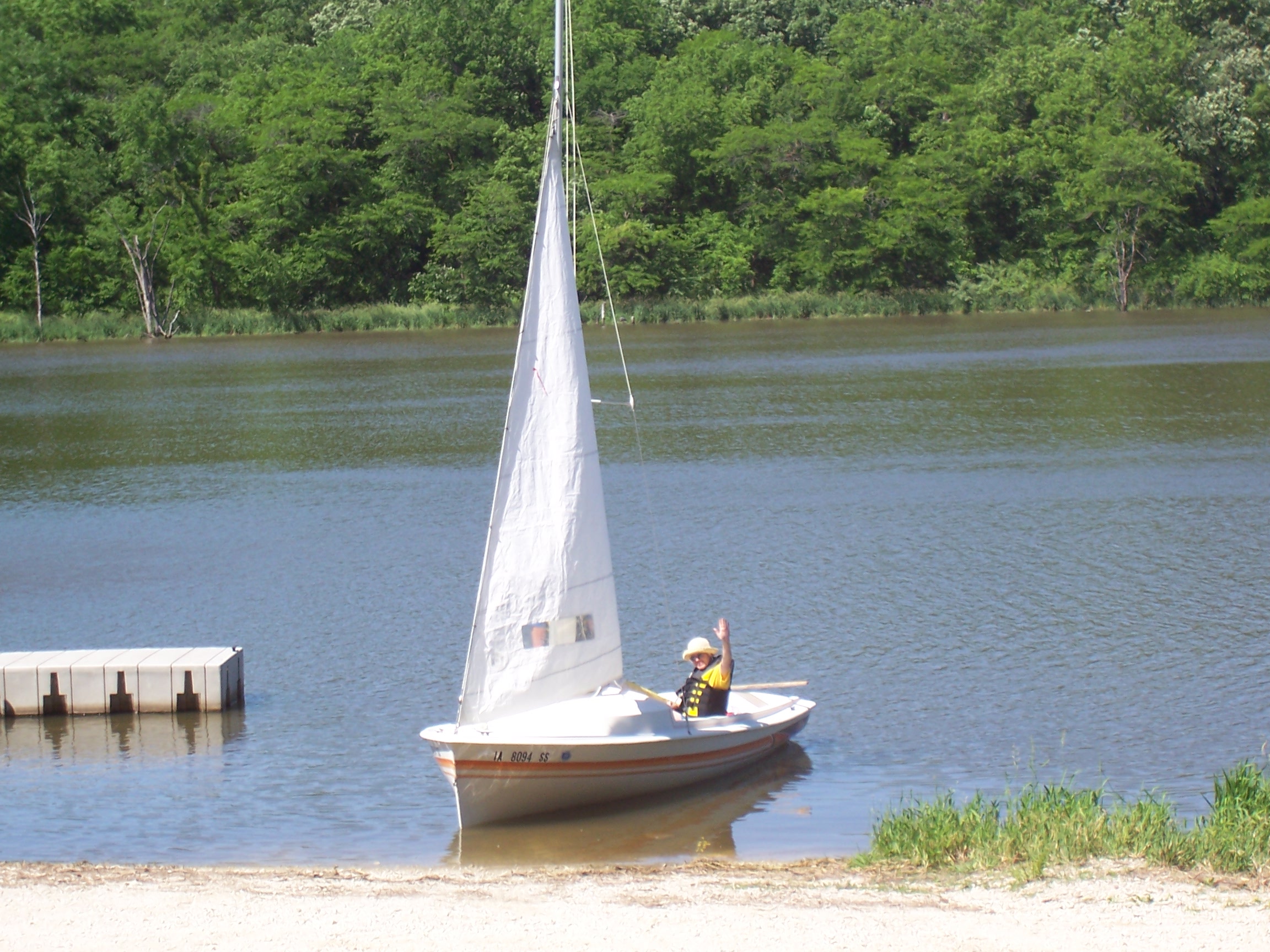
The mariner has a 17 foot 1982 O’Day day sailer. It had an accident being blown into a low bridge; the deck had separated from the hull on the port quarter and the boat has seen some tough years as well. I bought it for the price of the trailer plus 500 bucks for the boat. I reunited the deck with the hull and sailed it for a season or two. The centerboard didn’t work well when under way and the boat did not come with a motor. In a stiff wind, sailing was, shall we say, in an undetermined direction.

Marty in O'Day

The mariner lived on a twelve acre farm at the time and stored the boat in the implement shed next to the tractor. I raised the boat off the trailer and dismantled the trailer completely – every piece. Rust spots were sanded; new wiring would be put in. The mariner painted the trailer with a car finish white.

We sold the farm and moved to town. The mariner had no place to store the boat. So the mariner built a forty thousand dollar shed in the back yard to house the boat. For the money, the shed is also a wood shop, storage for garden tools and supplies and has a vehicle bay.

Shed 12-12 007

The poor boat hasn’t seen a drop of water for two years. This summer, there are plans to completely refurbish the boat. With only a sail cuddy, it ain’t exactly a passage boat but don’t forget – the mariner lives in Iowa.

The late spring jams things a bit. Late garden preparation, rewiring and building storage in the garage, and refurbishing the boat.

It is still my goal, however, to sail in the Chesapeake Bay this fall. It won’t be pretty but it will float and steer. It will be fun.


Who is God?

Reading through the Christian part of the Bible, the New Testament, there is constant affirmation of an inclusive God. God is not vengeful. God is not judgmental. God does not punish nor give favor. The New Testament God wants only that we develop a strong, mutually loving relationship between man and God. God speaks through Jesus to describe what we as followers should do to love God properly. One well known instruction is made very clear: Love God above all other Gods.

This reaches further into our life than we may think. A deity can take many forms that never occur to us. Any overzealous or self rewarding activity is a form of god-worship – called Baal worship in the Old Testament. I know friends who put the variety of life aside, including proper financial security, to be avid sports fans. How about the alcoholic who drinks away all the family money, leaving no emotional value in the drinker’s or the family’s life? How about the compulsive gambler? Then there’s the capitalist – including we small ones – who make decisions in favor of money rather than people. All these are Baal worship because these behaviors are used to appease one’s self. Only God can do that. One’s addictions to other icons prevent one’s ability to engage in God’s work or feel God’s joyful presence in one’s life. Without focus on the curing power of God, the loving relationship will never occur.

On the surface, Baal worship can seem innocent or helpful, even worthy of mental ease or meditation. Grow flowers, attend Zen classes, become a millionaire, paint pictures – it doesn’t matter. If the activity, whatever it is, becomes a source of dependence for fulfillment in your life, it is self gratification; it is Baal worship.

One may think such continuous focus on God will prevent living a complete, human life – quite the contrary. There is no requirement to be other than who you are. Enjoy the times you can enjoy; suffer the bad times. Fall in love, live the life you have at hand but take God with you to sustain your inner value, to be the rudder that steers you through those experiences and to ensure personal happiness.

What does this love relationship feel like? There are words like Grace, salvation, born again, God’s will and many other nuanced terms. But these words don’t describe the simple reality of a love relationship with God. Have you ever had a moment when mental anxiety was suddenly released? Remember a time when danger lurked but then danger passed and you felt a feeling of relief? The God relationship has the same uplifting effect but doesn’t require a continuous feeling of relief. Rather, it’s that tiny moment of discovered peace at the very end of the experience that we want to remember. Feeling at peace is a common experience in the God relationship. The God relationship provides quiet relief by letting you know that you are in a nonjudgmental world and trust that this quiet peace is able to guide you through the rest of your life. Don’t try to aim or direct this feeling; God is everywhere – even within you. It is within you that God can be felt. In time, you will feel a living guidance system; call it God’s rudder in our life.


Privacy

Privacy is a concept that, in the early years of the United States, was assumed to be part and parcel of life. Communication across the country did not even have telegraph. Newspapers were expensive to distribute very far; mail was expensive – if possible. Government records were often on paper, often not. In your town, gossip was the intruder on privacy. In fact, privacy was so complete that you could move to the next county or two and start life all over again: new name, new curriculum vitae; your privacy was absolute.

Criminals like Jesse James could ride from county to county and town to town with only a weak trail of infamy. It was the Eastern novel writers that made him famous. It was possible for criminals to move about freely, even crossing into Mexico and Canada at will.

What whittled away at privacy – including the privacy of those of us who are innocent, was technology. Telegraph came first, then improvements in printing, the telephone, country-wide radio broadcasting, then television. Today it is the Internet, satellites and all the communication accoutrement that comes with it. Virtually every corner has a camera; many stoplights have cameras; eavesdropping is absolute at the National Security Agency where your telephone conversations can be culled from millions of other simultaneous telephone conversations. Current news is talking about drones.

The next wave invading privacy is already upon us and will soon mandate every person’s participation. It is called “the cloud.” Cloud technology will do away with privacy all together. Desk top computers will disappear because all your software and private files will be stored online somewhere accessible by any nosy inquirer who pays for access to your records. Did you know that Google already reads all your email and recommends products and services to you based on even one word in your text – if not all of them?

Your home is no longer your private castle. It is as porous as a sieve.

The mariner can go on and on about the advances of technology and marketing (even your cell phone is not free of marketing). What is more important to the mariner is the crushing elimination of the concept of privacy. It is so severe that children growing up in today’s world dismiss privacy because of the communication, education, and convenience of these devices. They don’t know that an army of marketers, governments, and criminals are taking in all that traffic without their permission. Insects used to be the only invaders in our homes, now it’s bugs of a different kind: spam, website tracking, Trojans that take over your machine – all without asking permission. That’s the rub. No one asks your permission. Your privacy doesn’t belong to you anymore. It belongs to the purveyors of your name and assets. Going to the grocery store is tracked by cameras on the way there and a record of your charges showing what you bought is collected. But they didn’t ask your permission.

Compromising privacy for the sake of protection against illegal behavior is one thing but all privacy is lost when criminals are one of the technology parties wanting to know everything about you.

I miss living a life that was mine. I miss engaging in the world on my own terms. I miss privacy. It is nice to be able to sail away from all this. The ocean doesn’t care who you are, where you’re going and, despite the anxieties of landlubbers, is a peaceful place.


The States in Action

The mariner spent the morning reading web sites about State legislation that is in process. The overall impression is that the States are very defensive. There’s a lot about nullifying Federal gun legislation using the second and tenth amendments as a legal bulwark. A lot of legislation is focused on making more effective punishment for felony and misdemeanor conviction. Some legislation is favoritism to a given person or business – always tacked on to a larger bill just like the Congress does.

Generally, State legislators are quite defensive and small minded, having no hopeful attitude about how to make life better for its citizens. The mariner understands that the Federal Government and the economic conditions have dealt a heavy financial blow to the budgets and economies of the States. The States, however, can find their own ways back to civility and concern for the constituency without waiting for the Federal Government.

Unfortunately, many States are bound by balanced budget laws. Visiting a bank to refinance debt (issuing State bonds) is not an option if the State is constitutionally bound to a balanced budget. In addition, states have become overly dependent on Federal handouts for activities that are wholly within the State and really only the State’s business.

A lot of State government difficulty can be attributed to attitude. To use an old metaphor, legislators have been in the foxhole too long and have lost sight of the greater constituent need for them to lead the State into the future. This has become the task that voters and activists must pursue. A State’s constituency must force the legislators to turn from defensive and paranoid behavior, to turn away from legislative favoritism, and focus again on what is best for the common citizen of their State. That attitude has existed in the past for most States. Legislators will balk at the pressure of the citizens, citing financial impossibilities. It doesn’t cost a lot to be nice and care about people – ask any nonprofit organization serving the underprivileged.

But the main point the mariner wants to make is the States are free to be independently driven, to pass laws that benefit the State’s constituency without waiting for Federal change. This is especially true in societal situations where rational human behavior need not wait, for example, unions are under siege in several States, marijuana and same sex marriage and ignoring Federal gun laws that require registration. It is also true that an enlightened State government can do a lot to fix its own economics.

You, the local State citizen, have more influence over who is elected and what they will do while in office. The mariner still advocates that governmental change will emerge from State leadership.

Finally, the gun issue is a classic example of “one popular issue” campaigning. What else does the legislator believe besides leveraging the popular gun issue? It may be scary. In the southern States, voting by every citizen is at great risk. If the Supreme Court decides the Federal oversight of voting laws in southern States is no longer necessary, what’s the gun-toting legislator have to say about the right for every citizen to vote without burdensome constraints?