
Follow Up Stuff

Liberal Arts
The mariner recently submitted a number of posts about the importance of the fact that liberal art majors are disappearing. The group of subjects in this major includes what is commonly referred to as “humanities:” literature, languages, art history, music history, philosophy, logic, history, mathematics, psychology, and general science. The general theme in all these subjects is to have an understanding across several disciplines of thought. This broad understanding sharpens the student’s awareness about people and their cultures; it provides space in one’s knowledge base to make comparisons and apply lateral thinking across disciplines. Every subject has something to do with human interaction.
The mariner watched a book review on Fareed Zakaria’s GPS show (Sunday 10/04/15 CNN). The book is “Succeeding at Life – What High Achievers Know that Brilliant Machines Never Will,” by Jeff Colvin. Colvin has a stellar reputation as an organizer of startup businesses and the automated technologies that support them. Until recently, he was CEO of CIGNEX Datamatics Corporation. He now is a board member of The Estes Group, a prominent consulting firm. The next two paragraphs start the book:
“What hope will there be for us when computers can drive cars better than humans, predict Supreme Court decisions better than legal experts, identify faces, scurry helpfully around offices and factories, even perform some surgeries, all faster, more reliably, and less expensively than people? The unavoidable question – will millions of people lose out, unable to best the machine? – is increasingly dominating business, education, economics, and policy.
The answer lies not in the nature of technology but in the nature of humans. Regardless of what computers achieve, our greatest advantage lies in what we humans are most powerfully driven to do for and with one another, arising from our deepest, most essentially human abilities—empathy, creativity, social sensitivity, storytelling, humor, building relationships, and leading. This is how we create value that is durable and not easily replicated by technology – because we’re hardwired to want it from humans.”
Colvin goes on to cite a number of relationships where people strongly prefer human-to-human service. People find more comfort, trust and satisfaction visiting a human medical doctor or nurse than punching keys on a machine – even if all the doctor does is punch the same keys. Similarly, social workers, managers, organizers, consultants, attorneys and virtually every profession that interacts with people in a reflective situation will become more important than their technical counterparts associated with computers.
The mariner learned from this review that Australia and Japan are reducing humanities and increasing classes on computer programming as early as the fifth grade. He agrees with Zacharia and Colvin that wisdom, leadership and innovation are found in the humanities, not in computer code.
Church and State
If the Monday School class is still studying church and state, the mariner offers a “middle of the road” perspective for those areas where church and state conflict with one another. See post “Among the People” (Sep 22 2015)
In 1962, Eugene Rostow, a former dean at Yale Law School, coined the phrase “civil religion.” It related to government sponsored religious speech that was as conventional and uncontroversial as to be constitutional (example: In God We Trust on US money). In 1984, Justice William Brennan first used the phrase “ceremonial deism.” He said, in a Supreme Court case that involved a government sponsored Nativity scene that also included reindeer and candy canes, that some religious displays could be permissible under the first amendment. [Details from Church and State magazine March 2015]
The mariner recently wrote a letter to the editor of a local newspaper that was covering a local conflict between an atheist organization and the city mayor about putting a cross in a government park. In his letter, mariner claimed that Christian and Jewish tombstones in military cemeteries – and even government memorials – serve only to remind us what we required of these men that they gave their lives for us. It is the buried soldiers that are sacrosanct, not the tombstones and memorials. In reference to Rostow and Brennan, the tombstones are an example of ceremonial deism.
Ceremonial deism is a grey area along the barrier between church and state. State advocates complain these “uncontroversial” exceptions are an example of deism and religiosity slowly creeping into the state domain. Is this good, bad, or irrelevant? Perhaps the Monday School can advise us.
REFERENCE SECTION
An easy read that talks about various subjects of controversy between religion and science, culture, and changing attitudes. Easy. Quick. See:
http://altreligion.about.com/od/history/p/History-Of-Deism.htm?utm_term=galileo%20book&utm_content=p3-main-1-title&utm_medium=sem&utm_source=google&utm_campaign=adid-a521dd03-6347-4247-9136-0d38501528e2-0-ab_gsb_ocode-4954&ad=semD&an=google_s&am=broad&q=galileo%20book&dqi=books%20about%20galileo%20and%20church&o=4954&l=sem&qsrc=998&askid=a521dd03-6347-4247-9136-0d38501528e2-0-ab_gsb
Billy Collins, Poet
Reading Billy Collins’ poetry is not what the occasional reader of poems imagines. Billy Collins was the Poet Laureate for the US twice in a row and holds the same title for the State of New York. He is, by far, the most entertaining poet alive today. If you desire to broaden your mind by reading some poetry, read Billy Collins. The poem below is from his collection, The Trouble with Poetry: And Other Poems. He has written several collections.
“The Lanyard”
The other day as I was ricocheting slowly
off the pale blue walls of this room,
bouncing from typewriter to piano,
from bookshelf to an envelope lying on the floor,
I found myself in the L section of the dictionary
where my eyes fell upon the word lanyard.

No cookie nibbled by a French novelist
could send one more suddenly into the past —
a past where I sat at a workbench at a camp
by a deep Adirondack lake
learning how to braid thin plastic strips
into a lanyard, a gift for my mother.

I had never seen anyone use a lanyard
or wear one, if that’s what you did with them,
but that did not keep me from crossing
strand over strand again and again
until I had made a boxy
red and white lanyard for my mother.

She gave me life and milk from her breasts,
and I gave her a lanyard.
She nursed me in many a sickroom,
lifted teaspoons of medicine to my lips,
set cold face-cloths on my forehead,
and then led me out into the airy light

and taught me to walk and swim,
and I, in turn, presented her with a lanyard.
Here are thousands of meals, she said,
and here is clothing and a good education.
And here is your lanyard, I replied,
which I made with a little help from a counselor.

Here is a breathing body and a beating heart,
strong legs, bones and teeth,
and two clear eyes to read the world, she whispered,
and here, I said, is the lanyard I made at camp.
And here, I wish to say to her now,
is a smaller gift—not the archaic truth

that you can never repay your mother,
but the rueful admission that when she took
the two-tone lanyard from my hands,
I was as sure as a boy could be
that this useless, worthless thing I wove
out of boredom would be enough to make us even.
Billy Collins

Ancient Mariner
Autumn

The vegetable garden is winding down. Just a few chard and the last run of tomatoes left. The mariner canned apple pie filling today and it looks like more will be canned tomorrow plus a few jars of applesauce. Unlike many, the mariner doesn’t add cinnamon or nutmeg to the applesauce; just a few tablespoons of malt vinegar to heighten the apple flavor.

The flower gardens always look a bit tattered this time of year with only the marigolds, chrysanthemums and fall color of the spirea showing energy. The mariner may have mentioned that a strong storm destroyed three wonderful, old Ash trees. Having a tree service drop the trunks on the lawn means that a new lawn will have to be laid in the spring. Where the trees once stood looks like a landfill. Piles of wood chips from grinding the stumps are everywhere. The compost pile, about four feet high, adds to the dump motif.

The mariner had dug about half of a water feature that was to be an attractive pond with a small waterfall (when there were big old trees). The remaining trench has become home for four leopard frogs. They have become pets of a sort – depending on the ugly ditch to sustain itself. They pay their way, though, thriving on mosquitoes, gnats and crickets. He will give them winter quarters but in the spring, they must move on; restoration begins in earnest then.

Soon, projects will turn to cleaning the activity of summer. The shed, well let’s say the shed isn’t orderly and would appreciate some reorganization. Further, the mariner must harvest frost-sensitive bulbs and prepare the winter lamp garden. Cuttings will be taken of frost-sensitive plants like geraniums; seedlings of herbs and a few vegetables will be planted for winter growth. The rabbit fence must be completed before spring so that another vegetable bed can be added.

Otherwise, the job jar waits with many, many tasks too numerous to mention. The mariner has decided to take a vacation….

Ancient Mariner


How to Achieve Your Own Liberal Arts Education

Having written recently about the demise of liberal arts in colleges, the mariner pondered ways by which each of us still could be broadly educated and “erudite.” One truly can become well versed in subjects that are part of a good liberal arts education. This free education is a gift from the Internet.

There is no subject that cannot be researched or help broaden one’s understanding. One can learn any language; become an expert about any place or period in history, any science category, mathematics, literature and poetry, biology, sociology, health and medicine, botany, geography, physics, astronomy, etc. The mariner suggests the reader try to name a subject for which there is no information on the Internet.

What the student must bring to the computer is curiosity. Curiosity is the engine that drives the education process. Ask the three “?” questions: What is happening? How does this happen? Why is it happening? Otherwise, there is no syllabus; no textbooks are required; no fees or tuition required. Just bring your curiosity. A little practice rapidly will expand your inquisitiveness. Below are a few sample websites mariner uses from time to time.

https://en.wikipedia.org/wiki/Special:Search?search=&go=Go Want to know what Bananas in Pyjamas is all about? It’s in the Wikipedia. The best definition of this website is “an encyclopedia on steroids.” The Wikipedia often shows up in search engine results. Always helpful and full of detail.

http://translate.reference.com/ This is one of the best dictionary/translator websites. The mariner typed “Where is the dog?” (German) and received “wo ist der Hund?” One can even practice as if $400 were paid for expensive language software. The website has several languages usually offered in a liberal arts curriculum.

http://news.yahoo.com/nasa-sees-unavoidable-sea-level-rise-ahead-180844156.html NASA predicts 3-foot rise in sea levels. All the larger search engines have current event screens; many have scroll bars for popular headlines. This is a good place to review once a day if the reader does not want to suffer cable news channels.

http://www.nationaljournal.com/events/the-next-america-opportunity-for-all-20150625 Video of a conference talking about how the United States can grow the middle class. Suggest viewing in segments. Key content is the breadth of the issue. The National Journal is an excellent source for those interested in ideas about culture and politics.

http://www.theatlantic.com/magazine/archive/2015/05/ “The Man Who Couldn’t Stop Giving.” A fascinating article about why humans have generosity. The mariner subscribes to The Atlantic. This magazine, both online and in print, provides quality insights about many subjects.

http://www.smithsonianmag.com/?no-ist Topics are diverse, covering culture, archeology, current trends, and interesting biographies. The mariner subscribes to the Smithsonian.

http://www.livescience.com/ Mentioned in an earlier post, this website covers many areas of science, including current events. Livescience.com easily covers one’s science requirement in a liberal arts curriculum.

http://americanliterature.com/ Did you know Kate Chopin wrote The Awakening in 1899? What other book did she write? How many short stories written by Kate can you name? To paraphrase Ed McMahon, everything you ever wanted to know about American literature is at this website. One can read many, many books at this website. If you are familiar with a big chunk of this site, consider yourself an English Major. The reader will have no difficulty finding similar websites for literature around the world.

http://ahs.org/ American Horticultural Society’s website. A comfortable site that ranges from gardening buffs to serious breeders of species. Every “trade,” (gardening, woodwork, welding, quilt making, etc.) has websites. There are many skill-related websites – detailed enough to fix a dripping faucet or repair an electrical outlet.

By now, the reader understands the method for educating one’s self. The important thing is to search and search again until you find something you don’t know about. One could even learn what a professional librarian does – something the State of Iowa doesn’t require of its public school “librarians.”

Ancient Mariner

Return to Iowa

Return to Iowa

Yesterday, the mariner and his mate returned from cross-country visits with their children. It is good to see them; we see them seldom and one can see how they have changed. We cannot help but notice they have taken charge of their lives and evidence of apron strings is long gone. Still, their lives are interesting to observe, frequently stirring moments in our own memories of taking life in hand. We shall gather again this winter.

While visiting the son, two events occurred worth mentioning to readers. First, the republicans, perhaps the mariner should say Fox News, held their first debate. It was a sad affair with little of consequence emerging from the event. Four years between National elections is long enough for the mariner to forget that politicians don’t have debates. In fact, the art of avoiding answers to any question no matter how direct has been mastered by politicians. It is not a debate. Were the politicians sixteen years old, we may be able to call them debutantes – it is more a cotillion than anything else. Will it forever be that the electorate votes for personality rather than content? As the mariner has mentioned in the past, citizens get what they vote for. It is interesting that the inquisitors from Fox News posed questions based solely in conservative ideology and right-wing divisive issues. Not one question was posed in a liberal context to be countered by candidates. Where has the primary season gone? What is the US missing that we cannot match the British campaign season virtually untarnished by money and lasts but a few months rather than a few years?

The second event was the passing of The Daily Show. Jon Stewart’s last broadcast was August 6, 2015. Millions of viewers will miss him, including the mariner. It was frequently mentioned by associates that he helped us survive the craziness and incompetence of politics and news broadcasting. Yet, despite his claim that he presented “fake news,” his show became a source of truth, fact and accountability that was not adhered to by those he admonished. Jon Stewart is a man of moral strength and emotional sensitivity – a leader in our times. The mariner wishes Jon the best in his next adventure.

Also within the scope of our vacation visitation, are some experiences that may be of use to the reader. For example, driving time quickly becomes the major pastime as we drive about from one event to another. We later realized that each day should have one major event to which the family is committed. The challenge arises when there is an event during the day and an evening dinner or a secondary activity. Driving about to collect and discharge members of the family and arriving at various venues morning, noon, and night quickly transitions into a chauffeuring experience – a busman’s holiday so to speak.

Another experience is walking. Not that walking is difficult; it is that what one member considers a quick jaunt through the park may be another family member’s trip to Mount Everest. The disparate response to many different events is something to be considered. For example, Grandpa and little Becky may not respond in kind after a ride on the Tilt-a-Whirl. Taking a horseback ride may be fun to the teenagers but a fearful nightmare for Mom. Walking all day through a forty-acre garden may be a pleasant experience but everyone will know it is not pleasant for 18-month old Johnny. The reader gets the point.

Our coterie of family members is small and dividing the group by age, fitness, interest and time would have been difficult. Nevertheless, consider simultaneous events, e.g., send Mom et al to the gardens while the adventurous ride horses. This divides driving among different groups – somewhat preventing the driving vacation.

To top off the vacation, the mariner and his mate spent the last two days driving over 1,000 miles back to their small Iowa town.

Ancient Mariner


Flying

“WASHINGTON – Transportation Secretary Anthony Foxx said Friday the government has opened a price-gouging investigation involving five airlines that allegedly raised airfares in the Northeast after a deadly Amtrak crash in Philadelphia in May disrupted rail service.
The Transportation Department sent letters on Friday to Delta, American, United, Southwest and JetBlue airlines seeking information on their prices before and after the May 12 train crash.” (Newsday July 25 2015)
In a recent blog about the confrontation between capitalism and socialism in Cuba, the mariner demonstrated capitalist behavior by using airlines as an example: ….whereas only 4 [airlines] can mimic one another easily, coordinate hub flights to assure every flight is full, and, in order to keep profits high, slip down the slippery slope to collusion….
From a capitalist point of view, the airlines did nothing wrong by raising prices to the Northeast. It’s a matter of supply and demand. With the train option eliminated, demand rose for airlines, making a seat more expensive because supply had not changed. All’s fair in love, war and capitalism.
When the mariner was working for others, he constantly had to use airlines. For two years running, he belonged to United’s 100,000 mile club. This recognition provided easy upgrades to first class and access to the United club room at the airport where waiting was more pleasurable. Nevertheless, the mariner did not like flying because it was an experience very close to hog gestation cages. More than once, a drink sitting on the fold down tray went flying when the person in front pushed their seat back within six inches of his face. When he had a contract in Madison, Wisconsin, he calculated that the entire trip by air took eight hours door to door. It also took eight hours to drive to Madison, door to door – so he drove instead. And this experience was before TSA! On the way to a Caribbean sailing trip after he retired, the mariner stood in Orlando airport for two hours just to pass through TSA. He retired just in time.
But now he faces the airlines again. He must fly from Denver to Los Angeles and back. The mariner is not afraid of flying; he has 22 hours toward a private pilot’s license, a project that was interrupted by a career move. However, he is afraid of the airline corporations! Corporate greed is never on display more than when flying – unless you fly internationally and have LOTS of money. But that is flaunting one’s wealth – another form of greed.
This is the first post to the mariner’s blog associated with his trip to see his progeny. He will make every effort to share the good times….
Ancient Mariner

Farewell Jon Stewart Hello John Oliver

For sixteen years, the mariner has been a fan of Jon Stewart. There are millions of fans who truly will miss his self-deprecating humor, his wild impersonations of the Jewish dialect, the New Jersey style of banter, and particularly his turtle impression of Senator Mitch McConnell. It is hard to imagine how he sustained his energy for so long as a counterpoint to mediocre news media, especially Fox News, and pusillanimous politicians. His humor was sharp, insightful, educational, and despite his ‘fake news’ moniker, was a legitimate source of truth. His last broadcast of The Daily Show will be August 6 with President Obama as his guest. We truly shall miss Jon.

However, Jon has left an apt successor in John Oliver who appears in Last Week Tonight, The John Oliver Show at 9:30PM on HBO. John is a spinoff from Stewart’s staff. His episodes also can be viewed at

https://www.youtube.com/watch?v=i8xwLWb0lLY

Oliver is at his best when delivering an accusatory tone about the inadequacies of human nature and American values. John certainly will fill Jon’s shoes as the official muckraker of TV.

The link above will take the reader to a show about food waste. According to Oliver, food waste – only food waste – can fill 740 NFL-sized football stadiums each year. The mariner is aghast at our personal food habits and shared with John Oliver his disbelief about how charity tax breaks for small businesses do not survive Congress. Small business needs a tax break to cover the expense of charitable distribution which costs as much as normal distribution. The food episodes are truly enlightening. Write to your Congressional representatives requesting a charity tax break for all businesses that process food – from the farmer to the distributor to the retailer.

An odd but dependable observation: Why won’t we buy the last head of lettuce or the last peach?

Ancient Mariner

I Can’t Find That Person’s Shoes

It often is impossible to understand why another person believes the way they do. Sometimes it is impossible to understand a person’s motivation to act as they do. Empathy can stretch only so far before it evaporates, leaving a total blank as far as understanding a person’s ethical judgment. Walking a mile in someone else’s shoes is much more difficult than one may think. From different perspectives, one religious and one physiological, the mariner touched on this difficulty in past posts:
On the moral conflict between Christianity and capitalism, he wrote –
(Is Christianity Still Christianity? May 22, 2013)
Paul Tillich, a popular theologian in the 1960’s, said that Christianity is vulnerable to being subsumed by other forms of religion, very much as a chameleon changes its color to match its background. The other forms of religion, which Tillich defined as “quasi” religions, are capitalism, socialism, fascism, and authoritarianism. In the United States, the competing quasi-religion is capitalism. To be a Christian in a capitalistic society means that it is likely that a “Christian” is a Christian only to the extent that capitalism is not inconvenienced.
And –
On the fact that republicans and democrats use different parts of the brain to make decisions about risk, he wrote –
(Red Brain, Blue Brain June 19, 2015)
Republicans orient attention to external cues. What this means is Republicans find it less important to understand how they feel inside; more important is their control of potential risk outside.
On the other hand, Democrats orient attention to perceptions of internal feelings – how they feel about the external cues. This orientation also borders the temporal-parietal junction, and may reflect perceptions of internal feeling and motivation in others as well.

  • A genuine capitalist cannot understand why a person would give up financial security or relinquish authority to follow Christian principles that, to the capitalist, leave one defenseless against the world.
  • A genuinely compassionate person cannot understand why a capitalist can ignore people who are starving and homeless.
  • A genuine socialist cannot understand why a wealthy person objects to a one or two percent hike in taxes when it is an amount that will not alter lifestyle in any way and never be spent in the wealthy person’s lifetime.
  • A wealthy person cannot understand why a socialist doesn’t respect wealth as a societal right.
  • A genuine naturalist cannot understand why developers want to destroy sensitive habitat to build houses when there is plenty of reusable property elsewhere.
    An oil entrepreneur cannot understand why people want to stand in the way of progress.
  • A genuine populist cannot understand why banks intentionally gouge their customers.
  • A banker cannot understand why a populist wants to constrain opportunity with regulations.

We could go on….
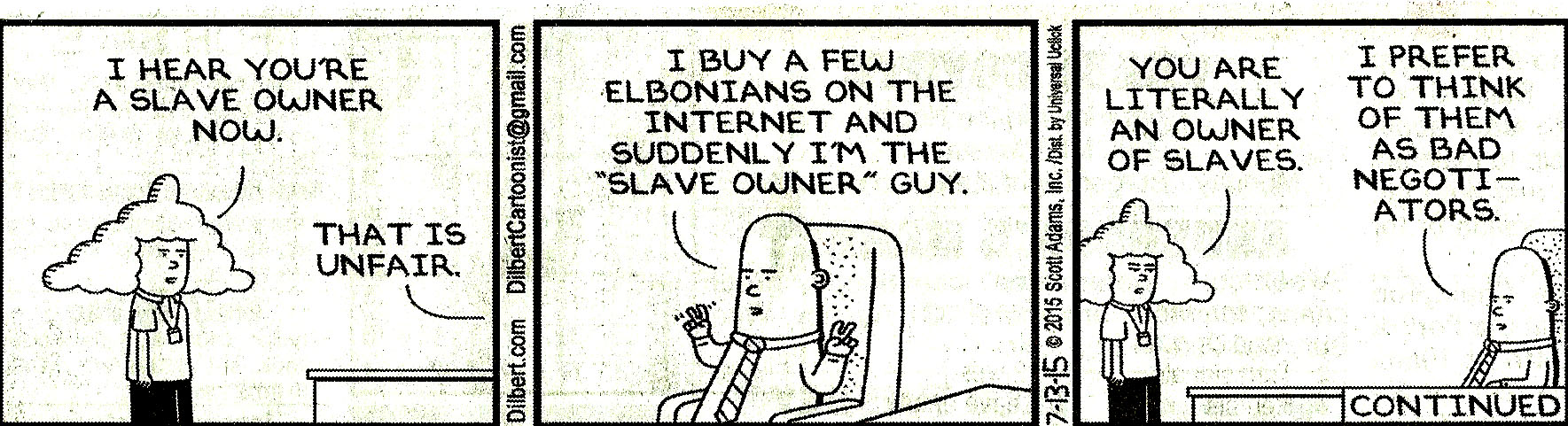
The mariner has maintained throughout his life that comic strips and single-pane cartoons are the most important section of the newspaper. The comics have a sly way of slipping through one’s prejudice, ignorance, and lack of emotional maturity to plant the seed of a new insight. Consider the following Dilbert strip:

Dilbert_001Were the strip in real life, we would not laugh so easily. The strip shows how every one of us is vulnerable to redefining reality to fit our personal preferences. It is easy to overlook how our decisions affect others, even abuse or kill them. It is easy to avoid acts of sharing or choose not to act in behalf of someone or something because it is simply inconvenient or uncomfortable.
Sometimes, in our hearts, we don’t really want to walk in the other person’s shoes.
Ancient Mariner

On a July Saturday

The mariner often emulates two champion naysayers from history: Old Testament prophet Amos and Children’s literary avatar, Chicken Little. True to their warnings of doom, the mariner has railed against political, cultural, economic and environmental trends.
But in the last three weeks, the mariner has felt tremblers. The tremblers have been subtle but they have been widespread. The rumbling has moved through FIFA women’s soccer, allowing a new sport and a women’s league to burst from the Earth in full bloom. Combined with the arrest of FIFA management for classic mob behavior, world soccer will never be the same.
The Earth shook when the Supreme Court ruled in favor of LGBT marriage, struck down a law that eliminated Women’s health centers in Texas, and upheld the Affordable Care Act. The theocratic right was wounded but didn’t die. Nevertheless, their leash was shortened significantly regarding attacks and pillaging of State laws and blackmailing elected politicians with their reelection if Tea Party legislation was not forthcoming.
President Obama updated the overtime regulations to make it more likely that workers will be paid for their extra hours. Minimum wage is on the increase in States ranging from $10/hour to $15/hr.
Bernie Sanders introduced American citizens to a forgotten word: socialism. Running ideologically as a democratic socialist, Bernie’s speaking events draw many more than any other candidate, including authoritarian candidate Trump.
Senator Lindsey Graham (R-SC), a rare combination of conservatism and sentimentality, challenged the Fox News version of candidate selection claiming it eroded the primary process put in place by both parties. The Fox News popularity contest has put Donald Trump at the top of the pile because of name recognition in national polls.
If the mariner may be Amos for a moment, beware the popularity of Trump. He stays at the front not only because he is unabashedly a showman, but because he speaks the specific words that many, many citizens have wanted to hear for a long time. He may seem a clown to 95% of the public but he is spot on with the other 5%. Lest you think 5% is insignificant, only 57% of eligible voters voted in the last presidential election. Given all the extremists will vote, that raises their influence to about 9% – enough to throw a close election – especially in primaries and State elections.
The mariner accompanied his wife to her 50th high school reunion. The turnout is better than expected. The restaurant is crowded and very, very noisy. Imagine riding in an automobile with one of those super loud sound systems. Everyone is deeply engrossed in conversations about who, where and when – at great length. It is difficult to move around in any case but a crowd of about eight people stands crunched together blocking the path into the room; further, they block access to the appetizer bar. Why is it, the mariner asks, that people will stand and talk in a space obviously needed for passage? The mariner calls this phenomenon the “doorway syndrome.” Doorway syndrome occurs in one’s home, after church at the exit, in grocery aisles, in driveways, and any other space where a group of people can camp and be as potent a blockage as Hoover Dam. The mariner has no couth so he loudly shouts for them to move out of the doorway and let people through. It’s okay; they don’t know who he is and even as he pushes through, they don’t move anyway. Frankly, they never stop talking.
Sunday, at 9:00A Eastern on ESPN, Djokovich will play Federer for the Wimbledon title in men’s tennis. It is a battle of Titans. This is as it should be British complaints notwithstanding.
The reader should be pleased that when the mariner began to look at work as an issue, the popular press followed suit. The latest The Atlantic has a major article by Derek Thompson, “World without Work” and a new book is out by Erik Brynjolfsson and Andrew McAfee, “The Second Machine Age.” The mariner will review these publications.
Today, the mariner’s town is awash with flooded streets and drains after 2+ inches of rain fell on an already soaked town. Tragically, the rain turned the midway at the County Fair into a creek with a firm current; the demolition derby scheduled for tonight is cancelled due to a flooded infield.
The setting Sun is out now as the day ends. Except for the Fair, it is a good day, tremblers and doorway blockers included.
Ancient Mariner

Ta-Nehisi Coates

The mariner is not a native Iowan. He is from Baltimore, Maryland and the surrounding area. He spent all but two of his teen years living in a small lower class community tucked in between a glass factory and a garbage dump. Two of his friends went to prison for long sentences; one friend supported two children and a useless mother by working as a prostitute; one friend from a contiguous working class neighborhood is a bright linguist that became a lifelong friend; many friends were using heroin before it had a media presence; gang fights between African Americans and Caucasians were common.
Later, in his thirties, the mariner became a parole officer. He had a special caseload of thirty-five transvestites. All but three were African American. They qualified for the case load because they were transvestites and drug dependent and had active arrest records. All had arrest records for prostitution and misdemeanors that reflected tough neighborhoods and interpersonal conflicts related to their sexual difficulties.
A couple of years later, the mariner was appointed to the Baltimore County Commission on Drug Abuse. A new commission, its goal was to establish drug rehabilitation legislation and treatment programs for the County.
It is with this background that the mariner eventually moved to Iowa. He became aware that Iowans and many Plains State citizens have no way to reference the reality of lower class, African American, inner-city people (and whites…and Hispanics…and Vietnamese and…). Iowans are good-hearted folks. Many are disciplined workers whose great grandparents emigrated from Germany and surrounding middle-European countries. In the earliest years of American independence, before the Louisiana Purchase, French immigrants moved in from Canada to live among the Native Americans.

There are African Americans in Iowa today but they do not constitute a visual presence in the all-white culture. Racism in Iowa is not an issue that rises to political awareness or neighborhood/town segregation. Racism is present in Iowa but not predominately and not because of direct interaction. To the extent that it exists, racism in Iowa truly is an adopted prejudice.
Iowa ranks at the top of states with a singular economic culture; it is farming. Even manufacturing in Iowa does not roam far from farming. A subgroup of farming production in Iowa still uses immigrant workers on its farms. This is not the African American inner-city experience. Without question, immigrants on farms could write their own discordant history but it is different.
The mariner offers a resource for Iowans to gain an insight into the African American experience. He offers an African American author who grew up in that environment. The author is an excellent writer who writes and speaks of the African American experience with poetic understanding, intellectual observation and is able to project the living experience of his youth. This writer does not have the typical edge to his writing that pundits and advocates would have. He provides information intended to enlighten readers to the African American experience. That is his only motive.

As one example, his observation of the recent spate of shootings and abuse by police departments says that the fault is not with the police departments, who are taking the brunt of public reaction but rather the citizens of the communities. He says the police department the community wants is the police department it gets. Whether obtained through racial bias – or by indifference from not voting – the police department works for elected officials.
The mariner recommends you read deeply in his bibliography and follow his blog on The Atlantic magazine website where there are several videos as well.
TA-NEHISI COATES
Writer
“Ta-Nehisi Coates is an American writer, journalist, and educator. Coates is a senior editor for The Atlantic, and blogger for that publication’s website where he writes about cultural, social and political issues. Coates has worked for The Village Voice, Washington City Paper, and Time. He has contributed to The New York Times Magazine, The Washington Post, The Washington Monthly, O, and other publications. In 2008 he published a memoir, The Beautiful Struggle: A Father, Two Sons, and an Unlikely Road to Manhood. He joined the City University of New York as its journalist-in-residence in the fall of 2014.” (from The Atlantic website)
www.theatlantic.com/author/ta-nehisi-coates  
Ancient Mariner

Yesterday Morning

Yesterday morning, it rained again in Iowa. All the puddles, all the standing water reservoirs on people’s lawns are refreshed and full. Being Sunday, the morning put a damper on religious services and many of the “day-off” activities that could use a break from June’s continuous rainfall.

By afternoon, the Sun broke through and the tone of the day shifted. In the mariner’s backyard, weeding the gardens is put off again – a thorough weeding hasn’t been performed since the end of May. The vegetable gardens are growing as if they received a miracle drug. Anyone who grows Zucchini knows how fast it balloons in size. This year, a gardener had best check the zucchini every few hours! The compost hasn’t been disturbed for a couple of weeks; there’s a fine set of cucumber plants growing.

This is the kind of day when one’s brain is slowed like a computer on a busy network. A lot has happened in just a few days: the Charleston murders, two unbelievable decisions by the Supreme Court about LGBT and the Affordable Care Act, Obama’s Eulogy at the funeral of Clementa Pinckney, the Netherlands required to reduce carbon emissions by 25% in 5 years, James Inhofe, chairman of the Senate’s Environmental Protection and Public Works Committee denying that global warming exists, and having the local family over for the mariner’s specially made pizza. The Wimbledon Grand Slam is in action, too. It’s a day just to let life happen.

To demonstrate the lack of focus on a day like today, the mariner and his son are exchanging emails about how thick the bark was on plant life during the Carboniferous Period (began 350 million years ago and lasted for 68 million years). This is the period from which we mine coal today. The subject draws the mariner’s mind back to the earliest Hominids (the split from the ape family that occurred 8 million years ago). Humans and their ancestral Homo family have been around for a very short time. How much longer will the Holocene Period (right now) and its Hominid family last?

These subjects seem irrelevant and too erudite to be worth conversation or even casual thought. What’s more important is our financial status, our zucchini, and fixing that stuck basement door; the church’s pancake breakfast is a few days away. That’s probably as it should be. There is a lot of living to be done today – too much to worry about events that did not and will not occur in our lifetime. Yet, these seemingly unimportant subjects are emerging in the news, the strategies of corporations, and how the US government and every other government are operated.

The mind drifts to computerization, robots, and the fears of artificial intelligence, when computers will be smarter and more aware than we are. The mariner likes the response of Steve Wozniak, co-founder of Apple. He said, “Don’t worry about the robots eliminating humans. We make good pets.”

Time to make pizza.

Ancient Mariner