In Port Day 2

It’s a lay about day; no events scheduled save a visit to a hamburger place to have lunch. Team members are spread about the house, each doing independent things.

Mariner watched TV. He watched CNN for twenty minutes with no gain in information except for the relative non-event about Chapo. Twenty minutes…..

The youngsters are preparing a delicious pulled pork supper. Outstanding.

Of course, the entertaining talk is about the lottery. The team is trying to work out compromises for how to split winnings. The mariner and his mate have read horror stories about how lottery winners aren’t happier. In fact, they are less happy, pursued endlessly by conmen and marketers like most are pursued by hornets, and often end up stone broke in a few years.

Mariner received two tickets as a birthday gift. We’ll see. He’s not holding his breath. Odds: 292,000,000/1. Rand Paul could win the Presidency 292 thousand times at these odds.

In a recent post, mariner offered an excellent book, How Not To Be Wrong, the Power of Mathematical Thinking by Jordon Ellenberg. Ellenberg’s book has a chapter called ‘What to expect when you expect to win the lottery.’

Two quotes, the first by Ellenberg, the second by Adam Smith, author of The Wealth of Nations:

“Should you play the lottery? It’s generally considered canny to say no. The old saying tells us lotteries are a “tax on the stupid” providing government revenue at the expense of people misguided enough to buy tickets.”

“…The world neither ever saw, nor will ever see, a perfectly fair lottery, or one in which the whole gain compensated the whole loss… [Meaning the amount played is always greater than the amount paid out]”

Lotteries, at least in the western world, began in Genoa during the seventeenth century as a method to determine which two of 120 lower house members would move to the upper chamber council for a year. It wasn’t long before gamblers started betting on which two would be selected. Eager for more betting than once each year, gamblers created an independent lottery very similar to today’s Powerball without lesser payoffs for nonwinners. Ellenberg covers other tales of government lotteries including the Michigan and Massachusetts “Cash Winfall” lotteries where unwon cash – millions of dollars – was rolled down to nonwinner pools to increase sales. Unbeknownst to the two states, on the occasion that cash was rolled down, three groups, MIT students, an Asian community, and a neighborhood group each pooled to buy 10,000 tickets or more. The enlarged cash pool made payoffs profitable, indeed guaranteed. More was won with one or two winners than the cost of all 10,000 tickets. Many in each group became independently wealthy by the time the government caught on and stopped Cash Winfall.

Is there a lesson to be learned by governments and Powerball players? Is there a more rational and predictive way to fund governments and healthy libidos? Of course, but neither will admit it. The truth is it takes stupid government officials who don’t know how to run government income and budgets properly to depend on lotteries as well as the stupid ticket buyers. Historical fact shows neither bode well in the long run.

Ancient Mariner
A Day in the Sonora Desert

The primary event today is to visit the renowned Phoenix Botanic Gardens – a first in every travel guide. Mariner has waited a long time to explore a desert biome. While not out in the wilderness, it is a rich accumulation of cactus and succulent of every variety. Watching carefully, one can glimpse the roadrunner of cartoon fame (Geococcyx), Gambels Quail, (Callipepla gambelii), and the Mourning Dove (Zenaida macroura). Needless to say, mariner purchased many small samples of desert plants to start his own Sonora Desert.

It was promised that there would be an update of the ‘morning line,’ that is, today’s list of betting odds for the next President.


Two Weeks Ago 1-09-2016
Hillary Clinton 8/11 72% 8/11 72%
Marco Rubio 11/2 18% 11/2 18%
Donald Trump 8/1 12½% 6/1 16%
Ted Cruz 10/1 10% 10/1 10%
Bernie Sanders 20/1 5% 18/1 5½%
Jeb Bush 22/1 4½% 22/1 4½%
Chris Christie 33/1 3% 28/1 3½%
Ben Carson 200/1 ½% 200/1 ½%
John Kasich 250/1 2/5% 250/1 2/5%
Martin O’Malley 250/1 2/5% 250/1 2/5%
Mike Huckabee 500/1 1/5% 500/1 1/5%
Carley Fiorina 500/1 1/5% 500/1 1/5%
Rand Paul 200/1 ½% 999/1 1/100%

Everyone has held their position except Rand Paul, who fell to the bottom. Otherwise, bettors have seen nothing that would require hedging their bets.

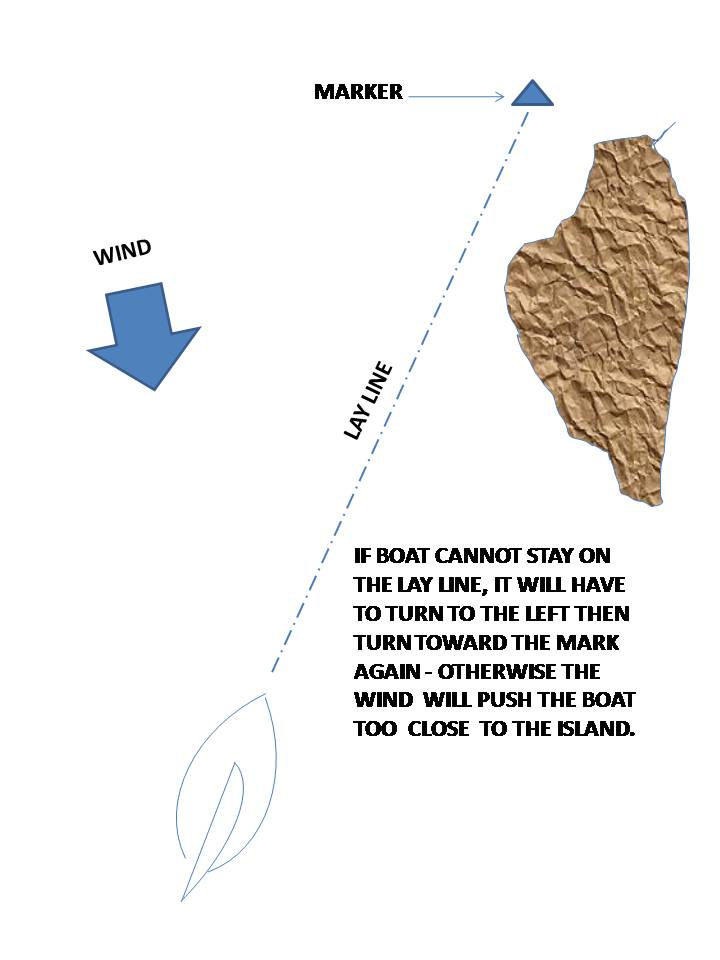
Some readers asked the meaning of “hold the lay line.” There are times when sailing a line (direction) there is close clearance. The helmsman must assure that the boat does not fall to the close side. If that happens, the helmsman will be forced to tack away to be on the open side of the line. See diagram.

LAY LINE

Mariner uses this term to represent driving. The driver must be sure to be in the correct lane, take the correct exit, hold speed, and stay in a direction that will provide successful arrival.

Tomorrow has a trip to a special zoo displaying desert wildlife.

Ancient Mariner

Ship’s Log Day 3

Given the weather, one may as well be on the 40th parallel (every stop from Denver to Philadelphia). The temperature lingers between 30°F and 34°F. Rain is spotty, ranging from mist to deluge. As we gain altitude, the rain turns to heavy snow. Fortunately, we visited a chandlery before we left – a nice lunch is onboard as we hold the lay line.

Flagstaff AZ is a waypoint about midday. Flagstaff is buried under a foot of snow with another 8 inches predicted today. Fortunately, Flagstaff is our bearing to change our course to the southwest for the final leg to Phoenix.

The terrain is a series of mountain ridges slowly dropping in altitude. Eventually an occasional palm tree can be spotted and the landscape fills with Saguaro cactus and other interesting desert plants. Sailing into Phoenix, an overnight motel is welcome. Docked 18:00 hours local time.

Ship’s Log Day 4

A cold wind blows through Phoenix; the temperature hovers around 45°F with light rain. The mariner’s first thought is that Phoenix (a) is too far to travel for a temperature increase of 15°F above that in Iowa. (b) Phoenix is a large, overgrown city with poor commercial zoning and a monolithic housing architecture. It is not the warm idyllic retreat the mariner had in mind. However, he will refrain from final judgment; mariner and his wife look forward to greeting their children and their partners – Altogether, a rare event.
It is likely mariner will depart Phoenix following the Mexican border into Southern Texas in search of a bone warming retreat.

Ancient Mariner


Cruising the Southwest

The mariner and his first mate are cruising toward Albuquerque, our second port. We are passing through the Texas Panhandle. Hour after hour, there is no sign of human life, no notable elevations other than some that remind the mariner of ocean swells. There is nothing to do except hold the lay line. As time rolls by, one becomes aware that the Panhandle has permanence – a stillness. It is a forgotten land while the rest of the world sails into an unknown future.

Suddenly, a very tall structure looms on the horizon. Quickly, one discovers it is a giant Christian Cross. It stands easily 120 feet tall – a proselytizing presence by itself. Mariner has a new understanding for the gargantuan, hyperbolic nature of the divine symbols of kings and gods typical of the ancient Abyssinian, Babylonian and Egyptian religions. Perhaps that is a weakness in Islamic and Christian religions today: their God denies images – let alone 120-foot images.

We cruise into New Mexican waters. The deserts seem more amenable to sharing with humanity – though barely. Occasionally, there are signs of managed fields and abandoned wooden huts. A new phenomenon occurs called a mesa. The mesa fires the imagination of travelers, realizing that, at the top of these flat, seemingly displaced forms, was the bottom of a body of water large enough to be a small ocean.

Before that, though, it was a mountainous region that collapsed when tectonic activity drew away the deep magma. The land we cross today is older than the Rocky Mountains – 80 million years old. The mesas resist erosion longer than surrounding surfaces, sustaining a fascinating, somehow historically obligated role to remind humans that they are indeed a short term renter of Earth’s sphere.

The mariner sails into an expected front of rain and snow that will encompass us all the way to Albuquerque. Hold the lay line.

Ancient Mariner


Travel may be Broadening but it’s also Different

Ship’s Log Day 1

In his newly acquired vessel, a van of recent vintage, the mariner set sail for Phoenix, Arizona, USA. When his first mate took the helm, he decided to lounge luxuriously aft in the Captain’s quarters. Opening his laptop to write to his readers – note the mariner’s skill at hitting both the right key and only the right key is already challenged – typing while moving has a fail rate approaching 75%. It is wise that programmers have provided voice-driven software. Now, if the mariner can reduce road noise enough for the software to hear his voice, things will be fine. Another tip for typing while moving is to turn off the mouse and use the inboard pad; all the mouse wants to do is escape.

The first day’s course is set for Oklahoma City; it involves foregoing the fastest course, due south, to avoid rain and flooding. At Leon, IA, we changed bearing to southwest; without incident docked in Oklahoma City 20:30 hours. 

Ship’s log Day 2

In the morning, as we ate our free breakfast, we encountered the first sign that we were traveling in foreign waters: the restaurant TV is on FOX channel. Regular readers know the mariner, on occasion, is not wholly conservative. Nevertheless, he considers himself a tolerant soul. It’s simply that he is unaccustomed to traveling abroad. Things are different.

The first impression, as we sail further into Southwest waters, is the tone of the media – not just TV but newspapers and advertising. Conversation, too, is less tolerant – or perhaps more judgmental about unaccustomed topics. It makes mariner think about chicken and egg relationships: what came first, the media or the people? Thinking about it, the people came first but what sustains public opinion? Would folks anywhere have more thoughtful opinions if the media didn’t harp on headline grabbing interpretations that induce separatism as a way of life? The mariner decides the same undue influence is universal but different in each region.

Since communication corporations decided that news is also a profit center and not just a public service, the public has been abused in its desire to know just the facts, ma’am. News departments are now required to obtain market share; not only does the public not receive important but unentertaining news, it receives altered news focused on market share at the cost of encouraging close-mindedness. It is not hard to know why there will never be another Ed Murrow, Walter Cronkite or Huntley-Brinkley.

It is time for the mariner to take a turn at the helm. Today our course takes us to the port of Albuquerque.

Ancient Mariner


A Short Reminiscence

Image

In a day or so, the mariner and his family are gathering in Phoenix for a vacation get together. Mariner and his wife are escaping the harsh winter of the plains while offspring are gathering for celebrations of various sorts. It is a time to relax in a blissful place – mentally, spiritually and physically.

So today, there will be no complaining, no panicking, and no passing of judgment. A forgotten object in a corner of a dusty bookshelf on the second floor landing has called up memories of a unique character in mariner’s life – his father-in-law.

He went by the name “Bos” (Boz) and owned the town’s hardware store for 50 years, finally retiring at the age of 81. Bos had a quirky sense of humor that entertained folks across the entire county. One of the mariner’s favorites goes as follows:

Around Christmas, Bos placed a galvanized bucket with a barren tree branch resting in it on a prominent spot on the counter. From one of the twigs on the branch, he tied a string; at the bottom of the string hung a bullet. Bos would sit back and, like a cat eager to pounce, watch customers come in, see the bucket, branch and bullet and ask, “What is that, Bos?” With great delight in the moment, he would say, “That’s my cartridge in a bare tree.”

Back in the sixties, when we all were younger, Bos played golf once a week like clockwork with three cronies. The foursome was a sorry lot as far as scores were concerned but the keen game for them was to be the first to hole out so they could race off to the trash can at the next tee. The prize was soda cans redeemable for five cents. The winner of the round was the one with the most soda cans. Having the most cans was nice but Bos relished the nickel refunds, which, characteristically, he stored away in a multitude of cigar boxes, pouches and tins. When the Hunt brothers were buying all the silver they could to push up the price and make a profit, the price of silver skyrocketed enough that Bos gathered his silver dimes, cashed them in and bought a new Ford truck for cash. That was Bos.

This tight fisted nature was common among the oldies in the town. Bos was always holding up the foursome while he searched for golf balls lost by others. He boasted that he had never bought a ball in all his times on the links. Bos had five-gallon buckets full of all brands, new and old. Most of the balls had seen their day and with a mighty swing may have traveled 125 yards.

One day, we were sitting in the parlor after dinner. Bos was fiscally conservative and would not invest in the stock market. Most of his invested holdings were in EE Bonds. He mentioned that he had to find somewhere to reinvest the bonds because they were maturing. The mariner suggested rolling them over into HH Bonds tax free. Bos was reticent to believe the government would offer such a favor that evades taxes. Mariner reassured him it was so but Bos still did not believe it. The mariner bet him a new, store bought golf ball that it was true. Sure enough, the rollover could be done tax free.

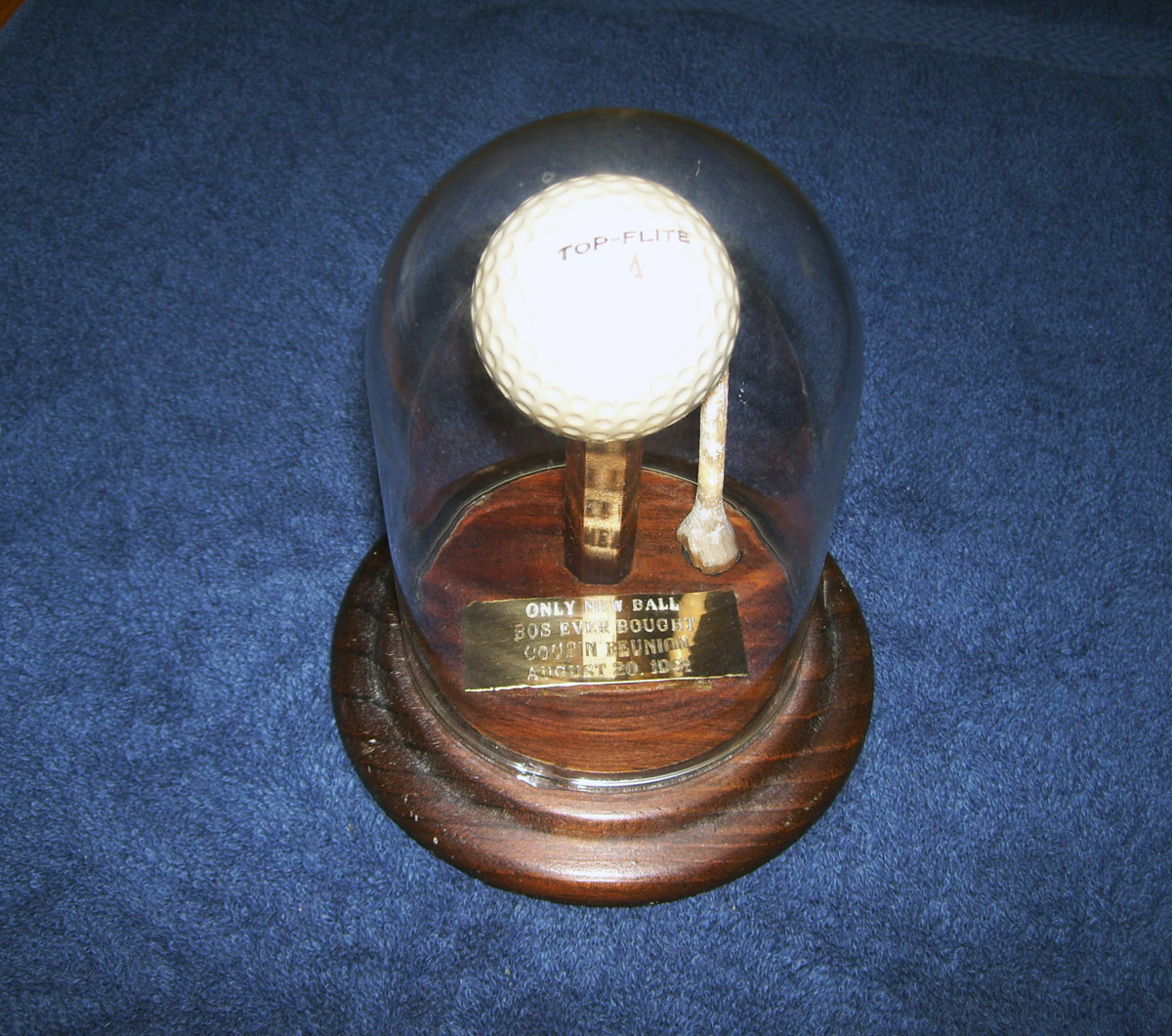
The object found on the second floor landing was the only golf ball Bos ever bought BosBall-2enshrined on a wooden base with a bell jar cover. A brass plate reads, “ONLY NEW BALL BOS EVER BOUGHT – Cousin Reunion August 20,1981” The ball has a patina now but it still retains the fun and sport from 35 years ago.

Bos passed on in 2001. Folks who knew him still remember his quirky humor and how active he was in the life of their small Iowa town.

Ancient Mariner

Silent Night, Holy Night

The computer clock gadget has passed midnight. It is Christmas Eve. Two energies emerge at the winter solstice: simultaneously, many religions celebrate a Holy moment – a moment that can be traced back millennia to a different time but, as it always will be, the religious holidays don the trappings of the present, always keeping just enough sacrament to give a celebrant pause about the value of life.

The second energy is that which comes from sharing. Not just presents in boxes, flashy decorations, and even some sharing by traveling the cold streets to share the overflow of caroling. It also is sharing a love-energy with folks who have nothing to share themselves. It is food boxes, clothes, making arrangements for visitations to family that, but for your sharing, would never happen. It is warm food – not just at the winter solstice, but year round. It is reconnecting with scattered second cousins one hasn’t seen for decades. Gifting is a special sensation, celebrated as needs require.

The mariner takes a break from the challenges around the world, challenges between races, between cultures, between civilized and uncivilized, between politicians, between people and biomes. He provides for you a gift: A few poems that the reader may find entertaining. The poems are taken from a poetry book, Lyrical Iowa, recently published by The Iowa Poetry Association. In fact, it is the seventieth year for publishing the poetic anthology. Contents of Lyrical Iowa are taken from the results of an annual competition. Like any competition, the poetry that makes it to the book is best of breed; there are nine categories each awarding a first, second and third cash prize.

1,898 poets submitted works. 64 winners received cash prizes. The mariner is proud to say that his wife won a first-place cash reward in the “First Time Entrant Category.” Many of her relatives especially will recognize the subject of the poem:

Sailing, Summer of ‘14

The old Styrofoam sailboat has been tied up in the rafters

of the garage for more than fifty years.

We cut it down from its musty ropes and wonder if it will

disintegrate into dust.

But Styrofoam does not disintegrate. It lasts forever.


The sail needs a patch with duct tape and a plastic trash bag

to make it good as new. New was in 1963.

We load the boat into the truck to take it to the lake.

We unload it at the dock and wonder if it will sink.

But Styrofoam does not sink. It floats forever.


We set sail onto the dark water, catching the breath of the wind,

catching our breath, learning the ropes, coming about, dodging

the boom, heeling, sailing, then smoothly we turn back to the dock.

Later, we find a photograph of the same boat at the same lake

at the same dock. The man in the boat is our grandfather, younger

in 1963 than we are now.

We wonder, as we tie the boat back into the rafters,

who will sail it next time.

For time, like Styrofoam, floats forever.

Marty Miller


A cute poem from the Humorous Category:

Missing

No Golden Gate, London or Brooklyn

in the pages, which seemed contrary

until I finally came to realize

it was an “un-abridged” dictionary.


Steven Thompson, Osage


Remember haiku? Here are a couple of winners:


Lonesome last Oak leaf

Floated softly to the ground

And whispered “winter.”


Ellen G Danner, Woodburn


The ice floes stay still-

Above this frozen river

Only the Moon moves.


Lee Enslow, Beaver


Mariner wishes everyone a fine holiday. Take the opportunity suggested by Joseph Campbell: find a blissful place and love yourself for being.

Ancient Mariner


Pop’s Pop Psychology

The mariner learned at his father’s knee. Father was attending college at the time and mariner was the one available to hear a recounting of many of the ideas that college provided for him. Father was a fan of pop culture – over simplified descriptions of personality, organization, emotion, and many other pseudo-psychology definitions. In memory of mariner’s father, a couple are defined in this post.

A popular one that many know is that there are three kinds of people in the world: WHY people, HOW people and WHAT people. The WHY person thinks about daily life in terms of ideas. It is difficult to define a situation or make a decision until the person understands why the situation exists. A classic example is Albert Einstein. If a person is extremely WHY, a classic example is the three-toed sloth.

The HOW person thinks about daily life in terms of solutions. The HOW person is constantly reinterpreting the circumstances of life into new relationships that may, or may not, improve those circumstances. Nevertheless, a solution has been achieved. The HOW person actually makes a decent manager – all other aspects being accepted. A classic example is Jeff Bezos, CEO of Amazon.com. If a person is extremely HOW, a classic example is the African Honey Badger.

The WHAT person thinks about daily life in terms of procedure. Father’s favorite example was his wife’s attempt to open luggage, which often requires different steps similar to a key, coded lock, different kinds of sliding latches, zippers, etc. Confronted with a new set of luggage, the wife had to try different combinations one at a time from the beginning until one worked.

Another example, perhaps a well-known anecdote, is the woman cooking a ham. Watching her is her daughter. “Why do you cut off a chunk of the ham before you bake it?” the daughter asked. “Oh, I don’t know; that’s how my mother did it.” Later, they visit Grandma and ask why she cut off a chunk of the ham. “My pot was too small.” If a person is extremely WHAT, a classic example is the Marmoset monkey.

The truth of the matter is all people have a bit of all three behaviors. Typically, one is dominant and a second is used if the dominant one fails. However, it is impossible for WHY and WHAT to coexist.

Another pop psychology definition that father used quite often as one of his own tools (he was a professor of sociology) is the one about how people learn. Again, there are three ways a person may learn: learning with the EYES, learning with the EARS, and learning with the BODY. Learning with the EYES includes reading, watching and thinking in pictures. An eye person will learn more and be able to apply learning more efficiently if that person receives education through the eyes. One every day example is the person who watches facial expressions to understand nuance. A very simple example is to watch another person stick their finger in a fire. Having watched this, the eye person needs no explanation as to why the fire burned; the event is embedded for life and will influence decisions thereafter. Art painters and writers use eye-based intelligence.

An ear person will learn more easily by listening. The reader may take in more listening to a lecture than reading the same words from a book. Anything requiring hearing is more easily learned. For example, musicians, those who interpret nuance by hearing tones in the voice, “Tell ‘em one time and they know how to do it” are typical of those who learn best by hearing.

Finally, learning with the BODY encompasses sensitivity to body motion of any kind including dexterity, sports, dance, and touch sensitivity. A BODY person will learn more by doing; If a body person is told what to do, or is shown what to do, the instructions will not be absorbed meaningfully until the body person actually does the task. Some assembly lines may contain a majority of BODY types with their dexterity and ability to memorize hand and body movement.

The mariner’s father had many more like these two examples. Mariner is confidant the reader has a few of their own.

Ancient Mariner


Role Play on the Campaign Trail

The mariner watches the Presidential campaign from dockside. He is not an active soldier day to day in the campaign skirmishes – although he is active in some important advocacy groups. All the candidates play one role or another as they seek any advantage to move ahead. Now, as months have passed, the mariner is reminded of role play that is similar to labor union negotiations.

In 1975, the mariner was fortunate to have the Maryland Secretary of Public Safety as a mentor. Mariner had the opportunity to attend a number of top notch training courses in management, systems development and labor negotiations. The labor negotiations class was sponsored by the American Arbitration Association in Washington D.C. The class of ten was divided into two teams, one representing management and one representing a labor union. Each team had separate instructors who taught the methods and strategies of labor negotiation. After a few days, it was time to negotiate.

Each team had been coached about the various roles that each team member played at the table. The chief negotiator was the only one who could commit to contract terms. His role was to be calm, self assured, but very direct in his comments. Another member was responsible for being the guy the other side could talk to and befriend – usually away from the table; another member played the role of a fact checker who kept the other side honest; then there was “Mad Dog.” Mad Dog had to show simplistic aggression, demanding concessions that were beyond what the team actually would accept. As a footnote, after six days, mariner’s team won the concession battle and had a good contract.

It was an interesting and intense experience. Everything we did, even in the evenings, was filmed to be used in a debrief session after the negotiation.

Mariner is reminded of that training as he watches the candidates. Guess who the Republican Mad Dog is…. His outlandish opinions and poor manners make the rest of the Republicans sound reasonable and urbane; Donald does a good job! On the Democrat side, Bernie is Mad Dog. He forces the dialogue to include progressive ideas that are so removed from the Republican dialogue they seem to be in a different language. However, Bernie’s unexpected influence in the democratic race has pulled Hillary to a more liberal platform. Bernie’s outlandish demands for a rebellion make Hillary’s comments more acceptable.

As to other team roles, one should watch the Republicans to see who emerges as chief negotiator. Will it be Ted Cruz or Marco Rubio? Some say Chris Christie has a chance although Chris is a better mad dog by nature. Jeb will be the fact checker; Lindsey Graham could be the nice guy everyone can talk to – if he makes the team.

There are only two team members on the Democratic side. Post Election, Martin O’Malley could play a role in the Administration. As mentioned, Bernie is the Mad Dog. Hillary has a lock on chief negotiator. It’s as if she is the CEO of management and no one has the authority to unseat her.

The only issue is that the candidates aren’t negotiating a labor contract; it’s dog eat dog.

People watching is fun.

Ancient Mariner


Current Reality

Today’s post has a number of reflections. There is somewhat of a theme in that they all relate to current reality but are derived from separate disciplines.

The first reflection is derived from the mathematical theory of chaos. Chaos Theory is a real system in mathematics. The most popular example is: If a butterfly flaps its wings in Africa and other physical influences are present, the fluttering will be the beginning of a Hurricane in the United States – or not.

Not to indulge in mathematics too much, chaos is a measure of change. Certain events and conditions occur which change the value of currently accepted values. These new values are in turn influenced by changes in other values. Eventually, everything that was accepted has changed and new, unanticipated values emerge. The US is in a whorl of change; it is chaotic because so many events seem not to be what was expected; around every corner are new extremes, unexpected crises and turbulence. The changes come faster and faster and there are few dependable expectations; chaos will take its course with little regard for history.

For example, US citizens did not expect the rise and influence of the tea party movement. It changed the Republican Party in ways that were not expected. This led to a breakdown in the ability of Congress to achieve legislation as expected. One bill was passed by the House more than forty times in an attempt to overturn The Affordable Care Act. Something is changing. What are the new rules? Who would predict the US would be at war with the Middle East for twenty-five years? Who knew that perniciously the industrial age would bring the Earth to a state of unacceptable pollution? So many situations have new, unexpected consequences.

Has a presidential campaign ever had more than twenty candidates? Values have changed. What are the nation’s new values that Donald Trump can be so popular? An amazing phenomenon is that a Nazi-style authoritarian is running against a democratic socialist in the same presidential year! There obviously is change occurring in America’s gestalt.

In recent weeks, killing innocents has become de rigueur. In the West, French and American atrocities have held the headlines – should it be said the news organizations have held the headlines. Beyond the Western nations, terrorist attacks have killed 147 at a University in Kenya, 43 people were killed and 239 wounded in Beirut, Lebanon; in recent weeks, Al-Shabaab, a militant group based in Somalia, attacked a mall in Nairobi, Kenya, leaving 67 dead; 49 people died when rebels shot down an Ukrainian plane; 224 died in the Russian plane bombed in Egypt; suicide bombers killed 81 at a church in Pakistan; and the Taliban took credit for killing two police officers with a car bomb in Afghanistan. Terrorism is a recent phenomenon, widespread, and not necessarily acting in behalf of a religion. Something has changed. Will the world ever be able to restore civility? What values must change to reconcile random murder performed by third-nation rebels? No one knows yet. The entire world seems to be caught in a tornado of chaos.

REFERENCE SECTION

Recently, mariner offered a book by Gene Baur, Living the Farm Sanctuary Life: the Ultimate Guide to Eating Mindfully, Living Longer, and Feeling Better Every Day. The mariner suggested it was an upbeat book about animal rights and proper dieting – an unusual approach, that is, being upbeat. The mariner tinkers in the kitchen. He found the recipes – the largest part of the book – were unusual and intriguing. Many of us have read vegan books and find the recipes mundane and make an attempt at competing with omnivore diets. Baur’s recipes often are unique and out of the norm for a vegan recipe book. Vegan and vegetarian readers will be well served to give this book a read.

The Atlantic Magazine has an article describing reactions to Donald from around the world. It may be a comforting read. See:

“What the World Is Saying About Donald Trump’s Comments About Muslims”

http://www.theatlantic.com/international/archive/2015/12/trump-muslims-global-reaction/419343/

Expanding the Liberal Arts Mind:

In the 17th century, Thomas Hobbes was a proponent of determinism. Generally, this philosophy means that every act is the result of previous acts. The battle was about free will and whether it could exist if everything was deterministic. This dialogue went on for centuries. In 1960, Edward Lorentz wrote a computer program that mimicked weather. He discovered that each time he loaded the first values, he received a different prediction. In a word, there was an element of “chaos” that prohibited predictability. This is why we cannot predict infallible weather more than a day or two ahead. For a great presentation that is as entertaining as it is enlightening, see:

http://www.abarim-publications.com/ChaosTheoryIntroduction.html#.VmdWKxZdG01

Ancient Mariner