Is Homo sapiens too Expensive for its Habitat?

Through his retirement years, mariner has had more time to sit aside and watch the world go by. What has emerged is awareness that Homo sapiens will have a relatively short, finite time as a member of living things on Mother Earth. For the last five hundred thousand years or so, H. sapiens has used superior skills to garner excessive resources beyond the amount required given the type of animal spawned within its natural environment.

It began when H. sapiens invented the spear. The invention of weapons to hunt game has been used by a few other primates but not with the intellectual capability to leverage weaponry as its own, organized thing.

Humans (AKA H. sapiens et al) elevated hunting with team management and scientific advancements like the atlatl; it was the advantage needed for earliest humans to overhunt environmental resources. Humans still overhunt species today (American Bison, Carrier Pigeon) – or intentionally eliminate them only because they interfere with other prerogatives (estuary and otherwise rare habitat, coral, useless specimen hunting) – from overhunting African wildlife to being, as of today, the cause for the extinction of 50% of all living species – plant and animal. Humans have so decimated the Earth’s biosphere they have added to cataclysmic events by causing the Sixth Great Extinction. The other five were caused by the greater laws of astrophysics.

Humans have extended hunting to the mineral and chemical world, also known today as science and technology, until we accomplished the following effects:

Better weapons for hunting using iron, steel, copper, and unnatural chemicals like Roundup and agent orange to make it easier than weed pulling by hand or landscaping large areas with axes and brushhogs. The primary reasons to impose these aberrations then, would be ‘it’s easier than by hand’ and ‘why not; we can do it.’ Humans pay little note to the infringement on nature’s way of running the biosphere.

Better weapons for destruction using chemicals and metals that have total disregard for ramifications to the biosphere, which, on the good side eliminates some of the dangerously overpopulated species (H sapiens) but on the other hand demonstrates the continuous devastation humans have on the biosphere. Mariner will mention only Hiroshima as an example and let intentional military destruction go at that. Did you know that nuclear warhead testing and use is responsible for Strontium 90 being present in our tobacco and similar broadleaf plants?

The mariner thinks all human abuse on the biosphere can be traced to the thought that it takes idle minds to invent trouble – why aren’t we busy cultivating common weeds into a food source and otherwise weeding them from our gardens by hand? As the ‘intelligent’ creature, why aren’t humans doing their share to help the biosphere for the betterment of all creatures? After all, the biosphere is the perpetual uterus for everything – including humans.

Humans ignore the sophisticated balance of the biosphere – how every living thing has a niche that provides enough to survive but limits its imposition on the balance of nature. 90% of Monarch butterflies are gone. The human impact continues as if humans want them all gone – or at least are indifferent to our unwelcome behavior that sends so many creatures from tree frogs to elephants into extinction in this century. Is this a sign of the apocalypse? If it is, it includes humans.

A conundrum arises if humans reset their attitude: There aren’t enough resources to support seven billion soon to be twelve billion humans who want to drink percolated coffee every morning before each human drives off in its own expensive seashell. [the hermit crab shares our plight] Point made. Not to mention the six hundred-thread bed sheets and Donald’s Mar a Lago. The biosphere will deal with that last one shortly.

Humans are pretending they aren’t aware that anything is wrong. HAH. Why are the following terms worthy of mention in most nations?

Grass fed – No Hormones – Not genetically modified food – Nature’s choice – Naturally caught seafood – No additives – Not commercially owned water source – Not made from ivory – Not manufactured from coal – and on and on. Think of a few on your own.

Accountable to readers for some kind of advice, mariner has the following:

No amount of effort will turn things around. Planet Earth has decided to end this age. Being the boss, Earth neither requires permission nor will accept suggestions.

Within the reader’s own biosphere, assume a lifestyle that respects simplistic, natural habits. Methuselah lived over nine hundred years without airplanes, trains, or automobiles. It took Noah’s flood to kill him off. Many of mariner’s closest friends travel frequently; the mariner admits to a few passage sailing trips. Bon voyage, he says. A simplistic solution may be to set aside a trip every now and then to use the unexpended resources to help our uterus (yes, graphic but the entire subject is contained within).

Remain aware of cultural impact. Many times biosphere issues can help lawmakers and voters decide the better direction for legislation, e.g., too much carbon for the biosphere.

Remain educated on the relationship between humans and the biosphere generally. It helps with awareness. Visit the following website to keep in touch.

http://www.overshootday.org/

Check out Earth Overshoot Day which this year is August 8.

A general news source for interesting and important topics: One article describes a day in the life of an orphaned hippopotamus; the main article headline reads, “Humans Stripping Earth of Its Resources – Global biodiversity has fallen 30 percent in 40 years, the new report says.” See:

http://www.seeker.com/humans-stripping-earth-of-its-resources-1765773906.html#news.discovery.  Otherwise, be aware that with a little more human-biocentric awareness, how can you simplify your life without the over-abundant dependence on the “plastic/electronic” aspects of your culture?

Further, definitely assign yourself the responsibility to grow some milkweed for the Monarchs, have a place on your property – if only your fourth story windowsill – to provide water to birds and food in the winter. Like the good Samaritan, don’t pass up opportunities to rescue the plight of any creature including Homo Sapiens.

Today’s comfort and sense of accomplishment is most important now rather than waiting 10,000 years to the end of our age when there will be no Homo sapiens.

Ancient Mariner
In case you feel you are not perfect

The mariner is preoccupied with spring gardens and major landscaping. Consequently, posts may be irregular. If you have difficulty viewing the Blog of the Ancient Mariner, write a short descriptive phrase in an email to skipper@iowa-mariner.com . If you feel a need to reply to a post, please do so! Mariner enjoys feedback.

The website will change over the summer to provide more reader options and promote the forum as a way to discuss posts and other reader contributions including communication directly between readers.

….

Mariner has mentioned a number of times that his father, a sociology professor, enjoyed collecting pop psychology tests and interpretations. He admitted that pop psychology was easily misinterpreted and provided insights that were entertaining conversation starters but quickly failed to measure a sound profile. In truth, he felt that general personality tests, even ones with serious scientific purpose, cause more trouble than knowledge gained. He had an especially poor opinion of the Myers-Briggs test that is widely used by businesses as a way to encourage compatibility and interaction, knowing that everyone is special but different.

Many readers have taken the Myers-Briggs test where they work. Test takers learn about all sixteen characteristics that make up humankind. When a new individual learns their four-letter description of themselves and has been enlightened as to how everyone is valuable but different, that individual should be sensitive to how others communicate and contribute to the common good – this is not what happens. Before the end of the day, the four-letter score becomes a condescending characteristic; it is a bat to belittle others – always implying incompetence. A typical conversation may be:

“So. What’s your type?”

“I’m an ISPF.” (artistic person)

“Oh, wow. Does your supervisor know? I mean, your job is awfully mechanical. I’m an ENTJ; that’s a corner score (the four scores at the four corners of the chart have special leadership talent).”

Another one mariner heard at one of his management training seminars:

“Never mind, you’re an ISFJ, you wouldn’t understand.”[1]

Nevertheless, the mariner’s father used his classes to try out various personality tests. He came to the conclusion that personality tests used for self improvement work much better if they aren’t public. The test should be introspective rather than comparative. He gave the following test to his classes many times. The questions are designed so that the question itself implies a standard to be approximated. Your score is determined by your deviation from the expectation of the question and, importantly, your own reaction to the deviation. The test triggers internal measurements which, if you reduce deviation, may help you be a happier and more confident person.

  1. What daily habit do you perform that makes you happy?
  2. What daily habit do you perform that clearly is one you would prefer not to do?
  3. On a typical day, do you have contact with at least three people you enjoy who are not in your family?
  4. With how many best friends do you still have regular contact from secondary school days?
  5. Each day, what important responsibility do you avoid?
  6. Do you participate in two civic/religious organizations each week?
  7. Do you meet with a group of eight active good friends each week?
  8. Do you have a job you enjoy?
  9. Do you spend one hour each week visiting non-family patients in a medical facility, retirement home or shut-in?
  10. Do you have a conversation with and touch or hug every family member each day?


  1. If applicable, do you have sufficient sex each week?
  2. Do you have physical activity that requires three aerobic hours each week?
  3. Do you take twenty minutes each day meditating or doing some restful activity?
  4. Do you think you’re fat?
  5. Have you had a physical examination in the last six months?
  6. Do you take a small trip every month to explore or participate in pleasurable activities?
  7. Have you taken at least a week’s vacation in the last six months or if retired, have you deliberately changed your daily routine to include new experiences and learning?
  8. Looking back on the questions so far, have you dismissed any question for any reason? Tell yourself why.
  9. Do you regularly play a musical instrument, sing in a choir or regularly attend music events or participate in performing arts?
  10. Has it been more than five years since you enrolled in an education, hobby, or trade skills class?


  1. Is debating with others more satisfying than being compatible?
  2. Do you feel others want to include you in your friend circle activities at every opportunity?
  3. Are you often skeptical of other people’s opinions and decisions?
  4. Do you receive two non-family calls or visits every day?
  5. Do you readily take charge even if not asked?
  6. Are you frequently slovenly when in public?
  7. Do others think you tend to talk incessantly? A clue is that others always end your conversations.
  8. Is it important for others to look up to you – or for you to look down on them?
  9. Do you watch the news on television every day or read a newspaper every day?
  10. Do you feel competent when you seek person-to-person contact with someone you’ve never met?

Having finished all the questions, return to each question. Without having a conversation with others, review your answers. More importantly, how did you feel about your answers? Note if you had a tinge of guilt, moral obligation, avoidance, or feeling a need to improve. The test is intended to help you improve your attitude, personal lifestyle, basic health, and your interpersonal qualities.

It seems an odd test but the mariner’s father said this test provoked more substantive discussion in class than any other – which he thought was a good sign that the test touched on self personality analysis in a non-threatening way.

Ancient Mariner

[1] See http://www.myersbriggs.org/my-mbti-personality-type/mbti-basics/the-16-mbti-types.htm for a description of the 16 types.

Cybele et al

Happy Cybele to everyone; and Nowruz; and Passover; and Ostara; and Easter; and Las Fellas; and return of the serpent; and Holi; and maslenitsa; and Alban Eilir; and Songkran.

Mother Earth returns to spring. Regardless of the term or its meaning, Homo sapiens has a bump of comfort as the days grow longer, the temperature rises, greenness emerges and most species begin procreation for another North Temperate Zone Spring.

Did the reader know the Easter egg is a Christian symbol of Easter? The decorated egg was first mentioned in Christian literature by a North African Christian community 500 years ago. Its earliest documentation is painted eggs representing the rebirth of Jesus – similar to the hatching of a chick from its egg. In worldly context, the egg is part of nearly all early religions.

Mariner wonders whether the Presidential election should be held during the week of the full moon nearest the spring equinox. Humans definitely are more accepting of newness as another natural period of new growth, both intuitively and physiologically, raises our mood. Perhaps voters may be more accepting of change and have a desire to ‘seize the future.’ The mariner for one is more skeptical in November as the darkness of winter looms.

Influenced greatly by history, the United States celebrates its heritage most visibly during Independence Day. It is celebrated loudly, militaristically and with great nationalist fanfare. Over the last four decades, the American culture has remained stalwart in its nationalist fervor but there is another element of our culture that has been with the US since its inception: it is best represented by the Statue of Liberty. Among the world’s nations, the US has stood for freedom, for compassion, for opportunity – the great melting pot of the world. This side of American culture is frayed and forgotten. Yet it is the one aspect of US history that is unique among nations.

Our nation is unusual in the diverse cultures considered mainstream. Our nation benefits from culturally diverse thought in science, technology, education, and freedom of religion. As the entire planet moves into new frontiers and new planetary difficulties, only the US has the cultural diversity and wealth to lead – but this leadership is at risk. Our trademark cultural diversity has waned; our democratic manner of selecting the right path has disappeared; our openness even to our neighbors is suppressed through fear and isolationism; our myopic focus on profit has destroyed our ability to share the bounty even among ourselves.

The US needs another national holiday. It is to celebrate the moral fortitude of our country. It is an event full of sharing. It is a typical American display of magnanimous support to others. It is the American Way.

Ancient Mariner


Blame it on the Elections

By now, most readers know the mariner is influenced by three alter egos: Chicken Little, a character quick to feel that the world is in crisis and no one will help; Prophet Amos, a character with distinct disapproval of the ways of human beings, chastising irresponsibility on every front; Guru, a way-out thinker who becomes lost in ethereal pondering and cannot fathom that Homo sapiens still exists. Reality and the Cosmos are so much larger than the self serving indulgence of human beings that the whole Earthly mess is just an insignificant phenomenon – an indifferent event on a Solar System planet drifting somewhere in the Milky Way Galaxy.

There are other influences, primarily interpersonal alertness, an appreciation of tasteless humor, and an accumulation of experiences across a lifetime.

Concentrate all these egos and experience into a very short timeframe surrounded by incompetence and disregard for very important social activity, and the mariner becomes depressed. What Chicken Little, Amos and Guru find significant is irrelevant to the masses, to friends and neighbors. No doubt, depression is common among many during election time.

With eight Presidential candidates remaining, mariner fears the worst. None qualify in his mind to deal with the plight of American humanity – indeed all of humanity. His acquaintances, who by and large are bright, insightful people, do not feel the need to respond to crisis, irresponsibility, or endangered culture; it is enough to vote their preferred person (likely limited to their own political party) while disregarding the fact that democracy has all but disappeared and, given our candidate choices, will continue to disappear.

There’s always the millennials who still trust in unbridled dreams of the future. But Amos does not buy this; they are just young Homo sapiens – same as their ancestors. Further, by 2100, the African continent alone will grow 6 billion more humans adding to gross overcrowding and further disintegration of the Earth’s biosphere.

All this aside, which is the best candidate of a poor lot? Mariner has great difficulty deciding – knowing that the great issues of his alter egos will go untended no matter the choice. We must turn to small victories of great importance: Can the voters replace a 1985 Congress with one that can function in 2016? Amos has his doubts.

Ancient Mariner


Visiting the Folks

The mariner returned recently from the Southwest. It was important to see his children again; that was a fulfilling experience. Mariner also went to the Southwest to visit the Sonora desert. He has never been to a desert biome and that experience, too, was fulfilling.

Now, about a week back in Iowa, he had time to absorb the impact of the visit. The desert experience reminded him that it has been a long time since he visited the planet he lives on.

Perhaps a visit to our home – our planet – is something each of us should do on a regular basis. Homo sapiens pushed aside Earth to make room for human-specific priorities. This is our prerogative; evolution has provided humans with propensities that encourage redesigning our environment to fit our needs and that enable us with technologies that can create new potential for our species. Wrapped up in our concrete cities, our electronic gadgetry, our quest for comfort and privilege, we forget that we are offspring of our planet.

Many people, of course, feel they return to nature to camp, jog, walk, and other human purposes. This is not the same thing. This is like visiting one’s invalid great grandfather not to restore the bond between the two of you, or to look genuinely after his needs but to impose on him your own personal accomplishments and interests. Truth be told, wise old grandpa couldn’t care less; he has his own reality to deal with. And so it is with the wise old parent of all of us: Earth.

Had we, over the millennia, considered our planet and its biosphere to be part of the formula for success, perhaps we may not be causing the sixth extinction, we may not have allowed Carbon imbalance, we may not have been so destructive that we have our own epoch – the Anthropocene, created because our trashiness has literally changed the surface of the Earth.

Every one of our species should visit Earth every few months. The visit entails setting aside human interpretations of what we see. This is a good time to practice empathy and imagination; empathy is something humans should exercise frequently anyway because empathy is not used when it should be.

Hello, field mouse. You seem busy. Why do you scurry so much? Is the space you live in adequate and satisfactory to your needs? You caught a cricket. Will you carry the cricket back to a nest? How can I help you defend your environment?

Hello, hawk. How far do you fly to find your meals? What do you eat? Are there places for you to nest safely? How can I help you defend your environment?

Hello, turtle. Hello, opossum. Hello, bluebird. Hello, frog. Hello, monarch butterfly. Hello, bee. Hello, rain forest. Hello, bat. Our fellow inhabitants suffer for our lack of empathy and respect for their environmental needs. We humans have the ability to push aside any life form and any ecological presence so we can build Interstates, convert hundreds of acres from open land to super malls with room for us to park our cars. Our capability to overrule nature is a power. Power corrupts. Homo sapiens is so corrupt, in fact, that we don’t provide proper habitat even for our own. Millions starve to death. War, an antiquated tool, is used too easily.

Recently, Stephen Hawking proposed that Homo sapiens will be extinct within 10,000 years. The first signs of human ritual occurred about 10,000 years ago. We are halfway through our time on this planet. No doubt, many other residents are cheering that day.

Mariner urges you to spend a half day in the wilderness – meaning more than ten blocks from a sidewalk and paved street. As you walk, take your time to find tiny little environments, small creature environments, and wide-ranging environments. Stop and empathize. The other inhabitants will appreciate the rare, good vibes.

Ancient Mariner


A last piece about The House that Tom Built

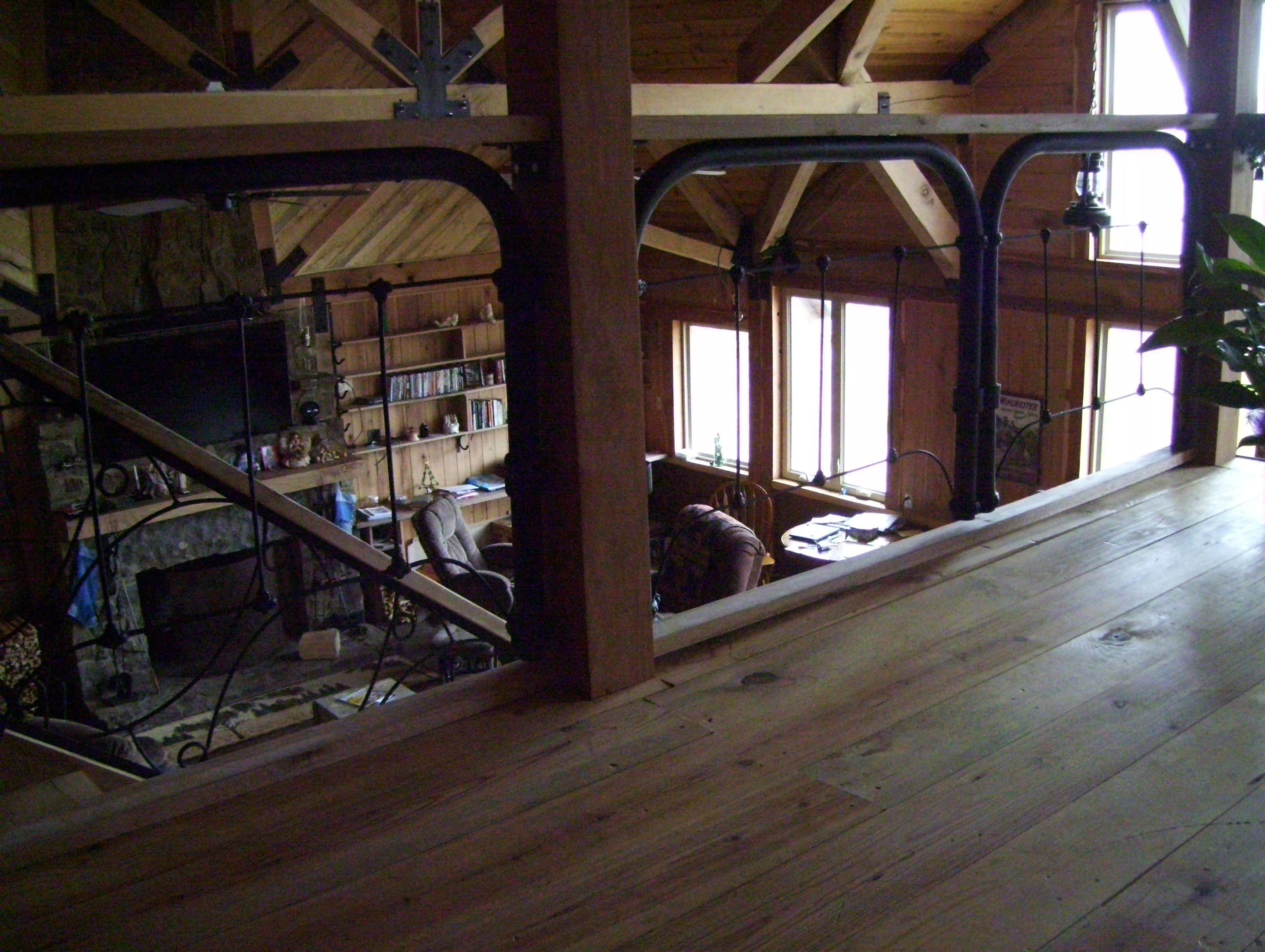
It was mentioned that Tom never misses an opportunity to visit closeouts and auctions. Below is a collection of products provided by Tom’s ingenious skill with what most would pass up as useless items.

0015AA

Figure 1 Balusters are old bed frames.

0016AA

Figure 2 Recognize an antique hay rake?

0017AA

Figure 3 These connection brackets took some thought.

0019AA

Figure 4 Some things one can’t build by one’s self.

REFERENCE SECTION

Reporting on the monkey head transplant, mariner can understand that many readers considered this story as something out of the fringe crazy folks. From all efforts to confirm the story, mariner is confident the head transfer was made. A similar transplant occurred as early as the 1970’s. However, in a BBC article, a rational (if judgmental) evaluation is made by a mainstream neurosurgeon. See: http://news.bbc.co.uk/2/hi/health/1263758.stm

Cybernetics

Here and there, page six articles are appearing that suggest a contraction in DotCom investment. Hyperbolic headlines predict another ‘bubble’ collapse similar to that in 2000. Indicators are that the big old giants (IBM, Oracle, etc.) have eroding markets; further, there are only so many incremental improvements in Apple products and only so many market-worthy apps before app integration emerges. The mariner’s career was in the era of system integration at the customer level – that is taking discombobulated subsystems and developing new integration efficiencies primarily through the development of super databases. Today, that solution has evolved into cloud solutions; the era of customer-based data centers is over. The big IBM operation in the basement of a corporation is on its way out – just plug into a cloud.

The same is true of home-based processing. New 4G devices press subscribers to store data on proprietary clouds rather than on independent, home-based hardware. Very soon, as individuals upgrade their home operating systems, they will discover that owning operating system disks is no longer possible. The home user will have to rent operating systems and integrated programs like MS Office, Photoshop, and utility software like Norton and Firefox from the owners of the clouds – a marketplace more akin to Amazon.com than to an independent retailer. It is similar in function to the mariner developing new integration efficiencies in 1990-2010.

As any technology ages market pressures require that investment cash flow remain high. This is accomplished by functional integration. It happens in every industry. At the moment, there is a pause as automated information industries look for the next integration. Many prognosticators suggest that 3-D will be the next innovation: the TV screen will become your room – not just a screen – dress decently before you answer your deviseless voice from somewhere phone; a 3-D pad will float in front of you so you can punch emoticons; are you a gamer? Prepare to be your own warrior – electronic champions will be passé.

The mariner postulates simplistic examples that require huge processing capabilities – beyond even the latest in memory processing technology. To the chagrin of the mariner, privacy and security may be a memory as each of us becomes an amalgamated function to create integrated information.

Today, perhaps it is not a bubble collapse but just a gathering of the troops for the next invasion.

Ancient Mariner

Of Monkeys and Metamorphosis


It’s too bad Joseph Campbell did not live to see a metamorphosis performed in a hospital operating room. Campbell had a clear understanding about consciousness, and its ability to press for life beyond duality. Metamorphosis is the experience of Jesus on the cross; Jesus is able to disassociate consciousness from the body – simply a container to feed the spirit. Pain, human history, and self-centeredness fall away.

A few days ago, it was announced that surgeons successfully transplanted an entire skull from one monkey to another. Immediately, so many questions filled the mariner’s head:

Given the first head’s disassociation from its body, did the first head experience metamorphosis?

Did the replacement head experience metamorphosis when it was removed from the contributing body? Was there confusion about the consciousness of self when it was associated with another body?

One can hope both monkeys were very close in size and confirmation else the replacement brain would assume that, more or less, this is like the other monkey and would issue muscle memory instructions apropos of the previous body. One can imagine that picking the nose may well be difficult.

It is common knowledge that both nurture and nature constitute the conditions of a primate body, brain, genetic propensities, and psychological behaviors. Is handedness not an issue for the new body of the transplanted skull? Monkeys grab things with all four limbs; this could be a life or death situation high in a tree.

But mariner squanders questions on the mechanics of brain-to-body management. What would Aristotle want to know? What would Freud want to know? If the new body was addicted to alcohol or good cigars, how would the transplanted brain deal with this?

If the contributing monkey liked parsnips but the new body didn’t, how would this be resolved?

We’ll have to wait for the interviews.

Not that the previous subject brings politics to mind – well, actually it does. Donald is joined by Sarah. Oh my, oh my! Sarah associates with Glenn. Oh my, oh my, oh my!!

.

.

.

Oh my…

Ancient Mariner


The House that Tom Built

Think first of someone with the talent of an artist: that intuitive awareness that most of us can appreciate but never emulate; think da vinci; think the Statue of Liberty by Bartholdi and Eiffel; think Eiffel Tower by Eiffel; think the Vietnam memorial by Maya Linn; think Frank Lloyd Wright. These artists have intuitive creativity enriched by a requirement for function – Pablo Picasso and Andy Warhol need not apply. Now you understand the intuitive genius of Tom.

Tom is not famous; his artwork is not easily reproduced nor, perhaps, not widely wanted in an age when upscale homes must flaunt expensive materials, artificial elegance, Pier One decor, and look-alike neighborhoods. Tom never considered himself an artist. That awareness probably would have restrained his creative eye and certainly would have affected his enjoyment. Tom’s career as a PhD in soil microbiology and working for large agricultural chemical manufacturers similar to PPG and Uniroyal also was creative when he was presented with a new biological chemical to analyze or sent to a golf course or a farm or park because someone had to identify an unknown cause for poor plant performance. It was Tom who sent mariner a bottle of “stuff” to keep his Poinsettias from growing lanky after Christmas.

Tom had a dream. Long before he retired, Tom began drawing his dream house. Drawings that eventually had detail like how many square-nut half inch bolts he would need. He kept his drawings on laptop software to retain measurements and scale and how many two-by fours are needed – as if Tom knew what a 2×4 was. If he needed one, he would cut down a tree, cut the tree into large planks, dry the wood for a year in a specially heated school bus AKA wood drying kiln, run the plank through a planer and jointer, and then cut 2×4-inch pieces (real 2x4s, not 1 5/8 by 3 5/8).

Tom has a loving and extremely forgiving wife. She asked, as Tom finally retired and committed himself to building the house, “How long?” “Oh, about 4-5 years,” he said. Tom didn’t mention that first they would have to build and live in a small house and giant workshop. Tom quickly gained a reputation for identifying a project – which, one discovered, required another project before that one, and another before that one, and another before that one. The reader and mariner will go to a lumber yard on Saturday to buy some materials. When Tom said he was ready to start framing, that meant he had to build a sawmill, buy a school bus, retool the front-end loader so it could function like a fork lift, cut down and square 20 acres of trees, dry the bulk lumber for a year, cut the rough wood into framing pieces, and make massive steel plates to hold trusses together.

Tom is a skilled welder. By welding this and welding that, he has created, resurrected or modified tools from broken angle iron to major equipment like forklifts, front-end loaders and jeeps – redesigned to achieve unique tasks. The home handyman envies Tom’s collection of used and restored heavy duty saws, planers, jointers, sanders, routers, endless jigs and drills. Mariner wanders Tom’s workshop in awe of the nameless tools and devices made to accomplish unique tasks on a grand scale. For example, to turn the bus into a kiln, he welded steel drop down covers for the bus windows. These allow regulation of temperature; he installed a large heater – some would say a small furnace – to achieve the high temperatures needed.

Tom also is a perpetual visitor to auctions, sellouts of closing stores, lumber yards, farms and private sales of lumber, steel, plumbing supplies (Tom could start a museum about plumbing and heating), and, as his wife, the reader, and the mariner might consider – junk. One must admit that it is junk but Tom sees in it an artful reuse for a future project. Artful, indeed, as his artist’s eye will transform it into a tasteful creation or a needed function.

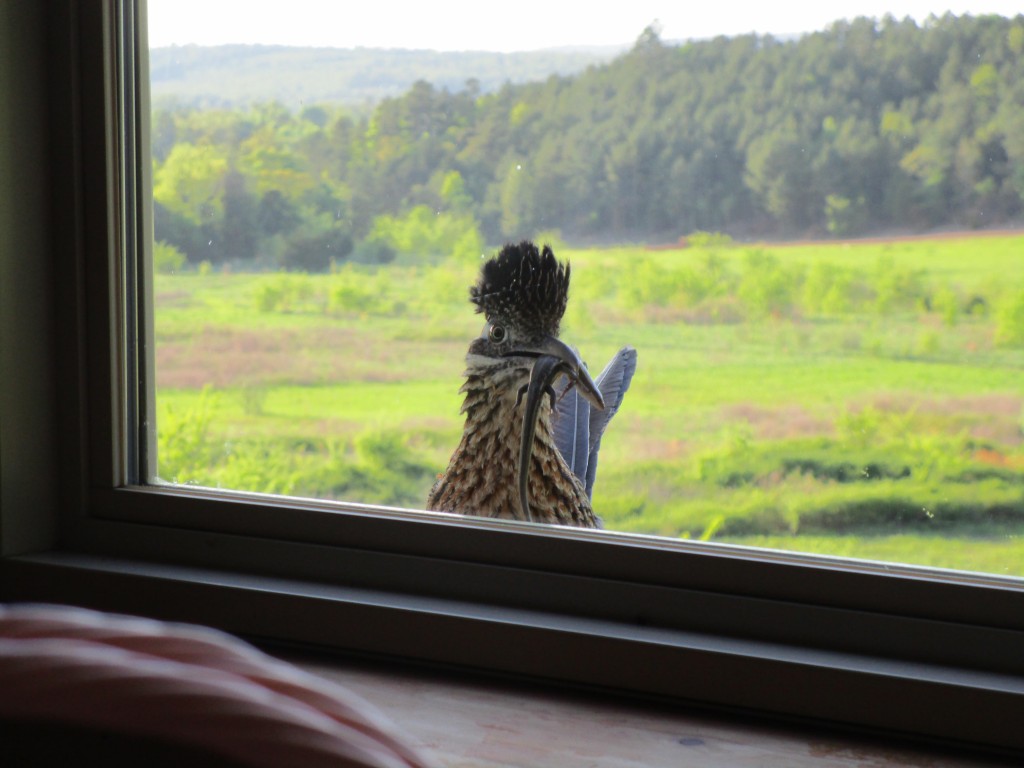
1-Sharp Tailed Grouse with skink for breakfast; Serengeti in background.

 Tom is blessed that he owns 120 acres as his share among his siblings. The house site sits on a high hill overlooking a large field that once had grazing cattle but now has an idyllic Serengeti appeal. Wildlife abounds in this remote region of Arkansas. Deer families roam the ‘Serengeti’ as if they were Thompson’s Gazelles. An unexpected visitor for those not familiar with this part of Arkansas is the domestic but feral hog; not the razorback or the peccary – but a relative of Wilbur. They are destructive as hogs tend to be and willingly tear up gardens much worse than Iowa rabbits. Tom converted his father’s cattle trailer – made from cattle fence and metal posts – into a hog trap that catches them alive. Tom and his wife make sublime smoked pork!

The project began in earnest around 2003-2004 when Tom laid spray paint lines on the location. (More in another post.)

REFERENCE SECTION

  • Stephen Hawking is doing a series for BBC wherein he says the human race will disappear sometime between 100 and 10,000 years but not to worry: the human seed will live on in space – if we make it through the next 100 years! Buy your ticket now. See:

http://www.cnet.com/news/stephen-hawking-were-about-to-wipe-ourselves-out-but-dont-worry/

  • The reader may be aware that for years US News magazine has ranked US colleges and Universities using an elaborate set of conditions; the effort has drawn general praise by readers and education pundits. Now US News has applied its research model to nations ranked from the best country to live in to the worst country to live in. It ranked 60 nations. The US came in fourth behind Germany, Canada, and the United Kingdom. The website is interactive so the reader can drill down into a country’s stats and history. See:
  • http://www.usnews.com/news/best-countries/overall-full-list
  • Fareed Zakaria has a Sunday show on CNN (Global Public Square aka GPS). Mariner has recommended GPS in the past. This past week (1/17), he focused on radicalism and how social media is the hotbed of radicalization. Zakaria points to a recent personal experience where atrocious lies about him were posted and went viral (called trolling). See Fareed on CNN https://twitter.com/FareedZakaria/status/689238727818932228 or read about his recent attack from social media in his column in the Washington Post. https://www.washingtonpost.com/people/fareed-zakaria

Ancient Mariner

In Search of the Southwest Passage


Van dropped anchor in El Paso19:15 hours. Two reasons are behind this effort to sail the Southwest Deserts: Most important is gathering together a widely distributed set of our children. The long weekend has been an astounding success with good bonding and family renewal sure to provide confidence as all of us begin new adventures.

It has been a good shakedown cruise for Van and her crew. Van behaved remarkably well but the crew discovered it had a lot to learn about stowage.

The second reason, a very strong one albeit second to gathering the family, is the search for warmth. Mariner’s idea of warmth is Cancun, Mexico. In this respect, the cruise has been a dismal failure. Heavy snow, cold, sunless days overcast such that running lights were required. From Oklahoma to Flagstaff, the high was 34°F. Dropping down into the Phoenix basin did not improve things much with highs running 38° to a best of 50°F and a stiff cold wind to boot.

Arizona and New Mexico host three very large desserts; the flora and fauna is outstanding – the weather did not pass muster. Even as we steered Van into lower latitudes, El Paso offered 41°F with the coldest wind yet. Mariner is aware that San Antonio sits astride two biomes: to the north, one can expect weather very similar to our experience so far. To the south, there is a remarkable change in flora suggesting that it is virtually always warmer and does not experience hard frosts. It is in this more pleasant clime that the crew will dock Van for two days before we cruise to relatives and friends in Wylie, Texas and Havana, Arkansas – then back to home port for even colder weather.

Iowa caucuses grow near. Vote at any cost – but vote wisely. The US culture has come to a standstill that requires significant, visible commitment mostly from voters.

Ancient Mariner


Sailing On

The mariner disembarks for El Paso tomorrow. Bearing I-10 all the way.

Today, we visited a chocolate factory. It was difficult not to buy out their stock. Clemson lost. Phoenix provided a pleasant sunny day.

The January/February Atlantic is dedicated to the 2016 election. It provides a broad view of trends and discusses American shifts in culture regardless of the outcome of the election. Online, you can read the magazine at www.atlantic.com

Mariner often uses the phrase “old school” politician. The criminal abuse allowed by Michigan Governor Rick Snyder toward the city of Flint is an atrocity typical of old school politicians who protect status quo and destructively manipulate budgets to minimize budget overruns. In an article, CNN states “This had been the status quo for nearly two years and until September, city and state officials told worried residents that everything was fine. Former Flint Mayor Dayne Walling even drank it on local TV to make the point.

“When our team (Dr. Mona Hanna-Attisha, pediatrician) saw that it was getting into children and when we knew the consequences, that’s when I think we began not to sleep,” Hanna-Attisha said.

At first, the state publicly denounced her work, saying she was causing near hysteria. They spent a week attacking her before reversing their narrative and admitting she was right. See full article at:

http://www.cnn.com/2016/01/11/health/toxic-tap-water-flint-michigan/index.html

It is important to know your incumbent’s voting history as a guide. Use your search engine to retrieve specific information. For example, mariner typed “Steve King voting record gun legislation” and had King’s whole history regarding his votes on the gun issue. One can search several voting topics by changing the words behind ‘voting record.’

The reason this is unusually important is that you must vote for a cause of your choice and let that dictate whether you will vote for an incumbent. In the past, one would say “The Congress is terrible” but would reelect their own Congressman on very forgiving, general principles. Not so, this time. Vote for an issue, not a person.

Try to identify the candidate as ‘old school’ (stability and fiscal conservatism) versus ‘new school’ (identifying current and future issues with declared policies about the future).

Ancient mariner