
China

The mariner hasn’t posted much about China. China is constantly changing. The US-Sino relationship is a lot like a human working with an elephant. The elephant has some shortcomings that permit some malleability but whenever the elephant decides to rebel, it can do so without recourse. We must never forget that as an economic entity, China has a population that is projected to reach 1.39 billion by the end of 2015; it is the world’s most populous country. The US population is 320.5 million. The Chinese nation is 4.3 times the size of the United States. China’s back country, noted at the moment for its primitive society, is almost the same size land mass as the US – 50 states included. The disparity of culture between China’s large cities with international commerce and that of the back country is an overhead in terms of bringing millions of Chinese into the 21st century. On the other hand, the opportunity for growth and expansion has no limits.
To the western world, China was an unknown, mysterious nation until the Second Sino-Japanese War, 1937-1945. Two western nations, Germany and the US, along with Russia, provided military support to China. This provoked Japan to bomb Pearl Harbor in 1941 – starting the Pacific arena of the Second World War. WWII engulfed the Sino-Japanese war.

Before and during WWII, China also was in a civil war between the Kuomintang Party and the Communist Party of China (CPC). Leading the CPC was Mao Zedong, a follower of Marxist-Lenin philosophy. In 1949, Mao won the civil war and unified China under communist rule. The Kuomintang retreated to form the nation of Taiwan.

Mao’s aggressive leadership quickly made him a notable personality around the world. His supporters say he drove imperialism out of China, modernized China, turned the nation into a world power, raised the status of women, and improved education and health care. China’s population grew from 550 million to over 900 million during the period of his leadership.

His detractors consider him a dictator who severely damaged traditional Chinese culture, a perpetrator of systematic human rights abuses who was responsible for an estimated 40 to 70 million deaths through starvation, forced labor and executions, making Mao the worst example of genocide in human history.

As part of a strategy to defeat Japan in WWII, Korea was divided into North Korea and South Korea along the 38th parallel. Russia used North Korea while the US used South Korea. After WWII, North and South each claimed to be the official government of a united Korea. Eventually, the two Koreas went to war. Russia and China backed the North; the US backed the South. The claim to be the true government has never been settled; to this day, the 38th parallel is a militarily secured no man’s land between North and South Korea.

Mao died in 1976. China’s government changed the nation’s name from The Republic of China to The People’s Republic of China. In 1982, the office of President was created but with greatly reduced authority – although the President is in charge of the military and, in the case of Xi Jinping, the current President, chairman of the Communist Party as well. Since 1982, the current government is constrained by the need to keep the communist government popular. The President is nominated by the National People’s Congress. China has and still is experiencing a difficult metamorphosis.

Today, China is second only to the US in economic power. China has formed an international bank to compete with the International Monetary Fund (IMF). The bank will use the Chinese dollar, the Yuan. This is a direct challenge to the US dollar as the world currency. However, China has overreached itself by going into heavy debt – even for China. Recently, China had to let the Yuan float against other currencies, which forced a depreciation of the Yuan by 2.5%. China had maintained a false value for the Yuan that improved its trade balance.

China still has momentous issues with income disparity, poverty, illiteracy and developing a viable domestic economy. Everyone around the world knows that if China can overcome its internal growth issues, it will be the big kid on the block.

More on China in a future post.

REFERENCE SECTION

The New York Times has an excellent international news staff that stays focused on China. See http://topics.nytimes.com/top/news/international/countriesandterritories/china/index.html

For an array of opinions about China and the US that are not simplistic, visit

http://www.naturalnews.com/china.html

For authentic Chinese food recipes, see

http://rasamalaysia.com/chinese-food-recipes-chinese-recipes/

For a video library on Chinese history, visit

http://chinahistorypodcast.com/

 Ancient Mariner
 

Behind the Headlines

The mariner is working hard to avoid the mindless traps of television pundits, mindless presidential candidates, old-fashioned attitudes about major professions and institutions (old-fashioned meaning since 2005), and mindless bickering about cultural icons. One almost must turn off communication with the commercial information world and search the back roads to find reasoned evaluations of the real world today. What follows are a few counterpoints to the common press insights that most of us live by. Certainly, we must always remember that thoughtfulness is washed away by the race to have the most viewers, the most readers, and the most acceptable opinions.

Economy

The mariner has reviewed several respected economic journals and even a few foreign reports to determine how the US is faring economically on the world stage. It turns out the US is not doing too bad. In fact, compared to the Euro zone, the BRIC nations, and the Middle East, even Mexico, Japan, India and other trading allies, the US has grown in economic power around the world. The US has come out of the recession faster and with more growth than any other nation on the planet. This opinion does not dismiss the disparities of oligarchy, wage suppression and blatant pressure to diminish citizen rights nor does it take into account the environmental cost that grows by the year. Still, Donald is wrong. America is already great and beating other countries in the game of economics.

Middle East

All the Middle East nations comprise very much a hodgepodge of foreign policy issues. The Iran nonnuclear agreement appears to be accepted by citizen majorities in both the US and Iran. Those objecting to the deal are the US hawk conservatives and the Ayatollah Khomeini in Iran. Reports indicate that the agreement will survive resistance.

The Syria/Kurd/Turkey/Iran/Iraq/Isis/US/Russia/Shiite/Sunni/mass emigration conflict is in free fall, obviously. Russia has come into Syria to support Bashar al_Assad, which suggests Assad is weakening. Russia’s presence puts a new spin on speculation about escalation of war. The mariner suspects that Russia does not want escalation but somehow must sustain influence with Syria and indirectly, demonstrate that Russia can’t be forgotten as an influence in the region. Again, the Obama administration remains publicly silent but US intelligence is active.

The emigration into Europe is an issue all its own, acknowledging that the migrants are fleeing the aforementioned war zone. The United Nations count is 4.1 million refugees. Germany may benefit more because it took a large number that will offset aging population in Germany. Other European countries also have aging populations and aging economies. Perhaps this is the reason Europe is more willing than not to receive large numbers of Syrian immigrants. Perhaps, as well, the US should bump its number significantly since the United States also has an aging population. It should be noted that the US is the largest contributor of funds to the migrant crisis.

Proper Leadership is Lacking in US Culture

The mariner was checking out the book The Silo Effect, The Peril of Expertise and the Promise of Breaking Down Barriers by Jillian Tett (Simon and Shuster). Today on Global Public Square, Fareed Zakaria featured the same Book and Chris Hayes, MSNBC anchor, reviewed the same on his website. Great minds. . . .

The mariner is intrigued because so much of the text reflects his own career experience as a consultant who, by the nature of his assignments, was constantly battling highly territorial departments that did not want to change or share their information. Tett calls these vertical departments ‘silos.’ Tett’s point is that specialization – both of organizations and personal ambition – prevents innovation, creativity, and intelligent interpretation of reality. Historically, these open-minded attributes are the edge that made the United States a premier nation among nations. (Reference mariner’s posts about the demise of liberal arts education.)

Tett cites a number of institutions that deliberately reorganized to improve corporate functionality, customer service, innovation, and efficiency. Tett is a PhD anthropologist; her explanations tend toward behavioral modification rather than the management modification prominent in Deming, Drucker, and others popular in the 60’s and 70’s. An example at the Cleveland Clinic is not only to reorganize medical departments but also to renovate the building so that meeting spaces, casual spaces, and medical processes draw mixed teams and managers into an open space concept. Tett uses SONY as an example of death by specialization; the company was tightly organized and highly specialized at the worker level. SONY lost its top-of-the-heap position selling SONY Walkman music devices – failing to read new market pressures. In the meantime, Steve Jobs stepped in with the IPod. SONY hasn’t been at the top since.

Politics, Religion and Economics

Thinking about Jillian Tett’s book and its emphasis on creative problem solving, and the desire to integrate values to better predict future reality, turns the mariner’s mind to the battles of church and state, conservative right versus progressive left, oligarchy versus democracy, etc. All these issues and many more are bound by their belief systems. One cannot share absolute principles – only defend them. One cannot merge polarized attitudes – only seek to destroy opposites. Today, suffering our dysfunctional governments, our religious institutions that long ago forgot Christian principles, and our descent into greed, we are at a huge intersection in the nation’s history. An open question: How can we introduce innovation into an age of specialization?

Ancient Mariner

Marriage

Marriage. A cause for war or peace, a furtherance of power, an icon for the act of proliferation, a guarantee of lineage and wealth, something nice if it is affordable, a device of psychological need, a hobby – perhaps an act of genuine love.

Marriage is much in the news recently with an abundant set of examples that suggest marriage has its own niche aside from church versus state bickering. The mariner read an extensive book review of The Marriage Book, Centuries of Advice, Inspiration and Cautionary Tales from Adam and Eve to Zoloft, edited by Grunwald and Adler, published by Simon and Shuster. The Marriage Book is a deep collection of marriage history, photographs, charming and entertaining examples of marriage by famous couples in history, and some serious thoughts that marriage as an institution is becoming class centric.

There is no need for the mariner to recite the details of several marriages in current events, he will just name the keyword; the reader will remember. There is a set of Monarchy weddings: Andrew, Charles, William (Great Britain), Madeline (Sweden), Philippe, Laurent, Armedeo (Belgium), Frederik (Denmark), Sophia (Greece)……

There is a set of Hollywood marriages. No, there is a superset of Hollywood marriages, second marriages, third marriages, etc. There are even remarriages.

There are notable marriages in families like Clinton, Kennedy, Nixon, Eisenhower and too many iconic wealthy marriages to note.

There are religious marriages. Roman Catholic, Fundamentalist Protestant, Baptist, generic Protestant, Jewish, Muslim Sunni, Muslim Shiite, Greek Orthodox, Latter Day Saints, Hindu, Buddhist, atheist, and Scientology.

There are nationality weddings. Polish, Israeli, Greek, Italian, Icelandic, Sudanese, American courthouse…..

There are shotgun marriages, good idea when drunk marriages, underwater marriages, skydiving marriages, “The baby is two years old; should we consider marriage” marriages…..

There are minority marriages: interfaith, interracial, homosexual, international and underage.

Finally, there are non-marriages. Statistically, the number is far larger for African American women and senior citizens. Next in line are young people under the age of 27.

Increasingly, there is no marriage. This is the point of discussion. In the United States, the median age at which women marry is now 27, the highest it’s been in a century. The same trend exists in Europe. That’s according to a new report by Bowling Green State University’s Julissa Cruz, published by the National Center for Family and Marriage Research. Not only are marriages occurring later, marriages are occurring less frequently. Note the table below.


Year Marriages Population Rate per 1,000 total population
2012 2,131,000 313,914,040 6.8
2011 2,118,000 311,591,917 6.8
2010 2,096,000 308,745,538 6.8
2009 2,080,000 306,771,529 6.8
2008 2,157,000 304,093,966 7.1
2007 2,197,000 301,231,207 7.3
20061 2,193,000 294,077,247 7.5
2005 2,249,000 295,516,599 7.6
2004 2,279,000 292,805,298 7.8
2003 2,245,000 290,107,933 7.7
2002 2,290,000 287,625,193 8.0
2001 2,326,000 284,968,955 8.2
2000 2,315,000 281,421,906 8.2

Despite an increase of 32.5 million in population, there were 184 thousand fewer marriages. Generally speaking, upper classes are marrying late, while poorer women are deciding that they’re better off single.

Consider the following:

The decrease in the divorce rate reflects later marriages more than anything else. However, the later average age of marriage rising to the late twenties and thirties is more controversial. Economists note that the increase in the age of marriage and falling divorce statistics are only a small part of the phenomenon. Economists say these statistics reflect the increasing tendency of the well-off to marry similarly well-off partners; those marriages are more likely to last at any age.

Class-based behavior is the dominant factor driving the statistics. On the one hand, male and female college graduates will marry and stay married. On the other hand, marriage is disappearing from the poorest classes. Also increasingly, women across the board are marrying men who aren’t the natural fathers of their children.

The later age of marriage for college graduates is caused by a new middle class behavior: Women are investing in their own education and earning potential, which extends the age of marriage and childbearing. For men, it takes a two income family to live a middle class life. Further, men must pursue not only college and post graduate education, career success often depends on relocation, job changes and personal investment in qualifications beyond college. Once established, men, and the women who wait to marry them, are ready for a stable family life. As the economy becomes more difficult for any working adult, early marriage is inconvenient until as late as the thirties. Commonly, children aren’t born until the early forties.

Changes in the last quarter century indicate that marriage is increasingly becoming a marker of class — the delayed marriages of the middle class produce steadily lower divorce rates, very few non-marital births, and substantial resources to invest in a falling number of children. For the rest of the country, the statistics may simply confirm a greater move away from marriage altogether.

The conflict between church and state in Kentucky provides volatile news and skirmishes among advocacy groups but the larger scope of marriage as a social phenomenon is not about church and state – it is about economics and the future job market for all young adults.

[Some contribution to the above analysis is provided by June Carbone, the Edward A. Smith/Missouri Chair of Law, the Constitution and Society at the University of Missouri-Kansas City.]

—-

Just a side note on the series about achieving the reader’s liberal art education online: CNN often is criticized for chasing time-filling non-news instead of working harder to produce genuine news that affects everyone more directly. However, amid the Tower of Babel produced by pundits, there is one journalist who produces top-drawer information, explains more deeply the what, how and why of events, and offers opinions for those who think a bit more than others. His name is Fareed Zakaria. The mariner admits he is a fan and counts Fareed among his favorite authors. Nevertheless, Zakaria is college and graduate level in his presentations. A self taught liberal art major will have an excellent sense of current events that will lead to mysteries for the search engine. See:

http://globalpublicsquare.blogs.cnn.com

Watch his Sunday morning show, Global Public Square, at 10AM Eastern on CNN. Definitely worth copying to the DVR for more convenient viewing. Of importance to those tracking Presidential candidates, Fareed had an opening opinion piece on the Sunday, September 13 broadcast. If you missed it, check his blog.

Sharing Fareed’s investigative style is Frontline on PBS. This series covers larger, substantive issues in many subject areas. Many topics relate to the wellbeing of each of us in an often conflicted world. See:

http://www.pbs.org Frontline.

Finally, California passed legislation that makes physician-assisted suicide legal. California joins Oregon, Washington, New Mexico, and Vermont. Montana has legislation that protects physicians from liability when providing assistance at the patient’s request. The mariner suspects age has a lot to do with one’s opinion about euthanasia in ways that may surprise us. Replies are welcome on the mariner’s website.

Ancient Mariner


Distribute Your Wealth Now!

Yes, you. If you have the wherewithal to read the mariner’s blog, you have wealth. No one else can address the depravity, greed, ignorance, prejudice, starvation, disease, death, destruction of the biosphere, incessant war, and class abuse.

The United Methodist Church has a mission project called “Imagine No Malaria.” One can acquire a tee shirt that says, “If you think you are too small to make a difference, try spending the night with a mosquito.” This proverb is a fine challenge; it can apply to any issue around the world or around the corner. If you want to support this project, send a contribution to your local Methodist Church.

Below are other efforts that need your wealth and your health.

Habitat for Humanity. (www.habitat.org) Builds homes for the homeless. This is an organization that has immense impact on a family’s life in a very short time. HH will accept your body and a hammer as well. Check the website for information.

Salvation Army. (www.salvationarmyusa.org) “ONE MISSION: Into the world of the hurting, broken, lonely, dispossessed and lost, reaching them in love by all means.” Contribute goods and cash. SA also helps those in disaster zones and ignores national boundaries. Check local phonebook for free pick up; donate cash on the website.

Religious Institution. Visit your institution or search for that institution’s website to find a magnitude of mission projects for people in need around the world.

World Wildlife Fund. (www.worldwildlife.org) “The group’s mission is to stop the degradation of the planet’s natural environment and to build a future in which humans live in harmony with nature. Currently, much of its work focuses on the conservation of three biomes that contain most of the world’s biodiversity: oceans and coasts, forests, and freshwater ecosystems. Among other issues, it is also concerned with endangered species, pollution and climate change.” Visit website for gifts and donations.

Food and Water Watch. (www.foodandwaterwatch.org) “Food & Water Watch works to ensure the food, water and fish we consume is safe, accessible and sustainably produced. So we can all enjoy and trust in what we eat and drink, we help people take charge of where their food comes from, keep clean, affordable, public tap water flowing freely to our homes, protect the environmental quality of oceans, force government to do its job protecting citizens, and educate about the importance of keeping the global commons — our shared resources — under public control.”

The mariner is a member of FWW. He feels there is a need to protect shared resources by keeping resource administration in the public sector where profit is less of a threat to our health and access to critical resources is not denied for any reason. FWW is an advocacy organization that responds to federal, state and local legislation that may be detrimental to the wellbeing of citizens.

Local charities. In your search engine, type “charities near me” to find organizations supporting every sort of need from homeless to abject poor to neighborhood cleanup to slum restoration to medical need to foster children services, even to homeless pets. There is no shortage of need for your wealth and your health.

Add to this list your commitment to improve local government by becoming active in local issues and participating in the primary and voting process.

The mariner has provided a short sample of ways by which the reader can become engaged in improving the world. One does not have to wait for an election.

Ancient Mariner

Liberal Arts – A Lost Art

MOUNT PLEASANT, IA. — Melodies seeped through doors and floated down the hallways last week inside Old Main, the grand, three-story home to Iowa Wesleyan College’s music department.

Despite renovations and fire, this 160-year-old building — the second oldest on campus — has retained its beautiful, historic wrinkles. So the music made here beneath a tiny gold dome isn’t trapped within modern, acoustically sealed studios.

Old Main exhales the sound of its aspiring virtuosos into the world at large.

It’s an apt metaphor for how Iowa Wesleyan music graduates in turn have educated generations of music students around southeast Iowa and beyond.

And it helps demonstrate why beloved Old Main has been a symbol at the epicenter of this college’s financial crisis.

Iowa Wesleyan President Steve Titus announced last month that half the college’s major programs (16 of 32, including music education) would close as the college sheds jobs: 22 of 52 faculty and 23 of 78 staff, for a projected $3 million savings.

Sociology, history, pre-law, studio art, philosophy of religion and communication are among the other programs to be scrapped.

Titus and the board of trustees — which voted unanimous approval — more or less have been able to sell the plan with another statistic: Only 52 students out of about 600 at the United Methodist Church-affiliated school (less than 9 percent) are enrolled in the majors to be cut. And 17 of those students will graduate this year. Popular programs such as business administration, education and nursing will forge ahead. [Kyle Munson, Des Moines Register, Feb 16 2014]


What draws liberal arts to the forefront of the mariner’s mind is Fareed Zakaria’s latest book, In Defense of a Liberal Education. Zakaria is one of mariner’s favorite authors. His books are lucid, insightful and easy to read. Zakaria says  liberal arts education is more important than technical training or job-based education. He writes:

“Engineering is a great profession, but key value-added skills you will also need are creativity, lateral thinking, design, communication, storytelling, and, more than anything, the ability to continually learn and enjoy learning – precisely the gifts of a liberal education.”

From the inception of the United States, the keystone that differentiates it from all other countries is that it provides a liberal arts education. This emphasis on broad knowledge and thinking skills produces a nation known for its free thinking, creative, and even futuristic society. The edge the nation holds among nations is the ability of its workforce to capture the latest ideas, to innovate new solutions, and to sustain a free-thinking culture – until now.

The failure of small liberal arts colleges is a bellwether. The small liberal arts college is most vulnerable to financial issues. One cannot blame students for seeking job-enhancing education. For forty years, the nation has been losing jobs for a shrinking middle class, computerization, manufacturing moves to less expensive labor markets and, since 2005, the American economy. In addition, larger institutions have the ability to compete in a dollar race with other institutions because they have large trust funds, government subsidy and a formidable advantage over small colleges in tuition from thousands of students – a tuition that inflates beyond inflation every year.

It may be a romantic notion. Perhaps it’s time to move on to dollar-efficient training of students for jobs that do not require wisdom or creativity. Fareed quotes William Bennett while Bennett was interviewing North Carolina’s Patrick McCrory:

“How many PhDs in philosophy do I need to subsidize?” Bennett asked – a sentiment to which McCrory enthusiastically agreed. (Ironically, Bennett himself has a PhD in philosophy, which appears to have trained him well for his multiple careers in government, media, nonprofits, and the private sector.)

As liberal arts education declines, so will the free thinking element of US democracy. Disappearance of liberal arts is indeed the bellwether behind a significant number of news headlines today. Exclusive boundaries are growing stronger around increasingly narrow minded groups. One example is the creationist battle in Texas for dominance in history books. Because the Texas School Board orders so many books, publishers tend to appease the board even though the history books are bought across the country. Another example is Congress, where virtually nothing creative or inventive occurs – only ideological bickering and blockading of each group’s legislation. This close-minded attitude has been creeping into mainstream society for decades and becomes more established as jobs, income, and pragmatism become the cause for education.

Our national jewel, free thinking and problem solving wisdom, will evaporate. We will be as any other nation that constrains individual discovery to promote fiscal efficiency and nationalistic objectives.

Liberal arts remain a conundrum for the United States. Without the wise insight proffered by a liberal arts education, where will we find those leaders who will sustain a liberal arts education?

Ancient Mariner

The Great Barrier of Nationalism

In the last post, Today is Earth Overshoot Day, the mariner wrote of global issues that are ignored by governments around the world. Water and minerals have reached an end game and face inadequacy during this century. Food is both abused by waste and unavailable to millions because of political obstruction. Ecosystems of all kinds are wantonly destroyed to increase profit. One-third of the Gulf of Mexico is a dead sea because of the toxicity flowing off the Mississippi River. 90% of Monarch butterflies have disappeared. Coral reefs around the world are dying. Coral is the bottom of the food chain; without coral whole species of fish and mammals will disappear. Much of Micronesia will vanish beneath the sea in 50 years. Although we know deforestation of great forests is not good for our atmosphere, yet the clearing continues.

The mariner knows he sounds like Chicken Little but the ramifications of not caring about our planet or ourselves already are measurable. While there is a futile attempt by multiple nations to limit Carbon Dioxide, that effort miserably falls short of functional change, let alone actually modifying global circumstances. Still, governments feign ignorance about global warming and converting to alternative energy now and deny passing legislation to prevent profit taking at the expense of everyone’s biosphere.

Why is each nation so reticent to join with others to avoid terminal catastrophes for humanity? The answer is nationalism. The twenty-first century presents issues that can only be solved if the world politic changes its priorities. These priorities are not nation-sensitive. The type of government does not matter be it communist, socialist, capitalist, authoritarian, monarchy or tribal. In every case, the wellbeing of the nation, its economy, its culture, and its advantage among nations, are the first priority.

The one new nation that has evolved without nationalist priorities is corporations. Focused on profit as a first and last cause, corporations glean unfathomable amounts of cash and assets from the world economy. This cash is used to grow and acquire more assets or it is parked in long term investment. Corporate profit is sufficient to take serious steps toward global rejuvenation but does not for the sake of profit. If the sums stored away by corporations were taxed for the benefit of global issues, relatively simple issues like fossil fuels could be bought outright – diminishing the pressures against Earth’s biosphere in short order. Although the solution is simple, the process is tangled in worldwide nationalism – nations who benefit from their corporate contributors.

Operating largely outside the jurisdiction of nations, corporations are in effect today’s pirates – not roaming the seas but roaming the Internet that allows rapid reorganization and fast-dollar marketing and to move to nations that are more amenable and enable larger profits. The Trans-Pacific Partnership in Congress right now will make participating corporations virtually impervious to nation-based human rights and labor law. Corporate payoffs to legislators and kings are huge and difficult to resist.

To a small degree, one can understand greed as a goal. Certainly, it is personally rewarding. On the other hand, fairness is a tangible factor. If one makes a mess in a friend’s home, one pays the price of cleaning the mess rather than leaving it for the friend. Somehow, governments have forgotten fairness. Some of this forgetfulness can be attributed to outdated government concepts. The founding fathers of the United States left fairness to the individual so that there can be freedom for all, freedom to pursue happiness, etc. This liberated the new country from the abuses of colonialism but it provided no structure for fairness. If one could pick a single issue why the US and State governments are broken, one would have to say the governments don’t enforce fairness – hence the ease with which the US has become an oligarchy and allows the fast-buck, under-taxed marketplace.

Humanity has been unfair to Mother Earth. All of human history has been an expansion of skimming Earth’s riches but not cleaning human mess, not restoring or respecting what Earth has given toward our arrogant sense of success. Not only has humanity been thoughtless, humanity has been wanton. Without Earth, there would have been no success; without Earth now, there will be no humanity tomorrow. A respected ecologist has put the end 600 years from now.

Ancient Mariner

Today is Earth Overshoot Day

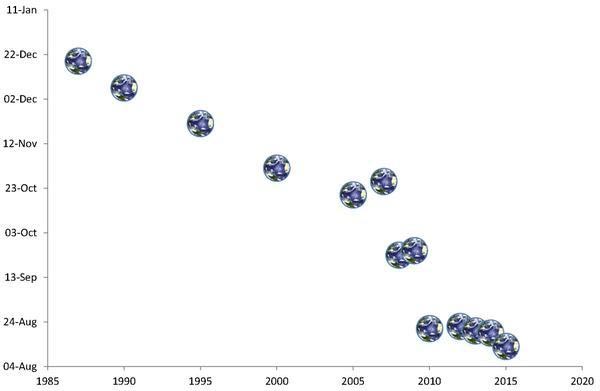
Many may not know this term. It is the day of the year that humanity requires more of the Earth’s resources than Earth can provide for that year. In 2015 that day fell on August 14. From now until December 31, humanity is borrowing against future years. An example is the use of aquifers – water stored deep in the Earth. We are rapidly draining aquifers dry. What will happen when we have drained all the water? It took hundreds of thousands of years to create aquifers; humanity is draining them dry within 200 years. The chart below shows that earlier each year, humanity consumes more than the Earth can provide:

The latest population projection shows that by 2100, 85 years from now, the number of humans will grow from 7 billion+ to 12 billion+. That number is approaching double today’s population. Ecological resources are a global issue. It is larger than one nation, or the many international coalitions. It affects every nation on every continent. Every day the world dickers with economic and military wars, and ignores bellwether changes like global warming and creating dead seas that used to provide large quantities of life, global issues loom closer. Solving global issues will require every nation’s participation and will take decades to accomplish.

On a more imminent topic, the United States and most of the temperate climate nations will be affected by the strongest El Nino since 1950 – the first year records were kept. Southern California likely will get the rain it needs, albeit via heavy storms and flooding; Northern California and the top tiers of states all the way to the great lakes will be drier and warmer through the winter; the Upper Mississippi Valley and the Ohio Valley will have drier weather, perhaps even drought-like. The South, coast to coast, will have much wetter weather again via large storms. A second jet stream will come from Alaska and pass over the Great lakes into New England and the Middle Atlantic states.

The degree to which this strong El Nino will disrupt agriculture or cause flooding is still unknown but NOAA advises “above average” changes to our weather patterns. A tip to how much above average is in the name given by the cable weather channel: Godzilla El Nino. Crudely bilingual but a tip. If one remembers 1997-1998, El Nino produced snowstorms in New England that fell in feet per hour, rainstorms across the South that fell in inches per hour. Iowa and Missouri flip-flopped from very cold to very warm to very cold again.

Many planetary events have heightened profiles. In the mariner’s opinion, global warming is an indirect cause of stronger weather patterns and may, along with a weakening magnetic field, exacerbate plate tectonic activity. Because of the Sun’s cycle, scientists predict a small ice age in mid-century. Times they are a-changing!

Where will we put another 5 billion people? Not on islands or seashores – they will be underwater.

Ancient Mariner

The Future is Here

The first mate and the mariner will soon depart to visit our far-flung children. He will do his best to post moments of interest. Of particular interest, to the mariner at least, is to imbibe fresh seafood other than the occasional never-frozen catfish – a fine plate in Iowa but the only one. Leaving a small quiet town, we shall thrust ourselves into the urban society of large megacities, traffic, and cultural phenomena unseen on the gravel roads and cornfields of Iowa.
We find that options offered by AirBnB are quite satisfactory, certainly on par with four star accommodations, and affordable at 1/3 the price. Already we have reserved a home in Phoenix for our winter retreat and a reunion of said children and families.
The mariner recently posted a series on the future of work, suggesting that automation will erase whole job sectors in a few decades. He sees the current AirBnB movement as an example of redistributing income based on individual resources and skills rather than depending on business resources. Eventually, businesses will revolt against income distribution to independent workers – first trying to outlaw them or force them to comply with peripheral law and regulation, then being forced by market pressure to reduce product cost to reasonable levels that do not provide the degree of profit available to businesses today. In any case, it should be interesting to watch the future of AirBnB and other self-financed efforts as a spearhead movement toward the future of work.
A long time friend of the mariner had a career in utility management. When the friend retired, he set about doing renovation work. He specializes in turning attics into finished rooms. His only promotion is word of mouth. Yet, for many years, he is as busy as he wants to be.
Another friend has retired to do consultant work with newspapers and dictionaries along with publishing detailed accounts of movie house history. He is as busy as he wants to be and travels frequently. Over the years, the mariner has come across numerous craft persons who maintain a modest cash flow as artists, cabinet makers, making knick-knacks, colored glass glaziers, and family builders and renovators. With a few dollars to invest, one can open a simple store front specializing in a high quality product – one as simple as cupcakes. Already, the desire to find contentment in what one does, along with a contribution to the marketplace in return for income, has become a job sector to be noticed and an example of the future of work.
Ancient Mariner

The Future of Work Revisited

A reader posted a reply to The Future of Work – III When Jobs End. It is copied below:

“Does it only count as a job if you get paid for it? Or does a job also imply some kind of accountability? If you don’t do your job you don’t get paid. How is the welfare mother held responsible for the outcome of her ‘work?’ It seems that she gets paid whether she ‘works’ or not. Maybe that is the frustration of the working class against the welfare loafers–that those with regular jobs are held accountable to a standard which feels very judgmental–the dreaded performance review. Hence, the workers are judgmental against those who aren’t held accountable and still get paid. How do we remove accountability from the equation?”

Living in a Max Weber world (wrote “The Protestant Ethic and the Spirit of Capitalism,” in 1904) and also under the influence of the protestant ethic itself which emphasizes that hard work and frugality are the result of a person’s salvation in the Protestant faith, it is hard to envision a society that is based on other virtues than capitalism and sanctification by work.

There are places where capitalism survives but is subsumed into socialism as the primary ethic. One thinks of the Nordic countries but the top ten socialist nations in the world includes Canada. Reference:

http://blog.peerform.com/top-ten-most-socialist-countries-in-the-world/

This website has a short paragraph about each country and is a good place to start one’s investigation of socialist ideals and how GDP functions in a socialist culture.

What is important to us as we contemplate the future of work is individual happiness. If happiness or at least contentment is a dominant ethic, the workplace must accommodate that ethic – rather than first accommodating personal profit and success over others. Microsoft Corporation in Redmond, Washington has made the physical workplace one which induces contentment in the employees. A Microsoft employee has a liberal leave policy, flexible hours, babysitting services, picnic and exercise space, 24-hour food services and a host of smaller conveniences. Microsoft is rated the best among peer companies for its profit sharing/401K retirement program. One will never say that Microsoft does not support capitalist principles and does not have profit in mind. Still, the working individual is allowed to integrate the reality of living an individual human life with accountability to the corporation.

Despite the expense of an employee’s contentment, Bill Gates is the wealthiest man in the world. Gates is an exception in a country known for its capitalism; he is known for his liberal philosophy and is one of a handful of billionaires actively supporting human welfare around the world. However, if one is not so wealthy, putting individual happiness first is virtually impossible in the competitive environment of capitalism. Culturally, it will be immensely difficult for today’s political and business environment to adopt contentment as a requisite in the future of work. The economy of today’s culture also will require mind-bending adjustment. It is common knowledge that the US is an oligarchy; wealth is the first measure of a person’s value – even in the little town where the mariner lives. Putting profit first leaves behind a broken and insecure middle class and an underclass comparable to 19th century India.

It is virtually impossible to move a person embedded in the current work culture to the future work culture – particularly a person older than a millennium who has worked a lifetime in the labor class. Referring to the three cases in FOW II, this person still would call the part time worker lazy, still would call the welfare mother lazy, and would fault the children as much as the parents for not accepting responsibility; the person would give credit to the parents for their work ethic. Being embedded in today’s capitalist culture is why it is difficult to imagine the future of work.

To address the issue of accountability, the future of work is based on the principle that “it takes a village,” if the mariner may borrow a term. The reason the welfare mother is seen as a risk to the work ethic today is that she is isolated, has virtually no peer support, and does not have enough income to pursue a normal life; in other words, she is programmed to fail then she is blamed for the failure. If the culture around the mother included her as a resource and supported her as if she were an asset to the “village,” she likely will be judged in a better light by others and could be depended upon to do a better job. The social pressure on her would be as strong as being wealthier than one’s neighbor is today.

Ancient Mariner


The Lobby Economy

Mind you, the mariner observes the world from dockside. He is a generalist and an idealist and his assumptions, while based on factual research, may not be simpatico with all readers. That is fine with the mariner. He wants only to inform on all matters of interest, leaving the reader to receive the information as the reader chooses. This has been a public service announcement.
The mariner is finished with the future of work. It is an alien world to our capitalist society; only large numbers of unemployed will force change in the Federal and State Governments. Fortunately, we have a foot in the door to future work with the existence of entitlement programs and safety net programs like Social Security, Welfare, Medicaid, and unemployment insurance. It is important in coming elections not to let entitlements slide backward. Generally speaking, this means democrats must control Congress.
The topic in this post is to ponder the economy the US has today given that a handful of major industries control both social and economic priorities for our daily life, cost of living, and what the policies portend for the future. Specifically, the mariner will look at banking, fossil fuels, agriculture, alternative resources, guns, and an overview of issues related to personal rights. This is another series requiring more than a single post.
In this post, we will look at banking.
No doubt, the reader remembers the recession that began in 2007 and, in some respects, continues today. The noisy headlines of media focused on the Federal Government bailing out Chrysler, General Motors and Wall Street. The phrase commonly heard was, “The banks are too large to fail!” but fail they would if fiscal conservatives and libertarians had their way. The reader may remember that shady dealings with subprime mortgages bundled and rated AAA were priced accordingly and sold despite the fact that the mortgages in too many cases were sold to homeowners under false pretenses and were bound to be foreclosed when balloon payment came due. A domino effect ran through the mortgage industry calling in loans that were under water. 1.2 million families lost their homes and any equity they may have had. Real estate values plummeted.
Interestingly, from the beginning Goldman-Sachs purchased insurance against failure of the derivatives – knowing that the derivatives were overrated and likely will not hold the price. Some large investors went so far as to put short orders on the derivatives and when the derivatives fell, made tens of millions of dollars.
Some analysts were shrewd enough to ask the real question: Why had these mortgage shenanigans caused a recession? The basic banking answer is the banks did not hold enough liquid reserve to cover their losses and compensated by covering risk with their own insurance which still was charged against the bank’s bottom line. But there is more.
Unfortunately, the banks were gambling with depositor savings, something the Glass-Steagall Act in 1933 prohibited until it was repealed in 1999 when President Clinton signed the Financial Services Modernization Act into law. The battle continues today as Congress tries to dismantle the Dodd-Franks bill passed in 2010 that restored the separation mandated by the Glass-Steagall Act. Note: Of all lobbying contributions, the banking industry is the by far the largest.
The real question remains. Why are the banks running the economy? Why is the idea that banks are too big to fail even a catch phrase?
The answer is that the banks are filling a vacuum. In a healthy economy, the Gross Domestic Product (GDP) is driven by companies that produce something – manufacturing, agriculture, oil, technology, etc. In recent decades, corporations have moved manufacturing overseas; agriculture has a dysfunctional economy heavily underwritten by government subsidies and loans; oil is not a meaningful export; technology is international. What theses normal GDP industries have in common is that they hide profits overseas and may be unnecesarily leveraged to banks. Being in debt to a bank, as is often quoted, is like having a partner.
This is an overly simplified analysis; it identifies the fact that banks need regulation by governments as much as any industry. There are other fiascos like the power of eight people on the Monetary Policy Committee in Great Britain that determines worldwide interest rates; collusion abounds. Still, the banks have power because they are the big boys on the cash flow field. The US and private enterprise are on the dime to restore manufacturing, correct hidden profit schemes, to stop moving corporate headquarters to places like the Cayman Islands, and to reorganize agriculture.
At the consumer level, credit cards are a profit tool for banks. Interest rates are exorbitant – pushing as much as the consumer market will bear. As consumers move into a non-cash world, they are susceptible to interest rates as high as 29%. What happened to usury laws? The mariner recommends strongly that un-indebtedness is the most important family policy; it can make the difference between a quality life and being owned by the banks like a tick owns a dog.
Ancient mariner