About Communism

Communism in the West has been associated with foment, antigovernment vitriol and suppression of the people. Blame this view on Karl Marx and Friedrich Engels, Joseph Stalin and Senator Joseph McCarthy. Marx and Engels took the bait that Rousseau took during the French Revolution: trying to write a solution to tyranny by doing away with authority altogether.

Conversely, true unadulterated communism existed in Asia for centuries – beyond the intrusion of emperors and warlords – and still does in pockets of the continent. To clear the mind of all the consternation, remember the root word ‘commune’. Many may remember the movement of the hippies in the 1970s when communes supported nearly one million citizens. Today, the commune has reduced itself to one family at a time and is called ‘living off the grid’.

Unlike capitalism and socialism, cash flow doesn’t flow very far. In fact, the less cash the better. If a person visited Taiwan in 1990, their first impression would be that for the seventh richest nation in the world, there seemed to be no money on the streets or in local commerce. Unlike capitalism and socialism, the nation’s wealth came from the citizenry who put away any cash for a rainy day rather than reinvesting in local appearances, AKA classism.

Communism depends on communal participation and is heavily influenced by extended family obligation. Sustainability is the primary objective, not profitability. For example, a specific sauce in China, dou-chi, has been made by hand by the same families for centuries. Recipes can be traced back to the Han Dynasty (200 BCE). Very popular in China today, one would think production of dou-chi would have succumbed to more industrial processes – but not in communist regions where family, labor and product are bound into a tightknit culture that functions with very little cash flow. Sharing to sustain life is preferred to using cash.

Visiting a communist region shows how inconvenient cash really is and probably exists only, as the old story goes, because it is easier than carrying sheep around. One also notices that cash is an expensive commodity to maintain. When the reader thinks of communism, think of off the grid homesteaders – that’s pure communism.

Class and elitism are bad words in communism. Karl Marx even disliked the idea of personal property. Under communism, it isn’t how much property one owns (if one owns any); it’s the contribution to the ‘commune’ which in early millennia was virtually all of China away from cities and sea travel.

As a national philosophy in today’s world, communism couldn’t operate successfully; any trade that occurs between nations isn’t tit for tat because everyone’s trying to make a dollar, not dou-chi. Nevertheless, in the pockets where it flourishes, peace and wellbeing are simpler to achieve.

Ancient Mariner

The Beginning

May 4, 1970 was the beginning of mariner’s disillusionment with all things politic, including the citizens. His skeptical attitude remains with him today. It was the shooting to death of four Kent State college students and wounding of nine others by the Ohio National Guard. These assassins weren’t every day police, who even today can be expected to do such things; these were part of the Armed Forces of the United States.

Laurel Krause, whose 19-year old sister was killed, wrote on March 7, 2014 “It has been 44 years, and the U.S. government still refuses to admit that it participated in the killing of four young students at Kent State. There has not been a credible, independent, impartial investigation into Kent State. No group or individual has been held accountable.”

One can write all the US Constitutions they want; nothing constrains bias, prejudice and bigotry. The reaction of conservatives was that the students deserved it. They were the same bunch that today rebels against shelter-in-place. They were the same bunch that today rapes children while priests. They were the same bunch that today denies human value by denying health care to those who need it. They were the same bunch that today divides Christianity into racist and elitist factions. They were the same bunch that hoards wealth while thousands die in the US from starvation and disease. They were the same bunch that today elected Donald. They were and are the electorate.

Ancient Mariner


Hola

Recent developments in South America have upended the United States’ historical — and often misguided — tendency to lump the region into a one-size-fits-all policy. A politically and economically muscular Brazil, the rise of an anti-American bloc of countries led by Venezuela, and the emergence of economic and even political extraregional rivals in the hemisphere have created a more diverse, independent and contentious region for the United States.


But the reports of the United States’ demise have been greatly exaggerated. Economically and politically, the U.S. remains the leader in what is admittedly a much-changed, more assertive region. What is now necessary, however, is a long-overdue rethink of U.S. policy toward South America.


Meanwhile, South American countries have not stood around waiting for the United States to fill the resulting void. Economically within the region, the U.S. has been losing market share. In 2011, China replaced the U.S. as the major trading partner for Brazil and Chile. At the same time, China has signed free trade agreements or trade deals with Chile, Peru, Cuba and Costa Rica, while providing a series of concessionary loans to Venezuela and Ecuador. Even Washington’s greatest South American ally, Colombia, has refused to wait, signing a free trade agreement with Canada and launching negotiations for a free trade agreement with China. [World Politics Review]


A mariner fantasy for most of his life is the integration of the two Americas, North and South, and throw in Australia and New Zealand. What a trade powerhouse that would be. One continent is in the northern hemisphere, the other in the southern hemisphere – a boon to 12-month agricultural GDP. South America has oil, too, but it leads in amounts of rare minerals like Lithium. In South America, weather similar to the Gulf Coast is as large as the continental United States. In reference to the last post about the Pacific Rim, ten nations from Mexico to Argentina have coasts on the Pacific Ocean – and China knows it.


Two things interfere with collaboration: social history and racism. The United States has been too interested in the northern hemisphere and its cultural links with old world nations. Europe launched the existence of the United States in 1607. That liaison has run its course as new economic and technical forces are reshaping global economics and international policy.


Mariner doubts the US social image of anything south of Florida has changed since Hemingway lived in Cuba and politically since Castro was the dictator. Even Puerto Rico and Hispaniola get short shrift. Otherwise, as Donald would suggest, they are non-white immigrants. The literary relationship is little more than Carmen Miranda and “Don’t cry for me Argentina.” However, several professional tennis players have been quite successful in the US.


But. The coronavirus has reset the totalizator. Overnight new odds and probabilities have become real and immediate which otherwise would have taken a decade to emerge. Momentarily up in the air is how to deal with world recession; that certainly will have an effect on international relations. The disruption has had social ramifications as well because citizen pressure on governments has forced awareness of how incompetent governments have been at managing the wellbeing of the citizenry. The virus has forced to center stage the indigent, helpless and marginally threatened part of the population and indirectly has highlighted growing plutocracy and corporate greed.


Further, the virus has stopped dead the functioning of the job market. This will allow faster adaptation to artificial intelligence and change the way citizens work almost immediately instead of gradually.


It seems a perfect time to revisit and restructure the US relationship with everything in the western hemisphere below 20°N.


. . . and before global warming really grabs our attention!


Ancient Mariner

Over There . . .

In a desperate attempt to escape the gravity of the Trump-news broadcasting conglomerate, mariner has traveled to distant lands – a part of the planet where Donald is a sideshow. As a straightforward example, note this book review covered in a British news outlet:

“In it Rory Medcalf, Head of the National Security College at the Australian National University, highlights an emerging formation on the geopolitical map: the Indo-Pacific, a growing web of alliances centered on the “Quad” of India, Japan, Australia and the US, but also taking in a crescent of maritime states in eastern, south-eastern and southern Asia. Looser and more multipolar than other such formations, it is unified by the quest to balance, dilute and absorb Chinese power. “The Indo-Pacific is both a region and an idea: a metaphor for collective action, self-help combined with mutual help,” writes Medcalf. Two months on from its publication, virtually all of the trends that his book draws together have advanced.”[1]

North America not only has a shoreline on the Pacific, it has been drawn into Pacific Rim activity since the explorer Jorge Álvares reached southern China in 1513.[2] The US involvement in Asia is dominated by wars. Consider: The Korean Expedition 1871, acquisition of Samoa 1898, Spanish American War 1898 and 1913, Boxer Rebellion 1898, World War I 1917, World War II 1939, Korean War 1950, Laotian Civil War 1953, Viet Nam War 1955, 1965, 1974, Communist insurgency in Thailand 1965 and Cambodian Civil War 1967.
As Medcalf points out in his book, things have changed. In the part of the world fronted on the Pacific Rim, China has grown to be a super power in the midst of many smaller nations that easily can be dominated by China. The reader may recall an effort in 2016 called the Trans-Pacific Partnership (TPP). Twelve nations signed on but the agreement failed to be ratified by the US. The countries were Australia, Brunei, Canada, Chile, Japan, Malaysia, Mexico, New Zealand, Peru, Singapore, Vietnam, and the United States.

The TPP concept of an international trade agreement that assigned an economic role to each nation up front was a new turn in international relationships that heretofore were variable agreements subject to tariffs, internal politics and market activity. Still, many criticized the agreement for allowing business interests to ignore or supersede traditional national rights.

Americans are not accustomed to paying attention to India. However, India is a fellow ‘sumo giant’ along with China[3]. Together, India and China represent thirty-six percent of the world’s population; of every three humans on earth, one of them is an Indian or a Chinaman.

The United States ranks third in land mass and population, but ranks first in GDP at 21.44 trillion. China is second at 14.14 trillion and India is fifth with 2.94 trillion but has the fastest growing GDP in the world.

Mariner hopes his data profile may invite readers to invest time and interest in a part of the world that truly will dominate future centuries regardless of treaties. Already it can be seen that Europe and the Middle East will not have the clout to compete with the Sumo League. For the first time, the center of world civilization may be the Pacific Rim.

In any case, mariner had a great time visiting the ‘other’ world. Donald who?

Ancient Mariner

[1] Indo-Pacific Empire, China, America and the Conquest for the World’s Pivotal Region by Rory Medcalf,    Manchester University Press ISBN: 978-1-5261-5078-3

[2] An interesting side note, a Chinese adventurer named Hwui Shan crossed the Pacific to Mexico in 458 AD.

[3] In 2018, population of China is 41 million more than India. Due to higher population growth of India, margin between these two countries is coming down quickly. And in 2024, India will have more people than China with approximately 1.44 billion people.

The Facts, Ma’am

Mariner would like to contribute to the effort to defeat Covid-19. There are three valuable, fact driven sources for information on the virus:

https://www.usa.gov/coronavirus for fiscal procedures, enforcement policies and other actions taken by governments.

https://www.coronavirus.gov for medical and descriptive information.

https://www.newsy.com/categories/us/ for factual information on statistics and newsworthy activity. On DISH, see channel 283 or on ROKU, see NEWSY. Of specific importance are the factual presentations of New York Governor Cuomo, usually in late morning hours.

Also as a contribution to the effort against Covid-19, DO NOT ACCEPT INFORMATION OFFERED BY DONALD TRUMP’S PRESS BRIEFING! Largely, it is defensive crybaby arguments, campaign snippets, and undependable ‘facts’ that may be offered one day and retracted the next. The overall effect of this source is agitation, a tone that separates the public rather than unifying it, and a blatant cry for approval of Donald.

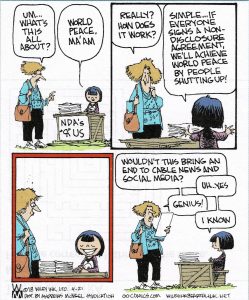
By the way, mariner’s Non Sequitur desk calendar is a fine source of wisdom:

Ancient Mariner

Alas, Poor Uncle Sam


. . . I knew him, Horacio — a fellow of infinite jest… Where be your gibes now? your gambols? your songs?

– – – –

Mariner has become frayed and disillusioned wandering the foxholes and ditches of daily politics, economics and social conflict. It reminds him of those old news videos of doughboys running in the trenches of World War I. Mariner searches desperately for reason, cohesiveness and purpose.

Alas, the trenches of Somme are the nation’s reality. Cash replaces tear gas; international trade replaces cannon fodder; political dialogue replaces machine guns; technology replaces bombs and strafing. And now an accelerant, Covid-19, has introduced the urgency of a raging forest fire.

Not only is shelter-in-place an urgent pragmatism, it is a metaphor for our times; it is our trench.

Meanwhile, out on the battlefield, Covid-19 has expedited cultural change. It has made space for artificial intelligence to rush in and set new standards. It has disrupted political change from an incompetent form of democracy to one that relates to the battlefield. It has destroyed the nation’s economy.

More than a million soldiers were killed or wounded on the fields of Somme representing seven nations. It was brutally personal. Currently in the United States 23,000 citizens have died and the plague is still progressing. It is brutally personal.

Subtly, a new force has joined the war: global warming. As today’s global war of change fights its way into the future, as small steps of stability are put in place, global warming will attack across all fronts – politics, economics and society. Global warming will introduce a new dimension of destruction just as the atomic bomb did at Hiroshima and Nagasaki.

In the United States today, political smoke fills the air, explosions erupt in the halls of government and reason dies under attack from greed, prejudice and moral decline. Yet, no different than the Battle of Somme, this time of great, historical change must continue to be fought. It is not nation against nation so much as it is faction against faction. It is the wealthy against the poor, the average, the good of all; it is the plutocracy of government fatally infected with cash and privilege; it is corporate America flushed with opportunity to monopolize society; it is data technology that will erase the idiosyncrasy of each citizen while all around this war the biosphere dies more rapidly every day.

Will reason, cohesiveness and purpose ever again exist? Will humanity survive? Is all this commotion part of the Sixth Extinction?

Ancient Mariner


Business and cultural survival

Mariner has highlighted a broad concern about the virus spinoff of big data corporations to use their endless clouds of tracking, identifying and profiling individuals to diminish privacy and security. Willingly, as ‘good fellows,’ they have offered their immense, person-identified databases to government agencies to help track the virus. Many editors and journalists have said, in so many words, ‘we will never get this snake back in the bag.’

This same phenomenon applies to the economy. Private equity firms, corporations, banks and investment firms will benefit from government handouts because the emergency legislation has profit loopholes in its wording. The Economist Magazine made this issue their lead story in this week’s addition. Mariner quotes the relevant section below:

“Don’t go from crisis to stasis

The last long-term shift is less certain and more unwelcome: a further rise in corporate concentration and cronyism, as government cash floods the private sector and big firms grow even more dominant. Already, two-thirds of American industries have become more concentrated since the 1990s, sapping the economy’s vitality. Now some powerful bosses are heralding a new era of co-operation between politicians and big businesses—especially those on the ever-expanding list of firms that are considered “strategic”. Voters, consumers and investors should fight this idea since it will mean more graft, less competition and slower economic growth. Like all crises the covid-19 calamity will pass and in time a fresh wave of business energy will be unleashed. Far better if this is not muffled by permanently supersized government and a new oligarchy of well-connected firms.”

Referencing mariner’s last post, corporatism is a form of authoritarianism.

Ancient Mariner

A nation divided . . .

A bill has been introduced in Congress to make Chicago the 51st state. Illinois is one of many states where one or more very large cities, like Chicago, dominate state politics. Mariner lives near the Illinois line and he knows downstate Illinois is no Chicago! It is classic conservative versus liberal, rural versus urban, agriculture versus manufacturing, republican versus democrat. The situation in Illinois is how Donald can brag he won Illinois because he won 90 counties out of 102. Donald does not mention that he lost Illinois to Hillary 5 to 3 in the popular vote.

By party affiliation Illinois is the third most democratic state in the Union behind New York and California. Converting the state from counties to districts which directly affects representation to the Electoral College, there are 18 congressional districts plus two at large for a total of 20. As it turned out, Hillary took all 20 because Illinois is one of those states that require all Electoral College representatives to represent the popular vote. However, seven of those districts were won by Donald. Many states do not follow Illinois’ interpretation and allow each district to represent its own vote. This is how Donald won the Electoral College in 2016.

So much for statistics. The real issue is a split society. These circumstances remind mariner of Ancient Greece during the era of city-states; it reminds him of the south versus the north in 1860; it reminds him of the generational dichotomy during the 1960’s. Now, it is conflict between thinly populated, monolithic agricultural regions versus crowded, high tech, internet-linked, culturally diverse cities.

The latest news demonstrates the defensiveness between rural and city in that nine states refuse to participate in Covid-19 recommendations. Defiance in either culture is a dangerous sign.

The US, among many nations around the world, is confronted by the Big Four: Economy, Global Warming, Artificial Intelligence and Role of Government. But now for the US, there is a fifth: cultural bifurcation.

This situation literally forces the Republic’s governments and its citizens to take control of dysfunctional relationships between the cultures. Specifically, the relationships in disarray are:

Taxes, Senate representation of population, gerrymandering, term limits, Electoral College and plutocracy (money runs the government).

Coronavirus certainly picked a terrible time to join the battle.

Ancient Mariner

The Great Tool of Survival in Crisis: Displacement of Self

Oh-oh – mariner feels a sermon coming on. He’ll keep it short.

All the western religions except for a few voodoo and cult variations have a common core of belief. It is to love whatever is real, however it is defined, and to love other humans first before self. Love is at the core; one must interpret many extrapolations in religious literature only in strict contrast to love – not in terms of one’s preferences, biases or self-reasoned values.

Mariner will reference only one scripture: Matthew 19:16 ff.

Just then a man came up to Jesus and asked, “Teacher, what good thing must I do to get eternal life?”

“Why do you ask me about what is good?” Jesus replied. “There is only One who is good. If you want to enter life, keep the commandments.”

“Which ones?” he inquired.

Jesus replied, “You shall not murder, you shall not commit adultery, you shall not steal, you shall not give false testimony, honor your father and mother, and love your neighbor as yourself.”

“All these I have kept,” the young man said. “What do I still lack?”

Jesus answered, “If you want to be perfect, go, sell your possessions and give to the poor, and you will have treasure in heaven. Then come, follow me.”

When the young man heard this, he went away sad, because he had great wealth.

Then Jesus said to his disciples, “Truly I tell you, it is hard for someone who is rich to enter the kingdom of heaven. Again I tell you, it is easier for a camel to go through the eye of a needle than for someone who is rich to enter the kingdom of God.”

Mariner uses this particular scripture because it pits engrained capitalism in its greedy context against salvation. Of all nations, the United States lives by capitalistic principles – religious and otherwise. And rich means everyone; one is always better off than someone else.

Salvation means displacing self in favor of others. This is the hardest, most awkward, most irritating rule for religious followers. “Isn’t it enough that I have sympathy?” “Isn’t it enough that I give money?” “Isn’t it enough that I’m not a racist?” “Isn’t it enough that I keep a job when others don’t?”

Did the reader notice the subject, “I”? That is the flaw. There is no “I”. There is only “them” and “they”.

When there are hard times religion’s core principle of love becomes an important factor at the center of society. Continuing to promote self first will make the hard times worse. Hoarding, price gouging, buying and selling stock and property for gain only for selfish reasons not helpful to the greater good, taking opportunity away from others, leaving hardship at the foot of others, all fit the ethics of greed. Society will pay a harder price for these tactics. It may be in these times of pandemic that fatalities may be part of that price. It may be that the entire economy will collapse. It may be the United States may survive only as a second class nation among nations.

It is time to displace one’s self interest and ask, “What do they need?” Do they need money and resources?” “Do they need comfort and healing?” “How can they be helped?” and the hardest, “Do they need me?”

Ancient Mariner


At the kitchen table

Remember the old days, the really old days when the Sunday paper was a heavy, three-inch edition with pages and pages of funnies, all the news to be had and life sections that were novella length? Mariner’s family would sit around the kitchen table and spend hours consuming the Sunday edition. Well, that tradition hasn’t disappeared in mariner’s family but the Sunday edition is gone.

The 3-inch tome has been replaced by social media, by emails from news agencies, by magazines, by online websites for comics, recipes, by electronic versions of Dear Abby and the latest Hollywood gossip. Mariner’s kitchen table is littered with computers, print-outs and magazines.

The biggest difference is the introduction of fake news and irresponsible commentary. Now, anyone with Internet access can be a publisher without the discipline to affirm facts and to represent society’s perspective.

This memory of olden days was raised by a 3-inch stack of news from today’s multitude of sources.

֎ We can’t let coronavirus make us accept a surveillance state, Amnesty International’s Rasha Abdul Rahim cautioned:

“Technology can play an important role in the global effort to combat the COVID-19 pandemic; however, this does not give governments carte blanche to expand digital surveillance. The recent past has shown governments are reluctant to relinquish temporary surveillance powers. We must not sleepwalk into a permanently expanded surveillance state now.”

Also, from The New Statesman:

Even so, Xi Jinping’s regime looks to have benefited from the pandemic. The virus has provided a rationale for expanding the surveillance state and introducing even stronger political control. Instead of wasting the crisis, Xi is using it to expand the country’s influence. China is inserting itself in place of the EU by assisting distressed national governments, such as Italy. Many of the masks and testing kits it has supplied have proved to be faulty, but the fact seems not to have dented Beijing’s propaganda campaign.

֎ New data provided to Axios spells out just how outsized a role immigrants play in the high- and low-skilled ends of the economy to keep Americans alive and fed during the coronavirus crisis, Axios’ Stef Kight writes.

Immigrants make up an estimated 17% of the overall U.S. workforce. But an analysis by New American Economy shows they’re more than one in four doctors, nearly half of the nation’s taxi drivers and chauffeurs and a clear majority of farm workers.

Reporting to work in hospitals, restaurant kitchens, cabs or the fields — for jobs deemed “essential” by the government — many documented and undocumented workers are putting themselves at higher risk of COVID-19.

֎ From Politico’s Huddle, one of mariner’s arguments for aged-based term limits:

Congress’ struggle to get tech savvy has frustrated some members. “Leadership from both parties has been very resistant to the use of technology,” said freshman Rep. Katie Porter (D-Calif.). “We have to do better than this.” And other lawmakers have been annoyed by the challenges of going digital. After technical difficulties on a GOP conference call with reporters yesterday, Rep. Patrick McHenry (R-N.C.) sarcastically chimed in: “Love conference calls. Let’s do more of them.” [The dispatch from Heather, Sarah and your Huddle host.]

֎ And back to the New Statesman:

Unlike the British program, Trump’s $2trn stimulus plan is mostly another corporate bailout. Yet if polls are to be believed increasing numbers of Americans approve of his handling of the epidemic. What if Trump emerges from this catastrophe with the support of an American majority?

Whether or not he retains his hold on power, the US’s position in the world has changed irreversibly. What is fast unravelling is not only the hyperglobalization of recent decades but the global order set in place at the end of the Second World War. Puncturing an imaginary equilibrium, the virus has hastened a process of disintegration that has been under way for many years.

֎ As to the comics section, mariner offers a note from Non Sequitur:

Two silk worms had a race. They ended up in a tie.

Ancient Mariner